Average Well Depth in FL: Why RO Is the Real Answer
If you're on a well in Southwest Florida, you've probably asked some version of this question already: what's the average well depth, and is mine deep enough?
That's a fair question. It's also the wrong place to stop.
Most homeowners start looking at depth after they notice something is off. The water smells like sulfur. The sinks stain orange. The shower glass won't stay clean. Coffee tastes flat. Ice looks cloudy. You start wondering whether a deeper well would fix it, whether your current well is too shallow, or whether this is just “Florida water.”
It isn't that simple. Well depth matters, but water quality at the tap matters more. In Southwest Florida, depth tells you where the water came from. It doesn't guarantee that the water is clean, pleasant, or suitable for your whole home without treatment.
What Every Homeowner Should Know About Their Well Water
A lot of bad decisions start with chasing a single number.
People want one neat answer for average well depth, but there isn't one number that tells you whether your water is good. In the United States, a USGS analysis found a median depth of 142 feet for domestic-supply wells and 202 feet for public-supply wells, which is why “average well depth” should be treated as use-specific, not universal, as noted in the USGS well depth publication.
That matters for one reason. A household well and a public system are built for different jobs, so comparing your well to some national average won't solve your staining, odor, scale, or taste issues.
What depth does tell you
Well depth gives you context about the water source. It can hint at the aquifer, the likely mineral load, and how vulnerable the well may be to changing conditions. That's useful.
It is not a water quality guarantee.
Practical rule: Use well depth as a clue, not as your decision-maker.
If your family is living with odor, scale buildup, mineral spotting, or persistent taste issues, you need to shift from “How deep is my well?” to “What is in my water, and how do I remove it from every faucet in the house?”
What homeowners should do first
Start with the basics:
- Find your well records: If you have them, review the drilling report and construction details.
- Check your symptoms: Rotten egg smell, hard scale, staining, and bad taste each point to different treatment needs.
- Get informed locally: The fastest place to start is a set of practical well FAQs for Southwest Florida homeowners.
A lot of homeowners waste time trying to outguess the water by depth alone. Don't. The right question isn't whether your well is average. The right question is whether your water is acceptable for your family, your plumbing, and your appliances.
Understanding Well Depth in Southwest Florida
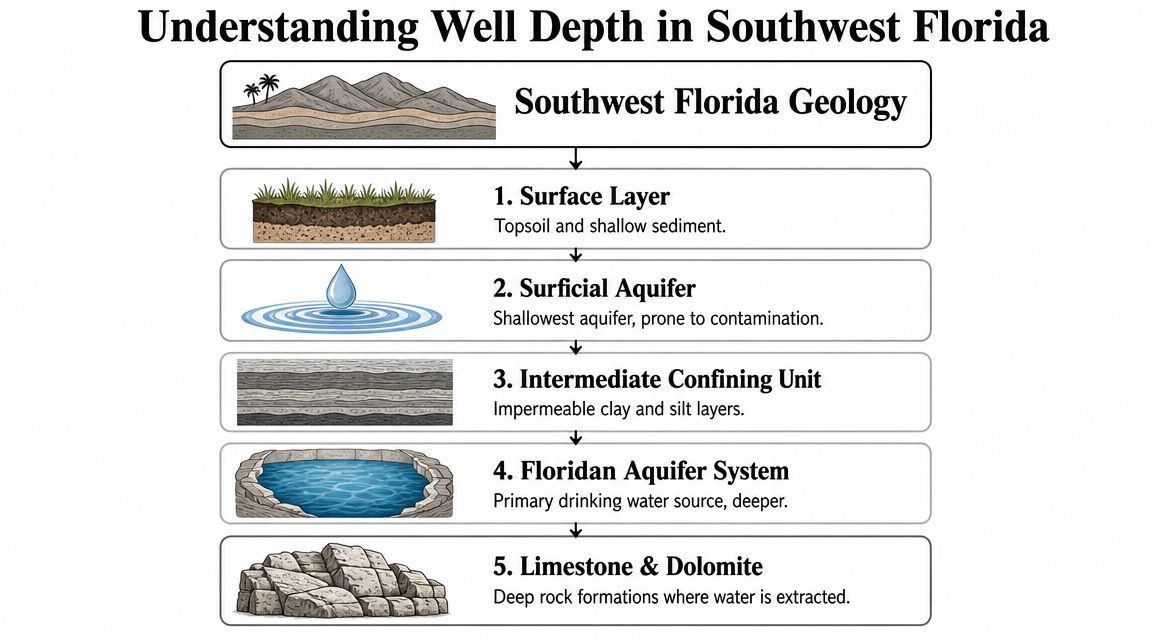
Southwest Florida doesn't behave like every other region, and that's why generic well advice usually falls apart here. Local geology, aquifer conditions, and coastal influence all shape the well you end up with and the water that comes out of it.
The number most homeowners hear
A practical industry benchmark is that a typical residential water well often falls between 100 and 300 feet deep, although residential wells can range from 50 to 800 feet depending on groundwater conditions, geology, and use, according to this well depth guide from North Star Well Service.
That's helpful as a broad starting point. It's not a design target.
A home in one part of Southwest Florida may have a very different well depth than a home a few miles away. Coastal influence, local formations, and the intended water demand can push drilling decisions in different directions. One neighborhood may deal with one set of mineral and salinity risks, while another deals with a different mix entirely.
Why local depth changes so much
The ground under your property isn't uniform. Some wells access shallower water-bearing zones. Others are completed deeper because the driller needs a more reliable source or a different quality profile.
A few factors usually drive the difference:
- Geology under the lot: Limestone, sediment, and confining layers affect where usable groundwater is found.
- Location near the coast: Coastal areas can bring different water quality concerns than inland properties.
- Water demand: A larger home, irrigation load, or higher usage can change how a system is designed.
- Existing nearby well logs: Good drillers look at local records, not national averages.
The real takeaway for Southwest Florida
There is no single “best” well depth here. There are only depths that come with different tradeoffs.
A shallower well can have one set of problems. A deeper well can have another. Neither one gives you automatic peace of mind.
That's the part homeowners often miss. They assume deeper means cleaner. Sometimes deeper just means different. And in Southwest Florida, “different” often still means treatment is necessary.
How Your Well Depth Directly Affects Water Quality
Depth changes the kind of water you're dealing with. It changes the mineral load, the likelihood of sediment issues, the potential for odor, and the treatment strategy that makes sense. If you ignore that, you end up buying the wrong equipment and living with water you still don't like.
Industry guidance notes that shallow wells are often under 100 feet, while deeper installations commonly range from 100 to 1,000+ feet, and drilling cost rises with depth because each additional foot adds rig time and casing needs, as explained in this well depth discussion from Epp Well Solutions.
Shallow and deep wells create different headaches
Shallower wells can be more exposed to what's happening nearer the surface. Deeper wells may be more stable in one sense, but they often bring heavier mineral content and dissolved solids that are harder to treat with simple equipment.
In practical terms, homeowners usually notice the problem before they understand the cause. The warning signs show up in the kitchen, bath, laundry room, and on the fixtures.
Well Depth and Common SWFL Water Issues
| Well Depth Range | Common Contaminants/Issues | Symptoms You Might Notice |
|---|---|---|
| Under 100 feet | Greater vulnerability to surface-related issues, sediment, changing water conditions | Cloudiness, inconsistent water quality, seasonal changes |
| 100 feet and deeper | Higher mineral load, dissolved solids, hardness-related issues, iron, sulfur-type odor concerns | Scale on fixtures, staining, bad taste, odor, spotting on glass |
| Much deeper wells | More complex chemistry that often needs advanced treatment, not basic filtration | Persistent taste issues, appliance wear, heavy mineral residue |
What homeowners usually get wrong
The biggest mistake is assuming the drilled depth tells you everything that matters. It doesn't.
The distinction between drilled depth and usable water-table depth is critical. A deep well isn't automatically better if the static water level and yield are poor, as discussed in the Washington State well guidance on depth-to-water and equilibration. That's exactly why a depth-first mindset leads homeowners in the wrong direction.
You don't live off the number on the drilling report. You live off the water that actually reaches the house, recovers properly, and can be treated reliably.
What this means for treatment decisions
If your water smells bad, tastes bad, stains everything, or wrecks appliances, you don't need a debate about whether your well is “normal.” You need a treatment approach that handles the full chemistry of the water you have now.
Basic filters can help with one narrow issue. They don't solve broad water quality problems. And in Southwest Florida, broad problems are common.
That's why depth should trigger testing and system design, not guesswork.
The Definitive Solution A Whole House Reverse Osmosis System
If you want one opinion from someone who's looked at a lot of Southwest Florida well water, here it is: stop obsessing over average well depth and solve the water.
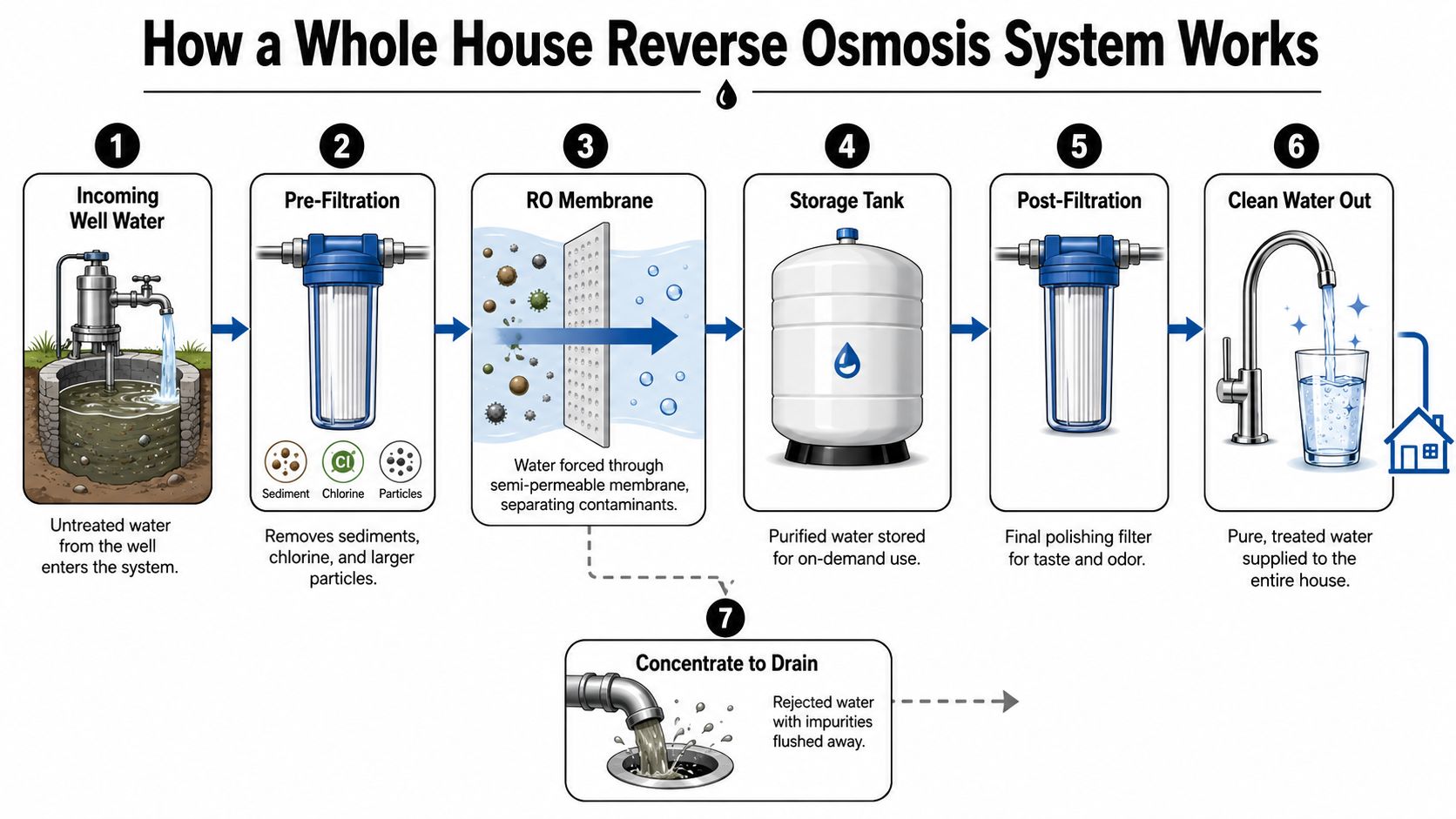
A whole house reverse osmosis system does exactly that. It treats the water coming into the home before that water reaches your showers, faucets, water heater, laundry, and kitchen. Instead of chasing one symptom at a time, you deal with the source.
Here's a visual of the process homeowners usually find easiest to understand.
Why whole house RO changes the conversation
Most water treatment systems are partial fixes. One system goes after hardness. Another improves taste. Another handles sediment. Another targets microbes. Homeowners stack equipment, keep fighting the water, and still don't get the result they expected.
Whole house RO is different because it's built around purification, not just symptom management.
That matters in this region because well depth introduces uncertainty. A deeper well doesn't promise better water if the static level, yield, and chemistry still create problems. The smarter move is to use a purification system that handles the water quality risk regardless of depth.
What you get at the tap
When a whole house RO system is properly designed, the benefits show up everywhere in the home:
- Better tasting water: Cooking, coffee, ice, and drinking water improve because you're not masking bad source water.
- Cleaner fixtures: Spotting, scale, and staining become far easier to control.
- Less abuse on appliances: Water heaters, dishwashers, ice makers, and washing machines don't have to work against the same mineral load.
- More usable water everywhere: Showers, tubs, and sinks all benefit, not just one point-of-use faucet.
That's the key advantage. You're not buying a nicer kitchen sink experience. You're changing the entire house.
A lot of homeowners also like seeing the process before they make a decision. This short video helps explain what a reverse osmosis system is doing and why it's different from a simple filter.
Why I recommend it for Southwest Florida wells
This area is rough on water systems. The water can carry dissolved minerals, odor issues, staining compounds, and other quality problems that don't disappear because the well is deeper than your neighbor's.
A whole house RO setup addresses the bigger issue. It gives you one central treatment point for the home and pushes the conversation away from “How deep is deep enough?” toward “Is the water clean enough to trust?”
Bottom line: If your water leaves scale on everything, smells off, or makes you avoid drinking from the tap, a whole house RO system is the upgrade that changes daily life.
For homeowners comparing options, a whole house reverse osmosis system is one of the few approaches that targets the broad water quality profile common to private wells in this area.
What now, not what if
If you already know your well water is unpleasant, waiting won't make it simpler. The well depth won't change the fact that your family is bathing in it, cooking with it, and running it through expensive appliances every day.
You have two practical choices:
- Keep patching individual symptoms with separate filters and workarounds.
- Install a whole house RO system and treat the home like the full water system it is.
I'd choose the second option every time.
Why Whole House RO Is Superior to Other Well Water Filters
A lot of homeowners buy treatment equipment in the wrong order. They start with the cheapest fix, then add another device, then another, and eventually realize they built a collection of compromises.
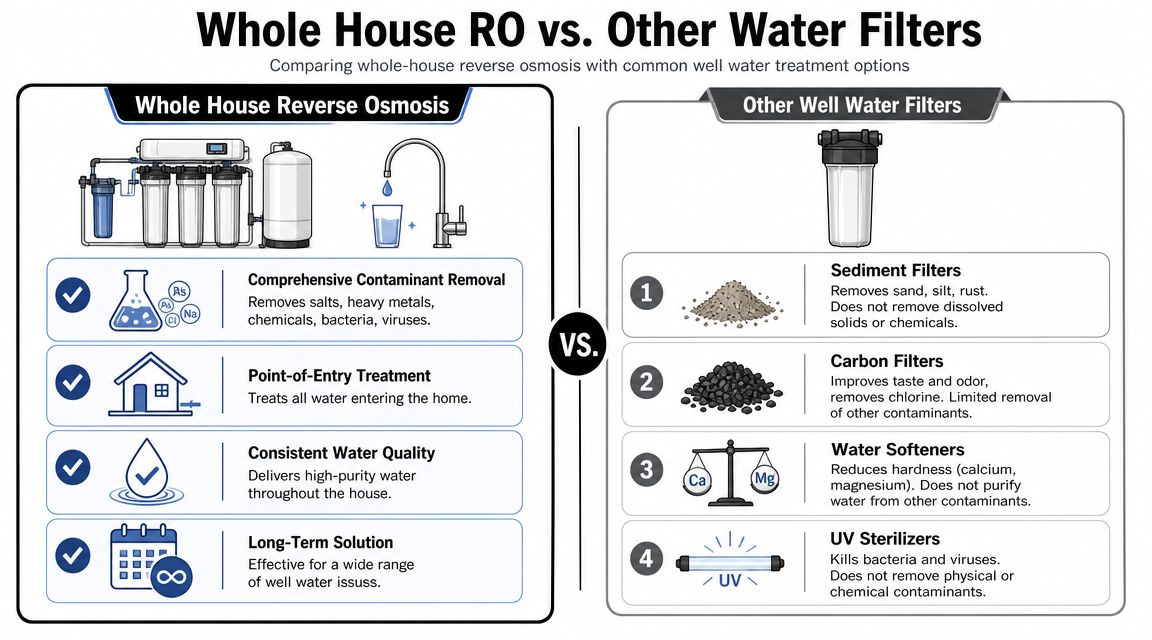
That happens because standard well water filters usually solve one category of problem. Whole house reverse osmosis solves the broader purification problem.
A large USGS analysis found the median depth of domestic-supply wells was 142 feet, and water at that kind of depth can contain significant mineral content and dissolved solids that basic filters don't adequately remove the way reverse osmosis does, according to the USGS Scientific Investigations Report on drinking-water well depth.
What other systems do well, and where they stop
A sediment filter is useful when you have visible particles. A carbon filter can improve taste and odor in certain situations. UV has a role when microbial control is part of the treatment plan.
A softener has a specific job too. If hardness is your main problem, a water softener for well water may help with scale and soap performance. But it doesn't turn difficult well water into purified water for the whole house.
The side-by-side reality
| System Type | What It Helps With | What It Leaves Behind |
|---|---|---|
| Sediment filtration | Sand, grit, visible particles | Dissolved solids, many mineral issues, broader chemistry problems |
| Carbon filtration | Some taste and odor concerns | Hardness, dissolved solids, many well-specific contaminants |
| Water softener | Hardness reduction | Other dissolved impurities, odor issues, broader purification needs |
| UV treatment | Certain biological concerns | Minerals, salts, dissolved solids, staining compounds |
| Whole house RO | Broad purification across the home | Requires proper design and installation for the property |
If your water has more than one problem, buying single-purpose equipment usually means you'll keep buying equipment.
Why RO wins in real homes
Whole house RO is superior because homeowners don't experience water in categories. They experience it as one daily reality.
They see buildup on fixtures. They smell sulfur in the shower. They notice spotting on dishes. They replace appliances sooner than expected. They stop drinking from the tap. A single-purpose filter can improve one symptom and leave the rest untouched.
Whole house reverse osmosis takes the opposite approach. It assumes the well water may be complex and treats it that way from the start. For Southwest Florida homes, that's the right assumption.
Take Control of Your Water Quality with Water Medic
You don't need to keep guessing whether your well is too shallow, too deep, or average. You need to know what's in the water and what it takes to clean it up across the entire home.
If you want a starting point, find your well depth from the original drilling paperwork, county records, or the well contractor if those records are still available. That gives you background. It does not give you a treatment plan.
The practical next steps
Use this sequence:
- Identify the symptoms first: Odor, staining, scaling, taste issues, and cloudy water all matter.
- Confirm the well details: Depth, age, pump behavior, and any past service history help frame the problem.
- Get the water evaluated: Treatment should be based on the actual water, not assumptions tied to one number.
That last step is the one that counts.
Homeowners waste time trying to diagnose well water by smell and guesswork. The water needs to be assessed as a system.
Why action matters now
Every month you delay, the same water keeps moving through your plumbing, fixtures, water heater, and appliances. If the water is harsh, mineral-heavy, or unpleasant, the house keeps paying for it.
A proper whole house treatment setup is a home decision, not just a plumbing accessory. It affects how your water tastes, how your bathrooms look, how your appliances hold up, and whether you trust the water coming out of the tap.
If you're done tolerating Florida well water and you want a straight answer, contact a local water treatment professional who can evaluate the chemistry and recommend a whole house RO system when the water calls for it. Water Medic of Cape Coral provides whole house reverse osmosis, well water repair, and related treatment services for homeowners in Southwest Florida.
If your well water smells bad, stains fixtures, or just doesn't feel right, don't keep guessing based on average well depth. Contact Water Medic of Cape Coral to discuss your water quality concerns and the right whole house treatment approach for your home.