Ft Myers Water Safety: Total Home Protection
Fort Myers homeowners keep hearing that the water is safe. That claim leaves out the part that matters most to your family. Water can clear a utility standard and still carry contaminants, reporting gaps, and treatment limits that should make any homeowner stop trusting the “safe to drink” label.
In Fort Myers, it's not merely whether the water looks clear in a glass. The actual concern is what still gets through, how long it takes problems to show up in reports, and whether you want to bathe, cook, and wash every load of laundry in water tied to concerns like PFAS and delayed notice issues around coliform bacteria. That is the underreported problem with Ft. Myers water. The official message sounds reassuring. The full picture is a lot less comforting.
Private wells raise the stakes even more. In Lee County and Cape Coral, well owners do not have the same municipal treatment barriers, and they do not get the same level of routine oversight. If your water source changes with rainfall, runoff, aquifer conditions, or aging equipment, your exposure can change too.
Homeowners in Southwest Florida need a system that treats the whole supply at the point of entry. A pitcher filter does not solve this. A faucet filter does not solve it. A properly designed whole-house reverse osmosis system does.
Is Your Ft Myers Water Really Safe to Drink
Fort Myers homeowners should start from one hard fact. The city's water record has included federal drinking water violations in recent years, as noted earlier. That alone is enough to stop treating the word “safe” like a final answer.
Legal standards leave room for risk
A utility can stay within regulatory limits and still deliver water that falls short of what you should accept for your family. Federal rules are built around allowable thresholds, testing schedules, and treatment requirements. They are not a promise that every contaminant of concern is fully removed at the tap inside your home.
That matters in Southwest Florida. Local water conditions put pressure on treatment systems through runoff, aquifer vulnerability, and persistent chemical concerns that do not disappear just because the annual report uses reassuring language.
PFAS is a clear example. These chemicals have become part of the Fort Myers water conversation for a reason. They persist, they are hard to remove with basic filtration, and they raise the standard for what good treatment should look like in a home.
Practical rule: If your local water history includes violations, reporting concerns, or contaminants tied to health-based guidelines, treat the whole home. Do not rely on taste, clarity, or a utility summary.
Private well owners need a stricter standard
Well owners in Cape Coral, Fort Myers, and across Lee County have even less margin for error. You do not have a city plant between your household and the source water. If conditions change underground or contamination reaches the aquifer, the responsibility sits with you.
Clear water proves almost nothing.
Water can look clean and still carry dissolved chemicals, hardness minerals, sulfur compounds, bacteria, or other contaminants that affect health, plumbing, fixtures, and appliances. Waiting for a smell, stain, or bad taste is a poor strategy and an expensive one.
Ask these three questions and get real answers:
- What is in my water at the house? Base decisions on testing, not assumptions.
- Which treatment removes those contaminants? Removal matters more than taste improvement.
- Does my whole plumbing system need protection? In Fort Myers and the surrounding area, yes in many homes it does.
The Unseen Risks in Southwest Florida Water
The biggest problem with Ft. Myers water isn't just contamination. It's that homeowners often find out too late, or they never learn the full story at all. Southwest Florida water quality is shaped by runoff, nutrient loading, surface water stress, and groundwater vulnerability. That creates a gap between public confidence and actual household risk.
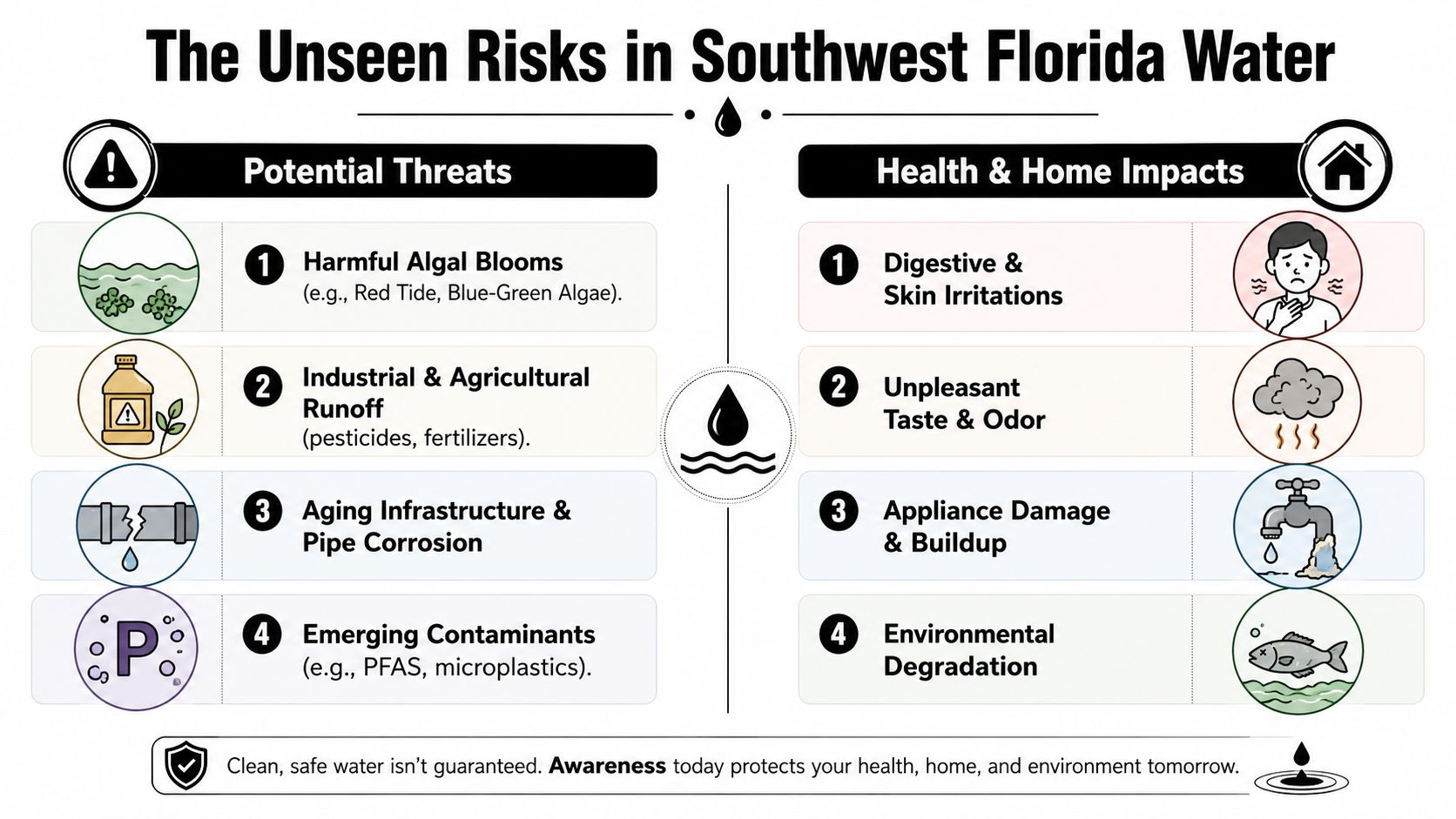
What local homeowners are up against
The regional challenge isn't one single contaminant. It's a mix of water issues that hit from different directions.
| Threat | Why it matters at home |
|---|---|
| Nutrient pollution | It affects source water quality and increases treatment burden |
| Agricultural runoff | It can carry fertilizer and pesticide residue into local water pathways |
| Industrial runoff | It contributes to persistent chemical concerns, including PFAS |
| Groundwater exposure | Private wells are vulnerable when contaminants move into the aquifer |
This is exactly why simple “safe or unsafe” language fails. Water quality in this area is more complicated than that.
The reporting delay problem
One of the most important recent examples came from coliform testing. Over 5% of water samples tested positive for coliform bacteria in November 2024, yet this information was not released until July 2025 due to a misread test and protocol failure, as reported by WUSF Public Media's coverage of the Fort Myers coliform disclosure delay.
That should change how homeowners think about “safe” messaging. A system can sound under control publicly while short-term contamination risks are still being sorted out behind the scenes.
Regulatory language can reassure you while your household still has a water quality problem that hasn't been fully communicated.
Why well water can be tougher than city water
Private well owners in Lee County have a separate risk profile. They don't just need cleaner drinking water. They need a complete treatment strategy that accounts for local hydrogeology, septic influence, and chemical loading from the surrounding area.
Here's where people get misled. They compare their well water to the city supply and assume the city system is the benchmark for safety. That's the wrong comparison. The right question is whether your home has a treatment system strong enough to deal with the water entering your plumbing fixtures, showers, kitchen, ice maker, and bath taps.
For many homes in Southwest Florida, the answer isn't a cartridge filter. It's a whole-house RO design with multiple treatment stages.
Why Basic Pitcher and Faucet Filters Fail
Pitchers and faucet filters are popular because they're cheap, easy, and visible. They also give homeowners a false sense of security. In Southwest Florida, that's a mistake.
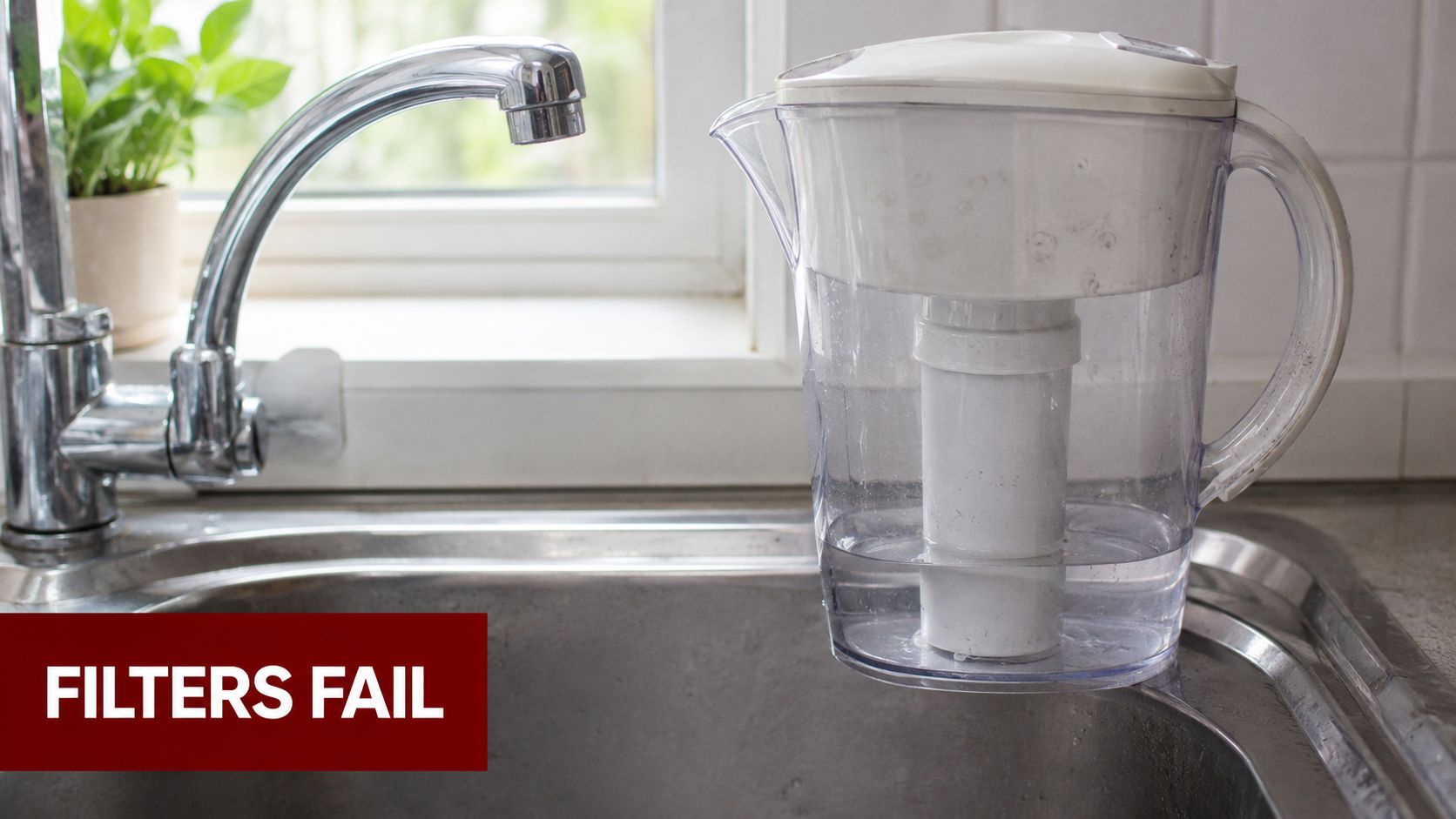
They improve taste, not total protection
Most basic countertop and faucet filters rely heavily on carbon media. Carbon has a role. It can help with taste, odor, and some chlorine-related issues. But local water problems don't stop at taste.
Private well owners in Lee County face higher risks from groundwater contamination tied to septic leaching and fertilizer or pesticide overuse, which is why the local context points toward whole-house reverse osmosis systems with multi-stage filtration rather than partial solutions, as discussed in the City of Fort Myers 2024 annual water quality report.
That matters because a pitcher only treats a small amount of water, at one point, for one use. Your shower isn't filtered. Your laundry water isn't filtered. Your ice maker isn't filtered. The water hitting your fixtures and appliances isn't fully treated.
Basic filters leave major gaps
A small filter at the sink doesn't solve a whole-home water problem. It only makes the kitchen look handled.
- Limited coverage: You're only filtering selected drinking water, not every tap.
- Limited treatment depth: Carbon alone isn't the right answer for the full contaminant profile common in this region.
- Limited consistency: As cartridges age, performance drops. Many homeowners don't replace them on time.
- Limited confidence: You still won't know what's reaching showers, tubs, or appliance lines.
If you want to understand where carbon filtration fits, it helps to compare it with stronger systems like the options discussed on this carbon filtration overview. Carbon can be useful. It just shouldn't be mistaken for a complete defense in Fort Myers and Lee County conditions.
A pitcher is a convenience product. It isn't a water safety strategy for a Southwest Florida household.
The Definitive Solution Whole House Reverse Osmosis
If your goal is to remove a broad range of contaminants from Ft. Myers water, whole-house reverse osmosis is the strongest residential option. Not a kitchen add-on. Not a faucet accessory. A real entry-point system engineered for the house.
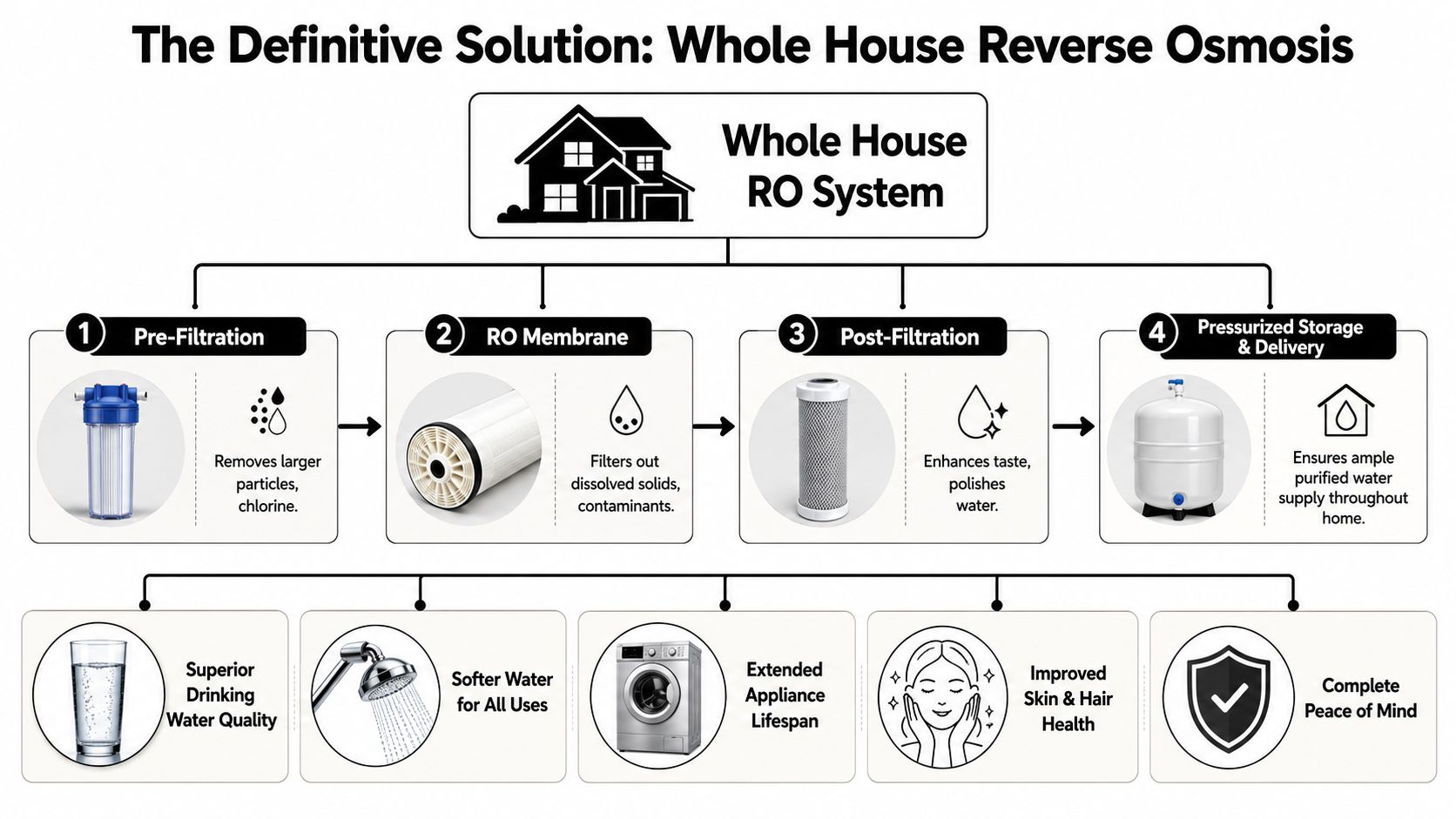
How the system actually works
Reverse osmosis uses a membrane that separates unwanted dissolved contaminants from the water stream. In a whole-house setup, that membrane is only one part of the process. A proper system uses multiple stages so the membrane can do its job and the home gets consistent performance.
A typical sequence looks like this:
Pre-filtration
Sediment and carbon stages reduce particles and other interfering material before water reaches the membrane.RO membrane
This is the core barrier. It handles the dissolved contamination load that basic filters usually miss.Post-filtration
Final polishing improves overall water quality before distribution.Storage and delivery
Treated water is held and delivered throughout the house so performance stays usable at multiple points.
Why sizing matters more than homeowners think
Many installations frequently go wrong. A whole-house RO system can't be chosen the way people buy a pitcher filter. It has to be sized for household demand, water conditions, and pressure.
Residential whole-house RO systems typically range from 200 to 10,000 GPD, and a standard family of four is commonly recommended at 75–400 GPD for all household taps, according to this whole-house reverse osmosis sizing guide.
That range tells you something important. There is no one-size-fits-all box. A system that's too small won't keep up. A system that's poorly matched to the home can create frustration, weak output, and premature component wear.
Pressure and recovery can't be ignored
Whole-house RO depends on stable operating conditions. Optimal feed pressure is 40–80 psi, with pressure below 40 psi reducing production and pressure above 80 psi risking membrane damage, and efficient systems target a 1:2 wastewater ratio, as outlined in this RO performance factors guide.
Here's the practical takeaway:
- Low pressure: Water production drops and homeowners blame the wrong part.
- Excess pressure: The system can suffer damage and shortened membrane life.
- Poor recovery management: Water use becomes inefficient and performance suffers.
Expert advice: Don't buy whole-house RO based on marketing claims. Buy it based on demand, feed pressure, recovery design, and the actual chemistry of your water.
What a complete system should include
A serious Southwest Florida setup should be built around multiple treatment stages, not a membrane alone.
| System component | Job in the treatment chain |
|---|---|
| Sediment pre-filter | Protects downstream components from particulate load |
| Activated carbon stage | Reduces contaminants that interfere with membrane performance |
| RO membrane | Removes dissolved contaminants at the core of the system |
| UV disinfection when needed | Adds another layer for homes with microbial concerns |
For homeowners comparing solutions, the difference is simple. Whole-house RO treats the home as a system. Small filters treat isolated moments. If you want complete protection, you need the first category, not the second.
For a closer look at how these systems are built for residential use, review this whole-house reverse osmosis service page.
Benefits Beyond the Faucet RO and Your Home
Many homeowners start looking at reverse osmosis because they want better drinking water. That's a good start, but it's too narrow. A whole-house system changes how water behaves across the property.
Better water touches everything
When treated water reaches every tap, the payoff shows up in daily routines.
- Bathing feels different: Water that's been properly treated is easier on skin and hair than water loaded with regional impurities and treatment leftovers.
- Appliances have an easier life: Cleaner water is gentler on dishwashers, washing machines, and other water-using equipment.
- Food and drinks improve: Coffee, tea, ice, soups, and pasta water all reflect the quality of the source water.
- Fixtures stay cleaner: Homeowners often deal with less visible residue and less frustration at sinks and showers.
These aren't luxury perks. They're what happens when the whole house gets the water quality your kitchen should've had in the first place.
The home protection argument matters
A whole-house RO system isn't just about what you swallow. It's about what your house processes every day. Every rinse cycle, every shower, every load of laundry, every filled pot, every guest bathroom sink. If the incoming water is compromised, the whole property absorbs the consequences.
That matters for homeowners who plan to stay in the house and for property managers trying to reduce wear and water-related complaints. It also matters for families with kids, older adults, or anyone who doesn't want to gamble on partial treatment.
Cleaner water at one faucet is nice. Cleaner water across the home is protection.
A practical fit for pool-focused homes
Southwest Florida homes often have another water-related priority: the pool. While pool care is its own category, homeowners benefit when they think about water quality as a full-property issue instead of splitting the house and outdoor systems into separate worlds.
Purified fill water can make water management simpler and reduce the headaches that come from feeding poor-quality water into the property again and again. If you own a pool, the value of better house water usually extends beyond the kitchen and baths. It becomes part of keeping the entire home easier to maintain.
Get a Free Water Analysis with Water Medic
If you're serious about Ft. Myers water, stop guessing. Test first, then build the right treatment plan. That's the only sensible path for a private well owner or any homeowner who wants clarity instead of generic reassurance.
A professional water analysis should answer the questions that matter:
- What contaminants or treatment concerns are showing up at your home
- Whether a whole-house RO system is the right fit
- What pre-treatment stages are needed
- How the system should be sized for your household
- What maintenance will keep it performing the way it should
What to do next
The process should be simple. Schedule a water analysis. Review the findings. Match the system to the house, not to a shelf label or a big-box recommendation.
If you're on a private well, this step is even more important. Well water can shift, local conditions can change, and assumptions don't protect anyone. A proper recommendation should account for the water source, treatment goals, household demand, and long-term system reliability.
You can review available options and service categories through Water Medic's residential water treatment services. The important thing is to move from assumptions to verified answers.
There's no upside in waiting until the water tastes worse, smells off, or starts causing obvious problems. By then, you've already spent time living with water that wasn't as clean as it should've been.
If you want a clear answer about your home's water, start with Water Medic of Cape Coral. Their team specializes in Southwest Florida water treatment, including whole-house reverse osmosis, well water solutions, and pool-related water support. A free water analysis is the fastest way to find out what your family is using every day and what system will protect the entire home.