Air in the Pipes? the SW Florida Fix for Pure Water
You turn on the kitchen faucet and it spits, coughs, and throws a burst of cloudy water into the sink. Then the bathroom tap does the same thing. Maybe the shower gives you that hollow gurgling sound that makes the whole house feel off. In Southwest Florida, that's a common call.
Most homeowners treat air in the pipes like a random nuisance. I don't. When it keeps happening, it usually means your water system isn't as stable, clean, or controlled as it should be. The noise is the symptom. The bigger issue is the water entering your home and how your system handles it.
A quick purge can calm things down for now. But if you want dependable water, better taste, cleaner fixtures, and less system stress, you need to think bigger than a temporary bleed-out. You need to look at the entire water picture.
That Sputtering Sound Isn't Just Annoying
A lot of people wait too long to take this seriously because the house still has water. The faucet sputters for a few seconds, the line clears, and life moves on. Then it happens again next week. Then after another utility interruption. Then after the system has sat overnight.
That pattern matters.
Air trapped in water pipes typically forms as pockets of gas at high points in the piping system, a phenomenon known as waterfall flow in two-phase flow systems, and it can restrict flow and increase pressure loss, as described in this overview of trapped air in water pipes. In homes with wells and pressure tanks, recurring air can also point to underlying tank or pump trouble, which is why repeat episodes deserve real attention.
Practical rule: One brief episode after a shutdown is annoying. Recurring air means your water system needs evaluation.
People often focus on the sound because it's obvious. I focus on what comes with it. Temporary cloudiness, sediment disturbance, inconsistent flow, and water that just doesn't feel right are all signs that the home needs more than a basic reset. If you want long-term confidence, the answer isn't chasing one symptom at a time.
Why Air Gets In and a Temporary Fix
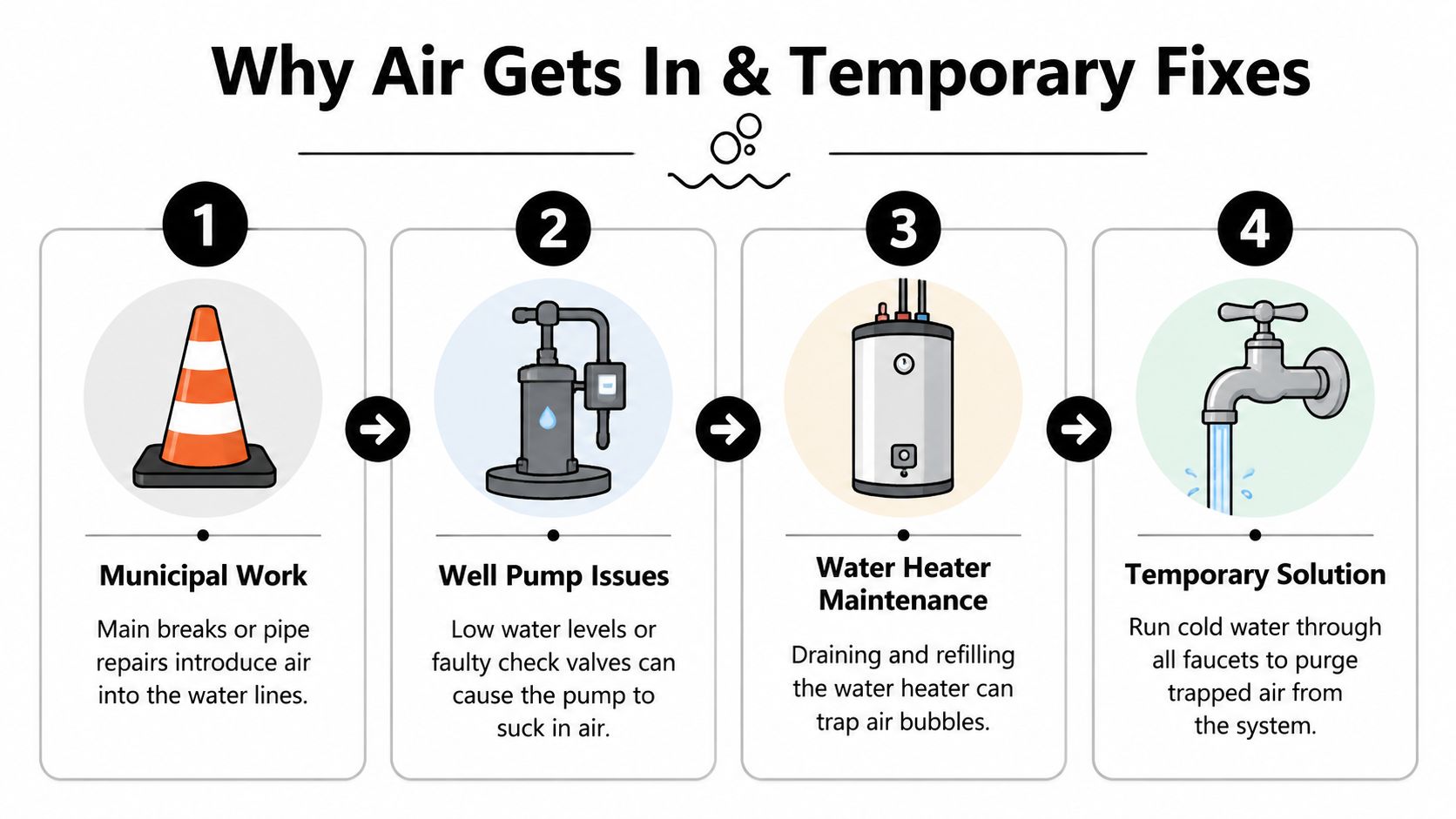
Air usually gets into a home water system after a shutdown, after pressurizing a new home, or when a well or pump system isn't behaving properly. In closed plumbing systems, air can also enter when the water meter doesn't have a built-in check valve, allowing variations in city supply to draw air into the pipes over time, as explained in this discussion of how air enters a closed plumbing system.
In Southwest Florida, I also look hard at the water source and the equipment feeding the house. If the problem keeps returning, the issue isn't the faucet. It's upstream. Homeowners with well equipment should pay close attention to the condition of their well and pump system support, because unstable delivery often shows up first as sputtering water.
How to bleed the air out
If you need to clear the system, use the standard purge method. A proven step-by-step methodology to remove air in water pipes involves shutting off the main water supply, opening all faucets halfway starting from the one closest to the main valve upward to the highest floor, flushing all toilets, and slowly reopening the main valve while keeping faucets open for 10–15 minutes until a steady, noise-free stream is achieved, according to this step-by-step air removal method.
Use this order:
- Shut off the main supply. Stop incoming water so the trapped air can move out instead of being pushed around.
- Open faucets halfway. Start near the main valve and work upward through the house.
- Flush toilets. That helps evacuate air from vertical lines.
- Restore pressure slowly. Let the faucets run until the stream is smooth and quiet.
What this fix does and doesn't do
This process is useful. It often works well when the air came from a recent interruption or refill event.
But it's still a temporary fix.
If the same house keeps getting air in the pipes, clearing the lines without correcting the water system is just repeating cleanup.
When the problem comes back, stop thinking in terms of isolated annoyance. Start thinking in terms of source water, pressure behavior, treatment, and overall system control.
The Real Problem Is Your Water Source Not Just Air
Recurring air in the pipes is rarely the story by itself. It's usually a clue that the home's water source is unstable, the delivery side needs attention, or the water quality is creating conditions you shouldn't ignore.
That matters in Southwest Florida because local homes often depend on either municipal supply that fluctuates or private well systems that demand tighter oversight. A house can have usable water and still have a poor water environment. That's the mistake people make. They judge the system by whether water comes out, not by how consistently and cleanly it comes out.
Why recurring air points upstream
Air pockets tend to collect at high points in piping, especially in long mains with low flow velocities and larger diameters. In practical terms, that means a home can keep showing the same symptoms even after you purge the lines if the underlying supply conditions don't improve.
For well-fed homes, persistent air often means the water system needs a more complete look. If that sounds familiar, a targeted review of well water repair options makes more sense than continuing to chase faucet symptoms.
Here's the bigger truth. Homeowners often say, “I just want the sputtering to stop.” Their underlying goal is stable, clean, reliable water across the whole house.
Why water quality belongs in this conversation
Air problems and water quality problems often travel together in real homes. When the system stirs up sediment, when water turns cloudy, when flow feels inconsistent, the homeowner doesn't experience those as separate technical categories. They experience them as one thing. Bad water confidence.
That's why I don't treat air in the pipes as a narrow issue. I treat it as a warning sign that the house needs better water management.
You can purge air from a line in minutes. You build long-term water confidence by improving the source, treatment, and delivery conditions.
If you solve only the noise, you haven't solved much.
The Ultimate Solution A Whole House RO System
A homeowner usually starts this conversation because of a sputtering faucet. The right ending is not “run the taps and hope for the best.” The right ending is a system that gives the entire house cleaner, more stable water every day.
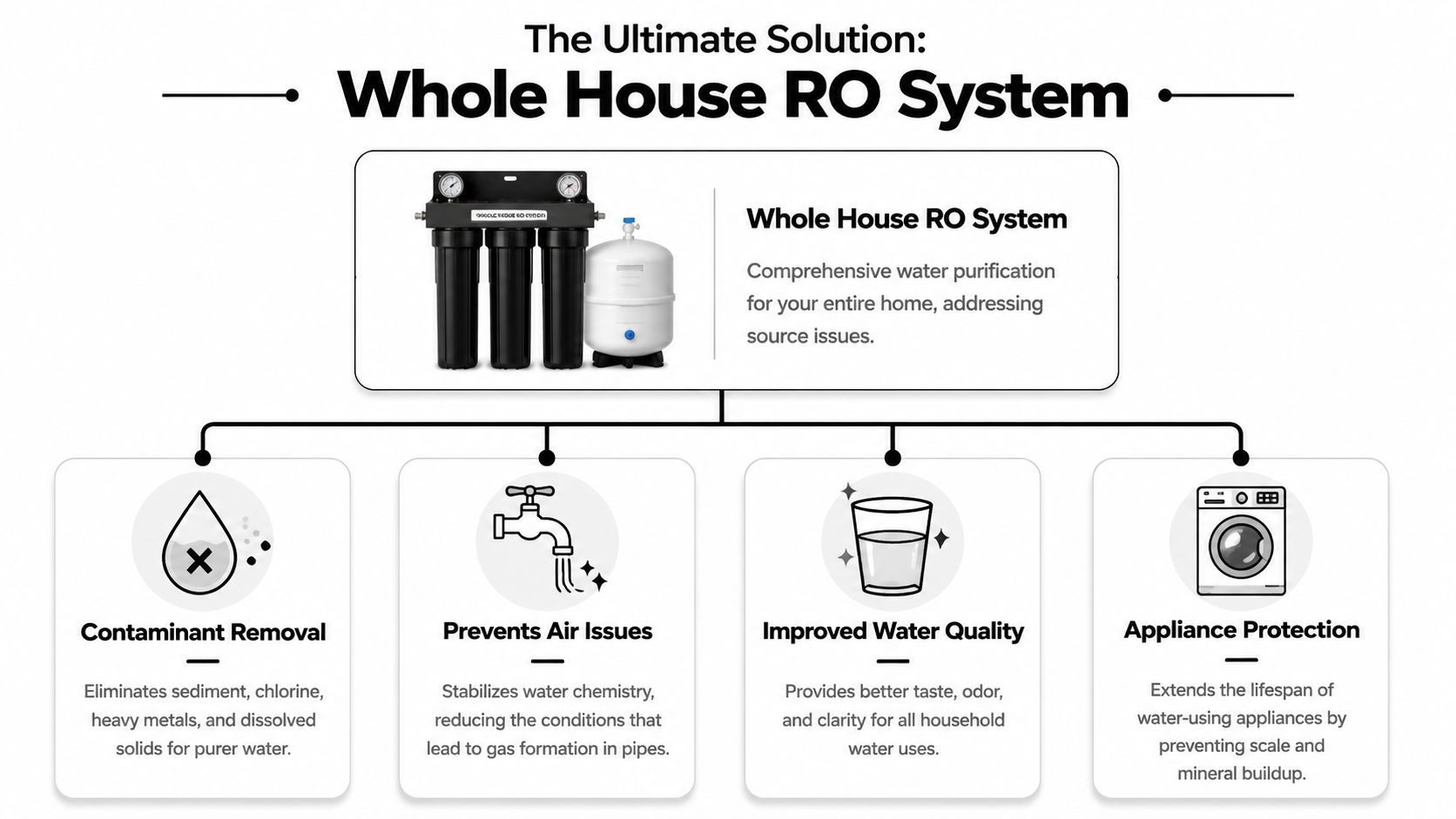
That's where a whole house reverse osmosis system separates itself from patchwork fixes. It doesn't just react to a symptom. It improves the water entering the home, the water moving through the home, and the water your family uses at every fixture.
Why whole house RO is the right frame for this problem
If your water source is inconsistent, every fixture in the home feels it. The shower feels it. The ice maker feels it. The dishwasher, washing machine, faucets, and water heater all work with whatever the system delivers.
A whole house RO system changes that equation. It creates a treated water environment for the entire property, not just a single drinking tap under the sink. That's a major difference.
Here's why I push homeowners toward whole house RO instead of one-off fixes:
- It treats the entire home. You're not solving taste at one sink while the rest of the house still deals with poor water.
- It reduces the overall contaminant burden. Cleaner source water supports better long-term performance throughout the system.
- It improves consistency. The house gets water that is filtered and managed instead of raw source water with all its swings and baggage.
What whole house RO actually removes
Reverse osmosis earns its reputation through its contaminant removal capabilities. Whole house reverse osmosis systems remove up to 99% of total dissolved solids including lead, arsenic, fluoride, nitrates, chlorine, PFAS, and microplastics, delivering water filtered at the micron level for extensive household water quality protection, according to this whole house RO contaminant removal overview.
That's not a cosmetic improvement. That's a major upgrade in the quality of water moving through the home.
When homeowners say they want pure water, this is what they mean in practical terms:
| Household area | What better water changes |
|---|---|
| Kitchen | Better taste, cleaner ice, fewer odor complaints |
| Bathrooms | Cleaner water for bathing, brushing, and daily use |
| Laundry | Less exposure to source-water contaminants in wash cycles |
| Appliances | Cleaner feed water for water-using equipment |
A lot of systems claim to “help.” Reverse osmosis is the standard I respect when the homeowner wants broad, meaningful purification.
Why sizing and efficiency matter
Not all whole house RO systems are worth owning. Some are undersized. Some are inefficient. Some are sold without enough attention to the actual conditions in the home.
A whole house reverse osmosis system is considered optimal when it achieves a recovery rate between 75-85%, meaning 75-85% of the feed water is converted into usable product water while minimizing wastewater discharge, based on this reverse osmosis efficiency benchmark.
That matters because homeowners shouldn't accept a sloppy setup. If you're investing in whole-home treatment, the system needs to be designed to perform well, not just installed and forgotten.
SW Florida homes need systems built for real conditions
System design gets even more important when water temperatures shift. For whole house reverse osmosis systems operating in varying temperature conditions, water production decreases by 1-2% for every degree Fahrenheit below 77°F, which is why a 20% safety margin in system capacity sizing is recommended for cold water climates, as explained in this RO sizing guidance for temperature changes.
Even if your home isn't dealing with severe cold, the point stands. RO isn't a commodity box. It's a performance system. Proper sizing, proper configuration, and proper support determine whether it feels effortless or frustrating.
That's also why the right answer for recurring air in the pipes isn't “just install something.” The right answer is to install a system that treats the whole water picture with enough capacity and efficiency to support daily life.
For homeowners comparing options, it helps to review what a dedicated whole-home reverse osmosis system is designed to do when the goal is complete household water treatment.
A short visual walkthrough helps make the system easier to understand.
Why RO is the long-term answer to air in the pipes
No, reverse osmosis doesn't change physics by magic. What it does is more practical and more valuable. It gives the home a cleaner, more controlled, more consistent water supply.
That matters because recurring air complaints rarely live alone. They show up in homes where the owner is also tired of:
- Unpredictable water behavior
- Bad taste or odor
- Cloudiness after disruptions
- Sediment getting stirred into fixtures
- General doubt about what's in the water
A whole house RO system addresses the bigger problem that sits behind all those frustrations. It upgrades the quality of every gallon the home relies on.
The best fix for recurring water symptoms is a system that improves the water itself, not another round of short-term troubleshooting.
If you own in Southwest Florida and want one answer that makes the whole property better, whole house RO is that answer.
How RO Protects Your Home and Prevents Future Issues
A whole house RO system isn't only about what you drink. It's about the environment you create inside the home's water system every day. Cleaner feed water changes how the home feels and how equipment ages.
That's the difference between reactive ownership and smart ownership. Reactive ownership waits for ugly symptoms. Smart ownership improves the water before those symptoms keep multiplying.
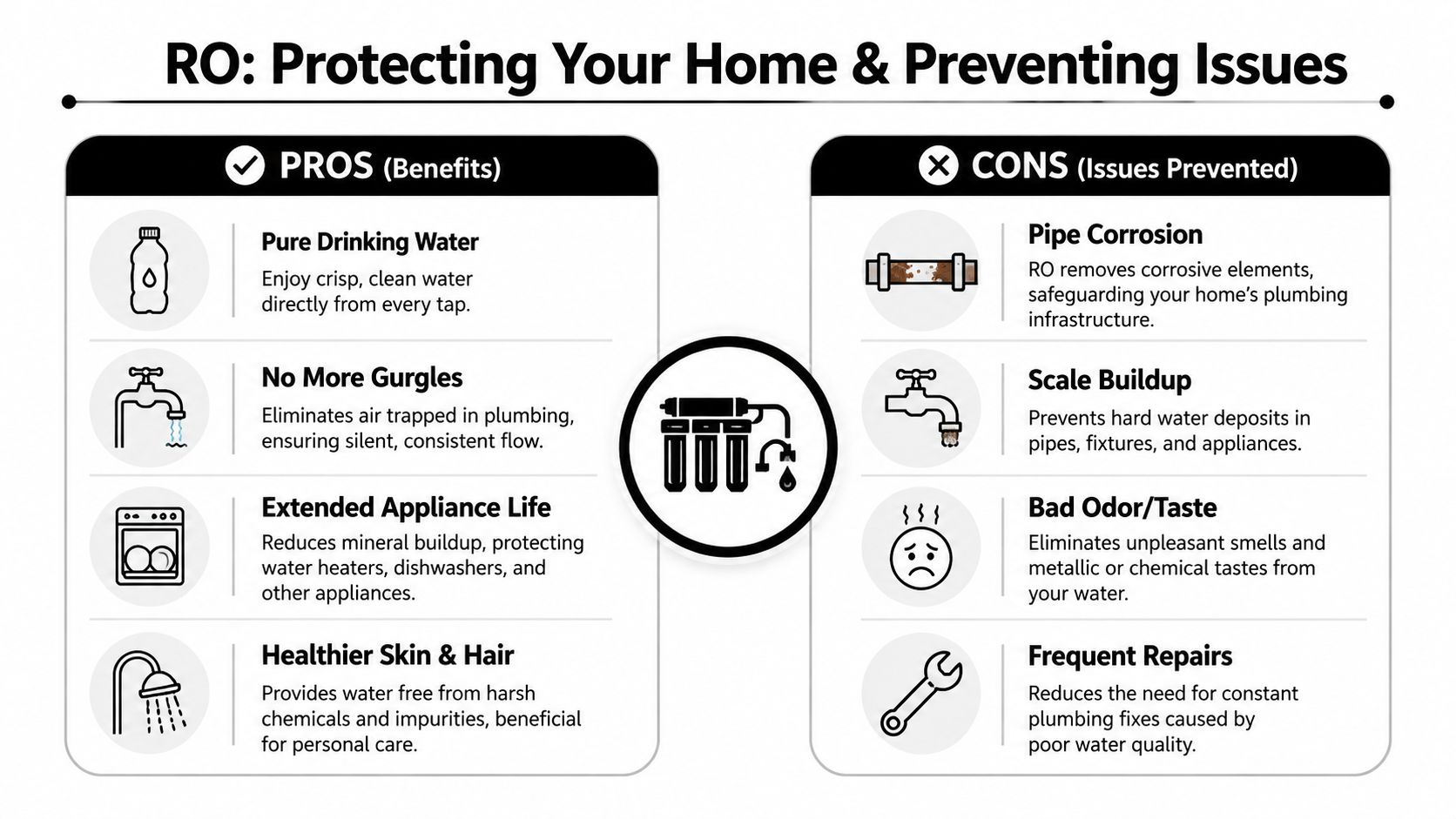
Better water supports a calmer home
When the system delivers treated water across the entire house, homeowners usually notice the everyday stuff first. Water tastes better. Odors ease up. Fixtures stay cleaner. The house feels more predictable.
That predictability matters if you've been dealing with air in the pipes. A more controlled water environment helps prevent the sort of ongoing nuisance conditions that keep homeowners in troubleshooting mode.
Protection is about design not guesswork
I look at RO systems as home protection equipment. The strongest setups are engineered to perform efficiently while serving the whole property. As noted earlier in the article, a whole house reverse osmosis system is considered optimal when it achieves a 75-85% recovery rate. That's the benchmark for a system that converts a strong share of feed water into usable product water while limiting waste.
Here's what that kind of design mindset protects:
- Appliance longevity: Better water quality helps reduce the burden that raw source water can place on water-using equipment.
- Fixture appearance: Cleaner water supports better clarity and less visible residue around faucets and showers.
- Household comfort: Families notice the difference in taste, odor, and daily-use confidence.
- Maintenance pressure: When the water is better, homeowners spend less time chasing symptoms.
Cleaner water doesn't just improve one tap. It changes the entire operating environment of the home.
Why this matters financially
Homeowners often hesitate because they're thinking only about the immediate annoyance. That's too narrow. The key comparison is short-term tinkering versus long-term system quality.
A whole house RO system makes sense because it's preventive. It aims at the source. It supports the fixtures, appliances, and everyday experience of the entire property. That's a much better investment than living with recurring uncertainty and treating every symptom like a standalone event.
Partner With SW Florida's Water Quality Experts
If you searched because your faucet is sputtering, you already know something isn't right. The mistake is stopping at the symptom. Air in the pipes is often the early warning. The core problem lies in water quality, system stability, and whether your home is getting the level of treatment it should.
General plumbing help won't solve a whole-house water problem. Southwest Florida homes need water specialists who understand source water, treatment performance, well systems, and the difference between a temporary purge and a permanent upgrade.
If you want fewer surprises, better-tasting water, cleaner water at every fixture, and a system designed for real local conditions, stop treating this like a minor irritation. Treat it like a water quality decision. That's what it is.
For homeowners, property managers, and real estate professionals in Cape Coral and across Southwest Florida, the smart move is to get the whole water system evaluated and choose a long-term solution that improves the home.
Talk with Water Medic of Cape Coral if you're tired of temporary fixes and want a real answer for air in the pipes, poor water quality, and whole-home protection. Their team specializes in water treatment, well water support, and whole house reverse osmosis systems built for Southwest Florida homes.