Your Guide to Whole House Water Systems
You know that filter pitcher you keep in the fridge? Or the little filter screwed onto your kitchen faucet? Those are what we call point-of-use filters. A whole house water system is the exact opposite—it's a point-of-entry (POE) solution.
Think of it as a gatekeeper for your home's entire water supply. It's installed right where the main water line enters your house, treating every single drop before it gets a chance to travel through your pipes. This means the water from every tap, every showerhead, and every appliance is clean and treated. It’s a complete overhaul of your home’s water quality, not just a band-aid fix for your drinking glass.
So, What Exactly Is a Whole House Water System?
Let's use an analogy. Imagine having a single, highly-trained security guard at the main entrance of a building, checking everyone who comes in. That's a whole house system. It purifies all the water at one central point, ensuring everything that flows past it is up to standard.
This is a huge step up from only filtering the water you plan to drink. A whole house system means the water you shower in, wash your clothes with, and cook your pasta in has all been treated to remove specific troublemakers. It’s about tackling water quality issues at the source, once and for all.
Why Every Faucet in Your Home Matters
Do those chalky white spots on your faucets and shower doors drive you crazy? Ever notice a faint swimming pool smell when you turn on the tap? These aren't just little quirks of your house; they're symptoms of underlying water problems.
A whole house system is engineered to solve these exact frustrations. The idea is to create a consistent, reliable supply of high-quality water by targeting a whole host of common issues:
- Sediment: Tiny bits of dirt, rust, and sand that can wear down your pipes and appliances from the inside out.
- Chlorine: It’s great for disinfecting city water, but not so great for the taste and smell of your morning coffee.
- Hard Minerals: This is the big one. Calcium and magnesium are the villains behind that crusty limescale buildup that wreaks havoc on your water heater, dishwasher, and plumbing.
- Other Contaminants: Depending on the setup you choose, these systems can also go after industrial chemicals, heavy metals, and even microorganisms.
By treating water right at the source, you’re essentially creating a shield for your plumbing, your expensive appliances, and—most importantly—your family’s health.
A Clear Trend in Home Improvement
More and more, people are realizing that what's in their water is just as important as what's in their food. This isn't just a niche interest anymore. The market for these systems is booming—valued at around USD 8.5 billion and on track to hit USD 12.3 billion. That kind of growth tells you something: homeowners are waking up to the benefits of clean water throughout the entire house. You can read more about the market growth for whole house filtration systems for yourself.
The journey always starts with one simple question: what’s actually in your water right now? Every water source is different, so a system that works for your neighbor might not be the right fit for you. Getting your water professionally tested gives you a clear roadmap, taking the guesswork out of choosing the perfect solution. To see how we can help with that, check out our water testing services.
The Everyday Benefits of Upgrading Your Water
Putting a whole house water system in your home isn't just about the equipment; it’s an upgrade that pays you back every single day. The improvements are real and noticeable, impacting your health, your home, and your budget from the moment it's installed.
One of the first things people notice is the simple peace of mind that comes with knowing every tap delivers cleaner water. While city water is treated to be safe, it often still contains chlorine and other chemicals that can affect how it tastes and smells. A good system acts as a final gatekeeper, reducing your family’s exposure to these unwanted elements every time you take a drink, cook a meal, or hop in the shower.
Protect Your Home’s Most Valuable Assets
Beyond the health benefits, properly treated water is one of the best ways to protect your home's plumbing and appliances. Hard water, which is incredibly common, is full of minerals like calcium and magnesium. These are the culprits behind that crusty, damaging scale buildup that slowly clogs your pipes and hammers your expensive appliances.
Think of limescale as cholesterol for your plumbing. It builds up over time, narrowing the pipes, restricting water flow, and forcing your water heater to burn more energy just to keep up. This not only drives up your utility bills but also drastically cuts short the life of your dishwasher, washing machine, and even your coffee maker.
A whole house system stops these minerals right at the source, protecting your investments. Your appliances will run more efficiently, need fewer repairs, and can last for years longer. It’s preventative maintenance that saves you from the headache of surprise replacement costs down the road.
Unlocking Financial and Quality-of-Life Perks
The financial upsides don't stop with your appliances. When you have amazing, great-tasting water flowing from every faucet, you’ll find that the need for bottled water just disappears. For most families, that simple change alone can add up to hundreds of dollars in savings each year, not to mention cutting down on plastic waste.
Soft water is also a total game-changer for cleaning. It lathers up beautifully, which means you'll use far less soap, shampoo, laundry detergent, and other cleaning supplies to get the same, or even better, results.
- Softer Skin and Hair: Hard water minerals can strip your skin and hair of their natural moisture, leaving them feeling dry and brittle. Soft water lets soap rinse away completely, so you feel genuinely clean and hydrated.
- Brighter, Softer Laundry: Clothes come out feeling softer, colors stay vibrant, and your whites won't get that dingy, gray look over time.
- Spotless Dishes and Fixtures: You can finally say goodbye to the constant fight against those chalky white water spots on your glasses, shower doors, and faucets.
A whole house system doesn't just filter your water; it elevates your entire home experience. It's the unseen upgrade that you feel, taste, and notice every single day.
If your main battle is with the frustrating effects of mineral buildup, it's worth understanding how a targeted solution can help. You can learn more about our dedicated water softeners that tackle hard water head-on, often serving as a key part of a complete whole house strategy.
Ultimately, choosing to install a comprehensive water treatment solution is an investment in a healthier, more efficient, and more enjoyable home. It’s a decision that transforms a basic utility into a daily luxury.
Finding Your Perfect Match Among Water Systems
Choosing the right whole house water system is a lot like picking the right tool for a job—you first need to know what you’re trying to fix. Not every home deals with the same water issues, so a one-size-fits-all approach just doesn't cut it. The real secret is matching the technology to the specific troublemakers lurking in your water supply.
It’s actually simpler than it sounds. You start by pinpointing your main frustration, whether that's the gritty feel of sediment, the chemical aftertaste of chlorine, or the stubborn limescale buildup from hard water. Once you know the enemy, you can find the system designed to take it out.
Water Softeners for Hard Water Problems
If you're in a constant battle with chalky white spots on your glassware, stiff laundry, and soap that refuses to lather, the culprit is almost certainly hard water. This common headache is caused by high levels of dissolved minerals, mostly calcium and magnesium. A water softener is the specialist built for this exact job.
It works through a clever process called ion exchange. Think of it like a magnet swap: the system is filled with resin beads that grab onto the "hard" minerals and trade them for harmless sodium or potassium ions. This simple exchange stops destructive scale from building up in your pipes and appliances, leaving you with water that feels noticeably softer on your skin and makes your soaps work the way they're supposed to.
Sediment Filters for Physical Particles
Ever notice your water looking a bit cloudy or finding tiny specks of dirt, sand, or rust in your glass? That’s sediment, and it often gets picked up as water travels from the treatment plant or a private well. A sediment filter acts as the gatekeeper for many whole house water systems, catching these larger particles before they can cause bigger problems.
These filters work just like a screen, trapping debris while letting clean water flow through freely. By getting rid of sediment early on, you not only make your water look and feel cleaner but also protect any other filters downstream from getting clogged up. It’s a simple step that keeps your whole system running efficiently.
This breakdown shows how different filter stages work together, from basic to advanced.
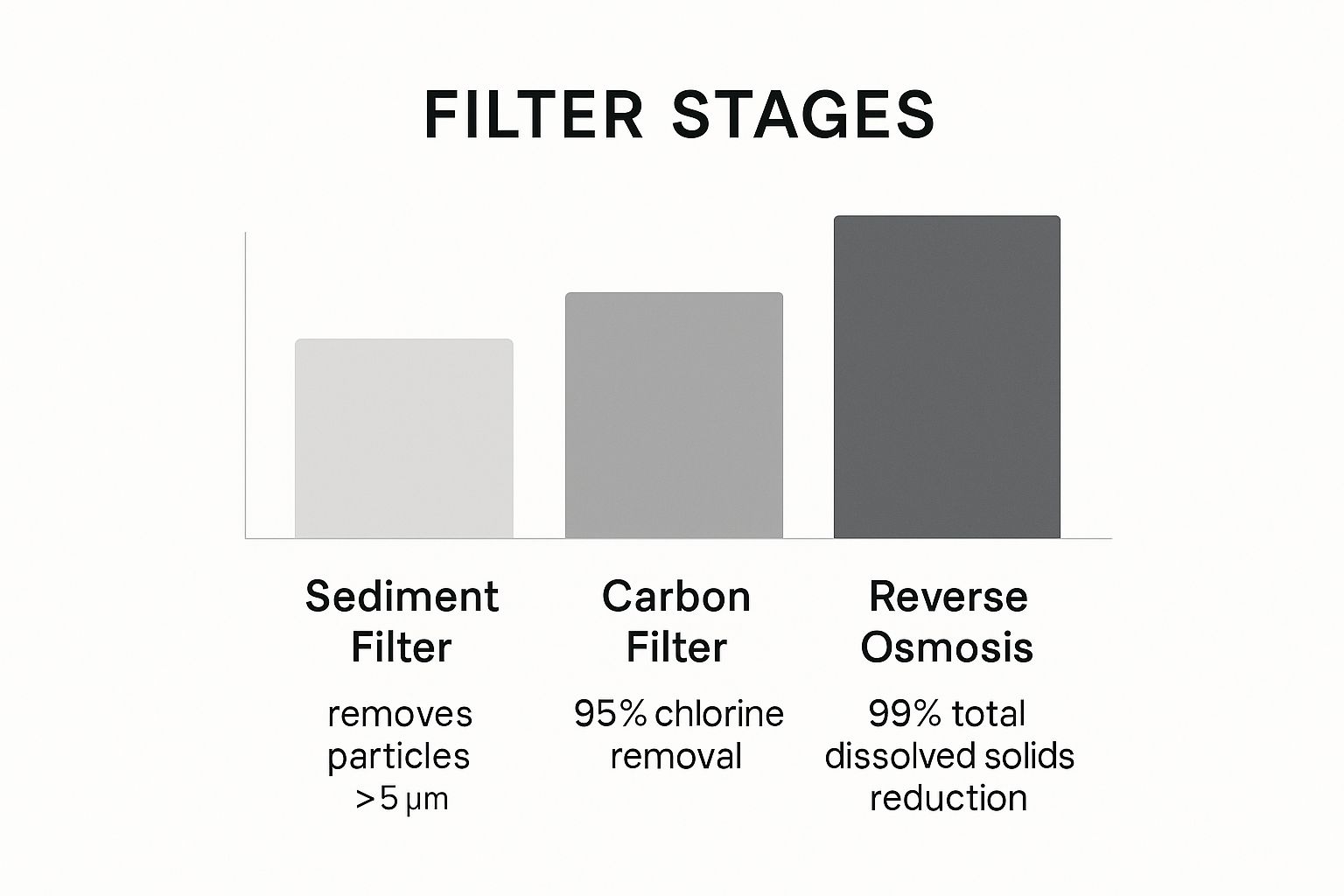
As you can see, the filtration process becomes more powerful at each step, starting with sediment and ending with technologies that can remove nearly everything.
Carbon Filtration for Better Taste and Smell
Does your tap water sometimes taste or smell like a swimming pool? That’s the chlorine your local water utility uses to keep it safe. While it’s great for killing germs, its lingering presence can ruin a good cup of coffee or a home-cooked meal. This is where carbon filtration comes to the rescue.
Activated carbon filters are incredibly porous, acting like a super-sponge for chemical contaminants. As water passes through, things like chlorine, pesticides, and other volatile organic compounds (VOCs) get trapped on the carbon's massive surface area. The result is water that not only tastes and smells fresh and clean but is much healthier, too.
Advanced Multi-Stage and RO Systems
For homeowners who want the highest level of protection, advanced multi-stage systems provide a layered defense. These setups combine several technologies into one seamless unit—typically starting with a sediment filter, then a carbon filter, and sometimes other specialized media to tackle a whole range of issues at once.
The gold standard in home water purification is a whole house reverse osmosis (RO) system. This technology forces water through an ultra-fine membrane, removing up to 99% of all dissolved solids. We're talking about heavy metals, salts, and microscopic impurities that other filters simply can't catch.
This level of purification is no longer just a luxury. With growing concerns about water quality, the global market for these systems is booming—from USD 15.7 billion to a projected USD 26.1 billion. If you want the absolute best for your family, you can explore our guide to whole house reverse osmosis and see how it delivers unparalleled purity to every single tap in your home.
How to Choose the Right System for Your Home
Choosing a whole house water system can feel daunting, but it doesn't have to be. With the right approach, you can move from confusion to total confidence. The key isn't to guess—it's to understand exactly what your home needs and match it with the right technology.
Think of it like getting a diagnosis before you start a treatment. You wouldn't take medicine without knowing what's wrong, right? The same logic applies here. The entire process starts with one critical, non-negotiable step: finding out what's actually in your water. Our team specializes in guiding homeowners through this journey, ensuring the solution you get is the one you genuinely need.
Start with a Professional Water Test
The single most important thing you can do is get your water tested by a professional. It's the only way to know for sure what you’re dealing with. Is it just hard minerals causing limescale? Is it sediment making your water cloudy? Or is it something more, like high chlorine levels from the city treatment plant or iron and sulfur from a private well?
A comprehensive test gives you a detailed chemical breakdown of your water. With that report in hand, we can pinpoint the exact problems and recommend a system designed to solve them. This data-first approach means you’re investing in a solution that will actually work, not just one that looks good in a brochure.
Calculate Your Household's Water Demand
Once you know what needs to be filtered, the next question is how much water your household uses at peak times. We measure this in gallons per minute (GPM), and getting it right is crucial for your daily comfort.
Imagine a busy morning in your house. Someone’s in the shower, the dishwasher is running, and a load of laundry is going. A system with a low flow rate would choke under that demand, and you'd be left with a weak, frustrating trickle from the showerhead.
Choosing a system with a flow rate that meets or exceeds your home's peak demand is critical. An undersized system will always be a bottleneck, but a properly sized one guarantees strong, steady water pressure at every faucet, all the time.
To figure this out, we'll help you look at a few key things:
- Number of People: The more people in your home, the higher the chance of simultaneous water use.
- Number of Bathrooms: This is one of the biggest indicators of potential peak water demand.
- Water-Using Appliances: Don't forget the dishwasher, washing machine, and even the ice maker. They all add up.
Match Contaminants to the Right Technology
Now for the fun part. With your water test results and flow rate in hand, we can start connecting your specific problems to the right solutions. This is where our expertise really comes into play, helping you build the perfect filtration strategy.
- Hard Water & Limescale? A water softener is your go-to solution.
- Cloudy Water or Sediment? A dedicated sediment filter is a must, usually as the first line of defense.
- Chlorine Taste & Smell? An activated carbon filter is exactly what you need.
- Multiple Issues or Well Water? A multi-stage system provides the layered, comprehensive protection you're looking for.
This matching process ensures you aren’t overpaying for filtration you don’t need while making absolutely sure you’re covered for the contaminants you do have.
Evaluate Your Space and Budget
Finally, let's talk logistics. Whole house water systems need a home of their own, usually near your main water line in a garage, basement, or utility closet. Our technicians can take a look at your space to plan for a clean, professional installation.
Budget is obviously a major consideration, but it helps to see this as a long-term investment in your home and your family's health. Concerns over water quality are on the rise globally, and as a result, the water treatment market is projected to grow from USD 45.15 billion to nearly USD 91.39 billion. You can learn more about the growing water treatment market to see why so many homeowners are making this a priority.
We believe in providing clear, straightforward options that fit your budget and deliver real value. To get expert help tailored specifically to your home, schedule a free, no-obligation consultation with our team today.
Understanding Professional Installation and Maintenance
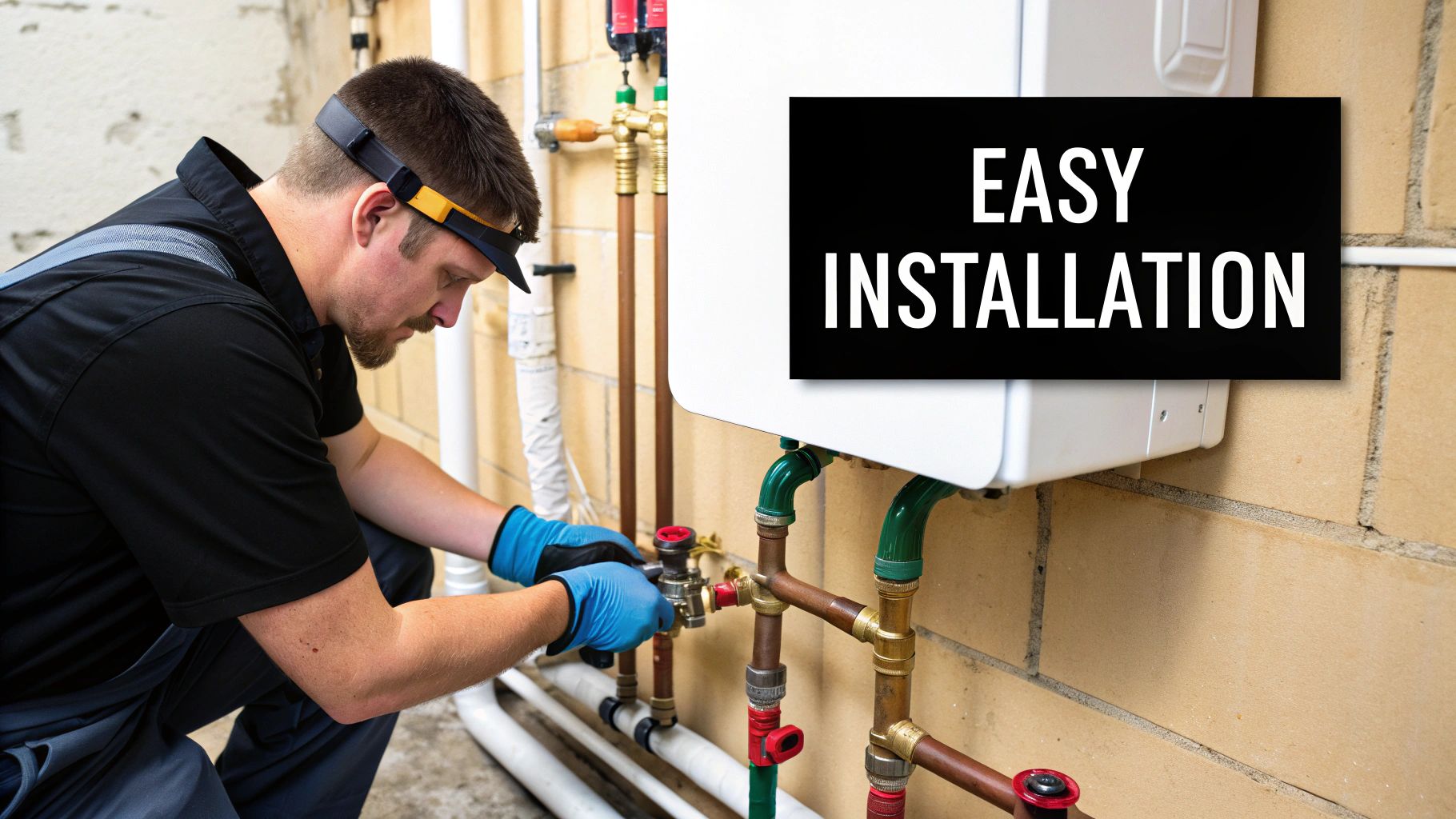
Putting a high-quality whole house water system in your home is a fantastic upgrade, but the system itself is only half the story. The other, equally important half, is getting it installed correctly. A top-of-the-line filter is only as good as the hands that set it up, and that’s why professional installation isn’t just a recommendation—it’s essential.
Think of it this way: you wouldn't buy a powerful new engine for your car and then just drop it under the hood yourself, hoping it all connects properly. You’d hire a certified mechanic to make sure every hose, wire, and bolt is perfectly in place for peak performance. Your home’s water system deserves the same expert attention.
A professional installation is your guarantee that everything will work exactly as it should from the moment it's turned on. Our technicians make sure the unit fits seamlessly into your existing plumbing, preventing leaks, pressure drops, or any of the other common issues that pop up with a bad setup. This expert touch is what protects both your investment and your home from potential water damage.
Why Professional Installation Is a Must
Trying to install a whole house system yourself might seem like a good way to cut costs, but it almost always leads to bigger headaches and expenses down the road. Pipes that aren't connected just right can cause slow, hidden leaks that quietly damage your walls and floors. Worse yet, incorrect settings can mean the system isn't even filtering your water effectively.
There’s another big reason, too: your warranty. Most manufacturers will void their warranty unless the system is installed by a certified professional. If a part fails, you'll need to show proof of professional installation to get it covered. So, choosing our team not only ensures your system runs perfectly, but it also keeps that valuable warranty locked in.
A professional installation isn't just a service; it's an insurance policy. It guarantees your system operates at peak efficiency, protects your home from plumbing mishaps, and secures the manufacturer's warranty on your equipment.
The Simplicity of Ongoing Maintenance
Once your system is expertly installed, keeping it in great shape is surprisingly simple. Maintaining a whole house water system isn't some complex, time-consuming chore. It's just a predictable routine that protects one of your home’s most important assets.
What you need to do really just depends on the type of system you have.
- For many filter-based systems, the main task is just swapping out the filter cartridges every few months or up to a year.
- For water softeners, it’s as easy as occasionally pouring a bag of salt pellets into the brine tank.
That’s pretty much it. These small, easy steps are all it takes to make sure your system keeps delivering pure, clean water day in and day out.
Peace of Mind with Professional Service Plans
We get it—life is busy, and even simple tasks can fall through the cracks. That’s why we offer service plans designed to take all the maintenance off your plate, giving you complete peace of mind. Our technicians handle everything on a set schedule, from filter changes to full system check-ups.
With a service plan, you never have to mark a calendar or wonder if your system is running as it should. We manage the entire schedule for you, making sure your equipment stays in perfect working order all year long. This proactive care not only guarantees consistent water quality but also helps your system last much longer.
To see how we can make your system's upkeep totally effortless, take a look at our monthly maintenance plans and find the one that’s right for your home.
Breaking Down the Cost and What You Get Back
Making the move to a whole house water system is a significant home improvement, so it's fair to wonder, "What's the bottom line?" Let's pull back the curtain on the costs so you can see it for what it truly is: a long-term investment that pays you back in real, tangible ways.
Think of the total cost in three parts. First, there's the system itself. This price tag can vary quite a bit, depending on whether you need a simple water softener or a more complex, multi-stage filtration setup. We help you find that sweet spot between what your water needs and what your budget allows.
Next up is the professional installation. This is a one-time fee for an expert to properly connect the system to your main water line. Getting it right from the start is key. Finally, you have minor ongoing costs, which are usually just for things like swapping out a filter or adding salt to a softener.
The Real Return on Your Investment
This is where things get interesting. The true value of a whole house system isn't just about the amazing water; it’s about the money it puts back in your pocket. From the moment it's installed, the system starts working to lower your household expenses.
Take hard water, for instance. It’s silently wreaking havoc on your expensive appliances. That crusty scale buildup makes your water heater, dishwasher, and washing machine work overtime, spiking your energy bills and sending them to an early grave. By getting rid of those damaging minerals, a good system can extend the life of these appliances by up to 50%. We're talking about saving thousands on premature repairs and replacements.
Investing in a whole house water system is like putting a protective shield around your most valuable appliances. The money you save on repairs and replacements alone can often cover the cost of the system over its lifespan.
Counting Up Your Daily Savings
The financial perks don't end with your appliances. How much do you spend on bottled water each year? For most families, it’s a surprisingly high number. With pure, great-tasting water flowing from every tap in your house, that expense completely vanishes.
You’ll also notice you're buying a lot less soap, detergent, and cleaning supplies. That's because soft water lathers up beautifully, so you can use up to 75% less product to get everything sparkling clean. That means less money spent at the store and fewer chemicals going down the drain.
It all adds up to some pretty compelling savings:
- Fewer Appliance Headaches: Your plumbing, water heater, and dishwasher are protected from damaging scale.
- Ditch the Plastic Bottles: Enjoy unlimited, amazing water straight from the tap.
- Slash Your Supply Bill: Use way less soap, shampoo, and laundry detergent.
Curious what the numbers would look like for your home? Let's figure it out together. For a personalized estimate that details the costs and your potential savings, we invite you to request a no-obligation quote from one of our water experts today.
Common Questions About Whole House Water Systems
Deciding on a whole house water system is a big step, so it’s natural to have a few questions pop up. We get it. To help clear things up, we've put together some straight answers to the things homeowners ask us most often.
Will It Ruin My Water Pressure?
This is probably the number one concern we hear: "Will this thing turn my shower into a sad little trickle?" The short answer is no—not when it's done right.
A properly sized and professionally installed system won't impact your water pressure. Our experts calculate your home's peak water demand to make sure the system's flow rate can handle everything at once, keeping your showers strong and your faucets flowing freely.
What's the Real Deal with Maintenance?
Next up is maintenance. People want to know, "Honestly, how often will I be changing filters?" The exact timing depends on the system you choose and the quality of your incoming water, but it's usually a pretty straightforward task.
- Filters: Most sediment or carbon filters need to be swapped out every few months to a year.
- Water Softeners: This is even easier. You just need to check the salt levels every so often and top them off as needed.
A common myth is that filter changes are a huge hassle. The reality is, it’s a quick and simple job that protects your investment and ensures your water quality stays top-notch.
Can I Just Install It Myself?
Finally, we often get asked if a professional installer is really worth it. While the DIY route might look like a way to save a few bucks, it can easily lead to frustrating and expensive problems like hidden leaks, incorrect settings, or even a voided warranty.
Hiring a professional is your peace of mind. It’s a guarantee that every fitting is sealed tight, the system is calibrated perfectly for your home, and your manufacturer's warranty remains fully intact. A whole house system is more than just an appliance; it's a long-term upgrade to your home's health and plumbing infrastructure.
Ready to get crystal-clear answers tailored to your home? The experts at Water Medic of Cape Coral are here to help you understand every detail, from system selection to ongoing care. Visit us online at https://watermedic.com to schedule your free consultation today.