
Pink Slime in Shower: Safe Removal & Prevention Guide
You finish a shower in a Cape Coral home, reach for the faucet, and notice a pink-orange film along the grout and around the drain. It feels slimy, looks unpleasant, and often returns soon after cleaning. Most homeowners call it pink mold, but pink slime in a shower is usually a bacterial biofilm, not mold.
In Southwest Florida, recurring growth deserves more than another quick spray. Humidity, soap residue, well-water minerals, and dissolved contaminants can work together, so surface cleaning may remove the symptom without changing the conditions that support it. The durable approach combines careful removal, better drying, and, where water quality contributes, whole-house treatment.
What Pink Slime Actually Is in Your Shower
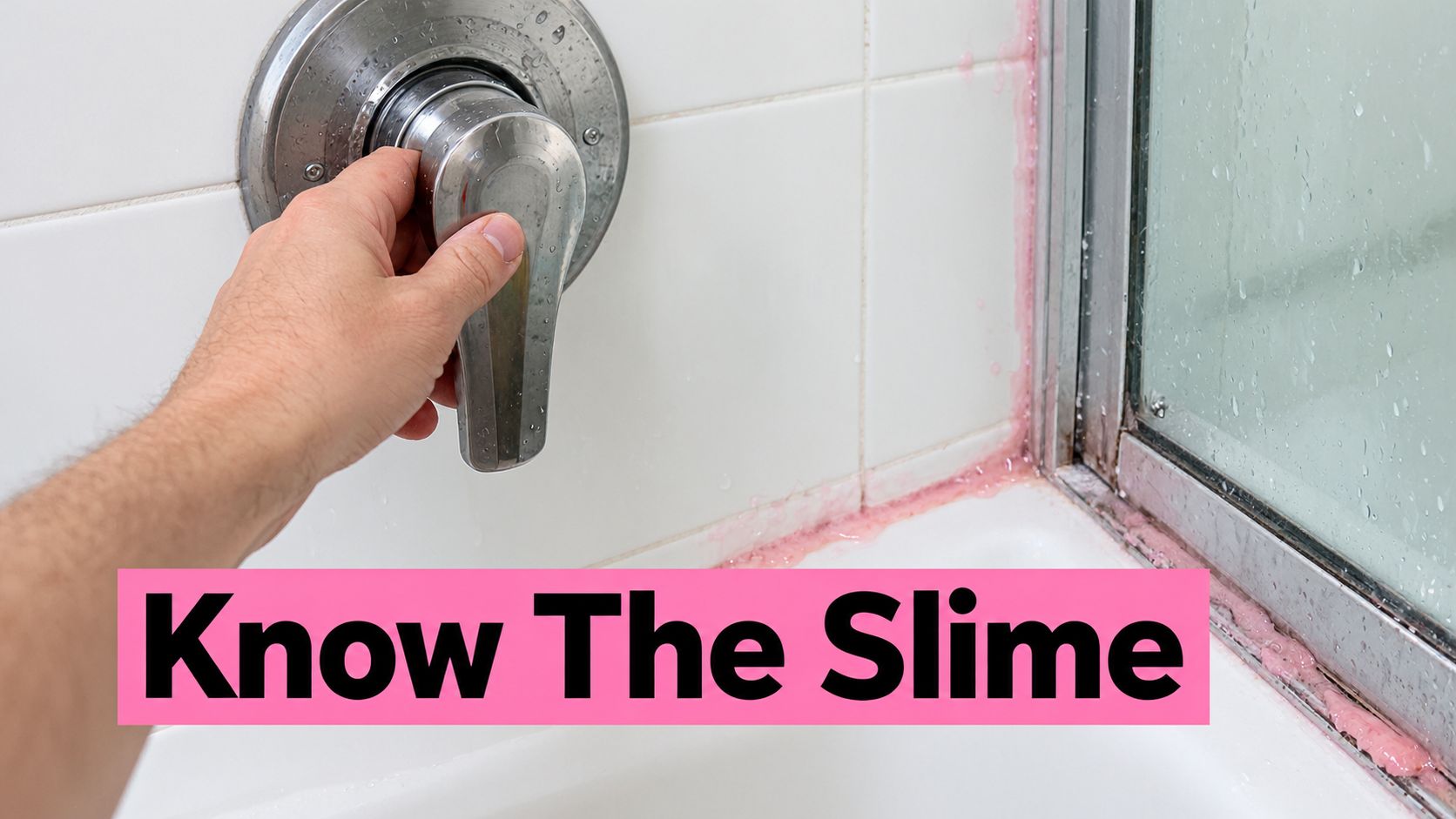
A homeowner turns off the shower and spots a pink film clinging to tile grout, a caulk seam, or the base of the fixture. The color may be soft pink, pink-orange, or orange, and the texture is usually slick rather than fuzzy. That appearance points most often to Serratia marcescens, a bacterium commonly found in warm, damp environments.
It isn't usually mold. Serratia marcescens feeds on phosphorus-containing materials, soap, shampoo residue, and other organic deposits that collect on wet bathroom surfaces. It commonly appears in shower corners and grout, but the same film can show up along toilet water lines and inside basins. GBIF's species record for Serratia marcescens describes its environmental presence and formal identification dating back at least to 1823.
The visible film is only the starting point
Serratia marcescens forms a biofilm, a community of cells held together by a protective matrix. That matrix helps the bacteria attach to grout, caulk, drains, and other damp surfaces. A bathroom cleaner may make the pink color disappear while leaving residue and embedded growth behind.
Routine cleaning also fails when it treats only appearance. Soap and shampoo residue remain available as nutrients, and humid air keeps the surface wet enough for the film to establish again. Identification matters because the right response isn't an antifungal treatment alone. It begins with physical removal, followed by disinfection and drying.
If the film is already visible, use the safe removal process rather than just spraying over it. If it returns, the prevention routine needs to address moisture, residue, and potentially the household water source.
Health Risks and Why It Keeps Coming Back
For most healthy people, casual household exposure to pink shower slime is unlikely to cause serious illness. Serratia marcescens is still an opportunistic pathogen, which means the risk changes when the organism enters through an open wound, the eyes, inhalation, or contaminated water exposure. Reported infections include urinary tract, respiratory, and wound infections, with pneumonia occurring more rarely, as described by Lysol Canada's guidance on pink bathroom growth.
Residents with compromised immune systems, post-surgical wounds, or other medical vulnerabilities should take recurring growth more seriously. Young children also deserve extra care because they may touch contaminated surfaces and then touch their eyes or mouth. Wear gloves during cleanup, improve drying, and seek medical guidance for symptoms or concerns rather than diagnosing an infection from the bathroom appearance alone.
Why Southwest Florida bathrooms support recurrence
Cape Coral bathrooms often combine warm conditions, frequent shower use, and persistent humidity. Private-well homes may also have dissolved solids, mineral residue, or other water characteristics that leave more material on surfaces after evaporation. Those conditions don't prove that the water itself is contaminated, but they can make the shower a better place for biofilm to form.
The recurrence problem is biological, not merely cosmetic. The visible pink layer can sit over a protective extracellular matrix that reduces chemical access. Low ventilation and lingering moisture give the colony time to recover, while soap and shampoo residue supply additional nutrients.
Practical rule: If pink growth returns after cleaning, look at the drying environment and the residue left by the water, not only the cleaner used.
A spray-only routine often fails because it reaches the exposed surface without disrupting the film. Quaternary-ammonium sprays may be convenient, but mature biofilms can be less responsive when the matrix remains intact. Better control requires physical removal first, then disinfection, then environmental changes that make recolonization harder.
The water-quality question needs precision. Pink slime is usually a surface contamination issue, not proof that household water is visibly pink or unsafe. However, recurring residue in a private-well home can justify testing and treatment assessment, particularly when improved ventilation and consistent cleaning haven't changed the pattern.
Safe Step-by-Step Removal of Pink Biofilm
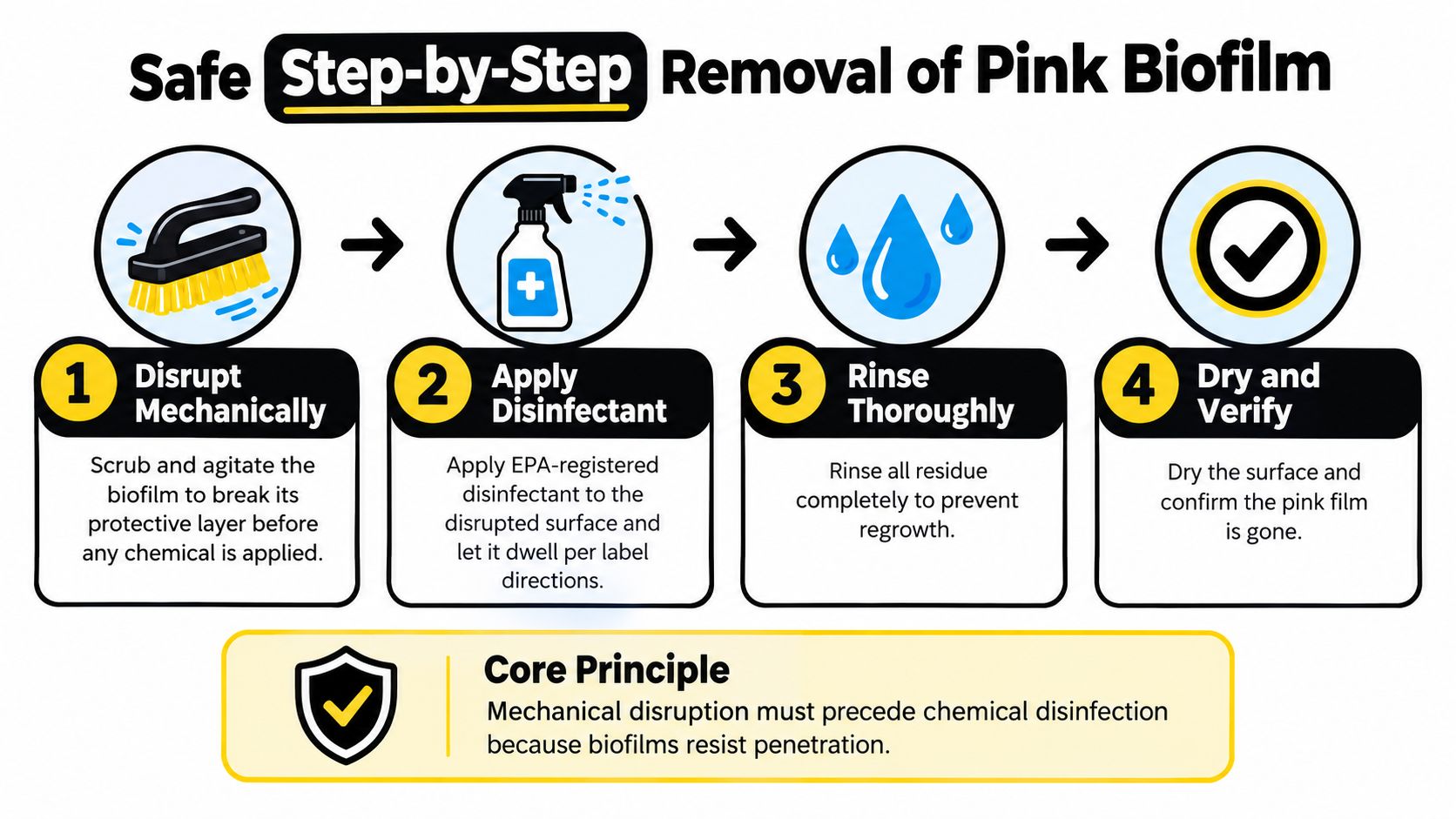
The core principle is straightforward: scrub before disinfecting. Biofilm resists chemical penetration, so a strong product applied over an intact film may reduce what you can see without reaching the organisms below.
Start with gloves, ventilation, and a brush suited to the surface. Scrub grout lines, caulk seams, shower corners, drains, and fixture edges until the slick layer has been physically broken up. An old toothbrush helps with narrow seams, while a firmer grout brush works better on tile joints. Avoid damaging delicate finishes, and follow the surface manufacturer's cleaning guidance.
Work in the correct order
Once the visible film has been disrupted, apply an EPA-registered disinfectant or oxidizing cleaner to the exposed surface. Keep the area wet for the contact time stated on the product label. Kill effectiveness depends on contact time and access to the surface, not on how aggressively a product sprays.
Rinse completely after the label-directed dwell period. Residual cleaner and loosened organic material shouldn't remain on the tile, grout, drain area, or fixtures. Dry the enclosure with a squeegee, towel, or clean cloth, then leave the door or curtain positioned to allow air movement.
The aerator service information from Water Medic can also help homeowners understand how fixture components collect residue, but cleaning the visible shower surface remains the immediate priority.
The most common mistakes are predictable:
- Spraying without scrubbing: The disinfectant meets the outside of the biofilm while the protective matrix remains.
- Rushing contact time: Wiping the product away immediately limits its intended action.
- Leaving moisture behind: Wet grout and caulk recreate the conditions that supported the growth.
- Using one spray for every surface: Product compatibility and label directions matter, especially around stone, colored grout, and specialty finishes.
- Mixing cleaners: Never combine bleach, vinegar, hydrogen peroxide, or other products. Chemical reactions can release hazardous fumes.
Cleaning can restore the appearance, but it won't permanently solve recurring growth if humidity and residue remain high. Treat the removal as the reset, then change the moisture and water conditions that feed the next cycle.
Why Whole House Reverse Osmosis Prevents Recurrence
Repeated pink slime in a well-water home often deserves a water-quality assessment alongside better ventilation. Dissolved solids, mineral deposits, and other residual materials can remain on shower surfaces as water evaporates. Those deposits add texture and residue, giving bacteria more opportunity to attach and find nutrients.
A whole-house reverse osmosis system addresses that contributing factor at the point where water enters the home. Unlike a faucet-only unit, a whole-house RO system treats incoming water and sends purified water to faucets and fixtures throughout the property. Some systems use a pressurized storage tank to support flow across multiple outlets, as explained by Crystal Quest's whole-house reverse osmosis overview.
Cleaner water changes the surface conditions
Commercial whole-home RO systems are commonly described as removing up to 98% to 99% of contaminants, including dissolved solids, heavy metals, chemicals, organics, and other pollutants, according to Excalibur Water Systems' whole-home RO information. That figure describes the systems' marketed contaminant-removal capability, not a guarantee that every shower will remain free of bacteria.
The practical benefit is different from a disinfectant's role. Surface cleaning deals with the established biofilm. RO reduces the dissolved material and residue that can remain after water dries, which can leave fewer nutrients and attachment sites on the shower enclosure. It doesn't eliminate every airborne organism, and it doesn't replace ventilation or cleaning, but it can remove a major contributor that scrubbing can't address.
Water-treatment perspective: A cleaner shower surface is easier to maintain when the water itself leaves less residue behind.
For homeowners in Cape Coral and Lee County, Water Medic of Cape Coral provides whole-house reverse osmosis systems as part of its water-treatment services. The company has served Southwest Florida homeowners for over 25 years, with systems designed to improve water quality throughout the home rather than at only one drinking-water tap.

The decision is strongest when three conditions appear together: the home uses well water, pink residue returns despite proper surface cleaning, and mineral or dissolved-solid buildup is noticeable elsewhere. In that situation, repeated scrubbing treats the visible result while whole-house treatment addresses water entering every fixture.
Prevention Routine and When to Call a Pro
The most effective prevention routine is small, consistent, and measurable. Dry the shower after use, remove soap residue before it accumulates, and keep bathroom humidity below about 60%, the benchmark identified in the cited Serratia marcescens background. A wall-mounted humidity gauge makes the target easier to verify than guessing from how the room feels.

A routine that prevents the next film
Use a squeegee or towel on tile, glass, corners, and fixture surfaces after every shower. Run the exhaust fan long enough to dry the enclosure, leave the curtain or door open for airflow, and wipe away soap and shampoo residue during weekly cleaning.
A simple maintenance check looks like this:
- After each shower: Remove standing water from the enclosure and keep surfaces exposed to air.
- During weekly cleaning: Scrub residue from grout, caulk, drains, and corners before it becomes a thick film.
- During monthly observation: Check whether pink discoloration is returning in the same locations and whether humidity remains high.
- For water assessment: Consider carbon filtration options when water characteristics, taste, odor, or residue indicate that additional treatment may be appropriate.
Call a qualified water-treatment professional when pink growth returns quickly after thorough cleaning and good ventilation. Professional help also makes sense when discoloration persists inside caulk or grout, the affected area extends behind fixtures, or household members are medically vulnerable.
Decision trigger: Fast recurrence after proper cleaning usually means surface care isn't addressing every contributing condition.
Water Medic of Cape Coral offers whole-house reverse osmosis installation and well-water treatment services for Southwest Florida homes. A water-quality assessment can help distinguish a humidity-and-residue problem from one that also needs treatment at the household water supply.
Frequently Asked Questions About Pink Shower Slime
Does pink slime mean the drinking water is unsafe?
Not by itself. Serratia marcescens is commonly described as airborne and surface-driven, so pink film in a shower doesn't prove that the household supply is contaminated. A recurring issue in a private-well home can still justify water testing, especially when residue appears throughout multiple fixtures.
Is bleach the best choice?
Bleach can be useful on compatible non-porous surfaces, but bleach alone isn't the strongest approach for mature biofilm. Mechanical disruption, followed by an EPA-registered disinfectant used according to its label, generally provides better surface access than applying bleach over an intact film.
How long will prevention last after whole-house RO installation?
RO can reduce a major source of dissolved residue, but it won't guarantee a permanent end to pink growth. Results depend on ventilation, drying, cleaning habits, and the conditions in the bathroom, so continue those controls after treatment is installed.
Can pink slime damage the shower?
The film is primarily a surface contamination and staining concern. Persistent growth can remain embedded in porous grout or caulk and become harder to remove, but the visible color alone doesn't establish structural damage.
Water Medic of Cape Coral provides whole-house reverse osmosis installation, water testing, and well-water treatment for homeowners dealing with recurring shower residue and pink biofilm. Visit Water Medic of Cape Coral to request a consultation for a treatment approach suited to your Southwest Florida home.