
Expert Well Pump Repair in SW Florida 2026
Your sink spits air, the shower drops to a weak stream, and somebody in the house says, “Did we just lose the well pump?” In Southwest Florida, that moment gets stressful fast because you're not just worried about water pressure. You're wondering if the water is still clean, whether the pump is dying, and how big the bill is about to be.
My view is simple. Don't treat well pump repair like a one-part fix. A bad pump can affect the quality of the water coming into your home, and fixing the mechanical problem without addressing treatment is shortsighted. For most SW Florida homes on private wells, the primary goal isn't just getting water flowing again. It's getting reliable, clean, treated water through the whole house, and that's where a whole house reverse osmosis system changes the conversation.
Is Your Well Pump Trying to Tell You Something
One of the most common calls starts the same way. A homeowner notices the faucet coughing air for a few days, then the pressure dips during a shower, then the pump starts sounding different outside. They ignore it because the water still runs. Then one morning, nothing.
That's usually not bad luck. It's a warning cycle.
Industry analysis reveals that 73% of pumps exhibit detectable warning signs within one to six months before complete failure, including gurgling noises, air spitting, and fluctuating pressure, which gives homeowners a real chance to act before the system quits (well pump warning sign analysis).
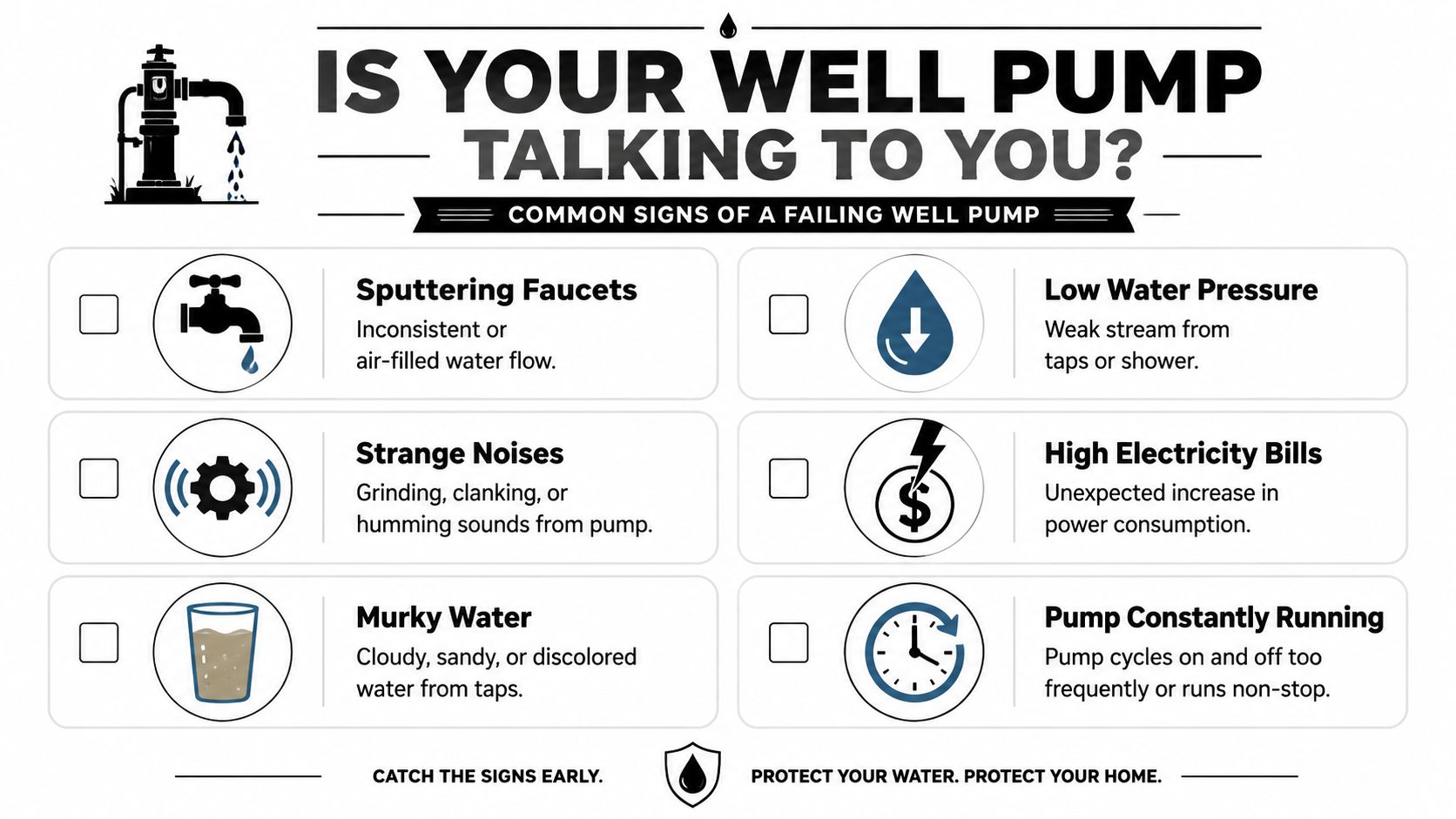
What those warning signs usually mean
If your faucets sputter, the system may be pulling air, dealing with pressure instability, or struggling to move water consistently. If pressure drops across multiple fixtures, don't assume it's just a nuisance. That often points to a pump that's working harder than it should or a control issue that's making the system act erratically.
Murky water is where people need to get serious. In this area, cloudy or sandy water can mean sediment is getting where it shouldn't, and that matters for both the pump and your family's water quality. If your pump runs constantly or cycles too often, the system is telling you something is off. Pumps don't like strain, and strain turns into expensive repair.
Practical rule: If the symptoms are changing, the problem is usually getting worse, not better.
Don't stop at the pump
Many homeowners make the wrong call. They focus only on restoring pressure. I get it. No one wants to think about treatment equipment when the shower barely works. But in SW Florida, that narrow approach costs people later.
A pump problem can stir up sediment, worsen taste and odor issues, and put more stress on every treatment stage downstream. If the home doesn't already have a serious treatment setup, this is exactly when I'd talk about a whole house reverse osmosis system. It doesn't replace proper well pump repair, but it gives your home a far better defense against the water quality problems that often show up when the pump side starts slipping.
The signs that deserve a fast call
Some symptoms need attention now, not next week:
- Air spitting from faucets: This often shows up before a full interruption in service.
- Pressure that rises and falls: Fluctuation is rarely random.
- Water that looks cloudy or dirty: That's not just cosmetic.
- A pump sound that changed: Humming, grinding, or clanking means stop guessing.
- Electric bills that suddenly seem off: A struggling pump can run longer and waste power.
You don't need to panic. But you do need to stop waiting for total failure before doing something.
Safe DIY Troubleshooting Before You Call an Expert
Some checks are worth doing yourself. I'm all for that, as long as you stay in your lane and stay safe. The goal isn't to become your own pump technician. The goal is to rule out simple control issues before you pay for the wrong repair.
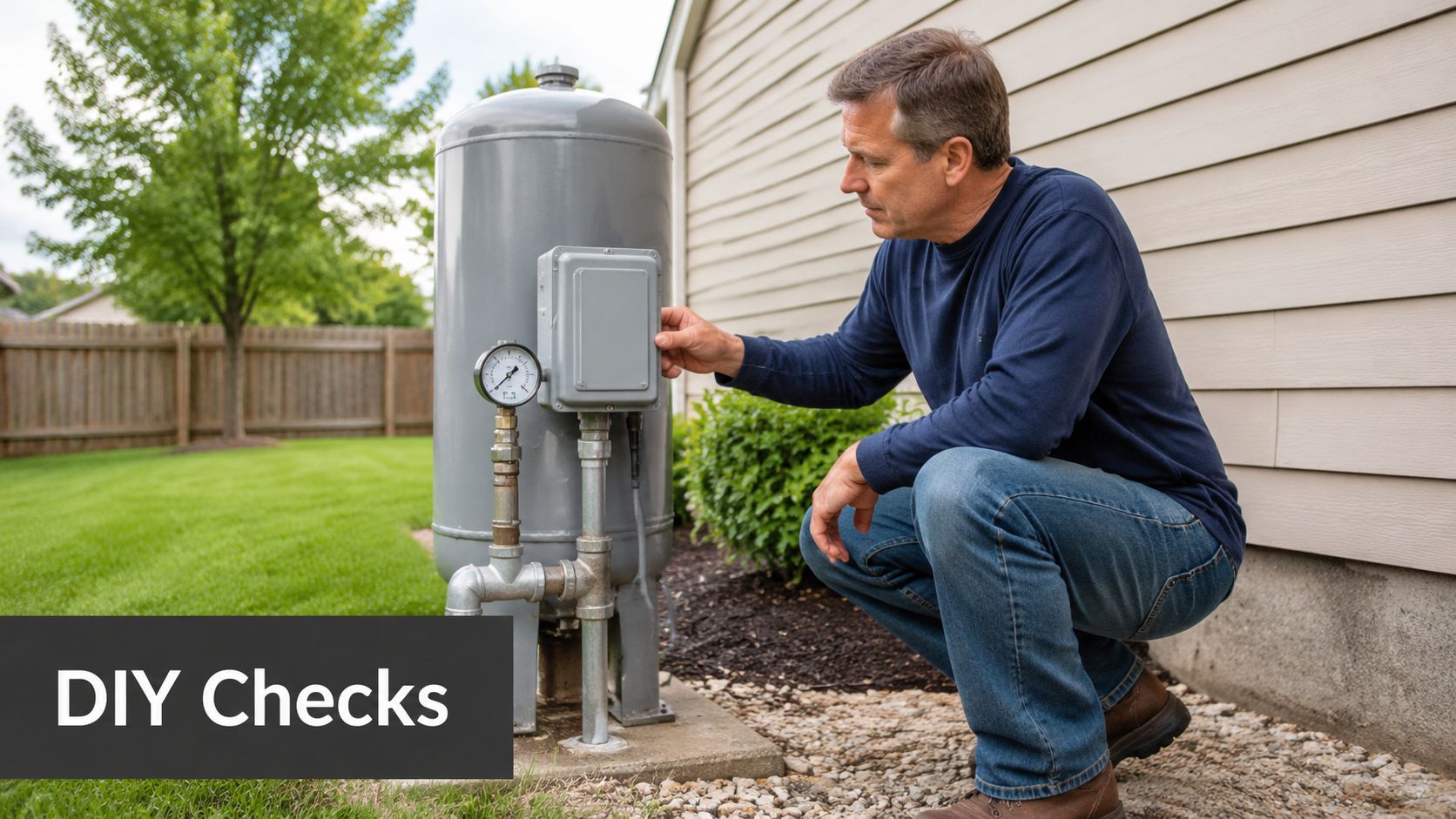
Start with the obvious controls
A lot of “pump failures” aren't pump failures at all. Data from the National Ground Water Association indicates that 68% of well-related service calls are caused by non-pump failures like electrical or pressure control issues, and homeowners can waste $200–$500 on pump replacement quotes when the actual issue is a $50 pressure switch.
Start here:
- Check the breaker first. If it tripped, reset it once. If it trips again, stop there.
- Look at the pressure switch. In Florida, insects and debris love these boxes. If it looks dirty, scorched, or stuck, that's a clue.
- Listen to the pressure tank. Strange clicking, rapid cycling, or a dead-sounding tank can point to a control problem, not a dead pump.
- Watch the gauge if you have one. If pressure swings fast or won't build normally, write that down before you call.
What not to do
Don't start taking apart electrical components if you're not trained. Don't force a switch. Don't assume no water means the pump is shot. And don't let somebody sell you a full pump replacement before the control side gets checked properly.
A clean diagnosis saves more money than a fast guess.
If you want to see the kind of system issues that show up around pressure tanks and pump controls, this short video helps frame what technicians look for in the field.
When to stop troubleshooting
There's a hard line between homeowner checks and actual diagnostics. Once the issue moves past the breaker, visible switch condition, and obvious tank behavior, you need somebody who works on well systems all the time.
That's especially true if your water quality has changed along with the pressure. At that point, the conversation should include both pump function and treatment performance. If you want to see what that service category includes, look at well pump and water system service. Don't keep throwing guesses at a system that needs testing.
Understanding Well Pump Repair Costs in Southwest Florida
Let's talk money without dancing around it. People usually ask, “What does well pump repair cost?” The honest answer is that the bill depends on what failed. That's why diagnosis matters more than assumptions.
Angi's 2026 cost report lists the average well pump repair at $973, with a typical range of $373 to $1,622 depending on the failed part and labor rates (Angi well pump repair cost data).
Typical Well Pump Repair Cost Breakdown
| Component Repair | Estimated Cost Range |
|---|---|
| General well pump repair | $373–$1,622 |
| Average repair cost | $973 |
That range is wide for a reason. A control issue, motor issue, intake issue, or internal wear problem can all show up to the homeowner as “low pressure” or “no water.” Same symptom. Very different repair path.
Why cheap quotes often get expensive
A generalist can look at a weak system and jump straight to replacement talk. I think that's lazy. A proper well pump repair visit should separate control problems from actual pump failure before anyone talks about major parts.
That matters because homeowners often compare bids the wrong way. They ask who can get there fastest or who gave the lowest number over the phone. Better question. Who is diagnosing the failed component instead of guessing?
Cost filter: If a quote comes before real system testing, treat that quote as a rough opinion, not a decision point.
If the repair stretches your budget, use a payment plan instead of delaying a real fix and risking worse water conditions in the house. Water treatment and pump financing options can help spread out the cost while the right repair and treatment work get done.
My recommendation on budgeting
Budget for two things, not one. First, the pump-side correction. Second, the water treatment side if your water has been affected by sediment, pressure inconsistency, or general well quality issues. In Southwest Florida, I'd much rather see a homeowner spend thoughtfully on repair and a whole house reverse osmosis system than keep paying for repeat service while the water itself still isn't where it should be.
The Hidden Link Between Your Pump and Your Water Quality
This is the part most articles get wrong. They treat well pump repair and water treatment like separate subjects. In real homes, they're connected.
When a pump starts failing, seals wear, pressure gets unstable, and sediment control gets worse. That doesn't just affect flow. It affects what comes through the taps. If your family is drinking, cooking, bathing, and washing clothes in that water, then pump health is also a water quality issue.
Recent EPA data shows that 42% of rural well water contamination cases in 2025 were linked to pump-system failures such as backflow, seal leaks, or sediment intake, not just outside contamination.
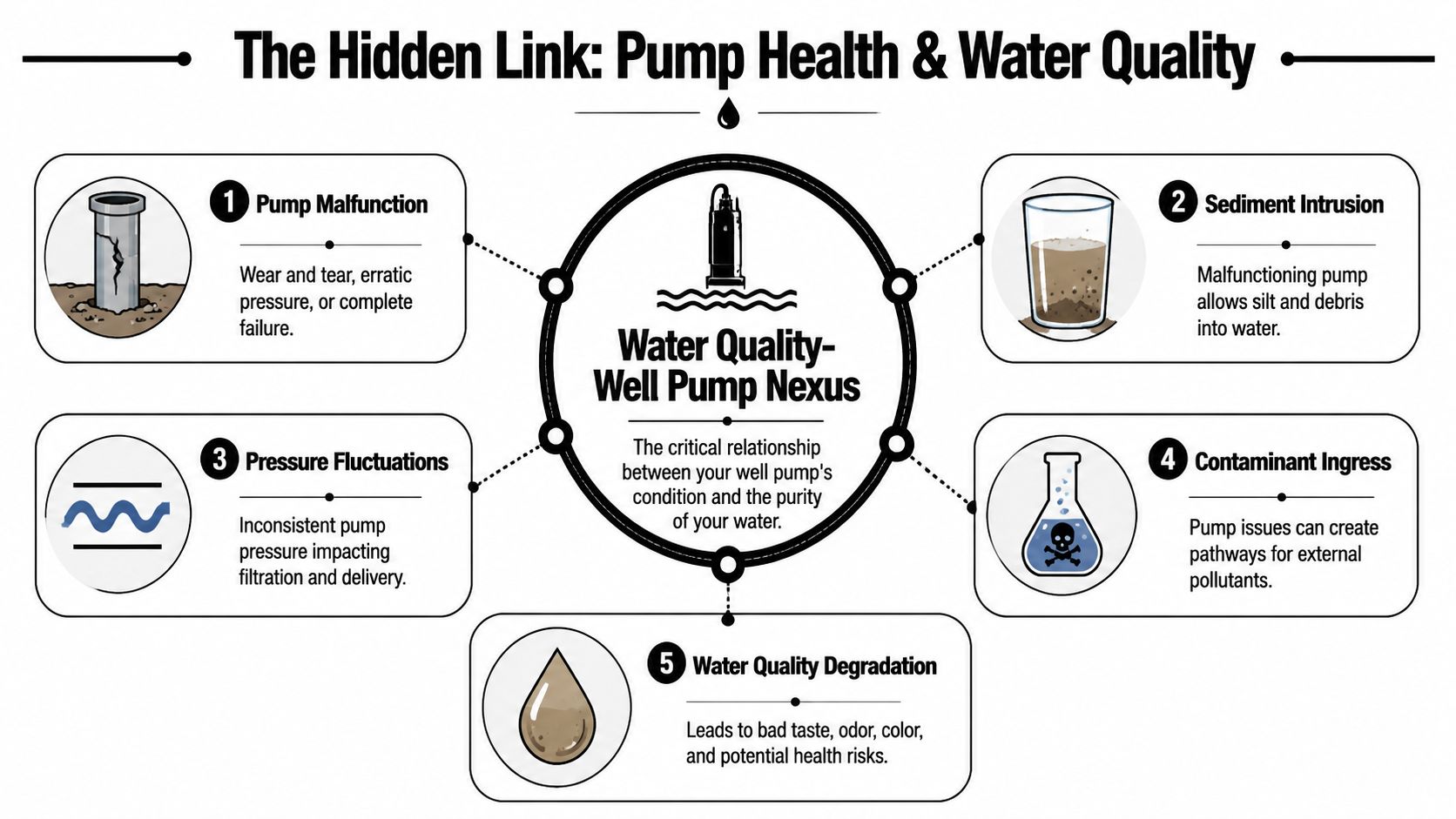
What a failing pump can do to your water
A struggling pump can pull more sediment into the system. It can contribute to cloudy water, unpleasant taste, discoloration, and filtration problems throughout the house. Even if the water keeps moving, it may not be water you should feel good about using without proper treatment.
In Southwest Florida, that matters even more because homeowners are already dealing with challenging raw water conditions. When the pump side weakens, those existing issues get harder to manage. Filters load up faster. Water quality becomes less consistent. Complaints about odor, staining, and general water appearance often get worse.
Why whole house reverse osmosis makes sense
This is why I push homeowners to think bigger than repair. Once the pump is corrected, the smartest long-term move is often a whole house reverse osmosis system. It addresses the actual water entering the home, not just the mechanics that move it.
A whole house RO setup gives you broad treatment across the property. That means cleaner water at the kitchen sink, in the shower, in the laundry, and anywhere else the household uses water. If the pump issue has exposed sediment or aggravated quality problems, whole house RO is the upgrade that makes the repair worth something beyond restored pressure.
For homes that need staged treatment, whole-home carbon filtration options can also play an important role alongside reverse osmosis, especially when taste, odor, and organic contaminants are part of the bigger water picture.
My opinion on the right order of operations
Do the mechanical repair correctly first. Then protect the house with treatment that matches the reality of well water in this region. If you stop at the pump, you're settling for “water is back.” Most families want more than that. They want water that looks better, tastes better, and creates fewer worries day to day.
Fixing the pump restores service. Treating the whole house restores confidence.
That's why I don't see a whole house reverse osmosis system as an add-on. In many SW Florida homes, it's the finish line.
Why a Water System Specialist Beats a General Plumber
Your house can have water pressure and still have a bad well system. That is the mistake general plumbing calls often miss.
A private well has to be diagnosed as one connected system. Pump, controls, tank, wiring, sediment load, and treatment performance all affect each other. If someone treats it like a simple pressure complaint, you get a quick repair bill and the same problem returns.
The technical side matters fast. A specialist checks whether the pump is pulling the right amperage under load, whether voltage is dropping where it should not, and whether the motor is being damaged by sediment, scale, worn bearings, or a failing control. Those conditions can look similar at the faucet. They are not the same repair.
The failures generalists often miss
One common example is a failed check valve or torque arrestor. That problem can beat up a motor long before the motor itself is the true cause of failure, as noted earlier in the article.
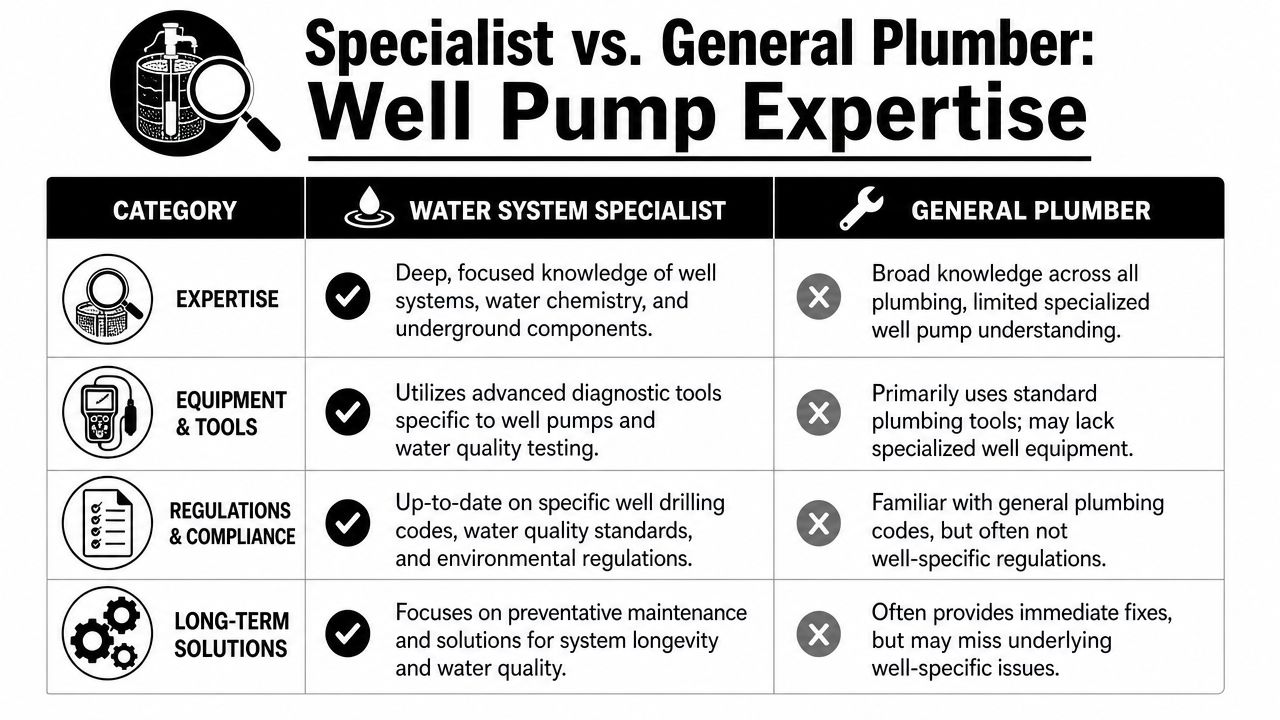
When the check valve fails, water can fall back through the system at shutdown. That creates shock in the line and extra twisting force on pump components. If the torque arrestor is loose or worn out, the pump assembly can move more than it should, and that movement shortens the life of bearings, wire splices, and the motor itself. A general plumber may swap the obvious failed part and leave the underlying cause in place.
That is how homeowners end up paying twice.
What a specialist checks that protects your water, not just your pressure
A water system specialist looks beyond whether the shower turns back on. They check the full chain of what the failure did to the water coming into the home.
- Electrical condition: Voltage, amp draw, controls, and how the system behaves under load
- Mechanical wear: Impellers, bearings, sediment abrasion, scaling, and signs of pump stress
- Pressure system response: Tank performance, pressure switch operation, and cycling behavior
- Water quality impact: Extra sediment, cloudy water, treatment disruption, staining, odor, or taste changes after the pump event
That last point matters a lot in Southwest Florida. A pump problem often stirs up sediment or changes how treatment equipment performs. If nobody checks that side of the system, your family may have water service back but still be dealing with grit, staining, sulfur odor, or treatment equipment that is no longer working the way it should.
My advice
Hire the person who works on well systems and water treatment together. That is the safer call for a private well home.
Water Medic of Cape Coral is a good example of that kind of company. It handles well water repair and treatment work, not general house plumbing. That matters because the right repair does more than restore flow. It protects the equipment, checks what the event did to your water quality, and helps you avoid fixing the pump while ignoring the water your family uses every day.
Secure Your SW Florida Home's Water with Water Medic
The biggest mistake homeowners make is stopping at “the water is running again.” That's too low a standard for a private well home. If the pump has struggled, your household needs to think about reliability, treatment, and what your family is using every day.
Approximately 42% of well pump failures are preventable through proper maintenance, and proactive service can extend pump lifespan from an average of 8 to 15 years to over 20 years, while emergency replacement costs typically run 40% to 60% higher than planned repairs (well pump maintenance and lifespan data). That's why I'm a big believer in scheduled system attention instead of waiting for a total shutdown.
What smart homeowners do next
They don't just ask, “Can you get my pressure back?” They ask better questions.
- Is the pump problem fully diagnosed: Not guessed at, not assumed.
- Did the event affect water quality: Sediment, taste, odor, and overall treatment performance matter.
- Is the home protected long term: A proper whole house reverse osmosis system gives the house far better coverage than piecemeal treatment.
- Can this be prevented next time: Maintenance is cheaper than emergency failure.
The long-term solution I'd choose
For most well homes in this region, the right path is a complete water strategy. Repair the well system correctly. Confirm the water quality impact. Then install or upgrade a whole house reverse osmosis system so the family isn't relying on untreated well water moving through the home.
That approach does more than solve today's problem. It lowers stress every time someone turns on a tap.
If your well system is acting up, don't settle for a surface-level fix. Talk with Water Medic of Cape Coral about a proper diagnosis, repair options, and whether a whole house reverse osmosis system makes sense for your home's water quality.