Best Whole House Filtration System for Well Water in SWFL
Rust stains on the tub. A sulfur smell when the shower starts. Cloudy water one week, yellow tint the next. That's a familiar pattern for well-water homes in Southwest Florida, and it usually means you're dealing with more than one contaminant at the same time.
Most homeowners start with a simple filter because it sounds easier. Then they add another device for odor. Then a softener. Then a cartridge change schedule that never quite keeps up. The water improves a little, but the core problem stays the same. The well water is complex, and the treatment setup isn't built for it.
If you're trying to find the best whole house filtration system for well water, the key question isn't which box has the nicest marketing. It's which treatment approach can handle the full chemistry of Southwest Florida well water across the entire house, day after day, without turning into a maintenance headache. In many homes here, that answer points to whole house reverse osmosis.
Tired of Stains and Smells from Your Well Water
A lot of well-water calls start with the same complaint. The homeowner is tired of cleaning orange rings out of sinks, tired of that rotten-egg smell showing up at the worst time, and tired of apologizing for how the water tastes. They've usually already tried a “filter” that helped one symptom and ignored the others.
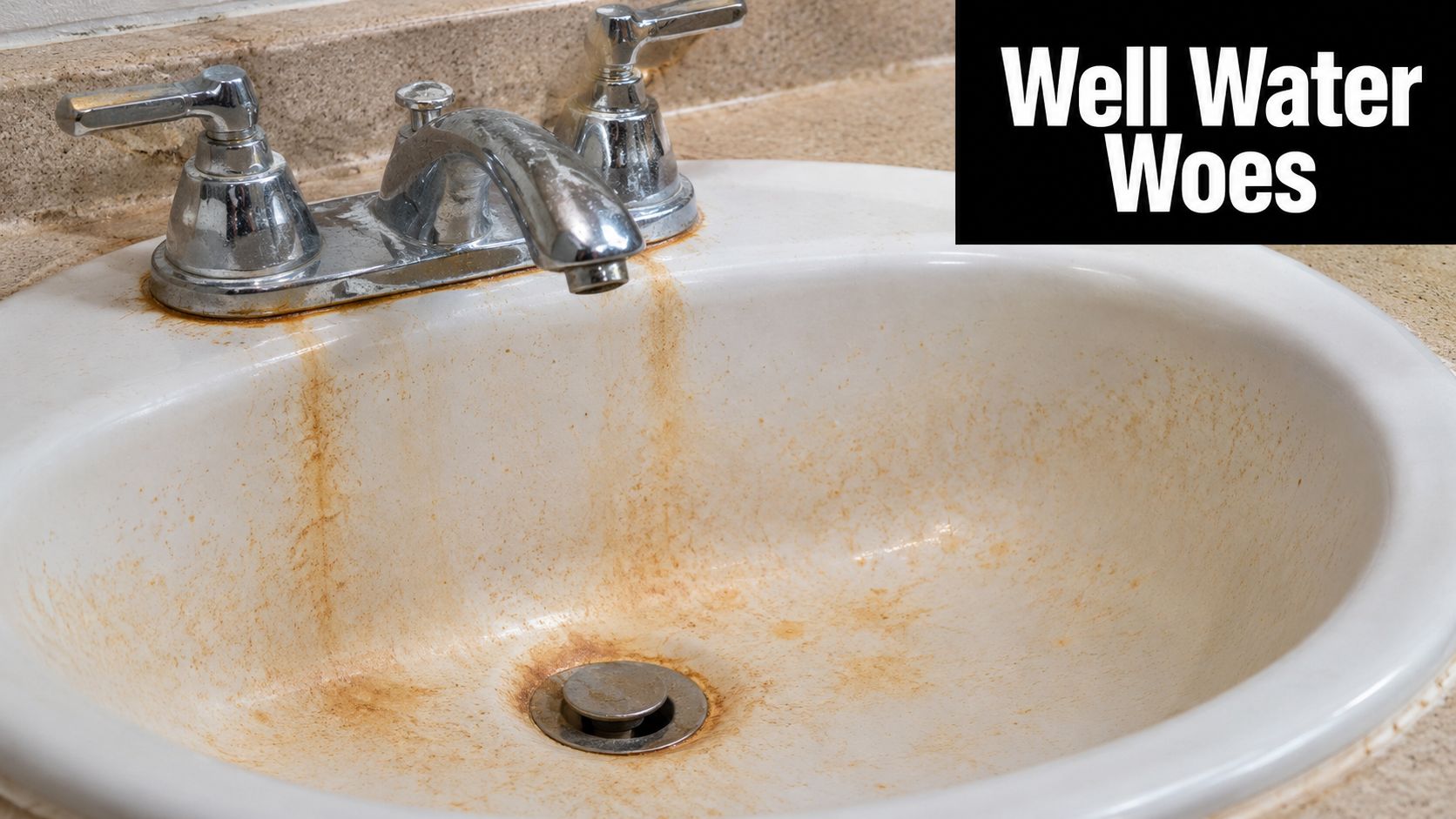
That's why this topic needs a direct answer. For Southwest Florida well water, the treatment decision shouldn't start with whatever is cheapest or easiest to install. It should start with what the water is doing in the home.
Early in the decision process, this comparison helps separate patchwork solutions from complete treatment.
| System type | What it handles well | Where it falls short on SWFL well water | Best fit |
|---|---|---|---|
| Basic sediment filter | Sand, grit, visible particles | Doesn't solve odor, dissolved minerals, staining, or broad water-quality issues | Pre-treatment only |
| Carbon filter | Taste and odor improvement in some applications | Limited if the water has multiple well-water contaminants at once | Supplemental stage |
| AIO system | Iron and hydrogen sulfide control | Focused on nuisance contaminants, not complete dissolved-solids reduction | Good for targeted well issues |
| Whole house reverse osmosis | Broad purification across the entire home | Needs proper design, sizing, and maintenance | Full-house treatment where water quality is the priority |
The mistake isn't buying treatment. The mistake is buying treatment for only one symptom when the whole water profile needs attention.
The strongest long-term results usually come from designing the system around the raw water, not around a product category. That's where many homeowners finally stop chasing stains, smells, and bad taste one at a time.
Why Your SWFL Well Water Needs a Serious Solution
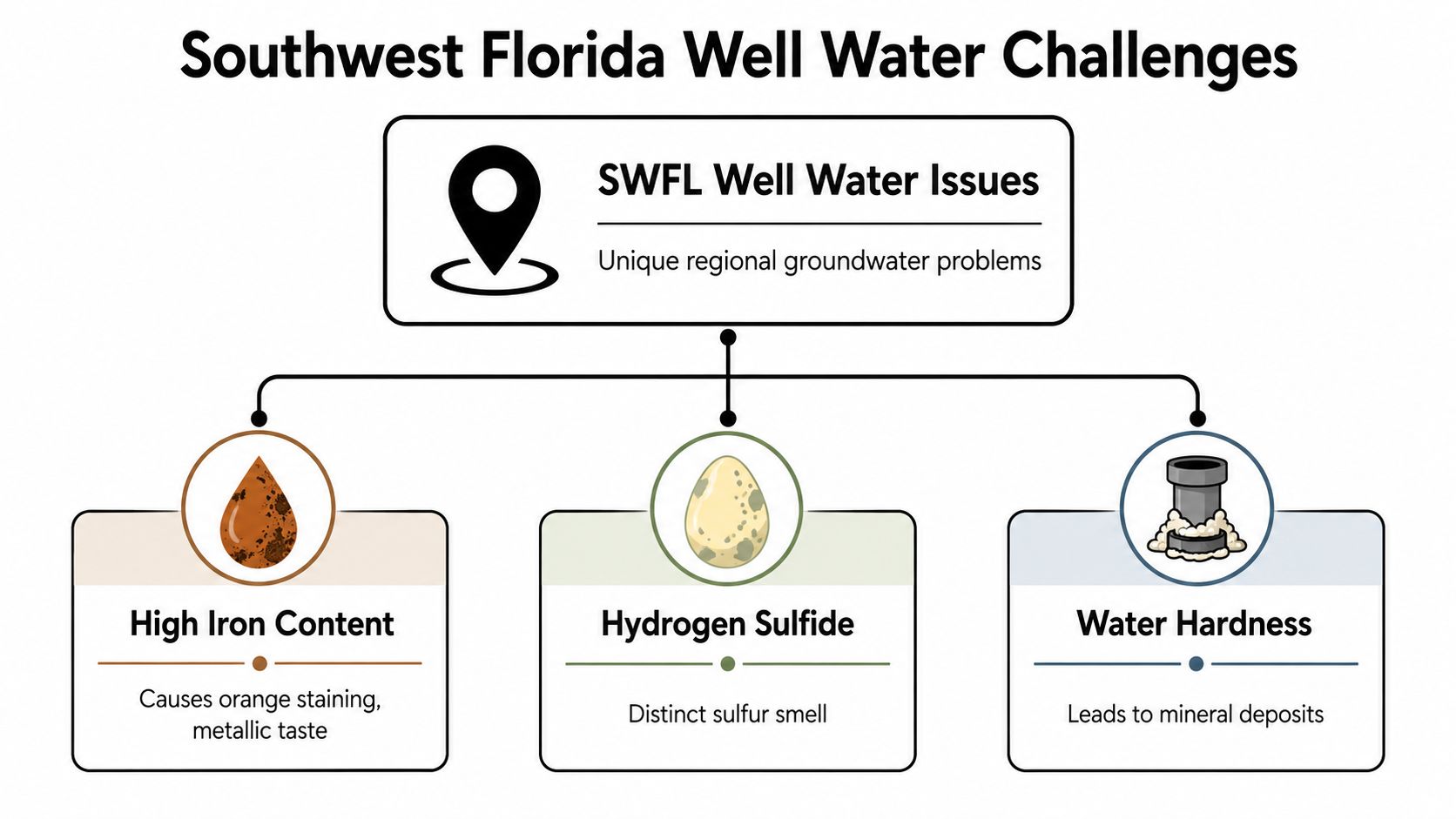
Southwest Florida well water is rarely a one-problem situation. A home may have iron, hydrogen sulfide, hardness, discoloration, and suspended sediment all at once. A filter that performs acceptably on a mild water issue can fall apart fast when local water swings between clear and dirty conditions.
What homeowners usually notice first
The first signs are practical, not technical:
- Orange or brown staining that keeps coming back
- Sulfur odor that makes showers and sinks unpleasant
- Mineral residue on fixtures, doors, and dishes
- Water that changes character after rain, seasonal shifts, or heavy use
Those symptoms matter because they point to water that isn't stable enough for a single-stage fix.
Why standard filters fail early
Many off-the-shelf systems fall short. A 2024 Florida Underground Water Association finding summarized by iFilters reported that 68% of well water systems in Southwest Florida failed to meet sediment removal standards after 6 months due to unaddressed high-turbidity spikes, with a 40% reduction in carbon filter lifespan under these conditions.
That lines up with what treatment specialists see in the field. When turbidity spikes, the filter media protecting the rest of the system gets overloaded. Once that happens, everything downstream works harder and lasts less time.
Practical rule: If the water gets dirty in surges, a light-duty single-stage filter won't stay reliable for long.
The local problem is layered
A homeowner may think the smell is the problem. Another may think the staining is the problem. In reality, both may be side effects of a larger treatment mismatch. The water needs a system that can deal with particles, nuisance contaminants, and dissolved material in one integrated approach.
That's why the best whole house filtration system for well water in this region usually isn't a simple cartridge housing from a retail shelf. It's a serious treatment train designed for unstable well water and built around test results, not guesswork.
Comparing Standard Filters to the Gold Standard
There's nothing wrong with traditional filter categories when they're used for the right job. The problem is that Southwest Florida well water often demands more than one job at once.
What standard systems do well
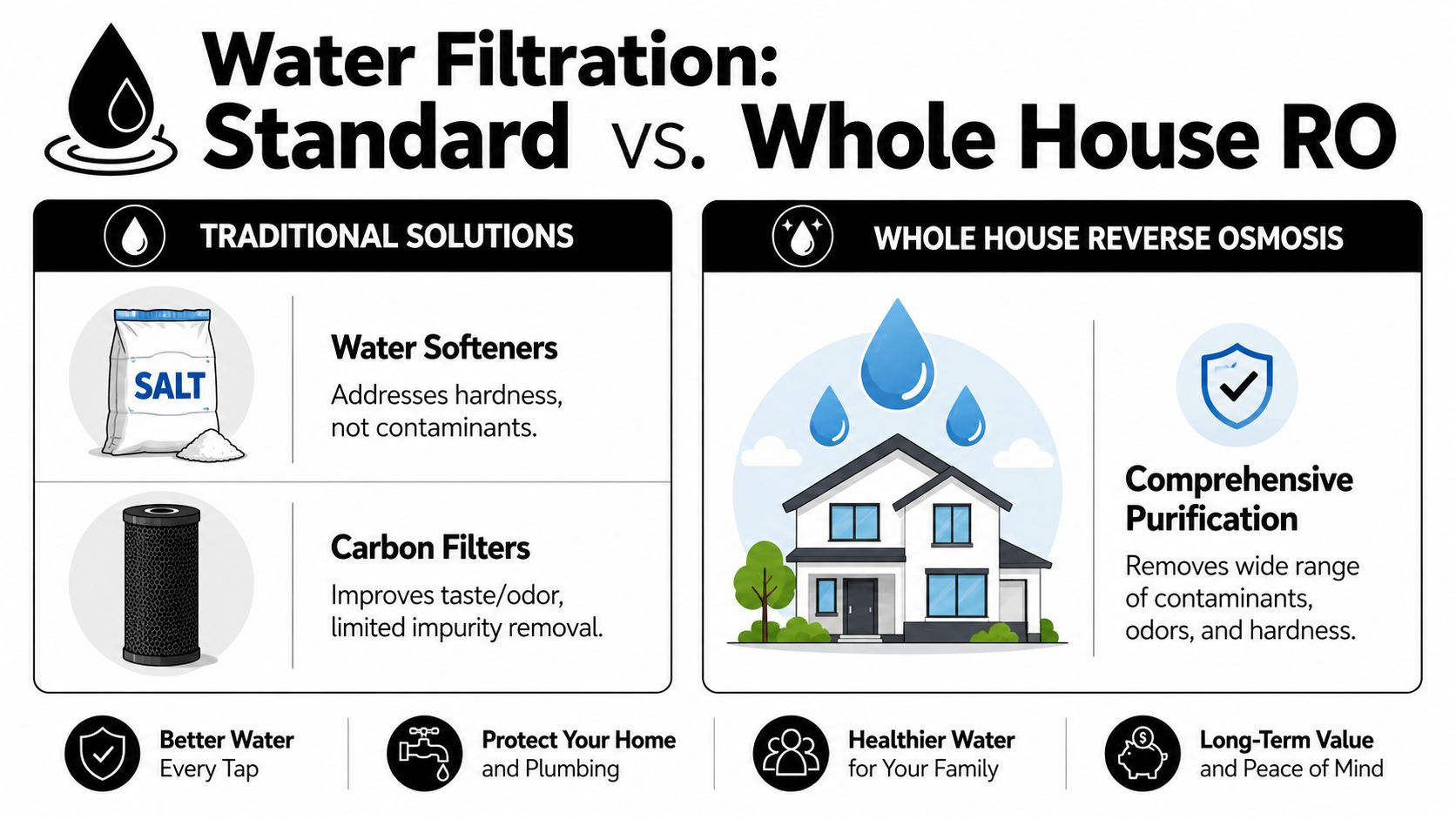
A carbon filter can improve taste and odor in the right setting. If you want to see where that type of treatment fits, whole-home carbon filtration options are commonly used as part of a broader treatment plan.
An AIO system also has a clear role. WaterFilterGuru's review coverage notes that air injection oxidation systems are designed to oxidize and then capture common well-water nuisance contaminants such as iron and hydrogen sulfide, which are the dominant causes of staining and rotten-egg odor in private wells.
That matters. If a home's main issue is iron and sulfur, AIO is a technically relevant option.
Where single-purpose systems stop
The limitation is simple. A softener addresses hardness. Carbon addresses certain taste and odor concerns. AIO addresses iron and sulfur. Each one solves a slice of the problem.
Well water in this region often doesn't arrive in slices.
You may have staining, odor, dissolved solids, mineral loading, and variable sediment conditions at the same time. Once that happens, stringing together separate fixes can become bulky, maintenance-heavy, and inconsistent.
Why whole house RO sits in a different class
Whole house reverse osmosis isn't just another filter body with different media inside. It's a full purification approach. Instead of targeting one nuisance issue, it addresses a much wider range of water-quality problems through staged treatment and a membrane barrier.
That's the true dividing line:
- Traditional systems patch specific symptoms
- Whole house RO is built to transform the water itself
If the goal is to reduce one nuisance contaminant, a targeted filter can work. If the goal is clean water from every faucet in a difficult well-water home, whole house RO is the standard that other systems are measured against.
That's why many homeowners who start with “good enough” treatment eventually move to a whole house RO design. They get tired of solving only part of the problem.
The Ultimate Solution A Deep Dive into Whole House Reverse Osmosis
Whole house reverse osmosis gets misunderstood because many people only know RO as the small unit under a kitchen sink. That's a point-of-use application. It makes sense for drinking water, but it doesn't clean the water feeding the showers, laundry, ice maker, water heater, and every other fixture in the house.
Aquasana's guidance makes that distinction clearly. It notes that reverse osmosis is highly effective, but is often treated as a point-of-use solution, while whole-house systems are meant to protect the entire home and are often paired with RO for ultimate purity. It also notes that some advanced whole-house options can last 5 years or 500,000 gallons in service life, which shows the kind of long-run performance homeowners look for in central treatment (Aquasana on whole-house well-water filtration and RO).
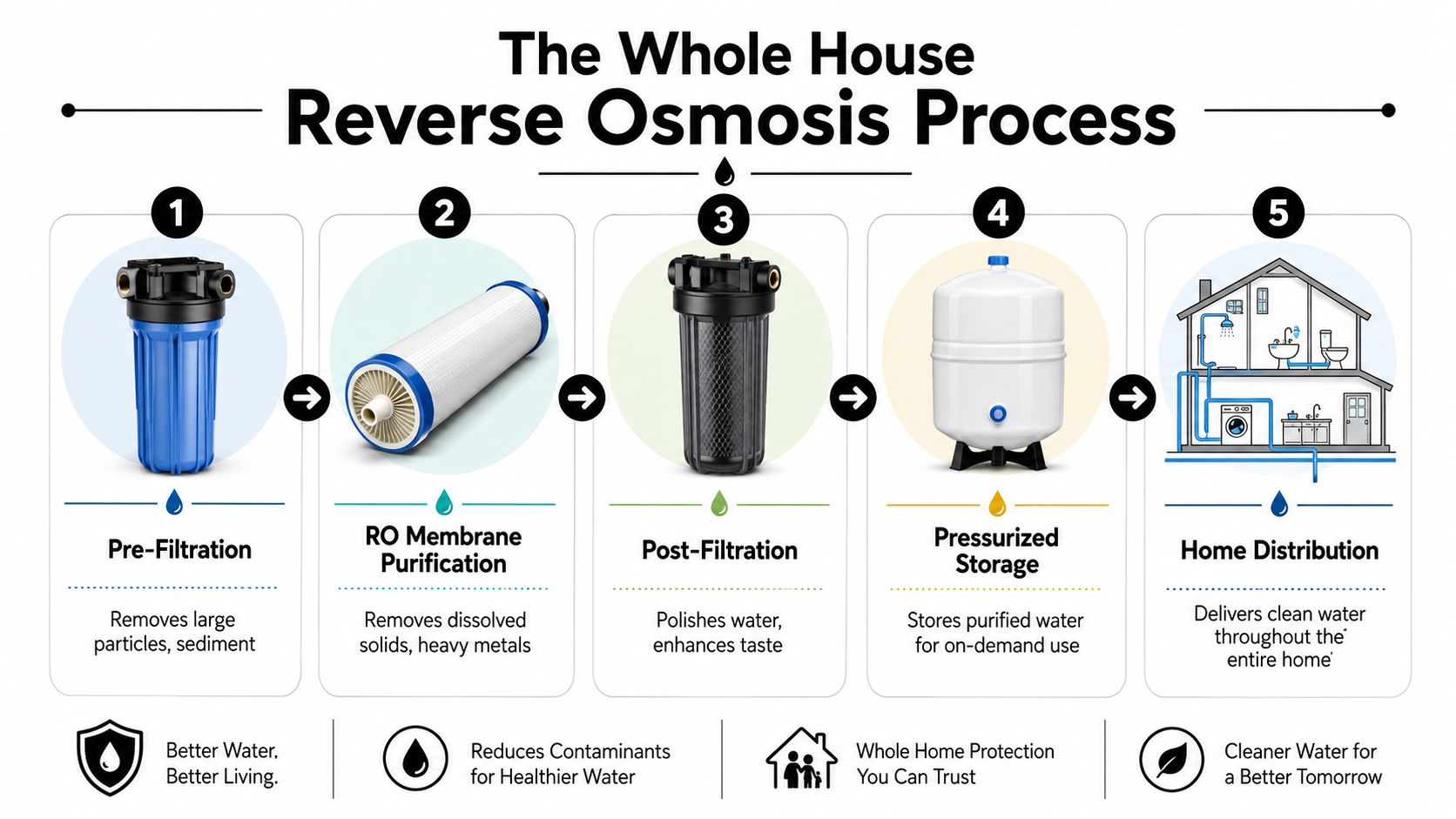
How the process works across the home
A properly built whole house RO system isn't one stage. It's a sequence.
Pre-filtration protects the heart of the system
Well water usually needs solid front-end protection. Sediment pre-filtration catches particles and helps stabilize what reaches the membrane. On difficult water, this isn't optional. It's what keeps the purification stages from getting overwhelmed.
Carbon stages handle odor and polishing roles
Depending on the design, carbon is used to address taste, odor, and certain chemical concerns before or after membrane treatment. Carbon is useful, but by itself it's not the complete answer for well water. In whole house RO, it becomes part of a coordinated treatment train instead of carrying the whole load alone.
A lot of failed systems come from treating carbon as the main event instead of one stage in a larger process.
The RO membrane does the heavy lifting
Whole house reverse osmosis distinguishes itself from ordinary filtration. The membrane is designed to reject a broad range of dissolved contaminants that basic filters do not adequately address. That matters for homes dealing with minerals, salts, and other dissolved material that keeps showing up as bad taste, staining, spotting, or general water quality complaints.
For many Southwest Florida properties, this is the point where the water finally stops behaving like untreated well water.
Here's a quick visual overview before getting into distribution and storage:
Why whole house RO is different in daily use
Once the water has been purified, the system stores treated water and distributes it through the home. That changes the experience everywhere, not just at a drinking faucet.
- Showers feel cleaner because the house isn't using raw well water at the point of bathing.
- Laundry benefits because the water feeding the washer has already been treated.
- Ice and cooking water come from the same purified house supply.
- Fixtures and glass stay cleaner because the water quality is more controlled.
This is why whole house RO often becomes the only complete answer in a hard well-water market. You're not trying to manage symptoms room by room. You're changing the water before it enters daily life.
When a homeowner should stop piecing systems together
There's a clear moment when partial treatment stops making sense. It's when the home has multiple recurring complaints and the owner is rotating through filter changes, salt, odor remedies, and stain cleanup without a stable result.
At that stage, a whole-house RO design is usually the more rational path. Water Medic of Cape Coral offers whole house reverse osmosis systems as part of custom water treatment work for Southwest Florida homes, along with water testing and ongoing service support.
The right whole house RO system doesn't just make the water more tolerable. It changes the baseline quality of water the house lives on.
For homeowners asking about the best whole house filtration system for well water, that's the standard worth using. Not “which unit helps a little,” but which system can deliver whole-home purification on difficult raw water.
Sizing Your System for Peak Performance and Flow Rate
The first question most homeowners ask after hearing “whole house reverse osmosis” is simple. Will the water pressure feel weak?
It shouldn't, if the system is sized correctly.
Capacity matters as much as contaminant removal
A whole-house system has to do two jobs at once. It has to treat the water effectively, and it has to keep up with the way the home uses water. Morning use is the usual stress test. One shower is on, another bathroom is active, the kitchen is running, and the house still expects normal flow.
Independent testing coverage summarized by Just Plumbing AZ reported that top-rated whole-house systems can remove up to 99.6% of contaminants, filter as much as 1 million gallons, and maintain about 9 GPM flow in the process (lab-test summary on whole-house system capacity and flow).
Those numbers matter because they show what buyers should look at beyond marketing language. The right benchmark isn't just “does it filter water.” The benchmark is whether the system can do real treatment at useful household flow.
What sizing should account for
A serious sizing decision usually includes these factors:
- Household demand: How many bathrooms, how many people, and how often water is used at the same time.
- Raw water quality: Dirtier, more variable water often needs more thoughtful staging ahead of purification.
- Treatment goals: A home seeking broad purification needs a different layout than a home only softening water. In some cases, a water softener still plays a role in an overall treatment plan, but it is not a substitute for full purification.
- Storage and recovery: Whole house RO relies on proper storage and distribution design so the home doesn't feel starved during peak use.
Why one-size-fits-all systems disappoint
Many disappointing installs aren't caused by RO itself. They're caused by under-sizing, poor pre-treatment, or trying to apply a generic design to a demanding well.
A properly designed system should match the home's use pattern and the water chemistry together. That's what keeps the treatment performance strong without turning the shower into a trickle.
Understanding the Investment in Perfect Water
Whole house reverse osmosis is a premium solution. It costs more than a basic filter because it does more than a basic filter. It's designed to treat the entire house and to keep doing that over time, not just make the kitchen tap taste better for a while.
What you're really paying for
The investment covers more than equipment. It covers system design, correct staging, membrane protection, storage, controls, installation quality, and ongoing service. For difficult well water, those details determine whether the system performs cleanly or becomes a constant maintenance project.
The bigger mistake is treating a serious water problem with a bargain setup that needs constant correction.
Long-term performance matters more than brochure claims
That's why verified reduction over time matters. In laboratory-based testing of a comparable whole-house system, one independent reviewer reported 100% removal of chlorine and three disinfection byproducts, with performance guaranteed for 6 years or 1 million gallons, while also noting that the system did not meaningfully reduce boron or fluoride (lab-based whole-house performance discussion on YouTube).
That result is useful for one reason. It shows buyers how to think. A system may perform extremely well on some targets and still be the wrong fit for other contaminants. The right purchase decision comes from matching treatment design to your actual water chemistry.
Don't buy on price alone. Buy on what the system is built to remove, how long it can do that, and whether the design fits your water.
Why professional treatment design matters
The best whole house filtration system for well water isn't a universal box. It's the system that matches the home's raw water and usage pattern. That's why water testing, specification, and maintenance planning are part of the investment.
For homeowners weighing the upfront cost, payment flexibility can matter too. If you're evaluating options, water treatment financing is one way to spread out the cost of a serious system rather than settling for a smaller fix that doesn't solve the underlying problem.
In a region with difficult well water, value is stability. Clean water at every tap. Less chasing symptoms. Less guessing.
Your Decision Made Simple The Water Medic Solution
If your well water leaves stains, carries odor, or changes character throughout the year, basic filtration usually won't give you a permanent answer. It may help one symptom. It usually won't solve the house-wide problem.
That's why whole house reverse osmosis stands apart. It treats the water as a complete system problem, not as a collection of isolated annoyances. For many Southwest Florida homes, that's the treatment level that finally makes the water feel settled, clean, and usable throughout the property.
If you've been comparing options for the best whole house filtration system for well water, keep the decision simple. Test the water. Look at the full contaminant profile. Choose a system that's built for the entire home, not just one faucet or one nuisance issue.
A well-designed whole house RO system does what pieced-together filters often can't. It reduces the broad water-quality burden entering the home. That means cleaner water for bathing, laundry, cooking, and daily use. It also means fewer compromises.
If you're ready to stop living with stained fixtures, sulfur odor, and unpredictable well water, contact Water Medic of Cape Coral for a water test and consultation. They specialize in water treatment for Southwest Florida homes and can help determine whether a whole house reverse osmosis system is the right fit for your property.