
RO Membrane Life Expectancy for Whole House Systems
Whole house RO membranes typically last 2 to 5 years, and some well-maintained systems last longer. In Southwest Florida, though, your actual membrane life depends more on well water conditions and pretreatment quality than on the calendar hanging in your garage.
If you're on a private well in Cape Coral or Lee County, you've probably had this moment. The water still looks clear, but something feels different. Maybe the taste is flatter, the shower water feels less consistent, or the system seems to work harder than it used to. Most homeowners assume the membrane has a fixed expiration date, like batteries in a smoke detector.
That's not how whole house reverse osmosis works.
A membrane doesn't usually fail all at once. It drifts. It slowly loses its ability to reject dissolved salts and keep up with the water demand of the house. In a whole house system, that matters more than it does in an under-sink unit because your membrane isn't just making a few glasses of drinking water. It's protecting water for the entire home, every day, against the unique mix of minerals and fouling challenges common in Southwest Florida wells.
One of the clearest ways to think about RO membrane life expectancy is this: the membrane is the engine, but pretreatment is the oil and air filter. If the upstream protection is weak, the engine wears out early. If the system is matched well to the water and maintained consistently, the membrane can keep performing far beyond what many homeowners expect.
Industry guidance puts residential RO membrane planning in a 2 to 5 year service window, but the limiter is performance decline from fouling, scaling, oxidation, or compaction, not the date on the install invoice, as noted in this RO membrane lifespan guide.
For homeowners considering a full-property solution, whole home reverse osmosis systems are built for a very different workload than sink systems, which is why membrane care has to be approached more deliberately.
Introduction to RO Membrane Life Expectancy in Your Home
A lot of homeowners call after they notice small changes, not major failure. The water may still seem usable, but something is off. That's often the right time to pay attention, because membrane aging usually starts subtly.
Why whole house systems need a different mindset
A whole house RO membrane handles a bigger job than a kitchen drinking water unit. It processes more water, sees more variation in feed water, and depends heavily on pretreatment to stay clean. In Southwest Florida, that feed water may carry hardness, silica, iron, or seasonal shifts that push the membrane harder than a homeowner realizes.
That's where confusion starts. People ask, “How long should my membrane last?” The more useful question is, “How is my membrane performing in my water?”
A membrane's lifespan isn't a factory promise. It's the result of water quality, pretreatment, operating conditions, and maintenance habits over time.
What homeowners usually miss
Expecting a fixed replacement date is understandable. But whole house RO works more like tires on a vehicle. Two identical sets won't wear the same if one driver stays on smooth roads and keeps the alignment right, while the other drives rough roads with poor maintenance.
That same logic applies here:
- Clean feed water helps: Better pretreatment reduces the fouling load reaching the membrane.
- Stable operation matters: Pressure and recovery settings affect how much stress the membrane sees.
- Well water changes the story: Private wells can behave differently from one property to the next, even in the same neighborhood.
By the end of this guide, you'll be able to judge whether your membrane is probably aging normally, whether your well water is shortening its life, and when it makes sense to get the system tested instead of guessing.
How Whole House Reverse Osmosis Membranes Work
A reverse osmosis membrane is a thin-film composite polyamide barrier that separates water from dissolved salts and many other unwanted substances. The easiest way to picture it is as a security gate that lets water molecules through under pressure, while holding back much of what you don't want in the house water.
Think of the membrane as the system's checkpoint
Water enters the system under pressure. The membrane divides that water into two paths. One becomes the treated water your home uses. The other carries away concentrated rejected material.
Two terms matter here:
- Salt rejection means how well the membrane keeps dissolved solids out of the finished water.
- Permeate flow means how much treated water the membrane can produce.
If rejection drops, more dissolved material slips through. If permeate flow drops, the system struggles to keep up.
Why whole house RO puts more demand on the membrane
An under-sink RO unit serves one faucet. A whole house RO system serves the property. That means the membrane is working against larger volume swings and more sustained demand.
In plain terms, a point-of-use membrane is like a coffee maker. A whole house membrane is more like the main kitchen appliance line for the entire home. If pretreatment slips, the whole house membrane feels it faster because it processes more water and has less room for neglect.
That's why pretreatment exists in the first place. Sediment filtration removes the grit that can plug the membrane surface. Carbon filtration helps protect chlorine-sensitive membrane material where oxidants are a risk. Other upstream equipment may control scale-forming minerals before they harden onto the membrane.
Why membrane health affects daily water quality
Homeowners often think membrane condition only affects drinking water taste. In a whole house system, it influences much more than that.
A declining membrane can show up as:
- Higher finished-water TDS: More dissolved material gets through.
- Lower production: The system can't keep up as easily.
- More pressure-related strain inside the treatment train: Fouling and scaling make the system work harder.
- More frequent service needs: Filters and cleaning intervals often tighten when the membrane starts drifting.
That's why homeowners who invest in whole house RO usually benefit from a system-level approach instead of looking at the membrane as a stand-alone part.
Key Factors That Determine How Long Your Membrane Lasts
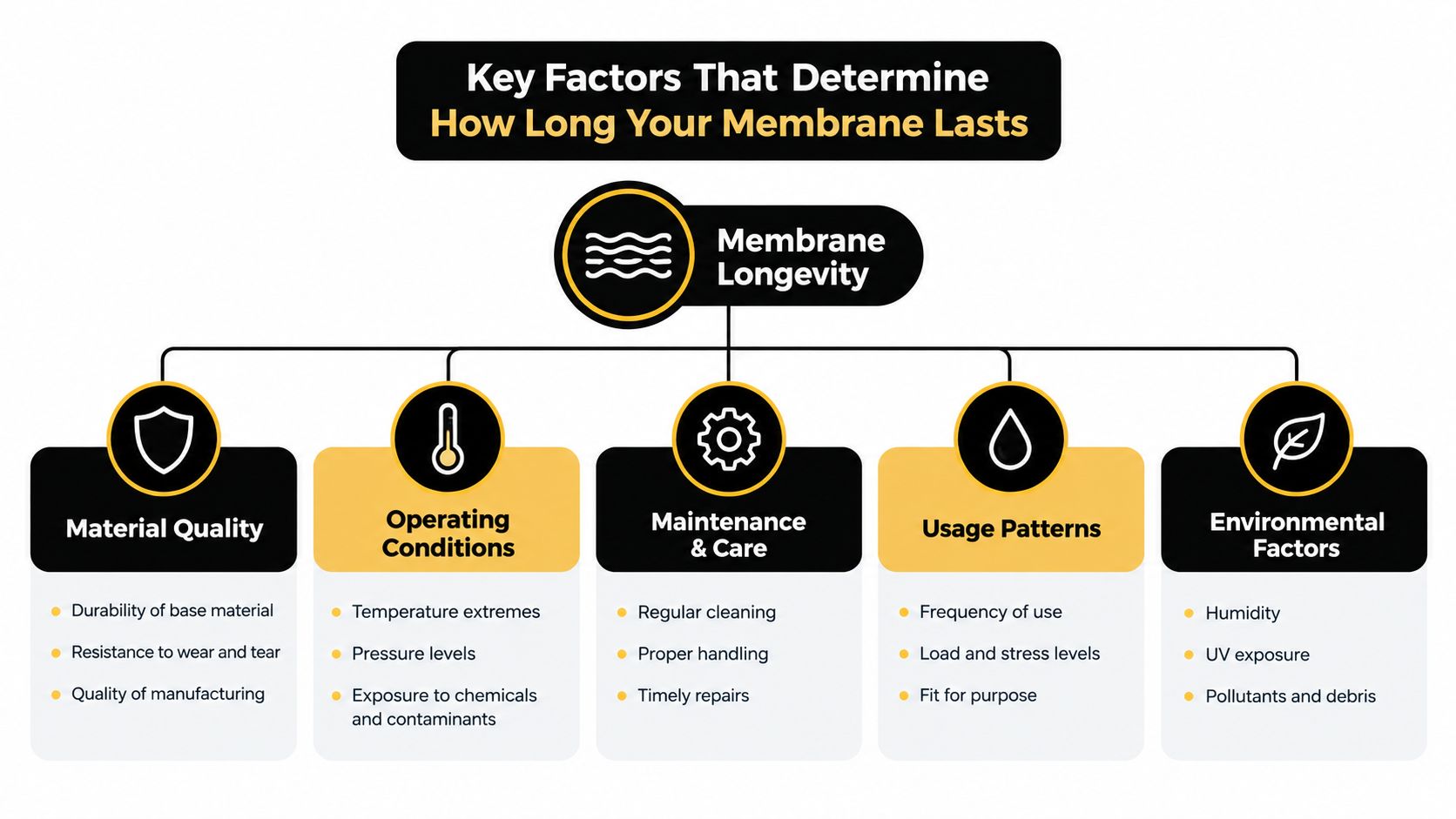
Membrane life isn't mostly about brand. It's mostly about conditions. Historical field and review data show that a common operating range is about 2 to 5 years, while some well-maintained systems have been documented at 10 to 11 years without replacement, according to this technical review on reverse osmosis membrane life expectancy.
That spread is the whole point. Membrane life can vary dramatically because the job conditions vary dramatically.
Feed water quality shapes the workload
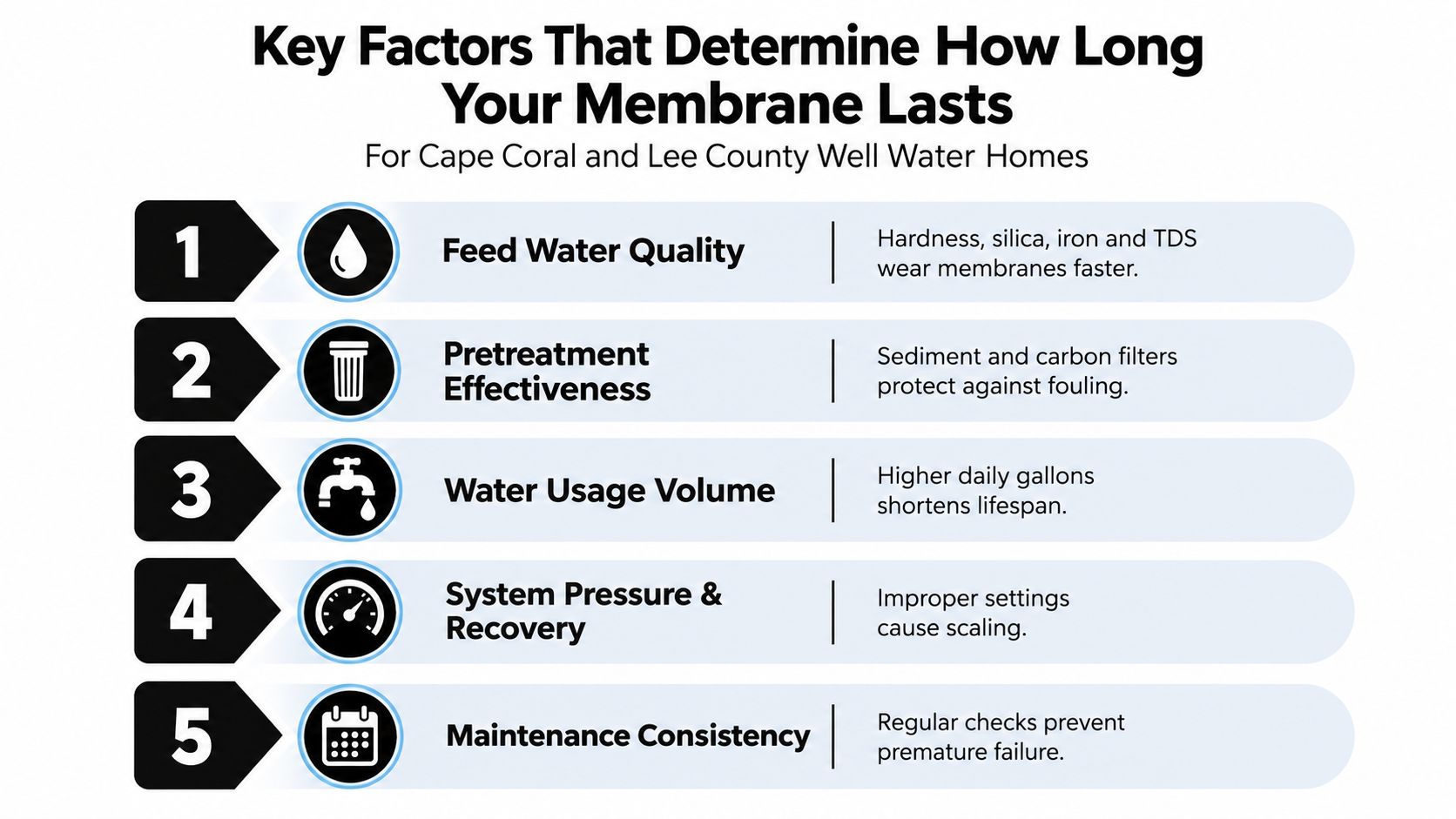
Southwest Florida well water can be challenging. Hardness, silica, iron, and overall dissolved solids all change how much stress the membrane sees.
If you think of the membrane as a windshield, feed water quality is the road condition. Clean pavement is easy. A gravel road throws more at the glass.
When a home has heavy mineral loading, the membrane usually reaches its limits sooner unless the pretreatment is designed for that water.
Pretreatment is the membrane's bodyguard
Pretreatment is often the difference between normal aging and early failure. Sediment filters stop larger particles before they cake onto the membrane. Carbon stages help protect sensitive membrane material from oxidant damage where that's relevant.
For many homes, this is the most important upstream protection category to get right. Carbon filtration components often play a key protective role in a properly designed treatment train.
Practical rule: If pretreatment is weak, replacing the membrane alone usually treats the symptom, not the cause.
Oxidants can damage the membrane permanently
Thin-film composite polyamide membranes are especially vulnerable to chlorine exposure. Once oxidation damages the membrane surface, rejection performance can drop in a way cleaning won't reverse.
This is one of the easiest failure paths to misunderstand because the homeowner may not see obvious warning signs at first. The water can still look fine while the membrane chemistry is already compromised.
Usage volume and operating conditions matter
A whole house system serving a busy family sees more daily load than a lightly used seasonal property. More water processed means more opportunity for fouling, scaling, and compaction.
Pressure and recovery settings matter too. If the system runs outside its intended operating balance, scale can form faster and the membrane can wear unevenly.
Maintenance consistency changes outcomes
Membranes don't reward guesswork. They reward routine.
The homes that get the longest service life usually have a pattern: filters are changed on time, water quality is watched, and performance drift gets addressed before it becomes failure.
That's why two homes with similar systems can have very different results. One homeowner treats maintenance as part of the ownership cost. The other waits for an obvious problem. The membrane tells the story later.
Expected Replacement Intervals for SW Florida Homes
If you want a planning number, use 2 to 5 years for a whole house residential membrane. That's the realistic window most homeowners should expect. But planning by calendar alone can cause two mistakes. Replacing too early wastes money. Waiting too long can let water quality drift farther than you want.
The floor is not the target
EPA WaterSense supporting material for point-of-use reverse osmosis systems says the membrane-life test is designed to ensure the membrane lasts at least one year, and EPA expects qualifying membranes to last longer under those challenging test conditions, as summarized in this discussion of the EPA membrane-life benchmark.
That one-year benchmark is useful as a minimum durability context. It is not a good replacement strategy for a properly designed whole house system.
Calendar thinking versus performance thinking
A calendar is easy. Performance is smarter.
If your well water is relatively manageable and pretreatment stays in good shape, a membrane may keep working well beyond the timeframe many homeowners casually assume. If your pretreatment is inconsistent or the water is aggressive, the membrane may decline much earlier.
Here's a practical comparison table.
| Water Condition | Pretreatment Level | Typical Life Expectancy |
|---|---|---|
| Cleaner well water with stable conditions | Strong pretreatment and consistent maintenance | 2 to 5 years is the normal planning range, with some well-maintained systems lasting longer |
| Challenging well water with fouling or scale pressure | Good but not closely monitored pretreatment | Often trends toward the shorter end of the planning range |
| Aggressive water with poor pretreatment or recurring fouling | Weak or inconsistent pretreatment | Can shorten significantly, and some guidance notes 12 to 24 months in tougher residential conditions |
| Severe pretreatment problems or chronic membrane abuse | Inadequate upstream protection | Early failure becomes much more likely |
What this means for a SW Florida homeowner
If you're on a private well, don't buy into a single replacement date. Use the planning window, then verify with system performance. That's especially important for whole house RO because the membrane is central to the quality of water across the property, not just at one faucet.
Signs Your Whole House RO Membrane Needs Replacement
Most membranes don't announce the end with one dramatic symptom. They leave clues. Homeowners who catch those clues early usually avoid the frustration of poor water quality and reactive service.
A useful way to think about RO membrane life expectancy is performance drift. If the membrane is slowly producing less water, letting more dissolved material through, or needing more frequent attention, that's usually more meaningful than the install date.
A residential guidance summary notes that the better question is when performance drift becomes measurable, not whether the calendar says it's time, and that chlorine breakthrough, fouling, scaling, and inconsistent pretreatment can shorten life to 12 to 24 months in some cases, as described in this guide to when RO membranes need replacement.
When finished-water quality and production both drift in the wrong direction, the membrane is usually telling you more than the calendar ever could.
Rising TDS or a saltier taste
If the membrane's rejection is slipping, more dissolved solids pass into the treated water. Some homeowners first notice this as a taste change. Others only catch it with a TDS check.
A simple habit helps here. Keep a record of your normal treated-water readings. If they trend upward over time, that's a stronger signal than one isolated number.
Lower water production
When fouling, scaling, or compaction builds, the membrane can't move as much treated water through. In a whole house system, that often shows up as reduced production rather than an obvious single-faucet symptom.
Look for a system that seems to recover more slowly or needs more attention to maintain normal performance.
More frequent cleaning or service attention
A membrane that used to run smoothly but now needs more frequent intervention is often nearing the end of its useful run. That doesn't always mean immediate replacement, but it does mean the system should be evaluated.
Pressure trend changes inside the system
Homeowners don't always have gauges or logs, but technicians do. Rising pressure drop across the membrane stage often points to fouling or scaling buildup.
If your system has already had upstream filters changed and performance still isn't returning to normal, membrane condition moves much higher on the suspect list.
When to call for testing
Call for a professional check when you notice a pattern, not just a one-day quirk.
Good reasons include:
- TDS trend is rising: Treated water quality is slipping over time.
- Production feels weaker: The system doesn't seem to keep pace like it used to.
- Service frequency has increased: The unit needs more attention than it once did.
- You're on a variable well: Seasonal shifts can mask membrane decline unless someone tests the system directly.
How to Extend Membrane Life and Protect Your Investment
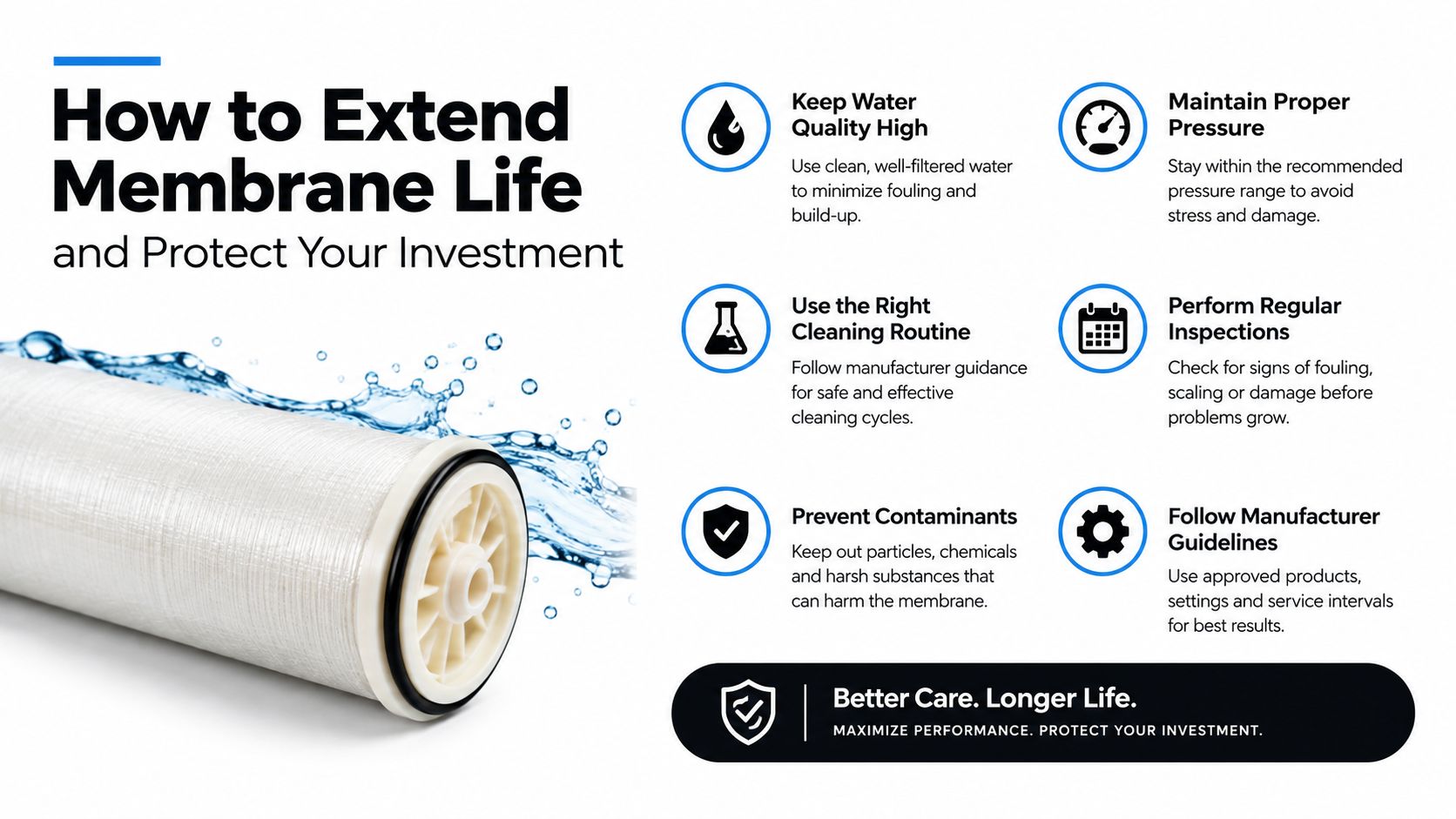
The longest-lasting whole house RO membranes usually don't come from luck. They come from protection. If the membrane is the heart of the system, the rest of the treatment train has to keep that heart from doing jobs it was never meant to do alone.
Build the right upstream defense
The first step is solid pretreatment. Sediment control matters because grit and suspended material can foul the membrane surface. Scale control matters because hardness and silica can shorten useful life. In many well-water homes, water softeners are part of that protective strategy upstream of RO.
Replace support filters before the membrane pays the price
Homeowners often wait until the water seems obviously different. That's late.
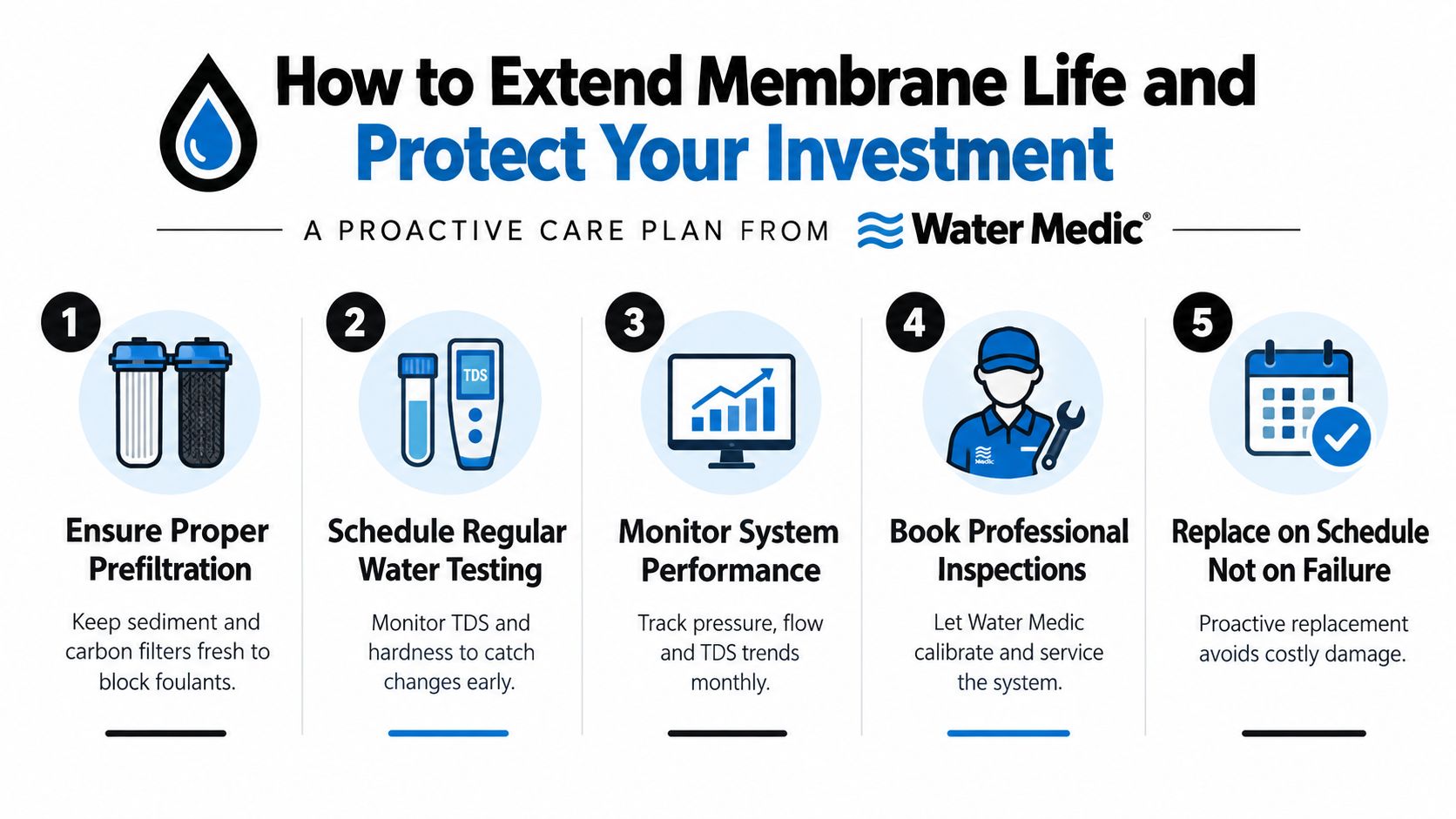
A better habit is to replace supporting filters on schedule and verify that oxidant protection is still doing its job. Once chlorine or other oxidants reach a chlorine-sensitive membrane, the damage can be permanent.
Small maintenance steps upstream are often what decide whether a membrane lands near the short end or the long end of its service life.
Track trends instead of guessing
A whole house RO system should be watched as a system, not as a mystery box.
Useful habits include:
- Keep baseline readings: Know what normal treated water quality looks like for your home.
- Notice pattern changes: One odd day isn't always meaningful. A steady drift usually is.
- Schedule periodic inspections: A trained technician can spot membrane stress before the homeowner sees obvious symptoms.
Use professional service when the water is complex
Some wells are straightforward. Others aren't. If the water has strong mineral loading or changing seasonal character, a custom service approach makes more sense than generic replacement timing.
One option for homeowners who want that kind of support is Water Medic of Cape Coral, which provides whole-house RO system installation and service for Southwest Florida properties.
Planning Your Next Steps for Reliable Clean Water
A good planning window for whole house membranes is 2 to 5 years, but that number only helps if you pair it with performance checks. In Southwest Florida well water, membrane life is shaped by pretreatment, fouling control, oxidant protection, and how closely the system is maintained.
That's why guessing often costs homeowners twice. Some replace early because they don't trust the system anymore. Others wait too long because the water still seems “close enough.” Neither approach is ideal for a whole house RO setup that serves the entire property.
The better move is simple. Treat membrane life as a measurable outcome. Watch for quality drift, lower production, and recurring service signs. Then confirm what the system is telling you with proper testing.
If you're not sure whether your membrane is aging normally or your well water is shortening its life, a local evaluation makes the decision much easier. A system check tied to your actual water conditions will tell you more than any generic online replacement rule.
With 25+ years of local expertise, prompt service, and technicians who understand Southwest Florida well-water treatment, the right guidance can help you protect both water quality and membrane life without replacing parts blindly.
If your whole house RO system is due for evaluation, Water Medic of Cape Coral can test system performance, inspect pretreatment, and help determine whether your membrane is still protecting your home the way it should. For local help with well-water treatment and whole-house reverse osmosis service, visit Water Medic of Cape Coral.