
Nitrates and Phosphates: Whole House RO Guide
The lab envelope is still on the Cape Coral counter. Nitrate is printed one way. Phosphate, or phosphorus, is printed another. Coffee, cooking, and infant formula all come from that private-well tap, and the water in the glass looks clear.
Clear water is not the test. Nitrates and phosphates are dissolved nutrients. A sediment cartridge will not stop them, and neither will a carbon filter. If a drinking result hits its action level, move drinking and cooking to a verified source and have a whole house reverse osmosis system sized to this well, not to one faucet.
What Your Nitrate and Phosphate Numbers Mean
Act on the drinking line before you study the chemistry. The U.S. Environmental Protection Agency national primary drinking water regulations set the maximum contaminant level for nitrate at 10 mg/L when measured as nitrogen and for nitrite at 1 mg/L. Nitrate above that federal limit is a particular concern for infants younger than six months, for whom EPA warns of serious illness and possible death, including methemoglobinemia, commonly called blue-baby syndrome. Private wells are not regulated under the Safe Drinking Water Act the way public systems are, so you arrange testing and treatment yourself. Fertilizer runoff, septic or sewage contamination, and erosion of natural deposits are the sources EPA names.
Convert the unit before you call it a pass
A slip that says 10 mg/L nitrate is not the same result as 10 mg/L nitrate-nitrogen. The EPA Lower Yakima Valley groundwater page treats private-well nitrate as nitrate-nitrogen (NO₃–N). Multiply nitrate-nitrogen by 4.43, so 10 mg/L as nitrogen is about 44.3 mg/L as nitrate ion. Do not treat 10 mg/L as nitrate ion as a pass. Boiling does not remove nitrate. Water leaves as steam and the nitrate stays, so the concentration can rise.
A number under the MCL is not an all-clear for every house. EPA nitrate exposure guidance notes that a 2025 Nebraska public-health report flagged wells measuring 3–10 mg/L as a caution range, citing newer studies of possible effects below the regulatory limit. Use that band when someone is pregnant, when you mix formula, or when repeat tests stay high.
| Result | Reporting unit | Action level | What to do now |
|---|---|---|---|
| Nitrate | mg/L as nitrogen (NO3-N) | 10 mg/L EPA MCL; caution from 3 mg/L | Stop using for infant formula; use a verified source for drinking and cooking; evaluate whole-house RO |
| Nitrate ion | mg/L as NO3 | About 44.3 mg/L equals the 10 mg/L nitrogen MCL | Convert before judging; do not treat 10 mg/L as nitrate ion as a pass |
| Nitrite | mg/L as nitrogen | 1 mg/L EPA MCL | Same drinking restriction; confirm with a lab before choosing treatment |
| Phosphate or phosphorus | mg/L as phosphorus, not as phosphate | No EPA drinking-water MCL | Use as a nutrient and algae indicator; do not assume the same fix as nitrate |
Phosphate is a nutrient indicator, not a drinking-water pass-fail score. The FY25 Southwest Nebraska well testing report notes that phosphate has no EPA maximum contaminant level and may point to agricultural influence. Compare phosphate only on one basis, usually milligrams per liter as phosphorus. Milligrams per liter as phosphate are a different number.
Practical rule: If a drinking row meets its action level, stop using that tap for drinking and cooking, especially formula, and request a whole-house reverse osmosis evaluation. A lab test should set the starting concentration and later confirm treated-water performance.
Why Dissolved Nutrients Pass Ordinary Filters
Stir a spoon of salt into soup. The broth can look clear while the salt is still there. Nitrate and phosphate behave the same way in a Lee County well. They are ions in solution, not grit you can see in a glass.
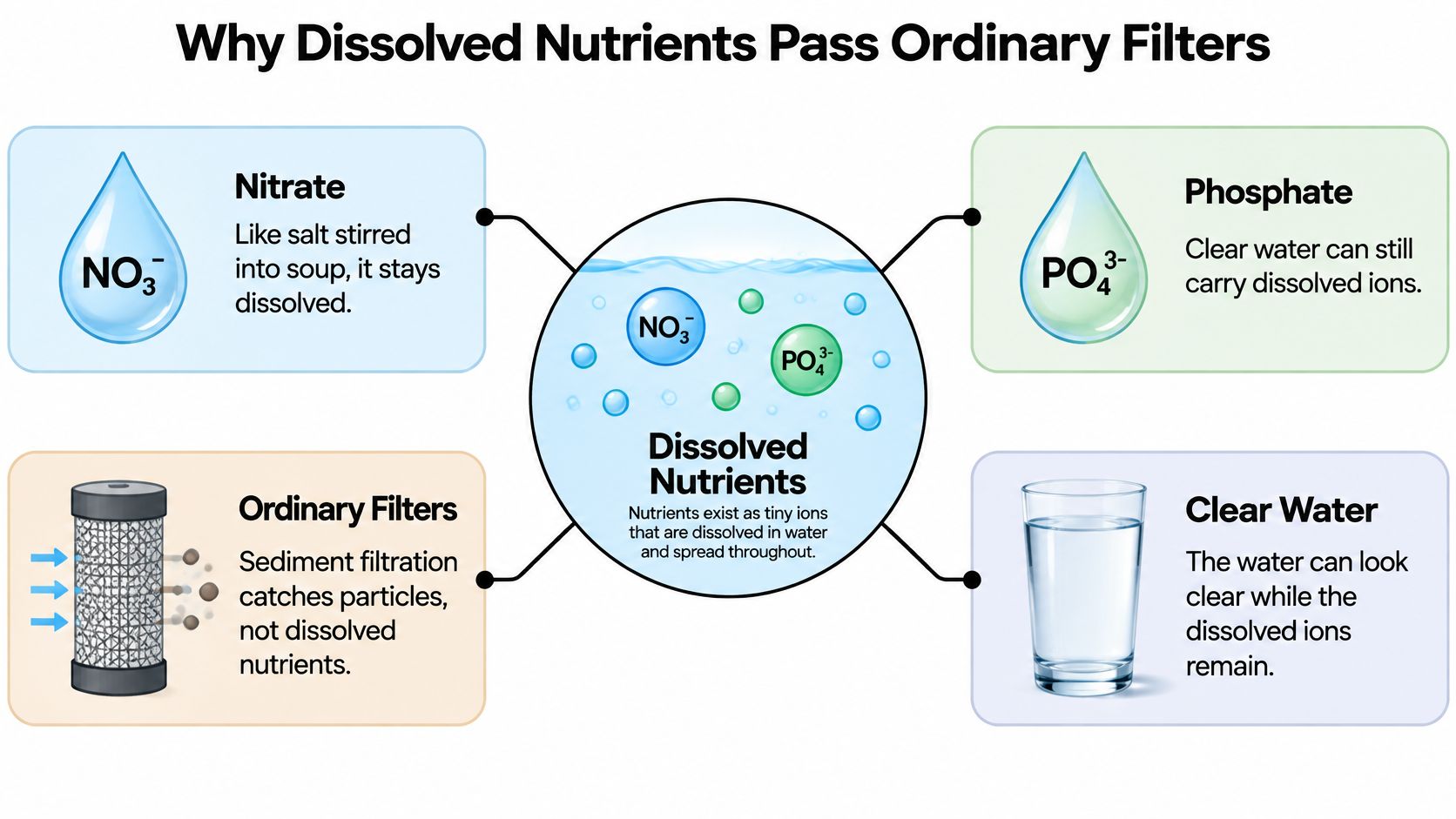
What a cartridge actually catches
Sediment filtration stops particles. A carbon filter can improve taste, odor, and some organic compounds. Neither stage is built to hold nitrate. If the housing was sold as a taste fix, that is all you should expect from it.
EPA nitrate materials identify a 10 mg/L nitrate-as-nitrogen threshold and describe reverse osmosis as a membrane process. Contaminated water is forced through a barrier that nitrate cannot pass through readily. That is a different mechanic from a mesh or a carbon bed. Nitrate control needs a technology designed and validated for dissolved ionic contaminants.
Phosphate is a family of results
Phosphate on a lab sheet is not one bottle on a shelf. Orthophosphate is the fraction algae can use immediately. Condensed phosphate and organic phosphorus can become available later, after mineralization or release from sediment. A lab may report orthophosphate, or total phosphorus after digestion. Keep the reporting basis identical or the comparison is false.
A clear pool or a normal-looking well sample can still carry nutrients. Limestone and soil do not automatically filter them out. Drinking-water safety and ecological nutrient control are separate jobs. A nitrate reduction claim does not prove phosphate reduction, because certification is tied to specified contaminant claims. A pool phosphate reading does not prove the well is unsafe to drink.
Test raw water and treated water, read the exact certified claims, and plan maintenance. For dissolved nitrate at a Cape Coral or Lee County house, the household tool is the membrane, not another cartridge.
Where Southwest Florida Wells Pick Up Nutrients
A Lee County well does not invent nitrate. It receives what the land and the drainage send.
Fertilizer on lawns and nearby agriculture, animal waste, septic systems, sewage, landfills, urban drainage, and natural nitrogen in soil can all raise nitrate. Phosphorus arrives from detergents, fertilizer, organic debris, wastewater, and runoff. Sediment can release more of it later. Your kitchen tap is the point where those paths meet a glass.
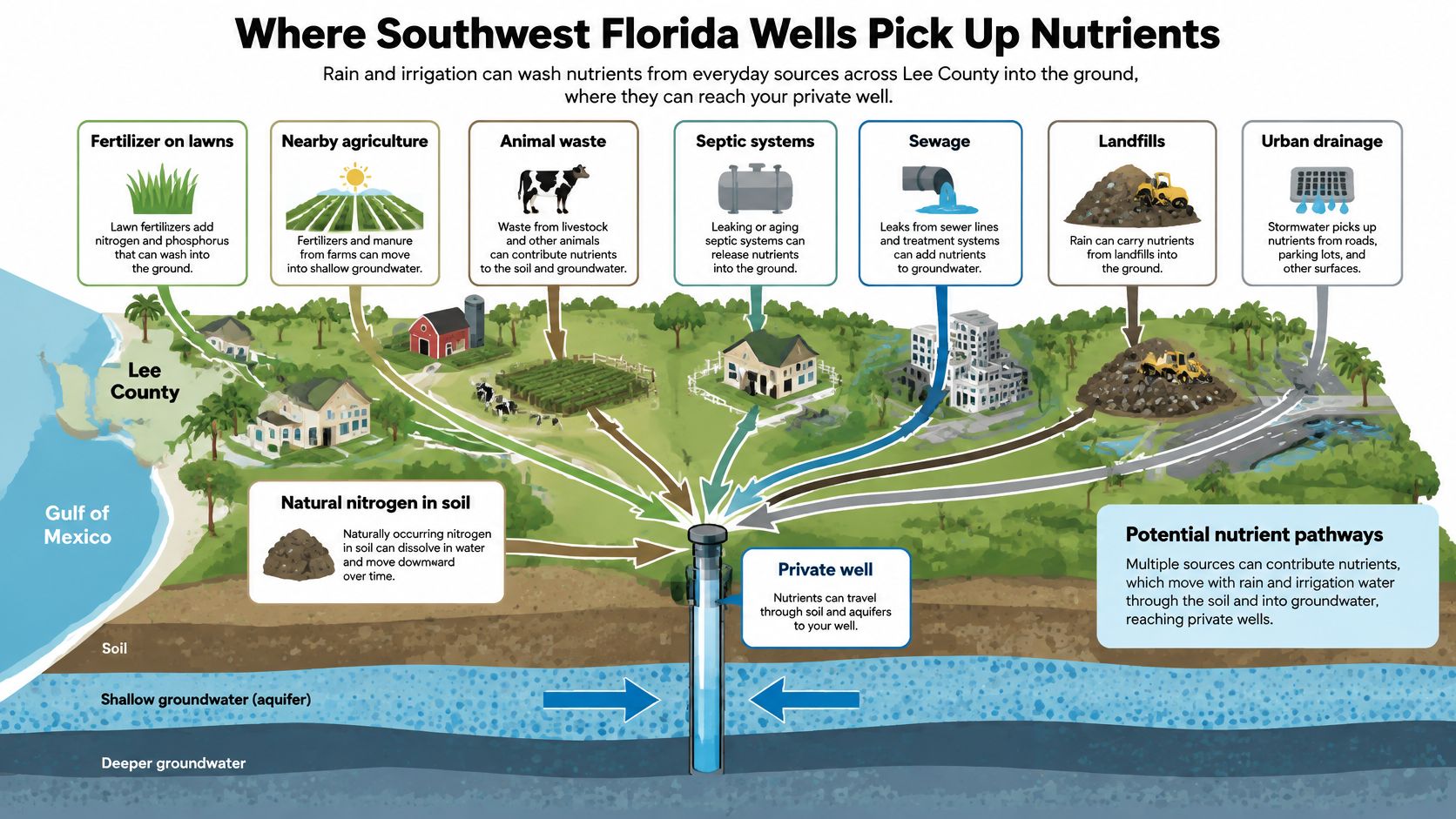
Nobody from a public utility is required to sample that tap. These well FAQs are a starting point for what owners arrange themselves. Risk is not theoretical for shallow wells near agriculture. The WHO nitrate background document cites EPA material reporting that more than 20% of shallow household wells in agricultural areas had nitrate above drinking-water standards in an earlier national assessment. Local results often climb after flooding and from April through July. One dry-season sample is a snapshot, not a trend.
Why a canal-front house should care
Excess nitrogen and phosphorus speed algae growth, then oxygen loss, degraded habitat, impaired recreation, and sometimes harmful blooms. The EPA nutrient pollution overview reports excessive phosphorus and nitrogen in more than 40% of U.S. rivers, streams, and lakes and in about 20% of coastal waters. Freshwater nutrient pollution is estimated to cost at least $2.4 billion annually in the United States, in 2015 dollars, largely through reduced property values and lost recreation. For a canal home or an HOA, that is usable water and property amenity, not a distant farm story.
A single household test cannot name the source. It can show whether drinking water, irrigation, or a pool nutrient load needs attention first. Source clues decide the lab panel. The drinking fix is still treatment matched to dissolved ions.
How to Test Well Water the Right Way
Start this week with a lab panel, not a gadget.
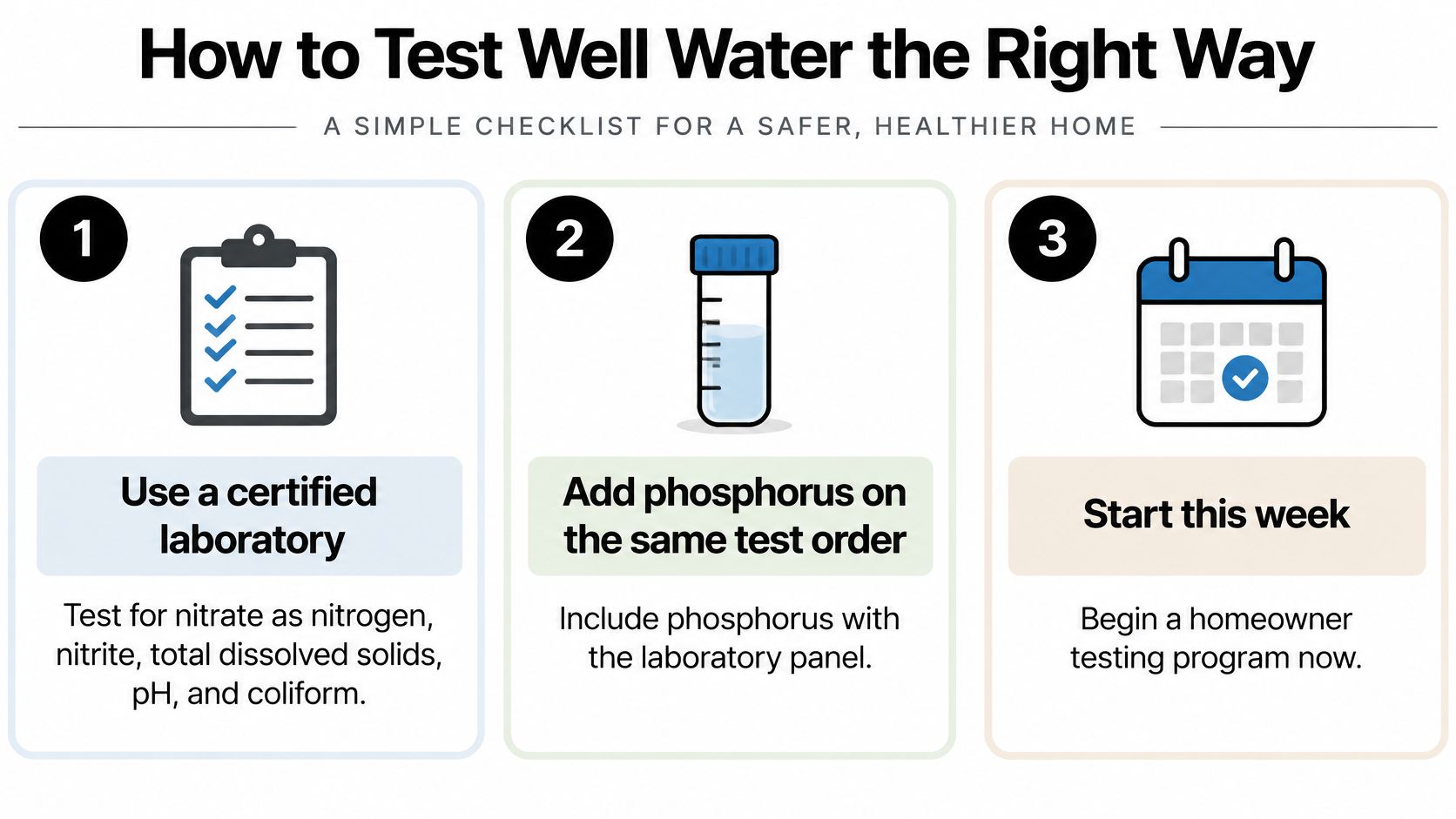
- Order a certified laboratory panel. Ask for nitrate as nitrogen, nitrite, total dissolved solids, pH, and coliform. Add phosphorus on that same reporting basis if algae or fertilizer influence is the question. A certified method is what a treatment decision should rest on.
- Treat a home strip as a screen only. Color charts and mixed units are a poor reason to buy equipment. Use a strip to decide whether to call the lab sooner, not to size a membrane.
- Sample raw and treated water the same way. Pull the raw well before any treatment. After a system is in, pull treated water with the same lab method. Property managers should keep both slips together so a later check has a baseline.
- Repeat on a calendar, not a whim. Test at least once a year, again after flooding, and when you can from April through July, when nitrate is often higher.
- Write the unit on every line. Compare nitrate with 10 mg/L as nitrogen only after the unit is confirmed. A mismatched unit will send you to the wrong decision.
- Restrict use the day the drinking line is crossed. If nitrate is over that nitrogen limit, stop drinking and cooking with the water, especially for infant formula, until a verified source or proven treatment is in place.
Routine disinfection does not remove dissolved nitrate. Chlorine and similar disinfectants address microbes. They leave the ion in the water.
Pool phosphate testing supports algae control. It does not replace sanitizer residual, pH, filtration, and circulation. Those four still run the pool. The well panel still runs the drinking decision.
Book the sample so it lines up with a system evaluation. Arrange sampling with a treatment review instead of buying a one-off cartridge from a guess.
How a Whole House Reverse Osmosis System Works
For a Cape Coral or Lee County house on a private well, whole-house reverse osmosis is the option that treats water used throughout the residence. A single drinking faucet leaves every other tap on raw well water.
The archived EPA consumer fact sheet on nitrates and nitrites lists reverse osmosis with ion exchange and electrodialysis as treatment technologies for nitrate and nitrite. Reverse osmosis forces water across a semipermeable membrane that restricts nitrate. Performance depends on system design, membrane condition, operating pressure, water chemistry, and filter changes on the manufacturer's schedule. A one-time install without service is a weak plan.
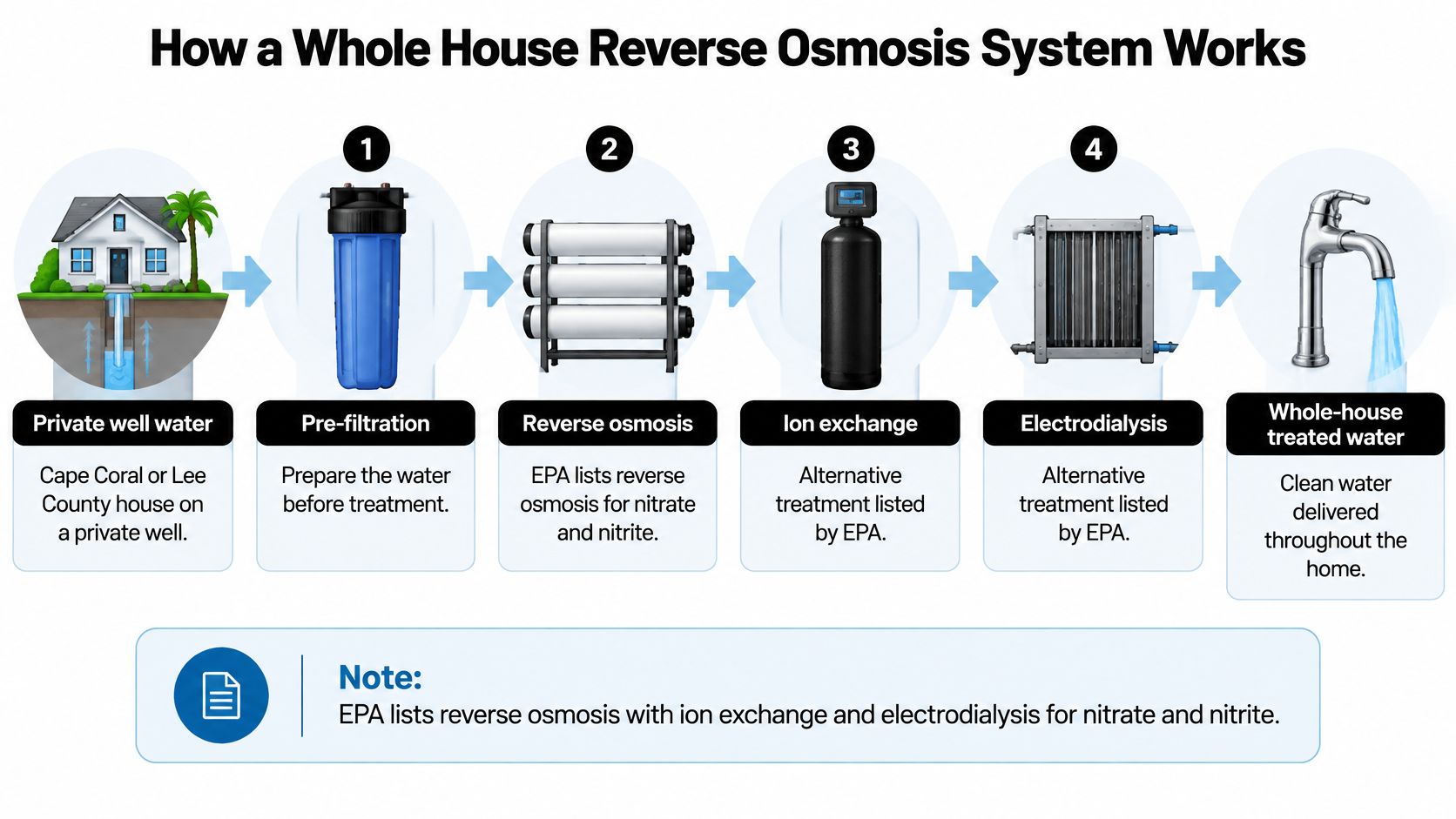
Match the membrane to the lab slip
A technician starts from the lab number, then matches daily flow, membrane capacity, operating pressure, and pretreatment to that well. Sediment and carbon stages ahead of the membrane are support. They keep the membrane from fouling. They are not the nitrate barrier. If the water will foul the membrane, the design has to change before the membrane is asked to carry the house.
Ask which reduction claims were tested, under what conditions, and whether rated capacity fits the home. The words "reverse osmosis" on a label are not a nitrate claim and not a phosphate claim. Dissolved phosphate can be captured by reverse osmosis, anion exchange, adsorption, or chemical precipitation when that process is specified. Sediment filtration alone will not do it.
Three houses, three different jobs
Formula in the house. Drinking and cooking come off the well the same day. A verified alternative source covers bottles and the stove until a treated line is proven with a retest.
A caution-band result that climbs each summer. You do not buy a new gadget every June. You retest raw and treated water on the same method and confirm the membrane is still doing the job the first slip required.
Green pool water at a canal house. The pool gets its own nutrient and sanitizer work. The well gets a drinking-water design. One product does not close both.
Water Medic of Cape Coral, at watermedic.com, has more than 25 years on local well water. The team sizes whole-house reverse osmosis to the property and checks treated water rather than assuming the membrane worked. It is a water-treatment specialist, not a general home plumber.
Which Treatment Fits a Private Well
Judge every option by one question. Does it remove dissolved nitrate for the whole house, with a documented claim?
| Option | Dissolved nitrate | Dissolved phosphate | Whole-house fit | Choose it when |
|---|---|---|---|---|
| Whole-house reverse osmosis | Yes, when the nitrate claim is documented | Only if that claim is tested, not assumed | Yes, sized to flow and pretreatment | Nitrate is at or above 10 mg/L as nitrogen, or the whole home needs treated water |
| Point-of-use reverse osmosis | Yes at one faucet if certified for it | Only with a specific claim | No | A single drinking tap is truly the only use |
| Ion exchange | Yes, EPA-listed for nitrate and nitrite | Anion exchange can target phosphate | Possible with proper sizing | A designed alternative is preferred after the same lab and flow review |
| Electrodialysis | Yes, EPA-listed | Not assumed | Specialized | A qualified design shows it fits the well better than RO |
| Dilution or blending | No removal, only a lower mix | No removal | Weak | Never as the plan for infant formula or a result over the MCL |
| Pool phosphate remover | Not a drinking-water process | Lowers pool phosphate nutrient | Pool only | Green water or high pool phosphate, alongside sanitizer, pH, filtration, and circulation |
Whole-house reverse osmosis is the recommendation when the lab confirms nitrate at or above 10 mg/L as nitrogen, when the caution band coincides with infants, pregnancy, or cooking for the whole house, or when you want treated water at every tap.
Point-of-use reverse osmosis can cover one faucet. Bathrooms and other kitchen fill points remain on raw well water. That is a narrow choice, and only when one drinking tap is the only use.
Ion exchange and electrodialysis are recognized nitrate technologies. They still need flow, resin or stack capacity, and a service plan. They are not a shortcut around the lab slip.
Dilution only lowers a number by mixing sources. It does not remove the ion. It is a poor primary plan for formula or any result over the MCL.
A pool phosphate remover, with steady sanitizer, pH, filtration, and circulation, belongs to the pool. It is not the drinking-water system.
What the paperwork has to show
NSF/ANSI 58 is the principal consensus standard for reverse-osmosis drinking-water treatment systems. It covers RO systems and components and includes test procedures for reduction of total dissolved solids and other specified contaminants. An RO unit should not be sold as removing nitrate or phosphate merely because it is labeled reverse osmosis. Request which claims were tested, under what conditions, and whether rated capacity fits the home's demand.
Cost follows flow, pretreatment, membrane capacity, and whether both nitrate and a documented phosphate claim are required. Do not buy from a price tag online. A written quote should follow the lab slip. Compare that documentation with Water Medic before you order equipment.
Book a Whole House RO Assessment in Cape Coral
Call when the lab already tells you the house needs treated water at every tap.
Book the assessment when nitrate is at or above 10 mg/L as nitrogen, when a caution-band result coincides with infant formula or pregnancy, when numbers jump after flooding or in the April through July window, or when you want whole-home treated water instead of one faucet. HOAs, small apartments, and hotels on a well should book the same drinking-water assessment. Keep pool phosphate work on a separate visit.
What to have in hand
Bring the latest lab slip with units written on it, the number of baths and occupants, and the labels on any filter already installed. The visit should confirm flow, pretreatment, membrane capacity, the NSF/ANSI 58 claims that match the contaminants found, and a retest of treated water. Until that retest passes, keep drinking and cooking on a verified alternative source.
Modest fertilizer use, keeping yard debris and irrigation runoff out of canals, annual lab testing, and filter changes on the manufacturer schedule are worth doing. They are not a promise that a household habit will drop well nitrate. Pool owners should test phosphate, hold sanitizer and pH, and run filtration and circulation. That work stays with the pool.
Water Medic, at watermedic.com, has served Southwest Florida for more than 25 years with whole-house reverse osmosis and pool care, prompt technicians, and service after installation. The team treats water systems and pools. It is not a home-plumbing or pool-plumbing contractor.
Send the lab report and ask for a whole-house reverse osmosis recommendation sized to that well.
Water Medic of Cape Coral tests private-well water for nitrates and phosphates and sizes a whole house reverse osmosis system to the lab slip, the home's flow, and a treated-water retest. Pool phosphate care stays on its own visit, separate from the drinking-water design. Send your report and book the assessment with Water Medic of Cape Coral.