
Changing Reverse Osmosis Membrane: Signs and Steps 2026
The whole house reverse osmosis system that feeds your Cape Coral kitchen, showers, and laundry used to refill on a normal cycle. This week the water tastes off, or the treated side falls behind when two fixtures run at once. You're staring at a membrane price and trying to decide whether changing the reverse osmosis membrane is the next job, or whether the carbon and sediment stages upstream are the problem.
I would not buy the element because a calendar date arrived. A new membrane can't correct iron, hardness, exhausted carbon, or a tank that never got sanitized. Measure first, then spend.
Signs a Whole House RO Membrane Needs Replacing
The decision in front of you is simple and easy to get wrong. Flow is down or the taste has changed, and the question is whether the membrane is finished or whether something cheaper upstream is starving it.
| Symptom | Check First | Replace the Membrane If |
|---|---|---|
| Lower permeate flow | Replace sediment and carbon prefilters, then confirm pressure and water temperature | Flow stays low after fresh prefilters and stabilized pressure |
| Taste or odor returns | Sanitize the storage tank and check the carbon prefilter age | Taste returns after sanitizing with new prefilters |
| Lower treated-water pressure | Check tank pre-charge and feed pressure | Pressure stays low once the system has stabilized |
| Rising TDS in treated water | Measure feed and product TDS together at the same time | Rejection falls below the 75% baseline after prefilter replacement |
| Membrane one to five years old, output normal | Schedule a performance check and review the service log | Replace only when flow or rejection declines |
EPA guidance puts typical membrane life at one to five years, depending on local water quality and household use, and puts prefilters near every six months because soluble and particulate matter cut efficiency and contaminant removal. Age is a reason to test, not a reason to swap on sight. The same guidance treats reduced production, lower treated-water pressure, and an unexpected taste or odor as reasons to call for service on a system that serves drinking, cooking, bathing, and the rest of the house.
The EPA WaterSense criteria use a minimum 75% total dissolved solids reduction as the performance baseline. Take feed and product readings at the same visit, after the system has settled.
Practical rule: If a fresh prefilter set and stable pressure restore flow and rejection, leave the membrane in service. If rejection stays under that 75% baseline after those fixes, plan the replacement.
Keep a dated service log with TDS, flow, pressure, and water temperature. The next decision should rest on measured change, not on what you remember from the last visit.
Choose a Membrane That Matches Your Whole House System
A replacement element has to match the system it goes into, not just the old part number on a faded label. NSF/ANSI 58 sets the performance and safety requirements for reverse osmosis systems, covering material safety, structural integrity, TDS reduction, efficiency, recovery, contaminant-reduction claims, and the information given to owners. NSF notes that these systems push water through a semipermeable membrane under pressure and commonly add filters before or after that membrane. An uncertified or incompatible component undermines the documented claims.
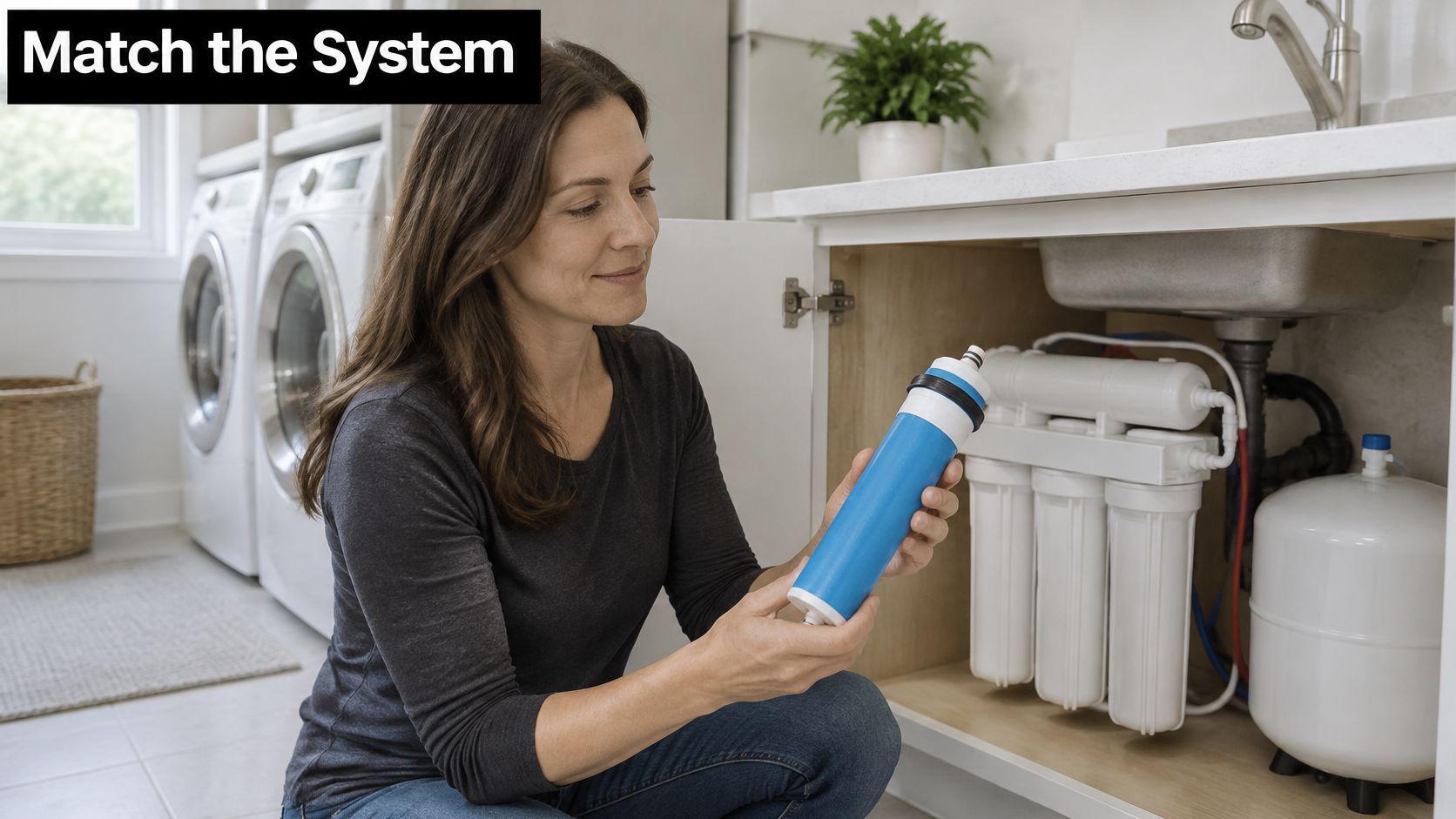
Hold the new element to the same TDS-reduction baseline used for qualifying systems, at least 75%. Then match type, housing, seals, and production to how the house uses water. A whole house reverse osmosis system serving drinking, cooking, and bathing needs a rating sized to peak daily demand. An undersized element starves the storage tank and fouls faster because it runs longer at a higher recovery.
| Criterion | What to Verify | Why It Matters |
|---|---|---|
| Certification | NSF/ANSI 58 listing for the contaminants the system must reduce | Keeps the documented performance claims valid |
| TDS reduction | At least a 75% TDS reduction baseline | Matches the WaterSense performance benchmark |
| Membrane type | Thin-film composite or the manufacturer-specified equivalent | Matches the system's pressure and chemical tolerance |
| Housing fit | Same diameter, length and O-ring specification as the existing housing | Prevents bypass around the element |
| Production rating | Gallons per day matched to household demand | Undersized elements foul faster and starve the tank |
| Warranty and records | Manufacturer warranty and the rated replacement interval | Gives a baseline to compare with future test results |
File the certification sheet and the rated specifications in the service log. Those numbers become the comparison point for every later test, which is more useful than a brand name alone.
How to Replace the Membrane Step by Step
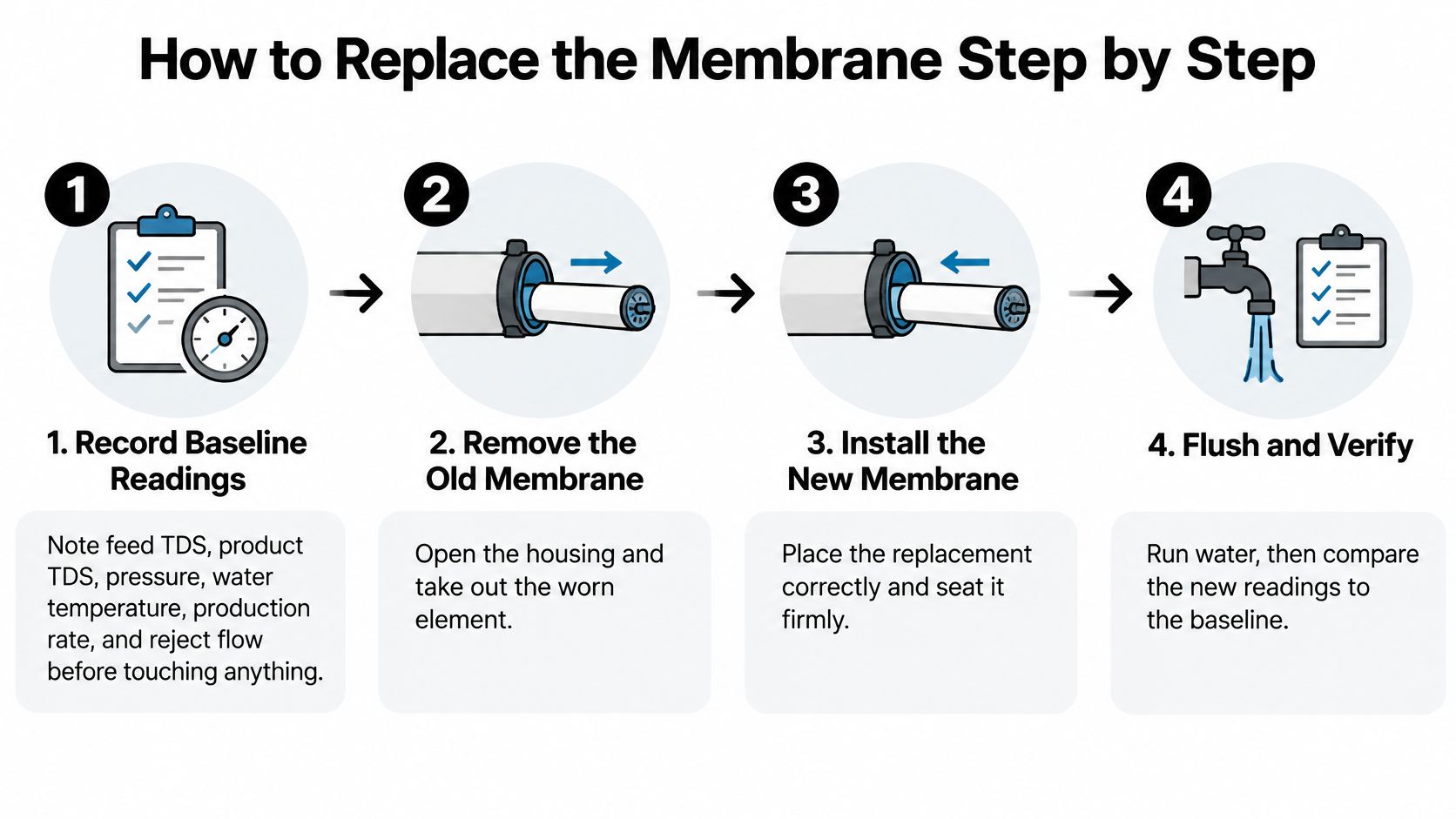
Start with numbers, not with a wrench. EPA guidance on point-of-use treatment treats a membrane change as a diagnosis. Record the baseline, refresh overdue prefilters, and only then judge the element. Calculate salt rejection as 100 × (1 − product TDS / feed TDS), correct for temperature, and let the system stabilize before you call the result final. A drop that remains after fresh prefilters, adequate pressure, and sanitizing points to exhaustion, fouling, scaling, or chlorine damage.
- Record the baseline. Write down feed TDS, product TDS, pressure, water temperature, production rate, and reject flow. The new element has to beat these readings, so you need them before anything is disturbed.
- Change the sediment and carbon prefilters first. They're the inexpensive test. If flow and rejection recover, the membrane wasn't the problem.
- Shut off the feed and the storage tank, then depressurize. No fitting should come apart while the system is still under pressure.
- Photograph the tubing and the housing layout. Reassembly should match the original orientation, not a guess from memory.
- Remove the old element without contaminating the housing. Inspect the O-rings and lubricate them with a lubricant the manufacturer rates for that elastomer.
- Seat the rated membrane in the marked flow direction. A half-seated element bypasses, and product TDS will tell on you within a week. Before this step, confirm the carbon prefilter isn't already exhausted.
- Reconnect the tubing and open the feed slowly. A slow start lets you catch a crossed line before the tank fills with the wrong stream.
- Flush and discard the first several tankfuls. Don't drink the early water. Preservative and loose fines need those cycles to leave the system.
The mistake that ruins a new element
Installing a new membrane while chlorine-exhausted carbon stays upstream damages thin-film composite membranes. A post-install TDS test alone doesn't prove the pretreatment train is protecting the element. Check carbon age and chlorine breakthrough before you seat the new membrane, not after the first bad reading.
Sanitize and Troubleshoot After the Swap
Sanitation comes before the first performance reading. A clean element in a dirty tank will fail the taste test for reasons that have nothing to do with the membrane.
- Sanitize the storage tank and the post-membrane lines with a sanitizer rated for potable systems, matched to the membrane material, then rinse until the sanitizer is gone. The wrong chemical can attack a thin-film composite the same week you installed it.
- Refill and dump several full cycles. Each discarded tank removes residual sanitizer and the first flush of fines.
- Confirm tank pre-charge with the system depressurized, then restore feed pressure. A soft bladder makes a good membrane look lazy.
What the symptom usually means
Low production usually means cold feed water, low feed pressure, or a fouled prefilter. Check those three before you blame the element you just installed.
Taste or odor that returns after a fresh membrane usually points to a stale storage tank, carbon past its service life, or biofilm in the tank. The membrane isn't the first suspect.
Air or a light cloud in the first draws is normal purging and clears within minutes. Cloudiness that stays points at sediment or pretreatment, not at trapped air.
Product TDS that jumps in the first week suggests a mis-seated element or a damaged O-ring. Open the housing and reseat it.
A noisy or hard-running pump points at pressure settings, not at the membrane sheet. Log each correction so the next visit compares a corrected system with its baseline.
Confirm the New Membrane Performs as Expected
Taste can't prove the swap worked. Take a baseline-and-acceptance set once the system is stable, then repeat it after several tank turnovers. Compare those numbers with this membrane's commissioning values, not with a generic target from a different house.
| Reading | When to Take It | Pass Signal |
|---|---|---|
| Feed and product TDS | After several tank turnovers, once readings stabilize | Rejection at or above the 75% baseline |
| Permeate flow | Same visit as the TDS readings | Close to the new membrane's commissioning value |
| Operating pressure | Same visit, with the system running | Stable within the rated operating range |
| Water temperature | Recorded with every reading | Noted so flow can be corrected for cold water |
| Recovery rate | Compare with the rated recovery on the spec sheet | Within the rated recovery range |
| Element seating and bypass | Visual check after installation and TDS check | Element fully seated and product TDS stays low |
The EPA residential RO framework treats membrane life as something you measure. The ASSE 1086 membrane-life test runs at least 20 days and produces at least 1,000 gallons, about one year of representative residential production. That's why a stabilized baseline matters more than a single glass of water on install day.
Read the abnormal result before you condemn the element
Low pressure cuts flow and makes rejection look worse than the sheet really is. Cold water lowers production even when the membrane is sound. A mis-seated element lets feed water bypass into the product line. High iron, hardness, silica, or suspended solids foul a well-water membrane fast, and higher-efficiency systems can foul sooner still, so prefiltration and operating conditions decide how long the new element lasts.
A nominal replacement interval is not a guarantee. On a private well in Southwest Florida, record the lab results and look at iron, manganese, hardness, tannins, and any disinfectant exposure. Replace only after pretreatment, pressure, seals, and the flow restrictor have been ruled out. Date every reading so the next visit shows a trend, not a single guess.
Well Water Conditions That Shorten Membrane Life
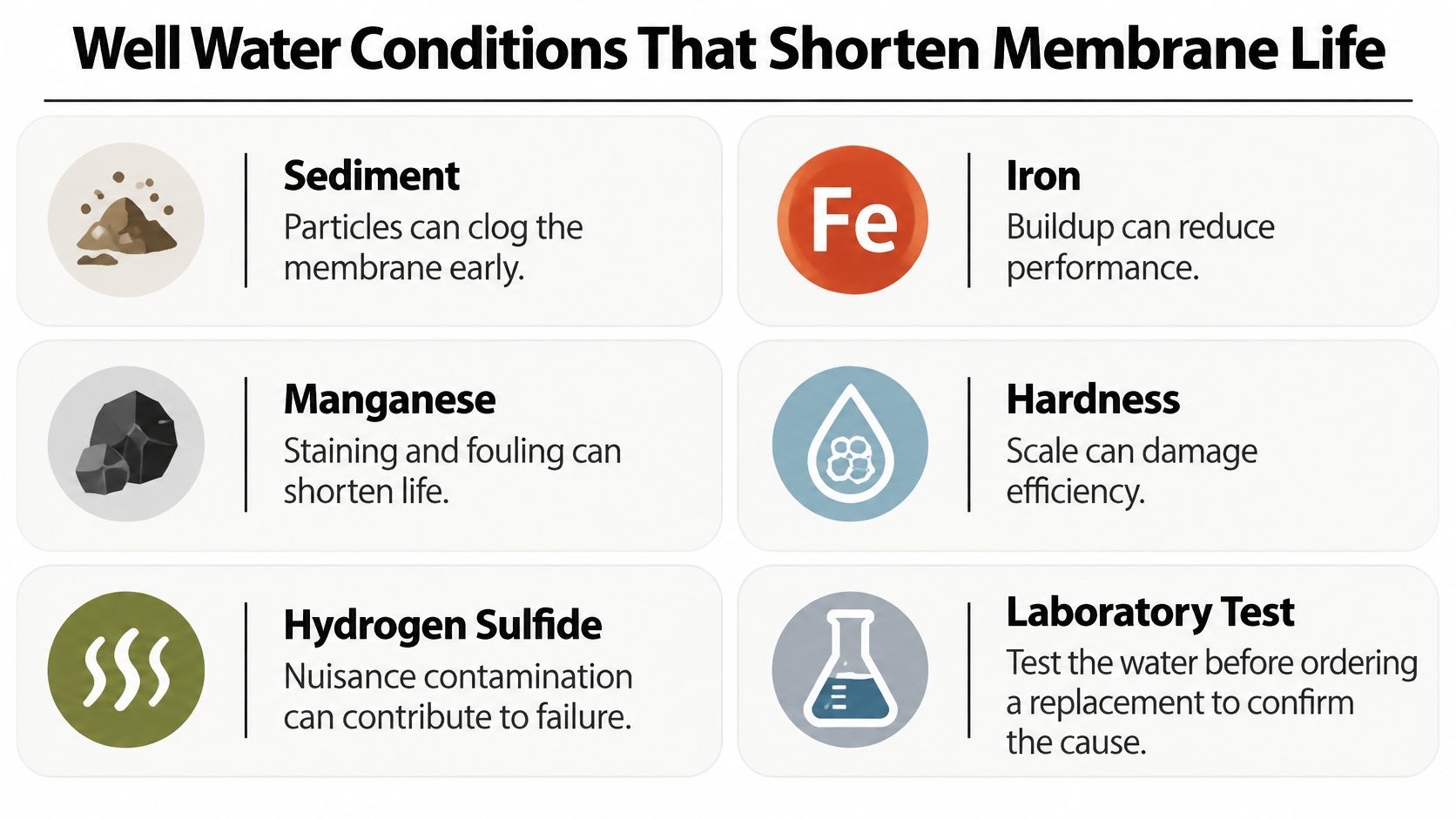
On a Lee County well, the water often decides membrane life before the element does. Most well water, with small exclusions, isn't drinkable without proper treatment, and reverse osmosis is the best way to get reliably clean drinking water. Early failures still trace to what reached the membrane, not to a bad part out of the box. Run a laboratory test and review the carbon and sediment schedule before you order a replacement. A fresh element won't fix an upstream problem, and well water repair belongs ahead of another membrane purchase when the chemistry hasn't changed.
| Feed-Water Condition | Effect on the Membrane | Pretreatment to Check |
|---|---|---|
| Iron | Fouls the membrane surface and cuts flow | Sediment filtration and iron treatment, confirmed by lab test |
| Manganese | Deposits on the membrane and lowers output | Lab test and treatment before the membrane |
| Hardness | Scale forms and can damage the membrane | Softening or scale control upstream |
| Tannins and organic matter | Coat the surface and foul the membrane | Carbon prefiltration sized for organics |
| Chlorine | Oxidizes thin-film composite membranes | Carbon prefilter in good condition and on schedule |
| Biofilm and microbes | Biological growth reduces flow over time | Sanitation schedule and stagnation control |
| Sediment and silt | Clogs the membrane face | Sediment prefilter changed on schedule |
A 2025 review of biofouling describes microbial attachment and biofilm on thin-film composite membranes as a persistent limit on performance. Silt-density index and turbidity are imperfect warnings. One can be fast and inaccurate, the other accurate only after a delay. Membrane life also depends on stagnation, sanitation, pretreatment, and whether anyone tracks performance between visits.
Record baseline flow and rejection after installation, then investigate a gradual loss of flow or a rise in pressure before the system fails outright.
Cleaning has to match the membrane material and the contaminant. Indiscriminate chemicals damage thin-film composite membranes. For Southwest Florida wells, iron, manganese, hardness, tannins, and disinfectant exposure are the usual priorities. Fix those, then judge the element.
Schedule a Membrane Check Before the Next Failure
The tap slows on a Tuesday, the TDS reading has crept up, and the membrane is still in the housing. That is the moment to measure the system, not to order a replacement element because a year has passed on the calendar.
Book an evaluation if any symptom in the first table shows up, or if the whole house system has run a year or more on well water with no recorded test. The useful visit compares current TDS rejection, flow, and pressure with the baseline, then chooses prefilter correction, cleaning, or membrane replacement. Buying the element first skips that choice. A new membrane will not correct an upstream problem that the readings have not identified.
Before the appointment, gather the latest well laboratory results, the dates of the last prefilter and membrane changes, the service log, and any readings from the last swap. Those papers turn a guess into a measured call.
Water Medic sells, installs, and maintains whole house reverse osmosis systems and offers a monthly maintenance plan for their upkeep. On a privately owned, direct-to-consumer reverse osmosis system, Water Medic can enforce a higher water quality standard than the quality of city tap water. The company works on water treatment equipment. It is not a home plumber.
If treated water has slowed, changed taste, or drifted on a TDS test, an evaluation can show whether the membrane, the prefilters, or the well chemistry is the cause. Visit Water Medic of Cape Coral to request a whole house reverse osmosis evaluation.