Homes with Well Water: Testing and Treatment Guide
Who's checking your water right now? If you live in one of the homes with well water in Cape Coral or Lee County, the answer isn't a utility, a lab on a schedule, or anyone else. It's you. Clear water with no odor tells you almost nothing about dissolved salts, nitrate, bacteria, or PFAS. That's why we don't start with equipment. We start with a certified lab report, build a whole-house reverse osmosis plan around what's in your well, and prove the result with a post-install test.
Testing Schedule Every Well Owner Should Follow
A private well has no utility monitoring it for you. Federal drinking-water rules don't regulate, treat, or routinely monitor privately owned wells, so the owner carries the job that public-water customers delegate to a regulated utility, and the CDC guidelines for testing well water lay out that baseline. Test once a year through a state-certified laboratory. Don't guess, and don't rely on a home dip strip to make a health decision.
The baseline panel is total coliform bacteria, nitrate, total dissolved solids (TDS), and pH. Each one answers a different question. Coliform shows vulnerability to microbial intrusion. Nitrate can point to septic, fertilizer, or agricultural impact. TDS screens for overall dissolved mineral load, it doesn't name a single contaminant. pH flags corrosion potential and whether treatment will work as intended.
When the Annual Test Isn't Enough
Certain events move your next test up. Flooding, well repairs, land-use changes nearby, and a shift in taste, odor, or color all call for a new sample. If a result exceeds a health standard, contact your local or state health department, confirm it with proper sampling, and choose treatment based on the contaminant and concentration, not a generic filter claim.
| Trigger | What to test | When to test |
|---|---|---|
| Routine baseline | Total coliform bacteria, nitrate, TDS, pH | Once a year |
| After flooding | Full baseline panel | As soon as water is safe to sample |
| After well repair | Full baseline panel | After the repair is finished |
| Taste, odor or color change | Full baseline panel plus suspected cause | As soon as the change is noticed |
| Nearby land-use change | Nitrate and total coliform bacteria | Before or soon after the change |
| Infant in the home | Nitrate | Before using the water for formula, for any infant under six months |
| Suspected PFAS | PFAS by a laboratory method | Separate test, ideally before buying treatment |
Clear, odorless water isn't proof of safety. It's only proof that you can't see what's dissolved in it.
Use the table to book your next test. That's the document that decides whether you need disinfection, a targeted stage, or a whole-house RO design, and it's the only sound starting point for homes with well water.
How to Collect and Read a Well Water Test
A good RO design starts with a sample you can trust. Follow these six steps in order, and don't skip the paperwork at the end.
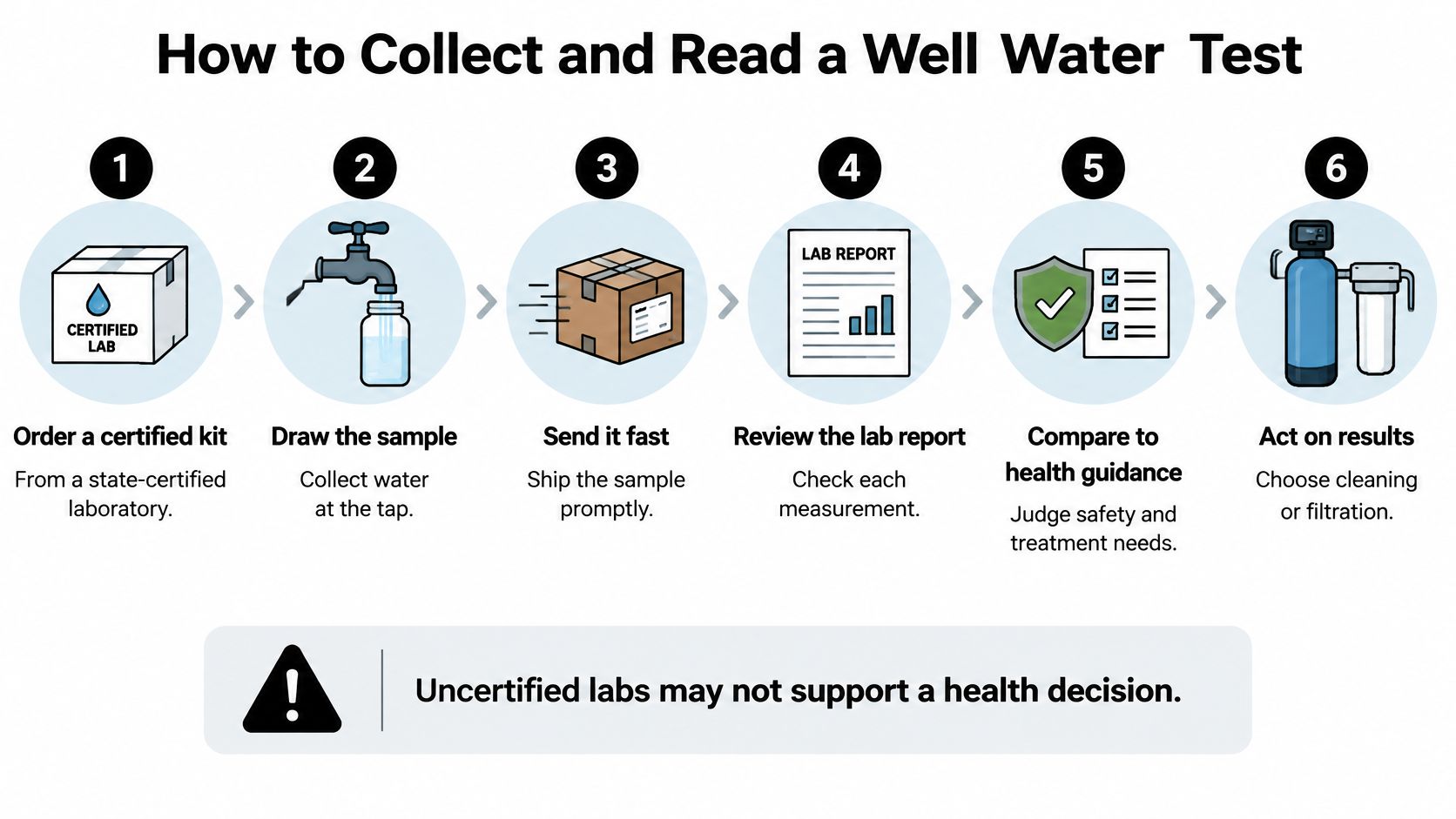
The Six Steps
Order from a state-certified lab: Results from an uncertified lab may not support a health decision. Ask for the full baseline panel plus any extra tests your situation calls for, and confirm bottles, hold times, and drop-off hours before you draw water.
Draw from the right tap: Use a kitchen cold tap before any filter or softener, and use the lab's bottle exactly as directed. Sampling after treatment hides what the well is sending into the house, which defeats the purpose.
Send it the same day: Bacteria counts change while a sample sits warm in a truck. Keep it at the temperature the lab specifies and ship or deliver it fast.
Read each line, not just pass or fail: Coliform is reported as present or absent. Nitrate is reported in milligrams per liter, TDS shows dissolved load, and pH shows acidity or alkalinity. Check the detection limit beside each value, because a result below detection isn't the same as zero, and you need that limit later to verify RO performance.
Act on a bad result immediately: The Illinois EPA private well testing page notes the EPA maximum contaminant level for nitrate is 10 milligrams per liter measured as nitrogen, and water above that shouldn't go to infants younger than six months. If coliform is present or nitrate is above that limit, contact your local or state health department and use bottled water for drinking and cooking until verified treatment is in place. Don't boil nitrate water to fix it. Boiling can raise the concentration as water evaporates.
File every report with your well records: Date it, keep it with the well log, and keep prior years. A buyer, inspector, or provider needs the trend, not a single snapshot.
Mistakes That Ruin a Sample
Don't sample right after shock chlorination or a filter change, because you'll measure the treatment you just added, not the well. Don't panic over one high TDS number either. Retest to confirm, then decide.
What healthy looks like: coliform absent, nitrate well below 10 mg/L, and TDS and pH holding steady across several years.
If your report doesn't look like that, you don't have a guessing problem. You have a treatment design problem, and for most Southwest Florida wells that design should be built around whole-house RO, sized and staged to the numbers on that page.
Local Contaminants Southwest Florida Wells Face
Cape Coral and Lee County wells draw from aquifers under real pressure from pumping, septic density, fertilized lawns, and storms. Different problems leave different clues, but the lab result, not the clue, makes the call.
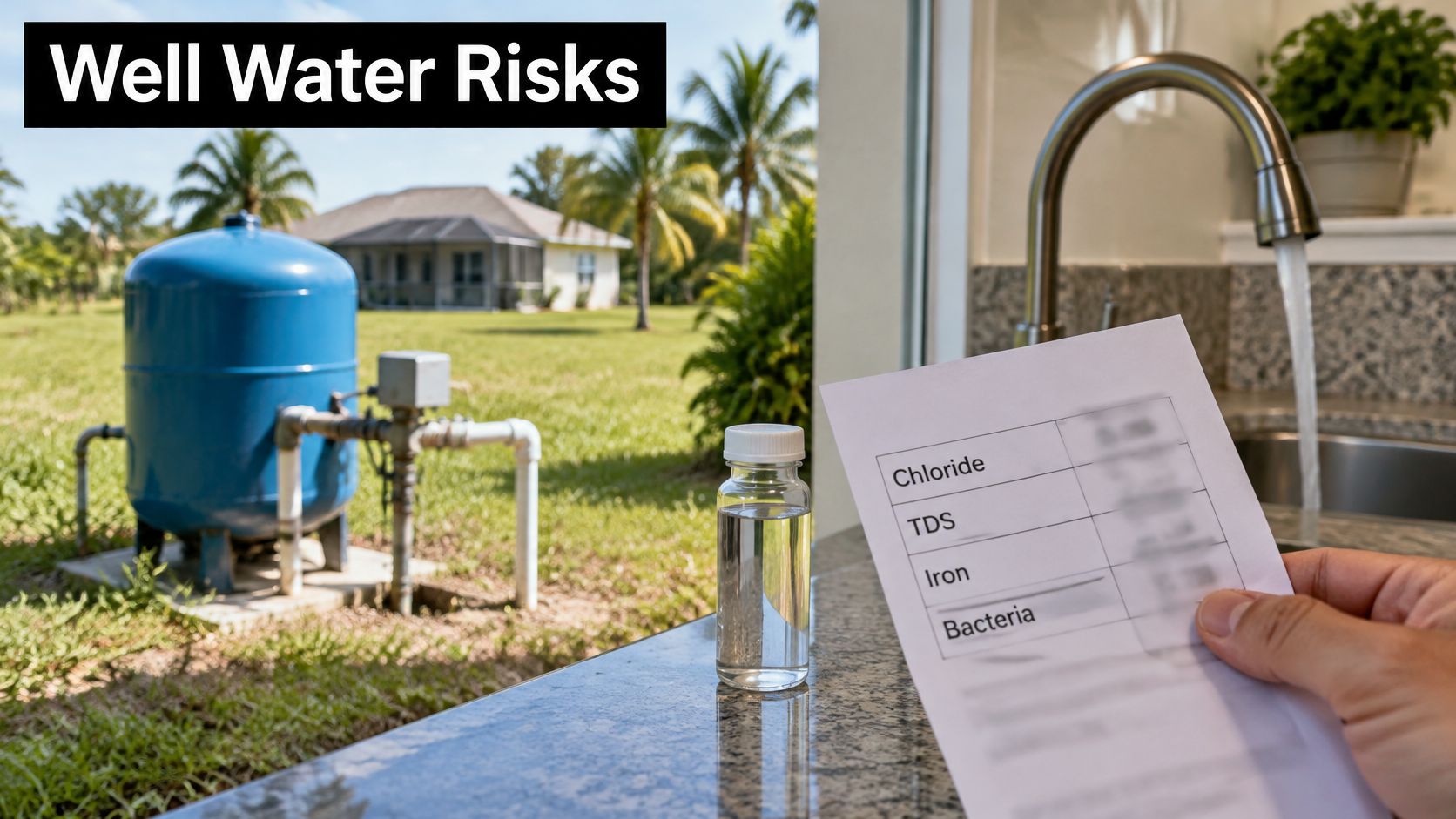
Saltwater intrusion raises chloride and TDS and often brings a salty taste. Say a Cape Coral household has clear, odorless water, but its TDS climbs every dry season. That rising trend points to the aquifer being stressed when pumping is heavy and recharge is low. A TDS and chloride panel confirms it, and that's a direct case for whole-house RO, because RO is built to reduce dissolved salts at every tap.
Bacteria, measured as total coliform, can enter through a poorly sealed well cap or after storms and flooding. Iron and manganese leave rust staining, black specks, and a metallic taste. Hydrogen sulfide gives you the rotten-egg smell. Hardness from calcium and magnesium leaves scale on fixtures and kills soap lather. Nitrate usually shows no sign at all and tracks back to septic systems and lawn fertilizer on close-together lots.
PFAS is the one you can't judge by senses at all. It has no taste, color, or odor and can only be confirmed through laboratory analysis, a point made on the Illinois EPA PFAS page. Don't buy treatment for PFAS on suspicion. Test for it separately, then require proof of reduction.
| Contaminant | Visible sign | Lab test | Matching treatment |
|---|---|---|---|
| Saltwater intrusion | Salty taste and rising TDS in the dry season | TDS and chloride | Whole-house RO |
| Bacteria | Often none; cloudy water or problems after storms | Total coliform | Disinfection, then retest |
| Iron and manganese | Rust staining, black specks, metallic taste | Iron and manganese panel | Whole-house RO or softener, per certification |
| Hardness from calcium and magnesium | Scale on fixtures and poor soap lather | Hardness test | Water softener |
| Hydrogen sulfide | Rotten-egg smell | Sulfide test | Confirm with provider after testing |
| Nitrate | Usually none; septic or fertilizer influence | Nitrate | Whole-house RO; boiling does not help |
| PFAS | None; no taste, color or odor | PFAS by laboratory method | Whole-house RO only when certification or post-install test confirms reduction |
One rule governs the table. If coliform comes back positive, disinfect and retest before anyone quotes an RO system. RO is the backbone for dissolved contaminants in homes with well water here, but it isn't a substitute for fixing a bacteria entry point first.
Treatment Options Matched to Your Test Results
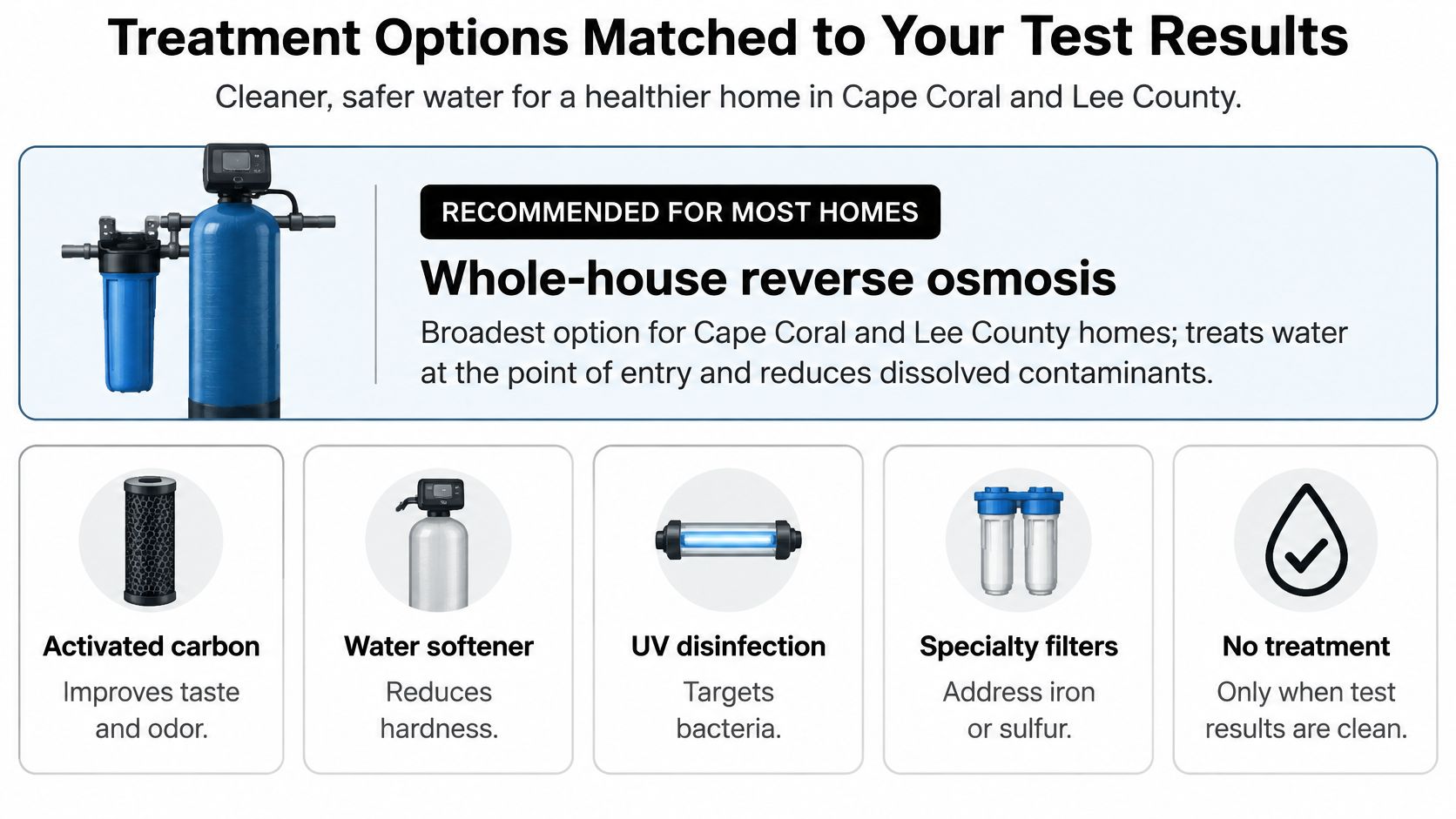
For most homes with well water in Cape Coral and Lee County, whole-house reverse osmosis is the broadest, strongest choice. It treats water at the point of entry, so kitchens, bathrooms, laundry, and ice makers all get the same verified water. Most well water, with small exclusions, isn't drinkable without proper treatment, and reverse osmosis is the best way to get reliably clean drinking water.
What Certification Actually Means
Don't buy the phrase reverse osmosis. Buy the certification behind it. NSF/ANSI 58 covers materials, structural integrity, TDS reduction, efficiency, recovery, and contaminant reduction, and TDS reduction is a required claim while claims for contaminants like nitrate, lead, arsenic, and fluoride are optional and must be supported by testing, as explained in the NSF guide to NSF/ANSI 58. Ask every provider to show you the specific claims printed on the listing and match them line by line to your lab report.
| Option | Main targets | Coverage | Main limitation |
|---|---|---|---|
| Whole-house reverse osmosis | TDS, nitrate and many dissolved contaminants covered by certification | Every tap on the treated supply | Also removes chlorine and some beneficial minerals |
| Carbon filtration | Chlorine, taste, odor and some organic chemicals | Whole house or single point | Does not remove dissolved salts or nitrate |
| Chlorination or disinfection | Bacteria and some viruses | Whole system | Does not remove chemicals or minerals and needs a follow-up test |
| Water softener | Calcium and magnesium hardness and scale | Whole house | Does not treat bacteria, nitrate or sediment |
How a Whole-House RO System Should Be Built
A proper design follows a clear order. First, confirm the lab results, including any separate PFAS test if that's a concern. Second, size the RO to household demand so showers and laundry don't starve the system. Third, install a sediment pre-filter to protect the membrane. Fourth, add the RO membrane stage, a storage tank, and post-treatment. Fifth, run a post-install lab test to prove reduction, including a PFAS test if PFAS drove the decision.
Other stages earn their place only when your report calls for them. A softener ahead of RO can protect the membrane and cut scale where hardness is high, which is why many homeowners review whole-house water softeners as a supporting stage rather than a stand-alone answer. Carbon can polish taste and odor. Disinfection handles bacteria. None of them replaces RO for dissolved salts and nitrate.
Whole-house RO also removes chlorine and some beneficial minerals, so your design needs honest planning for disinfection and post-treatment, not a sales pitch that pretends there's no trade-off.
Require a written quote tied to your lab report. It should list each stage, the NSF/ANSI 58 listing and claims, tank size, and the post-install analytes. If a quote could've been written before seeing your water, reject it.
Costs and Provider Selection for Well Water Treatment
You won't get a responsible price from a phone description of your water. Price follows the lab report, household demand, and the stages your contaminants actually require.
| Cost item | What drives the price | Ask for in the quote |
|---|---|---|
| Certified baseline lab panel | Number of panels triggered by the testing table | Itemized lab fees |
| Whole-house RO system | Household demand, tank size and pre-filter stages | Stage-by-stage price with NSF/ANSI 58 listing |
| Carbon or softener stage | Contaminants confirmed in the report and flow rate | Separate line item with its targets |
| Post-install test | Scope of the lab panel | Named analytes and detection limits |
| Monthly maintenance | Visit frequency and filter sets | Written service schedule and terms |
Six Questions Before You Sign
- Show the listing: Ask for the NSF/ANSI 58 listing and the exact contaminant claims on it.
- Itemize the quote: Require each stage, its certification, and the post-install analytes with detection limits in writing.
- Tie it to your report: Confirm the system was sized from your lab results, not a generic package.
- Ask about failures: Ask how the provider handles nitrate above the limit or a positive coliform result.
- Check local service: Confirm who responds in Cape Coral and Lee County after installation and how service is scheduled.
- Compare maintenance: Get filter sets, membrane checks, and visit frequency in the terms.
We price from the lab report and provide monthly maintenance, so you can check our written quote against this list item by item. That's how you should compare any provider for homes with well water, on evidence, not promises.
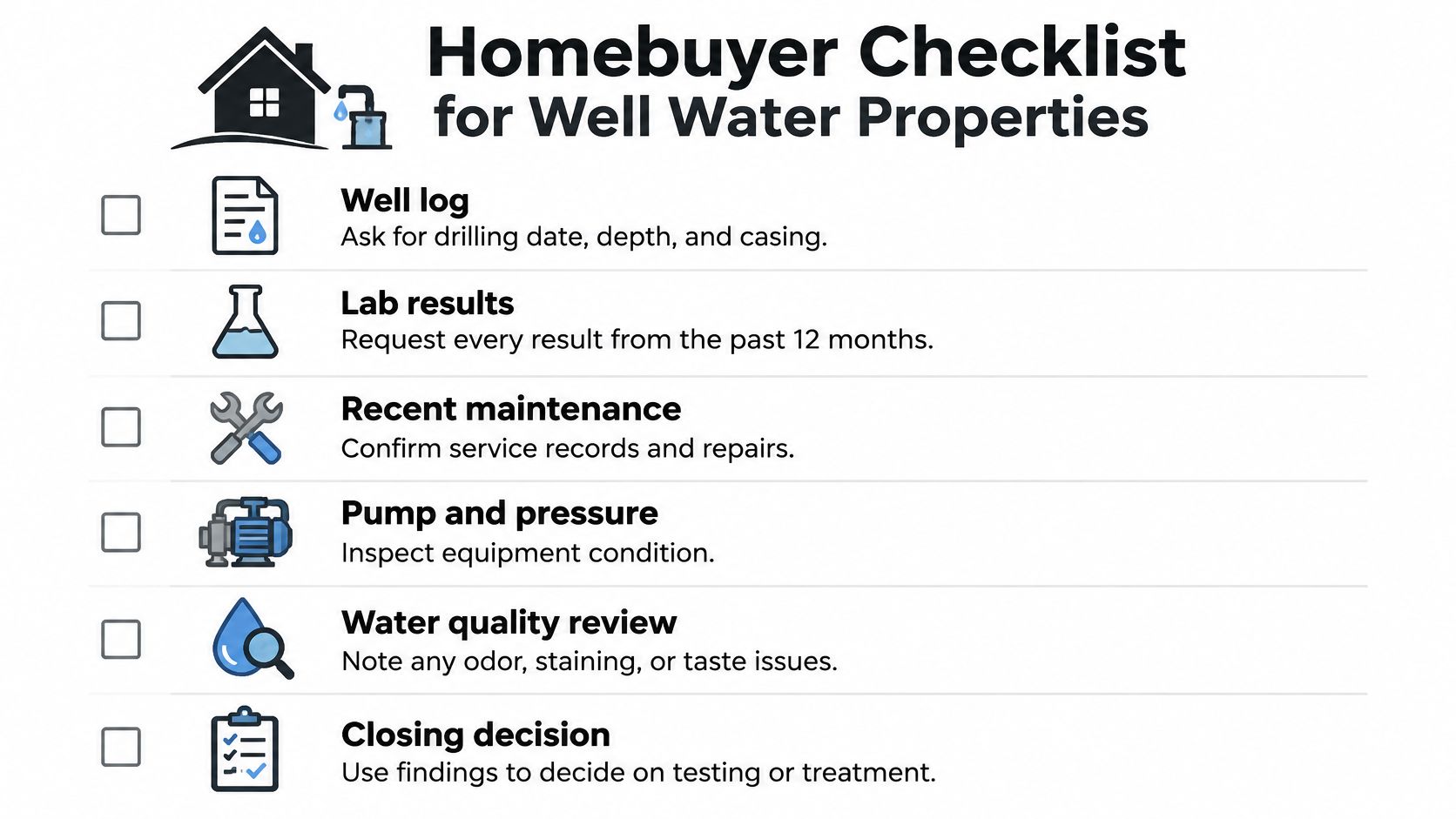
Homebuyer Checklist for Well Water Properties
Don't buy a well on trust. During your inspection period, turn an unknown water supply into a documented one, and price any needed whole-house RO before you close.
Documents to Request
- Well log: Get drilling date, depth, and casing details in writing.
- Lab history: Request every lab result from the past 12 months, plus a current baseline panel drawn before treatment.
- Repair and flood history: Ask about flooding, well repairs since the last sale, and what testing followed them.
- Seller disclosure: Ask the seller to provide well water results in writing and confirm whether treatment was added just to pass a test.
Equipment to Inspect
Check pump age, pressure, and flow, and note the condition of the storage tank. Confirm the well cap is sealed and vented. Measure the distance from the well to the septic system and fertilized lawn areas, because that spacing shapes nitrate and bacteria risk.
For treatment gear, record make, model, and service records for every stage. For any RO system, record its NSF/ANSI 58 certification and listed claims, the date filters and membrane were last changed, and softener salt levels if a softener is present. Ask directly about past taste, odor, or color complaints and what was done. A fresh filter installed the week before listing isn't a clean history.
Put a well test and a pump test in the purchase contract. Results you get before closing are leverage. Results you get after closing are your expense.
If the current panel shows rising TDS, nitrate, iron, or other dissolved contaminants, get a whole-house RO quote during inspection, based on that report. Homes with well water can be excellent buys in Southwest Florida, but only when you know exactly what the well produces and what it'll cost to treat it properly.
Routine Maintenance That Keeps a Well System Working
A whole-house RO system doesn't run itself, and a well can change without any visible warning. Additional testing is warranted after color, taste, or smell changes and after flooding, and the well should be checked for mechanical problems and cleanliness at least annually, per CDC guidance on well water prevention. If you suspect contamination, don't drink it. Use bottled water until the well has been treated and tested.
Your Short Routine
- Change sediment pre-filters on the manufacturer's schedule, not when flow drops.
- Track RO product-water TDS: A rising number signals membrane wear and calls for a membrane check.
- Check storage tank pressure so delivery stays steady.
- Top up softener salt and inspect the salt cell if you run a softener stage.
- Inspect the well cap and casing for cracks every year.
- Retest annually, and after any trigger that calls for an extra sample.
Keep a simple log a buyer or technician can read in seconds. For example: March 4 | TDS 12 mg/L | Sediment filter changed | Next due June 4. That log is the first document we ask to see when performance drifts.
When routine checks turn into repairs on a well head, aerator, pump, or treatment stage, schedule well water repair service promptly rather than working around a failing stage. Schedule service when a reading drifts or a stage hits its due date, not after the taste changes.
Book a Water Test and Whole-House RO Plan
You now have a decision to make, and it shouldn't be based on how your water looks in a glass. Here's the order we recommend for homes with well water in Southwest Florida.
Step 1. Order the right test. Get a certified baseline panel and any extra panels your triggers call for, including a separate PFAS test if that's on your list. Draw it correctly, ship it fast, and keep the full report.
Step 2. Build the system around your results. We treat well water with systems catered to each well's specific water test results, so the design matches the contaminants present in your well, not a neighborhood average. Bring us the report and we'll map each result to a stage that addresses it.
Step 3. Review a written whole-house RO quote. Your quote should list each stage, its certification and claims, tank and membrane sizing, and the post-install test that'll verify performance. We sell and install whole house reverse osmosis systems and provide monthly maintenance for them, which keeps filters, membranes, and TDS performance on track between annual tests. Review the system details on our whole-house reverse osmosis page and compare them against your lab numbers before you approve anything.
Step 4. Know the service process before work starts. If repairs are needed, our Well Technician contacts you to go over the necessary repairs before service, so you approve the work with full information. No surprises, and no stage added without a lab-based reason.
Don't buy a smaller system and hope dissolved contaminants cooperate. For saltwater intrusion, nitrate, and the mix of dissolved minerals Southwest Florida wells commonly produce, whole-house RO is the verified, whole-home answer. The lab report starts the plan. The post-install test proves it worked.
Ready to stop guessing about your well? Visit Water Medic of Cape Coral to book a certified water test and get a whole-house reverse osmosis plan built around your actual results, installed and maintained monthly by our Cape Coral team. Bring us your latest lab report, or let us help you get one, and we'll show you exactly what your water needs.