Heavy Metals in Water and Whole-House RO
You just got the lab report back on your Cape Coral well, and one line is flagged. The water looks clear. It doesn't smell. It tastes like it always has. That gap between what you can sense and what the lab can measure is exactly where bad decisions happen, and it's why we start with testing, not equipment.
Start With a Water Test Not a Guess
A Lee County homeowner we see often is holding a report that lists arsenic or lead above a benchmark, and the first question is whether to buy a filter that weekend. Don't. A single flagged result tells you something was detected. It doesn't yet tell you where it came from, how consistent it is, or what treatment will address it.
Detection is not diagnosis. Heavy metals in water can be present at health-relevant concentrations while the water looks, tastes, and smells completely normal. That's why USGS guidance on groundwater quality research frames laboratory comparison with health standards, not appearance, taste, odor, or clarity, as the actionable starting point for private-well owners.
Why Your Senses and a Cheap Kit Won't Settle This
Home screening kits have a place as a first alert. They don't give you the precision you need to design treatment, compare a result to a health benchmark, or decide whether a problem comes from the aquifer or from your own plumbing. If you're going to spend money on treatment, spend a little first on a certified laboratory result you can defend.
Practical rule: Never select treatment from a color-changing strip. Select it from a lab report that names the contaminant, the concentration, and the sample point.
The sequence we recommend is simple, and it saves homeowners from buying the wrong system twice.
- Sample raw well water: Collect untreated water at or near the wellhead so you know what the aquifer is delivering.
- Sample at the tap: Collect a second sample where your family drinks and cooks, because tap results can differ from source results.
- Match treatment to the profile: Use contaminant, concentration, and supporting chemistry to choose, size, and verify the system.
That sequence is the backbone of everything that follows. Our focus throughout is whole-house reverse osmosis, because that's what most Lee County well owners ask us to design when they want property-wide reduction. But a detection alone doesn't automatically justify the same response for every household. Concentration, which metal it is, where it's entering, and who's drinking the water all change the recommendation. Start with the test. Then we'll talk equipment.
Understand Common Heavy Metals
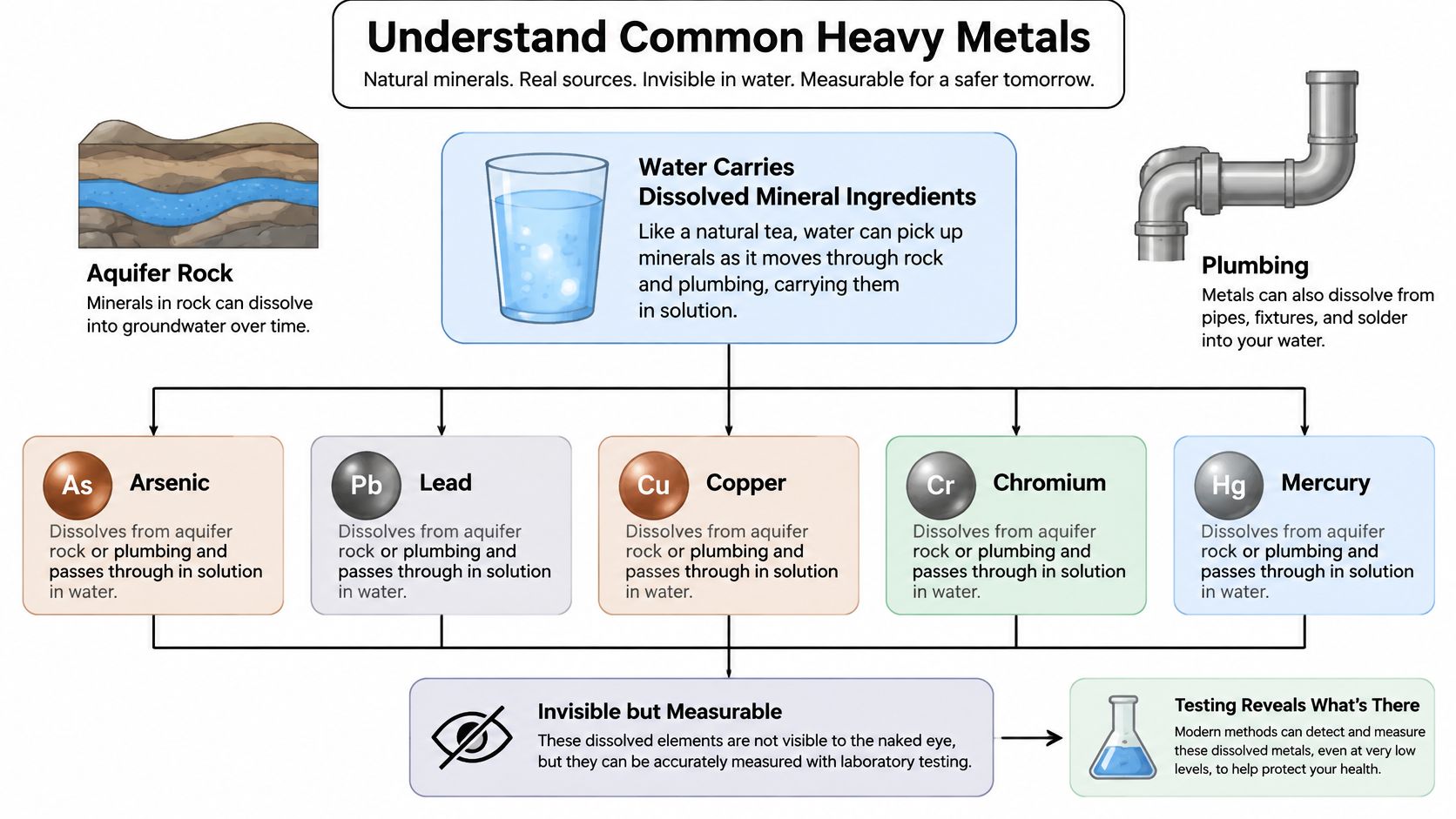
Think of well water as carrying dissolved ingredients it picked up along the way. As water moves through rock, soil, and then your home's plumbing, it dissolves minerals and metals into solution. You can't see them, but a lab can measure them, and some of them matter for health at very low concentrations.
The Metals We Discuss Most With Well Owners
Arsenic is the groundwater contaminant we test for most carefully in Southwest Florida because it can occur naturally as minerals dissolve into aquifers. Lead behaves differently. It often enters after water leaves the source, through contact with plumbing materials. Cadmium, chromium, copper, mercury, and nickel round out the list homeowners ask about, and each one has a different source behavior, health profile, and treatment response.
That difference matters more than the label heavy metal. Arsenic in an aquifer is a source-water problem that calls for treatment of incoming water. Lead picked up inside the building is a tap-side problem, and treating only the wellhead won't necessarily fix what comes out of the kitchen faucet after water sits overnight.
Arsenic also illustrates why form matters. It occurs mainly as arsenite, As(III), and arsenate, As(V), and WHO technical guidance on arsenic notes that treatment behavior depends on oxidation state, pH, competing ions, and dissolved iron. A total arsenic number alone doesn't tell a designer everything needed to pick media or pretreatment.
Health Risk in Practical Terms
- Chronic exposure drives most concern: Arsenic is associated with skin lesions, peripheral neuropathy, cardiovascular disease, diabetes, developmental toxicity, and cancers of the skin, bladder, lung, and kidney.
- Lead hits children hardest: Lead exposure is associated with neurodevelopmental effects, impaired kidney function, hypertension, reduced fertility, and adverse pregnancy outcomes.
- Senses don't screen for risk: Several of these metals give no taste, odor, or color warning at concentrations that still warrant action.
Vulnerable household members change how urgently we act. Infants, young children, and pregnant people deserve a lower tolerance for delay, confirmatory sampling done quickly, and interim steps for drinking and cooking water while treatment is designed. For everyone else, the principle is the same. Identify the metal, understand where it's coming from, then treat the actual problem.
Compare Health Risks and Regulatory Limits
A number on a lab report means little until you know which benchmark you're comparing it to, and benchmarks are not all the same kind of number. Confusing them leads homeowners to either panic over a detection or dismiss a result that deserves action.
Three Kinds of Numbers You'll See
- Maximum contaminant level goal: A health-based target with no expected risk, set at zero for both lead and arsenic because both can harm health at low levels. It's a goal, not an enforceable limit.
- Enforceable standard or action level: The number public water systems must respond to. For lead, the EPA action level is 15 parts per billion, and systems must act when more than 10% of sampled taps exceed it, per EPA guidance on lead in drinking water.
- Provisional guideline: The WHO retains 10 µg/L for lead and for arsenic but classifies those values as provisional, because reliably achieving lower concentrations can be technically difficult, especially in small or variable systems.
Arsenic shows how these numbers tighten as evidence grows. EPA records on chemical contaminant rules show the agency adopted a 10 micrograms per liter standard on January 22, 2001, replacing 50 µg/L, an 80% reduction, with public-system compliance required by January 23, 2006. Don't interpret an old report using today's benchmark, or assume water that passed an older standard would pass now.
A regulatory limit is a line for action, not a guarantee of zero risk. The WHO notes there's no clear threshold for several key lead effects, which is why prevention beats reassurance.
Reading Your Result Without Panicking or Shrugging
Risk depends on the contaminant, the concentration, how long exposure lasts, the route, the sample point, and who's drinking. Florida's 2025 assessment of approximately 145 wells found about 32 wells, or 22%, exceeding a state level for at least one concern, yet only two wells were above 30 micrograms per liter of arsenic, and the assessment concluded measured arsenic was unlikely to represent an imminent threat under realistic exposure scenarios, according to the Florida Department of Health assessment.
That nuance doesn't make chronic exposure acceptable. It means the right response sits between doing nothing and replacing everything. Confirm the result, reduce drinking and cooking exposure while you assess, and move promptly on a permanent fix.
One last distinction. Public-system compliance numbers don't automatically protect a private well. Federal drinking-water monitoring generally doesn't cover private wells, and domestic-well quality isn't regulated under the federal Safe Drinking Water Act. Those benchmarks are your comparison points. Arranging the test, and the treatment, is on you.
Identify Where Heavy Metals Enter Water
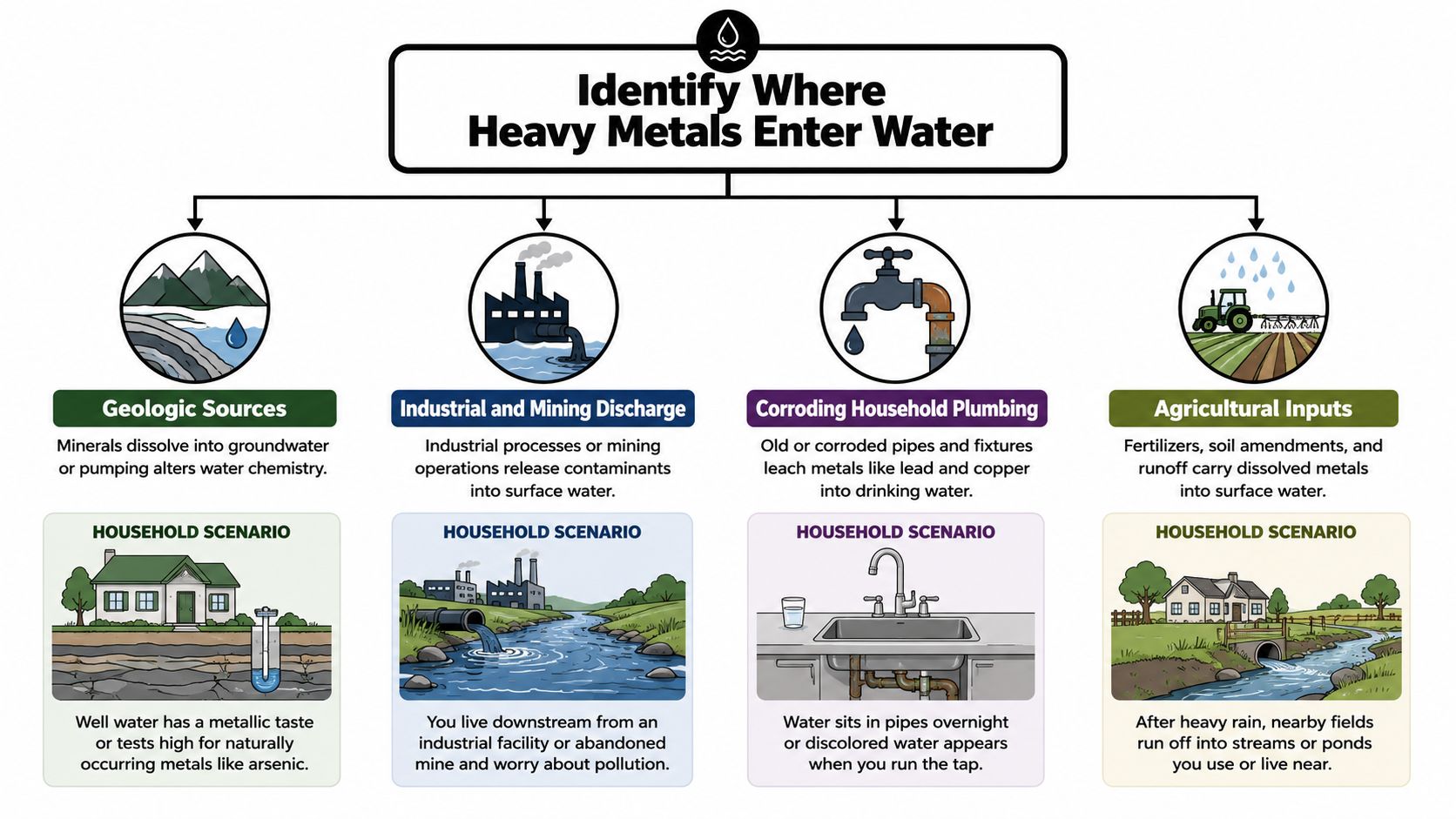
Where a metal enters determines where you sample and what treatment makes sense. We map four pathways with homeowners before we quote any system.
Four Pathways, Four Different Fixes
Geologic sources are the most common story for heavy metals in water on private wells. Minerals dissolve naturally into groundwater, and pumping can change geochemistry over time, so a well that tested clean years ago can shift. Arsenic is the textbook example. No industrial pollution needs to be visible for it to appear.
Industrial and land-use influences work from the surface down. What happens on land near or above your well, including waste handling, agricultural inputs, and older industrial activity, can move metals into soil and groundwater. If land use near your property changes, that's a retesting trigger, not a wait-and-see moment.
Seawater intrusion is a coastal reality in Lee County. When saltwater pushes into freshwater aquifers, overall water chemistry changes, including dissolved solids and competing ions that affect treatment performance. Don't assume a single contaminant explains a coastal well. Get the full chemistry panel and let a professional interpret it as a system.
Tap-side contributions happen inside the building. WHO drinking-water quality guidance on lead explains that lead can enter water after treatment through corrosion of plumbing, service lines, solder, and fixtures. A clean wellhead result with a high kitchen tap result points inside, not underground.
Turning Sources Into a Sampling Plan
- Pair your samples: Take raw water at the wellhead and treated or tap water at the kitchen faucet on the same round of testing.
- Note stagnation: Record whether tap water sat in plumbing before sampling, because that changes lead and copper interpretation.
- Retest after change: Flooding, pump or well work, nearby land-use change, and any prior detection all justify a fresh round.
That source map answers the big design question. Contamination at the wellhead supports whole-property treatment at the point of entry. Contamination only at the tap may call for a different scope. Diagnose the pathway first, and the equipment conversation gets much shorter.
Test Private Well Water and Interpret Results
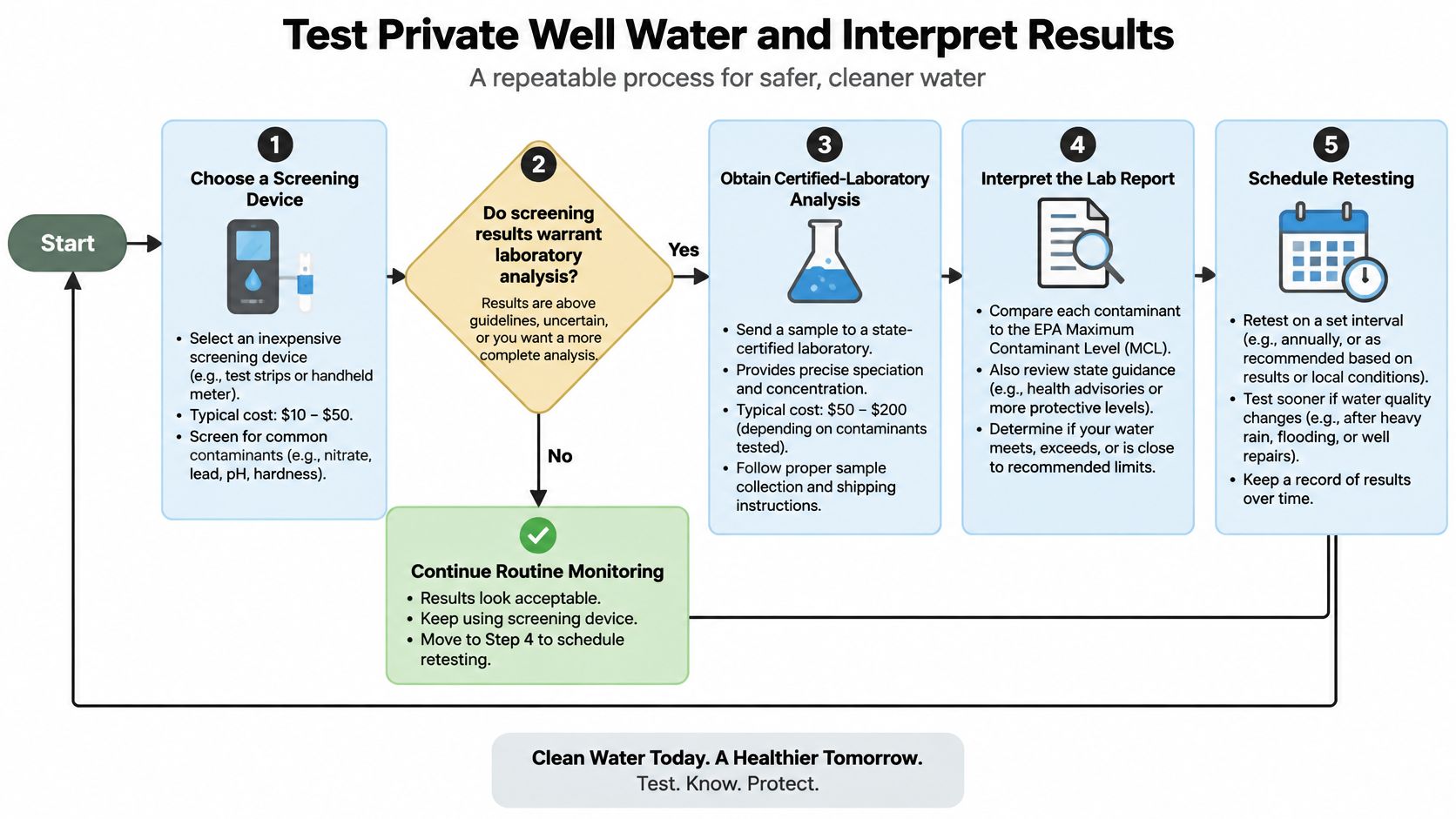
Testing isn't a one-time event before a purchase. It's a repeatable process you'll use for as long as you own the well, and Florida puts the responsibility squarely on you. Private wells here aren't required to meet EPA drinking-water standards, and there's no statewide sampling mandate, so your schedule is your protection.
Screening Versus Confirmation
An inexpensive home kit can flag that something deserves attention. It can't reliably quantify metals at health-relevant concentrations, and it can't speciate arsenic. Use screening to decide whether to test properly. Use a certified laboratory to decide what to install. Homeowners comparing testing options can review common well questions on our well water frequently asked questions page before ordering a panel.
For cadence, Florida Department of Health guidance on arsenic in well water recommends annual testing for core indicators and lead testing at least every three years for most homeowners. Arsenic needs separate attention because it has no taste or odor, and Florida identifies portions of the west coast where it's frequently found. Treat that schedule as a floor, not a ceiling.
What to Order and When to Retest
A treatment-ready panel goes beyond the metal itself. Ask the lab for the target metals plus iron, manganese, pH, alkalinity, and hardness, and add arsenic speciation when treatment design is on the table. Those supporting results determine pretreatment, media choice, and whether oxidation is needed before removal.
- After flooding: Retest before resuming normal drinking use, since surface water can change well chemistry quickly.
- After well or pump work: Any work that disturbs the well can shift results, so confirm water quality afterward.
- After taste, color, or staining changes: Sensory changes don't prove metals, but they're a valid trigger to check.
- After any prior detection: Confirm with a second lab sample, then retest after corrective action to verify the fix.
Keep the paper trail: Record sample dates, sample points, concentrations, lab methods, and every filter or membrane change. That log turns future troubleshooting from guesswork into comparison.
Interpretation follows a fixed order. Confirm the detection with lab data. Compare it to the right benchmark. Decide whether the source is the aquifer or the tap. Then design treatment, install it, and verify with post-treatment samples. Homeowners who follow that workflow rarely buy equipment twice, because every decision traces back to a documented result.
Choose the Right Treatment Method
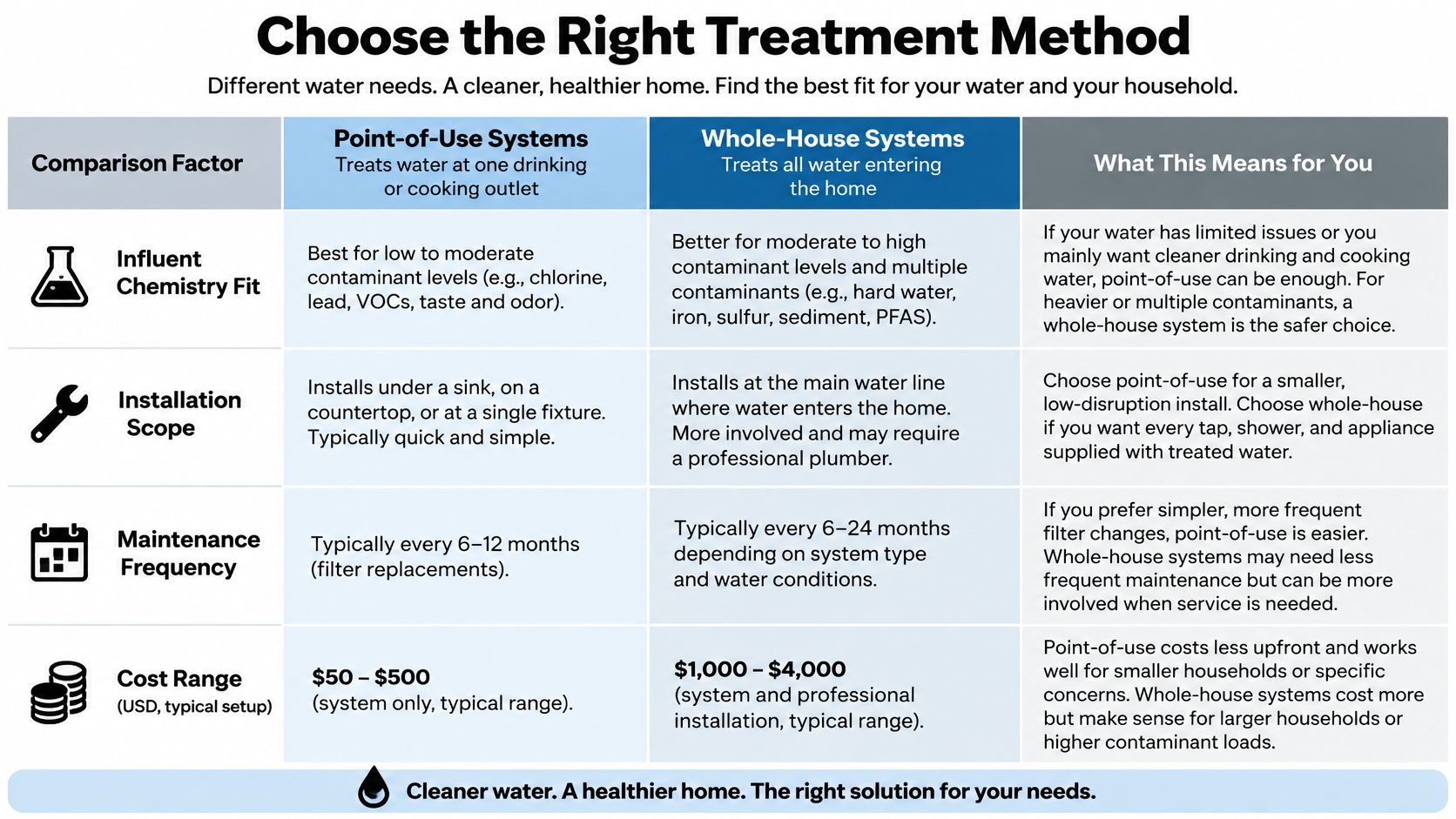
Once your lab profile is solid, the treatment decision gets honest. You're choosing scope first, then mechanism. Scope asks whether you treat one outlet or the whole property. Mechanism asks how the equipment separates the metal from your water.
Point of Use Versus Whole House
Point-of-use systems treat water at a single drinking or cooking outlet, typically under the kitchen sink. They're a sensible, lower-scope answer when the concern is ingestion only, the contaminant list is short, and the household accepts untreated water everywhere else. Whole-house systems treat all water entering the home, so every tap, shower, and appliance receives treated water. For well owners with source-water contamination across multiple metals, that's usually the design goal.
Reverse osmosis works by pressure-driven separation. Water is forced through a semipermeable membrane, and dissolved substances are rejected to a concentrate stream. The CDC identifies lead, copper, chromium, chloride, and sodium among substances RO can remove, and notes RO may also reduce arsenic, fluoride, radium, sulfate, calcium, magnesium, potassium, nitrate, and phosphorus, per CDC guidance on home water treatment systems. Importantly, residential RO combines pretreatment and post-treatment filters with the membrane, so performance depends on the complete treatment train, not the membrane alone.
Heavy-Metal Treatment Options
| Treatment Method | Typical Scope | Reduction Mechanism | Best-Fit Considerations |
|---|---|---|---|
| Reverse osmosis | Point of use or whole house | Pressure forces water through a semipermeable membrane, rejecting dissolved metals to concentrate | Broad dissolved-metal reduction when pretreatment, capacity, and certification match lab results |
| Adsorption media | Point of use or whole house | Metals bind to media surfaces as water passes through | Useful for targeted contaminants, media exhaustion must be monitored |
| Ion exchange | Usually whole house | Resin exchanges target ions for less harmful ions | Effective for arsenate, not arsenite, so arsenic form decides fit |
| Oxidation plus filtration | Whole house pretreatment or standalone | Oxidizes dissolved metals so they can be filtered, including iron-associated arsenic | Strong fit when arsenite or dissolved iron dominates the profile |
| Carbon filtration | Point of use or whole house support | Adsorption of certain chemicals and taste or odor compounds | Better as pretreatment or polishing, review options like carbon filtration systems for the right supporting role |
Arsenic form can flip this decision. Ion exchange handles arsenate but not arsenite, oxidizing arsenite to arsenate improves removal, and iron filtration may remove substantial arsenic when it's associated with iron precipitates. No method universally removes every metal. Whole-house RO is our featured recommendation for broad, property-wide reduction, provided pretreatment, storage, capacity, certification, and your water chemistry support the design.
Build a Whole-House RO System
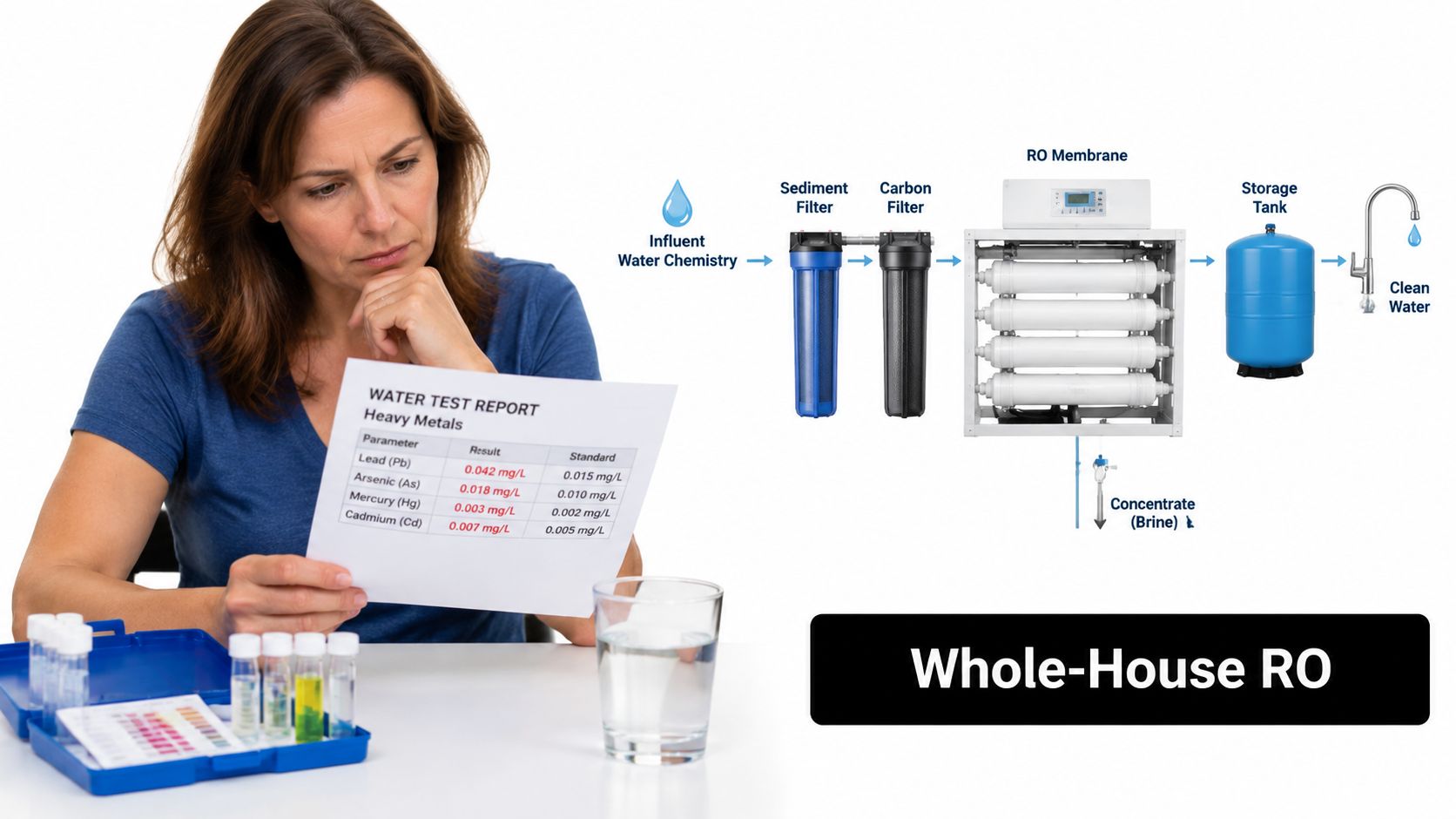
Take an illustrative Cape Coral case. A homeowner's lab report shows arsenic at the wellhead at a high level, moderate iron, and hardness that would foul a membrane quickly. The wrong move is ordering a generic RO unit online. The right move is building a treatment train around that specific water.
From Lab Report to Installed System
- Define targets from data: List each contaminant above its benchmark, plus iron, manganese, hardness, turbidity, pH, and oxidants that affect membrane life.
- Design pretreatment first: Iron, manganese, hardness, and turbidity ahead of the membrane determine whether you need oxidation, filtration, or softening stages before RO.
- Size for household demand: Whole-house RO produces water at a finite rate, so storage and repressurization must match peak household use, not average use.
- Verify claims in writing: Require documented, contaminant-specific reduction performance for the exact system being installed.
- Commission and sample: Test influent and effluent after installation to prove the installed train performs on your water.
Procurement deserves skepticism. NSF guidance on NSF/ANSI 58 for reverse osmosis systems explains that the standard includes testing procedures for arsenic, lead, cadmium, and hexavalent and trivalent chromium reduction claims, and that no federal regulations generally govern residential treatment systems, so voluntary certification carries the weight. EPA's arsenic guidance likewise notes the standard addresses chronic exposure and that equipment should have documented arsenic-reduction performance, per the EPA arsenic regulation fact sheet.
Homeowners who decide whole-house scope is more than they need can compare against a dedicated drinking-water option such as an under sink reverse osmosis system before committing. Water Medic of Cape Coral provides in-home water analysis and designs whole-house reverse osmosis systems from those results, which is one service route among the options you're weighing.
Our position is direct. If your lab profile supports it, a properly pretreated, correctly sized, certified whole-house RO system is the most complete answer for heavy metals in water at the source. If your profile points to oxidation and filtration instead, we'll say so. The lab report decides.
Maintain Monitoring and Know When to Call a Pro
An installed system isn't a finished system. Membranes foul, media exhaust, and well chemistry drifts, so the operating plan you adopt at installation protects you long after the first clean sample.
Your Ongoing Operating Plan
- Replace prefilters on schedule: Follow manufacturer guidance for your specific train, because exhausted pretreatment exposes the membrane to iron, sediment, and oxidants it wasn't built to handle alone.
- Service the membrane proactively: Pressure changes, declining production, and creeping effluent results are service signals, not nuisances to ignore.
- Sanitize storage: Whole-house RO relies on stored treated water, so storage sanitation belongs in your maintenance calendar.
- Verify with lab samples: Periodic influent and effluent testing confirms the system still reduces your target metals. Equipment presence proves nothing. Post-treatment results prove everything.
Breakthrough is quiet. Media exhaustion, pH shifts, and changing well chemistry can let metals pass before you notice any difference at the tap, which is why scheduled verification beats waiting for symptoms.
Signals That Warrant a Specialist
Call a qualified local water-treatment professional when several metals show up at once, when arsenic form is uncertain, when wellhead and tap results disagree, or when your water needs substantial pretreatment before RO. Those are design problems, not shopping problems, and they reward property-specific sampling, documented equipment selection, and after-treatment verification.
For Cape Coral and Lee County well owners, local matters. Coastal chemistry, west coast arsenic occurrence, and private-well responsibility combine into a situation where generic advice underperforms. A specialist who samples your water, designs to your report, installs the train, and verifies the result gives you one accountable path from detection to confidence.
Your final checklist is short. Test with a certified lab. Identify the source pathway. Choose scope and mechanism from the data. Demand documented performance. Verify after installation, then monitor on schedule. Follow that sequence, and whole-house reverse osmosis becomes a measured engineering decision instead of an anxious purchase.
If your well report shows heavy metals in water you're not sure how to interpret, Water Medic of Cape Coral offers in-home water analysis and whole-house reverse osmosis design, installation, and verification built around your actual lab results. Visit Water Medic of Cape Coral to schedule your property-specific analysis and get a treatment recommendation sized for your home, your water chemistry, and your household demand.