Florida’s Best Whole Home Water Purification Systems
When you start looking for the best whole home water purification systems, you quickly realize the "right" answer isn't a single product off a shelf. It's always a solution built specifically for your home's unique water quality problems. Here in Southwest Florida, the most effective systems often combine technologies—like a water softener paired with a carbon filter—to handle our common issues like hard water, chlorine, and that rotten egg sulfur smell.
First Things First: You Have to Understand Your Water
Navigating the world of water purification for your Southwest Florida home can feel overwhelming. You've got everything from simple faucet filters to complex, multi-stage systems. The most important thing to remember is that there's no universal solution. The stuff in your neighbor's well water could be totally different from what's coming out of your city pipes a block away.
This guide is here to cut through the confusion. We'll break down the main purification technologies and show you why a customized system is the only way to get truly pure, safe water from every tap in your house. Before you can pick the right gear, you have to know exactly what you're fighting. That's why a professional water analysis isn't just a good idea; it's the essential first step.
Matching the Treatment to the Problem
Different water issues need different tools. Getting a handle on which technology fixes which problem will empower you to make a smart choice. People are more concerned about their water than ever before. A 2023 survey actually found that 91% of Americans are using some form of water filtration, a huge increase driven by growing awareness of contaminants like heavy metals and microplastics. You can discover more about the water purification systems market and see just how big this trend has become.
Let's take a quick look at how our common technologies stack up against typical water problems:
| Technology | Best For Removing | Ideal Use Case |
|---|---|---|
| Water Softener | Hardness minerals (calcium & magnesium) that create that crusty scale buildup. | Homes plagued by spotty dishes, stubborn soap scum, and appliance breakdowns. |
| Carbon Filtration | Chlorine, chloramines, pesticides, and other chemicals causing bad tastes and odors. | City water that smells or tastes like it came straight from the swimming pool. |
| Reverse Osmosis | A huge range of contaminants, including salts, heavy metals, and nearly all dissolved solids. | When you want the absolute highest level of purity for your drinking and cooking water. |
This little chart really shows why a single device often falls short. A water softener is great for protecting your pipes and appliances from scale, but it won’t do a thing to improve the taste. On the flip side, a carbon filter will make your water taste fantastic but won't stop hardness from wrecking your dishwasher.
The key is to stop guessing. When you shift to a data-driven approach that starts with a water test, we can build the perfect system that targets your specific needs.
Figuring Out What's Actually in Your Florida Water
Before you can even think about choosing a whole-home water purification system, you have to know what you’re fighting against. Here in Southwest Florida, our water is often a complex cocktail of minerals and contaminants that can do a number on your home and your quality of life. Grabbing a generic filter off the shelf without knowing your water's specific chemistry is like taking medicine without a diagnosis—it's a complete shot in the dark.
The only real way to get a clear picture is with a professional water analysis. This is the critical first step that identifies the exact concentration of every contaminant, which lets us design a system that solves your actual problems instead of just guessing.
The Grime and Expense of Hard Water
One of the biggest culprits we see across the region is hard water—water loaded with dissolved calcium and magnesium. While it’s not going to hurt you, it’s incredibly destructive to your home.
You know you have it if you see those chalky white spots on your dishes, glassware, and faucets. That mineral buildup, called scale, also clogs up showerheads, slows down water flow, and drastically shortens the lifespan of your appliances. Dishwashers, washing machines, and especially water heaters are forced to work much harder, which you’ll notice on your energy bills.
The hidden cost of hard water is staggering. A study from the Water Quality Research Foundation found that water heaters can lose up to 48% of their efficiency because of scale buildup. That often leads to them failing years early, forcing an expensive replacement.
This isn't just a plumbing issue, either. Hard water is notorious for leaving ugly mineral deposits on all sorts of surfaces. You can find more strategies for tackling stubborn hard water stains to see just how far-reaching the problem can be.
The Stains and Smells from Iron and Sulfur
Ever notice reddish-brown or black stains in your sinks, toilets, and even on your laundry? That’s the classic calling card of excess iron and manganese. The moment these minerals hit the air, they oxidize and create tiny particles that stain everything they touch, slowly ruining fixtures and clothing.
Even more unpleasant is that distinct "rotten egg" smell, which comes from hydrogen sulfide gas. This is a common complaint for well water users and can make something as simple as a shower an awful experience. It's often caused by specific bacteria and can also corrode your plumbing over time. These signs often point to bigger issues within the well itself, so if you notice them, it’s a good idea to seek professional advice on well water system repairs and maintenance to get to the root of the problem.
The Contaminants You Can't See
Beyond the obvious problems, there are other troubling elements that can be lurking in your water supply. These are the ones you can't see, taste, or smell, and that’s what makes them so concerning.
- Bacteria and Viruses: These are especially common in well water. Microorganisms like E. coli and coliform bacteria can pose serious health risks if not eliminated, usually requiring a UV sterilization system.
- Saltwater Intrusion: Living in a coastal area like Cape Coral comes with a unique risk. When too much groundwater is pumped, seawater can seep into the freshwater aquifer. This raises the salt level, which damages pipes, kills plants, and makes the water taste terrible without advanced treatment like reverse osmosis.
There is simply no way to pinpoint these specific issues without a detailed analysis. A professional water test gives us the exact blueprint we need to build the perfect whole-home purification system for your Florida home, ensuring every drop is clean, safe, and problem-free.
Comparing Water Purification Technologies
Choosing the right whole-home water purification system isn't about picking the "best" one; it's about picking the right tool for the job. Think of it this way: a water softener, a carbon filter, and a reverse osmosis system are not interchangeable. Each is a specialist, designed to solve very different water problems.
The secret to clean, safe water is matching the right technology—or, more often, the right combination of technologies—to the specific contaminants we find in your water test. We're going to break down how each system works, what specific SW Florida water issues it solves, and just as importantly, what it doesn't do. This is how we build a real, long-term solution instead of just slapping on a temporary fix.
The Workhorse for Hard Water: Water Softeners
A water softener has one primary mission: to stop hard water in its tracks. It goes after the dissolved minerals, mostly calcium and magnesium, that leave behind that destructive, chalky scale buildup on all your pipes, fixtures, and appliances.
The magic behind it is a process called ion exchange. As your water flows into the softener's tank, it passes through a bed of resin beads that are holding onto sodium ions. These beads act like little magnets, grabbing the hard calcium and magnesium ions and trading them for the soft sodium ions. What comes out the other side is "soft" water—the kind that lathers up easily, leaves your dishes spot-free, and protects your home’s plumbing from the inside out.
For any of us here in Southwest Florida who have dealt with crusty faucets and appliances that die years too soon, a water softener is absolutely essential.
Key Insight: A water softener is the only true solution for preventing scale. Other systems might claim to reduce it, but only an ion exchange softener physically removes the hardness minerals. This simple process can extend the life of your water heater, dishwasher, and washing machine by years.
But a softener's specialty is also its biggest limitation. It won't do a thing to improve the taste or smell of your water. Chlorine, sulfur, pesticides, bacteria? A softener doesn’t touch them. It's a specialist, not a generalist.
The Taste and Odor Specialist: Activated Carbon Filtration
If your main complaint is the way your water tastes or smells—like that "public pool" chlorine odor from city water or an earthy, musty scent from your well—then an activated carbon filtration system is what you need.
Activated carbon works through a process called adsorption. Picture each tiny piece of carbon as a super-porous sponge with a massive surface area. As water flows through it, chemical contaminants like chlorine, pesticides, and other volatile organic compounds (VOCs) get trapped inside this huge network of pores.
This makes it the perfect choice for dramatically improving the day-to-day quality of your water.
- Chlorine and Chloramines: It’s fantastic at removing the chemical disinfectants used in municipal water supplies, getting rid of those harsh tastes and smells.
- Organic Contaminants: It’s also great at reducing many common pesticides and industrial solvents that can sometimes seep into our local water sources.
- Improved Safety: By grabbing these chemicals, you get water that’s not just better tasting, but also safer for drinking, cooking, and bathing.
But just like a softener, a carbon filter has its blind spots. It isn't designed to handle hardness minerals, heavy metals like iron, dissolved salts, or bacteria. That’s why pairing a carbon filter with a water softener is such a common and effective one-two punch for homes on city water—you tackle both the scale and the chemical taste. To see how these systems work together, you can check out our deep dive on high-performance carbon filters.
The Ultimate Purifier: Whole Home Reverse Osmosis
When you need the absolute highest level of purification available, Whole Home Reverse Osmosis (RO) is the undisputed champion. This technology is much more intensive than simple filtration and is capable of removing a stunningly wide range of contaminants.
Reverse osmosis works by using pressure to force water through a semipermeable membrane. This membrane is a marvel of engineering, with microscopic pores so tiny that pretty much only pure water molecules can squeeze through, leaving almost everything else behind.
The process is incredibly effective at removing:
- Dissolved Solids: This includes salt, a huge concern for coastal homes dealing with saltwater intrusion into their wells.
- Heavy Metals: Nasty contaminants like lead, arsenic, and iron are effectively blocked.
- Microorganisms: Most bacteria and even viruses are too large to get through the RO membrane.
- Chemicals: It removes a broad spectrum of chemicals, including fluoride.
A whole-home RO system gives you bottled-water quality from every single tap in your house. It is the definitive answer for complex water problems, especially for well water users or those in areas with known contamination risks. While we're focused on water here, it's interesting to see how this fits into the bigger picture of creating a healthy home. For example, many people also look into finding the best whole house air purifiers to tackle airborne contaminants.
The investment for a whole-home RO is higher, and it requires professional design and installation to make sure it doesn’t cripple your home's water pressure. But for total peace of mind, its performance is unmatched.
Below is a quick-glance table to see how these technologies stack up against the common water issues we face here in the Cape Coral area.
Water Purification Technology Comparison for SW Florida Homes
This table offers a straightforward comparison of how the main whole-home systems perform against the contaminants we see most often in local water tests.
| Technology | Best For Removing | Limitations | Average Maintenance | Estimated Cost |
|---|---|---|---|---|
| Water Softener | Hardness minerals (calcium & magnesium) causing scale buildup. | Does not remove chemicals, odors, tastes, or bacteria. | Refilling salt periodically (typically monthly). | $ |
| Carbon Filter | Chlorine, chloramines, pesticides, bad tastes, and foul odors. | Does not remove hardness, heavy metals, salts, or bacteria. | Replacing the carbon media every 3-5 years. | $$ |
| Reverse Osmosis | Up to 99% of all contaminants, including salts, metals, and chemicals. | Higher initial cost and requires pre-treatment for longevity. | Annual filter and membrane replacements. | $$$ |
This comparison makes one thing crystal clear: a "one-size-fits-all" approach to water treatment just doesn't work. The best whole-home water purification systems are rarely a single piece of equipment. They're a thoughtfully designed combination that provides a complete solution, perfectly matched to your home's unique water profile.
Designing Your Ideal Water Treatment System
Knowing the individual technologies is a great start, but the real magic happens when we combine them into a system that’s a perfect match for your home's water. Finding the best whole-home water purification system isn't about buying a single, off-the-shelf box; it’s about smart, targeted system design. Think of your professional water test as a blueprint—it tells us exactly what components to assemble to tackle every single issue in your water, from the obvious stuff to the contaminants you can't see, taste, or smell.
This isn't guesswork. It's precision. We see countless different water scenarios every day across Southwest Florida, and each one needs a slightly different set of tools to get the job done right. It's this custom-built approach that actually delivers the clean, safe water you're looking for.
This decision tree gives you a quick look at how a water test guides the first steps in choosing the right core technologies for common problems.
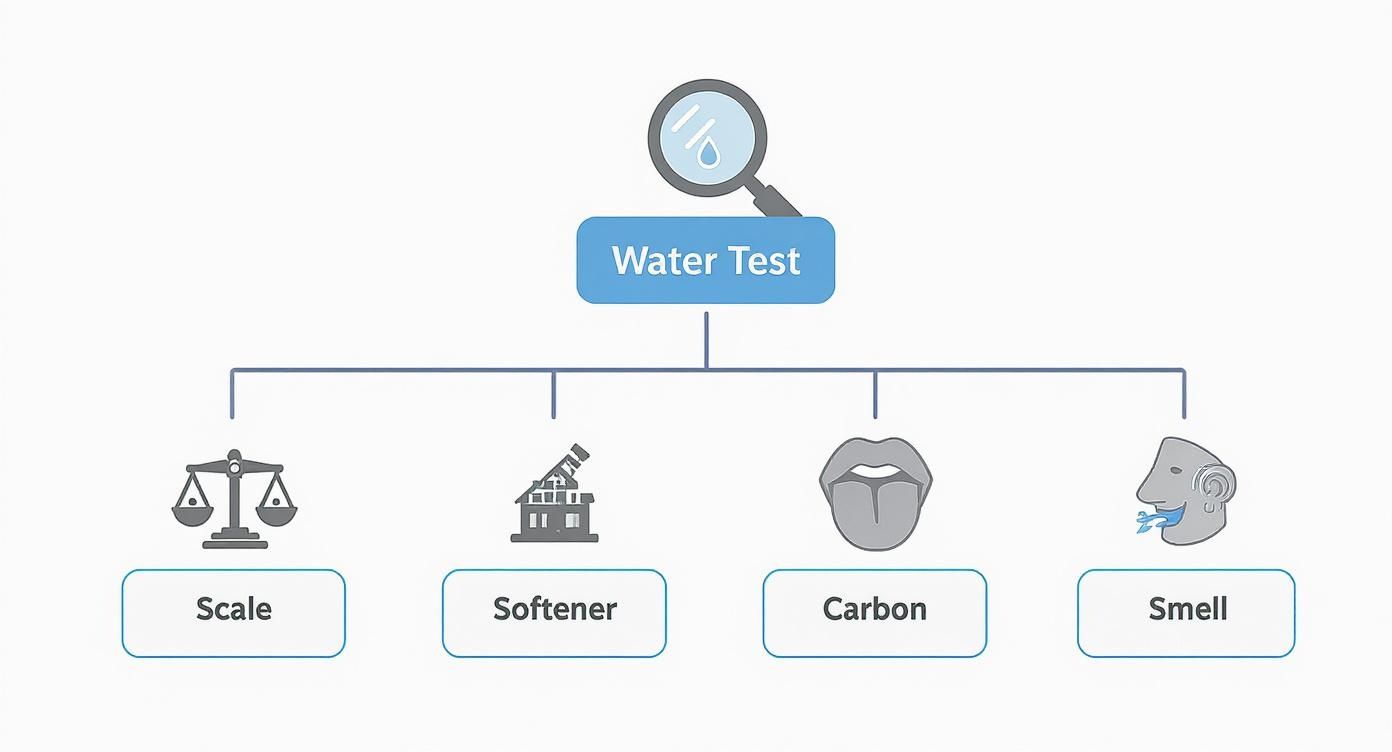
The key takeaway is simple: every great solution starts with a specific problem. A comprehensive water test is the only reliable way to pinpoint what that problem is.
Scenario 1: City Water With Hardness and Chlorine
This is probably the most common situation we see for homeowners in Cape Coral or Fort Myers. You're on municipal water, which is biologically safe, but it comes with its own baggage—frustrating problems that affect your daily life and the longevity of your home.
The Problems:
- Hard Water: Even city water in our area is often loaded with calcium and magnesium. This leads directly to scale buildup that chokes out appliances, clogs showerheads, and leaves those familiar chalky spots on your glassware.
- Chlorine Taste and Odor: Municipalities use chlorine or chloramines to disinfect the water supply. It's a necessary step for public health, but it leaves behind that harsh, swimming-pool taste and smell.
Our Recommended Solution:
For this exact scenario, a two-stage system is the way to go. First, we install a high-quality water softener to pull out those hardness minerals right where the water enters your home, protecting your entire plumbing system. Immediately after the softener, we add an activated carbon filter to adsorb the chlorine and other chemicals, which makes a night-and-day difference in the taste and smell.
This two-part combination is the gold standard for city water treatment. The softener deals with the destructive minerals, while the carbon filter polishes the water, making it perfect for drinking, cooking, and bathing. It’s a complete fix that addresses both protection and enjoyment.
The result is water that feels softer on your skin, tastes crisp and clean, and actively protects your investment. You’ll find yourself using less soap, your appliances will last longer, and you can finally enjoy a glass of water straight from the tap without cringing.
Scenario 2: Well Water With Iron Stains and a Sulfur Smell
Private wells are a completely different ballgame. That water hasn't been touched by a city treatment plant, so whatever is in the ground is what's coming into your house. This often means high levels of metals and dissolved gases that you have to deal with.
The Problems:
- Iron and Manganese: These are the culprits behind those ugly reddish-brown or black stains you see in sinks, toilets, and even on your freshly washed clothes.
- Hydrogen Sulfide: This is the source of that distinct and awful "rotten egg" smell that can make taking a shower or even washing your hands a truly unpleasant experience.
- Potential Bacteria: Because the water is untreated, there's always a risk of microbiological contaminants like coliform bacteria hiding in there.
Our Recommended Solution:
For this level of contamination, a multi-stage system isn't just a good idea—it's non-negotiable. We design a robust solution that attacks each problem in the right order:
- Specialized Iron Filter: The first line of defense is an air-injection or oxidizing filter specifically built to pull iron and manganese out of the water before they ever have a chance to stain anything.
- Activated Carbon Filter: Next, the water passes through a carbon system to remove the hydrogen sulfide gas, which completely eliminates the rotten egg smell and improves the overall taste.
- UV Sterilizer: As a final, critical failsafe, we install an ultraviolet (UV) sterilizer. This unit uses powerful UV light to neutralize any potential bacteria or viruses, giving you peace of mind and an essential layer of protection for your family's health.
This layered approach is critical because it ensures every issue is addressed properly. Trying to solve all of this with a single piece of equipment would be a waste of money and simply wouldn't work. By designing the system around your specific water test results, we can provide a definitive solution that delivers clean, safe, and great-smelling water from every single faucet.
For well issues that go beyond this, you can learn more about our dedicated well water system services.
Professional Installation and Long-Term Care
Choosing the right whole-home water purification system is a huge first step. But what really determines its long-term performance is what comes next: proper installation and consistent maintenance. This is what turns a piece of equipment into a reliable, lasting solution for pure water in your home.
This is also where professional expertise really proves its worth. An improperly installed system can cause a whole host of problems, from weak water pressure and leaks to completely voiding your warranty. Our licensed technicians know the ins and outs of Southwest Florida plumbing, ensuring your system is integrated perfectly from day one.
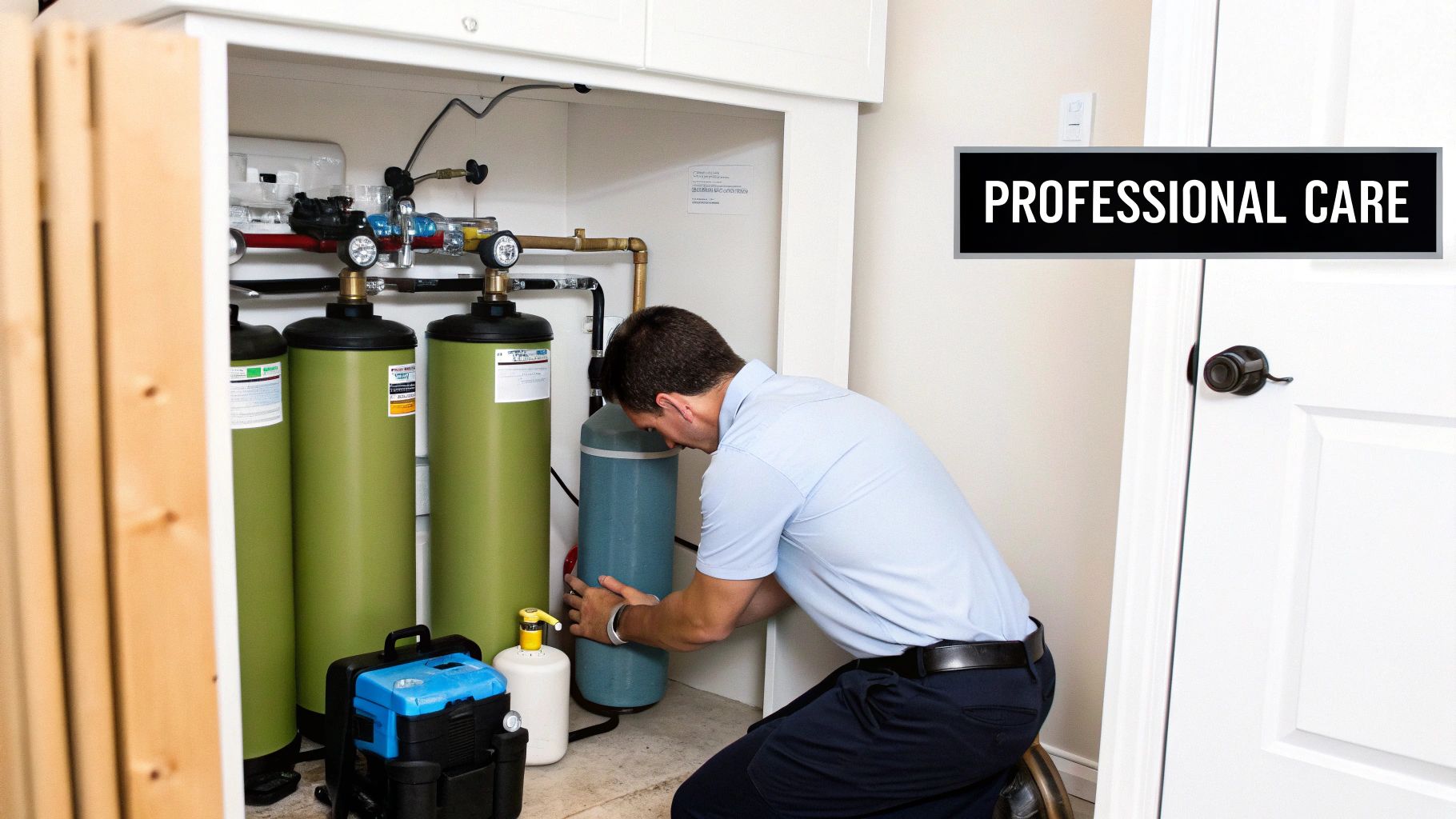
Why Professional Installation Is Non-Negotiable
Trying to DIY the installation of a sophisticated water treatment system is a common but very costly mistake. We get called out all the time to fix problems that started with a well-meaning but incorrect setup, and it almost always costs the homeowner more in the long run.
A professional installation from Water Medic means every single detail is handled correctly.
- Proper Placement and Space: We'll survey your garage or utility area to find the best spot that allows for both efficient operation and easy access for future service.
- Correct Plumbing Integration: Our team ties the system directly into your main water line using the right fittings and professional techniques to prevent leaks and pressure drops.
- System Calibration: We don’t just hook up the hardware. We program and fine-tune the system based on your specific water test results to get the most out of it.
The difference between a professional job and a DIY attempt is noticeable immediately. A properly installed system just works, humming along silently in the background. A poorly installed one creates constant headaches, from pressure drops during morning showers to leaks that can cause real damage. Getting it right the first time saves you money, time, and a ton of frustration.
Keeping Your System Running Smoothly
Once your system is up and running, a simple and consistent maintenance routine is the key to protecting your investment. While different systems have different needs, the upkeep is generally straightforward when you know what to do.
A water softener, for instance, just needs its brine tank topped off with salt periodically. An activated carbon filter will need its media swapped out every few years, and a reverse osmosis system requires new filters and membranes annually to keep its purification power strong.
To make this completely hands-off for our customers, we offer comprehensive service plans. These plans take all the guesswork out of maintenance, making us your long-term partner in water quality. Our technicians handle everything from routine check-ups to filter changes, ensuring your system performs at its best, year after year.
You can learn more about our proactive monthly maintenance services and see how we help protect your investment without you lifting a finger. This ongoing care is what ensures the best systems continue to deliver.
Why a Local Water Expert Matters
When you start digging into whole home water purification systems, it's easy to fall down a rabbit hole of online reviews or just grab a generic unit off the shelf at a big-box store. But here’s the thing: water in Southwest Florida is a different beast entirely. This is why choosing a local expert over a national chain or a general plumber can be the single most important decision for your system's long-term success.
Think about it. Those big-box stores are selling one-size-fits-all equipment designed for "average" water, which simply doesn't exist here. A general plumber is great at connecting pipes, sure, but they often lack the deep, specialized knowledge of water chemistry required for truly effective treatment. We, on the other hand, live and breathe the specific geology of Cape Coral and the surrounding areas—from the seasonal algae blooms in the canals to the pocket of high iron in a particular neighborhood.
The Local Advantage in Water Treatment
Our expertise is laser-focused on the challenges right here in our community. We have access to professional-grade equipment that is far more durable and effective than anything you'll find in a retail store. This lets us build solutions that precisely target the contaminants we find in your specific water test, rather than just taking a shot in the dark with a generic filter.
Choosing a local specialist means you're not just buying a product; you're investing in a partnership. We live and work in this community, so our reputation is built on accountability and delivering results that last. Your satisfaction is our business.
This commitment is clear from our very first step: a thorough diagnostic process. We’re not in the business of just selling equipment; we’re here to solve your water problems for good. Our deep understanding of local water ensures we recommend a system that not only works efficiently today but is also robust enough to handle potential changes in our water supply down the road.
Ready to stop guessing and get a real solution for pure, clean water throughout your home? Let's figure this out together. Take the next step and schedule your free water consultation with our team today. We’ll provide a clear, honest assessment and a plan built just for you.
Frequently Asked Questions
When you start digging into whole-home water systems, a few questions always come up. We hear them all the time from homeowners right here in Southwest Florida, so we’ve put together some straightforward answers to help you make sense of it all.
How Do I Know Which Water Purification System I Need?
Honestly, the only way to know for sure is to test your water. Grabbing a generic filter off the shelf at a big-box store is just a guess—it might do absolutely nothing for the specific issues in your water, whether that's hardness, iron, sulfur, or something else.
A professional water analysis is the crucial first step. It gives you a clear, scientific breakdown of what’s actually in your water. Armed with that data, we can recommend a system (or a combination of them) that solves your real problems instead of just putting a band-aid on them.
Will a Whole Home System Reduce My Water Pressure?
That’s a great question, and we get it a lot. The short answer is no, it shouldn't—not if it’s the right system for your home and it's installed correctly. Nine times out of ten, any pressure loss is because the unit is too small for the home's water demand or it was a DIY job that created a bottleneck in the plumbing.
When a licensed professional installs your system, we size it specifically for your home’s peak water usage. This means you can run the shower, dishwasher, and washing machine all at once without a drop in pressure. You get all the benefits of clean water with zero compromise.
What Is the Average Cost?
The price for a whole-home system can really vary, and that's because it's completely tailored to what your water actually needs. A simple water softener and carbon filter for someone on city water is going to be a different investment than a multi-stage system designed to tackle tough well water with high iron and bacteria.
After we test your water, we provide a clear, itemized quote so you know exactly what you’re paying for and why. Think of it as an investment not just in better water, but in protecting your pipes, fixtures, and expensive appliances from the long-term damage bad water can cause.
Ready to stop guessing and get real answers about your water? The team at Water Medic of Cape Coral is here to help you figure out the perfect solution for your home.