
Backyard Drainage Systems: A Homeowner’s Guide
If your Cape Coral yard turns into a shallow pond after a summer downpour, you already know the problem isn't “a little extra water.” It's the patch of grass that stays soft by the lanai, the mulch that washes into the patio edge, the pool deck that never really dries, and the muddy low spot that shows up every time the rain comes down hard. On Southwest Florida lots, backyard drainage systems are not a cosmetic upgrade, they're a site-wide water-management decision, and the wrong choice gets expensive fast.
The U.S. drainage system market was valued at USD 8.5 billion in 2024 and is projected to reach USD 12.3 billion by 2034 (Emergen Research). That demand makes sense when you look at residential costs too, because yard drainage installation averages about $4,619, with most projects between $2,144 and $7,162 (Emergen Research). In plain English, this is a normal property investment, not a niche repair.
The smartest move is to diagnose the yard before buying pipe, rock, or a trenching day. In flat, sandy, high-water-table neighborhoods, the right answer might be a French drain, but it might also be a swale, a dry well, or a hybrid layout that handles runoff, infiltration, and erosion together. A yard that stays soggy after storms is telling you exactly what it needs, if you know how to read it.
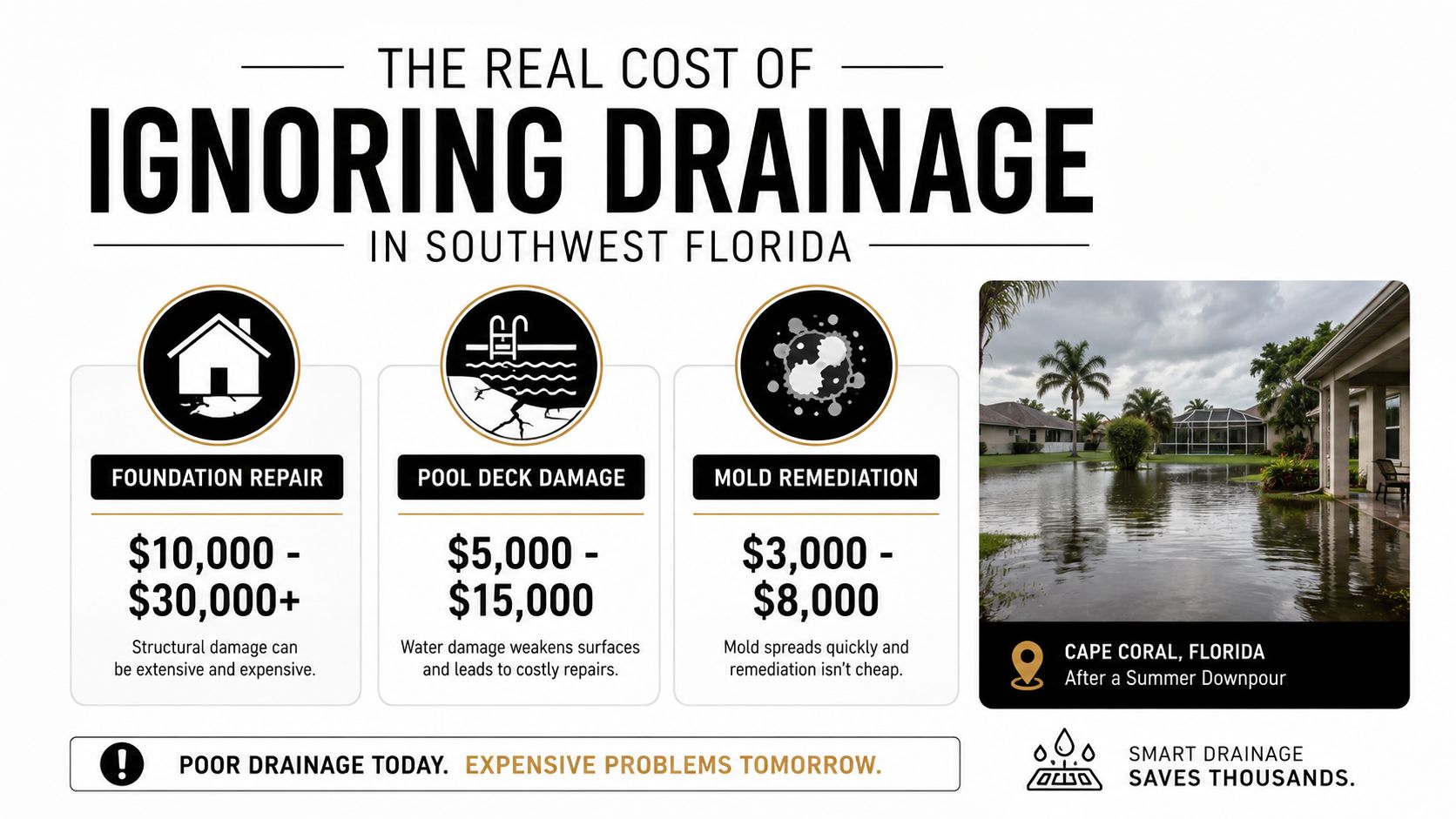
Why Backyard Drainage Systems Matter in Southwest Florida
Heavy rain in Southwest Florida exposes bad grading, overloaded downspouts, poor outlet choices, and low spots that trap water near the house, the pool deck, or the AC pad. The storm is not the problem by itself. The problem is a yard that has no smart path for water once it lands.
A 2,000-square-foot roof in a 2-inch-per-hour rainfall event can produce roughly 2,500 gallons per hour of runoff (Low Point Labs). That is a huge load for a flat lot, a narrow swale, or a drain line that cannot carry water out fast enough. The same planning logic is why impervious surfaces like roofs and concrete are assigned runoff coefficients of 0.90 to 0.95, while lawns on clay soil are 0.35 to 0.45 and lawns on sandy soil are 0.10 to 0.20 (Low Point Labs).
Why drainage problems become property problems
Water sitting near the foundation is part of the issue. Standing water also beats up turf, breaks down edge conditions, and raises humidity around the home. If your yard keeps holding water after storms, you are dealing with a drainage pattern, not a one-time puddle.
Practical rule: If the same low spot fills after every storm, stop treating it like a landscaping issue and start treating it like a water-routing problem.
Residential drainage spending tells the same story. Small yards often cost $800 to $2,000, large yards can exceed $12,000, and the average installation lands around $4,619. These figures come from a market overview on the U.S. drainage system market (Emergen Research). That is the price of fixing a recurring condition before it turns into a bigger repair job.
A proper yard check starts with what is happening on the property, not with a drain catalog. If you see repeated pooling, erosion lines, or water that hangs around after a storm, the site is telling you where the system is failing. In Southwest Florida, especially on flat sandy lots with a high water table, gravity drainage often runs out of room fast. That is why leak detection and moisture tracing belong in the diagnosis when the wet area does not match the rainfall pattern.
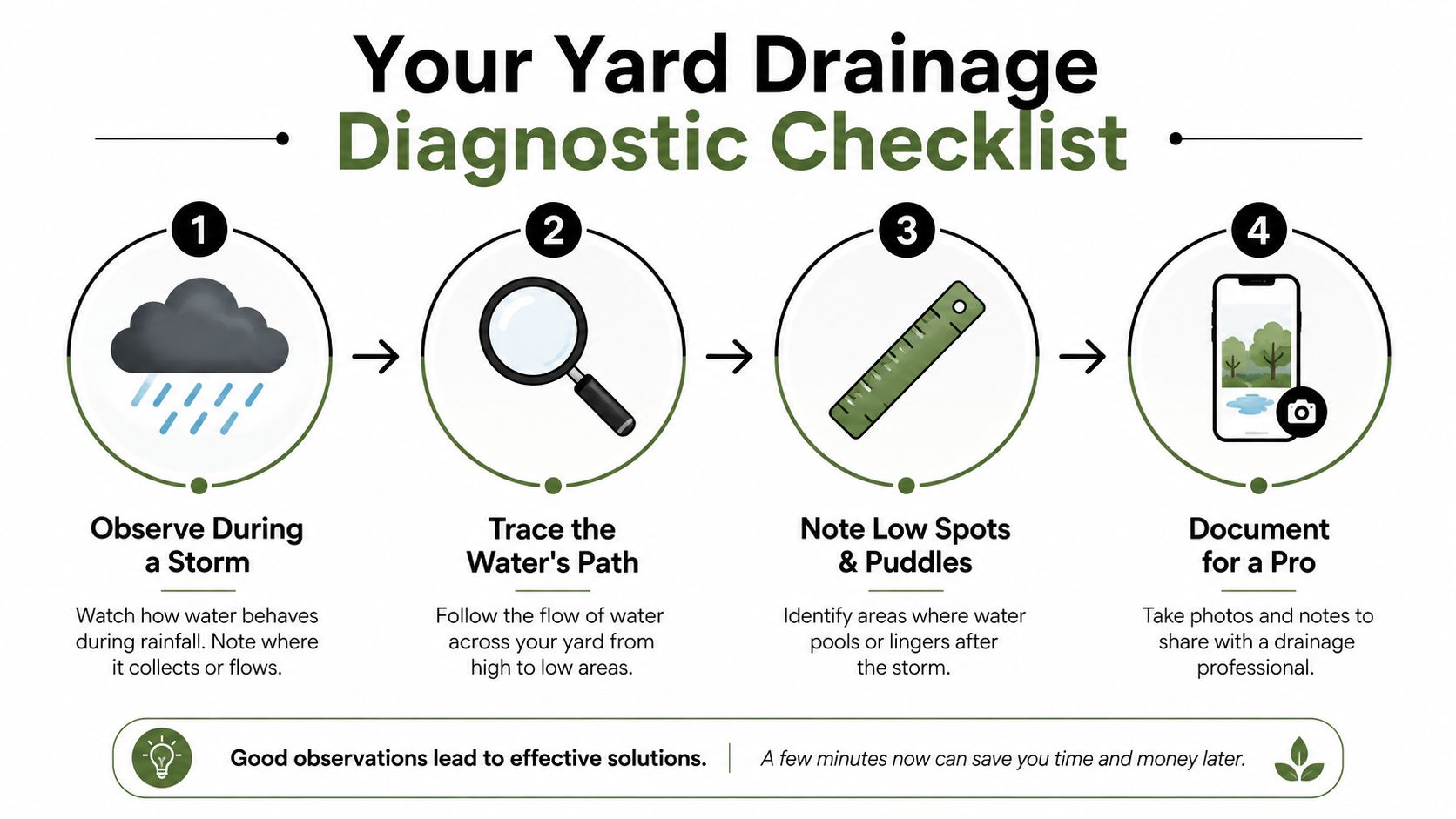
Diagnosing Your Yard's Drainage Problem
Start with a storm, not with a product catalog. Walk the property while it's raining or just after, and watch where the water travels, where it slows down, and where it stops. Tire ruts, mulch washout, and persistent damp edges are clues, not annoyances.
The first ten feet around the foundation matter most because that's where water does the most damage if it stays put. Check the slope with a long board and a level, and look for whether the grade carries water away from the house or pushes it back toward the slab. For exterior drainage, downspouts should discharge at least 5 feet from the foundation, and 10 feet is recommended for underground systems (University of Wisconsin-style exterior drainage guidance).
Separate surface water from subsurface water
A yard can have one problem, or two at the same time. Surface water shows up as visible pooling, washing, and sheet flow across hardscape. Subsurface water shows up as soggy turf that never really dries, even when the surface looks fine.
A simple hole-and-water test helps you see whether the soil can absorb what it gets. If water lingers, you're looking at a slow-draining zone, and that changes the fix. If runoff from the roof is the main issue, the fix is usually different from a site where the soil itself stays wet.
Write down three things, where the water starts, where it stops, and how long it sits. That short note is more useful than a vague “the yard floods.”
If you need a deeper site review, a focused service like water leak detection can help separate a drainage issue from a water-management issue elsewhere on the property. The point is to document the pattern before you spend money on the wrong system.
Comparing the Five Main Backyard Drainage Systems
The mistake I see most often is homeowners picking a drain type before they know what kind of water they're fighting. Surface water, groundwater, and roof runoff don't behave the same way, so the same tool won't solve all three. A good yard plan starts by matching the symptom to the system.
| System type | Best for | Typical cost range | Lifespan | Southwest Florida fit |
|---|---|---|---|---|
| French drain | Groundwater, saturated edges, basement-adjacent problem zones | Moderate to higher depending on length and outlet | Good when sized and maintained well | Strong, if there's a workable outlet and enough depth |
| Channel or strip drain | Patios, pool decks, hardscape edges, surface sheet flow | Moderate | Good with regular cleaning | Strong for hardscape runoff |
| Surface drain with catch basin | Low spots, roof runoff collection, visible pooling | Moderate | Good if debris is managed | Strong for point-collection problems |
| Swale and regrading | Broad yard-wide flow correction, gentle slope management | Low to moderate | Very good when grading is stable | Very strong on flat lots |
| Dry well or infiltration trench | No easy outlet, controlled dispersal, small-to-medium runoff capture | Moderate | Variable, depends on soil and maintenance | Mixed, depends on water table and percolation |
Surface drains versus groundwater drains
French drains are built to intercept water in the soil profile. Channel drains, catch basins, and swales are better when the problem is water moving across the surface or pouring off hardscape. If you install the wrong one, you'll still have a wet yard, you'll just have a more expensive wet yard.
For a French drain used in yard or patio drainage, the trench should be at least 22 inches deep and 14 inches wide, lined with 8-oz filter fabric, filled with 4 inches of clean rock, and fitted with 4-inch perforated PVC pipe placed perforations-down (Pacific Northwest National Laboratory stormwater guidance). The pipe should then be covered with 4 to 6 inches of more clean rock and topped with at least 9 inches of rock, stone, topsoil, or mulch (Pacific Northwest National Laboratory stormwater guidance).
A swale and regrade job is the quietest fix on the list, and on a flat Florida lot, it's often the right one. A dry well is useful when there's no clean place to send the water, but it only works if the soil and water table cooperate. That's why a hybrid design often beats a single long run of pipe.
What These Systems Cost in 2026
A soggy backyard can look cheap to fix until the bids come in. Then the actual bill shows up in the footage, the trench depth, the soil conditions, the discharge plan, and the cleanup needed to put the yard back together. A short surface fix is one price. A deeper system with fabric, rock, outlet protection, and restoration is a different job entirely.
What drives the budget up
Short runs cost less. Easy access costs less. A yard with a clear outlet, decent grading, and no surprises under the sod stays on the lower end.
Flat lots, a high water table, and discharge points that need protection push the price up fast. So do utility locates, trench restoration, permit checks, and HOA review. On Southwest Florida properties, those extras are not unusual. They are part of the job.
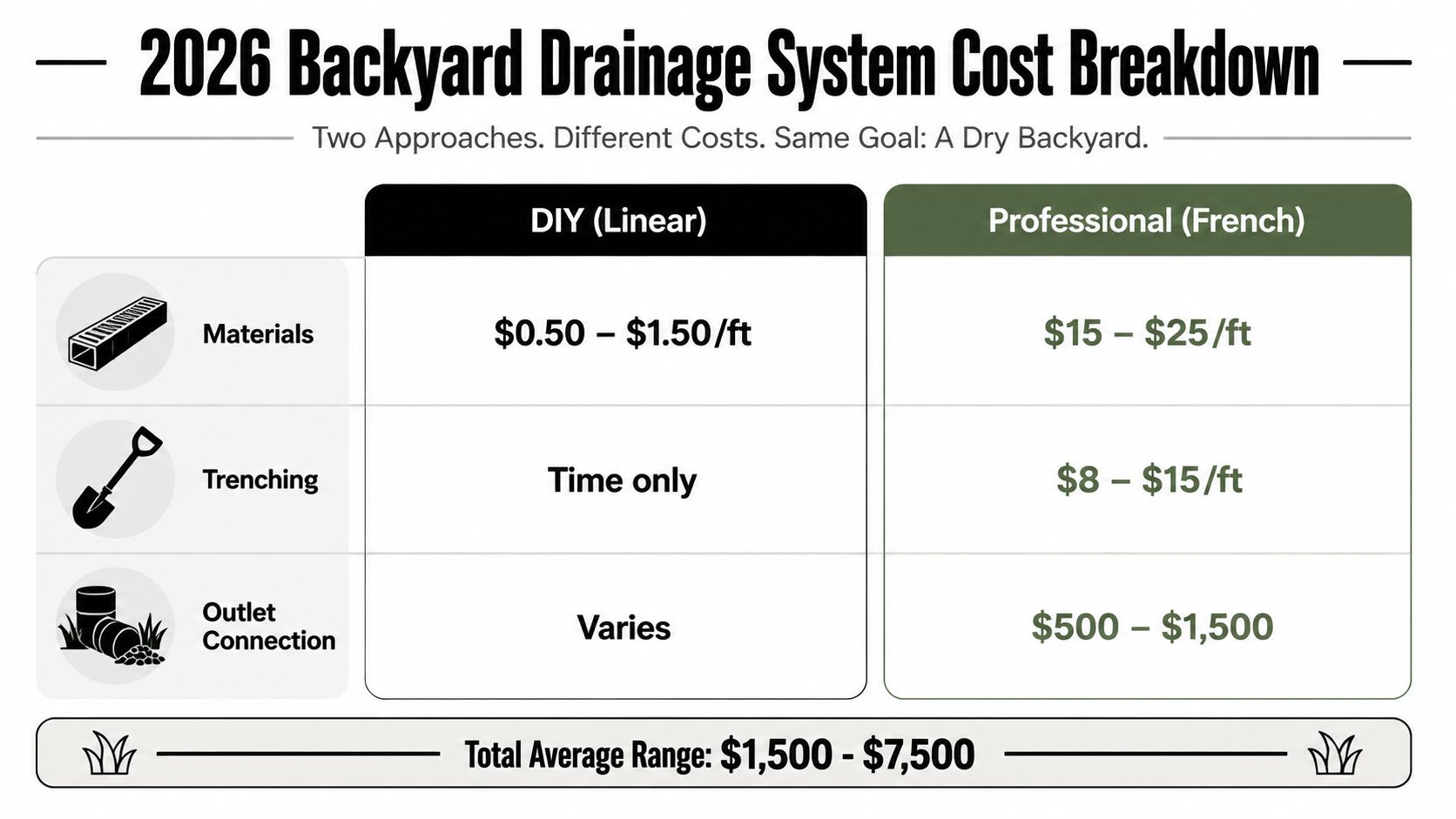
The residential market range is wide for a reason, with projects running from $800 to $2,000 on the low end to more than $12,000 on larger installs, with an average around $4,619 and many jobs landing between $2,144 and $7,162 (Emergen Research). That spread makes sense because backyard drainage is a site-specific build, not a box you buy off a shelf.
Why Southwest Florida often costs more
Cape Coral and Lee County lots usually need more planning around outlet protection and trench depth. Sandy soil moves water fast, but it also gives a trench less forgiveness if the layout is sloppy. If the system does not control the flow path, you pay once for the install and again to fix the failure.
Bottom line: Compare drainage bids by depth, outlet plan, and how much of the yard they effectively drain.
If you are weighing DIY against professional work, the price should reflect material placement, slope control, and a real discharge plan. A cost breakdown table comparing DIY linear and professional French backyard drainage systems by project expenses. gives a clean side-by-side view of where the money goes. The number at the bottom of the estimate means little if the system cannot move water away from the property.
Southwest Florida Site Conditions That Change Everything
A drainage layout that works in a higher-slope market can fall apart here because Southwest Florida doesn't give you the same margin for error. The seasonal water table, sandy soils, summer downpours, and outlet constraints change the whole game. That's why a generic drainage answer usually fails on a Cape Coral lot.
Why the ground itself changes the decision
Sandy soil moves water quickly, but that doesn't automatically make it easy to control. It can also shift, settle, and leave a trench unsupported if the build is sloppy. A French drain that looks great on paper can end up sitting too close to groundwater if the site is flat and the trench is shallow.
Why discharge options matter more here
Many homeowners ask whether runoff can go to the street, the swale, or a dry well. Sometimes it can, sometimes it can't, and the right answer depends on the lot, the grading, and local rules. In flat neighborhoods, the effective fix is often a hybrid: a short French drain where water collects, a swale where it can move across the yard, and a dry well or infiltration point where there's no direct outlet.
The planning question matters because a drain system only works when water has somewhere to go. If there's no lower point to reach, pipe alone won't save the yard. That's why the old “just install a French drain” advice misses so many Southwest Florida properties.
You should also think about how the system fits the site as a whole. The pipe, the slope, the outlet, and the hardscape all interact. On a flat lot, that's the difference between a dry patio edge and another project that never quite clears the puddles.
DIY Fixes and Routine Maintenance That Actually Work
Some drainage work is absolutely homeowner-friendly. Extending downspouts, cleaning basins, and correcting a small low spot are reasonable weekend jobs if you know where the water needs to go. The goal is simple, move water away from the structure and stop letting debris choke the system.
A short channel drain under a patio edge is one of the better DIY projects because it solves a visible surface-flow problem without turning the entire yard into a trench job. Regrading a tiny low spot can also work if the fix is shallow and the surrounding grade already supports the right fall. The job gets hard when you're trying to force water uphill or when the outlet is too small.
Keep the system working through storm season
- Clear grates and basins: Remove leaves, mulch, and sand before storms so water can enter the system.
- Check outlet points: Make sure the discharge point isn't buried, eroded, or blocked by settling.
- Inspect downspout extensions: Confirm they still move roof water well away from the foundation.
- Watch for new depressions: Settling around a discharge area usually means the grade is changing and needs attention.
- Look for recurring slow spots: If the same area stays wet, the system may be undersized or clogged.
The maintenance side matters more than most homeowners expect. If you want a practical checklist you can keep up with, use the monthly maintenance guide as a routine rather than waiting for the next big storm. Clean systems work better, and neglected ones usually fail in the same places every time.
The mistakes to avoid are simple. Don't undersize the pipe, don't skip filter fabric where it belongs, and don't tie a yard drain into a sanitary line. If the outlet, slope, or trench depth is beyond what a weekend fix can handle, stop there.
When to Hire a Professional Drainage Installer
Hire a pro when the water sits too long, the ground keeps moving, or the outlet options are bad. If standing water doesn't drain in 24 hours, if pool deck or foundation areas keep cracking, or if the only available outlet is uphill, the job is out of DIY territory. That's not a judgment, it's just a better use of time and money.
A quality site visit should produce more than a verbal guess. You want a written drainage plan, a sketched layout with slope and pipe size, and a clear scope of work. If the contractor can't explain where the water starts, where it ends, and why that route makes sense, keep looking.
What a local specialist brings
A Southwest Florida specialist understands how the water table changes the trench design, how sandy soil affects stability, and how local permitting can shape the project. That local knowledge matters because drainage is never just about digging. It's about reading the site correctly before a shovel ever touches the ground.
For homeowners who want a deeper look at what a capable water-management setup may include, the pumps page is a useful place to compare system components against your yard's actual conditions. Water Medic of Cape Coral brings more than 25 years of experience serving Cape Coral and Lee County homeowners and pool owners, which matters when the fix has to work in real Southwest Florida conditions.

Putting It All Together for Your Yard
Start with the pattern, not the product. Document where water collects, how long it stays, and what it hits on the way there. Then match the symptom to the system, because a yard with sheet flow on a patio needs a different answer than a low, saturated corner or a roof runoff problem.
If your lot has room to regrade, that may beat an underground system. If the water comes from the surface and the hardscape, channel drains and catch basins make more sense. If the site has no easy outlet, a dry well or hybrid layout may be the only realistic path.
The cheapest-looking fix is rarely the best over time. In a climate with frequent storms, a high water table, and lots that don't drain themselves, the winning move is the one that solves the actual site condition instead of masking it.
Use three questions before you spend a dollar: where does the water come from, where can it legally and physically go, and who should build it. If the answers are fuzzy, you don't need another guess, you need a proper assessment. That's how you get from a soggy yard to a system that holds up.
If you're done guessing and want the yard evaluated by a local team that understands Southwest Florida drainage, contact Water Medic of Cape Coral. They can assess the site, explain the right drainage approach, and help you choose a practical solution that fits your property instead of fighting it.