Pool Service Queen Creek AZ: Costs and Whole-House RO Guide
Queen Creek counted 59,519 residents in the 2020 Census, and the Census Bureau's estimate for July 1, 2025 puts the town at 89,770, according to the Census Bureau QuickFacts table for Queen Creek. That's a town that added households faster than it added anything else, and most new backyards here come with a pool.
A pool and a household water supply get judged by two different people on two different days. The pool tech reads free chlorine and pH at the edge of the water. A lab reads hardness, total dissolved solids and whatever else shows up in a sample. Both readings answer the same question about the same house: what does this water need, and how much of it?
Treat pool care and whole-house reverse osmosis as two separate contracts and you pay twice for the same information. Treat them as one water decision and the pool's chemistry log tells you how hard the water is working, while the lab report from the kitchen tells you how big the treatment system has to be. That's the working method behind any pool service Queen Creek AZ homeowners should expect: readings first, equipment second, and the same discipline applied to the tap as to the pool.
Pool Service Costs and What Each Visit Includes
| Service | What It Covers | How Often | Pricing |
|---|---|---|---|
| Weekly maintenance | Skimming, brushing, basket emptying and chemical testing | Weekly | Monthly plan, quote on request |
| Chemical balancing | Chlorine added as needed, pH and balance adjustments | As needed, after weekly test | Quote on request |
| Annual service visit | Full review of equipment and water chemistry | Once a year | Quote on request |
| Pool startup | 30-day startup for new or neglected pools | Once | Quote on request |
| Equipment repair | Pumps, filters, heaters and other major brands | As needed | Free estimate |
Weekly maintenance is the anchor of the budget and the only line item most homeowners need. It covers skimming, brushing, basket emptying and a full chemical test, and it's sold as a monthly plan so the number stays flat whether the pool is crowded in July or quiet in January. We run weekly plans for residential and commercial properties, and the visit sequence doesn't change between the two.
Chemical balancing is priced apart from labor because it can't be predicted. Chlorine goes in when the week's test calls for it, not on a fixed calendar, and pH or alkalinity adjustments are billed per the quote. A screened pool with two swimmers may take almost nothing in a cool month and a good deal more after a dust storm pushes a load of fine grit into the water.
Two more rows deserve attention. The annual service visit reviews equipment and chemistry once a year, which is where a capacitor on its way out or a filter that's channeling gets caught before it becomes a mid-July failure. A 30-day startup handles new plaster or a pool that's been sitting unattended, and it's quoted before the first day of work rather than after. Equipment repair covers pumps, filters, heaters and other major brands, and every repair begins with a free estimate, so you know the number before anyone touches the pad. Larger jobs run through our pool equipment repair service, where the estimate comes first and the parts list comes with it.
Recurring service makes sense for a market like this one. 90.2% of occupied housing units in Queen Creek were owner-occupied during 2020–2024, and the median value of owner-occupied homes was $635,400, per Census Bureau QuickFacts. Owners in that bracket keep a pool for a decade or more, and a decade of skipped chemistry is what turns a small repair into a resurfacing.
Three questions to ask before signing anything:
- What does the weekly visit include? Get the task list in writing, including whether vacuuming is as-needed or scheduled.
- How are chemicals billed? Flat rate or actual usage, and whether the quote is a ceiling or an estimate.
- Are repairs quoted in writing before work starts? A provider who won't put a repair number on paper is telling you something.
A monthly plan you can predict beats a cheaper plan with a surprise chemical bill every August.
Pool Chemistry Targets and Summer Service Triggers
| Parameter | Target | Why It Matters |
|---|---|---|
| pH | 7.0–7.8 | Higher pH shifts chlorine toward a weaker form |
| Free chlorine without CYA | At least 1 ppm | Baseline sanitizer level |
| Free chlorine with CYA or dichlor/trichlor | At least 2 ppm | CYA reduces the chlorine available to sanitize |
| Managed pool residual (Arizona benchmark) | 1.0–3.0 ppm | Reference for HOA, apartment and hotel pools |
| Managed spa residual (Arizona benchmark) | 3.0–5.0 ppm | Reference for managed spas |
Routine testing targets pH 7.0–7.8 and free chlorine of at least 1 ppm when cyanuric acid isn't used. If CYA or stabilized products such as dichlor or trichlor are in play, the CDC recommends at least 2 ppm free chlorine, because CYA reduces chlorine's disinfecting availability, as set out in the CDC guidance on home pool and hot tub water treatment.
The mechanism is worth understanding once. As pH rises, a larger fraction of chlorine converts from hypochlorous acid, the form that does the disinfecting, into hypochlorite ion, which does much less. The dose stays the same and the kill rate drops. That's why total chlorine alone can look healthy while the water isn't, and why free chlorine, pH and CYA get measured as three separate numbers every week. We test chemistry on every weekly visit and add tablets only as those readings call for it, never as a habit.
Managed facilities carry a firmer benchmark. Arizona pool rules require chlorine equipment able to hold a 1.0–3.0 ppm free chlorine residual in pools and 3.0–5.0 ppm in spas, with complete circulation through all pool areas and an adjustable automatic feeder. A sample pulled near a return can read fine while a corner of the pool sits short, so feeder calibration and return performance get checked on the same visit as the chemistry.
Summer rewrites the schedule. Intense UV, high temperatures and dust storms deplete chlorine faster and strain equipment, and Arizona heat maintenance guidance notes summer evaporation can pull several inches of water out of a pool in a week. Book an extra visit after a monsoon dust event, visible cloudiness, an algae bloom, or a large water addition, in that order of urgency.
Escalation rule: if free chlorine won't hold a day after a dose, stop dosing and test CYA, circulation and filter pressure instead. More chemical is the wrong answer.
After severe weather, run the same five checks before adding anything: free chlorine, pH, CYA, water level, and pump operation.
Why Whole-House Reverse Osmosis Protects Every Tap
A kitchen filter treats one faucet. Whole-house reverse osmosis supplies treated water to every fixture, so the design has to account for the household's water quality and demand.
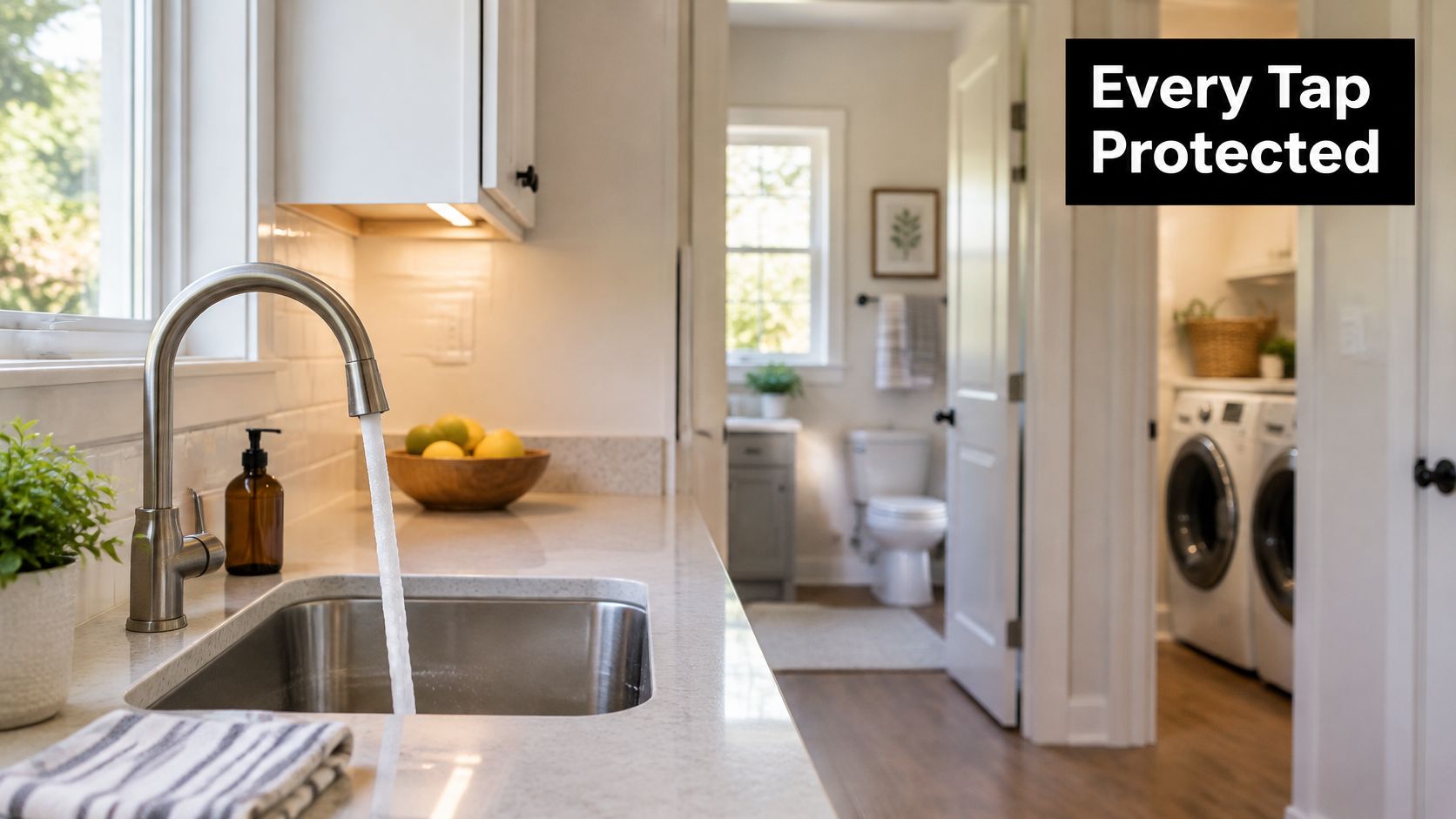
Point-of-use filters leave showers, laundry taps and other bathrooms untreated. Whole-house treatment can simplify maintenance by putting the home on one system and one service schedule. The trade-off is that the system must be sized for the water test and the demand from fixtures that may run at the same time.
Pool chemistry and household water quality are parts of the same water decision. Pool readings help define the service plan; lab results guide whole-house treatment and system size. Water softeners address hardness, while reverse osmosis treats dissolved solids and other contaminants identified by the lab. If scale is the main concern, consider water softeners before adding RO as a further treatment step.
Start with the test, not the brochure
Three questions shape the specification: What does the water test show? What does the household want treated? How many people and bathrooms will the system serve? Hardness, total dissolved solids, iron, sulfur and nitrate can each affect treatment choices. Taste and odor concerns call for a different target than nitrate or arsenic.
For private-well water, lab results provide the basis for choosing treatment. The Florida Department of Health in Lee County recommends testing well water for bacteria and nitrate at least once a year, provides sampling instructions through county health departments, and lists typical testing costs of $20 to $30 per sample.
Water Medic of Cape Coral can enforce a higher water quality standard on a privately owned, direct-to-consumer reverse osmosis system, with the system sized from the homeowner's lab results. The right specification matches those results to household demand, rather than relying on a product brochure or a broad purity claim.
How Reverse Osmosis Works and How Much Water It Sends to Drain
Reverse osmosis uses pressure to push feed water through a semipermeable membrane, producing treated water and a concentrated reject stream. The process runs in five stages.
- Feed water enters. A sediment pre-filter catches grit before it reaches the membrane.
- Pressure builds. A pump pushes water against the membrane, driving the separation.
- The membrane splits the stream. Water passes through; dissolved solids and other retained material remain in the reject stream.
- Treated water goes to storage. Permeate collects in a pressure tank, providing a buffer when household demand rises.
- Reject water leaves. The concentrated stream carries retained material to the drain.
The reject-water ratio deserves attention:
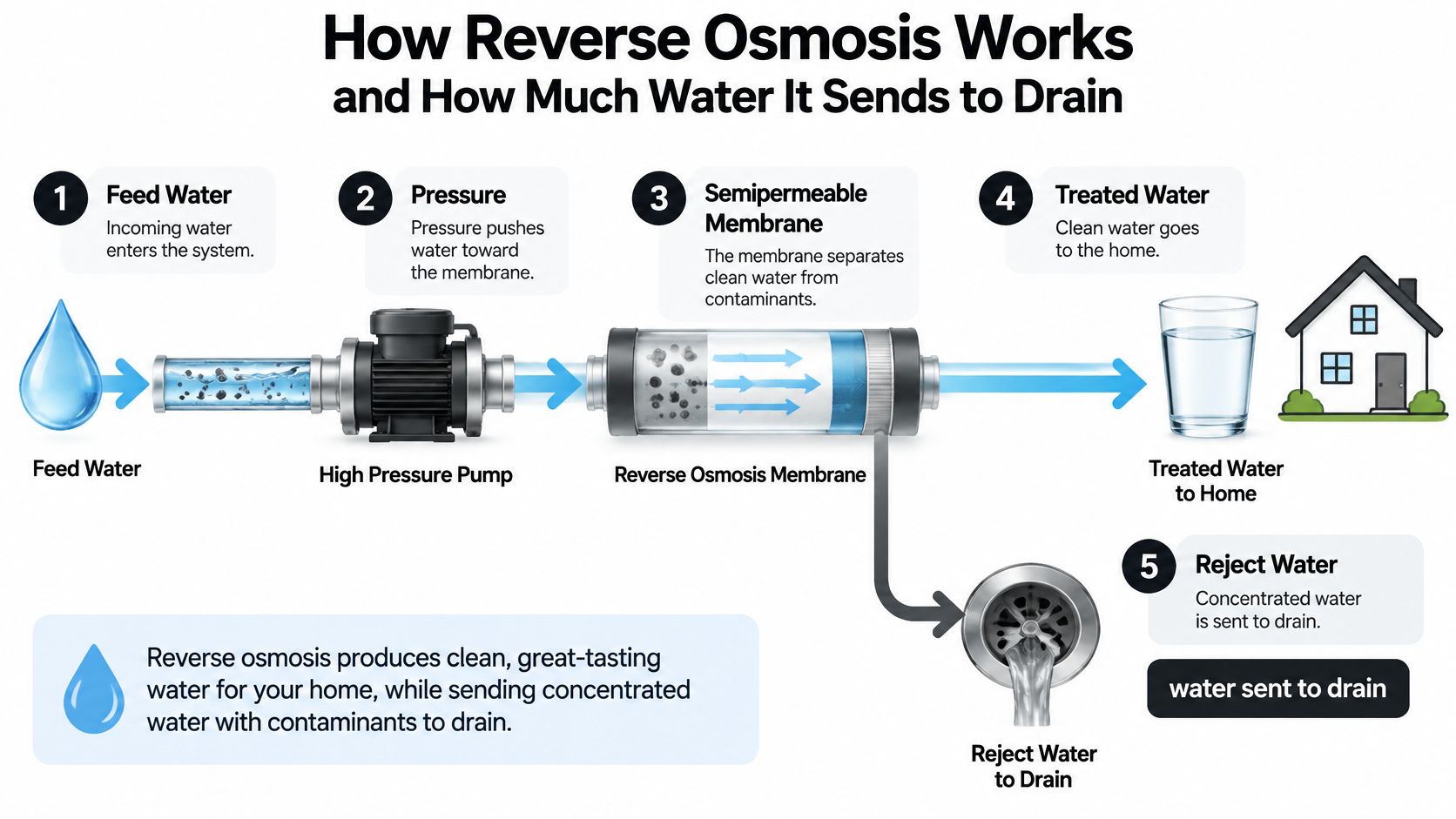
The EPA WaterSense guidance on water purification puts a typical point-of-use RO system at five gallons or more of reject water per gallon treated. Inefficient systems can send up to 10 gallons to drain per gallon produced. WaterSense-labeled units send no more than 2.3 gallons per gallon treated.
| System Type | Reject Water per Gallon Treated | What It Means |
|---|---|---|
| Typical point-of-use RO | Five gallons or more | A baseline for comparing units |
| Inefficient RO | Up to 10 gallons | Higher drain volume |
| WaterSense-labeled RO | No more than 2.3 gallons | Lower drain volume among labeled units |
| Whole-house RO | Ask provider for recovery rating | Get the rating in writing before purchase |
Reject water has been pumped and filtered, but it never reaches a tap. A system sending five or more gallons to drain per gallon treated can add up over a decade, so compare recovery ratings before choosing a whole-house unit.
Queen Creek is developing water-resource and capacity fees in response to groundwater concerns. The town reports cutting groundwater pumping by roughly 6% through a drought-proof supply investment and relying on the Colorado River for about 10% of its supply, according to the town's water resources document.
Ask for the system's recovery rating and how it handles reject water. A higher recovery rating means less water sent to drain for the same treated output. Confirm the proposed unit's storage capacity as well, so its supply can meet household demand.
Ask the provider to put the recovery rating in the quote. A ratio is more useful than a general claim of efficiency.
Certification and Sizing Checks Before You Buy
A system that "purifies water" is a marketing sentence. A system with certified reduction claims is a documented machine, and the gap between the two is where most bad purchases happen.
What NSF/ANSI 58 actually certifies
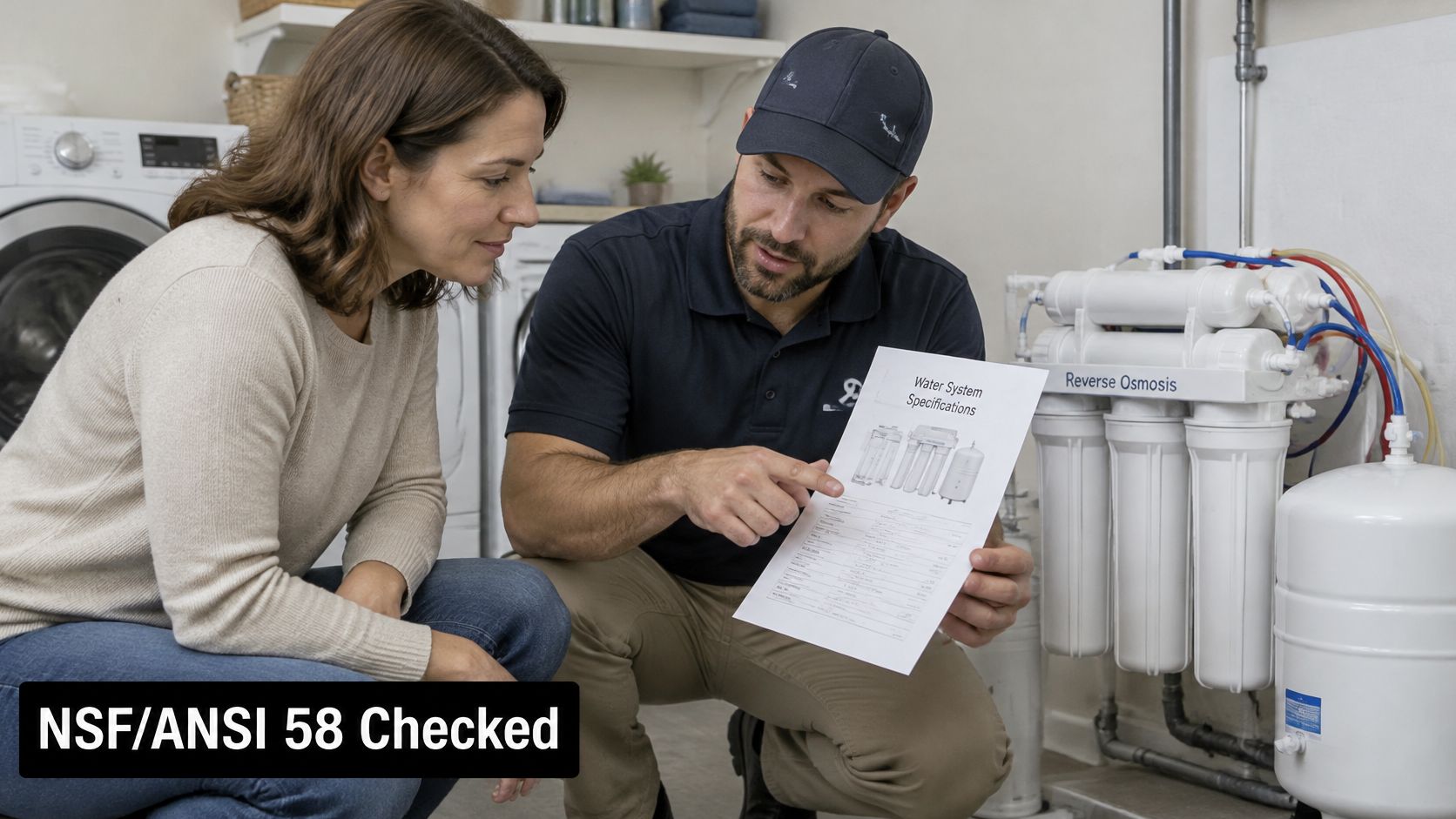
NSF/ANSI 58 is the recognized testing framework for reverse osmosis drinking-water treatment systems, and it separates independently evaluated performance from a broad claim of purity, as the NSF standard overview for reverse osmosis systems explains. Its categories include total dissolved solids reduction, contaminant-reduction claims, efficiency rating and recovery rating.
| Category | What It Measures | What to Request |
|---|---|---|
| Total dissolved solids reduction | How much dissolved solids the unit removes | Certified TDS reduction data |
| Contaminant reduction claims | Specific contaminants the unit is certified to reduce | Certified claim list matched to your lab report |
| Efficiency rating | Treated water produced compared with reject water | Efficiency rating for the proposed model |
| Recovery rating | Share of feed water converted into treated water | Recovery rating in writing |
Read the contaminant list against your own lab report rather than against the brochure. If nitrate shows up on the report, the unit needs a certified nitrate reduction claim, not a general statement about clean water. A TDS number on its own tells you nothing about iron, sulfur or bacteria.
Sizing the system to the house
Sizing is arithmetic plus judgment. Count occupants, count bathrooms, note whether the household fills a tub daily or runs a load of laundry every morning, and find the peak simultaneous flow the house can demand. Then match that demand to a system with a tank and membrane that won't short-cycle.
Build the specification from the lab results outward. A house with hard water and high TDS needs different pre-treatment than a house with sulfur odor, which is why we treat well water with systems catered to each well's specific water test results rather than a single catalog model. If you only want kitchen water treated, say so plainly and start with under-sink reverse osmosis. If every shower and every load of laundry should get the same water, that's a whole-house decision and it needs a bigger number.
The pre-quote checklist
Bring these four items to the quote meeting and the comparison stops being about price alone:
- Certified reduction claims covering every contaminant on your lab report, in writing.
- Recovery and efficiency ratings for the exact model proposed, not the product family.
- Pre-filter and membrane replacement intervals, because consumables determine the ten-year cost.
- Warranty terms covering the membrane and the storage tank, not just the housing.
No test results, no sizing. A provider who'll quote a whole-house system before seeing a lab report is guessing with your money, and the guess usually lands on a membrane that's either undersized for the household or oversized for the actual water.
Choosing a Pool and Whole-House Water Provider
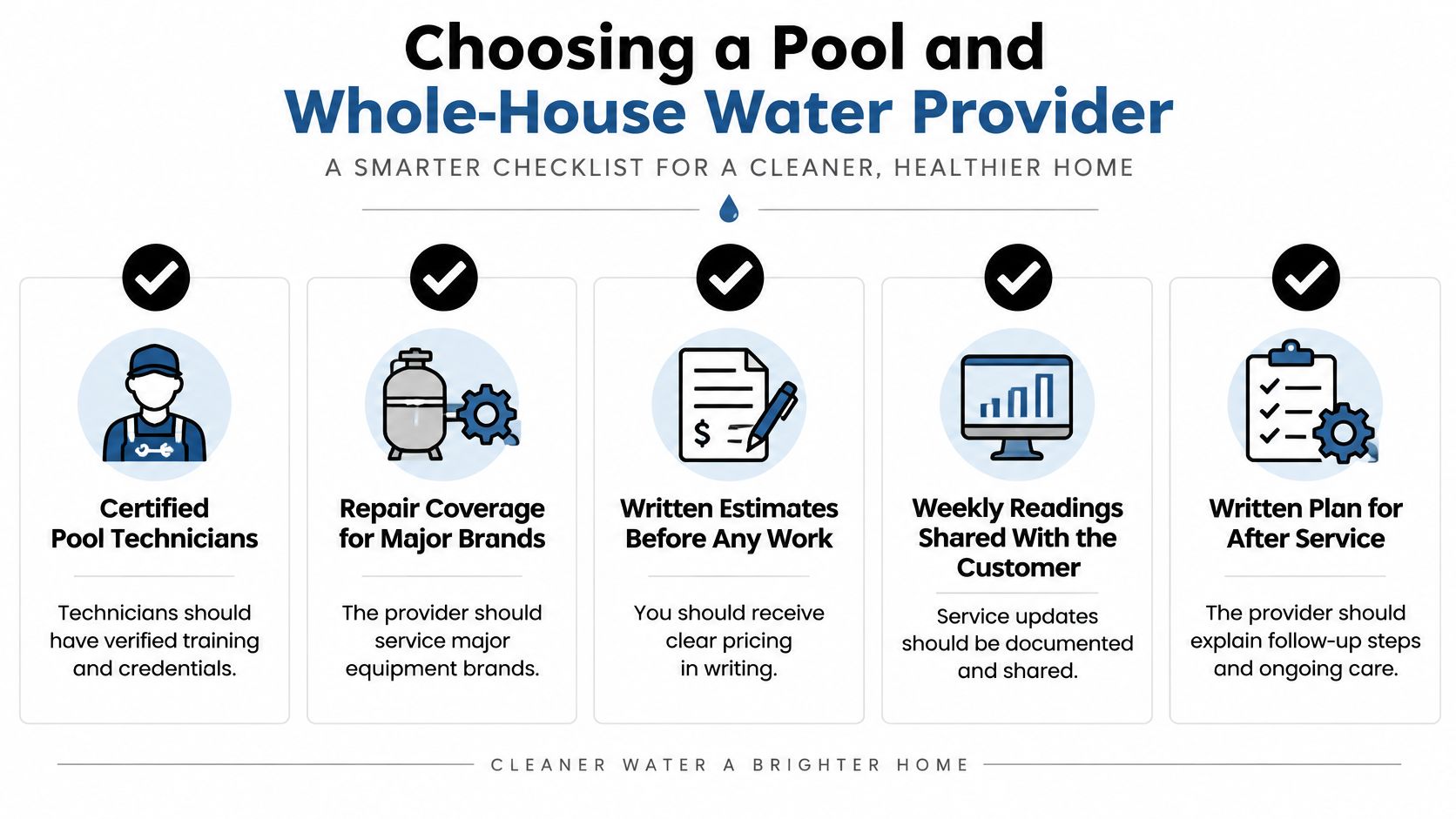
Run the same criteria against every bid, pool and water treatment alike, and the shortlist usually falls out on its own.
- Certified technicians. Chemistry and equipment decisions should be made by someone with formal training. Our pool technicians hold CPO (Certified Pool Operator) certification, so the person reading your numbers has been tested on them.
- Repair coverage for major brands. A repair stalls when the tech doesn't know the equipment, and stalling in August is expensive. We repair all major brands of swimming pool equipment.
- Written estimates before any work. Free estimates on pool equipment and repairs are standard for us, and the number should exist before the job starts.
- Readings shared with the customer. A service report with free chlorine, pH, CYA and any chemical added is what makes trends visible. Without it, every visit starts from zero.
- A written plan after the visit. What gets watched, what gets replaced next, and what triggers an extra call.
Water treatment adds one criterion the pool side doesn't need: certification documents for the exact system proposed. Ask for the NSF/ANSI 58 listing, the recovery rating and the membrane warranty as paperwork, not as a verbal assurance. A provider who can produce all three within a day is organized. One who can't is improvising.
Confirm coverage before you book. Water Medic of Cape Coral is based in Cape Coral, Florida, and serves homes and pools across Southwest Florida, so a Queen Creek address needs to be verified with us first rather than assumed from a service map.
Red flags are consistent across both trades. No test readings on the report. Chemicals added without a test to justify them. Pricing that shifts once the work begins. No answer on whether your address is covered. No certification documents for treatment equipment, or a claim that certification "isn't necessary" for residential systems. Any one of those is enough to keep looking.
A provider who hands you the readings and the paperwork is usually the one who also shows up in week six.
Book Your Pool Check and Water Test
Work through these in order, because each step feeds the next.
- Request a free estimate for any pool equipment repair or upgrade, so the number is on paper before the work is scheduled.
- Choose a plan that fits the monthly budget. Weekly service for routine care, or a 30-day startup if the pool has been sitting neglected.
- Schedule the annual service visit to review equipment, chemistry and seasonal preparation in one sitting.
- Order a water test for the house, then request a whole-house reverse osmosis evaluation built from those lab results rather than from a square-footage rule.
- Confirm your address is covered before booking, since our service area is Southwest Florida.
Pool care protects the equipment and the water in it. Whole-house reverse osmosis protects every tap in the house. Both start the same way, with written readings and a specific plan attached to them.
Water Medic of Cape Coral handles both halves of that plan: weekly pool service plans, CPO-certified technicians, free estimates on equipment and repairs, and whole-house reverse osmosis systems sized from your own lab results rather than a generic chart. If you're tired of guessing what's in the water at the kitchen tap, start with the test and let the numbers pick the system. Visit Water Medic of Cape Coral to request a water evaluation or a pool service quote.