
Pool Scaling Treatment: A Practical Guide for SW Florida
You step onto the lanai, run your hand across the waterline tile, and feel a rough white crust that wasn't there a few months ago. The pool may still look inviting from a distance, but a faint haze, chalky ring, or gritty spa spillover tells a different story. In Southwest Florida, pool scaling treatment works best when you correct the water chemistry and the source water behind the deposit, not when you keep scraping the same spots.
For Cape Coral and Lee County homeowners, that source may be city water, a private well, or water treated through reverse osmosis. Each refill adds dissolved minerals to the pool. If the water balance keeps favoring calcium carbonate, the scale will return after another hot, evaporative season. The practical answer is to identify the chemistry, choose the least aggressive treatment that fits the damage, and reduce the mineral load entering the pool.
What Pool Scaling Looks Like in a Real SW Florida Pool
A Cape Coral homeowner often notices the problem at the waterline first. The pool looked clean in spring, but after weeks of heat and evaporation, a white, chalky ring begins creeping across the tile just above the water. The surface may develop a faint haze, while the spa spillover feels rough under a fingertip instead of smooth and polished.
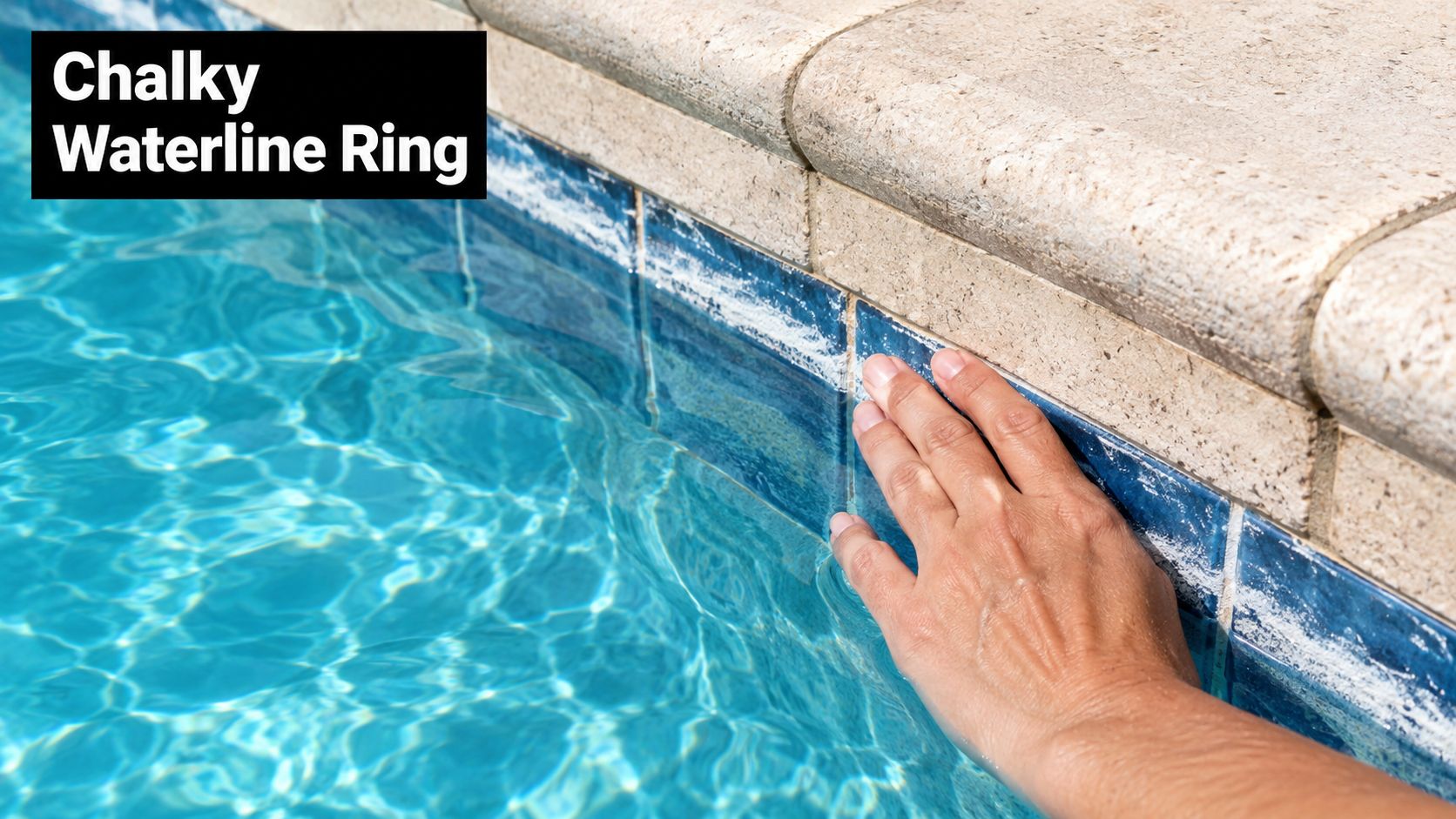
That crust is usually calcium carbonate scale, not ordinary dirt. Evaporation removes water but leaves dissolved minerals behind, and repeated top-offs add more mineral content. A private well can carry a heavier hardness load than treated city water, while post-RO water may reduce hardness but still requires careful pool balancing. The chemistry determines whether those minerals stay dissolved or attach themselves to tile, plaster, salt cells, and heating equipment.
The first visual signs are easy to dismiss because they look cosmetic. They aren't. Scale indicates that the water has moved toward precipitation, which can affect plaster, tile, heaters, and circulation equipment, as described in this technical overview of pool scaling and calcium deposits.
Practical rule: If the rough ring returns soon after cleaning, the deposit isn't the root problem. The water is still creating the deposit.
A homeowner may try a pumice stone, brush, or acid wipe and see immediate improvement. That can remove the visible layer, but it doesn't change the saturation conditions that created it. For persistent deposits, proper pool scaling treatment starts with testing pH, alkalinity, calcium hardness, temperature, and the overall saturation index.
A service visit through Water Medic's swimming pool services can help separate a surface-cleaning job from a water-source problem. That distinction matters in SW Florida, where every refill, storm-related top-off, and evaporative loss can restart the same cycle.
The Chemistry Behind Pool Scaling Treatment
A pool can look clean at the waterline while its chemistry is already preparing calcium carbonate deposits. The Langelier Saturation Index, or LSI, brings the main variables into one working calculation: pH, temperature, total dissolved solids, carbonate or bicarbonate alkalinity, and calcium hardness. It estimates whether water is balanced, likely to form scale, or aggressive toward calcium-based surfaces, as explained in this APSP LSI fact sheet summary.
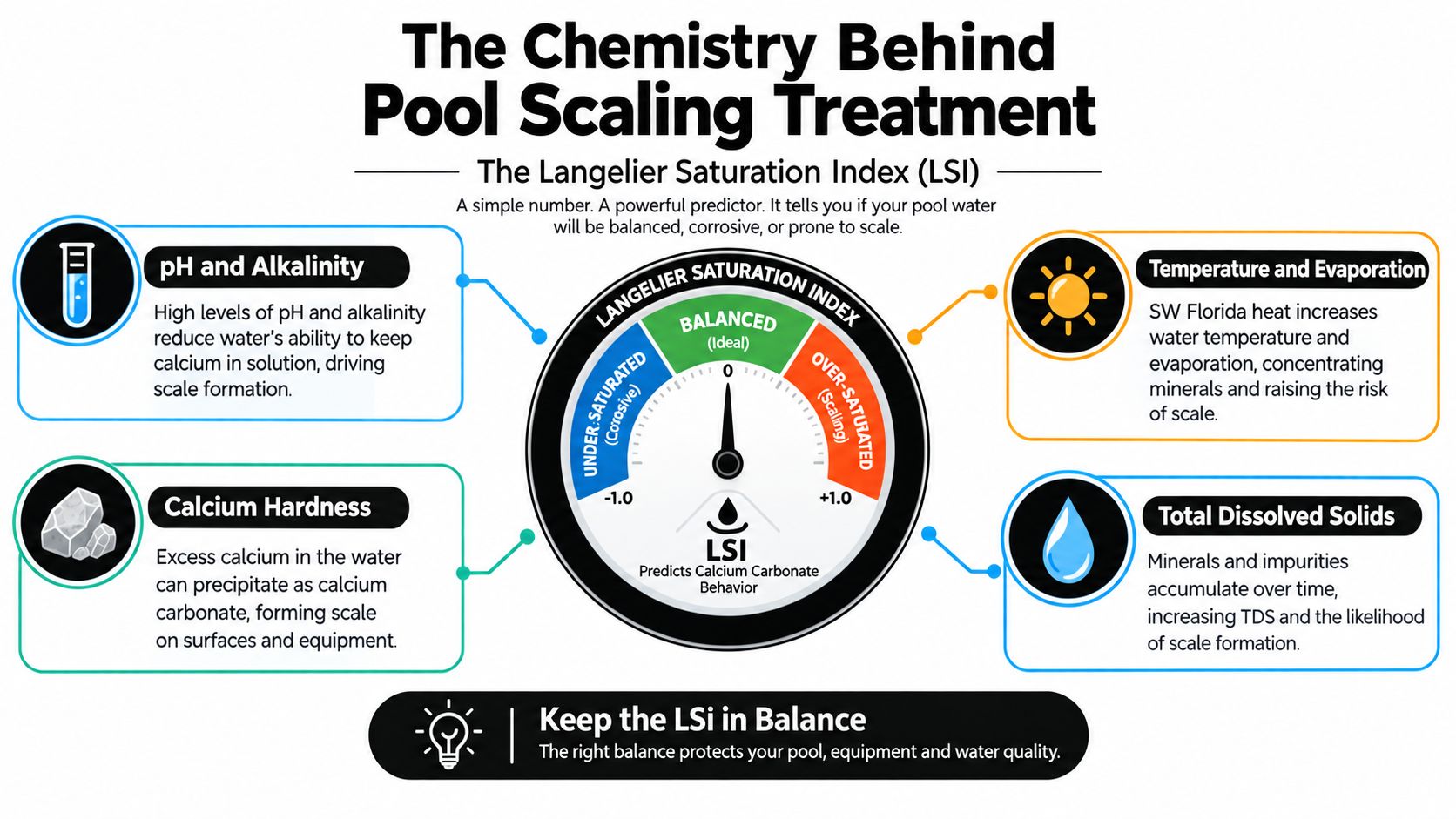
At LSI = 0, the water is considered balanced. A positive reading indicates increasing scale-forming potential, while a negative reading means the water is more aggressive toward calcium-based materials. APSP guidance has historically used an operating window of approximately -0.3 to +0.5. Once the reading rises above +0.3, calcium carbonate deposition becomes more likely. These ranges are summarized in the same LSI guidance for pool water balance.
Consider water at pH 7.8, with 500 ppm calcium hardness and a temperature of 84°F. Those figures cannot produce a complete LSI calculation without alkalinity and dissolved solids, but they show how warm water, high pH, and substantial calcium hardness can push conditions toward scale. Evaporation and alkaline fill water add pressure as the pool concentrates.
That connection matters in Cape Coral and across Lee County. Well water may bring a heavier mineral load, while RO-treated water changes the hardness profile without removing the need for careful balance. The pool inherits part of the source-water chemistry every time it is filled or topped off.
Salt systems add a concentrated trouble spot. A salt cell produces chlorine at electrically active plates, and deposits can form there when the pool's saturation balance is already positive. More hard fill water adds mineral load rather than correcting the condition.
Treatment depends on sequence. Lower pH, adjust alkalinity, manage calcium hardness, and use a suitable sequestrant when appropriate. For deposits that need to dissolve rather than only be scrubbed, technical guidance recommends a slightly negative saturation condition, roughly -0.30 to -0.01 LSI, with circulation and brushing. The process is detailed in this guide to LSI balance and calcium management.
Key Water Balance Factors That Drive Scaling
Four variables determine how quickly a SW Florida pool develops deposits: pH, total alkalinity, calcium hardness, and temperature. They interact, so changing one can alter the others. Test first, then adjust the factor creating the greatest pressure instead of adding several chemicals at once.
| Factor | Target Range | Typical SW FL Reading | Scaling Effect |
|---|---|---|---|
| pH | About 7.4 to 7.6 for routine control | Often drifts upward in mineral-heavy fill water | Higher pH increases the tendency for calcium carbonate to deposit |
| Total alkalinity | Set for the pool surface, sanitizer, and overall balance | Can run high when fill water is alkaline | Higher alkalinity buffers pH upward and adds scale pressure |
| Calcium hardness | Maintain a level compatible with the surface and saturation balance | Private well readings may be substantially higher | Excess calcium gives scale-forming water more material to deposit |
| Temperature | Monitor actual pool temperature | Heated spas and warm pools carry greater saturation risk | Warm water shifts the LSI and can expose weak balance quickly |
pH and alkalinity lead the daily battle
A pH reading that repeatedly climbs is often the first practical warning. High pH makes calcium carbonate less likely to stay dissolved, while high alkalinity makes that pH harder to bring down and keep there. In Cape Coral, alkaline fill water can make a pH-only correction short-lived.
Test before adding acid. Make measured adjustments, allow the pool to circulate, and retest before adding more. A drop-based kit or calibrated meter provides useful information that cloudy water or a clean-looking surface cannot.
Calcium hardness supplies the mineral load
Calcium hardness measures calcium and magnesium concentration, not total dissolved solids. The Texas A&M TWON water guide classifies water above 180 ppm as calcium carbonate equivalents as very hard. That distinction matters in Lee County, where private wells can add a substantial mineral load, and where RO-treated water may change hardness without eliminating the need for balance.
When calcium hardness exceeds what the pool's saturation balance can tolerate, pH and alkalinity have less room for error. The practical response may be controlled dilution, lower-mineral fill water, or professional water treatment. Repeatedly scrubbing tile removes the symptom, not the calcium entering with replacement water.
Temperature changes the outcome
Temperature is easy to overlook. Water that behaves acceptably during a cooler period can move toward scale formation when a heater runs or the pool stays warm through summer. Heated spas deserve especially close checks because heat, evaporation, and concentrated circulation can expose weak balance quickly.
Salt cells and heaters are common trouble spots under these conditions. Keeping pH, alkalinity, calcium hardness, and temperature in a workable relationship reduces deposits before they become a removal job.
Where Scaling Shows Up First in Your Pool
Scale tends to appear where water evaporates fastest, where surfaces run hotter, or where circulation creates a concentrated chemical environment. The location often tells you what kind of problem you're dealing with.
The waterline tile usually shows a white or gray crust that follows the normal water level. Each evaporation cycle leaves minerals behind on the exposed tile, and each refill raises the dissolved load again. A nylon brush may remove light residue, but thick rings often need controlled chemical or mechanical treatment.
On white plaster, the pattern can look different. Instead of a continuous ring, you may see rough calcium carbonate nodules or small raised patches that feel like sandpaper. Those nodules can spread across areas with active water movement, particularly around returns, steps, and spillovers. If the surface begins to pit or etch, aggressive DIY cleaning may make the finish worse.

The salt chlorinator cell is another early warning point. Chalky deposits form on the cell plates, restricting the active surface and contributing to reduced chlorine production or sensor alerts. Removing the cell for inspection can reveal a problem that isn't obvious from the pool deck.
Inside a gas heater, scale forms on heat-transfer surfaces and tubes. That layer acts as insulation between the flame-driven heat and the water, so the heater has to work harder to transfer heat. It can also shorten heat exchanger life. A homeowner who sees scale at the tile line may have a more expensive deposit developing inside the equipment.
A crust on the tile is visible evidence. A deposit inside a heater is hidden evidence.
One acid jug rarely fixes all four locations. Tile, plaster, salt cells, and heater components need different handling, and treating one surface without correcting the saturation chemistry leaves the other locations exposed.
Treatment Options From Gentle Fixes to Heavy Restoration
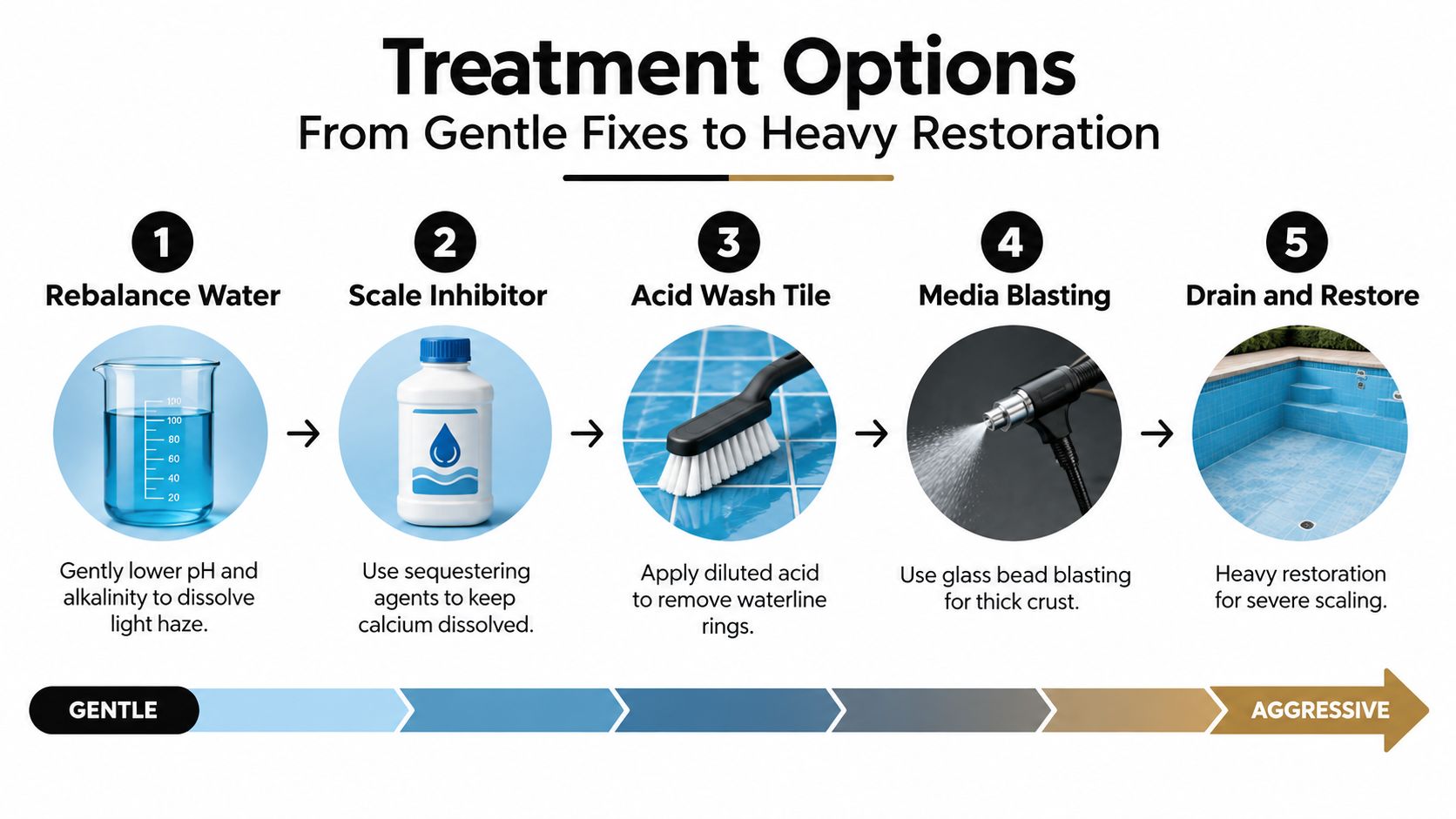
Good pool scaling treatment follows an escalation ladder. Start with chemistry correction, then move toward targeted removal only when the deposit's thickness or location demands it.
Start with balance and brushing
For light haze or loose calcium dust, bring pH and alkalinity back under control and circulate the pool. Brush tile with a nylon brush rather than attacking a delicate finish with an abrasive tool. A sequestering agent, such as ScaleTec or Pool Perfect, can help hold liberated minerals in suspension while circulation and controlled dilution do their work.
This approach is slower than pouring acid on the ring, but it addresses the conditions that keep calcium available for redeposition. It also carries less risk to tile grout, plaster, metal components, and surrounding finishes.
Use targeted removal for isolated deposits
A fresh waterline deposit may respond to a diluted muriatic acid paste applied in a sock, provided the surface and product directions support that method. For salt cell buildup, a vinegar soak can be appropriate for light, fresh deposits, but the cell should never be left in an aggressive solution longer than the manufacturer allows.
A partial drain and refill may help when calcium hardness has climbed above 600 ppm. That threshold is a decision point, not a universal prescription. The replacement water must have a lower mineral load, or the refill just restores the same problem.
Reserve restoration for damaged surfaces
Thick crust may require professional media blasting, such as glass bead blasting, where the finish can tolerate it. Plaster pitting may call for a professional no-drain acid wash, while heavy heater deposits may require mechanical descaling. A salt cell that has lost its effective surface or continues tripping sensors after cleaning may be beyond chemical rescue and need replacement.
Acid handling isn't casual maintenance. Wear chemical-resistant gloves, eye protection, and protective clothing. Never mix chemicals, pre-dilute only according to the product directions, add chemical to water rather than water to chemical when applicable, and keep baking soda available for an emergency neutralization response. Keep swimmers, pets, and children away from the work area, and never combine acid with chlorine products.
Why Source Water Matters for Long-Term Pool Care
Scale returns when the fill water keeps bringing minerals into the pool. Cape Coral and Lee County homeowners may use city water that has been softened to roughly 100 to 120 ppm hardness, or private well water that can measure 400 to 800+ ppm directly from the limestone aquifer. Those source-water figures are part of the local treatment decision, not a guarantee for every property.
Every top-off after evaporation, storm-related refill, or splash-out replacement adds water that the pool chemistry must hold in solution. If that incoming water carries significant hardness or dissolved solids, the pool reaches a scale-forming condition sooner, especially during hot weather.
| Water Source | Typical Calcium Hardness (ppm) | Scaling Risk for Pool |
|---|---|---|
| Treated city water | Roughly 100 to 120 | Lower mineral burden, but balance can still drift |
| Private well water | Roughly 400 to 800+ | High potential for recurring scale |
| Whole-house RO-treated water | Near-zero hardness before the pool receives it | Lower mineral input and easier saturation control |
A whole-house reverse osmosis system uses pressure to move water through a semi-permeable membrane. NSF/ANSI 58 is the standard identified for reverse osmosis systems, and NSF notes that most RO units include additional filters before and after the membrane to support membrane performance and water quality. The NSF explanation of reverse osmosis standards provides the technical background.
RO is useful here because it reduces dissolved solids broadly, not just hardness. EPA documentation reports removals above 95% for key dissolved constituents, including hardness and total dissolved solids, as shown in its reverse osmosis treatment document. That can reduce the mineral load entering the pool, lower the need for repeated chemical correction, and help protect heaters, salt cells, and tile.
The important shift is from treating scale after it appears to reducing the source material before it reaches the pool. A whole-house RO system won't replace pool testing, but it can turn recurring scale removal into more predictable maintenance.
Costs, Timelines, and When to Call a Professional
The right budget depends on whether you're correcting water balance, removing a surface deposit, or restoring equipment. A homeowner may spend about $30 on a sequestering-agent top-off, while a professional acid wash may run $600 to $1,200 in Southwest Florida. Heater descaling can take several days when the deposit is extensive and the equipment needs careful disassembly, cleaning, inspection, and testing.
| Method | Typical Cost (SW Florida) | Time Required | Best For |
|---|---|---|---|
| Chemistry correction | Product-dependent | Minutes for adjustment, followed by circulation and retesting | Light haze and active imbalance |
| Sequestering agent | About $30 for a top-off | Short application, then ongoing circulation | Dissolved minerals that need to stay suspended |
| Mechanical tile removal | Tool and labor dependent | A weekend for thorough scrubbing | Localized waterline crust |
| Professional acid wash | About $600 to $1,200 | One to three days with refill and rebalance | Broad surface scale and plaster treatment |
| Heater descaling | Job-specific | Multi-day work when deposits are heavy | Scale inside heat-transfer components |
A chemistry correction can begin quickly, but the water still needs circulation and retesting. Mechanical tile removal may occupy a weekend, while an acid wash commonly involves preparation, treatment, refill, and rebalance over one to three days.
Call for professional help when scale is inside the heat exchanger, white crust returns after each refill, the salt cell is coated and tripping sensors, or plaster is etching. An LSI above +0.5 that won't settle after two adjustment cycles is another strong warning that the problem needs more than a casual chemical correction. The LSI thresholds and their implications are outlined in the pool scaling reference, which should be used only alongside a complete test panel.
If the deposit is affecting heating or salt generation, arrange an equipment evaluation rather than continuing to pour acid into the pool. Pool equipment repair service can help identify whether cleaning is practical or whether the component has already suffered permanent damage.
A Prevention Plan That Actually Holds in SW Florida
A reliable prevention routine combines small weekly actions with deeper monthly and seasonal checks. Cape Coral's heat, evaporation, and mineral-heavy fill water punish a pool that gets tested only when the water turns cloudy.
Weekly work keeps deposits from bonding
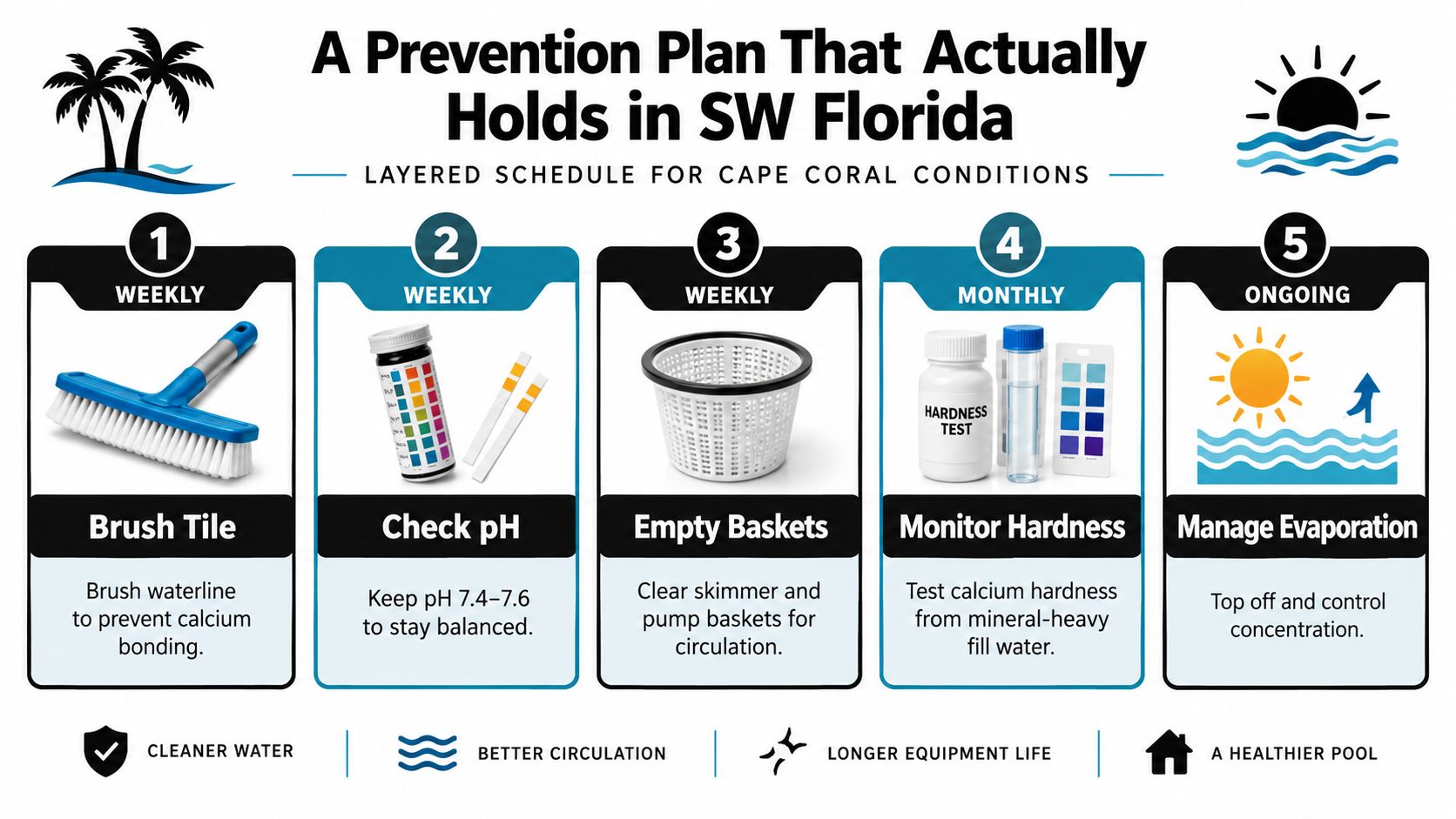
Brush the waterline tile before residue hardens. Check pH and free chlorine with a drop kit or calibrated meter, and empty the skimmer and pump baskets so circulation remains steady. A quick visual inspection of the spa spillover and salt cell indicators can reveal a developing issue before it spreads.
The maintenance image calls for keeping pH around 7.4 to 7.6 for routine balance. That range must still be evaluated with alkalinity, calcium hardness, temperature, and the complete saturation picture rather than treated as a stand-alone guarantee.
Monthly testing finds the drift
Once a month, run a full LSI panel that includes calcium hardness, alkalinity, CYA, temperature, and a temperature-adjusted saturation index. Check filter pressure and inspect the salt cell at the same time. If calcium hardness is rising, test the source water before the next major refill.
A physical treatment option such as ScaleNet anti-scale protection can be considered where reducing scale formation in the incoming water is part of the broader plan. It doesn't eliminate the need for pool chemistry control, but source-water management can reduce the repeated mineral burden.
Seasonal checkpoints make the routine durable
Use a 12-month rhythm rather than waiting for visible crust:
- January and February: Review winter chemistry, temperature effects, and equipment condition.
- March and April: Complete a pre-summer LSI audit before heat and evaporation intensify.
- May through August: Increase attention to waterline brushing, evaporation, top-offs, and pH drift.
- September: Recheck the pool after the wet season and any storm-related refills.
- October and November: Review source-water hardness after the dry season's concentration effects.
- December: Record the year's recurring readings and schedule equipment inspection if scale returned.
The durable fix is layered: control the pool water, inspect the equipment, and reduce the mineral load in the water used for refilling.
Water Medic of Cape Coral offers whole-house reverse osmosis systems, source-water treatment, and pool service support for homeowners dealing with recurring mineral deposits. Visit Water Medic of Cape Coral to discuss your fill-water testing, pool scaling treatment, and a practical plan for protecting your tile, heater, salt cell, and pool finish.