Reverse Osmosis Water Filter Whole House: Costs & Benefits
You know the signs. The shower glass won't stay clear. The faucets crust up. White spots show up on dishes right after a wash cycle. Laundry feels stiff. On well water, you may also get that sulfur smell, iron staining, or a lingering worry about what's coming out of the tap.
That's everyday life for a lot of homeowners in Southwest Florida.
In Cape Coral, Fort Myers, Punta Gorda, and the surrounding area, water problems usually aren't small. They affect the whole house. They affect how your skin feels after a shower, how long your water heater lasts, what your pool fill water does to the finish, and whether you trust the water you cook with. If you're trying to solve all of that with a pitcher filter or one little filter under the kitchen sink, you're solving the wrong problem.
A reverse osmosis water filter whole house system is the serious fix. It treats water where it enters the home, then sends cleaned water to every tap, shower, appliance, and fixture. If you want the most complete residential treatment approach available, this is it.
Your SWFL Home Deserves Better Than Standard Tap Water
A lot of homeowners in Southwest Florida wait too long to deal with bad water because they get used to it. They stop noticing the chlorine smell. They accept the film on shower doors. They keep replacing fixtures, cleaning scale, and wondering why appliances seem to struggle.
That's expensive thinking.
The problems usually show up all over the house
You might first notice it in the kitchen. Water tastes flat, chemical-heavy, or metallic. Then you see it in the bathroom. Scale on faucets. Spots on glass. Skin that feels dry after every shower. If you're on a private well, add iron staining, sulfur odor, and sediment to the list.
Pool owners get hit from another angle. Fill water quality matters. If the source water is loaded with minerals or nuisance contaminants, you're not starting with a clean baseline. You're filling the pool with problems you'll spend time and money managing later.
Local reality: In Southwest Florida, water issues rarely stay confined to one faucet. They spread through plumbing, fixtures, appliances, and outdoor water use.
Partial fixes don't feel like fixes
A softener handles hardness-related issues, but it doesn't give you purified water at every outlet. An under-sink RO unit improves one drinking tap, but the rest of the house still gets untreated water. Basic carbon filtration can help with taste and odor, but it won't address the full range of dissolved contaminants that homeowners worry about.
That's why whole-house reverse osmosis stands apart. It goes after the water problem at the entry point, before it reaches the rest of the home. If your goal is cleaner water everywhere, not just in one corner of the house, that's the right approach.
What Is a Whole House Reverse Osmosis System
A whole house reverse osmosis system treats water at the point where it enters the home. The system is installed on the main line, so the water moving to your showers, sinks, laundry, water heater, and appliances is treated before it spreads through the house.
That matters in Southwest Florida because the water problems here are rarely isolated. City water can bring chlorine taste, odor, and mineral issues. Well water often adds sulfur smell, iron, sediment, and staining. If you fill a pool from the same supply, those problems follow the water there too.
It treats the house at the source
An under-sink RO unit improves one faucet. A whole-house RO system treats the entire incoming supply.
That is the main difference.
If your goal is to stop hard water buildup, reduce dissolved contaminants, cut nuisance well-water issues, and improve water quality across the property, a single-tap filter will not do the job. Whole-house RO is built for homes where the water problem shows up everywhere, from shower glass and laundry to ice, cooking, and pool fill water.
Why reverse osmosis stands apart
Reverse osmosis uses a membrane that separates water from a wide range of dissolved impurities. Standard filters do not do that at the same level. They may catch sediment or improve odor, but they do not give you the same broad reduction of dissolved minerals and contaminants.
In Cape Coral and across Southwest Florida, that distinction is a big deal. Hardness, salinity concerns in some areas, iron on private wells, and inconsistent source water all push homeowners toward stronger treatment. If the water is attacking fixtures, leaving residue, or carrying odor into the house, you need more than a basic filter housing with a couple of cartridges.
Here's a quick visual overview of what homeowners usually want from this kind of setup.
What the system usually includes
A whole-house RO setup is not a single tank you drop in the garage. It is a full treatment system that usually includes pretreatment, the RO membrane stage, storage, and repressurization so the home has treated water available at normal household pressure.
That design is why it works in real homes.
For Southwest Florida properties, pretreatment is often the deciding factor. Well water with sulfur, iron, or sediment usually needs conditioning before the water reaches the membrane. Homes with very hard municipal water also need the system sized and configured correctly, or performance suffers and maintenance gets expensive fast.
A properly built whole-house RO system makes sense for:
- City water homes that want cleaner water at every fixture, not just better drinking water at one sink
- Well water homes dealing with sulfur odor, iron staining, sediment, or difficult overall water quality
- Homes with pools where fill water quality affects staining, scaling, and water balance
- Homes with expensive plumbing fixtures and appliances that need better water from the start
If you want one serious solution for Southwest Florida water, this is it.
The Unmatched Benefits for Your Southwest Florida Lifestyle
A whole-house RO system makes the most sense when you stop thinking about water as just something you drink. In Southwest Florida, water touches your entire property. It runs through showers, icemakers, dishwashers, washing machines, water heaters, coffee makers, outdoor spigots, and often your pool setup too.
If the incoming water is problematic, the whole house feels it.
Better living starts with better source water
For municipal water users, one of the first things people want gone is the chlorine taste and smell. They don't want to shower in it. They don't want to cook with it. They don't want guests noticing it. A whole-house RO system addresses the entire home's incoming supply, so you're not limiting improvement to one drinking faucet.
For well water users, the need is often more urgent. Sulfur odor, iron staining, sediment, and overall inconsistency are common complaints. If that sounds familiar, the right treatment plan often starts with diagnosing the actual problem, especially if the home also needs well water repair.
Water quality in Southwest Florida isn't one-size-fits-all. City water and well water create different problems, but both can justify a whole-house solution when the goal is clean water everywhere.
The benefits you'll actually notice
You don't buy a whole-house RO system to admire it in the garage. You buy it because life gets easier.
- Cleaner showers and baths: Water quality affects how water feels on skin and hair.
- Less frustration with spotting and residue: Fixtures, glass, and sinks stay easier to maintain when the source water is cleaner.
- Improved laundry results: Fabrics often feel and look better when they aren't repeatedly washed in problematic water.
- Better appliance protection: Water heaters, dishwashers, and other water-using equipment don't benefit from poor source water.
- More confidence in household water: Cooking, brushing teeth, pet bowls, and filling pots all become less of a question mark.
Pool owners should pay attention too
This gets overlooked. Pool chemistry starts with fill water. If you're topping off or filling a pool with water that already carries unwanted dissolved material, you're making maintenance harder from day one. Cleaner fill water gives you a better starting point and can help reduce some of the staining and nuisance issues pool owners hate dealing with.
If you own a nice pool, don't ignore the quality of the water you use to feed it.
Why I lean hard toward whole-house RO for tough local water
Because it solves the right problem. It doesn't pretend one faucet is enough. It doesn't stop at cosmetic improvement. It addresses the home's incoming water supply with a treatment method designed for broad contaminant reduction.
That matters in Southwest Florida. Hard water issues, well water odors, iron problems, and concerns about what's dissolved in the water aren't rare here. They're normal. If your water is creating problems in multiple parts of the home, a partial fix is usually wasted money.
How the Multi-Stage Purification Process Works
Whole-house RO works because each stage handles a specific job. If you skip the front-end design work, the system won't perform the way it should. If you size or install it poorly, you'll feel it fast.
That's why proper sequencing matters.
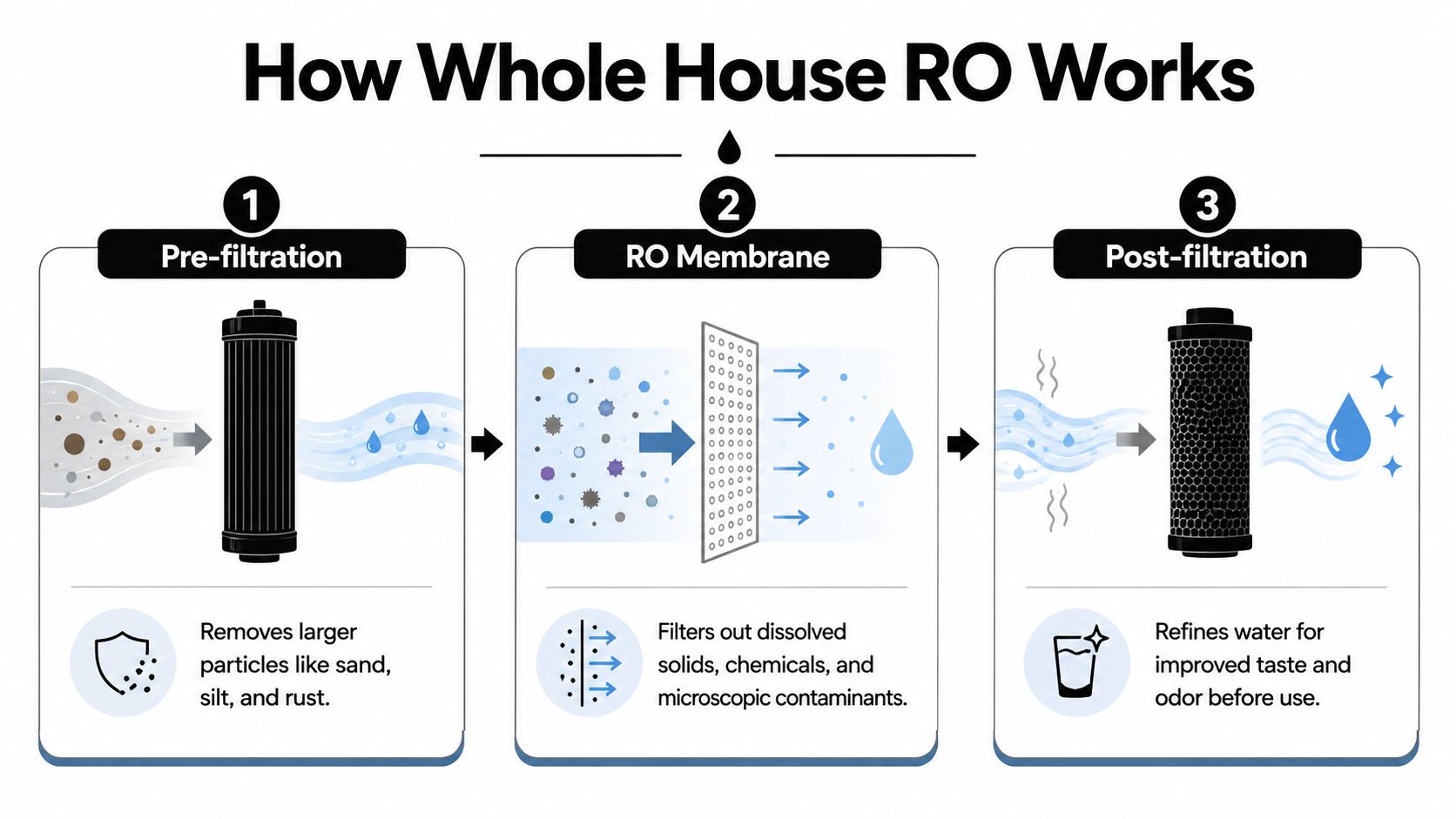
Stage one removes what would damage the system
The first stage is pretreatment. In this stage, a system deals with sediment and other unwanted material before water reaches the membrane. In many homes, pretreatment also handles chlorine or similar water quality issues that can shorten membrane life.
That front-end protection is not optional. It's one of the main reasons some systems last and others become expensive headaches.
If you want to understand one common pretreatment component, look at how whole-home carbon filters are used to support broader water treatment strategies.
Stage two is the actual reverse osmosis step
In reverse osmosis, pressure performs the critical work. According to Puretec's explanation of reverse osmosis basics, reverse osmosis works by forcing feedwater across a semi-permeable membrane at pressures that can range from 30–250 psi for fresh or brackish water. That process separates purified water from dissolved salts and contaminants.
The same resource explains why recovery rate and pretreatment matter so much. Push a system too hard without proper preparation and you increase scaling risk and shorten membrane life. That's not theory. That's system design reality.
Practical rule: Membrane performance depends on the water you feed it. Good pretreatment isn't an upgrade. It's part of the job.
Stage three makes the water usable across the house
After membrane treatment, the system still has to deliver water like a normal household expects. That usually means treated water storage and re-pressurization. Without that, you wouldn't get the household flow and pressure needed for normal daily use.
That's the big difference between whole-house RO and a simple under-sink unit. A whole-home system has to behave like infrastructure.
A properly built setup usually includes these moving parts:
- Pretreatment equipment that protects the membrane from sediment and other damaging inputs.
- The RO membrane stage where dissolved contaminants are separated out.
- Storage and delivery components that allow the treated water to move through the home with usable pressure.
That's why whole-house RO should be designed around the house, the source water, and the daily demand. It isn't a plug-and-play filter box.
Whole House RO vs Other Common Water Solutions
A lot of homeowners ask the wrong question. They ask, “What's the cheapest fix?” The better question is, “What problem am I trying to solve?”
If your issue is only drinking water at one sink, an under-sink system may be enough. If your issue is mainly hard water behavior, a softener may handle part of it. If the whole property is dealing with poor water quality, neither one is the complete answer.
Side-by-side comparison
| Feature | Whole House RO | Point-of-Use RO | Water Softener |
|---|---|---|---|
| Coverage | Entire home | One faucet or one location | Entire home |
| Primary role | Broad purification for household water | Purified drinking and cooking water | Hardness treatment |
| Contaminant scope | Broadest residential approach | Strong at point of use only | Limited compared with RO |
| Effect on showers and laundry | Yes | No | Yes, but mainly related to hardness behavior |
| Effect on appliance feed water | Yes | No | Yes, but not the same level of purification |
| Installation complexity | Highest | Lower | Moderate |
| Best fit | Homes with whole-property water issues | Homes focused only on one drinking tap | Homes mainly battling hard water symptoms |
Under-sink RO solves less than people think
I like under-sink RO for what it is. It's useful if your only concern is drinking and cooking water from one faucet. If that's your situation, an under-sink reverse osmosis system can be a sensible choice.
But it doesn't change your showers. It doesn't protect the rest of your plumbing. It doesn't improve laundry water. It doesn't help with the water feeding your appliances. In Southwest Florida, that usually means you're leaving most of the problem untouched.
A softener is not the same thing
A water softener can be valuable for hardness-related issues. It helps with scale behavior. It can improve soap performance. It can make everyday water use more manageable in the right setup.
But a softener is not reverse osmosis. It doesn't provide the same level of broad contaminant reduction. If someone tells you a softener and a whole-house RO system are interchangeable, they're oversimplifying.
The big drawback you need to accept
Reverse osmosis uses water to make purified water. That's the trade-off.
The EPA's WaterSense page on point-of-use reverse osmosis systems explains that a typical point-of-use RO system can generate five gallons or more of reject water for every gallon of treated water, while WaterSense-labeled systems must keep reject water to 2.3 gallons or less per gallon of treated water. The EPA also notes that RO can remove contaminants such as lead, VOCs, PFAS, arsenic, bacteria, and viruses.
That doesn't mean whole-house RO is a bad idea. It means you need to go into it with clear eyes. You're choosing broad, high-level treatment, and that requires more infrastructure and more careful design than a basic filter.
If you want the highest level of purification across the entire home, you have to accept that whole-house RO is a serious system, not a budget accessory.
Sizing, Cost, and Professional Installation
A Cape Coral homeowner usually starts asking about whole-house RO after the same pattern shows up all over the property. White scale on fixtures. Rotten-egg odor from a well. Orange iron stains in the toilets. Pool fill water that leaves the surface looking off before the season is half over.
At that point, sizing matters more than brand names.
Capacity has to fit the house and the water
Whole-house RO is sized around daily demand, but that is only part of the job. In Southwest Florida, the system also has to handle what the water brings with it. Hardness, sulfur, iron, tannins, and high dissolved solids change the design. A house on city water and a house on a private well may end up with very different pretreatment, storage, and pump requirements even if they are similar in square footage.
A bad sizing decision shows up fast. Showers lose pressure. Storage runs short during heavy use. Membranes foul early because pretreatment was undersized or skipped. On well systems, poor planning gets expensive even faster.
What the upfront investment really looks like
Whole-house RO costs real money because it solves a real problem at the entry point for the entire home. You are paying for pretreatment, RO production, storage, repressurization, plumbing integration, drain routing, and service access. In this category, cheap usually means incomplete.
As noted earlier, public health guidance puts installed whole-house RO pricing for smaller residential systems in the several-thousand-dollar range, and local conditions can push the total higher. Southwest Florida homes with sulfur wells, iron issues, or heavy hardness often need more equipment ahead of the membranes to protect the system and keep performance stable.
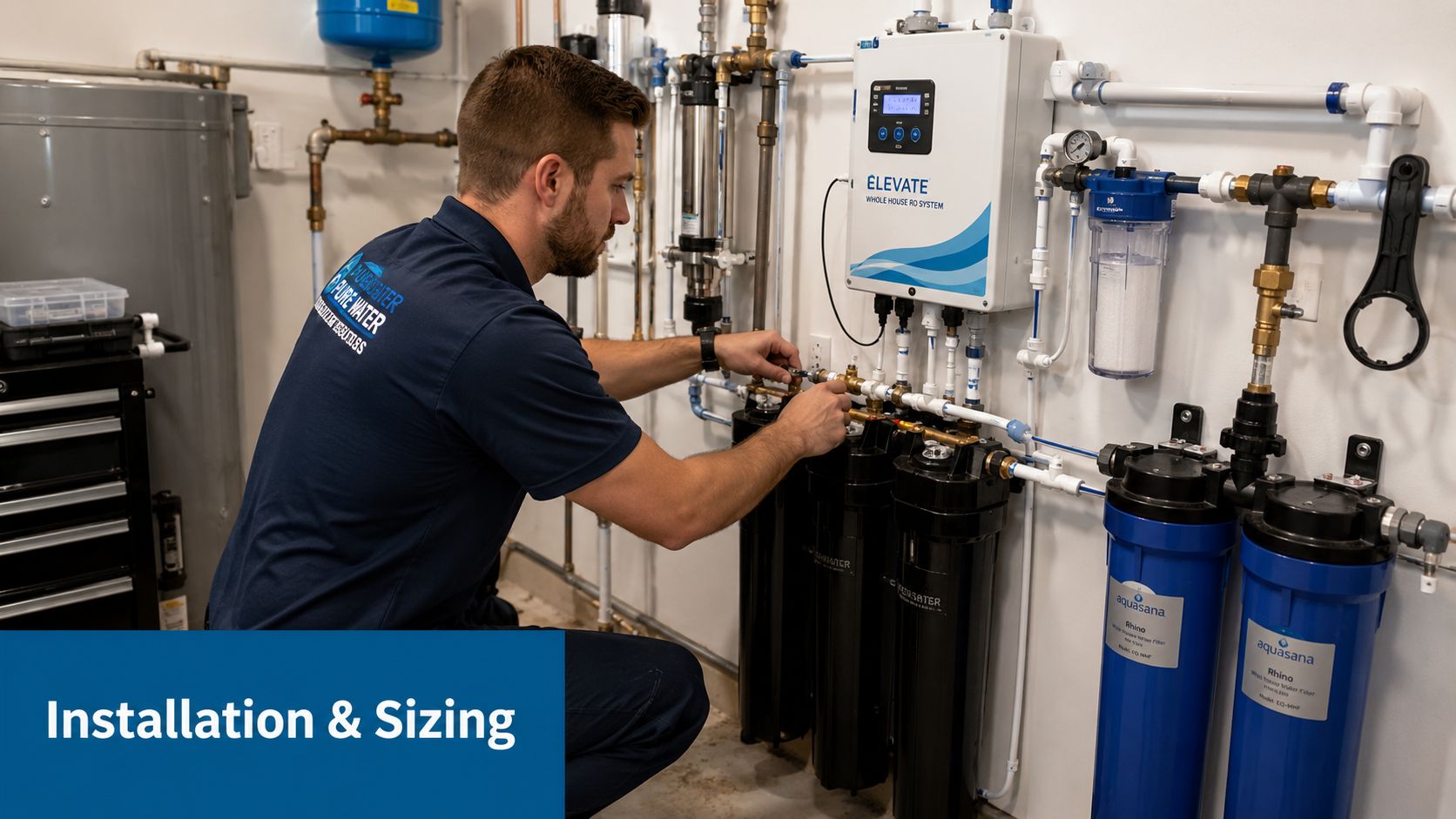
Professional installation is part of the system
Do not treat whole-house RO like a large version of an under-sink filter. It is a mechanical water plant for your house.
It has to be laid out correctly at the main entry, matched to your source water, and set up with the right pretreatment before water ever reaches the membranes. It also needs proper storage, delivery pressure, drain capacity, and room for routine service. If you want clean water in every shower, better water for laundry, and cleaner pool fill water, all of that has to work together.
If budget is the main objection, review water treatment financing options for whole-house systems before settling for equipment that will not solve the problem.
Water Medic of Cape Coral designs, installs, and maintains customized whole-house reverse osmosis systems for Southwest Florida homes. That local experience matters. Water here is hard on equipment, and well water problems in this area are not theoretical.
What I recommend before you sign off
Use this checklist:
- Get a real water analysis first. Do not size RO from a sales sheet or a guess.
- Size for peak household use. Bathrooms, laundry, guests, and pool-related demand all count.
- Confirm the pretreatment train. Sulfur, iron, sediment, and hardness have to be handled correctly.
- Ask how pressure will be maintained. A whole-house system should feel usable at every fixture.
- Make sure service access is built in. Filters, membranes, tanks, and pumps need room to be maintained.
A properly designed system costs more because it does more. For many Southwest Florida homes, that is the difference between chasing water problems room by room and fixing them at the source.
Your Simple Path to Pure Water Across Your Entire Home
If your Southwest Florida home has water problems in more than one place, stop trying to fix them one at a time. A whole-house RO system treats the issue where it begins, at the main water entry. That's why it remains the strongest residential option for homeowners who want broad purification across the property.
You don't need a complicated process to get there.
Start with the real problems in your house
Walk the property like a water specialist would. Check the shower glass, fixtures, dishwasher results, laundry feel, appliance history, and any well-water odors or staining. If you own a pool, include your fill water concerns too.
Write down what's happening. That gives the installer something real to solve.
Then get the water tested and the system designed
The right recommendation comes from matching the water condition to the equipment. Not every home needs the same pretreatment approach, storage arrangement, or capacity. Homes on city water and homes on private wells often need different supporting components even if the end goal is the same.
Clean water decisions get easier once the guesswork is gone and the actual water problem is identified.
Keep the path simple
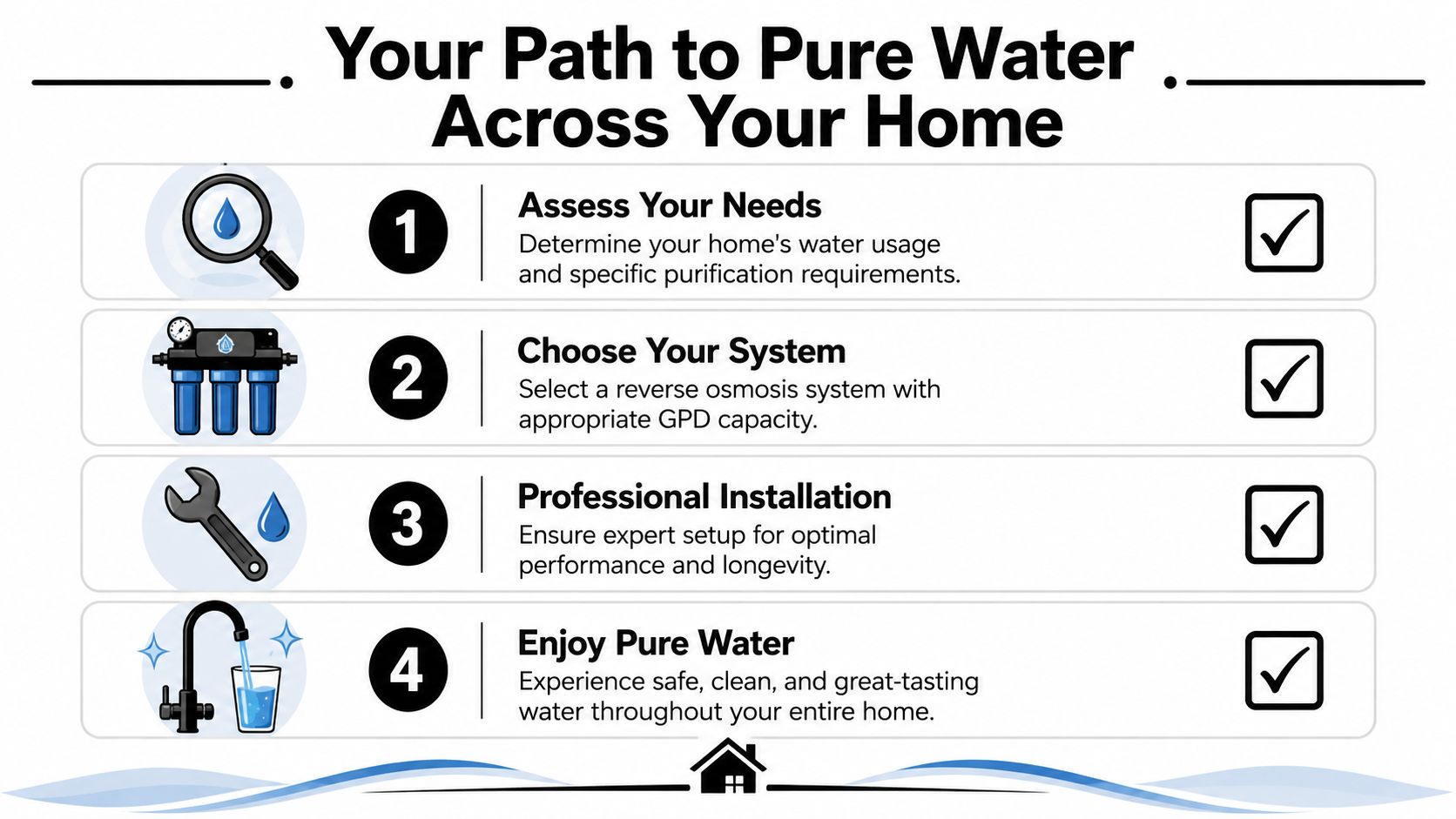
- Assess the symptoms around the house, not just at the kitchen sink.
- Schedule a water analysis with a qualified local specialist.
- Review a custom recommendation based on your home's water source and demand.
- Install the right system once instead of paying for partial fixes over and over.
If you're serious about solving water quality across the whole property, this is the path that makes sense. Not another temporary add-on. Not another small filter that only helps one faucet. A real whole-house solution.
If you're dealing with hard water scale, well water odor, iron staining, or you want cleaner water from every tap, talk to Water Medic of Cape Coral. A local water analysis and a custom whole-house RO recommendation will tell you quickly whether this is the right fit for your home.