Bacteria in Hot Tubs: Your Ultimate Water Quality Fix
You bought the hot tub for relief. End of day, lights low, jets on, stress off. Then the water starts turning on you. A faint odor. Cloudiness that keeps coming back. Skin irritation after a soak. More sanitizer, more shock, more test strips, and still the water never feels fully right.
That's the pattern I see all the time in Southwest Florida. Homeowners think they have a hot tub chemistry problem. Most of the time, their problem is a source water problem. If the water going into the tub starts dirty, mineral-heavy, or loaded with dissolved contaminants, you're fighting a losing battle from the first fill.
Your Hot Tub Should Be a Haven Not a Hazard
You step into the tub to relax after a long day. The water looks fine, the jets are running, and within minutes your skin starts to sting or your nose catches that stale, chemical smell. That is not normal hot tub water. It is water that has already started slipping out of control.

I see this constantly in Cape Coral. Homeowners assume bacteria only become a problem in abused public spas or tubs that never get cleaned. Private hot tubs run into the same trouble when they are filled with water that already carries excess minerals, dissolved contaminants, and sanitizer demand from day one.
Hot tubs are especially unforgiving because warm, agitated water speeds up every mistake. Heat burns through sanitizer faster. Air bubbles spread contaminants through the water and into the mist above it. Body oils, lotions, and organic waste build up quickly in a small volume of water. If the source water is poor, the tub never gets ahead of the problem. It just cycles between temporary improvement and the next round of cloudiness, odor, or irritation.
That is why chemical-only advice falls short.
You can shock the water, raise sanitizer, clean filters, and still keep fighting the same battle every week. The fundamental solution starts before the water ever reaches the tub. Cleaner source water gives you a stable baseline, lower contaminant load, and a hot tub that stays easier to manage instead of constantly needing rescue.
Why trouble shows up faster than owners expect
A hot tub can look clean and still be one step away from a bacteria problem. Clear water only tells you light can pass through it. It does not tell you whether the sanitizer is holding, whether dissolved solids are overwhelming your chemistry, or whether the water is clean enough to stay safe under heat and aeration.
Watch for the pattern that shows the water is unstable:
- Sanitizer drops fast: chlorine or bromine disappears sooner than it should after dosing.
- Water balance keeps drifting: pH and clarity improve briefly, then slide back.
- The soak feels harsh: skin feels itchy, dry, or irritated after using the tub.
- Odor keeps returning: the water develops a musty or overchlorinated smell even after treatment.
Those are not random annoyances. They are early signs that your hot tub is being fed water that makes sanitation harder than it should be.
If you want a hot tub that feels clean, stays clear, and stops fighting you, stop treating the tub like the only problem. Fix the water entering the house. That is how you stop bacteria pressure at the source and improve every faucet, shower, appliance, and fill line on the property.
Common Hot Tub Bacteria and Their Health Risks
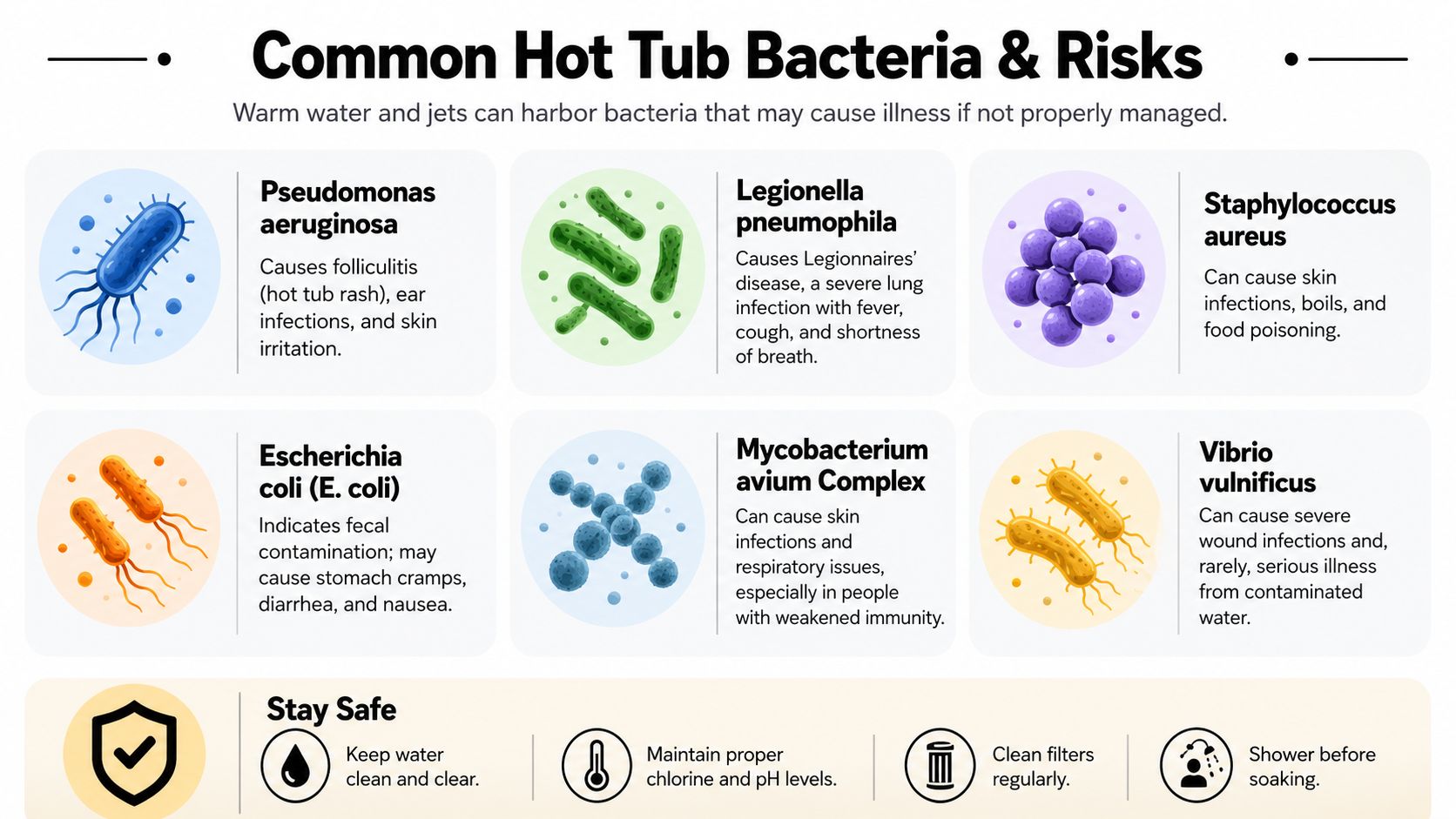
A hot tub problem gets serious when the water starts exposing people instead of helping them relax. The organisms I watch for first are Legionella, Pseudomonas, and Cryptosporidium because each one points to a different kind of failure in water quality control.
Legionella is the one I take most seriously
Legionella pneumophila causes Legionnaires' disease, and hot tubs create the exact conditions it likes. Warm water, circulation, and airborne spray make exposure easier because people can inhale contaminated mist instead of swallowing water.
AARP's summary of CDC findings on hot tub risks explains the core issue clearly. Legionella grows well in warm recreational water, and sanitizer becomes harder to maintain as temperature rises.
That puts older adults, former smokers, and anyone with weaker lung health in a bad position. If your spa throws vapor and fine droplets into the air, poor water quality becomes a breathing risk.
Pseudomonas is usually the first one people notice
Pseudomonas aeruginosa is the bacteria behind many cases of hot tub rash and swimmer's ear. It often shows up before an owner realizes the tub has a deeper water problem because the first clue is physical. Red bumps, itchy skin, irritated ears, or a general “everyone felt off after we soaked” complaint.
This bacteria takes advantage of inconsistent sanitation and protected surfaces inside plumbing lines and jets. Once it settles in, dumping in more chemicals rarely solves the full problem if the incoming water keeps adding load the sanitizer has to fight. That is one reason I recommend whole-home carbon filtration that reduces incoming contaminants before they reach spa equipment.
Cryptosporidium proves clear water can still be unsafe
Crypto is a chlorine-tolerant parasite. Owners hate hearing that because it breaks the common assumption that “clear and chlorinated” means safe.
As noted earlier, outbreak reporting has repeatedly tied recreational water illness to organisms that survive or spread despite routine maintenance. Crypto is one of the biggest reasons visual clarity means very little by itself.
Quick risk snapshot
| Organism | Main concern | How exposure happens |
|---|---|---|
| Legionella | Legionnaires' disease or Pontiac fever | Breathing mist from contaminated water |
| Pseudomonas | Hot tub rash, swimmer's ear, respiratory symptoms | Contact with poorly maintained warm water |
| Cryptosporidium | Gastrointestinal illness | Exposure to contaminated recreational water |
The takeaway is simple. These are not random germs that appear out of nowhere. They show up when the tub is being asked to stay clean with water that was already hard to manage before it ever reached the shell.
Beyond Chemicals The Root Cause of Bacterial Growth
Most hot tub advice is too shallow. It tells you to test sanitizer, adjust pH, shock regularly, and clean the shell. That's fine as far as it goes. It just doesn't go far enough.
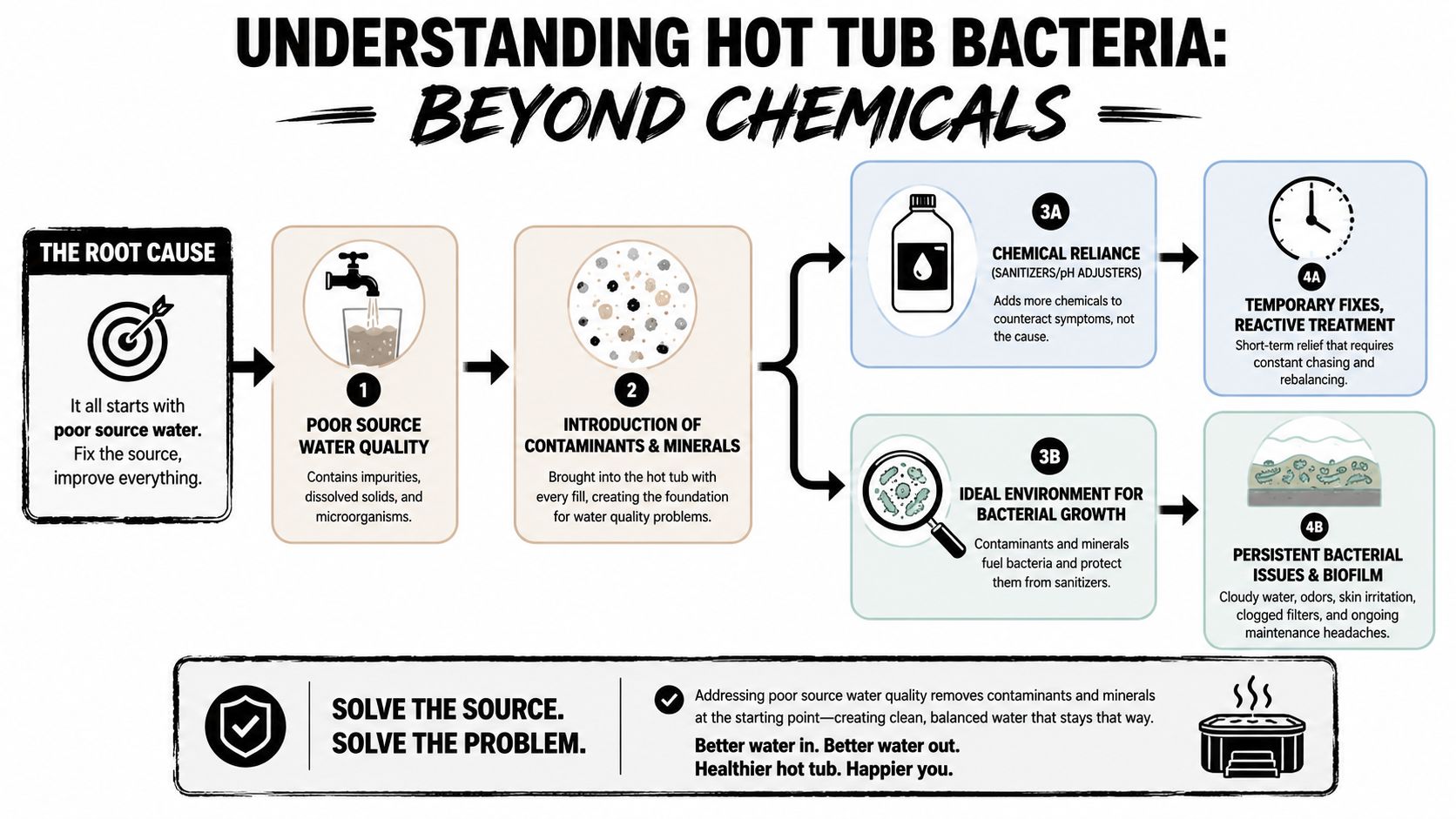
The main issue often starts before the water ever reaches the tub.
Your hot tub only performs as well as the water you fill it with
If your home water comes in carrying dissolved solids, minerals, sediment, and residual contaminants, your sanitizer has more work to do from day one. That leads to unstable chemistry, more chemical consumption, and a system that gets harder to control the longer it runs.
People often try to patch that with extra chlorine, bromine, oxidizers, clarifiers, and water enhancers. That's reactive maintenance. It's not a root-cause fix.
A quality pre-treatment step matters too. Proper carbon filtration for whole-home water treatment helps reduce contaminants before water reaches downstream purification equipment, which supports more stable performance across the property.
Visual cleanliness means almost nothing
One of the most overlooked risks is that a hot tub doesn't even have to be in active use to create exposure concerns. According to CIDRAP's report on Legionella risk from stagnant and poorly maintained hot tubs, non-contacting hot tubs such as display units can release infectious mist into the air even without human immersion. That directly challenges the common belief that only bathers are at risk.
That's a critical point for homeowners, property managers, and real estate professionals. A tub can look clean, smell acceptable, and still be unsafe if the underlying water management is poor.
The worst hot tub water problems usually don't come from what you can see. They come from what your sanitizer is trying, and failing, to keep up with.
Chemicals are maintenance tools, not miracle workers
Use chemicals. You need them. But stop expecting them to correct bad source water forever.
If every refill starts with compromised water, you're forcing the hot tub to operate under stress all the time. That's when recurring bacterial issues, cloudy water, and stubborn contamination become normal.
The Permanent Fix For Crystal Clear Water
If poor source water is the problem, then the permanent fix is to improve the source water. For a home with a hot tub, the strongest upgrade is a whole house reverse osmosis system.
This isn't the little under-sink unit people picture when they hear “RO.” A whole-home RO system treats water before it reaches your hot tub, showers, faucets, ice makers, and appliances. That changes the entire water environment of the house.
Why RO changes hot tub performance
Reverse osmosis removes a broad range of dissolved impurities from incoming water. That matters because Total Dissolved Solids (TDS) are one of the biggest reasons hot tub water gets hard to manage. High TDS contributes to water that feels loaded, burns through sanitizer faster, and becomes more difficult to balance.
According to this discussion of high-performance RO system output, a well-engineered whole house RO system can reduce tap water from about 400–440 ppm TDS to as low as 20 ppm, with top systems reaching 5–10 ppm TDS. That's a dramatic cleanup of the water before it ever touches the tub.
Better fill water creates a simpler hot tub
When your hot tub starts with low-TDS water, everything gets easier:
- Sanitizer works cleaner: It spends less time reacting to background contaminants.
- Balancing is more stable: pH and overall chemistry tend to be easier to manage.
- Water feels better: Soaking water feels cleaner, lighter, and less harsh on skin.
That's the part most hot tub cleaning guides miss. They focus on what to add after the water is already in trouble. A whole house RO system changes what goes into the tub in the first place.
The benefit extends far beyond the spa
A homeowner usually starts thinking about RO because of one pain point. The hot tub. Then they realize the same bad source water has been affecting the entire property.
A whole-home system improves water for bathing, cooking, drinking, laundry, and fixtures. It gives the house one purified water standard instead of one good faucet and a long list of problem taps.
This video gives a helpful look at the kind of whole-home water treatment approach that solves the issue at the source.
Temporary treatment versus full-property correction
| Approach | What it does | What it misses |
|---|---|---|
| More hot tub chemicals | Reacts to current symptoms | Doesn't improve incoming fill water |
| Occasional drain and refill | Resets the tub temporarily | Reintroduces the same source water issues |
| Whole house RO | Purifies water before it enters the home | Requires proper design and installation |
Practical rule: If you're constantly correcting the hot tub, but never improving the water feeding it, you're paying for the same problem over and over.
For homeowners in Cape Coral and across Southwest Florida, this is the upgrade that makes the rest of your water management finally make sense.
What to Expect From a Professional RO Installation
A whole house RO system isn't a single filter canister. It's a coordinated treatment system, and its performance depends on sizing, staging, and installation quality. If any of that is off, the system won't deliver the water quality or production your home needs.
That's why professional design matters.
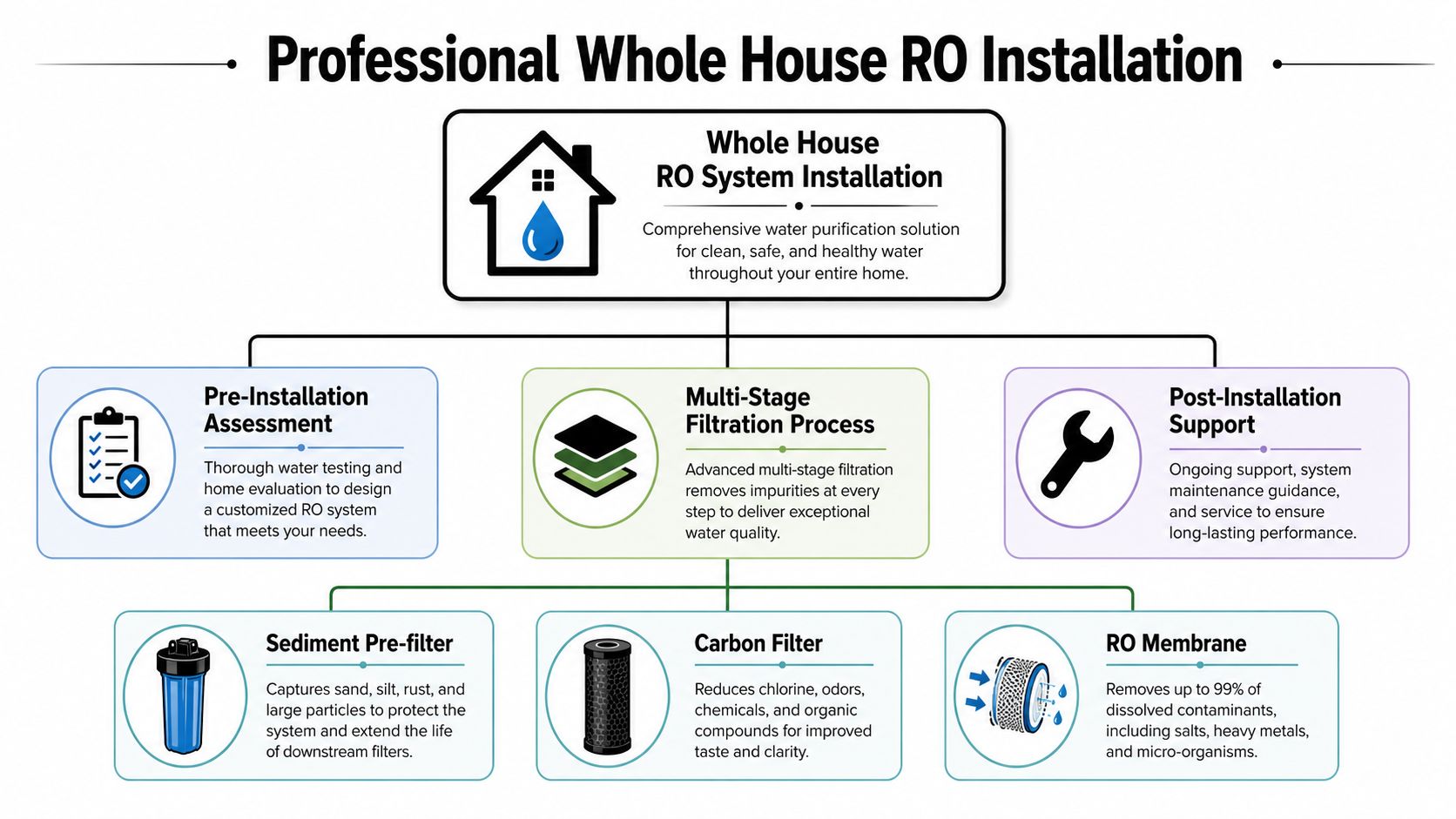
The system works in layers
Think of RO as a security team for your water, not one guard at the front door. Each stage handles a different job, and each one protects the next.
Sediment stage
This first barrier captures grit, particulates, and suspended material that would otherwise load up the rest of the system. It's basic, but it's critical.
Carbon stage
Carbon handles contaminants that can interfere with downstream treatment and overall water quality. It's one reason pretreatment is so important in a full-home design.
RO membrane
The membrane is the precision stage, separating dissolved solids out, giving you the low-TDS water that makes hot tub maintenance easier and whole-home water noticeably cleaner.
Proper sizing is not optional
Many homeowners get bad advice. They hear a system “should be enough” without anyone doing the math for household demand, feed-water conditions, and operating environment.
According to Axeon's guide to sizing industrial and whole house reverse osmosis systems, these systems typically achieve 75% recovery, with a feasible range of 50–90%. The same source notes that for every degree below 77°F, treated water production decreases by 1–2%, which is why professional sizing matters.
That's not a trivial detail. The system has to match the house. If it doesn't, the homeowner feels the mismatch every day.
For homeowners considering a full-property upgrade, a professionally designed whole-home reverse osmosis system is the right path, not a pieced-together collection of filters bought in isolation.
What a competent installation should include
- Water assessment first: The installer should evaluate the quality of the incoming water and your household demand.
- Application-specific sizing: A home with a hot tub, larger family use, or higher demand needs a system selected for that reality.
- Service access built in: Filters, membranes, tanks, and sanitation points should be reachable for routine maintenance.
Why local knowledge matters in Southwest Florida
Cape Coral area water conditions aren't the same as what installers see in other parts of the country. Local experience matters because source water characteristics, homeowner expectations, and property layouts all affect what works well long term.
A professional installer doesn't just drop off equipment. They build a water treatment system that fits the property and performs consistently.
Long-Term Benefits and Simple Maintenance
A lot of homeowners hear “whole house RO” and assume the upkeep will be complicated. It isn't. Good maintenance is predictable, scheduled, and far easier than constantly fighting bad hot tub water.
The key is staying ahead of wear items instead of waiting for performance to fall off.
The maintenance schedule is straightforward
According to Atlantic Blue Water Services' maintenance guidance for RO systems, the sediment filter should be replaced every 12 months, the carbon filter every 6–12 months, and the RO membrane every 2–3 years, with annual sanitization recommended.
That schedule is manageable because each component has a clear job. Replace the prefilters on time, protect the membrane, sanitize the system, and the equipment stays effective.
What homeowners notice over time
The benefits don't stop at the hot tub.
- Hot tub care gets easier: The water starts cleaner, so balancing and sanitizing become less frustrating.
- The whole house feels different: Bathing, cooking, and drinking water improve at every point of use.
- Equipment protection improves: Cleaner water supports better long-term system performance.
A maintenance schedule beats a water emergency every time. Predictable service is cheaper in stress, time, and hassle.
This is where service plans make sense
The smartest setup for most homeowners is simple. Install the right system, then put maintenance on a recurring plan so nothing gets missed.
A scheduled monthly maintenance program keeps the system performing the way it was designed to perform. That matters because neglected maintenance doesn't just reduce water quality. It shortens the useful life of the equipment you invested in.
If you compare that with the cycle of shock treatments, balancing chemicals, repeat draining, and ongoing irritation from poor source water, the RO route is the cleaner decision.
Reclaim Your Relaxation With Pure Water
The solution to bacteria in hot tubs isn't dumping more product into unstable water. It's fixing the water before it reaches the tub.
That's the shift homeowners need to make. Stop treating the hot tub as an isolated problem. The tub is where bad source water becomes impossible to ignore. Once you improve the water entering the property, hot tub care gets easier, water quality improves throughout the home, and the whole experience becomes what it should've been from the start.
If your hot tub water keeps turning cloudy, burning through sanitizer, or making you question whether it's really clean, don't settle for another round of temporary corrections. A whole house reverse osmosis system is the definitive upgrade because it addresses the root cause.
You bought the hot tub to relax, not to run a chemistry experiment in your backyard. Clean source water changes everything.
If you want a real answer instead of another temporary fix, contact Water Medic of Cape Coral. They can help you evaluate your current water quality and determine whether a whole house reverse osmosis system is the right upgrade for your home.