Southwest Florida Water Management: A Homeowner’s Guide
You can tell a lot about a Cape Coral house by the first glass of water in the morning. A homeowner on a private well pours a glass at the kitchen sink, sets it beside the kettle, and notices the same thing every week, a faint off smell, a chalky ring inside the kettle, and ice that tastes flat. That's not a random annoyance. It's a sign that southwest Florida water management reaches right into the kitchen, and the fix usually isn't another little cartridge under one faucet.
For a lot of homes in Lee County, the choice is simple. Keep chasing symptoms with small filters, or solve the water at the point where it enters the house with whole-house reverse osmosis. I'd take the second option every time for a serious private-well or coastal water problem, because patchwork treatment gets expensive in time, maintenance, and frustration.
What a Cape Coral Homeowner Is Actually Up Against
A northwest Cape Coral homeowner doesn't wake up thinking about aquifers or district boundaries. They wake up thinking about coffee, ice, and whether the water smells strange again. That daily frustration is exactly why this topic matters. The tap doesn't deliver “just water” in Southwest Florida, it delivers whatever the local geology, rainfall, irrigation habits, and utility treatment happen to leave behind.
The kitchen-table test
If the kettle keeps scaling up, the shower water feels harsh, and the fridge water tastes dull, the house is telling you something. You can keep stacking point-of-use fixes, a shower head filter here, a faucet cartridge there, but that's treating the symptom, not the supply.
Practical rule: when the same complaint shows up in multiple rooms, the problem is usually the source water, not the fixture.
Cape Coral and Lee County add another layer because many properties sit on private wells or are close enough to saltwater influence that water chemistry changes fast with location. Florida's Department of Health says private well owners should test bacteria and nitrate at least once per year, and test lead every three years because routine sampling isn't required for private homes (Florida Department of Health private well guidance). That's not a paperwork exercise. It's the minimum standard for knowing what you're drinking and what's sitting in your storage tank or RO system.
The bigger point is this. In Southwest Florida, the tap is part chemistry, part geography, part management decision. If you're buying treatment, buy for the house, not for one faucet.
How SWFWMD and Local Utilities Shape Your Tap
The Southwest Florida Water Management District was created in 1961 by a special act of the Florida Legislature to help with the Four River Basins, Florida Project, a major flood-control effort launched after Hurricane Donna in 1960 (District history). Then Florida's 1972 Water Resources Act pushed the region toward a more integrated water-management model. That shift matters because water stopped being treated like a narrow utility issue and started being managed as one regional system.
The district's footprint is huge. It covers about 10,000 square miles across 16 counties and includes about one quarter of Florida's population, roughly 5.5 to 5.6 million people, or about 17% of the state's land area (Florida Auditor district report). That scale is why a homeowner's well or irrigation setup in Cape Coral can't be treated like a local one-off.
What those levers mean at home
SWFWMD isn't just a name on a letter. It shapes what can be drilled, pumped, restricted, and refilled. A new irrigation well can trigger permit questions. An HOA lake or decorative water feature may not be something you can casually refill during a shortage order. A whole-house RO install can also bring local utility review questions into the picture, especially where backflow or service-area rules matter.
The district's current shortage notices also show that rules can differ by source and address. Residents on private wells can face one-day-per-week irrigation rules across wide parts of the region, while a separate and stricter order applies in a designated northeastern Cape Coral area that uses the Mid-Hawthorn Aquifer for irrigation (district shortage notice). That's why I tell homeowners to stop asking, “What's the rule in Southwest Florida?” and start asking, “What's the rule for my address and my water source?”
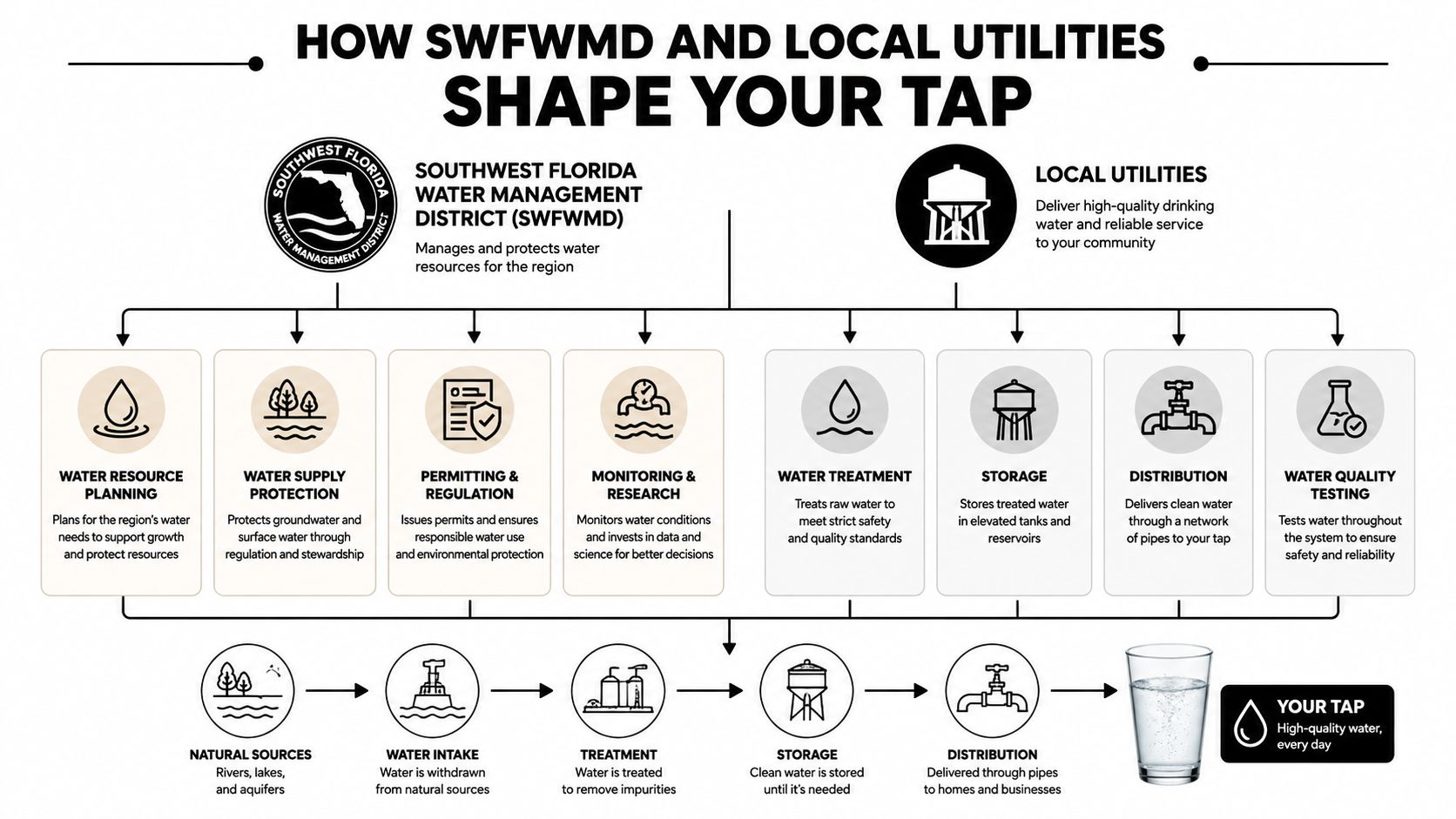
The short version is plain. If you own a house here, district policy is not abstract. It shapes your irrigation schedule, your treatment choices, and your long-term water budget.
The Four Water Issues That Drive Treatment Decisions
There are four water problems that decide whether a Cape Coral home needs a softener, carbon, RO, or some combination of all three. People love to debate brand names. I care about the problem in the pipe.
Issue by issue
Private well quality swings come first. Florida's own guidance says bacteria, nitrates, and lead are the most common widespread drinking-water contaminants, and UF/IFAS recommends additional targeted testing for TDS, pesticides, VOCs, chloride, sulfate, and metals when a well is near agricultural areas, fuel storage, dumps, landfills, factories, or seawater intrusion zones (Florida well water guidance PDF). That tells you why a one-size-fits-all filter is a bad bet. The treatment has to match the actual test results.
Salinity intrusion is the second issue, and Lee County's groundwater picture shows why. USGS reporting summarized in the provided estuaries report notes that water-bearing zones between about 400 and 1,200 feet contain saline water, with dissolved solids averaging 1,936 mg/L and chloride averaging 869 mg/L in sampled waters (USGS summary in the estuaries report). In plain English, deeper pumping can move you from usable water into brackish or saline water fast. That drives the case for proper well design, membrane treatment, and sometimes a dedicated polishing stage.
Stormwater nutrient loading is the third issue. A regional estuaries report says nutrient pollution is one of the most prevalent water-quality problems in Southwest Florida and identifies inadequately treated stormwater and improper fertilizer application as major sources. It also recommends strong stormwater and fertilizer ordinances to reduce impacts (regional estuaries report). For a homeowner, that translates to seasonal nuisance, algae pressure, and more aggressive source control around drains, runoff, and irrigation timing.
Utility disinfectant changes are the fourth issue. Lee County Utilities announced a disinfectant switch from free chlorine back to chloramines in 2026, with temporary taste, odor, and color changes expected and precautions advised for aquatic-animal owners (WGCU report on Lee County disinfection changes). That matters because carbon stages and membrane pre-treatment have to be matched to the disinfectant residual in the water.
| Regional Water Issue | What Homeowners See | Treatment Implication |
|---|---|---|
| Private well swings | Off tastes, hardness, odor, inconsistent quality | Test first, then size sediment, carbon, softening, and RO to the actual water |
| Salinity intrusion | Brackish taste, higher TDS, scaling risk | Use membrane-based treatment, and plan for proper pre-treatment |
| Stormwater nutrient loading | Algae pressure, nuisance water quality around runoff | Prioritize source control and keep treatment aligned with seasonal contamination risk |
| Utility disinfectant changes | Taste, odor, color shifts, chloramine exposure | Use carbon and membrane stages that match the disinfectant residual |
If you're sorting through these issues and comparing treatment paths, this water softener overview is worth a look as a baseline reference, but in this region softening alone usually isn't the end of the story.
Watering Rules, Shortage Orders, and What They Mean for Your Bill
The common mistake is thinking watering rules only affect the lawn. They don't. They affect pump run time, refill timing, system sizing, and how a homeowner or HOA budgets water across the property.
Source matters more than the headline rule
Private well owners, reclaimed-water customers, and city or utility customers don't all live under the same operating reality. SWFWMD can tighten rules during shortage orders, and Cape Coral can layer on stricter local requirements in some neighborhoods. That means two houses on the same street can have different compliance obligations if their source changes.
Bottom line: don't guess from the neighborhood. Check the source, the address, and the current order.
If you use reclaimed water for irrigation, that water is treated differently from a private well supply. If your property sits under a stricter Cape Coral ordinance or HOA overlay, your allowed watering window can be shorter than what your neighbor sees. And if you're filling a pool or service tank, the source matters again. Potable fill water and reclaimed or well water don't behave the same way once they hit heaters, plaster, or treatment systems.
A whole-house RO buyer should care because irrigation assumptions often get built into the property's water balance. If the home is running a lot of outdoor demand, the treatment system's production and storage strategy needs to fit the actual use pattern. That's especially true in shortage periods, when a homeowner who ignores the rules can get hit with cost surprises or audit flags.
| Water Source | Standard Rules | During a SWFWMD Shortage Order | Pool Refill Impact |
|---|---|---|---|
| Private well | Source-specific irrigation limits can apply | Rules can tighten by district order and address | Fill water may need treatment if hardness or salinity is high |
| Reclaimed water | Managed separately from potable supply | May be treated differently from well or city water | Refill chemistry still matters for heaters and surfaces |
| City or utility supply | Utility rules and service-area policies apply | Shortage orders can add more limits | Potable fill water may carry disinfectant residuals that need conditioning |
For pool owners, the practical issue is not just volume. Chlorine or chloramine residuals, calcium hardness, and fill-water source all affect the result. If you want a pool that stays balanced without constant correction, the fill-water plan has to be part of the treatment plan.
Why Whole House Reverse Osmosis Fits Southwest Florida
Whole-house reverse osmosis makes sense here because it deals with the mess at the source instead of asking ten small filters to play cleanup crew. In Cape Coral and Lee County, that matters. You've got hardness, sulfur odor, salinity concerns, and utility disinfectant residuals all pulling in different directions.
Why I keep recommending membrane treatment
A properly designed whole-house RO system gives the house a single, controlled water standard. It can protect water heaters, fixtures, appliances, and drinking points without making you manage separate filters all over the property. Add a permeate pump and an atmospheric storage tank, and you get a system that handles demand more smoothly than a bare-bones setup.
That matters because bottled-water runs get old fast. So do sour-smelling taps and scale buildup on water-contact surfaces. When the incoming water is variable, a membrane-based system gives you consistency that a softener alone can't deliver.
Cape Coral's own utilities department says it operates two reverse-osmosis treatment plants, the 18.0 MGD Southwest Reverse Osmosis Water Treatment Plant and the 12 MGD North Cape Coral RO Water Treatment Plant (Cape Coral utilities water production page). That doesn't prove every house should have RO, but it does prove membrane treatment is already part of the local water reality. This region uses RO at scale because the water demands it.
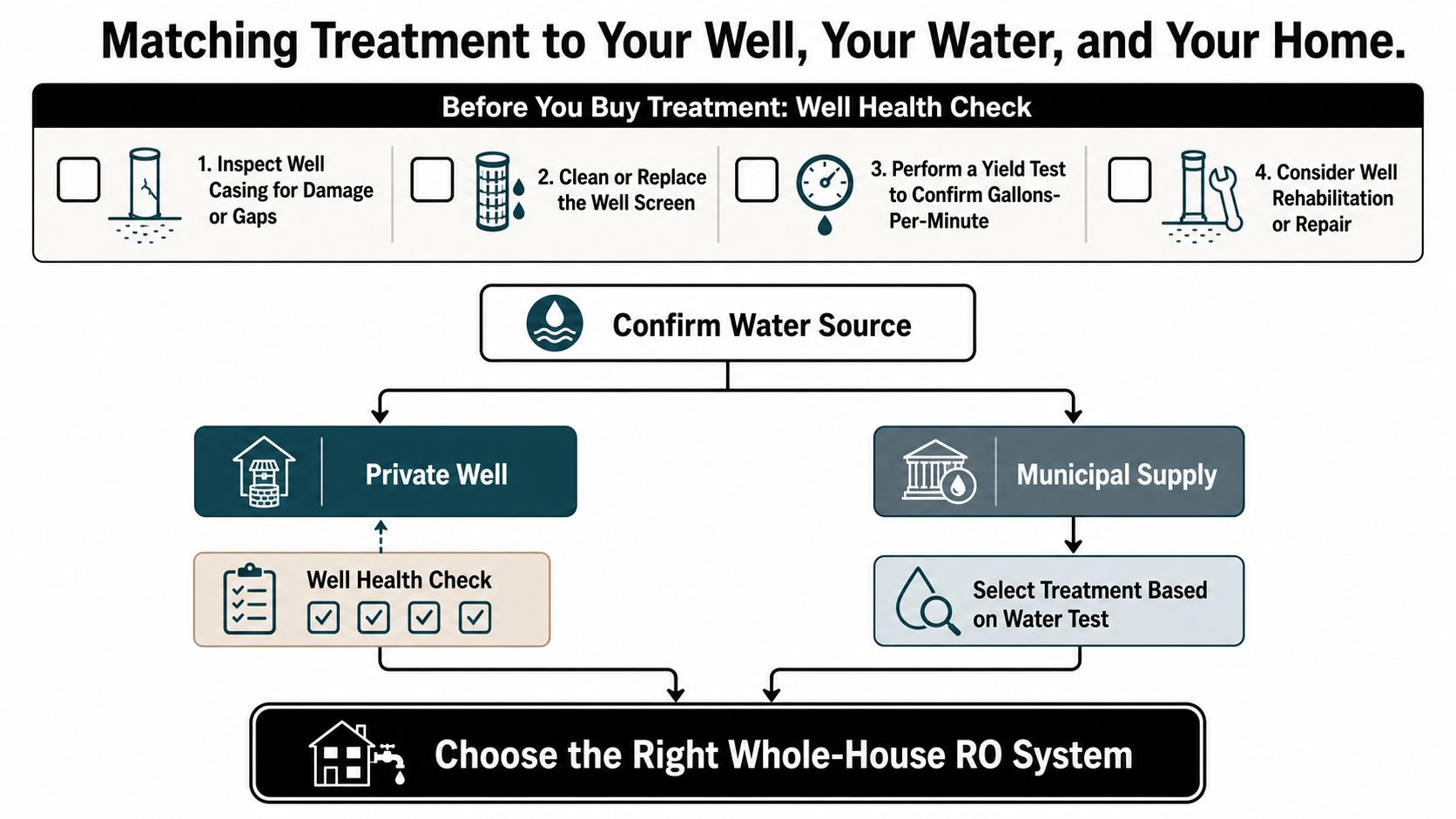
If you want the simplest answer from a service standpoint, I'll give it to you. For a lot of Lee County homes, especially on private wells or near coastal influence, whole-house reverse osmosis is the workhorse solution. You can layer softening and carbon ahead of it, but RO is the part that resets the water.
Matching Treatment to Your Well, Your Water, and Your Home
A homeowner can waste a lot of money by starting in the wrong place. If the well itself is failing, treatment gear will not fix it. A cracked casing, damaged screen, or weak yield calls for repair or rehabilitation first, including well water repair services, before anyone spends serious money on a whole-house system.
Put the well first, then the treatment
Use this sequence in the field. Inspect the well casing, check the screen, confirm yield, and find out whether the well needs rehabilitation or repair. If the well cannot produce stable water, the treatment system will spend all its time chasing a moving target.
Rule of thumb: don't overbuild treatment on top of a weak well.
Once the source is sound, the usual Cape Coral staging is straightforward. Sediment first. Carbon next if the water needs chlorine or chloramine reduction. Then a softener where hardness justifies it. Then RO for the final polish. If sulfur is strong or iron shows up in the test, a sulfur-reducing or iron filter may belong ahead of the membrane stage. That is not fancy. It is just the right order.
Testing should stay simple and disciplined. Check hardness, TDS, sulfur, and nitrates on a schedule, and retest anytime taste, odor, or scaling changes. If the numbers point to salinity intrusion, rising nitrate, or a changing well profile, stop adding little point-of-use gadgets and call a Cape Coral water-treatment specialist who can size the system to the actual data.
Whole-house reverse osmosis system details matter most after the house has been tested and the treatment train is built around those results, not around a sales package.
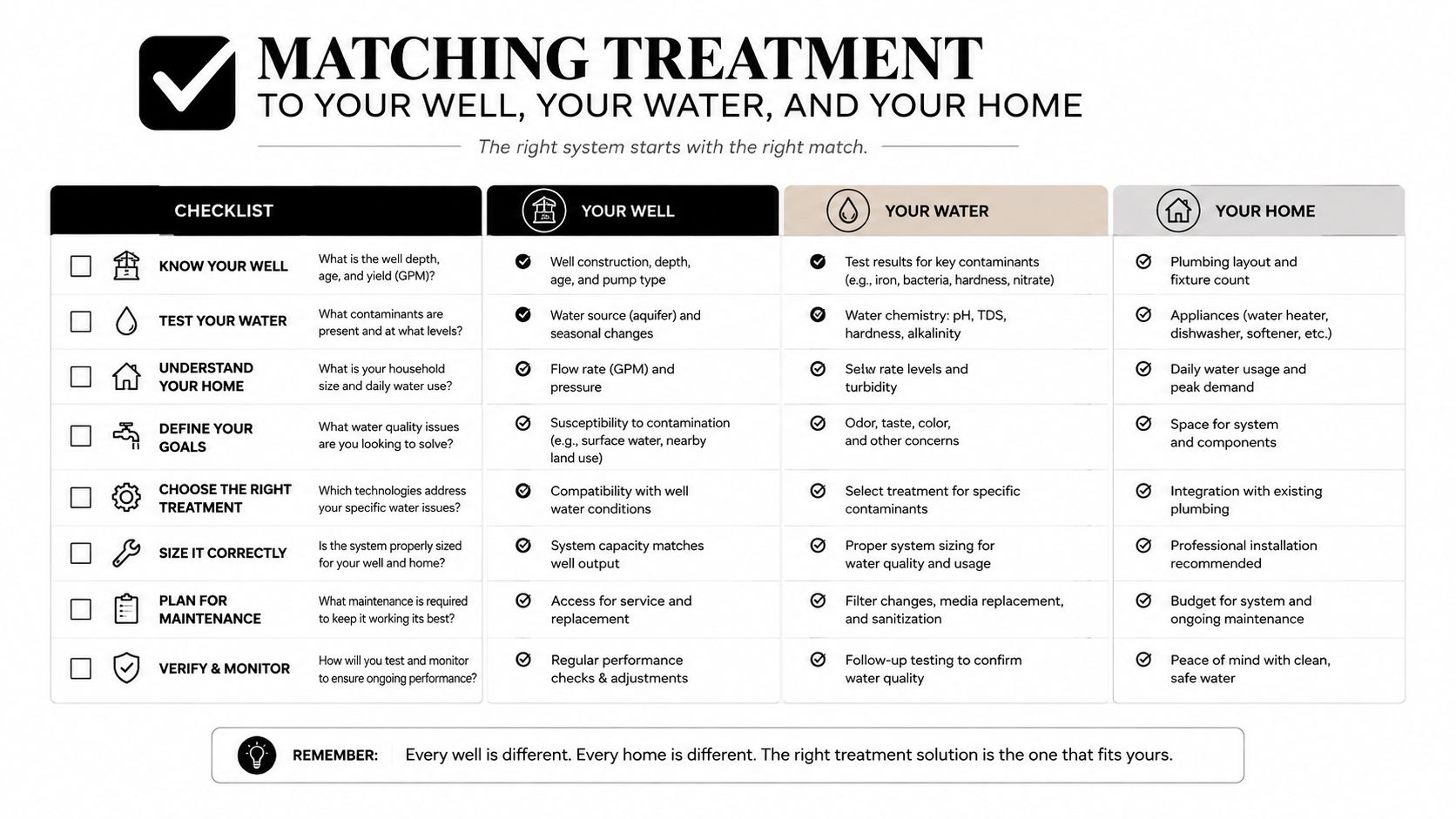
What to verify before you buy
- Tank size: make sure storage matches household peak use, not just average use.
- Daily production: the system should cover cooking, showering, laundry, and drinking without constant recovery lag.
- Drain capacity: the waste stream has to be handled correctly, or the system will not run right.
- Pre-treatment fit: if your water has sulfur, iron, or heavy hardness, stage the front end properly.
A faucet filter will not solve a whole-house problem. It improves one glass and leaves the rest of the house unchanged.
Pools, HOAs, and Community Water Systems
Pools and HOA common areas get overlooked because everyone thinks in terms of the house first. That's a mistake. In Southwest Florida, the pool, the irrigation lines, and the community water features all share the same supply logic, and bad fill water shows up everywhere.
What pool owners should ask
Before you refill, ask three direct questions. Will the fill water interact badly with your heater because of chlorine or chloramine residuals. Will the calcium hardness push plaster or finish issues. And should the water pass through a softener or RO stage before it reaches the pool.
For HOAs, the same discipline applies to lakes, fountains, and irrigation taps. Those may pull from reclaimed lines, private wells, or city supply, and each source brings different permitting and management touchpoints through Lee County Utilities or the City of Cape Coral. Property managers should not sign off on a bid until they know the cistern sizing, backflow prevention approach, and service-line ownership.
Practical move: ask every vendor who owns the water path, who maintains it, and who is responsible when the source changes.
That question alone weeds out sloppy proposals.
| Water Source | Typical Pool/HOA Need | Recommended Pretreatment |
|---|---|---|
| Private well | Reduce hardness, sulfur, or staining risk | Sediment, carbon, softening, then RO if the test supports it |
| Reclaimed line | Manage chlorine-related impacts and source variability | Carbon and source-specific conditioning |
| City supply | Control disinfectant residuals and balance fill chemistry | Carbon, then additional treatment if the water test calls for it |
Pools don't care about marketing. They care about chemistry. Get the source right, and the maintenance gets easier.
Your Next Steps and Local Resources
Start with the source. Confirm whether the property uses city water, a private well, or reclaimed water. Then pull a current Lee County or Cape Coral water-quality report, or order an independent panel if the house is on a well. After that, verify any active SWFWMD shortage order, schedule a well inspection if the property relies on groundwater, and book a whole-house RO consultation based on the actual results.
Who to call
If you have permitting questions, call SWFWMD's Brooksville office. For service-area issues, talk to Lee County Utilities. If you're on canal-side lots or inside Cape Coral utility territory, check with the City of Cape Coral Utilities. Those are the desks that can keep you from buying the wrong system or assuming the wrong rule applies.
If you want the water in your house evaluated the right way, keep it local and test-driven. That's how you avoid buying too little treatment, or too much of the wrong kind.
Water Medic of Cape Coral handles whole-house reverse osmosis, well water repair, and water-system assessments for Southwest Florida homes. If your water tastes off, leaves scale, or keeps forcing you into stopgap fixes, visit Water Medic of Cape Coral and ask for an evaluation built around your actual test results.