
Is Alkaline Water Good for Dogs? a Vet-Informed Guide
For most healthy dogs, the potential benefit of alkaline water comes from hydration, not alkalinity. For dogs at risk of urinary stones, veterinary guidance commonly targets urine specific gravity below 1.020, but the right urine pH depends on the diagnosis, not the pH printed on a water bottle.
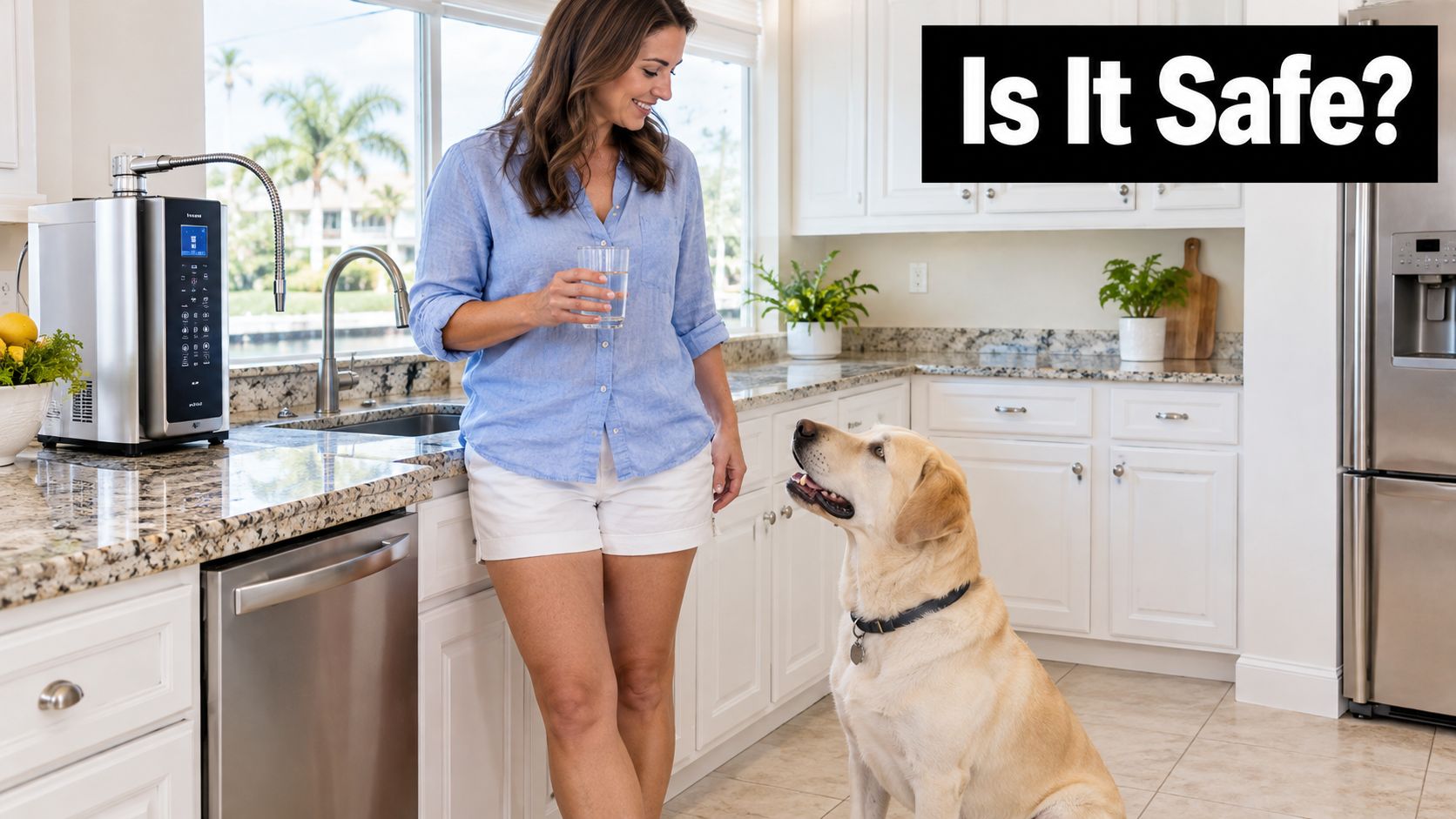
In a Cape Coral kitchen, a family has just switched its Lab to water from a countertop ionizer. The dog seems happy to drink it, but the owner is wondering whether the change is helping. That's a sensible question, especially in a home where the well water's taste, mineral content, or test results have already raised concerns.
When people ask, “Is alkaline water good for dogs?”, they're often trying to solve different problems: encouraging a dog to drink more, supporting urinary health, or getting more confidence in the water coming out of the tap. Those aren't interchangeable goals. A dog's health history, urine chemistry, and household water supply matter more than an alkaline label.
Why Dog Owners Are Asking About Alkaline Water
Alkaline water is often presented as a simple upgrade: raise the pH, and the water must be healthier. That shortcut doesn't hold up as a general rule for dogs. A controlled study published in 2018 compared adult dogs drinking nutrient-enriched water with dogs drinking ordinary tap water. Urine pH, specific gravity, and osmolality were similar at baseline and at most other sampling points, so the study doesn't establish that changing a dog's water reliably changes its internal urine chemistry (the 2018 canine water study).
The practical question is not just whether a dog can drink water with a higher pH. It's whether the dog is drinking enough, whether the water supply is suitable, and whether a veterinarian has set a specific urinary-health target. For a healthy dog with no urinary history, clean, appealing water matters more than chasing an alkaline number.
Start with the problem you're trying to solve
A dog that turns away from water may need a more appealing source or a clean bowl, not water with a higher pH. An owner concerned about crystals or stones needs advice tied to the dog's diagnosis, not a consumer product's claim. And a homeowner worried about well water needs testing to learn what's in the supply.
That distinction matters in Southwest Florida, where private-well households may be making decisions based on taste, odor, or assumptions about mineral content. The right next step depends on what the owner wants to improve: hydration, urinary health, or confidence in the water itself. Those goals can overlap, but alkaline water alone doesn't address all of them.
What Alkaline Water Actually Is
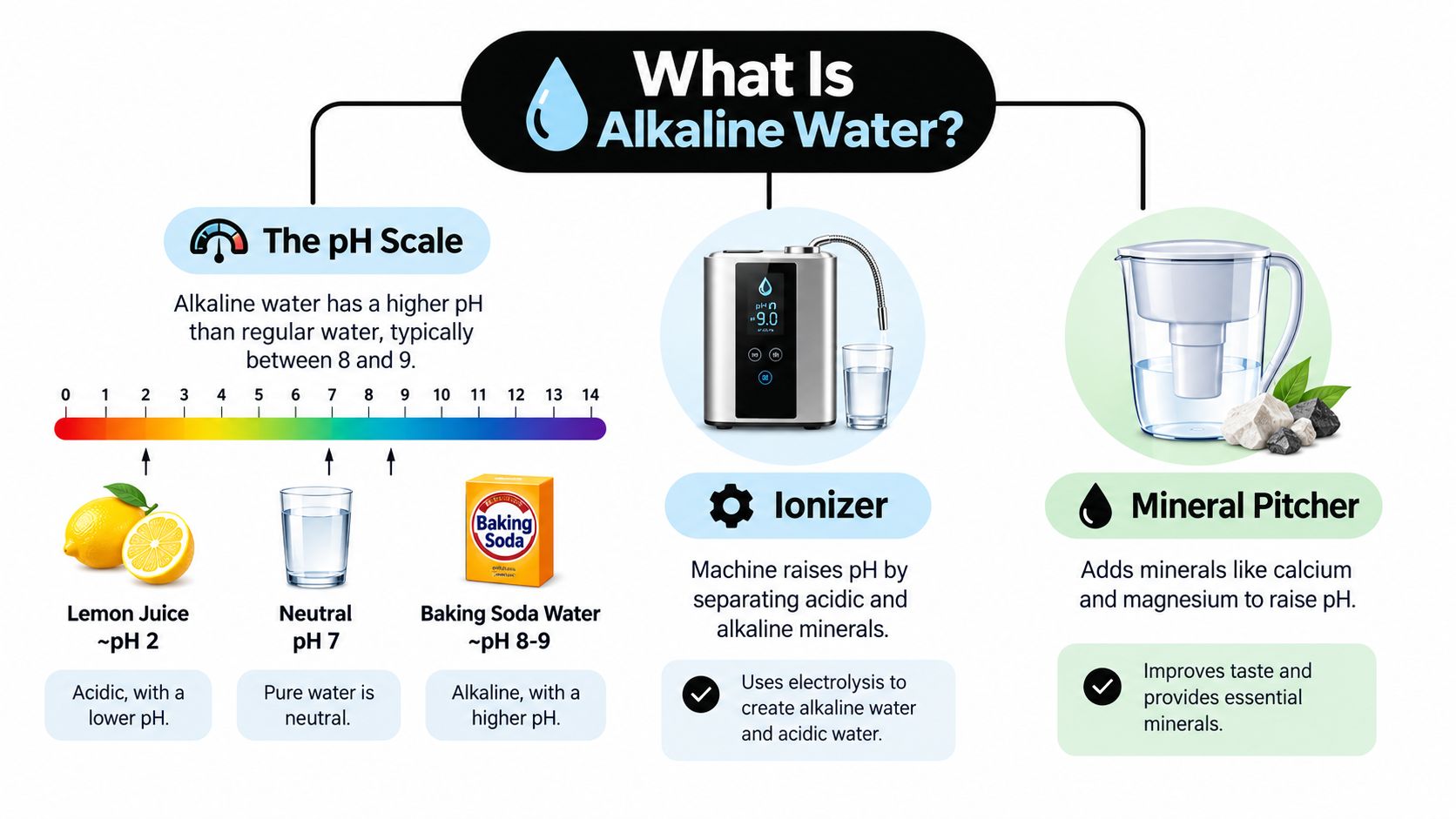
Think of pH like a simple scale that describes how acidic or alkaline a liquid is. Lemon juice is acidic; baking-soda water is alkaline; water around neutral sits between them. Consumer products usually call water “alkaline” when its pH is above neutral, but that label describes one water characteristic, not a complete measure of purity, mineral balance, or suitability for a dog.
pH is not the same as mineral content
An ionizer can alter water's pH, while a mineral-addition product raises mineral content and may also increase pH. Some filters can affect both, depending on their design and the source water. These approaches aren't identical, and neither tells you by itself which contaminants are present or how much dissolved material the water contains.
For homeowners, total dissolved solids (TDS) and specific contaminant reduction can be more useful treatment questions than pH alone. Reverse osmosis systems are evaluated under NSF/ANSI 58, which includes a required TDS-reduction claim category. Claims for reducing particular contaminants, such as nitrate, arsenic, lead, or fluoride, are optional and need to be supported by applicable testing (NSF/ANSI 58's reverse-osmosis framework). Don't assume an RO system handles every contaminant just because it uses reverse osmosis.
A water bottle's pH also isn't a veterinary urine test. A dog's kidneys and other body processes regulate internal chemistry; a consumer water label doesn't show whether the dog's urine is in a target range. A healthy dog may not be meaningfully affected by a modest change in drinking-water pH, while a dog being managed for a urinary condition needs an individualized plan.
What the Veterinary Evidence Actually Shows
The evidence supports a straightforward conclusion: there's no strong case for routine alkaline-water supplementation in healthy dogs. The controlled canine study discussed above measured urine chemistry and didn't find consistent differences between the water groups across most sampling points. That result doesn't prove that every water treatment has no effect, but it does argue against assuming an alkaline label will reliably alter a dog's urinary health.
Hydration is the more established lever. More water can produce more dilute urine, reducing the concentration of minerals that can contribute to crystals and stones. Research summarized in ACVIM consensus recommendations found that increasing dietary moisture to about 73% reduced calcium-oxalate relative supersaturation in dogs from 13 to 8 in short studies lasting 12–19 days, roughly a 38% reduction (ACVIM consensus research summary). That finding points to water content and urine dilution, not water alkalinity, as the relevant consideration.
The urine test matters more than the bottle
Veterinarians assess urine pH and specific gravity because those measurements relate to the dog's actual urine. A dog's target depends on its stone type or other diagnosis, and can also be affected by diet, infection, medications, genetics, and urine volume. Changing the drinking water without knowing the clinical target is guesswork.
Practical rule: If a dog has a urinary diagnosis, ask what urine result the treatment plan is trying to achieve before changing water chemistry.
For dogs without a relevant medical history, offering clean water the dog will readily drink is a reasonable priority. For dogs with a history of stones or crystals, alkaline water could move urine away from a veterinarian's intended target. In that situation, don't treat a water product as a supplement or substitute for testing.
When Alkaline Water May Help, Harm, or Simply Not Matter
The answer depends on the dog. The right way to sort it out is to consider the dog's urinary history first, then decide whether water treatment has a role.
Healthy dog with no urinary history
If a dog is healthy and has no known urinary problems, alkaline water usually isn't necessary. Focus on a reliable source and whether the dog drinks readily. If a new water source makes the dog more willing to drink, that may be useful for hydration, but it doesn't establish a special benefit from alkalinity.
Dog with a stone history
Urine pH goals differ by stone type. Merck Veterinary Manual describes targets around 6.0–6.5 for dogs predisposed to struvite stones and 6.5–7.5 for calcium-oxalate prevention; both approaches commonly include a urine specific gravity target below 1.020 (Merck Veterinary Manual guidance on canine urolithiasis). Struvite stones are associated with alkaline urine and urinary-tract infection, while calcium-oxalate prevention focuses on limiting urine concentration, not raising pH.
| Condition | Target urine pH | Target specific gravity | Owner takeaway |
|---|---|---|---|
| Struvite risk | 6.0–6.5 | Below 1.020 | Don't add alkalinity without the veterinarian's direction. |
| Calcium-oxalate prevention | 6.5–7.5 | Below 1.020 | Prioritize the prescribed plan and urine dilution. |
| Urate-stone predisposition | 7 or higher in some protocols | Set by the veterinarian | Use a diagnosis-specific plan, not a general water product. |
A water softener addresses water hardness, not a dog's urinary diagnosis. If hardness is part of the household water concern, learn what a water softener is designed to address, then keep the dog's treatment plan separate.
The special case of urate stones
Dogs predisposed to urate stones, including Dalmatians and Bulldogs, may be managed with increased fluid intake, low-purine nutrition, and alkaline urine, with some protocols aiming for urine pH of 7 or higher. That's a veterinary-directed exception, not a reason to alkalinize every dog's water. Match the water plan to the diagnosis, not the bottle label to the dog.
Warning Signs to Watch After Changing Your Dog's Water
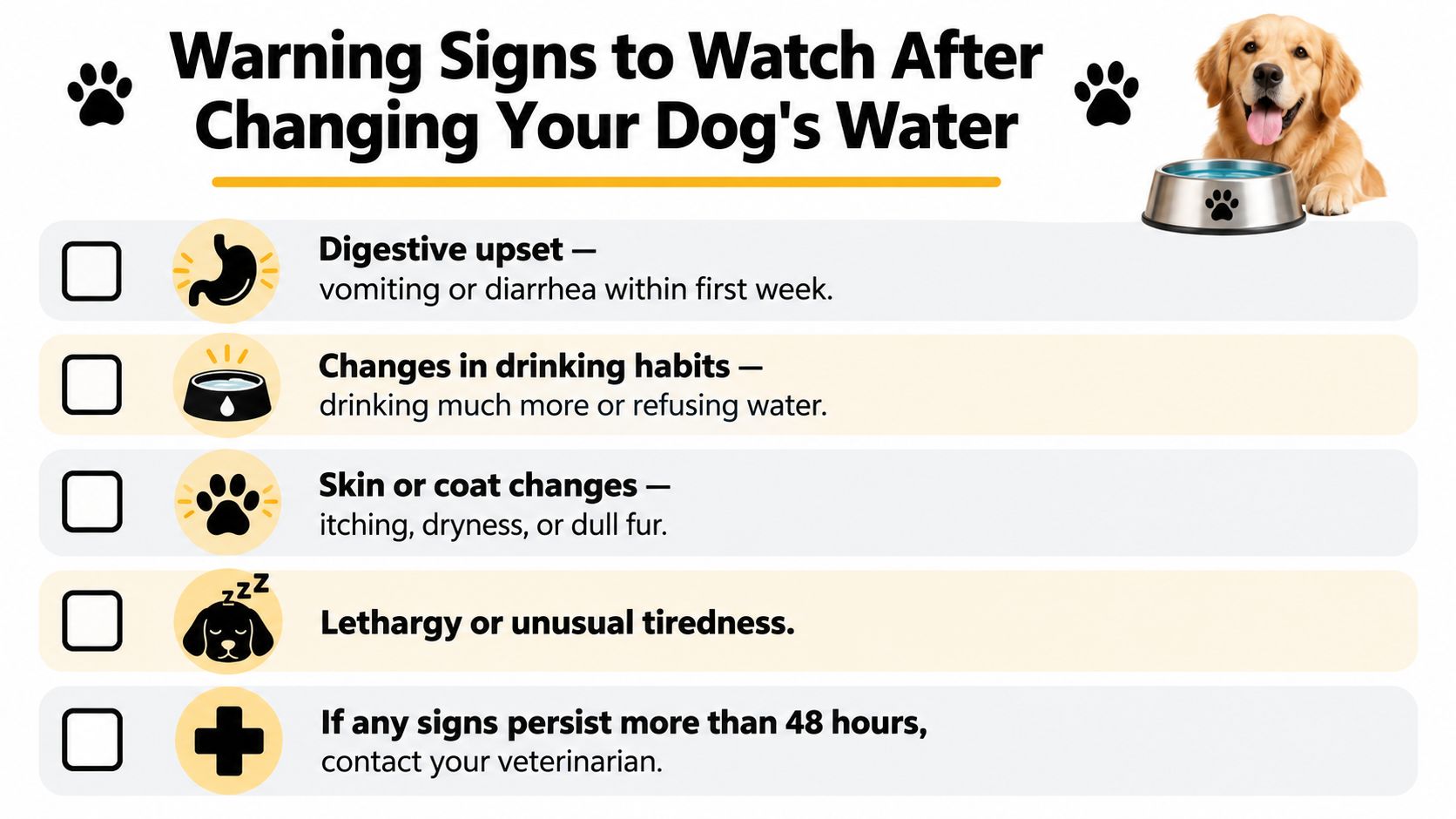
When you change a dog's water source, ionizer setting, or household treatment, pay attention to what changes in the dog, not just what the water tastes like. A dog may prefer the new water and drink more readily. That can be a positive sign, but a marked change in drinking habits can also warrant a closer look, especially if it continues or comes with other symptoms.
What to watch for
- Drinking changes: Notice if your dog suddenly drinks much more, drinks much less, or refuses the water.
- Urination changes: Call your veterinarian if your dog strains, has more frequent accidents, or you see blood in the urine.
- Urine appearance: A strong change in urine color or odor deserves attention, particularly alongside altered urination.
- Digestive or energy changes: Vomiting, diarrhea, or unusual tiredness should not be dismissed as proof that a water change is harmless.
A dog drinking more because the water tastes better is different from a dog drinking more while losing weight or acting unwell. The first may reflect preference; the second deserves a veterinary call. Don't rely on visual observation to determine urine pH or specific gravity. Veterinary stone-prevention guidance commonly targets specific gravity below 1.020 in dogs at risk of urolithiasis, with pH targets varying by condition (urine pH and specific-gravity guidance).
If your dog has a history of stones, urinary obstruction, kidney disease, or recurrent infection, have the veterinarian check urine pH and specific gravity before making a deliberate pH change. Don't wait for warning signs to decide whether the change fits the treatment plan.
How Source Water in Southwest Florida Shapes the Answer
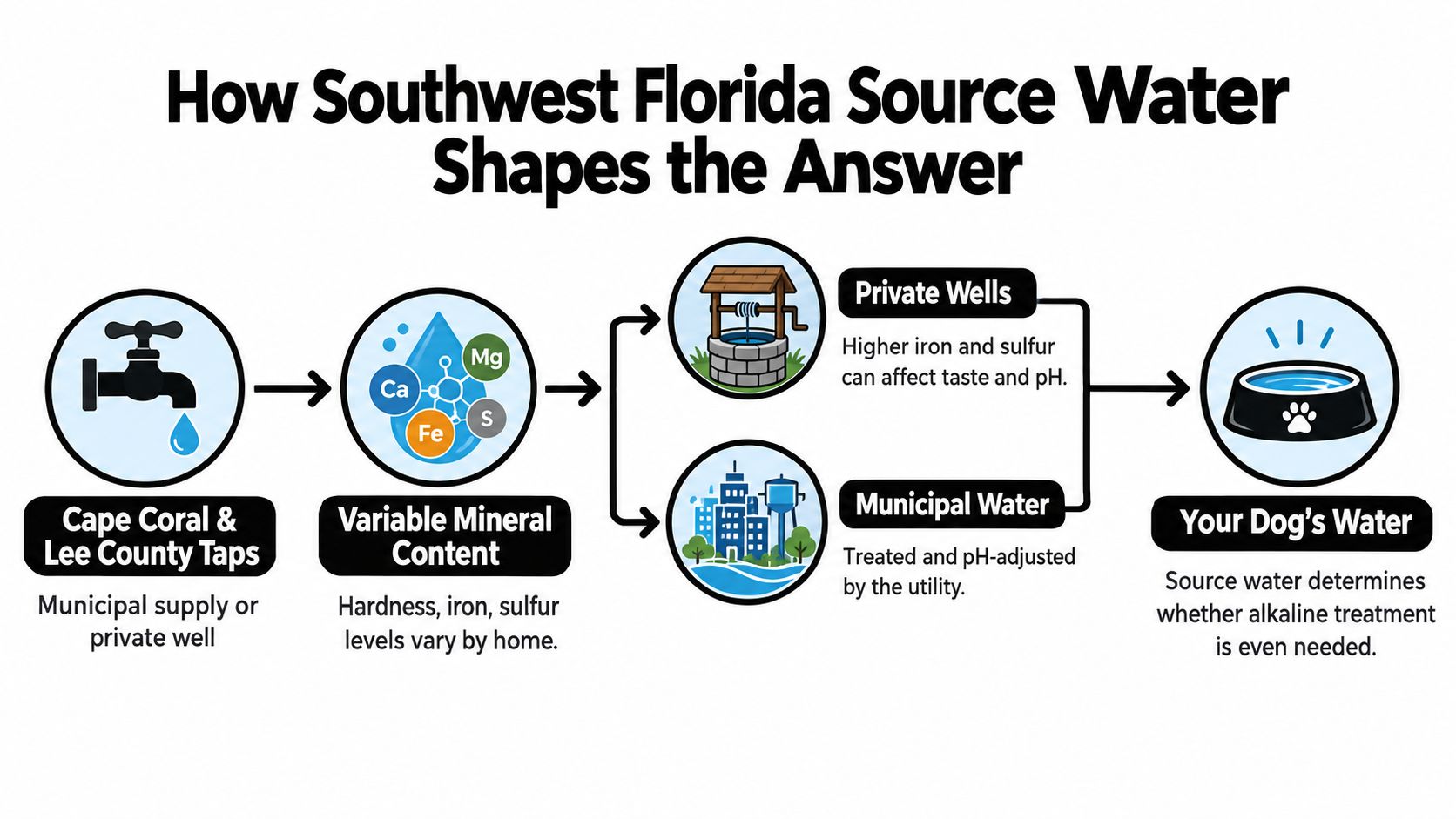
For a dog in Cape Coral or Lee County, the water question starts with the household supply. A private well and a municipal tap aren't the same starting point, and a countertop ionizer can't tell you whether the source water contains a contaminant that needs attention. Test results are more useful than assumptions based on taste or a pH reading.
Test first, then choose treatment
The Florida Department of Health strongly recommends that private-well owners in Cape Coral and Lee County test for bacteria and nitrate at least once each year, and test again after flooding or well repairs. University of Florida guidance also recommends testing the specific contaminant being treated when equipment is installed, at regular intervals afterward, and whenever water quality changes (Florida private-well testing guidance). That gives you a baseline for deciding whether treatment is needed and whether it continues to meet the household's goals.
A whole-house reverse osmosis system is a treatment option for homeowners who want to address their supply more broadly, including TDS and contaminants covered by the system's supported performance claims. The key is to compare those claims with the lab report. NSF/ANSI 58 doesn't mean every RO system is certified to reduce every contaminant, so ask which specific reduction claims have been tested.
The dog's bowl is only one part of the home's water picture. If you're on a private well, reviewing common well-water questions can help you prepare for a conversation about the supply and appropriate treatment. If you're on municipal water, get clear on what concern you're trying to address before adding a pH-changing product.
A Practical Next Step for Your Dog and Your Home
Start with your veterinarian. Ask whether your dog's urine pH and specific gravity should be checked before changing water chemistry, and share any history of stones, infections, urinary obstruction, or kidney disease. If your dog is predisposed to a particular stone type, ask how water, diet, and any prescribed treatment fit together.
Then get a current lab report for your household water. Use the results to decide whether the drinking water needs targeted treatment or whether a broader whole-house approach makes more sense. For most healthy dogs, the sensible choice is clean water the dog will drink, not a more expensive bottle with a higher pH.
If the home's test results point to a treatment need, compare systems by their tested claims and the contaminants in your report. A whole-house reverse osmosis system may be worth discussing when you want treatment designed around the household supply, rather than making a decision based only on an alkaline label.
Water Medic of Cape Coral provides water-treatment options, including whole-house reverse osmosis systems, for homeowners in Southwest Florida. If you want to connect your well-water test results with a practical treatment plan for your home and your dog's drinking water, visit Water Medic of Cape Coral.