
How to Get an Accurate Mold Removal Estimate
A realistic Cape Coral mold removal estimate commonly falls around $1,223 to $3,749, with an average project cost near $2,364, but widespread contamination can reach $10,000 to $30,000. The number depends less on the stain you can see than on containment, hidden growth, HVAC involvement, and the materials that have to be removed.
You notice the dark patch after returning from a trip, or you catch a musty smell when the air conditioner starts. The visible area may look small, yet the estimate comes back far higher than expected. That isn't automatically padding. In Southwest Florida homes, humidity, storm exposure, and concealed cavities can turn a surface cleanup into a controlled removal and restoration project.
A reliable mold removal estimate should show what the contractor inspected, what will be contained, what will be removed, how affected areas will be cleaned, and how the work will be verified. If the quote only says “mold treatment” followed by one lump sum, you don't have enough information to compare it with another bid.
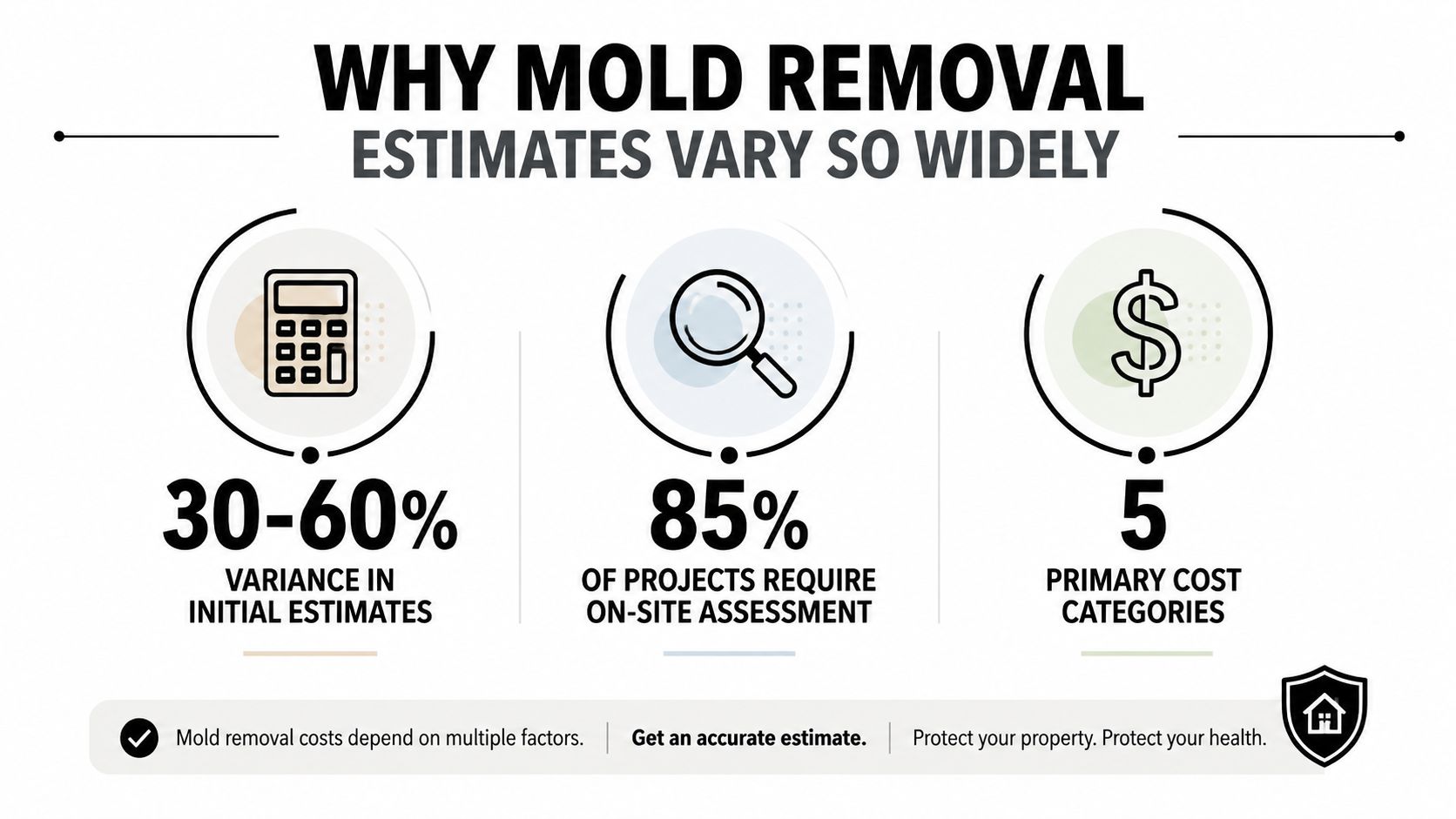
Why Mold Removal Estimates Vary So Widely
The first mistake homeowners make is treating mold like a stain. A stain is visible. Mold remediation is a scope-of-work decision that may involve demolition, disposal, cleaning, containment, and rebuilding. National pricing guidance from Angi's mold remediation cost guide places the average project near $2,364, with most homeowners paying $1,223 to $3,749 and contractors commonly charging $10 to $25 per square foot.
That range only becomes useful after someone identifies the affected materials and the boundary of contamination. A 100-square-foot affected area can land around $1,000 to $2,500 using square-foot pricing, while whole-house contamination may rise to $10,000 to $30,000 because the job includes more than surface cleaning.
The visible patch isn't the full scope
Drywall and insulation are porous. Once contamination has penetrated those materials, cleaning the face of the material may leave the underlying problem in place. Tile, metal, and sealed concrete are less absorbent, so a contractor may be able to clean them without removal, provided the inspection confirms that contamination hasn't spread behind them.
HVAC components change the calculation again. Growth inside ductwork or near air-handling equipment can require specialized containment and cleaning, while a small accessible patch on a non-porous surface may require far less labor. That's why two homes with similar-looking growth can receive very different estimates.
Practical rule: Compare the written scope, not the size of the stain and not the confidence of the salesperson.
A defensible quote also accounts for the conditions that caused the growth and the work needed to keep the area dry. Homeowners who want a broader moisture-control routine can review Water Medic's monthly maintenance service as one part of ongoing property care. The lowest quote often wins by leaving out inspection detail, containment, verification, or restoration.
What a Professional Inspection Actually Covers
Before anyone writes a serious dollar figure, the home needs a documented assessment. A qualified inspector should record the water-intrusion history, complete a visual inspection, map moisture with calibrated pin and non-invasive meters, and define the contamination boundary.
That sequence matters. If a contractor prices only what the eye can see, the estimate may exclude wet materials behind a wall, affected subflooring, insulation, or HVAC components. A proper assessment connects each finding to a cost line instead of guessing from a photograph.
Four pieces of a defensible assessment
History and documentation. The inspector records when the moisture event occurred, which rooms were affected, and what drying or cleaning has already taken place. This gives the contractor context for interpreting current moisture readings.
Visual inspection. The inspection should cover adjoining rooms, ceilings, wall surfaces, closets, equipment areas, and other locations where air movement or concealed moisture could have carried contamination.
Moisture mapping. Pin meters help evaluate moisture in suitable building materials, while non-invasive meters help screen larger areas without unnecessary damage. The inspector should identify readings that justify opening a wall or removing a finish.
Boundary definition. The written report should distinguish affected areas from areas that were inspected and found unaffected. That boundary drives containment, personal protective equipment, removal methods, disposal, cleaning, and clearance criteria.
The National Mold Authority assessment guidance ties this process to ANSI/IICRC S520, a framework used to classify affected zones by condition level and determine the appropriate remediation controls.
What shortcuts tell you
A quick visual glance isn't a substitute for moisture mapping. A quote that ignores HVAC components or fails to identify the boundary may look attractive because it has removed difficult work from the scope. For homeowners who need help locating concealed moisture before requesting estimates, Water Medic's leak detection service is a relevant option to consider.
Ask for the assessment findings in writing. You should be able to see why the contractor chose a particular containment method, removal method, and clearance approach.
The Cost Drivers That Actually Matter
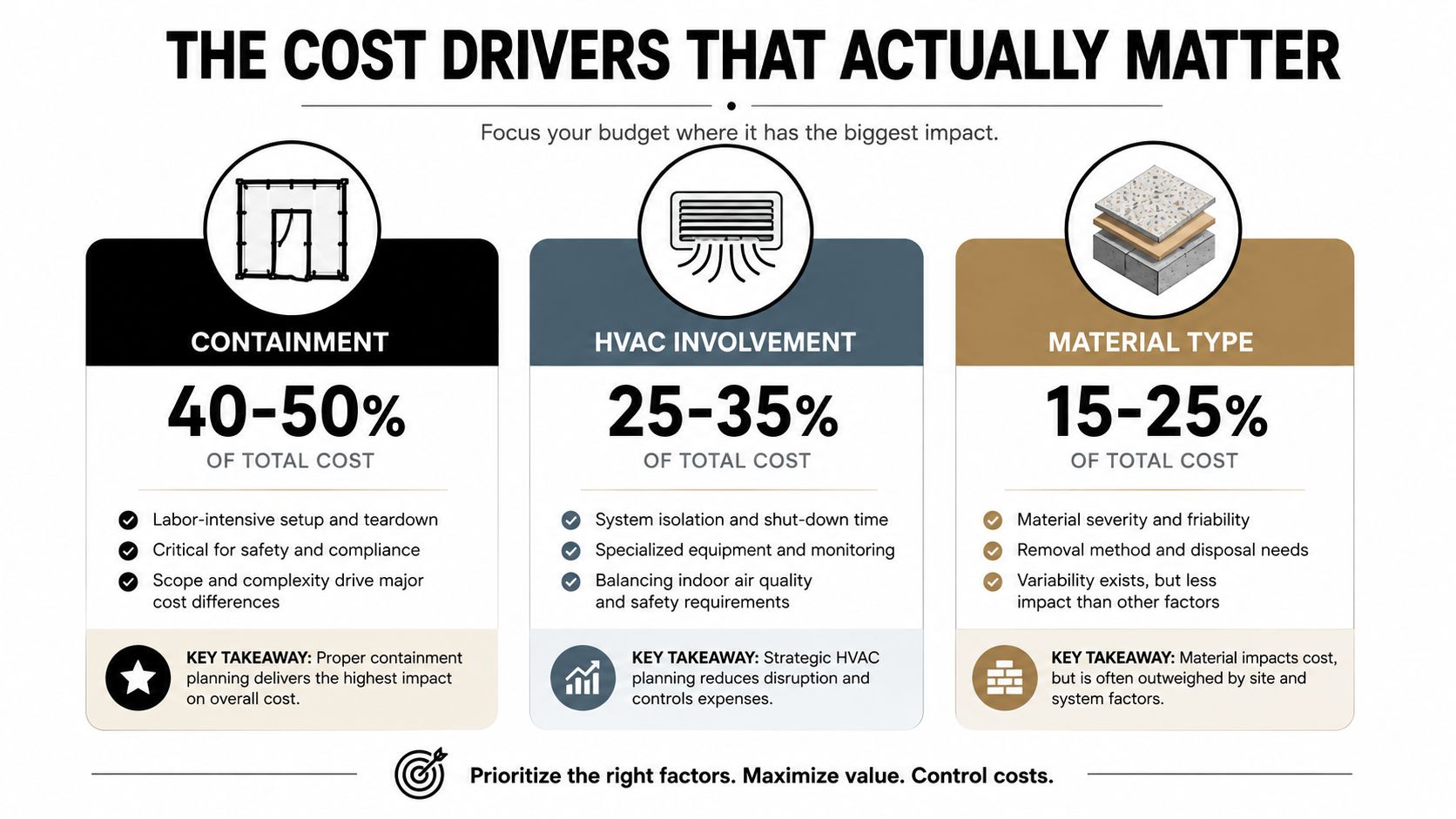
Two homes can show similar-looking mold and still receive quotes that differ by thousands. Square footage gets the attention, but containment, HVAC involvement, material type, hidden amplification, and access usually drive the cost. In Cape Coral, humidity and storm-related moisture make those details especially important.
Public estimator guidance commonly uses a base rate of $10 to $25 per square foot. Containment barriers and negative-air equipment may add $500 to $800 as a separate setup cost, according to mold remediation pricing guidance from Local Service Calculator. Treat those figures as a starting framework, not a complete price for every home.
Containment comes before removal
Containment separates the work area from occupied parts of the house. Depending on the boundary, the crew may need sealed barriers, controlled access, negative-air equipment, and filtration. An estimate that lists labor and cleaning but says nothing about containment does not explain how the crew will prevent cross-contamination.
HVAC involvement can change the scope quickly. If the affected area connects to ductwork, return-air paths, or air-handling equipment, the crew needs a different plan than it would use for an isolated wall surface. A small concealed patch can therefore cost more than a larger, accessible area.
Material type changes the job
Porous materials such as drywall, insulation, and carpet padding often require removal because contamination can remain embedded. Tile, metal, and sealed concrete may sometimes be cleaned in place. The estimate should state which materials will be removed and which will be cleaned.
Access adds another cost layer. Attics and crawlspaces are commonly priced 20% to 50% higher because crews work in restrictive spaces with more demanding PPE, containment controls, and labor conditions. Local Service Calculator's mold cost guidance provides that range, but the contractor still needs to show what added work justifies it.
The EPA's widely used 10-square-foot benchmark helps homeowners judge when professional remediation is appropriate. For pricing context, Restore Advisor's remediation guidance describes small jobs under 10 square feet as often costing $500 to $1,500, medium jobs from 10 to 100 square feet as commonly costing $1,500 to $5,000, and larger projects over 100 square feet as frequently reaching $5,000 to $15,000 or more.
Do not accept a contractor's “severe” label in place of a defined scope. Ask whether growth involves insulation, ducting, wall cavities, or other concealed areas. Scope-of-work language is more useful than severity language.
How to Read a Line-Item Estimate
A reliable estimate breaks the job into identifiable phases: source correction, containment setup, demolition and removal, cleaning, and post-remediation verification. Each phase carries different labor, equipment, disposal, and documentation requirements. Square footage alone cannot explain the price. Containment, HVAC involvement, and hidden amplification often create the largest differences between quotes.
Every line item should state what the crew will do, where the work will occur, and which materials are included. “Mold treatment, miscellaneous” is not a usable scope.
| Line Item | What It Covers | Typical Range |
|---|---|---|
| Source correction | Identifying and addressing the moisture condition that supports growth | Varies by finding and required correction |
| Containment setup | Barriers, controlled access, negative-air equipment, and filtration | Often an added setup charge of $500 to $800 |
| Demolition and removal | Removing affected porous materials, bagging, transport, and disposal | Usually tied to affected area, material type, and access |
| Cleaning | Cleaning suitable non-porous surfaces and treating the contained work area | Varies with surface type and contamination boundary |
| Post-remediation verification | Reviewing completed work against the agreed clearance criteria | Must be identified separately or clearly included |
Read assumptions before totals
A quote for a small wall area may leave out cavity exploration, insulation removal, HVAC work, reconstruction, or verification. That does not automatically make the quote dishonest. It does make the scope incomplete when the inspection points to those tasks.
In a Cape Coral home, an air-conditioning condensate pan overflow can leave a small visible patch while contamination extends into the wall cavity. The actual scope may include containment, selective demolition, disposal, cavity cleaning, drying, and verification. The patch is small. The work is not.
HVAC deserves its own line item when ducts, air handlers, insulation, or return paths may have been affected. A cheap quote that ignores those areas can become expensive through change orders, while a higher quote may already include the hidden work.
Request matching bids. Provide each contractor with the same inspection report, contamination boundary, access information, and clearance expectations. Compare whether every company priced the same tasks, not merely whether the totals look similar. Ask which exclusions could trigger a change order, and require those exclusions in writing.
Inspection and Testing Costs Worth Knowing
Inspection and testing should answer a specific question. A visual check may be appropriate when the affected area is obvious and the scope is limited. A broader inspection makes more sense when the home has a musty odor, recurring moisture concerns, multiple affected rooms, or suspected hidden amplification.
Neutral industry guidance places a visual inspection of one area around $175 to $325. A whole-home inspection with 2 to 3 air samples may run $550 to $1,100, and each laboratory sample can add roughly $90 to $175, according to the Mold Inspectors Near Me inspection cost guide.
Testing isn't the same as inspection
An inspection evaluates conditions, locations, materials, and moisture. Sampling provides laboratory data about the collected samples. Neither replaces the other when the goal is a defensible remediation scope.
A contractor shouldn't push testing to create another fee, and a homeowner shouldn't reject useful testing because a visual walkthrough feels cheaper. Ask what decision the test will inform. If the result won't change the containment plan, removal method, or clearance criteria, the expense may not add value.
Ask about reimbursement before work begins
Most homeowner policies don't directly cover inspection costs. They may be reimbursable when mold results from a covered peril, but policy language controls the decision. Get the inspection invoice, report, photographs, moisture readings, sampling rationale, and laboratory results organized before submitting anything.
The practical reason to document first is simple. A low estimate can expand once hidden damage, sampling, and access limitations are measured. Paying for the right assessment early can protect you from approving a price that was never based on the complete condition.
Insurance, Documentation, and the Coverage Question
Insurance doesn't usually turn on whether mold exists. It turns on why the mold exists, what the policy covers, and whether the homeowner can document the event and resulting damage. Gradual humidity and long-term maintenance neglect are often treated differently from a sudden covered event or qualifying storm-related damage.
Start before demolition. Photograph the affected areas, surrounding finishes, equipment, and visible moisture conditions. Keep dates, contractor notes, invoices, inspection reports, sampling records, and the final remediation documentation together.
Build a claim file that supports the scope
- Photographs and dates: Capture the condition before materials are removed, including wide room views and close details.
- Inspection report: Preserve the moisture map, affected boundary, findings, and explanation for any sampling.
- Written scope: Keep the line-item estimate showing containment, removal, cleaning, disposal, and verification.
- Completion records: Save clearance or post-remediation verification documents and receipts for restoration work.

Coverage varies by peril and policy
Standard homeowners coverage, flood coverage, and wind-related provisions can treat the same visible damage differently. In Cape Coral and Lee County, storm-driven water and flood-related conditions deserve careful policy review because flood insurance and standard homeowners insurance aren't interchangeable.
Don't assume an adjuster will infer the reason for every line item. Give the adjuster the inspection findings and explain how the documented condition supports the proposed containment and removal. If financing the work becomes necessary while coverage is reviewed, Water Medic's financing information can be part of the options you evaluate.
Questions to Ask and How to Compare Estimates
The best contractor isn't the one who gives you the fastest number. It's the one who can explain the number without dodging details. Ask the same questions of every bidder and require written answers.
Contractor qualification questions
- S520 experience: Are you trained or certified for work aligned with ANSI/IICRC S520 practices?
- Written scope: Will you provide a line-item scope that identifies the boundary, materials, containment, removal, cleaning, disposal, and verification?
- Mold-specific insurance: Does your coverage apply to mold remediation work, not just general restoration?
- Containment plan: What barriers, access controls, negative-air equipment, and filtration will you use?
- HVAC review: Did you inspect return-air paths, ductwork, and air-handling components where relevant?
- Independent verification: Will a qualified third party perform post-remediation verification, or will the remediation company verify its own work?
- Warranty terms: What does your warranty cover if mold returns within 12 months, and what conditions void it?
A contractor who can't answer these questions clearly may still offer a low price, but you won't know what you're buying.
Normalize the bids
Put two or three estimates into the same comparison grid. Use these columns:
| Comparison Point | Bid One | Bid Two | Bid Three |
|---|---|---|---|
| Inspection date and affected boundary | |||
| Porous materials included for removal | |||
| Non-porous cleaning method | |||
| Containment and negative air | |||
| HVAC evaluation or treatment | |||
| Disposal included | |||
| Reconstruction included or excluded | |||
| Post-remediation verification | |||
| Warranty terms | |||
| Change-order conditions |
The important comparison isn't the final total. It's the assumptions beneath the total. One contractor may include wall-cavity exploration while another prices only visible surfaces. One may include verification while another ends the job after cleaning. Those aren't equivalent bids.

Know when the higher quote is better
A higher bid deserves consideration when it identifies more affected materials, uses a clearer containment plan, includes HVAC evaluation, and explains how the crew will verify completion. It's a warning sign when the difference is only vague labor padding, unexplained equipment fees, or repeated “miscellaneous” charges.
Your home's moisture controls also deserve attention after remediation. Mold prevention is not the same as water treatment, but homeowners often manage both as part of broader property care. A whole-house reverse osmosis system treats water at the point of entry, and NSF explains that these systems are typically installed near the water meter for municipal supply or near a pressurized storage tank for well water. Whole-house treatment can combine reverse osmosis with UV, softeners, or whole-house filters, as described in NSF's home water treatment overview.
Reverse osmosis uses pressure to force water through a semi-permeable membrane. NSF/ANSI 58 covers reverse osmosis drinking water treatment systems and their components, according to NSF's standard overview. Rejection performance is calculated as [(Feed TDS minus Product TDS) divided by Feed TDS] multiplied by 100, so a 99% rejection rate means 99% of total dissolved solids don't pass through the membrane, as explained in the HRO 6-series manual.
A healthy residential RO membrane commonly rejects 95% to 99% of dissolved solids. A rejection rate below 80% is a strong replacement threshold, while 80% to 89% may indicate fouling or aging, based on Crystal Quest's RO rejection guidance. These figures concern water quality, not indoor mold removal, but they illustrate the same principle: measure the condition, define the scope, and choose the service based on evidence rather than a headline price.
Water Medic of Cape Coral provides whole-house reverse osmosis estimates and water treatment guidance for Southwest Florida homeowners, including private-well properties. Visit Water Medic of Cape Coral to discuss the water-quality side of a broader home-maintenance plan and request a service estimate.