How to choose water filtration system: A Home Guide
Picking the right water filtration system isn't a one-size-fits-all decision. It really boils down to what’s in your water and what your family needs. You could go for a simple point-of-use filter that just handles the kitchen sink, or you might need a whole-house system to treat every drop of water entering your home. The smartest approach is always to figure out what contaminants you're dealing with first, then find the technology built to remove them.
Why Choosing the Right Water Filter Matters
If you're worried about what's coming out of your tap, you're not alone. Those concerns are completely valid. Even city-treated water can pick up some nasty stuff on its way to your faucet. Older pipes in the municipal system—or even in your own home—can leach lead. That chlorine taste? That’s from the disinfection process. And depending on where you live, things like agricultural runoff can introduce chemicals you definitely don't want in your morning coffee.
Taking control of your home's water supply offers a peace of mind that’s hard to put a price on. A good filtration system isn't just a nice-to-have appliance; it’s a core component of a healthy, secure home.
The Rise of Home Water Filtration
The growing demand for cleaner water isn't just a local thing; it's happening everywhere. The global water filters market hit a staggering $15.88 billion in 2024 and is expected to soar to $26.42 billion by 2032. This boom is fueled by a simple fact: people are more aware of water contamination than ever before and are actively seeking ways to ensure their drinking water is safe.
As your local experts here in Southwest Florida, our job is to help you cut through the noise. We’ll help you navigate the options to find a system that’s a perfect match for your home’s specific water profile. We’re here to take the guesswork out of the equation.
A high-quality water filter does more than just improve taste; it acts as a final protective barrier for your family, catching contaminants that slip through municipal treatment processes. This is your last line of defense.
More Than Just Filtering
Once you have clean water, it’s also smart to think about what you’re drinking it from. The safety of your water bottles and storage containers matters, too. It's worth learning about things like the importance of BPA-free materials in water contact to make sure your entire water habit is as healthy as possible.
From the first water test to picking the right system and handling the professional installation, we provide a complete service that ensures long-term reliability. Our commitment is simple: deliver clean water solutions that protect your family, your plumbing, and your appliances for years to come.
So, What's Really in Your Tap Water?
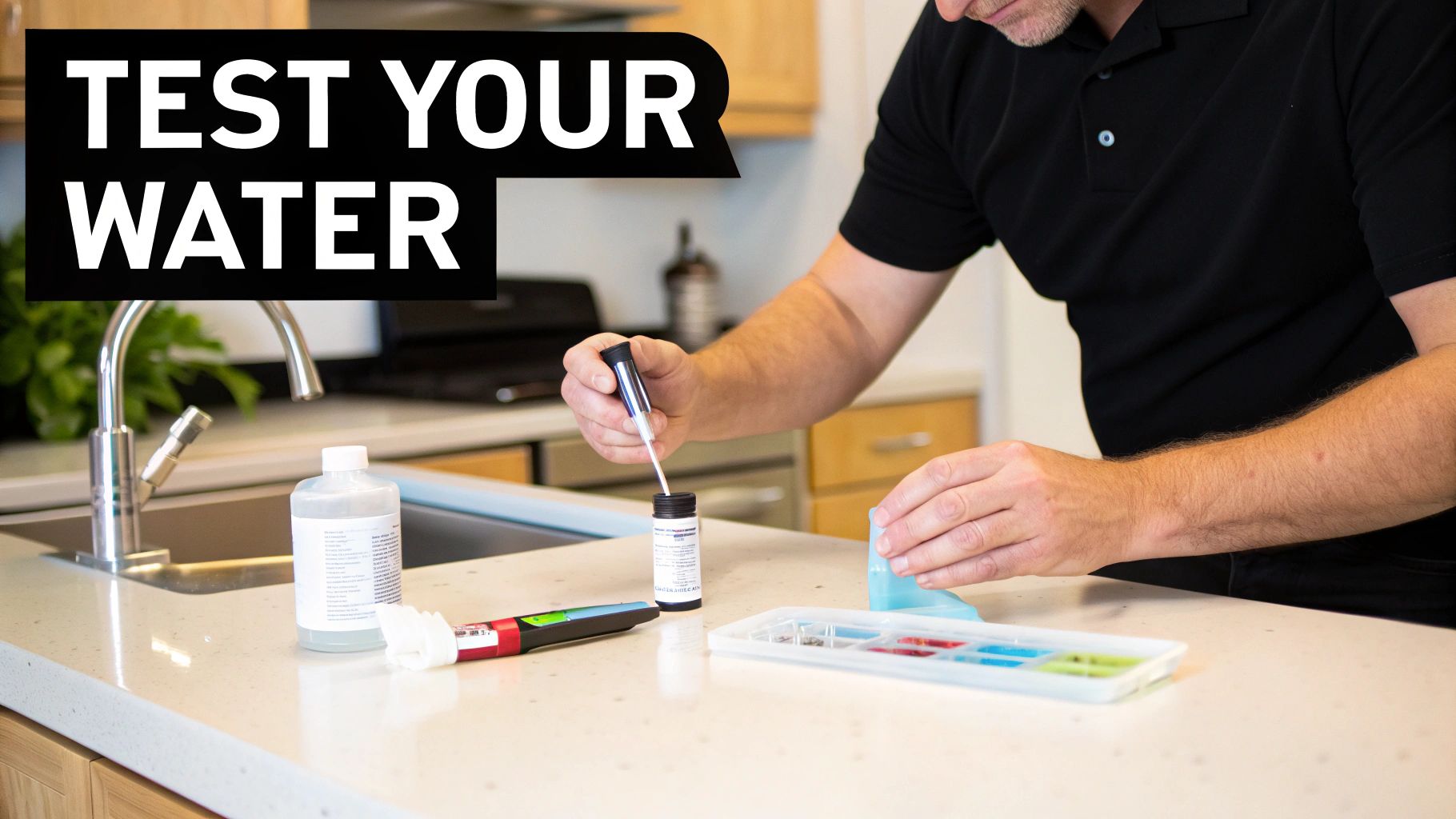
Before you can fix a problem, you have to know what it is. It sounds simple, but you'd be surprised how many people jump straight to buying a water filter without knowing what they're trying to filter out. That's like getting a prescription before a diagnosis—a total shot in the dark.
This first step is non-negotiable. Pinpointing the specific contaminants in your water ensures you invest in a system that actually solves your home's unique issues, rather than wasting money on one that doesn't.
If you're on a municipal water supply, your local Consumer Confidence Report (CCR) is a good place to start. Every community water system is legally required to publish one of these reports each year, and it gives you a breakdown of the contaminants they found during testing. A quick search on your local water provider's website should bring it right up.
But here's the catch: a CCR isn't the whole story. It only tells you about the water quality at the treatment plant, not what’s coming out of your kitchen faucet. As water travels through miles of pipes to get to you, it can pick up contaminants along the way. Lead from older service lines or plumbing is a classic example. And if you have a private well, a CCR is completely irrelevant to you, which makes your own testing an absolute must.
Getting a Precise Picture of Your Water
The only way to be certain about what's flowing through your pipes is to have the water tested professionally. This takes all the guesswork out of the equation and gives you a clear, science-backed roadmap to the right filtration solution.
At Water Medic, our entire process is built around giving you these exact, actionable insights. We don't just send you a kit and have you mail it back.
Our technicians come right to your home to take samples directly from your tap. This is crucial because it gives us a true snapshot of your water quality, factoring in your home's unique plumbing and any local environmental influences. From there, we run a comprehensive analysis looking for a whole range of potential issues.
- Hardness Minerals: We're looking for calcium and magnesium here. These are the main culprits behind that crusty scale buildup that wreaks havoc on your appliances and leaves annoying spots on your glassware.
- Chlorine and Chloramines: Municipalities add these to disinfect the water, but they can leave behind a distinct chemical taste and smell and can be harsh on your skin and hair.
- Heavy Metals: We test for dangerous metals like lead, which poses a serious health risk, especially for children, and can leach from pipes without any noticeable taste or smell.
- Bacteria and Microorganisms: This is especially critical for anyone on well water. We need to make sure your water is biologically safe for your family to drink.
- Sediment and Turbidity: This test checks for fine particles like sand and silt that can make your water look cloudy and, over time, clog up your plumbing fixtures and appliances.
Once our analysis is complete, we don't just hand you a confusing sheet of numbers. We walk you through a clear, easy-to-understand report that explains exactly what we found and, more importantly, what it means for you and your family. This is the solid foundation you need to make a smart decision.
We recently worked with a family who was frustrated that their brand-new, expensive dishwasher and washing machine were already performing poorly. Our professional test revealed incredibly high levels of sediment in their water, which was clogging the internal filters and mechanisms of the appliances. This discovery led them straight to the perfect whole-house filter for their situation, likely saving them from hundreds, if not thousands, in future appliance repairs.
To truly understand how to choose a water filtration system, you have to start here. If you're ready for a definitive answer about what's in your water, you can schedule a professional water test with one of our experts today.
Figuring Out Which Water Filter Is Right for You
Once your water test results are in, you'll have a much clearer picture of what you’re up against. Now comes the fun part: matching those challenges to the right piece of hardware. This decision isn't just about specs and flow rates; it’s about finding a system that fits your home, your lifestyle, and your budget.
Let’s walk through the most common types of home water filters. Our experts will help you cut through the jargon and get straight to what each one does, who it's for, and what it’s really like to live with.
Whole-House Filtration Systems
Think of a whole-house system as a security guard for your home’s main water line. Installed right where the water enters your house, it filters every single drop before it can reach your faucets, showerheads, or appliances.
This is the ultimate solution for total home protection. You set it, and you forget it.
- Who is this for? A whole-house system is a game-changer if your concerns go beyond just drinking water. If you're tired of chlorine drying out your skin and hair, or you've seen sediment and scale build-up damage your dishwasher and water heater, this is the system for you. It's comprehensive peace of mind in a tank.
We've installed countless of these systems, and the key is to size it correctly for your home to ensure you get clean, clear water everywhere without ever noticing a drop in water pressure.
Under-Sink Water Filters
If your main goal is pristine water for drinking and cooking, an under-sink filter is a fantastic, focused solution. These units are installed right in the cabinet under your kitchen sink, feeding a dedicated faucet with highly purified water.
It's a powerful way to get top-tier filtration exactly where you need it most, without overhauling your entire plumbing system. For many, it's the perfect balance of performance and price.
I often recommend under-sink systems to people who want a major upgrade in their drinking water's taste and safety but aren't ready for a whole-house commitment. They're also a great option for renters.
Countertop and Faucet-Mounted Filters
When you need a simple, flexible fix, countertop and faucet-mounted filters are hard to beat. They are incredibly easy to install—most people can do it themselves in minutes. Faucet filters clip right onto your tap, while countertop models sit next to the sink and connect with a small hose.
They won't remove the heavy-duty contaminants that a bigger system can, but they do a great job of tackling chlorine and improving the general taste and smell of city water. If you want to understand the technology that makes these so effective, it's worth exploring activated carbon filters, which are the workhorse component inside.
Reverse Osmosis (RO) Systems
For the highest level of purification you can get in a home, Reverse Osmosis (RO) systems are the undisputed champions. An RO system, usually installed under the sink, forces water through a series of filters and a special membrane to strip out up to 99% of all dissolved contaminants.
This is the system you want when dealing with serious issues like:
- Heavy metals such as lead and arsenic
- Fluoride
- Nitrates
- Viruses and bacteria
If your water test came back with some alarming results, an RO system is your definitive answer. The installation is a bit more involved, but the purity of the water is truly unmatched. Our certified techs can set it all up to make sure it’s running perfectly from day one.
Water Filtration System Comparison at a Glance
To help you see how these options stack up, here’s a quick comparison table. It breaks down the most popular systems based on what they do best, how much they cost, and what it takes to keep them running. This should help you zero in on the best choice for your home.
| System Type | Primary Use | Average Cost | Maintenance Needs | Best For |
|---|---|---|---|---|
| Whole-House | Treating all water entering the home for comprehensive protection. | High | Professional service; media/filter changes every 1-5 years. | Homeowners wanting to protect plumbing, appliances, skin, and hair. |
| Under-Sink | Purifying water at a single tap for drinking and cooking. | Moderate | DIY or professional filter changes every 6-12 months. | Families wanting high-quality drinking water without a whole-home investment. |
| Countertop | Improving taste and odor at the kitchen sink. | Low | Easy DIY filter changes every 2-4 months. | Renters or those seeking a simple, flexible, and affordable option. |
| Reverse Osmosis | Maximum contaminant removal for drinking water. | Moderate-High | Annual filter and membrane changes, often requiring a professional. | Homes with specific, hard-to-remove contaminants like heavy metals. |
Each system has its place, and the "best" one is simply the one that solves your specific water problems most effectively.
Finding the Right Filtration Technology for Your Water
Alright, you’ve got your water test results in hand. Think of that report as a diagnosis from a doctor; now it's time to choose the right treatment. Every filtration system is a specialized tool. The goal isn't to find the "best" system overall, but the best one for the specific issues in your water supply.
It’s a bit like fixing something at home—you wouldn’t use a hammer to turn a screw. In the same way, a simple carbon filter that’s great for chlorine taste won’t touch heavy metals. This is where our experts translate that technical report into a practical, effective solution for your family.
The infographic below gives you a great starting point, showing how your needs can lead you to different types of systems.
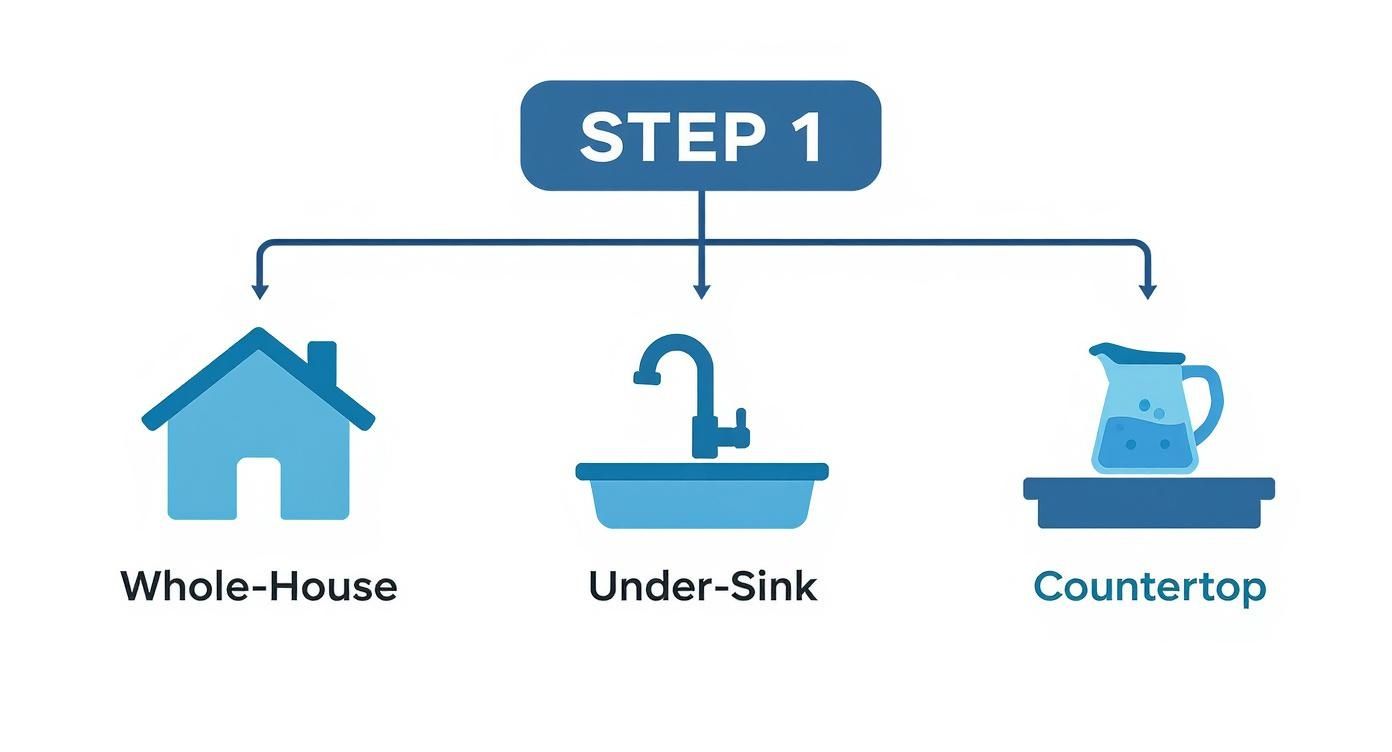
As you can see, one of the first big questions is whether you need to treat all the water coming into your house or just the water at a specific tap.
Matching the System to the Contaminant
Let's break down the common scenarios we see every day. If your main issue is that municipal water taste and smell of chlorine, the solution is straightforward: an Activated Carbon filter is your best friend. The carbon material is incredibly porous and acts like a magnet, pulling those unpleasant chemicals out and leaving you with crisp, clean water.
But what if your report flags more serious problems? Things like dissolved salts, fluoride, or heavy metals like lead and arsenic require a much more robust approach. This is where Reverse Osmosis (RO) is the undisputed champion. An RO system forces water through a hyper-fine membrane that can remove up to 99% of total dissolved solids (TDS). It delivers a level of purity that other technologies just can't achieve. You can dive deeper into the specifics of an under-sink reverse osmosis system to see how it works.
Your professional water test is the blueprint for a perfect system. It takes the guesswork out of the equation and ensures you invest in a solution that directly addresses the contaminants actually present in your water.
Dealing with Biological Dangers
If you're on a private well, you face a different set of challenges. Microbial contamination is a major risk that standard filters can't handle. These invisible bacteria, viruses, and cysts can cause serious illness.
The gold standard for neutralizing these biological threats is Ultraviolet (UV) Purification. A UV system exposes water to a powerful light that instantly deactivates microorganisms by scrambling their DNA, making them completely harmless. Best of all, it does this without adding a single chemical to your water, serving as a critical firewall for any well water supply.
Ultimately, the best solution is often a combination of technologies. We look at your water report and help you build a system that covers all your bases—RO for dissolved solids, UV for microbes, and activated carbon for taste and odors. This multi-barrier approach ensures every drop from your tap is as safe and pure as it can possibly be.
Budgeting for Your Water Filtration System
When you start thinking about how to choose a water filtration system, the conversation almost always turns to one big question: what's this actually going to cost? It's important to view a high-quality system as a real investment—not just in your home, but more importantly, in your family's health.
To make a smart choice, you have to look beyond the initial price tag. The sticker price is just one piece of the puzzle. A realistic budget needs to account for the whole picture, from professional installation to filter replacements and any routine maintenance that keeps it all running smoothly.
Beyond the Initial Purchase Price
We believe you should know exactly what you’re paying for, with no surprises down the road. That’s why we’re always upfront about the full cost. Here’s what you really need to factor into your budget:
-
Professional Installation: I know the DIY route can seem tempting for saving a few bucks. But from experience, an improper installation can lead to leaks, serious water damage, and a system that isn't even filtering your water correctly. Professional installation ensures your system is optimized from day one, protecting both your home and your investment.
-
Filter Replacements: Every filter has a finite lifespan. Depending on the system you choose and how hard your water is, you'll need to swap out cartridges or media on a regular schedule. This is a non-negotiable part of keeping your water pure.
-
Long-Term Maintenance: Think of it like any other major appliance in your home. An occasional check-up makes sure everything is working as it should, catching small issues before they become big, expensive problems.
Investing in a professional installation and a solid maintenance plan isn't an "extra" cost. It's the smartest way to protect your system, avoid future repair headaches, and guarantee your family always has clean, safe water on tap.
We want to make this as manageable as possible for you. Our straightforward maintenance plans and flexible financing options are designed to fit your budget, putting clean water within reach without the financial stress. You can explore our simple financing plans to see how we can make it work for your family.
The Smarter, More Sustainable Choice
Finally, let's put the cost in perspective. What’s the alternative? For many, it's bottled water. That endless cycle of buying, hauling, and recycling plastic bottles adds up fast, both financially and environmentally.
Today's home filtration systems are designed to be efficient and minimize water waste. When you do the math, filtered tap water is a far more economical and eco-friendly choice in the long run. If you're curious about the numbers, you can find more insights about the benefits of filtered tap water on bccresearch.com.
Your Top Home Water Filter Questions, Answered
When you start digging into water filtration, a few key questions always seem to pop up. It's completely normal. Getting these details sorted out is the final step before you can confidently choose the right system for your home. Let's tackle the questions our experts hear most often from homeowners.
Can I Just Install a Whole-House Water Filter Myself?
We get this one a lot, especially from handy homeowners. While you can definitely screw a filter onto a faucet, a whole-house system is a whole different ballgame. This isn't a simple weekend project; it involves cutting into your main water line.
Getting it wrong can mean serious leaks, a major drop in your home's water pressure, or even a system that doesn't filter anything at all. To avoid a potential disaster and protect your investment, this is one job best left to a professional. Our certified technicians will make sure it's installed perfectly, giving you peace of mind from day one.
How Often Do I Really Need to Change the Filters?
There's no single answer here, as it really depends on two things: the type of filter you have and how much gunk is in your local water. If your water has a lot of sediment, for example, your filters will clog up much faster.
But here’s a solid rule of thumb:
- Most carbon filters need to be swapped out every 6 to 12 months.
- The workhorse of an RO system, the reverse osmosis membrane, can last anywhere from 2 to 3 years.
Keeping up with this is non-negotiable for ensuring your water stays pure. To make it a no-brainer, our filter subscription services handle all the reminders and scheduling for you. You get fresh filters delivered right on time, without ever having to think about it.
A common myth is that a whole-house system will kill your water pressure. The truth? A properly sized and professionally installed system will have a minimal impact you likely won't even notice. If you see a big drop in pressure, it’s almost always a sign the filter is clogged and overdue for a change.
Is It Healthy to Drink Reverse Osmosis Water?
Yes, absolutely. Reverse osmosis (RO) is the gold standard for a reason. It's incredibly effective at removing a huge range of contaminants that other filters miss, from heavy metals like lead to fluoride, pesticides, and salts.
Now, it's true that the process also removes some minerals. But here's the thing: we get the vast majority of our essential minerals from our food, not our water.
For those who want the ultimate purified water, we offer advanced RO systems with a remineralization stage. After the water is completely purified, this stage adds healthy minerals like calcium and magnesium back in. This not only adds health benefits but also improves the taste, giving you perfectly crisp and refreshing water.
Ready to stop guessing and find the perfect water solution for your home? The team at Water Medic of Cape Coral has been helping homeowners in Southwest Florida get pure, safe water for over 25 years. Schedule your free consultation today and get the answers you need.