Finding the Best Water Filtration Systems for Your Home
The best water filtration systems do a lot more than just make your water taste better. They’re a critical line of defense for your family's health and your home's plumbing. For homeowners, especially here in Southwest Florida where our water has some unique challenges, a high-quality system isn't just another appliance—it's a fundamental investment in your well-being. The right solution always comes down to what's actually in your water, and our expert team at Water Medic can help you find it.
Why a Water Filtration System Is a Smart Home Investment
You expect clean, safe water every time you turn on the tap, but that’s not always what you get. While municipal treatment plants do a solid job, contaminants can still find their way into the water as it travels through miles of pipes to reach your home. This is where a whole-home filtration system really proves its worth.
Investing in one of the best water filtration systems is about taking control and actively removing impurities. We’re talking about everything from silt and chlorine to invisible things you don't want your family exposed to, like lead, pesticides, and bacteria. The peace of mind you get from knowing your family is drinking, cooking, and bathing in purified water is priceless.
Understanding Common Water Contaminants
Southwest Florida's water often contains a few specific troublemakers that can affect both your health and your home. Without the right filtration, you’re likely dealing with:
- Hardness Minerals: Calcium and magnesium are the culprits behind that crusty limescale buildup. It’s tough on your appliances, clogs up your pipes, and leaves those stubborn water spots on faucets and shower doors.
- Chlorine: It’s necessary for disinfecting the public water supply, but that doesn't mean you want to drink it. Chlorine leaves a distinct chemical taste and odor, and it can dry out your skin and hair.
- Total Dissolved Solids (TDS): High levels of TDS, which include salts, minerals, and other organic matter, can make your water taste "off" and look cloudy.
A professional water analysis is the only way to know for sure what’s coming out of your faucet. It’s the most important first step because it ensures you choose a system that targets the specific contaminants in your supply, making your investment effective from day one.
A Growing Need for Pure Water
Concerns about water quality aren't just a local issue; it's a worldwide conversation. The global water filtration market is on track to hit $35.18 billion by 2034, a clear sign that more and more people are becoming aware of the health risks tied to contaminated water. Since unsafe drinking water is linked to serious health problems, reliable purification is more important than ever.
Protecting your family shouldn't break the bank. We believe everyone deserves clean water, so we offer flexible options to fit different budgets. You can explore our convenient financing plans to see just how affordable a top-tier system can be. Investing in one of the best water filtration systems is a proactive step toward a healthier home and a smarter future.
Comparing Water Filtration Technologies
Choosing the right water filtration system for your home really starts with understanding the different technologies behind them. Not every filter is built the same, and the best one for you hinges entirely on what specific contaminants you need to get rid of. We'll walk through three of the most popular and effective methods—Reverse Osmosis (RO), Activated Carbon, and UV Purification—to help you see which one truly fits your family’s needs.
Instead of just a generic pros-and-cons list, we’re going to look at how these systems actually perform in the real world. We'll dive into their effectiveness, what it takes to keep them running, and the long-term costs. Our goal is to give you the practical knowledge you need to make a smart, confident decision for your Southwest Florida home.
This image shows a great example of a modern kitchen with different filter types, illustrating just how seamlessly these systems can fit into your daily life.
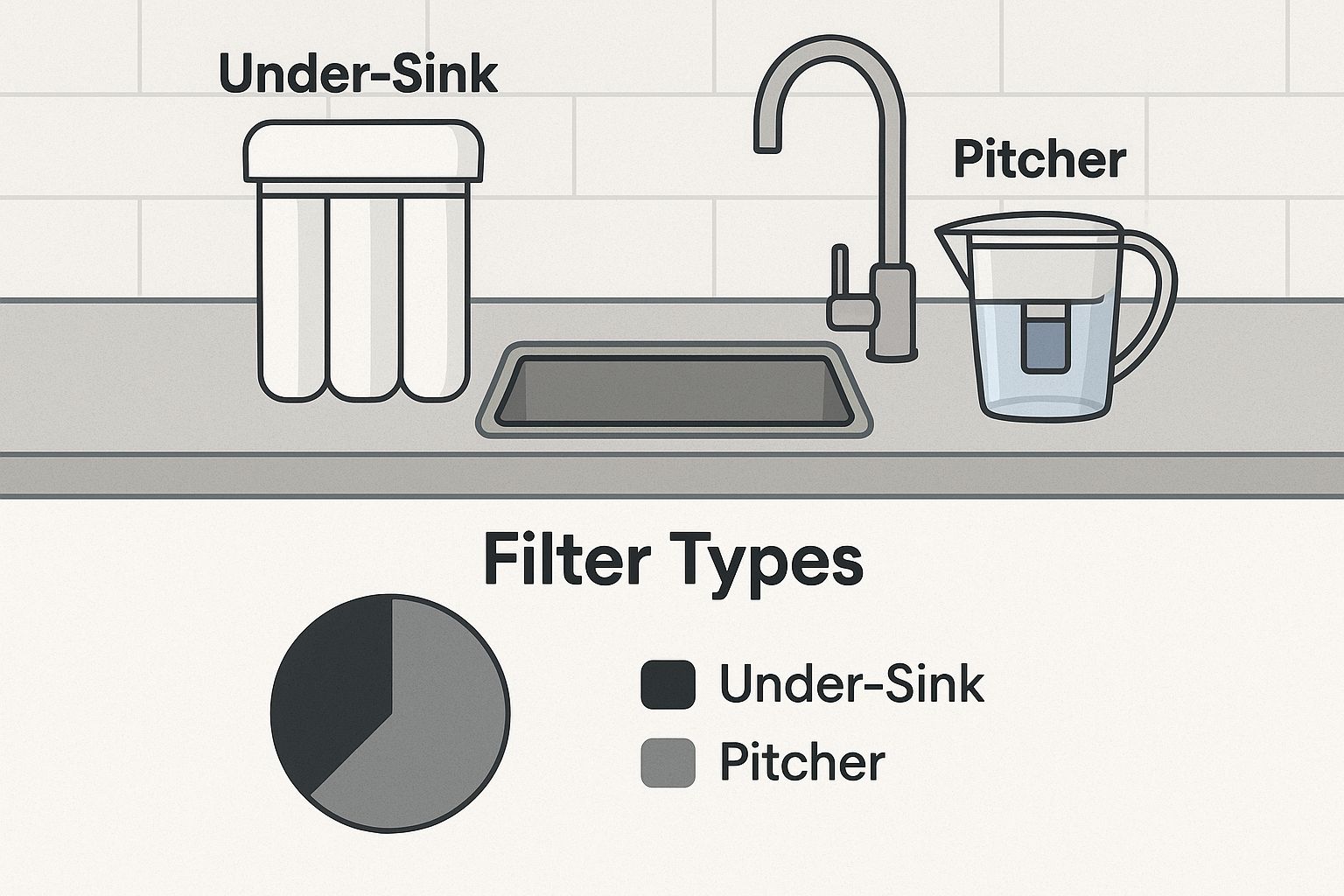
As you can see, solutions can be as simple as a countertop unit or as robust as a full under-sink system, so there's a huge variety of options out there for homeowners.
Reverse Osmosis: The Purity Powerhouse
When you're looking for the absolute highest level of purification, a Reverse Osmosis (RO) system is the undisputed champ. This technology uses a special semipermeable membrane to filter water down to the molecular level, stripping out an impressive list of contaminants that other systems just can't touch.
So, how does it work? An RO system uses pressure to push water through this incredibly fine membrane. The tiny water molecules get through, but the larger molecules of dissolved salts, minerals, heavy metals like lead, and all sorts of chemical contaminants are left behind and flushed away.
For anyone in Southwest Florida dealing with high Total Dissolved Solids (TDS), an RO system isn't just a nice-to-have—it's often a necessity. It’s the single most effective residential technology for slashing TDS and giving you exceptionally pure drinking water.
While RO is a workhorse, it's true that it produces some wastewater (called brine) during the purification process and needs its filters and membrane replaced periodically to keep performing at its peak. Our expert technicians can design and install a system optimized for efficiency, so you get maximum purity with minimal waste.
Activated Carbon: The Chlorine And Chemical Magnet
Activated carbon filters are probably the most common and reliable way to improve the taste and smell of your tap water. This technology relies on a bed of activated carbon, which is an extremely porous material that acts like a powerful sponge for specific contaminants.
The magic is a process called adsorption, where chemical impurities literally stick to the massive surface area of the carbon as water flows past. This makes it incredibly effective at removing:
- Chlorine: Gets rid of that chemical taste and odor so common in city water.
- Volatile Organic Compounds (VOCs): Reduces things like pesticides, herbicides, and other industrial chemicals.
- Sediment: Catches larger particles like sand, silt, and rust that can make water cloudy.
Activated carbon is a fantastic choice for general, all-around water improvement. You can learn more about our advanced carbon filters to see just how much they can elevate your home's water quality. It is important to know, however, that carbon filters on their own won't remove dissolved solids, heavy metals, or microscopic organisms like bacteria and viruses.
UV Purification: The Microbiological Guardian
Unlike other systems that physically block or trap contaminants, an Ultraviolet (UV) purifier is all about sterilization. It uses a powerful UV light to scramble the DNA of microorganisms, making them harmless and stopping them from reproducing. It’s an essential tool for disinfecting water without adding a single chemical.
A UV system is a critical final line of defense, particularly for homes on well water or in areas where boil water notices are a recurring headache. It offers true peace of mind by neutralizing those unseen biological threats that can make you sick.
Just remember, a UV purifier doesn't remove sediment, chemicals, or dissolved solids. Because of this, it's almost always installed as part of a multi-stage system, usually following a sediment or carbon filter. This ensures the water is clear enough for the UV light to do its job effectively.
Water Filtration Technology Head-to-Head Comparison
To really make the differences clear, let's put these three technologies side-by-side and see how they stack up on the factors that matter most to you as a homeowner. This will help you quickly identify which one is the best match for the specific water challenges you're facing.
| Feature | Reverse Osmosis (RO) | Activated Carbon | UV Purification |
|---|---|---|---|
| Primary Function | Removes dissolved solids, heavy metals, chemicals, and some microorganisms. | Improves taste and odor by adsorbing chlorine and organic chemicals. | Neutralizes bacteria, viruses, and other microorganisms. |
| Contaminant Removal | Removes up to 99% of TDS, including lead, arsenic, fluoride, and nitrates. | Excellent for chlorine, VOCs, pesticides, and sediment. | Does not remove any physical or chemical contaminants. |
| Best For | Homes with high TDS, hard water, or specific chemical contamination concerns. | Improving the general taste and safety of municipally treated water. | Homes on well water or as a final safety measure against pathogens. |
| Maintenance Needs | Requires regular filter and membrane replacements to maintain efficiency. | Filter cartridges need to be replaced every 6-12 months on average. | UV lamp needs replacement annually to ensure effective treatment. |
| Professional Consultation | Essential. Proper sizing and installation are key to performance and longevity. | Recommended. Ensures the correct type and size for your water usage. | Critical. Must be paired with pre-filters for optimal results. |
Choosing the best water filtration system can feel like a big decision, but it doesn't have to be overwhelming. Understanding how each of these technologies works is the first, most important step toward finding the perfect solution for your home. Our team is here to give you a personalized assessment of your water quality, making sure you invest in a system that delivers pure, safe, and great-tasting water for years to come.
How to Figure Out What's Really in Your Water
Before you can pick the right water filtration system, you have to know what you’re up against. Your home’s water gives you clues about its quality every single day, but most of us just don't know what to look for. Learning to spot these signs is the first, and most important, step in diagnosing the problem and finding the right fix.
Think of yourself as a water detective. You might notice little things that seem insignificant, but they often point to much bigger issues with your water supply. Paying attention to these details helps you build a case for what kind of filtration you actually need.
What Your Senses Can Tell You
Your eyes, nose, and even your sense of taste are your first line of defense. Many common water problems here in Southwest Florida leave behind some pretty obvious evidence. Start by looking for these tell-tale signs:
- Weird Taste or Smell: Does your water have a metallic twang? That often points to high levels of iron. If it smells like rotten eggs, you’re almost certainly dealing with hydrogen sulfide gas, a classic well water issue. A "swimming pool" scent is a dead giveaway for high chlorine levels.
- Stains and Scale Buildup: Those blue or green stains on your sinks and faucets are a classic sign of copper pipe corrosion, often made worse by acidic water. Reddish-brown streaks scream iron. And that hard, crusty white scale on showerheads and in your coffee pot? That’s the work of hard water minerals like calcium and magnesium.
- Cloudy or Murky Water: If your water comes out looking foggy or discolored—a condition called turbidity—it's usually filled with suspended gunk like silt, clay, or sediment. Not only does it look unappealing, but it can also get in the way of proper disinfection.
While these observations are a great start, they only scratch the surface. A simple look-and-smell test can't detect invisible threats like lead, arsenic, bacteria, or volatile organic compounds (VOCs). For the full story, nothing beats a professional lab analysis.
Why Professional Water Testing Is a Must
A DIY check is a good first step, but it’s just that—a first step. To really understand what's going on with your water's chemistry and biology, you need hard data. A professional water test is the only way to get a detailed report identifying specific contaminants and their exact concentrations.
This scientific approach removes all the guesswork. Instead of choosing a filter based on a hunch, you'll get a clear roadmap showing you exactly what problems need solving. It ensures your investment is targeted and effective from day one. At Water Medic, we believe in making data-driven decisions, which is why we offer a Free Water Analysis to give you the clarity you need.
Matching the System to Your Household
Beyond the water chemistry, you have to think about your family's size and daily habits. A solution that’s perfect for a retired couple living alone is probably not going to cut it for a bustling family of five.
Ask yourself these questions:
- How much water do we use? A home with more people needs a system with a higher flow rate. The last thing you want is a drop in water pressure every time someone flushes a toilet while the dishwasher is running.
- Where do we need filtered water? Are you just concerned about the water you drink and cook with? Or do you want to protect your entire home—your pipes, appliances, skin, and hair? This is the key difference between a small under-sink system and a comprehensive whole-house solution.
Thinking through these practical details ensures you get a system that not only fixes your water problems but also fits seamlessly into your life. The demand for effective water treatment is growing fast, with the industry projected to hit $591.2 billion by 2030. This growth is fueled by stricter quality standards and a worldwide focus on clean, safe water. You can read more about these global water technology trends to see why advanced purification is so important. Booking a professional assessment is your first step toward getting better water for your own home.
The Best Water Filtration Setups for Southwest Florida
Living in Southwest Florida is incredible, but our local water comes with a unique set of challenges that a generic filter from a big-box store just can't handle. If you're a homeowner anywhere from Cape Coral to Naples, you’re likely familiar with notoriously hard water, high levels of Total Dissolved Solids (TDS), and maybe even the occasional whiff of sulfur or the rust-colored stains left by iron.
Simply buying any filtration system won't cut it. You need a setup specifically designed to battle these regional water problems head-on. This is where decades of local experience really matter—we don’t just sell equipment; we engineer complete water treatment solutions that protect your family’s health and your home’s plumbing.
Tackling Hard Water and High TDS
The two complaints we hear day in and day out are about hard water and high TDS. Hard water, which is loaded with calcium and magnesium, is the culprit behind the limescale buildup that destroys appliances, clogs pipes, and leaves those stubborn spots on your glasses and shower doors. High TDS levels often give the water a brackish, slightly salty taste, making it unpleasant for drinking or cooking.
A simple carbon filter might make the water taste a little better, but it does absolutely nothing to remove the minerals causing these core issues. This is precisely why a one-size-fits-all approach is doomed to fail in our area.
The most effective strategy for Southwest Florida homes is a multi-stage approach. We find that combining a robust whole-house system with a specialized point-of-use filter provides the most complete protection, addressing every faucet and every glass of water in your home.
This layered defense means you're targeting general water quality for the entire house while also achieving the highest purity right where you need it most—the kitchen sink.
The Ideal Setup for Maximum Protection
After years of hands-on experience in this region, we've zeroed in on a system configuration that delivers phenomenal results for local homeowners. It's widely considered one of the best water filtration systems available because it addresses the full spectrum of Southwest Florida's water problems.
Solution 1: The Whole-House Guardian
Your first line of defense should always be a whole-house water treatment system. Installed where your main water line enters your home, it ensures every drop of water—for bathing, laundry, and cleaning—is treated from the start.
For our region, the ideal setup almost always includes:
- A Water Softener: This is non-negotiable for fighting our hard water. It uses an ion exchange process to physically remove the calcium and magnesium, which protects your pipes and appliances from scale and helps your soaps and detergents work much more effectively.
- A Whole-House Carbon Filter: Once the water is softened, a large carbon filter steps in to remove chlorine, chemicals, and other contaminants that create funky tastes and odors. This is what gives you better-feeling skin and hair after a shower and improves the water you use for laundry.
This first stage takes care of the "big picture" problems, protecting your home's infrastructure and improving water quality at every single tap. You can discover more about our whole-house systems and see how they are built for our local water.
Solution 2: The Point-of-Use Purifier
While a whole-house system makes a massive difference, we always recommend a second, more powerful layer of filtration for your drinking and cooking water. This is where a point-of-use Reverse Osmosis (RO) system shines.
An under-sink RO system is the gold standard for purity. It’s the only technology that effectively removes the high TDS so common in our groundwater. By forcing water through an incredibly fine membrane, it filters out up to 99% of dissolved solids—including salts, nitrates, and fluoride—that carbon filters simply can't touch.
By pairing these two solutions, you truly get the best of both worlds. The whole-house system acts as a shield for your entire home, and the RO system delivers water that’s better than bottled quality, right from a dedicated faucet at your kitchen sink. This dual-system approach is the most reliable way to guarantee total water purity and peace of mind.
Why This Combination Is So Effective
This layered configuration provides a complete solution that leaves no stone unturned when it comes to our local water profile.
- Comprehensive Contaminant Removal: You’re not just masking problems with taste and odor—you’re actively removing hardness minerals, chlorine, chemicals, and dissolved solids.
- Protects Your Investment: The whole-house system drastically extends the life of your expensive appliances like dishwashers, washing machines, and water heaters by stopping damaging scale buildup in its tracks.
- Ultimate Drinking Water Quality: The RO system ensures the water you and your family actually consume is as pure and safe as possible, free from the specific contaminants we find in our local supply.
Choosing the right setup can feel overwhelming, but our team makes it simple. We always start with a professional water analysis to pinpoint your home's specific challenges. From there, we design a system that’s perfectly matched to your needs. Don't settle for a generic solution. Contact our water quality experts today to schedule a consultation and find out how we can bring clean, safe, and great-tasting water to your family.
Ensuring Long-Term Performance With Professional Service
Investing in a high-quality water filtration system is a fantastic first step. But the equipment itself is only half of the story. To get the pure, safe water you paid for day in and day out, professional installation and consistent maintenance are non-negotiable.
Think of it like a high-performance car; you wouldn’t just drive it off the lot and then skip every oil change. Your water system is working 24/7 to protect your family, and its performance hinges on being installed correctly and serviced right on schedule. This is where leaning on an expert transforms your purchase from just another appliance into a reliable, long-term asset for your home.
The Hidden Risks of DIY Installation
It's tempting to try and save a few dollars by installing a new filtration system yourself. We get it. While the DIY spirit is great for many home projects, this usually isn't one of them. A seemingly small mistake during installation can snowball into some serious headaches down the road.
We've seen it all. The most common DIY mishaps include:
- Improper Connections: A single leaky fitting, even a slow drip, can lead to costly water damage inside your cabinets, under your sink, or even within your walls.
- Reduced Water Pressure: If the system isn't plumbed in just right, it can create a bottleneck. The result? Frustratingly low water pressure every time you turn on a faucet.
- Compromised Filtration: This is the big one. If components aren't perfectly sealed and assembled, raw, untreated water can bypass the filters completely. You'll think you're getting pure water, but you won't be.
Opting for professional installation isn't just a convenience—it's insurance. It's about protecting your home and guaranteeing your system operates at peak efficiency from the moment it's turned on. Our trained technicians deliver a flawless setup, giving you total peace of mind.
A Clear Schedule for Optimal Performance
Once your system is up and running, a solid maintenance routine is what keeps it effective for years to come. Every system has different needs, but one thing is universal: neglecting service will always lead to a drop in water quality. Sticking to a schedule is the simplest way to keep your water pure and your system humming along.
Our service plans are designed to make maintenance completely hands-off. We keep track of your system's specific schedule and handle everything, so you never have to give it a second thought.
The Importance of Timely Filter Changes
If there’s one maintenance task you absolutely can’t skip, it’s changing the filters on time. Over months of use, filters get clogged with all the gunk they’ve pulled out of your water. When they aren't replaced on schedule, a few things start to go wrong:
- Flow Rate Plummets: Clogged filters are like a dam in your plumbing. They restrict water flow, causing a noticeable and annoying drop in pressure.
- Filtration Fails: A saturated filter can't grab any more contaminants. Worse, it can sometimes release a slurry of the particles it already trapped right back into your "clean" water.
- System Strain: Forcing water through a clogged filter makes the entire unit work harder. This puts a ton of stress on expensive components like pumps and membranes, leading to premature failure.
Regular filter changes are the lifeblood of your system. To make this effortless, we offer structured service and maintenance plans that remove all the guesswork. We manage the schedule, use certified replacement parts, and run system diagnostics to ensure everything is working perfectly. This professional oversight is what guarantees you get the clean, safe water you expect, year after year.
Frequently Asked Questions About Water Filtration
Deciding to install one of the best water filtration systems is a fantastic move for your home and family. But it's a big decision, and it's completely normal to have a few questions before you commit. We get it.
To help you feel 100% confident, we've gathered the most common questions we hear from homeowners just like you. Our answers are based on years of hands-on experience dealing with the unique water challenges right here in Southwest Florida.
How Often Should I Change My Water Filters?
This is probably the most important question we get, because the whole system's effectiveness hinges on timely filter changes. There's no single answer—it really depends on the type of system you have and how much water your family uses.
Here's a quick cheat sheet for the most common systems:
- Whole-House Carbon Filters: These workhorses are pretty low-maintenance. You'll typically change out the main media every 3-5 years, though some smaller pre-filters might need attention more often.
- Reverse Osmosis (RO) Systems: An RO system is a multi-stage affair. The sediment and carbon pre-filters usually need to be swapped every 6-12 months. The RO membrane itself, the heart of the system, is much more durable and can last 2-3 years.
- Water Softeners: The resin beads that do the heavy lifting in a softener are incredibly long-lasting, often going for 10 years or more with proper care. You will, of course, need to top off the salt regularly.
To make this completely hands-off for you, we offer a simple reminder service for our clients. We keep track of your system’s maintenance schedule and give you a heads-up when it's time for a filter change, so your water quality is never compromised.
Can a Filtration System Increase My Home's Value?
Without a doubt, yes. A professionally installed, high-quality whole-house water filtration system is a major selling point. In today's market, smart homebuyers see it as a significant upgrade, not just a nice-to-have feature.
It speaks volumes about how well the home has been maintained. Plus, it offers tangible benefits they can appreciate, like protecting all the plumbing and appliances from scale buildup. That kind of protection, combined with the promise of pure, safe water right from the tap, can make your property stand out.
What Is the Difference Between Softening and Filtration?
This is a really common point of confusion, but it's a crucial distinction. Think of it this way: softening and filtration are two different specialists working on two different problems to give you perfect water.
Water Softening has one specific job: to remove "hardness minerals" like calcium and magnesium. It uses an ion exchange process to do this, which is what stops that chalky, destructive limescale from building up in your pipes, water heater, and dishwasher. Softening is all about protecting your home's infrastructure.
Water Filtration is the broader term for catching everything else. It's designed to remove a wide range of contaminants, from chlorine and sediment to pesticides, heavy metals, and even bacteria. Filtration is all about protecting your family's health by improving the taste, smell, and safety of your water.
Here in Southwest Florida, most homes really need both to be fully protected. That's why we often design integrated systems that tackle both hardness and contaminants, delivering the best of both worlds. The demand for this level of quality is surging everywhere—the global water purifier market was valued at USD 35.25 billion in 2024 and is expected to more than double by 2034. It's clear people are prioritizing better water. You can read more about the global water purifier market trends to see how this focus on quality is growing.
Ready to experience the difference that truly clean, pure water can make for your family and your home? The experts at Water Medic of Cape Coral are here to design a custom solution that perfectly addresses your needs. Contact us today for a free water analysis and take the first step toward better water.