How Often Should Well Water Be Tested? a Cape Coral Guide
Test coliform bacteria and nitrate at least once every year, test lead about every three years, and test sooner after flooding, well repairs, or any change in color, taste, or odor. If your whole-house reverse osmosis system was selected from an old water report, how do you know it still matches what's coming out of your well?
For Cape Coral homeowners, testing should do more than produce a passing report. It should establish what needs treatment, guide whole-house reverse osmosis sizing, and verify that the installed system continues to perform. The right approach combines a routine calendar with extra testing when storms, nearby land use, or household needs change.
Annual Core Tests and How Often to Run Them
For most private wells, test total coliform bacteria, nitrate, total dissolved solids, and pH at least once every 12 months, as recommended by the Centers for Disease Control and Prevention. Federal drinking-water rules for public systems don't apply to privately owned wells, so homeowners must arrange their own monitoring.
Treat those results as the starting specifications for your water treatment system. A whole-house RO recommendation without a recent laboratory report is a proposal built on assumptions.
Core well water tests and recommended frequency
| Test | Recommended frequency | What it reveals | Guidance source |
|---|---|---|---|
| Total coliform bacteria | Every 12 months | Bacteria that can enter the well from surface water or waste | CDC, EPA, Florida |
| Nitrate | Every 12 months, sampled April to July | Contamination from fertilizer, septic systems, or animal waste | CDC, EPA, Florida |
| Total dissolved solids (TDS) | Every 12 months | Overall level of dissolved minerals, reported in ppm | CDC, EPA |
| pH | Every 12 months | Acidity or alkalinity of the water | CDC, EPA |
| Lead | About every 3 years | Lead presence in drinking water | Florida Department of Health |
The Florida and seasonal recommendations in this schedule help refine the broader annual baseline. They also prevent a common mistake: treating a basic mineral reading as a complete safety assessment.
What the report means for whole-house RO
TDS is an overall measurement, not a contaminant identification test. It helps characterize the dissolved mineral load an RO system will face, but it doesn't tell you whether nitrate, lead, or bacteria are present. Likewise, pH helps a treatment specialist understand the source water, but a normal pH doesn't establish that the water is safe.
Coliform and nitrate results answer different questions. Bacterial findings can require investigation and disinfection, while nitrate findings require treatment with verified nitrate-reduction performance. Don't assume that installing an RO membrane resolves every category of contamination.
Practical rule: Use the untreated-water report to design the treatment, then use treated-water testing to verify the result.
Collect samples that support a dependable design
For the untreated baseline, collect from a suitable cold-water tap before treatment. Follow the laboratory's instructions for bottle handling, sample collection, refrigeration, and delivery. Bacteriological sampling requires particular care, so don't substitute a household container for the laboratory's bottle.
Use a laboratory certified under Florida's environmental laboratory certification program. Ask for separate collection instructions when testing lead, because the appropriate sampling procedure may differ from a general raw-water sample.
Put the next test on your calendar, keep every report, and label each sample location. A record of raw and treated water gives a specialist a much stronger basis for evaluating RO performance than an isolated reading.
Florida Testing Rules and Seasonal Timing
Florida doesn't require routine sampling of private residential wells. Its voluntary guidance recommends coliform bacteria and nitrate at least annually and lead about every three years, according to the Florida Department of Health. No sampling requirement doesn't mean no contamination risk.
For a homeowner considering whole-house RO, that distinction matters. You're responsible for obtaining the information needed to select treatment, and you shouldn't confuse a voluntary testing schedule with an optional safety check.
Sample for the conditions your system must handle
The EPA's private-well guidance advises testing between April and July, when nitrate and nitrite levels are typically highest. A convenient winter sample may not capture the seasonal conditions that matter most when assessing nitrate treatment.
Consider a Cape Coral home beside a heavily fertilized canal-front lawn and an aging septic tank. I'd recommend late-spring nitrate sampling, with additional testing selected around the property's actual risks. I'd also discuss a broader panel every few years rather than assume that a basic bacteria result answers every chemical question.
That broader panel should be deliberate. A normal bacteria result doesn't rule out metals, radionuclides, PFAS, pesticides, or volatile organic compounds. Nearby land use, previous findings, and known contamination concerns should determine which of those analyses belong on the laboratory order.
This is also where whole-house RO specifications become more demanding. A system proposed for dissolved minerals alone shouldn't automatically be accepted for a property with a documented chemical contaminant. Require performance information for the substance identified.
Build a risk-based Cape Coral calendar
Heavy summer rain and storm-driven groundwater changes make seasonal planning practical in Southwest Florida. Don't wait for a noticeable change in the glass before deciding whether a storm warrants additional sampling.
Households with infants, pregnant people, older adults, or medically vulnerable residents should discuss expanded or more frequent testing with the Lee County Department of Health. Their needs should influence both the sampling plan and the treatment review.
Keep the calendar straightforward:
- Annual seasonal sampling: Schedule bacteria and nitrate testing during the recommended spring-to-summer window, alongside the remaining core indicators.
- Periodic lead testing: Keep the Florida lead-testing interval on a separate reminder so it isn't forgotten between routine visits.
- Event-based panels: Add targeted tests after a spill, nearby construction, septic work, or a change in taste or odor.
The answer to how often should well water be tested is therefore a calendar plus a trigger list. For whole-house RO owners, each new result is also an opportunity to confirm that the treatment still matches the source water.
Warning Signs and Life Events That Mean Test Now
An installed whole-house RO system isn't a reason to postpone testing after a contamination event. If the incoming water changes, the system may face conditions it wasn't selected to handle.
Use these warning signs to decide when to act.
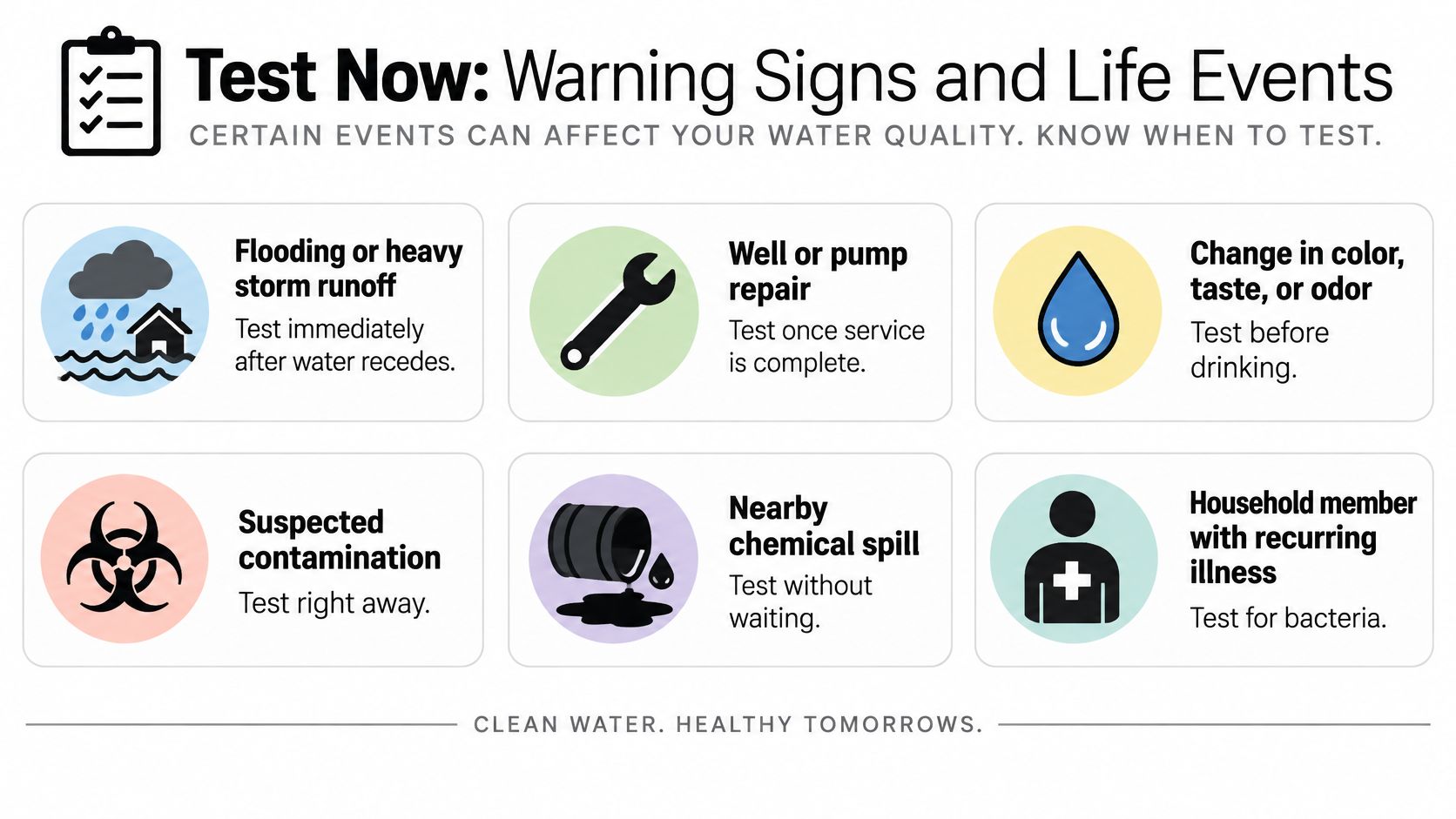
Events that mean test now, and what to order
| Trigger | Test to order | When to test |
|---|---|---|
| Flooding or heavy storm runoff | Coliform bacteria and nitrate | Promptly after the water recedes |
| Well or pump repair | Coliform bacteria and nitrate | Before drinking the water again |
| Change in color, taste, or odor | Coliform bacteria, nitrate, and TDS | As soon as the change is noticed |
| Suspected contamination nearby | Expanded panel matched to the risk | Before the next routine date |
| Pregnancy or a new infant | Nitrate | Early pregnancy, before the infant arrives, and during the first six months |
Protect drinking water while you investigate
After flooding, arrange sampling once the water recedes and the well can be safely evaluated. After well or pump repair, don't resume drinking the water until the recommended sampling and clearance steps are complete. An existing RO system doesn't provide automatic clearance.
If repairs are needed, our Well Technician contacts the customer to discuss the necessary repairs before service. For practical background on well operation and testing, use our well-water FAQs.
A chemical spill needs a different response from an unexplained odor. Tell the laboratory what happened and identify the suspected substance when possible, so the panel addresses the actual concern. Don't order only a bacteria test when the concern is chemical contamination.
Pregnancy changes the testing priority
The EPA's home-water-testing guidance recommends nitrate testing during early pregnancy, before bringing an infant home, and again during the infant's first six months, and notes the value of spring or summer sampling after a rainy period.
For these households, an RO proposal should include documented performance for the identified nitrate conditions. Clear-looking water and a general filtration claim aren't enough.
A change in taste tells you to investigate. A laboratory result tells you what the treatment must address.
Recurring household illness also warrants prompt medical advice and discussion of bacterial testing. Don't diagnose the cause from water appearance or assume that replacing a filter resolves it.
When a trigger occurs, arrange testing within days rather than waiting for the routine appointment. Record the event alongside the result, compare it with the previous baseline, and have the treatment evaluated if the source-water conditions have changed.
What to Do When Results Exceed Safe Limits
Don't buy a replacement RO system before identifying the failed parameter. A positive bacteria result, high nitrate, and high TDS call for different decisions, even when each appears on the same laboratory report.
Read the report's units, reference values, and laboratory comments carefully. Health-related findings and aesthetic findings aren't interchangeable: a mineral-related taste concern doesn't justify the same response as confirmed contamination that makes drinking water unsafe.
Turn an abnormal result into an action plan
Confirm the finding. Contact the certified laboratory about a repeat sample and the correct collection method. A positive total coliform result needs prompt attention, investigation, and follow-up sampling, not dismissal as an inconvenient result.
Protect the household immediately. If the result indicates a health concern, stop using the water for drinking, cooking, and infant formula while following laboratory or public-health advice. Use a verified safe alternative, such as bottled water, rather than relying on the existing treatment without confirmation.
Investigate the source. Compare earlier reports, sample locations, recent storms, nearby activity, and service history. A change in raw water requires a different investigation from deterioration found only after treatment.
Match treatment to the finding. Nitrate requires verified nitrate reduction. High TDS requires an assessment of dissolved mineral loading. Bacterial contamination may require disinfection and correction of the contamination pathway alongside filtration.
Verify the finished water. After corrective work or installation, collect treated-water samples for the contaminants that prompted the work. Don't judge success solely by taste or a lower general mineral reading.
Review the whole treatment train
Whole-house RO should be evaluated as a complete treatment arrangement, not just a membrane. Pretreatment, operating conditions, production capacity, storage, and any necessary disinfection must work together.
For example, a home with high nitrate and normal bacteria needs a different review from a home with bacterial contamination and otherwise unremarkable mineral results. The first requires proof of nitrate reduction under the source-water conditions; the second requires investigation of microbial control rather than an assumption that RO alone is sufficient.
Our well-water repair guidance provides a starting point when equipment evaluation is part of the response.
Before accepting the work: Request the follow-up sampling plan, including what will be tested and where the sample will be collected.
Choosing a Whole-House Reverse Osmosis System
Choose whole-house RO from the laboratory report, not from a generic household package. It's a strong treatment option when the report identifies dissolved contaminants such as nitrate, high TDS, or lead, but the proposed equipment needs verified performance for the contaminants involved.
For untreated well water that requires treatment, RO can provide reliably clean drinking water when correctly specified, maintained, and verified. Don't treat that as a promise that every RO system removes every possible contaminant.
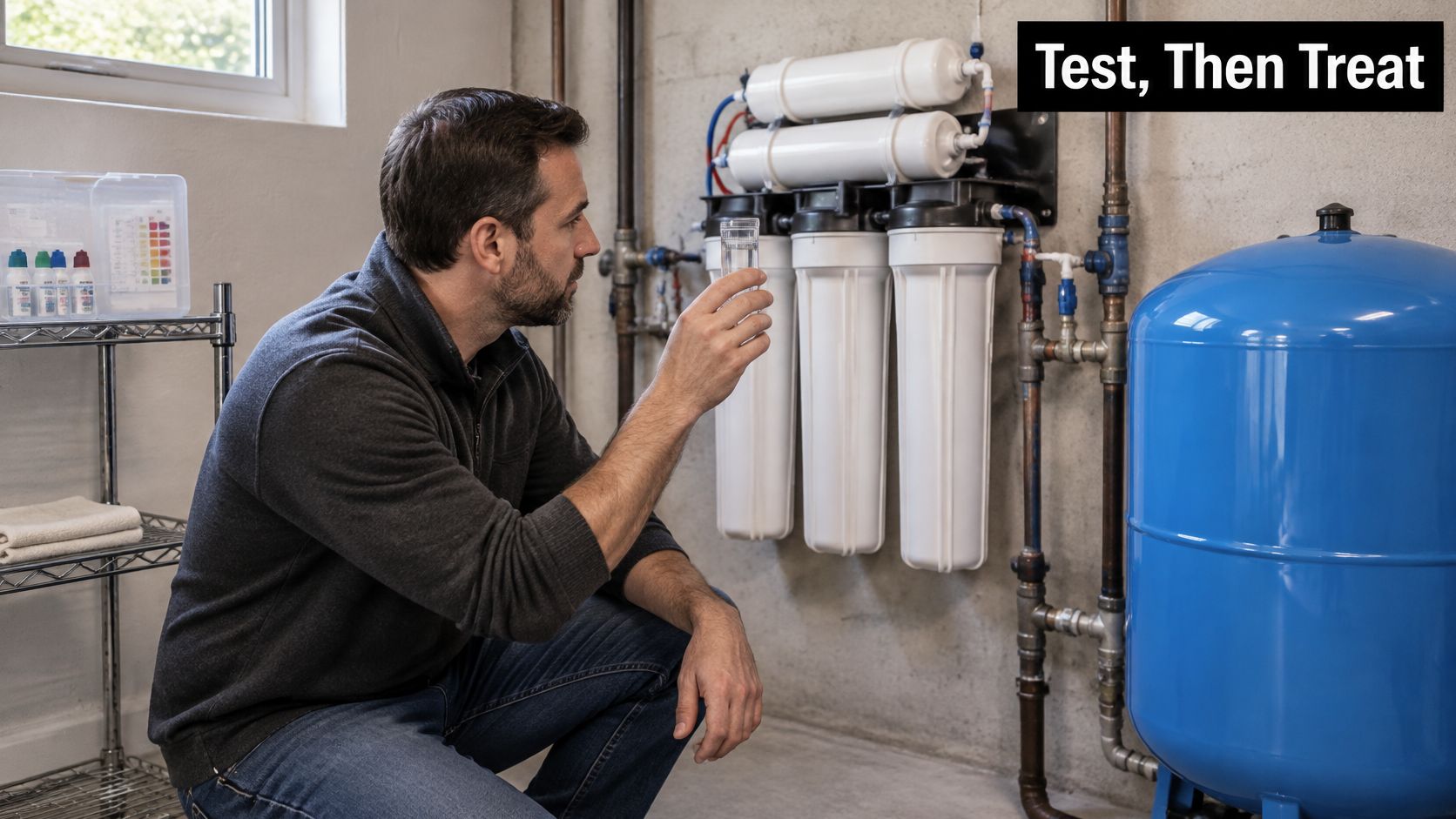
Separate household design from point-of-use benchmarks
The EPA's RO performance summary identifies NSF/ANSI 58 as the primary U.S. reference standard for point-of-use RO and describes WaterSense criteria including at least 75 percent TDS reduction, average recovery of at least 30 percent, no sample below 23 percent, and a final reading of at least 30 percent.
Those are useful comparison benchmarks, but their scope matters. They aren't blanket certification requirements for whole-house equipment, and a point-of-use label doesn't prove that a whole-house installation is suitable.
What to check when choosing a whole-house RO system
| Criterion | Benchmark | Why it matters |
|---|---|---|
| Certification | NSF/ANSI 58 | Primary U.S. reference standard for point-of-use RO performance |
| Contaminant reduction | At least 75 percent TDS reduction for WaterSense-labeled units | Baseline for reducing dissolved minerals in the covered units |
| Average recovery | At least 30 percent under the cited criteria | Shows how efficiently the system uses water |
| Lowest single recovery reading | Not below 23 percent under the cited criteria | Checks efficiency across samples |
| Final recovery reading | At least 30 percent under the cited criteria | Confirms performance at the final measurement |
| Sizing basis | Latest well test results and household demand | Matches treatment to source water and required output |
Compare performance under your water conditions
Recovery describes how much feed water becomes treated water. Strong contaminant reduction with poor recovery means more source water is needed to produce the household's supply. Ask for operating expectations under your actual water conditions, not just the equipment's most favorable test conditions.
Compare two homes: one has high TDS alone; the other has nitrate contamination with normal bacteria results. Both may be candidates for RO, but their acceptance criteria differ. The first needs a mineral-load and production assessment, while the second also needs documented nitrate-reduction performance.
Bring these items to a whole-house reverse osmosis review:
- Dated laboratory reports: Include sample locations and whether samples were untreated or treated.
- Flagged contaminants: Identify every result requiring action.
- Household demand: Include occupancy, daily use, and peak-use needs.
- Equipment documentation: Compare contaminant claims, certification scope, recovery, and maintenance requirements.
A properly sized system must deliver enough treated water without sacrificing the performance you're buying it to achieve.
Schedule Your Well Test and RO Review
Order the water test before committing to equipment. A current report lets you make a treatment decision based on your well, your household, and the conditions around your property.
Use the Florida baseline to organize routine testing, then add targeted analyses where local risks justify them. Keep laboratory safety testing distinct from general treatment screening so you know exactly what each result establishes.
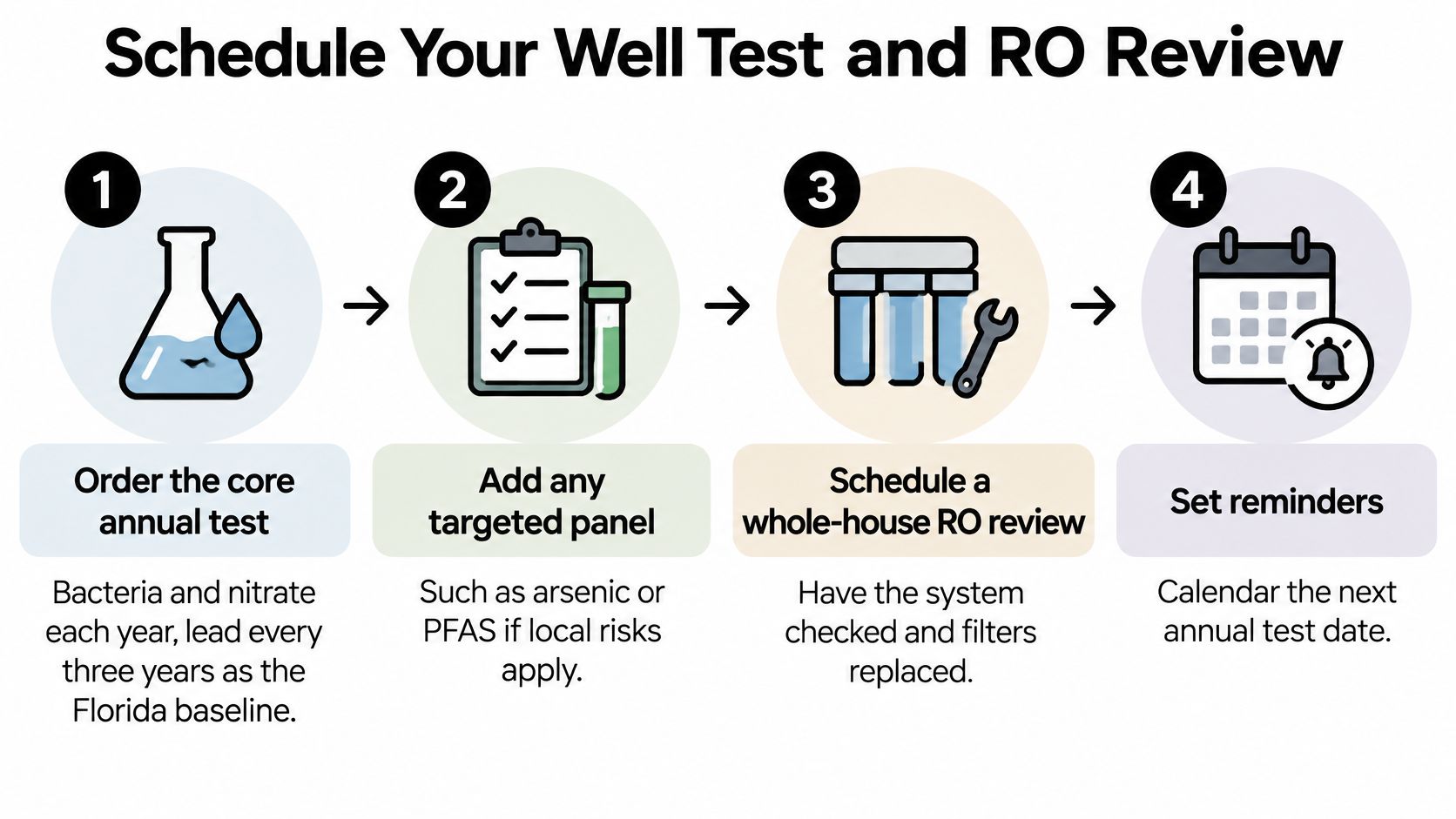
Bring the report into the service decision
Start by marking the laboratory's flagged results and gathering any older reports. Include the collection date, sample location, and recent events that might explain a change.
Next, request a whole-house RO review that considers both contaminant reduction and household demand. The decision should address what the system will remove, how much treated water it will produce, and how performance will be checked after installation.
- Confirm the maintenance tasks: Identify the filters, pretreatment components, and operating checks the proposed arrangement needs.
- Record expected performance: Keep the equipment documentation with your laboratory reports.
- Schedule follow-up verification: Arrange treated-water testing after installation and whenever a significant change warrants it.
- Set service reminders: Keep system inspection and the next routine laboratory appointment on the calendar.
Keep ownership manageable
Most of our water testing is free, but laboratory work is a separate consideration: we collect samples for tests such as bacteriological analysis and deliver them to the Lee County Department of Health for a fee. We also offer a monthly reverse osmosis maintenance plan and an annual service visit for customers.
Choose the maintenance arrangement alongside the system, not after performance declines. Test this season, review the results, and select the whole-house RO configuration that addresses the findings.
Water Medic of Cape Coral offers well-water testing, treatment suited to your well's results, and whole-house RO maintenance support. Order your test this season, then visit Water Medic of Cape Coral to book a whole-house reverse osmosis review based on your laboratory report and household water needs.