
Scum on Water: What It Means and How to Treat It
You step onto the lanai in Cape Coral and notice a slick layer stretched across the pool. Later, a glass from the kitchen tap shows a faint sheen that wasn't there yesterday. It's easy to call both problems “scum on water” and reach for a net, chlorine, or a household filter.
That's the wrong starting point. Scum is a symptom, not a diagnosis. It may be harmless natural foam, detergent residue, mineral buildup, organic debris, oily film, or a cyanobacterial bloom that needs immediate caution. The right response depends on the source, the appearance, the odor, and whether the film returns after you remove it.
What That Floating Film on Your Water Actually Is
A surface film forms where water, air, particles, and dissolved substances meet. That location concentrates material, so a thin layer can look far more alarming than the amount of material dispersed through the water. In a pool, the film may collect at the tile line or in corners. In a glass, it may appear as an oily shimmer, cloudy layer, or floating specks.
The first mistake homeowners make is treating every visible layer as pollution. Natural foam can form without a detergent spill. Government water-quality guidance explains that wind, waves, rapids, and other turbulence mix air with dissolved organic carbon released by decaying leaves, plants, and animals. Those organic compounds lower surface tension, allowing bubbles to form and persist. Government water-quality guidance explains how natural foam forms.
Detergent-related foam usually behaves differently. It's more likely to appear white and may have a noticeable perfume smell. Natural foam often gathers near shorelines, stream outlets, or places with strong agitation. In a residential setting, a pool return, waterfall, fountain, or recent storm can create similar movement.
Start with three observations
You can narrow the possibilities quickly without touching the film.
- Check the color. White foam, gray haze, green or blue-green mats, brown patches, and rainbow sheen point toward different causes. Color isn't proof, but it tells you which risks deserve attention first.
- Check the odor from a distance. Perfume suggests detergent or personal-care residue. A petroleum-like smell suggests an oily source. Musty, earthy, or foul odors raise concern about biological growth or decomposition.
- Check whether it reforms. Remove a small amount only if the water is clearly safe to handle. If the layer returns quickly, the source is still entering the water or forming within it.
A film limited to a pool surface isn't the same diagnostic problem as a sheen that appears in drinking water. A glass can reveal whether the issue travels with the water or remains an outdoor-surface problem. If you see discoloration, strong odor, green paint-like material, or a recurring layer, stop treating it as ordinary cleaning.
Practical rule: The appearance tells you what to investigate, not what chemical to pour in.
The Four Common Types of Scum and How to Tell Them Apart
At the pool edge or kitchen sink, describe what you see precisely. “Scum” is too broad for a useful service call. Say whether the material is foamy, slimy, chalky, oily, clumped, green, brown, or paint-like. That description helps separate a surface-maintenance issue from a source-water concern.
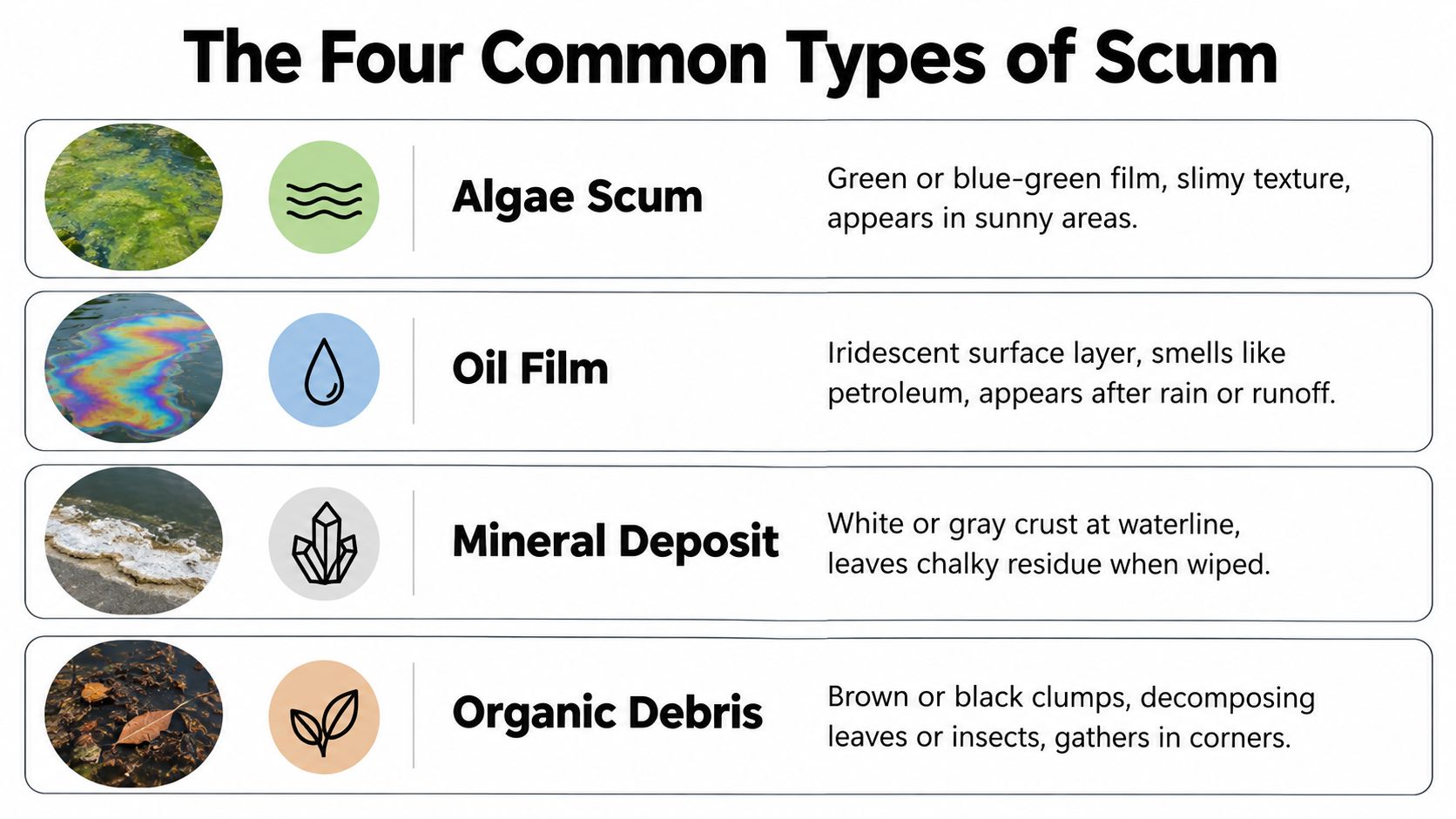
Natural organic foam
Natural foam is usually light-colored and gathers where water moves. Wind, pool returns, fountains, waves, or runoff can create the agitation needed to produce it. Decaying leaves and other organic matter supply the dissolved compounds that help bubbles last.
This type often breaks apart when movement stops. It may reappear after wind or rain, then thin out as conditions change. A natural foam pattern is different from a persistent oily sheen that reforms across still water.
Detergent or personal-care residue
White foam with a perfume or cosmetic smell points toward detergent, soap, sunscreen, lotion, or another surfactant. Surfactants change surface tension, which allows bubbles and films to spread across the water.
Look for a connection with recent cleaning, bathing, runoff, or a nearby discharge. Don't assume that a single skim solves it. If the input continues, the surface will continue to reform.
Cyanobacterial or algal mats
Green, blue-green, gray, or paint-like material deserves the strongest caution. The U.S. Geological Survey research record on harmful algal blooms identifies nutrient enrichment as a key cause of cyanobacterial blooms, which can create visible discoloration and surface scums.
Don't touch suspected cyanobacterial scum, consume the water, or let pets near it. Toxins can concentrate in floating accumulations. Warm, sunny, nutrient-rich, relatively still conditions in Southwest Florida can support rapid growth, so green or paint-like water should be isolated until properly assessed.
Oily, mineral, or organic surface film
A rainbow sheen suggests oil or another hydrophobic substance. Brown or black clumps may be decomposing organic debris. A white or gray crust at the waterline is more consistent with mineral deposition than a floating biological mat.
Water chemistry can also create a film that seems oily or cloudy. If you're comparing treatment options, don't confuse a softener with a purifier. A water softener evaluation addresses hardness-related concerns, but it isn't a universal answer for biological, petroleum-related, or every dissolved-contaminant problem.
Why Surface Skimming and Shock Treatments Keep Failing
Skimming removes what you can see. It doesn't remove dissolved nutrients, detergent inputs, suspended solids, or the conditions that keep a biological layer forming. That's why a pool can look clean in the morning and show a fresh film later the same day.
Shock treatment can also miss the target. A chemical dose may alter the appearance temporarily while leaving the underlying source untouched. If the material is entering with source water, collecting from runoff, or forming because of poor circulation, the surface will keep receiving new material.
Wastewater troubleshooting provides a useful warning. EPA guidance on persistent brown foam and scum identifies non-degradable surfactants, oil and grease, high total suspended solids, low food-to-microorganism ratios, and filamentous microorganisms as associated factors. It also explains that removing the visible layer without correcting operating conditions is temporary.
Treat the cause, not the layer
A recurring film needs a source-level investigation. Record circulation conditions, recent rainfall, water clarity, odor, likely runoff, and whether the issue appears in tap water. For a pool or decorative feature, improve circulation and remove visible material only when the water is safe to handle. For suspected algae, restrict access rather than stirring the surface.
A carbon filter may help with certain odors or organic compounds, but it isn't a universal biological-control system. Review what the equipment is certified to reduce before relying on it. A carbon filtration assessment is more useful than buying a generic cartridge based on a symptom alone.
The visible layer is the evidence. It isn't the whole problem.
If the film keeps returning, the next decision is whether you need better surface maintenance, targeted source testing, or treatment for the water entering the home. Repeatedly dosing and skimming without that decision wastes time and can obscure the condition.
A Homeowner's Diagnostic Checklist Before Calling Anyone
Before you call a treatment provider or county resource, create a short record. A clear description is more valuable than a guess about whether the film is “chemical” or “dirty.” Don't stir the material, pressure-wash it into the water, or add treatment chemicals before documenting the original condition.

Record the pattern
Take photographs in consistent daylight. Include one close view and one wider image showing whether the material gathers near a return, shoreline, corner, drain, or runoff path. Note the time of day, weather, recent rainfall, and whether the film is present before or after circulation begins.
Write down the color and odor without leaning over an unknown substance. If the water is visibly green, paint-like, strongly discolored, or foul-smelling, keep people and pets away rather than collecting a casual sample.
Compare locations
For a household concern, compare water from multiple fixtures using clean, clear glasses. Note whether the film appears at one faucet or throughout the home. Compare tap water with pool or outdoor water separately. A surface-only pool issue and a whole-home source-water issue require different testing decisions.
Look at whether the film floats, clings to the glass, settles, or leaves a chalky residue. Those observations help distinguish surface material from dissolved or suspended constituents. They also help a certified laboratory recommend a relevant panel instead of an unfocused test.
Choose baseline or symptom-driven testing
Florida's Department of Health recommends annual private-well testing for bacteria and nitrate. County health-department guidance commonly places the cost around $20–$30 per sample, as described by the Florida Department of Health private-well guidance.
That baseline test is useful, but it won't automatically explain every visible film. A sheen may come from plumbing surfaces, storage, surface-water intrusion, outdoor water, or another source, and visible residue doesn't automatically indicate coliform contamination. For a recurring symptom, collect a properly timed sample before changing treatment and ask a certified laboratory or county health department which additional analyses fit the evidence.
Write down what changed before the film appeared. Rain, landscaping activity, pool treatment, a new filter, and changes in water use can all help identify the source.
Whole House Reverse Osmosis Against Surface Water Complaints
A whole-house reverse osmosis system makes sense when the complaint follows the source water throughout the property, not when a one-time outdoor film sits on an otherwise unaffected pool. The system treats incoming water before it reaches fixtures, showers, appliances, and drinking points. That differs from wiping a pool surface or installing a small filter under one sink.
Reverse osmosis uses pressure to push water through a semipermeable membrane. The membrane has an approximate pore size of 0.0001 micron, and CDC information on home water-treatment systems explains that reverse osmosis can reduce contaminants including lead, copper, chromium, chloride, sodium, arsenic, fluoride, sulfate, calcium, magnesium, and nitrate. Actual performance depends on the system, the source water, and certified contaminant claims.
Compare the treatment choices
| System | Coverage | Film-related benefit | Maintenance |
|---|---|---|---|
| Whole-house reverse osmosis | Broad household coverage | Reduces identified dissolved constituents before water reaches fixtures | Requires membrane, prefilter, post-treatment, and system monitoring |
| Point-of-use reverse osmosis | Usually one drinking-water location | Produces treated water at a selected tap | Concentrated maintenance at one unit, no whole-home coverage |
| Carbon filtration | Depends on system placement | Can reduce selected odors and organic compounds when certified | Filter replacement and performance checks |
| Water softener | Whole-home treatment for hardness exchange | Helps with hardness-related deposits, not every film or contaminant | Salt or media management and routine service |
A whole-house design should start with laboratory water analysis, not a sales script. If the visible issue only appears in a pool after rain, RO may not be the correct remedy. If the same odor, sheen, or residue appears at multiple household fixtures, source-water treatment deserves serious consideration.
Ask the provider to identify the suspected constituents, show the system's certified claims, explain wastewater handling, and size the equipment for actual household demand. Don't accept “purified water” as a complete specification. A whole-home reverse osmosis evaluation should connect the lab report to the proposed membrane, pretreatment, storage, and maintenance plan.
What NSF and ANSI 58 Numbers Actually Tell You
Reverse-osmosis proposals often rely on words such as premium, advanced, and high-performance. Those adjectives don't tell you whether the equipment fits your water. NSF/ANSI 58 gives you a more useful reference point. It is the principal U.S. certification standard for reverse-osmosis drinking-water systems and addresses material safety, structural integrity, TDS reduction, efficiency, recovery, contaminant reduction, and information supplied to users.
Start with the contaminant list. Certification doesn't mean a system removes everything. It means the manufacturer has specific tested or certified claims for identified substances. Match those claims to your laboratory report.
Read the performance fields
The EPA WaterSense supporting materials for reverse-osmosis systems state that NSF/ANSI 58 testing requires at least 75 percent TDS reduction. They define efficiency as the percentage of incoming water that becomes treated water and specify a minimum efficiency rating of 30 percent for systems covered by the WaterSense specification. Automatic shutoff is also a required equipment feature under that specification.
These figures answer different questions:
- TDS reduction: How much total dissolved solids does the tested system reduce?
- Efficiency: How much incoming water becomes treated product water?
- Recovery: How much of the feed stream becomes usable treated water under the stated operating conditions?
- Automatic shutoff: Does the system stop sending water when treatment or storage conditions call for it?
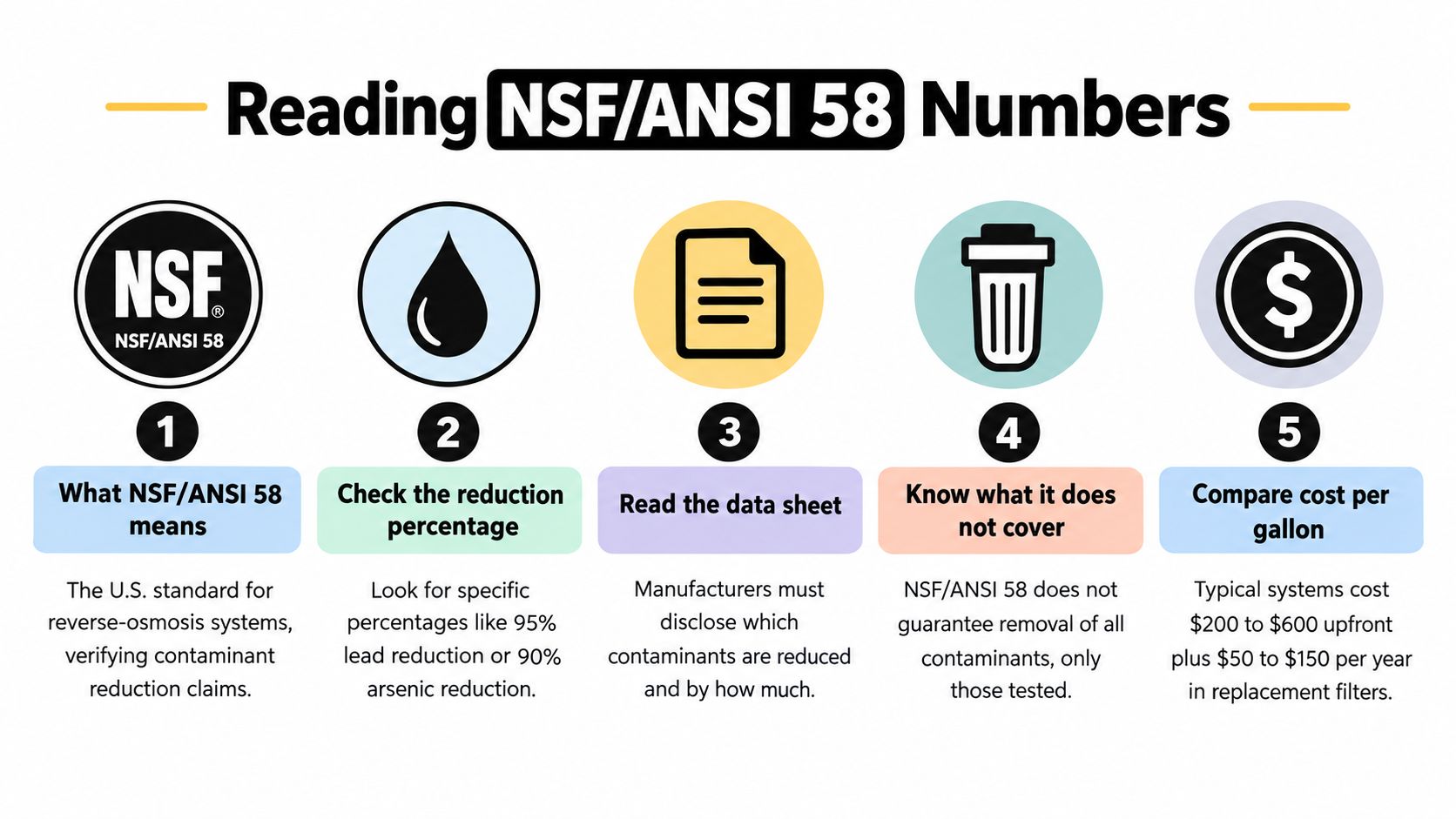
A professional quote should identify the system model, certified claims, expected feed-water conditions, pretreatment, and maintenance requirements. It should also explain how the design handles the difference between drinking-water treatment and whole-house demand. A drinking-water unit and a whole-house installation aren't interchangeable because both use an RO membrane.
Don't choose equipment from the largest contaminant list. Choose it from the match between your test results and the manufacturer's verified claims. If a proposal doesn't show that connection, it's incomplete.
When to Test, When to Service, and When to Call Water Medic
A one-time film after wind or rain can be documented and watched if there's no discoloration, odor, or exposure risk. A recurring film deserves more than repeated skimming, especially when it returns within a day, appears at multiple fixtures, or persists in private-well water.
Treat green, blue-green, gray, or paint-like material as a public-health concern until testing says otherwise. Government health guidance identifies scum, paint-like appearance, discoloration, and odor as warning signs for possible harmful blue-green algae. It recommends appropriate testing rather than assuming chlorine or a household filter will solve the problem. Health guidance for recognizing possible harmful algal blooms supports keeping people and pets away from suspect water.
Use this decision path:
- Outdoor film with a clear weather trigger: Photograph it, restrict contact if the appearance is suspicious, and monitor only when the water looks and smells normal.
- Film that returns repeatedly: Arrange a laboratory panel and request a source-water evaluation.
- Film at several household fixtures: Compare samples and evaluate whole-house treatment rather than treating one tap.
- Persistent well-water sheen or odor: Test before changing filters or adding chemicals.
- Suspected cyanobacterial scum: Contact the appropriate county or state public-health resource before altering the water or equipment.
If the evidence points to a recurring source-water problem, a whole-house RO evaluation is the practical next step. The right provider will test first, explain what the system can and cannot reduce, and design treatment around your Cape Coral or Lee County property rather than selling a generic filter.
Water Medic of Cape Coral can evaluate recurring scum on water, coordinate appropriate testing, and recommend whole-house reverse osmosis when the source-water evidence supports it. Visit Water Medic of Cape Coral to request a water-treatment consultation for your home, pool, or private well.