
Black Mold on Concrete: Complete Removal and Prevention
You're cleaning a garage, basement, or pool deck when dark, irregular patches appear across the concrete. The instinct is understandable: reach for bleach, scrub until the staining fades, and move on. That approach can make the surface look better while leaving the condition that supports black mold on concrete completely unchanged.
The first question isn't which cleaner to buy. It's whether the growth is colonizing the concrete surface or feeding on dust, pollen, leaf residue, cardboard fibers, paint residue, or another organic film sitting on top. That distinction determines whether you need controlled surface cleaning, aggressive moisture management, or professional remediation. It also matters for Southwest Florida properties, where persistent humidity can keep concrete damp long after it looks dry.
Identifying Black Mold on Concrete Surfaces
A homeowner in Cape Coral might notice dark patches while clearing storage from a garage. A pool owner may see greenish-black film along the shaded edge of a deck. Someone inspecting a basement slab may find irregular staining near a wall, a drain, or stored cardboard. In each case, the appearance alone doesn't prove that the concrete itself is supporting the mold.
Start with the material sitting on the slab. Mold growing on organic debris often looks powdery, fuzzy, or slimy and may wipe away relatively easily when carefully disturbed. The debris can include dust, pollen, leaf residue, pet material, or a thin biofilm. Raw, clean concrete is relatively inhospitable to mold, so surface contamination often supplies the nutrients that the mineral substrate lacks, as explained in InspectApedia's discussion of mold growing on concrete.
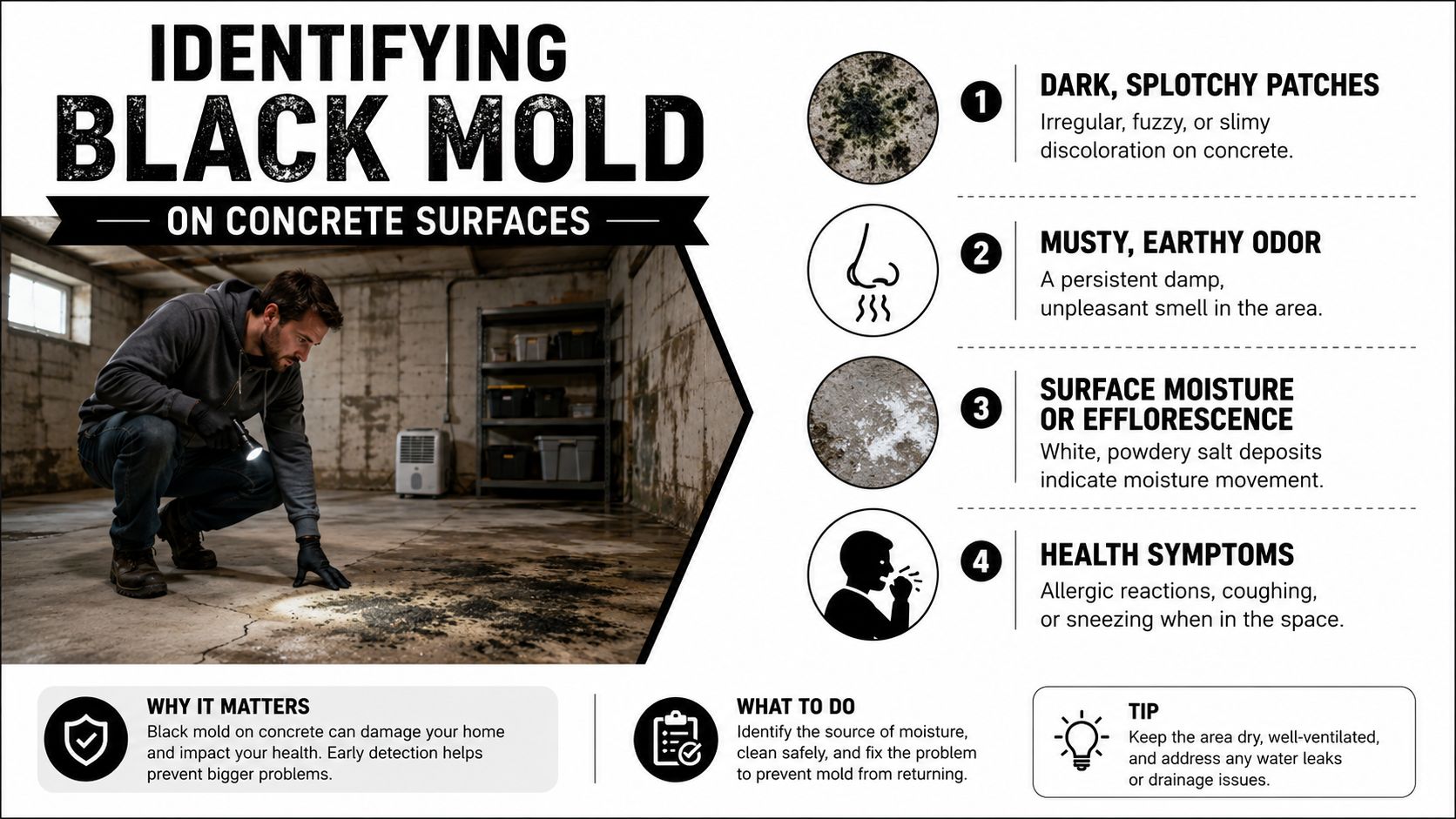
Read the surface before you clean it
Staining that appears embedded in pores and resists simple wiping deserves more attention. Look for a musty odor, a repeating moisture pattern, white efflorescence, or areas where the concrete is spalling, softening, or crumbling. Efflorescence is especially useful diagnostically because those white mineral deposits indicate that moisture has moved through or across the concrete.
Document the affected area before disturbing it. Photograph the growth, estimate its coverage, and note whether it sits near a foundation wall, floor drain, pool equipment, shaded enclosure, or another consistently damp location. Images in a concrete and mold remediation gallery can help you compare surface conditions, but photographs can't replace an inspection of the substrate and moisture pathway.
Practical rule: If the dark material returns in the same pattern after cleaning, treat the recurrence as evidence of an unresolved moisture condition, not as proof that you need a stronger bottle of cleaner.
Health concerns also affect the decision. Allergic reactions, coughing, sneezing, or respiratory irritation while occupants spend time in the area are reasons to limit exposure and avoid aggressive DIY disturbance. Identification doesn't require you to prove the exact species on your own. It requires you to determine whether the material is loose surface contamination or evidence of a deeper, persistent dampness problem.
Understanding Why Concrete Develops Mold
Concrete appears too hard and inorganic to support mold, but that assumption overlooks how concrete behaves in a humid building. The slab contains a capillary network that can absorb and retain moisture. Dust, pollen, skin cells, pet dander, and other organic residues collect in its surface texture, creating a nutrient layer where mold can establish itself.
The moisture threshold is the important part. Building-science modeling places the humidity limit for mold growth on concrete surfaces connected with ambient air above 88% to 90% relative humidity, while new clean concrete in dense layers may require conditions exceeding 97% to 98% RH before growth becomes likely, according to the improved mold-growth model published through Eurogypsum. The same source identifies the lowest humidity level for mold growth in building materials as around 80% RH, which explains why a cool slab can become vulnerable even when the room itself doesn't feel wet.
EPA guidance takes a preventive position. The U.S. Environmental Protection Agency's mold guidance recommends keeping indoor relative humidity below 60%, ideally between 30% and 50%, and says wet or damp materials should be dried within 24 to 48 hours to prevent mold growth. Concrete and cinder block can often be cleaned with suitable methods rather than automatically removed, provided the growth hasn't penetrated deeper layers.
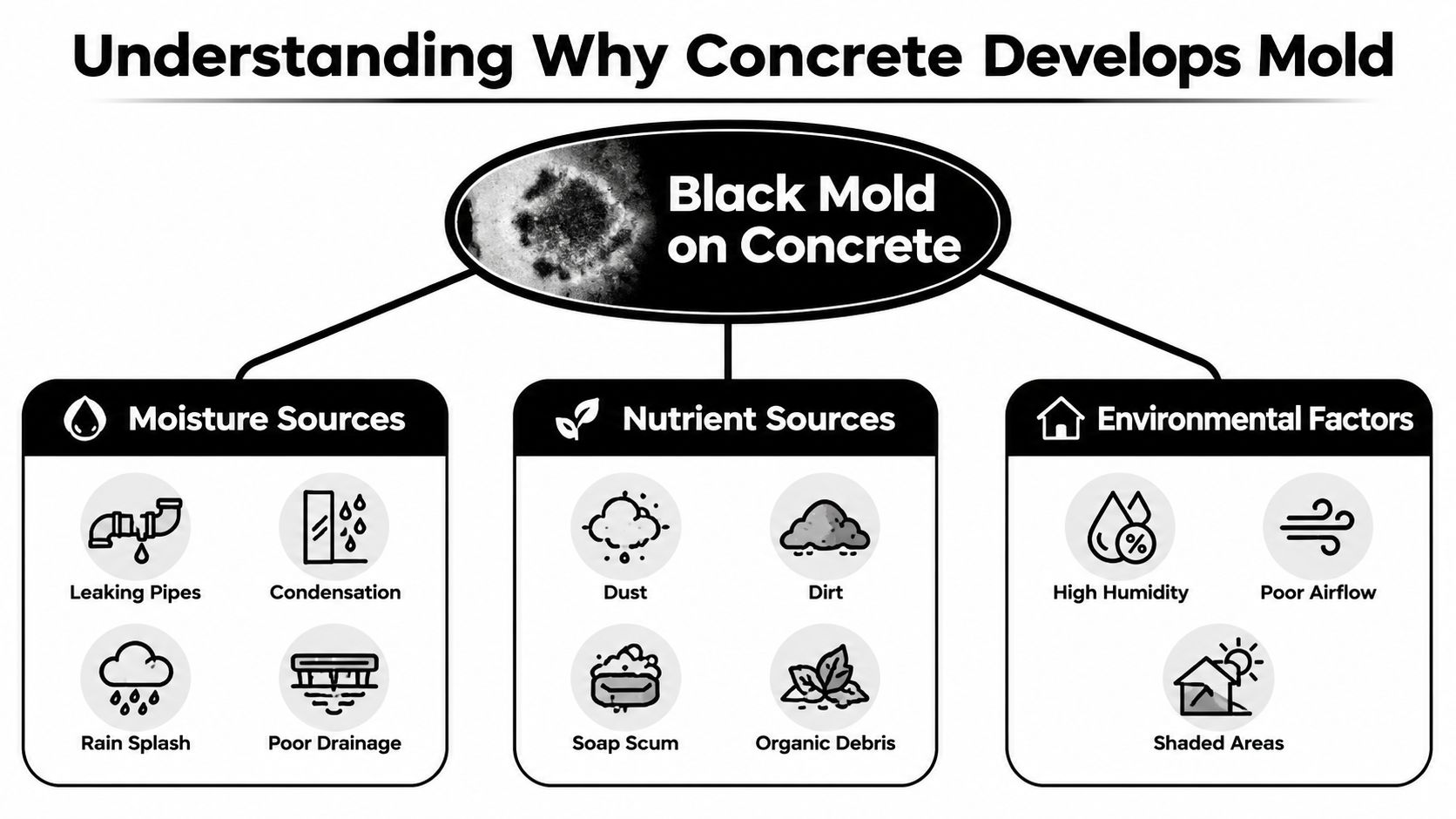
Three conditions usually converge
Concrete moisture problems typically involve one or more of these mechanisms:
- Capillary movement: Moisture can migrate upward from soil beneath or alongside a slab when the ground remains saturated.
- Condensation: A cool concrete surface can collect condensation when warm, moisture-laden air contacts it.
- Persistent environmental dampness: Poor airflow, shaded surfaces, pool enclosures, and humid enclosed rooms can keep the surface wet enough for growth.
Research on microbial corrosion of concrete demonstrates why persistent dampness deserves serious attention. Under black mold exposure, the study measured a 10% increase in concrete water absorption, while porosity rose from 14.3% to 17.9%; after 6 months of capillary moisture exposure, water absorption reached 37.3% under fungal influence, as reported in the microbial corrosion research. Those findings don't mean every dark patch will damage a slab, but they do show that biological growth can change the material's moisture behavior over time.
The practical conclusion is straightforward. Mold spores aren't the entire problem. Moisture, a colonization layer, temperature differences, and limited airflow create the conditions that allow growth to persist.
Step-by-Step Mold Removal Process
A reliable removal process separates containment, cleaning, extraction, and drying. Most failed attempts handle only the visible stain. The homeowner scrubs, sees a lighter surface, and assumes the work is finished. Residual growth in pores and moisture retained below the surface then create the conditions for recurrence.
Prepare the work area
Restrict access before disturbing the growth. Use plastic sheeting to isolate the area, prevent unnecessary air movement through the home, and avoid operating HVAC equipment in a way that circulates contaminated air. If the affected area is larger than 10 square feet, professional containment and air-handling practices become more appropriate.
Wear an N95 respirator, nitrile gloves, and eye protection at minimum for a small, controlled task. Lightly misting visible growth can reduce airborne disturbance, but don't saturate the slab and create another drying problem. Remove loose debris dry with a suitable HEPA vacuum or careful collection method before applying liquid cleaner.
Clean in manageable sections
Apply the selected cleaner to a small section, allowing roughly 10 to 15 minutes of dwell time when the product calls for that interval. Agitate with a stiff-bristle brush so the solution reaches the concrete's texture rather than only whitening the top film. Work methodically, and keep used solution contained instead of spreading it across unaffected areas.
A wet vacuum can remove contaminated liquid after scrubbing. The EPA remediation guide identifies concrete and cinder block as materials that can be cleaned with appropriate methods, including water extraction in suitable circumstances. Follow the cleaner's label, rinse when required, and protect nearby finishes from chemical exposure.
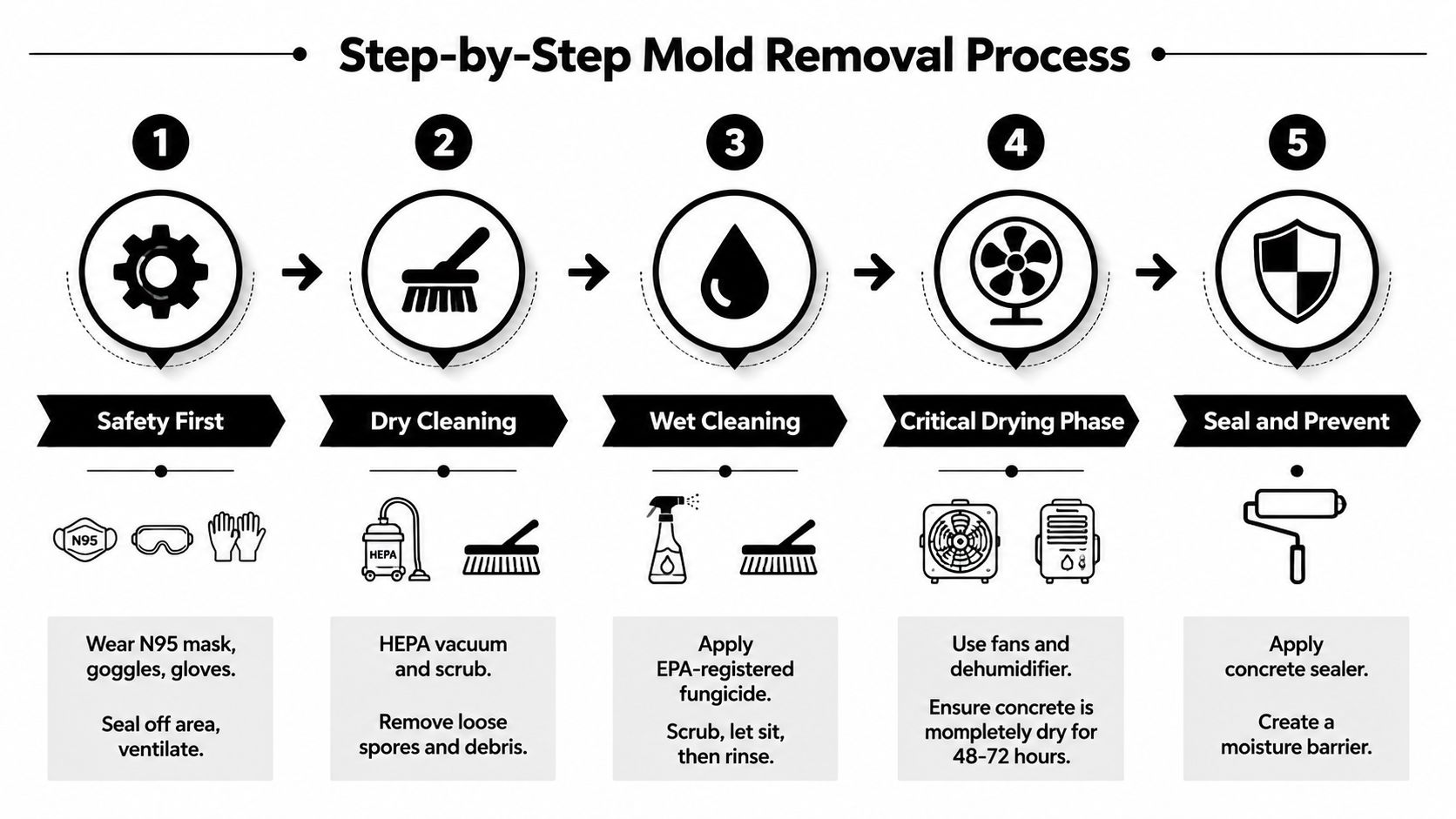
Drying determines whether the job worked
Set up fans and a dehumidifier immediately after cleaning. One specialist workflow recommends maintaining indoor humidity below 50% and running fans or dehumidifiers for 24 to 48 hours after cleaning, as described in this concrete mold removal guide.
Don't judge dryness by touch alone. Concrete can feel dry at the surface while retaining moisture internally. Use a moisture meter where appropriate, check the area repeatedly, and wait until the slab and surrounding materials have stabilized before applying a sealer or antimicrobial coating.
The cleaning removes what you can see. Drying removes the condition that lets it return.
Pressure washing can help with suitable exterior concrete, but excessive pressure can etch the surface. One technical guide cites keeping pressure under 1500 PSI for some applications, as outlined in this mold-on-concrete remediation guidance. Painted or coated concrete needs even more caution because aggressive washing can remove the finish while leaving the moisture source intact.
Choosing the Right Cleaning Solutions
No cleaner is a permanent mold solution by itself. The right choice depends on whether you're removing light surface contamination, treating established growth in concrete texture, or working near painted finishes, landscaping, pool water, or an enclosed room.
| Cleaning Agent | Best For | Kill Rate | Penetration | Safety Level | Contact Time |
|---|---|---|---|---|---|
| Diluted bleach | Heavier contamination on compatible, unpainted surfaces | Strong surface action | Limited in porous concrete | Requires careful ventilation and PPE | Follow the product label |
| TSP-based cleaner | Stubborn residue and heavy soil on compatible concrete | Cleaning-focused | Useful agitation support | Requires gloves, eye protection, and label controls | Follow the product label |
| Hydrogen peroxide | Light to moderate surface growth | Oxidizing surface action | Moderate, depending on texture | Use eye and skin protection | Follow the product label |
| White vinegar | Small areas and mild surface contamination | Slower surface action | Limited to moderate | Lower chemical hazard, but still needs ventilation | Allow adequate dwell time |
| Baking soda solution | Odor and light surface cleaning | Limited as a mold killer | Limited | Generally mild, with ordinary PPE | Allow adequate dwell time |
| Commercial fungicide | Specified mold remediation work | Product-dependent | Product-dependent | Follow label and PPE requirements | Follow the product label |
For heavier contamination on unpainted concrete, expert guidance commonly discusses a bleach solution around 1 part bleach to 10 parts water, or a TSP-based cleaner, followed by stiff-brush scrubbing and a complete rinse. The mold-cleaning comparison from Mold Compass also cautions against using pressure that can etch the slab.
Bleach often makes black staining disappear visually without reaching growth sheltered in pores or biofilm. That's why a pale surface isn't the same as a remediated surface. Oxygen-based products and hydrogen peroxide may be more practical where chlorine odor, runoff, or nearby pool features create concerns, but the label and the material compatibility still control the decision.
Never mix cleaners. In particular, combining bleach with ammonia can create dangerous fumes. Test any product on a small inconspicuous area first, especially on painted, sealed, or decorative concrete. Enclosed basement floors require more attention to ventilation, while pool decks require careful control of runoff and protection of nearby water features.
Preventing Mold Through Moisture Control
Cleaning is temporary if the slab continues receiving moisture. In Southwest Florida homes, recurring growth commonly points to a building-envelope or humidity-management problem rather than an inadequate scrubbing technique. The useful question is not whether the stain can be removed. It's whether the concrete can remain dry enough after remediation.
Three pathways deserve attention:
- Capillary rise: Moisture moves upward from damp soil beneath or beside the slab.
- Condensation: Warm humid air meets a cooler concrete surface and deposits water.
- Liquid water movement: Poor drainage, saturated soil, or inadequate water control keeps walls and slabs damp.
Diagnose before sealing
A plastic sheet test can indicate whether moisture is moving through the slab, although it isn't a substitute for professional testing. Moisture meters help identify changes across the affected area, and dew point calculations help determine whether condensation is likely when indoor air contacts a cool surface.
A penetrating silane or siloxane sealer can reduce liquid absorption while allowing some vapor transmission when the product is appropriate for the substrate. A topical coating can trap moisture beneath the surface and worsen blistering, peeling, or mold if the slab hasn't dried. Sealers should follow diagnosis, not replace it.
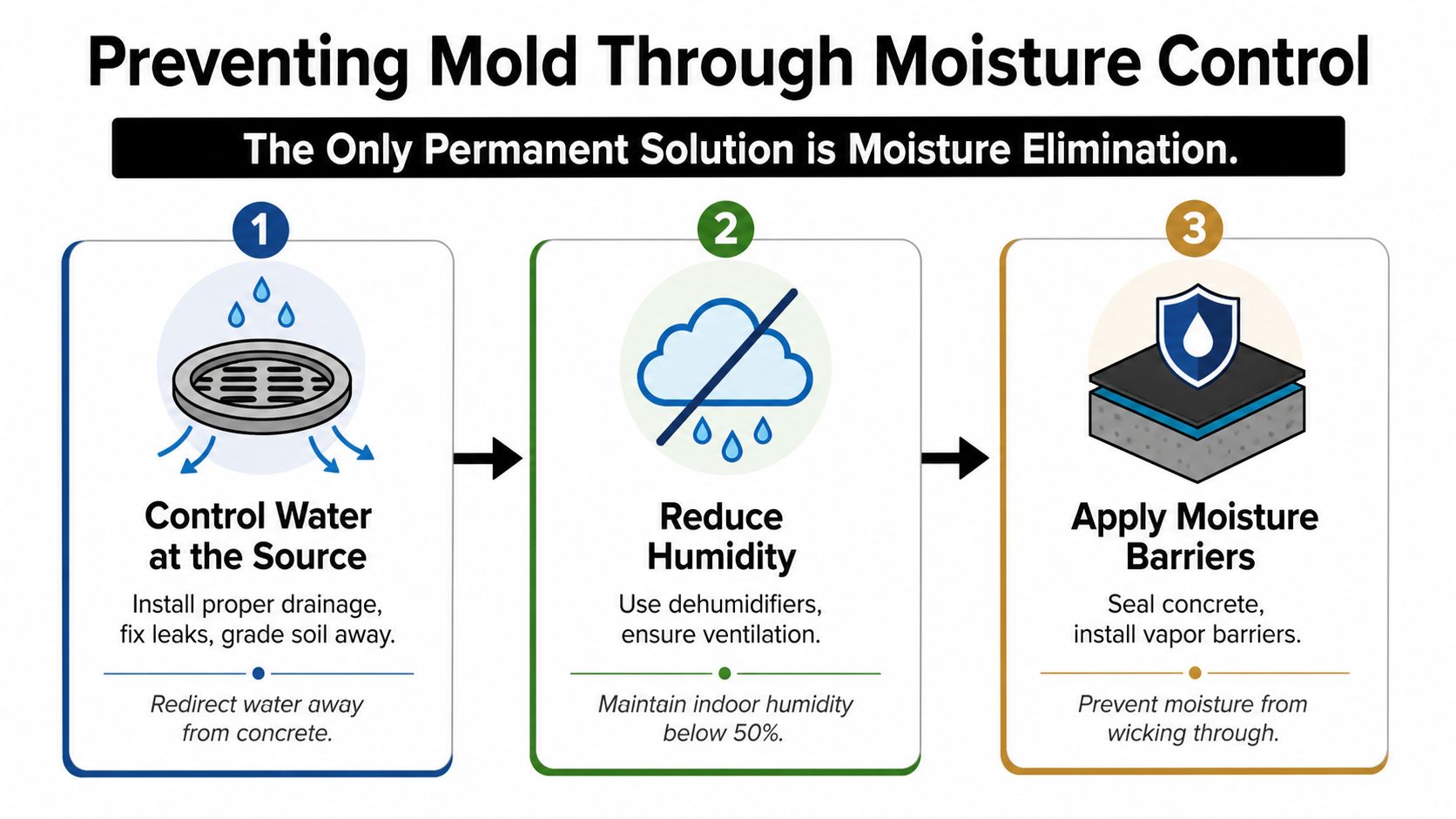
Put effort where it has the greatest effect
Exterior water management often provides the strongest first step. Confirm that soil directs water away from the structure, extend gutter discharge away from the foundation, and prevent roof or ground runoff from concentrating beside concrete. Interior vapor barriers, drainage improvements, and correctly selected dehumidification may be necessary when exterior measures don't resolve the condition.
For recurring or hidden moisture, professional leak detection services can help identify an active water pathway without relying only on visible staining. The inspection should consider condensation, slab moisture, drainage, and concealed migration rather than assuming the darkest area is the source.
EPA guidance recommends indoor RH below 60%, ideally 30% to 50%, and says materials wet for more than 48 hours should be evaluated using mold-remediation guidance, according to the EPA's mold resource. Those thresholds provide a practical operating target, but the correct dehumidifier capacity and ventilation strategy depend on the room volume, envelope, equipment, and moisture load. A crawlspace, basement, and pool enclosure shouldn't all be managed with the same equipment settings.
When to Call Professional Remediation Services
DIY cleaning can be reasonable for a small, isolated patch on sound, unpainted concrete when the moisture condition is understood and the occupant can work safely. Professional remediation becomes the better choice when the problem exceeds surface cleaning or keeps returning.
Use this decision framework:
- Coverage: Growth exceeds 10 square feet or extends across multiple connected surfaces.
- Recurrence: The same area returns after two cleaning attempts.
- Material damage: Concrete shows spalling, crumbling, or other structural degradation.
- HVAC involvement: Mold may have entered air-handling equipment or ducts.
- Occupant risk: Residents experience significant allergies, asthma symptoms, or have compromised immune systems.
A qualified remediation team can establish containment, use HEPA vacuuming, manage air movement, apply antimicrobial treatments or encapsulation where appropriate, and verify that the area has been properly cleaned and dried. Those controls matter because aggressive brushing and washing can spread contamination beyond the original patch.
The type of contractor should match the root cause. A mold remediation specialist focuses on containment and removal. A water-damage restoration contractor may be more appropriate when a broader drying response is required. If concrete mold returns because of persistent humidity, condensation, drainage, or subsurface moisture, cleaning crews alone won't solve the issue.
Recurring growth is a diagnostic signal. Treat it as evidence, not an inconvenience.
Insurance coverage depends on the policy, the cause of the moisture, exclusions, documentation, and whether the condition is considered gradual maintenance-related damage. Get the cause documented before assuming coverage. Mold on foundation walls, structural concrete, or load-bearing columns also deserves prompt professional evaluation because material deterioration can create safety concerns beyond indoor air quality.
When you need an assessment, containment, drying, or related property services, review the available professional remediation services and ask for a written explanation of the moisture pathway, the proposed cleaning method, and the drying verification process.
Water Medic of Cape Coral helps Southwest Florida homeowners and property managers address water-treatment and pool-service needs with experienced technicians and practical recommendations for humid properties. Visit Water Medic of Cape Coral to discuss whole-house reverse osmosis, pool services, and the moisture-related conditions that can affect concrete around your home.