
How Much Does a Perc Test Cost in Cape Coral
Most homeowners in the U.S. pay roughly $1,300 for a perc test, with a typical range of $750 to $1,900. In Cape Coral and Lee County, jobs often land higher because local permit fees, soil conditions, access, and engineering requirements can add substantially to the fieldwork.
You may be looking at a vacant lot, planning a septic conversion, or trying to confirm whether a property can support new construction. The number on a national cost calculator gives you a starting point, not a reliable Cape Coral budget. Southwest Florida sites can look simple from the street while still requiring extra soil evaluation, multiple holes, deeper excavation, or county review.
If you're also on a private well, the septic decision matters even more. The same property may need both wastewater approval and a careful review of the water source. I've walked enough Cape Coral lots to know that the cheapest quote often leaves out the exact items that later create delays.
What a Perc Test Actually Costs in 2026
The clearest national benchmark is about $1,300, with most homeowners paying $750 to $1,900, according to Angi's 2026 perc test cost guide. Broader estimates place some complete tests closer to $450 to $950 when county fees, excavation, and professional sign-off are limited. Difficult sites can exceed $3,000 when deeper digging or challenging conditions require more labor and equipment.
National databases combine rural Midwest parcels with coastal Florida properties. That blend hides the local reality. For a Cape Coral or Lee County property, I'd budget for a practical working range of $1,200 to $2,500, while recognizing that the final invoice depends on what the county and site require.
A quote below $900 may cover only a basic single-hole field test. Ask whether it includes the signed engineering report, county processing, and any required soil profile work. A quote above $2,500 often reflects additional borings, deeper excavation, difficult access, or a re-test path.
Practical rule: Don't compare perc test quotes until you confirm that every quote covers the same scope.
Perc test cost ranges at a glance
| Scope | Typical Range | What You Get |
|---|---|---|
| Basic field test | About $300 to $1,000 | Limited digging and drainage measurement, depending on local requirements |
| Common U.S. project | About $750 to $1,900 | Field testing with typical professional and administrative components |
| National benchmark | About $1,300 | A commonly cited average for homeowners |
| Complex evaluation | $3,000 or more | Deeper excavation, multiple locations, equipment, or engineered review |
A historical cost breakdown from CostHelper shows why totals vary. One older engineering example combined digging, presoak, testing, observation boring, layout, and county charges into a $3,505 total. The test itself is only one part of the transaction. Labor, documentation, and permitting usually determine the final bill.
Why Cape Coral and Lee County Require a Perc Test
A percolation test measures how quickly water moves through the soil. The result helps determine whether a septic drainfield can receive wastewater and disperse it safely instead of holding water near the surface.
Think of the yard as a sponge. A sandy sponge drains quickly, while a compacted or layered sponge holds water. The technician soaks the soil, measures the water-level drop, and records how the ground responds. That information helps establish whether the proposed drainfield area can support the planned septic design.
Lee County's health and environmental review process uses this type of site information before septic approval. The purpose isn't just paperwork. The county needs enough information to protect the property owner from a failing drainfield and to reduce the risk of wastewater affecting groundwater or nearby properties.
Cape Coral homeowners can encounter this requirement when developing an unsewered parcel, converting from municipal sewer, changing a proposed home location, or subdividing land. A prior evaluation may not answer a new project's questions if the building footprint or drainfield location changes.
The same soil data also matters to well owners. A shallow aquifer and a private well make responsible wastewater placement especially important. A passing field measurement doesn't replace the complete site evaluation or guarantee that every permit condition has been satisfied.
Breaking Down the Line Items on Your Bill
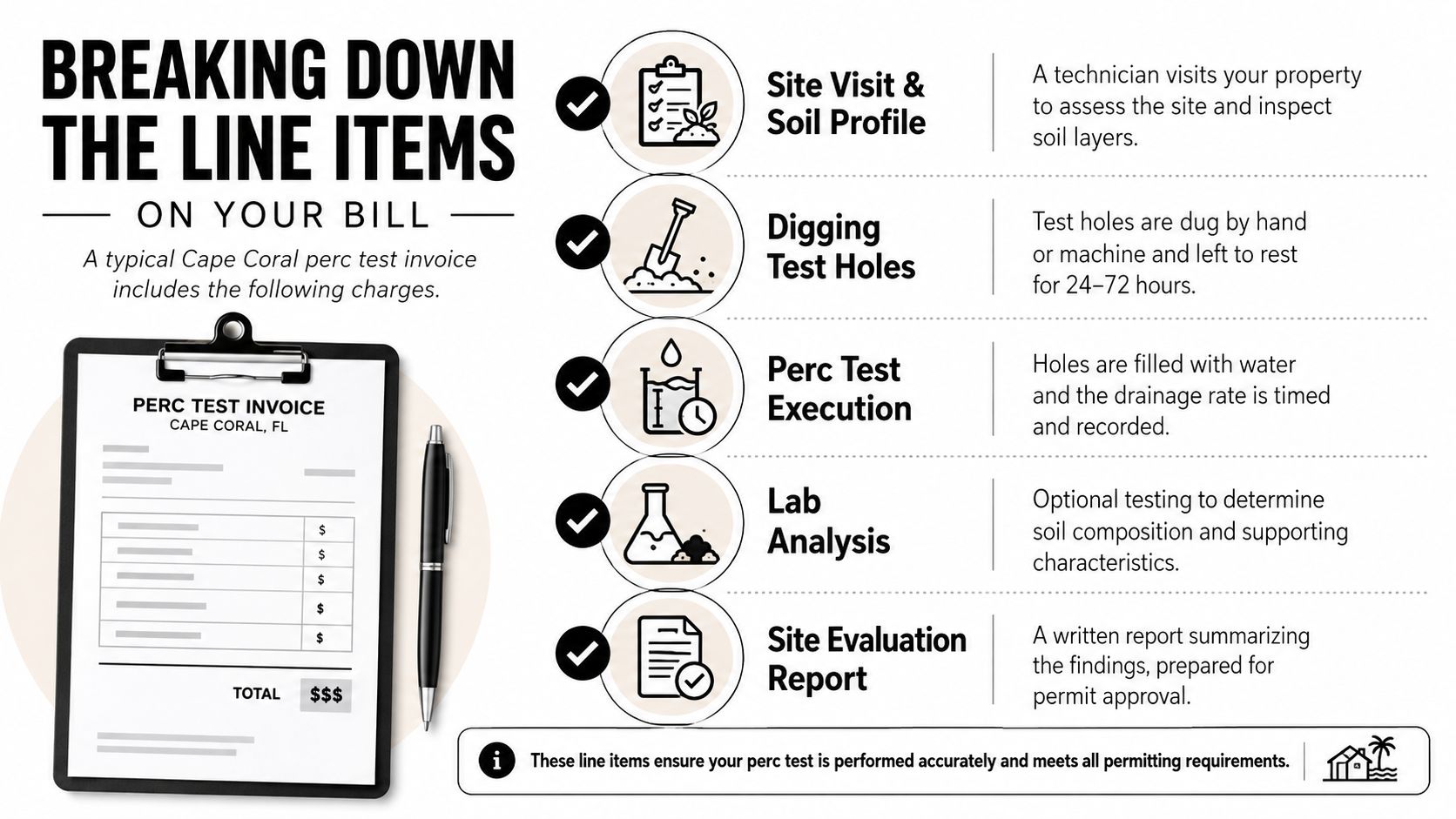
A professional invoice should make it clear what you're paying for. The first charge is usually the site visit and soil profile, where the technician inspects the proposed area and records the soil layers. That visit determines whether the crew can work by hand or needs machinery.
Digging comes next. Hand digging may work on an accessible sandy lot, while machine excavation requires equipment mobilization and operator time. After the hole is prepared, the soil may need a 24 to 72 hour presoak before the timed drainage readings begin.
The test itself involves filling the hole and recording how quickly the water level drops. A licensed engineer or other qualified professional may then review the field data and sign the site evaluation report. That sign-off is often separate from the digging charge.
Charges homeowners often overlook
- County processing: Confirm whether Lee County application and review fees are included or paid separately.
- Additional borings: A deeper soil profile or extra observation location can add labor and equipment time.
- Travel and mobilization: A crew traveling from Fort Myers or Punta Gorda may charge for bringing personnel and equipment to the lot.
- Drainfield layout: Some providers charge separately to flag a proposed drainfield area.
- Document copies: A recorded plat or additional plan copy may appear as an administrative add-on.
- Re-testing: A borderline or failed location can require another field visit and professional review.
Independent cost guidance places additional evaluation points at about $100 to $300 each, while deep-boring or soil-profile add-ons can add roughly $200 to $500. Those figures are documented in this perc test cost breakdown.
A quote that starts at $750 can move past $1,800 once excavation, professional sign-off, county charges, and extra fieldwork are included. Before you sign, ask for the number of holes, expected depth, presoak requirements, report fee, county fees, travel charge, and re-test policy in writing.
How the Test Works on Your Property
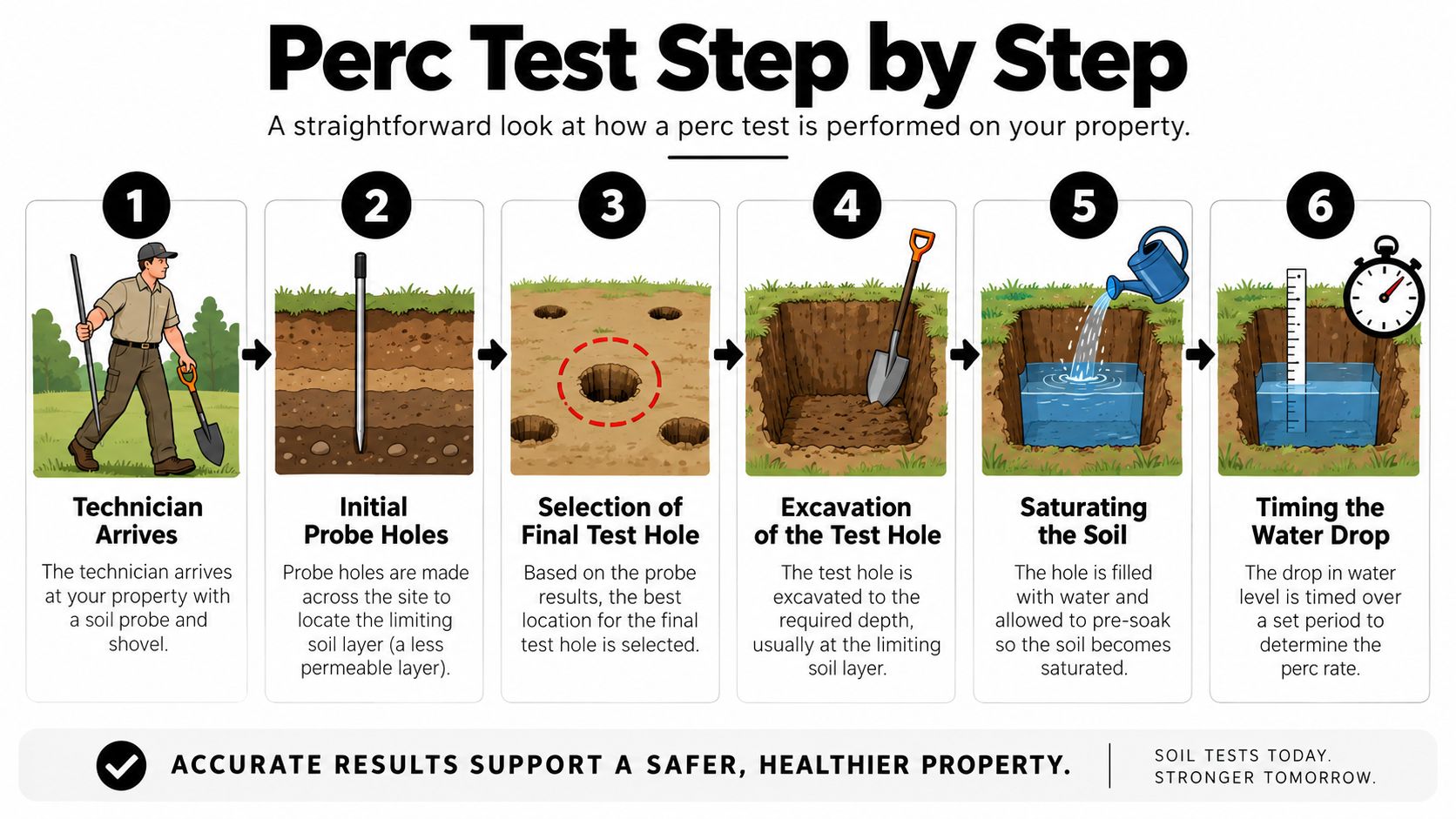
The technician usually starts by reviewing the proposed house and drainfield locations. Probe holes help locate the limiting soil layer, identify changes in the profile, and determine where the final test hole should go. This early work prevents the crew from collecting a reading in a spot that can't support the intended system.
The selected hole is then excavated by hand or machine. The crew uses tools such as probes, augers, shovels, measuring equipment, water containers, and safety gear. The soil is saturated during the presoak period so the observation reflects conditions closer to a wet-season scenario rather than a freshly dug, unusually dry hole.
During the observation, the technician fills the hole and measures the water drop at scheduled intervals. The observation window commonly runs 24 to 72 hours, depending on the site and local requirements. The resulting field notes go to the engineer for interpretation and inclusion in the signed report.
What the timeline looks like
Plan for one to two site visits, followed by two to five business days for the engineer to issue the completed report. The field crew may return to take readings, verify conditions, or complete additional work.
Weather, standing water, access, and a changed building location can affect the schedule. Don't schedule excavation or finalize a septic design until you know when the signed evaluation will be available for the Lee County application.
For homeowners managing both a well and a septic project, the well FAQs from Water Medic can help identify related water-quality questions before the fieldwork begins. The perc test addresses soil absorption and wastewater placement. It isn't a drinking-water test.
Hand-Dug vs Excavator and Single-Hole vs Multi-Hole
The digging method changes both the invoice and the information the engineer receives. A hand-dug test can suit a clear, sandy lot where the relevant soil layers sit close to the surface. It avoids heavy-equipment access problems, but it may not reveal a deeper restrictive layer.
An excavator or backhoe becomes more useful when the site contains hardpan, shell, dense layers, or other conditions below the accessible surface. Equipment adds mobilization and labor, yet paying for the right excavation can be cheaper than relying on an incomplete profile and repeating the work.
The number of test locations matters just as much. A single-hole test is the lower-cost option when it satisfies the project and local requirements. Multiple locations may be needed when soil varies across the lot or when the first reading raises questions. Cost guides place additional test locations at roughly $100 to $300 each, while deeper soil-profile work can add about $200 to $500. See this HomeAdvisor guide to perc soil test pricing for the broader cost context.
| Method | Typical Added Cost | Best For | Limitations |
|---|---|---|---|
| Hand-dug hole | A few hundred dollars in simple cases | Clear, accessible sandy lots | May not characterize deeper layers |
| Excavator or backhoe | Higher equipment and labor cost | Hardpan, shell, dense layers, or deeper profiles | Needs equipment access and site preparation |
| Single-hole evaluation | Lower total scope | Uniform sites that meet requirements | A failed or borderline result can trigger more work |
| Multi-hole evaluation | About $100 to $300 per added location | Variable soils or uncertain first results | Increases field time and report complexity |
Don't choose the digging method solely by price. Choose the method that gives the engineer enough information to approve the site without sending the crew back.
Lee County Permits, Re-Tests, and Hidden Fees
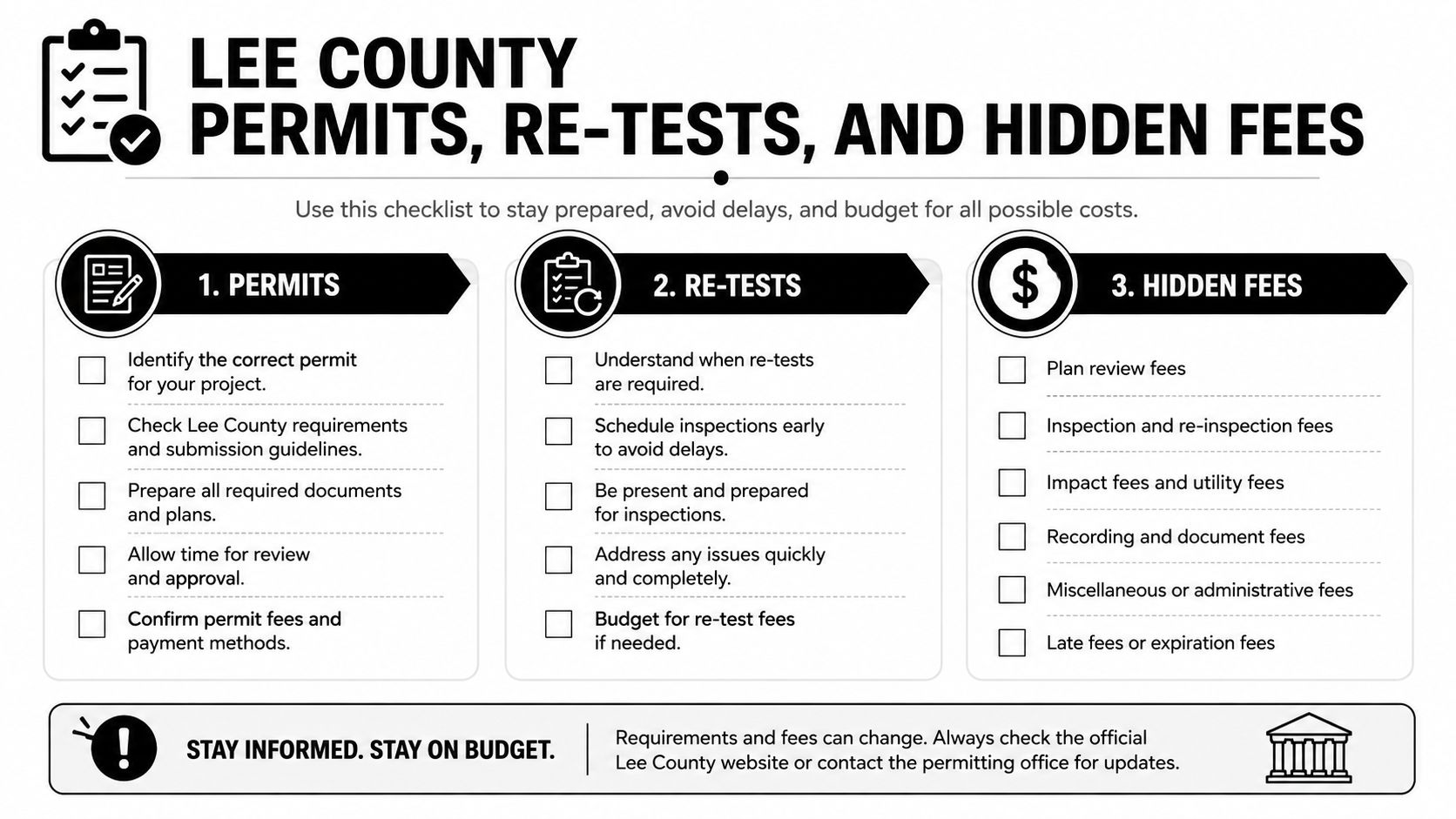
The administrative layer can be just as important as the field test. A complete packet may include the site evaluation report, property and building information, septic layout details, and county application or review charges. Ask the provider to separate field labor, engineering, and county payments so you know which charges are controlled by the contractor and which are government fees.
Common re-test triggers include a failed first location, a house-site change that moves the drainfield, and weather conditions that interrupt or invalidate the observation. A borderline reading can also prompt another hole or deeper profile work. Those decisions should come from the project's qualified evaluator and county requirements, not from a homeowner trying to save a small amount upfront.
The fees that change the budget
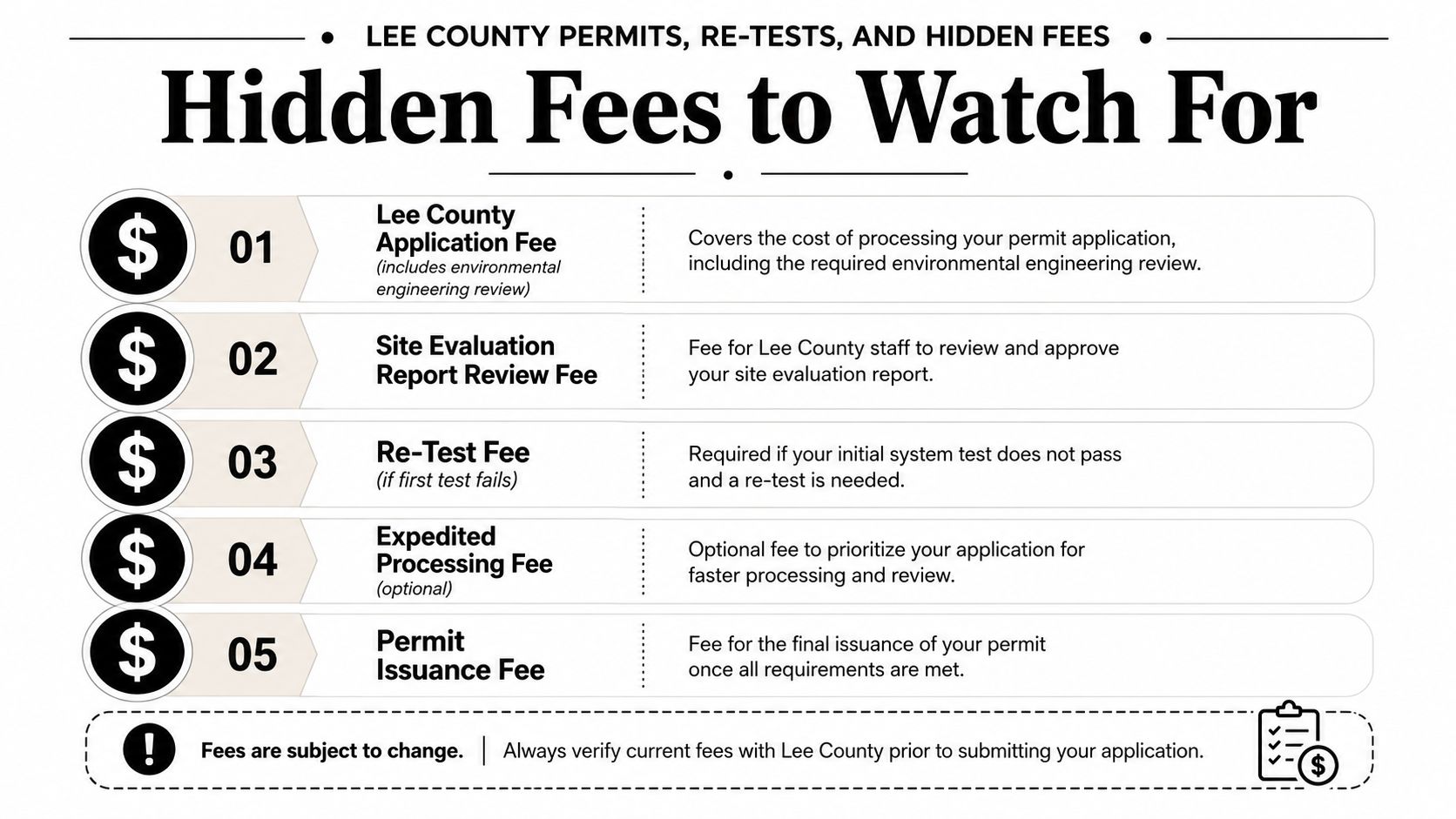
- Application fee: Paid for submitting the county package.
- Site evaluation review: May be separate from the field technician's report preparation.
- Re-test charge: Covers another mobilization, hole, presoak, and reading.
- Expedited handling: An optional administrative charge where available.
- Revised site plan: May apply when the test changes the drainfield location.
Independent guidance places some separate county application fees at about $50 to $200, while a complete site evaluation or permit-related package can reach roughly $400 to $1,000. Those figures are summarized in this septic evaluation and permit fee guide.
A $1,500 quote can become a $2,400 project when a second hole, a revised plan, and separate review charges appear. Require a written “included and excluded” list before authorizing the work.
A Realistic Cape Coral Cost Scenario
Two Cape Coral lots can produce very different invoices even when both owners ask for a “perc test.” Lot A is a cleared northwest Cape parcel with sandy fill, an existing well, and straightforward equipment access. The crew completes a single-hole evaluation, observes the site for 48 hours, and delivers a final bill of $950.
Lot B sits in a southeast Cape cul-de-sac with denser soils, standing water after recent rain, and limited driveway access. The evaluator needs a second hole, a 72-hour presoak, more equipment time, and an engineered site evaluation. The final project reaches $2,800.
| Line Item | Lot A, Low Cost | Lot B, High Cost |
|---|---|---|
| Initial site visit and soil profile | Included | Included with expanded evaluation |
| Test locations | Single hole | Second hole required |
| Observation | 48 hours | 72 hours |
| Equipment | Light mobilization | Heavier equipment and restricted access |
| Engineering | Standard signed report | Engineered site evaluation |
| County and administrative work | Standard | Additional review and revised documentation |
| Final total | $950 | $2,800 |
These are representative planning scenarios, not guaranteed bids for any specific property. The useful lesson is the pattern: access, soil variability, observation conditions, and documentation drive the gap more than the phrase “perc test” suggests.
If your property also has a well with quality or performance concerns, schedule that assessment separately and don't assume a septic evaluation answers it. Water Medic's well water repair service addresses a different part of the property's water system.
Smart Ways to Lower Your Perc Test Cost
The safest savings come from reducing avoidable fieldwork, not from buying the lowest advertised test. Schedule when the site is accessible and conditions are less likely to force a repeat visit. A first-pass evaluation costs less than paying for another mobilization, another hole, and another report review.
Get three written quotes, but make the providers price the same scope. Ask each one to separate digging, engineering, county fees, equipment, travel, and re-testing. A low field price can be misleading if the report or application work appears later as a separate charge.
Use the property to your advantage
- Clear the test area: Remove debris, unnecessary landscaping obstacles, and stored materials before the crew arrives.
- Mark the proposed home: Give the evaluator an accurate building location so the drainfield can be assessed in the right relationship to the structure.
- Ask about setbacks first: Have the tester identify obvious placement conflicts before digging.
- Bundle compatible work: Ask whether a well inspection or future septic planning visit can share mobilization.
- Confirm county costs: Require the provider to identify which Lee County charges are included and which you pay directly.
- Review the re-test policy: Find out what happens if the first location is borderline or fails.
Bundling a perc evaluation with related well or septic planning may reduce duplicated travel and setup, but get the combined scope in writing. If you need payment options for a larger water-treatment or property project, review Water Medic's financing information.
Whole-house reverse osmosis deserves its own budget conversation when a Cape Coral property relies on a private well. A household RO system typically produces only 1 to 5 gallons per day, and smaller systems can waste 3 to 20 liters for every liter treated, according to this Alberta household reverse osmosis resource. The EPA WaterSense RO specification defines waste-to-product ratio as the gallons wasted for each gallon treated, while the EPA supporting statement reports typical point-of-use systems operating at 10% to 20% efficiency, sending about 4 to 9 gallons down the drain per gallon produced, as documented in the EPA supporting statement. The University of Nebraska Extension reports household systems with 20% to 30% recovery and treated-water output of 10 to 35 gallons per day, as explained in its reverse osmosis publication.
Water Medic of Cape Coral provides water testing, whole-house reverse osmosis systems, well water services, and pool care for Southwest Florida properties. If you're budgeting a perc test and also need dependable water treatment for a private well, visit Water Medic of Cape Coral to discuss your property and request a practical next step.