SWFL Well Water Maintenance Cost: Whole House RO?
If you're on a Southwest Florida well, you probably didn't search for well water maintenance cost because you enjoy budgeting. You searched because something is already off. The shower smells like sulfur. The toilets keep getting rust stains. The dishwasher leaves spots. The pressure changes. Then the bills start stacking up, and none of them feel connected.
They are connected.
Most homeowners look at well maintenance the wrong way. They focus on the yearly service number and neglect the most impactful budget killer, which is bad water quality chewing through equipment, treatment parts, plumbing fixtures, and appliances. In Southwest Florida, that's the issue. If your water is loaded with minerals, iron, odor compounds, and other contaminants, you won't solve the problem with a basic maintenance schedule alone. You solve it by treating the water correctly at the whole-house level.
Understanding Your Well Water Maintenance Bill
A normal maintenance budget for a residential well system is often reported at $150 to $500 per year for annual maintenance, while professional service can climb to $373 to $1,622 once labor and house-call fees are added, according to this well pump maintenance cost breakdown. That's the number range most homeowners see first.
That range is useful, but it's incomplete.
What the yearly number usually includes
Your regular bill often covers the boring but necessary work:
- Inspection and tune-up work that catches wear before a failure
- Minor parts replacement on items like switches, fittings, or filters
- Basic system upkeep tied to pressure tanks, submersible pumps, and controls
- Service labor and travel charges when a pro has to come out
Those routine costs are almost always cheaper than an unplanned failure. The same maintenance source notes that emergency repair costs can rise above $1,000 when the system is allowed to drift until something breaks outright in the middle of real use.
Bottom line: The yearly maintenance number isn't the full story. It's just the visible part of the bill.
The real driver in Southwest Florida
In this region, the water itself is usually what pushes costs higher over time. If the well water is aggressive, mineral-heavy, or odor-heavy, your system works harder and your home absorbs the damage in slow motion.
That means:
- Pumps cycle under tougher conditions
- Treatment equipment needs more attention
- Fixtures stain sooner
- Appliances build up scale and lose efficiency
- Homeowners keep paying for partial fixes
That's why I don't tell homeowners to obsess over the annual maintenance figure. I tell them to identify the root cause of the maintenance bill. In Southwest Florida, that root cause is often untreated or poorly treated water. If you only patch symptoms, your well water maintenance cost stays unpredictable. If you fix the water quality, the budget gets easier to control.
The Hidden Costs of Untreated SWFL Well Water
Untreated well water doesn't just create nuisance problems. It creates a chain of repair and replacement costs that most homeowners never add up correctly.
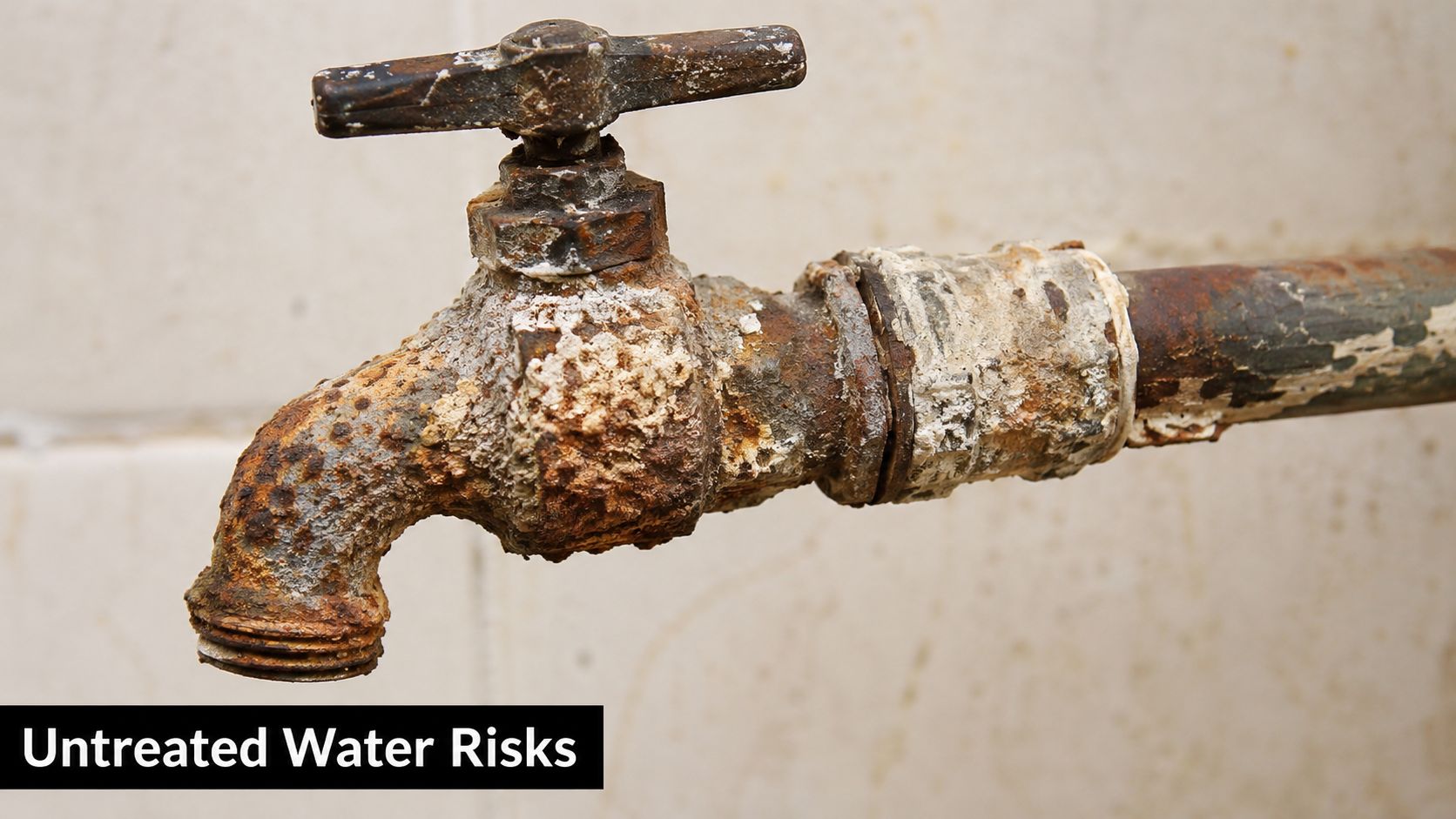
The annual upkeep figure for a well is often cited at about $150 to $900, but that ignores high-ticket replacements like pressure tank repairs at $300 to $1,200, pump replacement at $1,500 to $4,500, and emergency service at another $100 to $300, as explained in this well system lifecycle cost guide. That same source notes that professional inspections can extend system life from roughly 5 to 7 years to 10 to 15 years and may reduce repair expenses by about 30%.
Why Southwest Florida homeowners get hit harder
Local conditions matter. Heat, heavy groundwater use, and storm-related power issues put more strain on pumps, tanks, and controls. If the water also carries iron, hardness, sulfur odor, or scaling minerals, the equipment doesn't get a break.
Here's what untreated water usually costs you in practice:
- Iron staining ruins toilets, sinks, showers, driveway wash areas, and laundry. You keep buying cleaners, replacing fixtures early, or living with ugly stains.
- Hardness and scale build up inside water heaters, dishwashers, washing machines, shower valves, and plumbing lines. Flow drops. Efficiency drops. Lifespan drops.
- Sulfur odor problems make water unpleasant to bathe in and use around the house. Homeowners often install stopgap filters that don't solve the full chemistry problem.
- Sediment and water quality variation force treatment components to work harder and get serviced more often.
Untreated well water rarely stays a “water issue.” It becomes an appliance issue, a plumbing issue, and a house-value issue.
Band-aid systems keep the cycle going
A softener can help with hardness. A basic filter can catch some sediment. An odor filter can target one symptom. But if your water has multiple problems, stacking isolated fixes often becomes its own maintenance burden.
That's when homeowners call for well water repair services because the system keeps acting up, pressure keeps changing, or the treatment setup never seems fully dialed in. The issue often isn't just one broken part. It's that the water quality is overwhelming a pieced-together setup.
If you're replacing components, cleaning stains every week, and still not liking your water, your current approach isn't saving money. It's just spreading the expense around.
The Modern Solution Whole House Reverse Osmosis
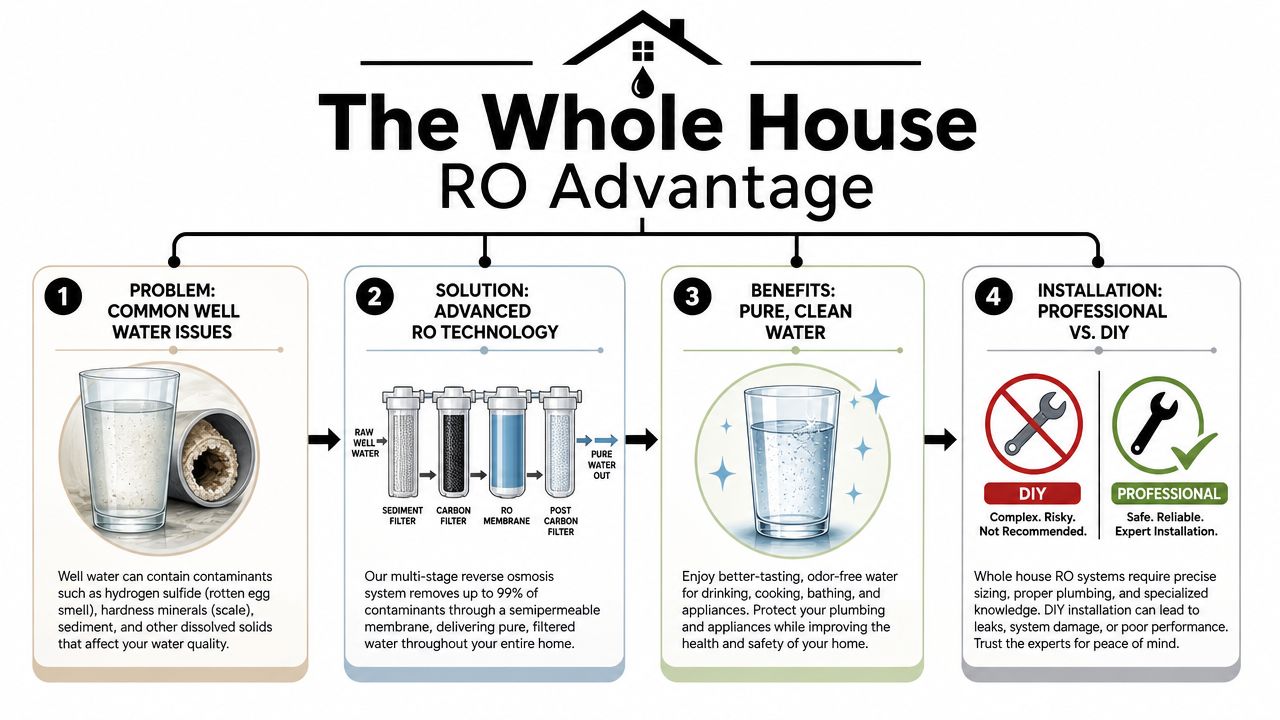
A whole house reverse osmosis system is the cleanest way to stop chasing separate water problems one by one. It treats the water before that water reaches your showers, faucets, water heater, laundry, and appliances.
Think of it as a private purification plant for your home. The system pushes water through a membrane that acts like a molecular gatekeeper. Clean water passes through. A broad range of dissolved contaminants gets rejected and flushed away.
Why whole house RO is different
Most homeowners have seen under-sink RO units. Those only protect one faucet, usually the kitchen sink. They improve drinking water, but they do nothing for the shower, the laundry, the water heater, or the plumbing throughout the house.
A traditional softener has a narrower job too. It addresses hardness, but it doesn't provide the same full-spectrum purification as a properly designed whole house RO system.
A whole-house setup changes the equation because it addresses the house as a system:
- Every tap gets treated water
- Showers stop running untreated well water
- Appliances receive cleaner feed water
- Plumbing sees less mineral and contaminant load
- Maintenance gets centralized instead of scattered across multiple patch systems
Who should be looking at this seriously
If your home has any combination of odor, staining, mineral buildup, bad taste, fixture damage, or recurring treatment headaches, you should be considering a whole house reverse osmosis system. That includes homeowners who already have a softener but still don't like the water.
Practical rule: If you're constantly fixing symptoms in different parts of the house, you don't need another symptom-specific gadget. You need a house-wide treatment strategy.
That's why I'm opinionated on this. For many Southwest Florida well owners, whole house RO isn't a luxury add-on. It's the first solution that matches the scale of the problem.
How RO Systems Drastically Reduce Maintenance Costs
The simplest way to lower well water maintenance cost is to stop feeding your home poor-quality water.
That's what whole house RO does. It removes the contaminants that trigger scaling, staining, treatment overload, and equipment stress. Once that happens, the maintenance picture changes from reactive to preventive.
It cuts the recurring treatment burden
Water-quality-driven maintenance is one of the most overlooked expenses in well ownership. Softener maintenance can range from $150 to $900 annually, resin replacement can add $500 to $1,000 every decade, and for high-mineral wells, filtration and softening can become the largest share of ownership expense, according to this well water softener maintenance guide.
That's why I push whole house RO so hard in this market. It consolidates the treatment strategy. Instead of building a Frankenstein system with separate components trying to keep up with ugly water, you install one integrated approach designed to improve water quality throughout the home.
It protects the expensive parts of your house
Whole house RO helps reduce costs in places homeowners often ignore until a breakdown happens:
- Water heaters stay cleaner internally when scale-forming minerals are reduced.
- Dishwashers and washing machines run with better-quality water and deal with less buildup.
- Shower valves, faucets, and fixtures avoid the constant mineral crust and iron staining that drives replacement.
- Plumbing lines face less long-term accumulation and fouling.
- Ancillary treatment equipment doesn't have to carry the same burden.
That doesn't mean no maintenance. Every water system still needs service. Filters still need scheduled replacement. Equipment still needs proper setup and follow-up. But there's a major difference between maintaining a well-designed house-wide purification system and constantly paying for damage caused by untreated water.
If your current setup requires frequent adjustment, repeated cleaning, and ongoing add-on equipment, it's probably costing more than a proper RO system would over time.
The financial shift that matters
Homeowners get stuck because they compare RO to “doing nothing.” That's the wrong comparison. A more accurate comparison is RO versus years of staining, softener upkeep, appliance wear, plumbing scale, service calls, and piecemeal fixes.
When you look at it that way, whole house RO stops looking expensive. It starts looking disciplined.
Cost Comparison Traditional Well Upkeep vs Whole House RO
If you want a realistic way to think about cost, stop asking only, “What do I spend this year?” Ask, “What kind of cost pattern am I buying into?”
Routine well maintenance is commonly reported at $150 to $900 per year, with an average around $450. Common repairs often run $150 to $800, and emergency repairs can exceed $1,000, based on this annual well maintenance cost overview. That's the traditional picture. It looks manageable until untreated water starts creating repeat expenses around the house.
Ten-year budgeting is the smarter lens
A homeowner with untreated or poorly treated water often deals with variable annual spending, surprise repairs, extra cleaning, and a steady stream of partial equipment fixes. A homeowner with whole house RO has a different pattern. The treatment plan is more intentional, and maintenance becomes more predictable.
Here's the side-by-side way I'd frame it.
| Expense Category | Traditional Maintenance (Untreated Water) | With Whole House RO System |
|---|---|---|
| Annual well upkeep | Ongoing routine maintenance commonly falls within published yearly ranges and can fluctuate based on service needs | Well equipment still needs maintenance, but cleaner water reduces the broader house-wide damage cycle |
| Common repairs | Minor repairs can show up periodically and often stack with treatment-related issues | Fewer water-quality-triggered issues affecting fixtures, appliances, and auxiliary treatment components |
| Emergency service | Surprise failures can push a repair visit above the emergency threshold cited in published cost guides | Emergencies tied to neglect can still happen, but the system is no longer fighting poor water at every fixture |
| Softener and treatment upkeep | Multiple stand-alone devices may need media, resin, salt, service, and adjustment | One comprehensive purification strategy reduces dependence on piecemeal fixes |
| Appliance wear | Higher risk of scale, staining, and mineral-related wear across the house | Cleaner feed water helps protect water-using appliances |
| Budget predictability | Low. Costs are spread across service calls, consumables, cleaning, and replacement timing | Higher. Scheduled service becomes easier to plan for |
What I recommend homeowners do
Track your current costs thoroughly. Include more than pump service.
Use this checklist:
- Count every water-related service call, not just well work
- Include softener or filter upkeep if you already have treatment equipment
- Add fixture replacement and stain cleanup costs that your water causes
- Include appliance problems tied to scale or mineral buildup
- Review your current service schedule against a structured monthly maintenance plan
If your costs are spread out over multiple categories and the water still isn't good, your setup is inefficient. Whole house RO fixes the economics by fixing the water itself.
Why Professional RO Installation in SWFL Is Crucial
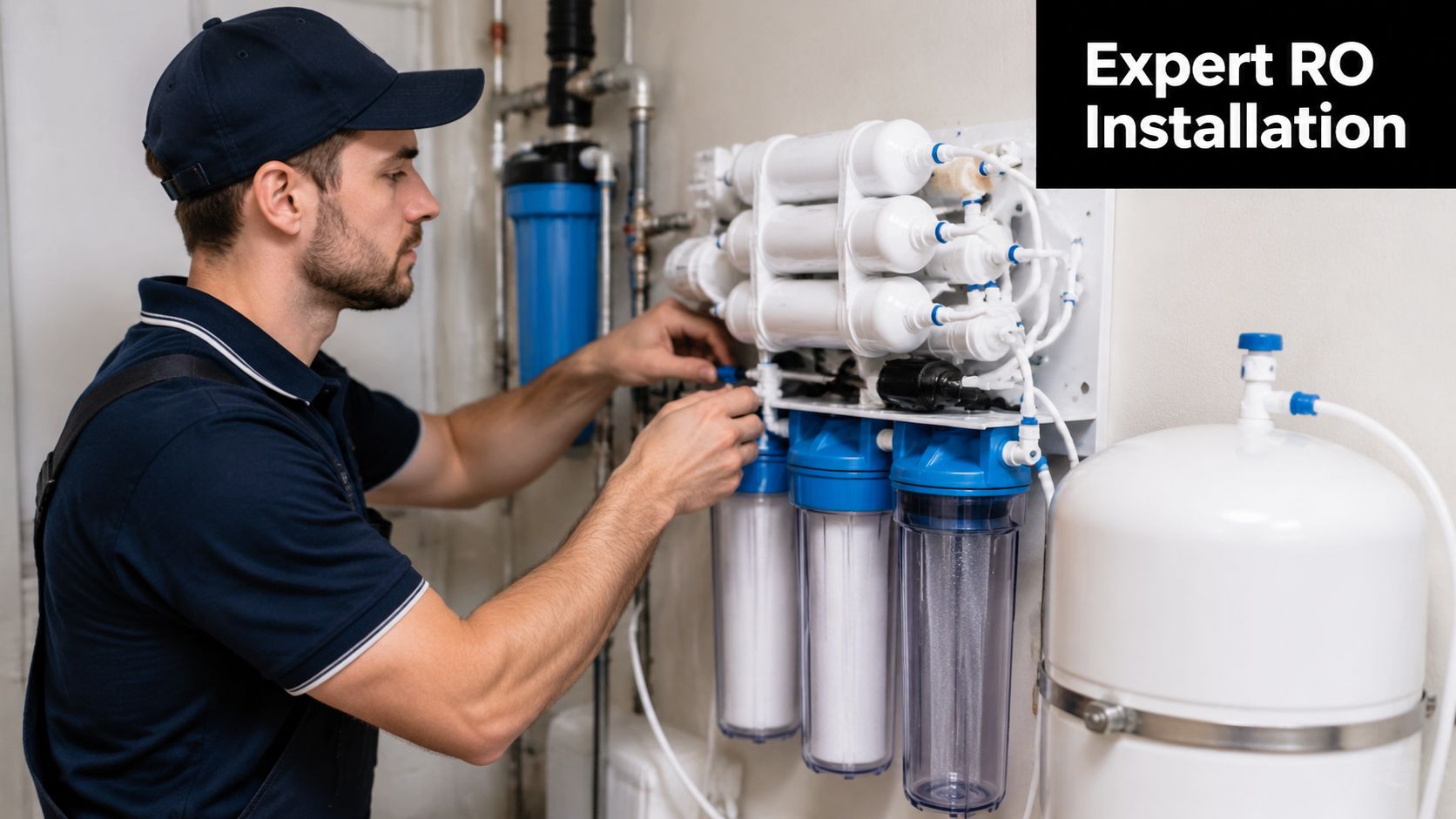
A whole house RO system is not a weekend DIY project. It has to match your home's water demand, your well's capacity, your pump behavior, and your actual water chemistry. If any of that is wrong, the system won't perform the way it should.
One benchmark source estimates that a typical 1 HP submersible pump running 2 to 3 hours per day can cost about $25 to $35 per month in electricity, and it stresses that pump run-time, pump size, and well depth drive operating cost, as detailed in this monthly well operating cost explanation. The same source makes the practical point that a professional assessment is necessary to size a treatment system correctly so you avoid pump burnout and excessive energy use.
What pros evaluate that homeowners usually miss
A proper installer looks at issues that directly affect cost and performance:
- Well output and pump behavior, so the treatment system doesn't overtax the water supply
- Household demand, including bathrooms, irrigation habits, and occupancy patterns
- Pretreatment requirements, because RO has to be protected from water conditions that can foul it
- Drain, storage, and repressurization design, which have to be integrated correctly
- Local water chemistry, which varies widely across Southwest Florida
Why local experience matters
Southwest Florida isn't a generic water market. Cape Coral, Fort Myers, and nearby communities all have their own combinations of hardness, iron, sulfur odor, and high dissolved solids. The system has to be built around those realities.
That's where local experience matters. Water Medic of Cape Coral works on whole house RO, well repair, and treatment issues in this region, and that kind of local field experience is what helps a system get sized and configured correctly in the first place.
A badly designed RO system doesn't save money. It creates callbacks, frustration, and performance issues you could have avoided by getting it done right.
If you're investing in whole house RO, protect that investment with professional design and installation. On a system this important, guessing is expensive.
Take Control of Your Water and Your Budget
The wrong way to think about well water maintenance cost is as a simple yearly service number. That number matters, but it doesn't explain why some homeowners stay in a constant cycle of stains, odors, repairs, filter changes, appliance wear, and frustration.
The better question is this: What is my water doing to my house every day?
If the answer includes mineral buildup, iron staining, sulfur smell, recurring treatment issues, or equipment strain, then the smartest move is to address the water quality at the whole-house level. That's why I recommend whole house RO so strongly for Southwest Florida well owners. It doesn't just improve taste or appearance. It changes the maintenance equation across the home.
The practical next step
Don't buy another partial fix until you know what's in your water and how it's affecting the rest of the system.
Do this first:
- Get the water evaluated properly, including the issues you've been noticing around the house.
- Look at your current treatment setup critically and decide whether it's solving root problems or just managing symptoms.
- Compare long-term ownership costs, not just this month's bill.
- Choose a system designed for the whole house, not a point fix that leaves most of the home unprotected.
Cleaner water is easier on your plumbing, easier on your equipment, and easier on your budget.
If you're tired of guessing, tired of stains, and tired of spending money without getting a real solution, stop treating this like a routine maintenance problem. Treat it like a water quality problem. That's how you bring costs under control.
If you want a clear plan for your home, schedule a water evaluation with Water Medic of Cape Coral. A proper analysis gives you the starting point you need to decide whether whole house RO is the right move and what it would take to protect your well system, plumbing, appliances, and budget.