
A Florida Homeowner’s Guide: how to keep a swimming pool clean and sparkling
Keeping your Florida pool sparkling clean isn't about some secret trick; it's all about consistency. Think of it as a simple but non-negotiable routine built on four core principles: circulation, filtration, cleaning, and chemistry. Get these right, and you’re not just protecting your investment—you're making sure the water is always safe and inviting for a swim.
This guide will walk you through exactly what it takes to maintain that perfect, pristine water all year long.
Your Guide to a Crystal-Clear Florida Pool
The secret to a clean pool is understanding how all its parts work together. Your pool is basically a living ecosystem, and it needs regular attention to stay in balance. This is especially true here in Southwest Florida, where the intense sun, heavy rains, and constant falling vegetation can turn a backyard oasis into a green mess in a hurry.
For those managing high-end properties like luxury Orlando vacation rentals, a pristine pool is non-negotiable. It's a huge part of the guest experience and directly impacts property value. A beautiful pool is a major selling point; a cloudy one is a major headache.
The Four Pillars of Pool Maintenance
A healthy pool is built on four pillars that all depend on each other. If you let one slide, the others will eventually start to struggle, leading to cloudy water, algae, or even expensive equipment damage. A solid maintenance routine gives each of these the attention it needs.
Let's break down the essential components of pool care. These four pillars work together to keep your water clean, clear, and safe.
At-a-Glance Pool Maintenance Pillars
| Maintenance Pillar | Primary Goal | Key Action |
|---|---|---|
| Circulation | Keep water moving | Run the pump and inspect skimmers |
| Filtration | Remove contaminants | Clean or backwash the filter regularly |
| Cleaning | Remove physical debris | Skim, brush, and vacuum the pool |
| Chemistry | Sanitize and balance water | Test and adjust chemicals weekly |
Each pillar is critical. You can have perfect chemistry, but if your water isn't circulating, you'll end up with dead spots where algae can take hold.
Here's a closer look at what each one involves:
-
Circulation: This is all about moving water through the pump and filter. Good circulation is your first line of defense against stagnant water, which is a breeding ground for bacteria and algae. It also ensures that the sanitizing chemicals you add are spread evenly throughout the entire pool.
-
Filtration: As water circulates, the filter is doing the heavy lifting. It’s like the pool's kidney, trapping dirt, debris, and all the tiny particles that make water look cloudy. A clean, efficient filter is absolutely essential.
-
Cleaning: This is the manual labor part—skimming leaves off the surface, brushing the walls and tile line, and vacuuming the floor. This gets rid of organic debris before it can break down, eat up your chlorine, and become food for algae.
-
Chemistry: This is where the science comes in. Maintaining the right balance of chlorine, pH, and alkalinity is what keeps the water sanitized, comfortable for swimmers, and safe for your pool's surfaces and equipment.
A proactive approach is always better than a reactive one. A little bit of consistent weekly maintenance will save you from big problems—like a full-blown algae bloom—that are way more time-consuming and expensive to fix.
While you can certainly master this routine yourself, the constant testing and balancing can be a lot to handle. That's why many Florida homeowners turn to the pros. A team like Water Medic of Cape Coral brings the expertise and equipment to keep everything perfectly balanced without you having to lift a finger. Our weekly pool service handles it all, so you can just enjoy your pool, worry-free.
Getting Pool Chemistry Right for Crystal-Clear Water
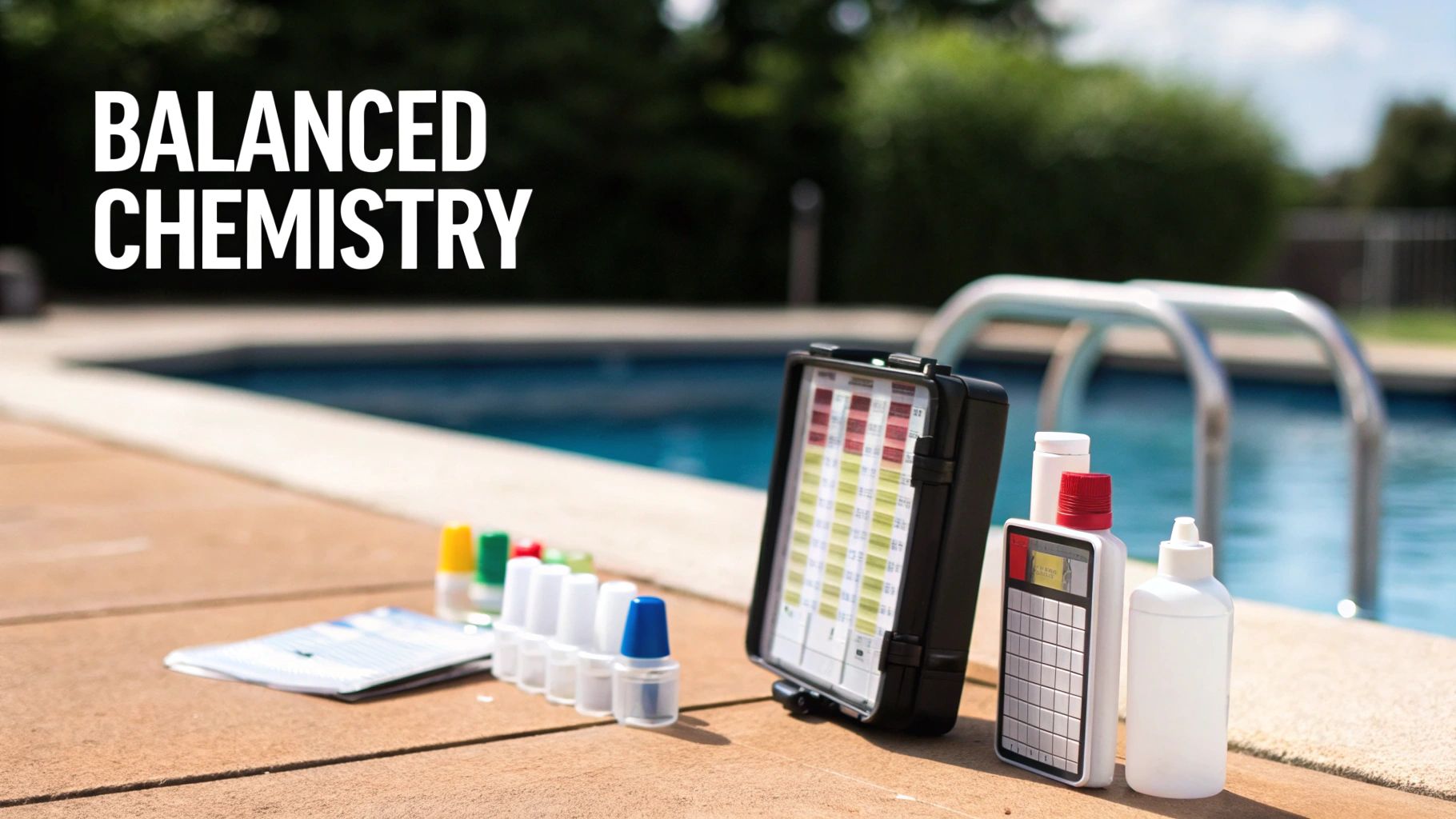
If your pump and filter are the heart and lungs of your pool, then the water chemistry is its nervous system. It's the invisible force field that keeps algae at bay, ensures swimmers don't get red eyes, and protects your expensive equipment from corrosion. Getting this right is absolutely non-negotiable for a clean, safe pool.
Think of your pool as a finely tuned ecosystem. When everything is in balance, the water is inviting and trouble-free. But the moment one chemical level goes astray, it can trigger a domino effect, leading to cloudy water, skin irritation, or even permanent damage to your pool’s plaster and plumbing.
The “Big Three” of Water Balance
You can get lost in the weeds with dozens of different chemical readings, but for most pool owners, it boils down to three key metrics. Get these right, and you’ve won 90% of the battle.
-
pH Level: This is the measure of how acidic or basic your water is. You’re shooting for a sweet spot between 7.4 and 7.6. It’s no coincidence this range is gentle on our eyes and skin, making for a much more comfortable swim.
-
Total Alkalinity (TA): This is your pH’s bodyguard. It acts as a buffer, preventing the pH level from swinging wildly with every rainstorm or bather. The ideal range here is 80 to 120 parts per million (ppm).
-
Chlorine: This is your sanitizer, the workhorse that kills all the nasty stuff like bacteria, viruses, and algae spores. For a standard pool, you want a free chlorine reading between 1 and 3 ppm.
Pro Tip: Always balance your Total Alkalinity before you adjust your pH. A stable TA acts like an anchor, holding your pH firmly in place. Once the pH is dialed in, your chlorine can work at peak efficiency.
Ignoring this delicate balance isn't just a hassle; it's expensive. The U.S. swimming pool industry is massive, with construction hitting $16.5 billion and cleaning services adding another $7.2 billion annually. With typical yearly maintenance costs running anywhere from $3,000 to $6,000, preventing problems with good chemistry is the smartest financial move you can make.
Why Does It Matter So Much?
So, what’s the big deal if your pH is a little high or your chlorine is a bit low? It’s about more than just aesthetics. An imbalance creates real-world problems that affect safety, comfort, and your wallet.
| Imbalance Condition | What You'll Actually Experience |
|---|---|
| Low pH (Acidic) | Stinging eyes and itchy skin. You might also notice ladders or handrails starting to corrode and plaster surfaces feeling rough or pitted. |
| High pH (Basic) | Water turns cloudy. You’ll see white, chalky scale forming on tile and in your salt cell. Chlorine becomes lazy and ineffective, opening the door for algae. |
| Low Alkalinity | This is "pH bounce." You'll add chemicals to fix the pH, and it will swing right back a day later. It's frustrating and wasteful. |
| High Alkalinity | It becomes nearly impossible to lower your pH. The water may look persistently cloudy no matter what you do. |
| Low Chlorine | The water gets a slimy feel. Algae starts to creep in, and the pool becomes a breeding ground for bacteria. It's simply not safe to swim. |
| High Chlorine | An overwhelming chemical smell. It can bleach swimsuits, dry out skin and hair, and irritate swimmers' eyes and lungs. |
When you add chlorine to your pool, it creates a disinfectant that does the heavy lifting. To really dig into the nitty-gritty, you can explore the science behind safe cleaning with hypochlorous acid and see how it all works on a molecular level.
A Practical Guide to Testing and Adjusting
You need to test your water at least once a week—more often if it’s getting a lot of use or after a heavy Florida downpour. Whether you use test strips or a liquid drop kit, the process is straightforward: grab a sample from elbow-deep water away from any jets, add your reagents, and match the colors to the chart.
Once you know your numbers, you can start making careful adjustments.
- pH too low? Add a pH increaser (soda ash).
- pH too high? Add a pH decreaser (muriatic acid or sodium bisulfate).
- Alkalinity too low? Add an alkalinity increaser (which is basically just baking soda).
- Alkalinity too high? This is trickier. You'll typically use a pH decreaser to slowly bring it down.
Always read the dosage instructions on the product label and never mix different chemicals together outside of the pool. Add one chemical, let the water circulate for a few hours, and then re-test before adding anything else. This careful, step-by-step process is key.
This constant chemical dance is exactly where the pros come in handy. At Water Medic of Cape Coral, we don’t rely on color-matching charts. We use professional-grade digital readers for pinpoint accuracy and apply precisely measured chemicals to get it right the first time. We understand how one adjustment affects everything else, saving you from the frustrating cycle of chasing the right balance. Let us handle the science so you can focus on enjoying your pool.
Keeping Your Pool's Circulation and Filtration Systems Healthy
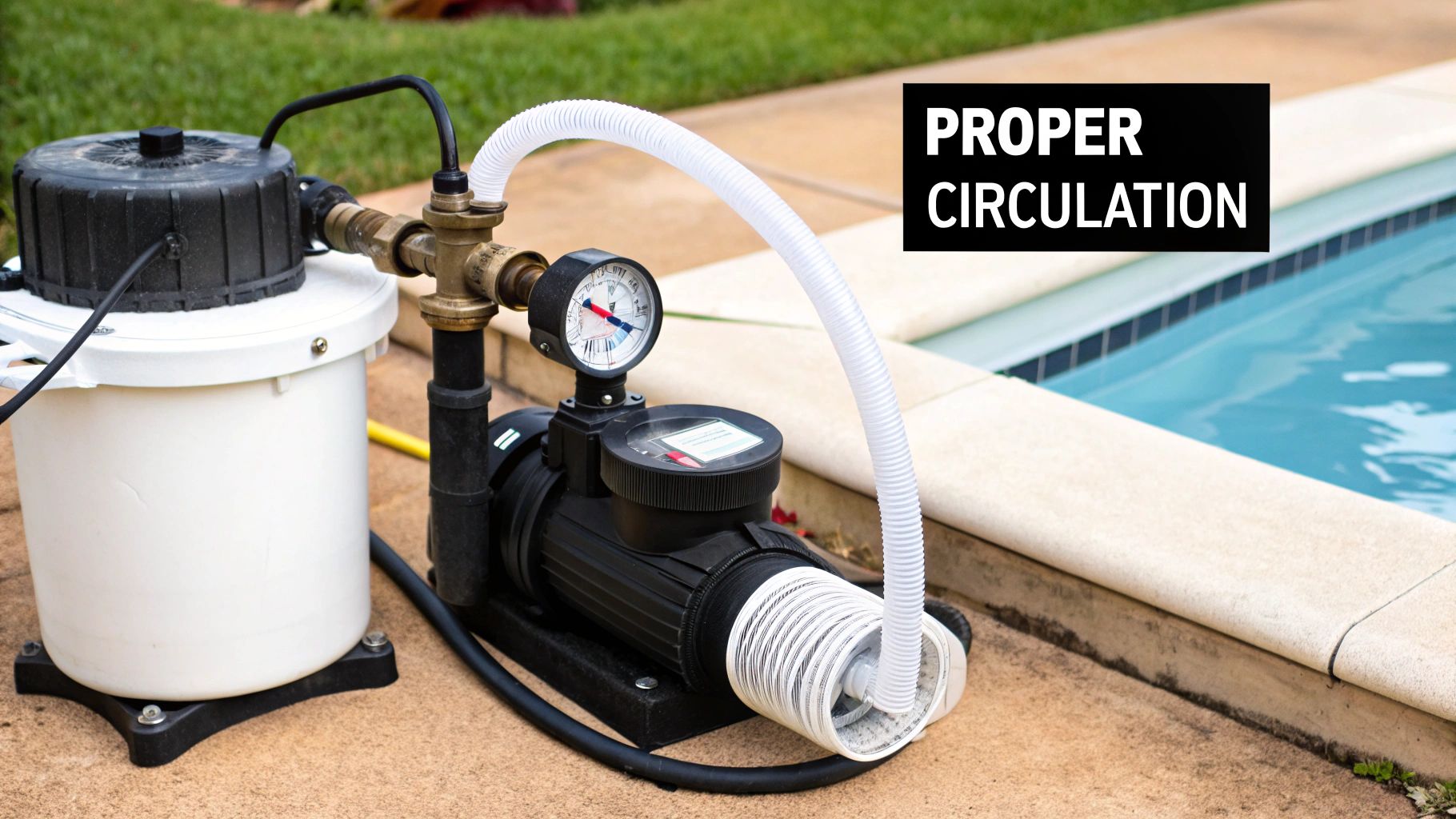
You can have perfectly balanced water chemistry, but if that water isn’t moving, it’s all for nothing. Your pool's pump and filter are the unsung heroes of a clean pool—the heart and kidneys of the whole operation. When they aren't working right, even the most carefully measured chemicals can't do their job, leaving you with stagnant, cloudy water that’s an open invitation for algae.
Think of it this way: the pump is the heart, pushing water through the entire system. The filter acts as the kidneys, grabbing all the gunk and impurities. This constant motion is what spreads your chlorine around to sanitize every last drop of water. The moment water stops moving, problems start brewing.
Why Pump Runtime Is Critical in Florida
Here in Southwest Florida, our climate is relentless. The intense heat and sun burn off chlorine and encourage algae growth like nowhere else. This isn't a place to cut corners on running your pump. Your goal should be to run it long enough to turn over the entire volume of your pool's water at least once a day.
For most backyard pools in our area, that means a runtime of 8 to 12 hours every single day. When we get into the peak of summer, you'll want to lean closer to that 12-hour mark. It’s the best way to prevent dead spots where algae can get a foothold and to keep your water sparkling.
A common mistake we see is homeowners trying to save a few dollars on their electric bill by cutting the pump's runtime. It almost always backfires. You end up with an algae bloom that costs far more in time, frustration, and chemicals to fix than you ever saved on electricity.
Understanding Your Pool Filter
As water circulates, it gets pushed through the filter, which is designed to trap everything from dirt and leaves to microscopic particles. There are three main types you'll encounter, each with its own maintenance routine.
-
Sand Filters: These are the old-school workhorses. They use a special grade of sand to catch particles down to about 20-40 microns. They are famously low-maintenance but offer the least fine filtration.
-
Cartridge Filters: These use a pleated fabric cartridge that screens out debris. They hit a sweet spot between performance and ease of use, trapping particles as small as 10-15 microns.
-
Diatomaceous Earth (D.E.) Filters: For the absolute cleanest water, D.E. is king. It provides the finest filtration, trapping particles down to an incredible 1-3 microns. It works by using a powder made from fossilized diatoms, but it also requires the most hands-on attention.
Knowing When and How to Clean Your Filter
A dirty filter can't do its job. Worse, a clogged filter restricts water flow, putting a huge strain on your pump motor and making your energy bills creep up. The most important tool you have for this is the pressure gauge on your filter tank.
When you have a freshly cleaned filter, take a look at the pressure gauge and make a note of the "clean" PSI reading. When you see that the pressure has climbed 8 to 10 PSI above that starting point, it’s time to clean it. If you let it go, you're just asking for poor circulation and potential equipment damage.
| Filter Type | Cleaning Method | How It Works |
|---|---|---|
| Sand | Backwashing | This reverses the water flow through the filter, flushing all the trapped dirt and debris out through a waste line. |
| Cartridge | Manual Cleaning | You’ll need to physically remove the cartridge(s) and give them a thorough rinse with a garden hose to dislodge all the grime. |
| D.E. | Backwashing & Recharging | You'll first backwash the old, dirty D.E. powder out, then add a fresh slurry of new D.E. powder through the skimmer. |
Doing these tasks correctly is vital. An improper backwash can waste a ton of water and chemicals, and accidentally damaging a filter cartridge during cleaning means you're buying a new one.
If you start hearing strange noises from your pump, spot a leak, or notice the pressure gauge is acting erratically, those are clear warning signs. Catching these problems early is key. For a professional diagnosis, you can learn more about our expert Pool Equipment Repair Services and see how we fix these critical components before they turn into major headaches.
Your Essential Weekly Pool Cleaning Routine
Consistency is what separates a sparkling, inviting pool from a frustrating, swampy mess. While chemistry and circulation are the invisible forces at work, your weekly hands-on cleaning is what removes the physical junk that fuels so many problems. This isn't just a chore; it's a simple, effective habit that keeps your pool ready for action.
Think of it this way: every leaf, bug, and speck of dirt you pull out is one less thing for your chlorine to fight. This frees up your sanitizer to focus on the microscopic threats you can't see, which is exactly what it's supposed to do.
The "Big Three": Skimming, Brushing, and Vacuuming
I like to call these three tasks the weekly workout for your pool. They're completely non-negotiable and need to be done at least once a week—more often if you’ve had a storm or a big pool party.
-
Skim the Surface: This is your first line of defense. Floating debris is the most obvious offender, so grab a long-handled skimmer net and glide it across the surface. Getting those leaves, grass clippings, and bugs out before they sink makes a huge difference.
-
Brush the Walls and Steps: People skip this step all the time, and it's a huge mistake. Algae spores are invisible, and they love to cling to pool walls, hide in corners, and settle on steps. A good, thorough brushing knocks them loose and sends them into the water where your filter and chlorine can destroy them.
-
Vacuum the Floor: After you’ve brushed everything down, give the debris a little time to settle. Then, it's time to vacuum the pool floor. Whether you have a trusty manual vacuum head or a modern robotic cleaner, this final step sucks up all the dirt and dislodged algae, leaving the floor pristine.
Using the Right Tools for the Job
This is critical. Grabbing the wrong brush can cause some serious, expensive damage to your pool’s surface. You have to match your tools to your pool type to avoid scratches or tears.
| Pool Surface Type | Recommended Brush Type | Why It Matters |
|---|---|---|
| Concrete/Plaster/Gunite | A brush with stiff, stainless steel bristles. | These surfaces are tough and can handle an aggressive scrubbing to get rid of stubborn algae. |
| Vinyl Liner/Fiberglass | A brush with soft, nylon bristles. | A wire brush will easily scratch, tear, or gouge these softer surfaces, leading to costly repairs. |
This is the kind of detail a pro never overlooks. Our technicians show up with the right equipment for your specific pool, so we can give it a deep clean without ever risking damage to your investment.
Picture a classic Florida summer thunderstorm. It blows through in twenty minutes, but now your pool is a collection of leaves, palm fronds, and dirt. A quick, 20-minute skim-and-brush session right after the storm stops that debris from sinking, decaying, and throwing your water chemistry into chaos for the next week.
Beyond the Big Three: Other Weekly Checks
The physical cleaning is just part of the routine. To keep the whole system happy, you need to check on the equipment that makes it all run.
-
Empty Skimmer and Pump Baskets: These baskets are designed to catch bigger debris before it clogs your filter or, even worse, your pump's impeller. Check them weekly and empty them out. If they get too full, they choke off water flow, straining your pump and ruining circulation.
-
Test Your Water Chemistry: A clean-looking pool doesn't always mean balanced water. Swimmers, rain, and sunshine all mess with your chemical levels. A weekly test for pH, chlorine, and alkalinity is the bare minimum to catch and fix imbalances before they turn into bigger headaches.
-
Check the Water Level: Water disappears constantly, especially in the Florida heat. You want the water level to be about halfway up the skimmer opening. If it drops too low, the pump can start sucking air, lose its prime, and burn out the motor—a very expensive fix.
This weekly process, while pretty straightforward, really eats into your time. It’s the weekend chore that stands between you and actually enjoying your pool. There's a reason the professional swimming pool cleaning industry is so massive, with nearly 79,000 businesses in the U.S. generating $8.8 billion in revenue. As you can see from industry reports on pool cleaning services, many homeowners decide their time is better spent elsewhere, leaving the consistency to pros who do this all day, every day.
At Water Medic of Cape Coral, our service plans are built around this exact routine. Our technicians handle every skim, brush, and vacuum, so you know it’s done right, every single time. By checking out our monthly pool maintenance plans, you can see how we give you back your weekend and guarantee a perfectly clean and balanced pool without you ever having to lift a net.
Troubleshooting Common Florida Pool Problems
https://www.youtube.com/embed/Bxamh_u0asA
Even when you follow a perfect weekly routine, Florida’s climate will inevitably throw you a curveball. The intense sun, sudden downpours, and year-round vegetation create a perfect storm for issues like algae blooms and cloudy water. When things go wrong, knowing how to spot the problem is the first step to getting your pool back to crystal clear.
These issues are more than just an eyesore; they're symptoms of an underlying imbalance that can impact water safety and even the lifespan of your equipment. Tackling them quickly is key.
Conquering Algae: The Florida Scourge
Algae is easily the most common and frustrating problem for pool owners here. It can pop up overnight, turning your backyard oasis into a green, murky pond. Figuring out which type you're dealing with is crucial for getting rid of it for good.
-
Green Algae: This is the one you'll see most often. It might float freely, giving the water a hazy green tint, or it might cling to your pool walls and floor in slimy patches. It’s a classic sign of low chlorine or poor water circulation.
-
Yellow/Mustard Algae: Look for this one in the shady corners of your pool. It looks like a fine, yellowish-brown powder and is a real pain to get rid of. It’s resistant to normal chlorine levels and brushes away easily, only to reappear just as quickly.
-
Black Algae: This is the toughest algae of all. It shows up as small, hard black spots that send roots deep into your pool's plaster or grout. Each spot has a protective shell, making it highly resistant to chlorine. You'll need to attack it with a wire brush to break that shell open before treatment can work.
The go-to fix for most algae is to shock the pool. This means jacking up the free chlorine level—often to 10 ppm or higher—to kill the bloom. After shocking, you have to run your filter around the clock for at least 24 hours and keep brushing the pool surfaces to knock the dead algae loose so it can get filtered out.
Diagnosing and Fixing Cloudy Water
Waking up to a cloudy pool is a real letdown. The water isn't necessarily green, but it’s lost its sparkle, and you can't see the bottom. This annoying haze usually boils down to one of three things.
First, check your water chemistry. High pH is a frequent offender because it makes your chlorine less effective, allowing microscopic particles to just float around. The second likely cause is a dirty or old filter. If your filter is clogged or the media (sand, cartridge, D.E.) needs replacing, it just can't do its job of trapping that tiny debris.
Finally, don't underestimate environmental factors. A big pool party with lots of swimmers or a heavy rainstorm can overload the water with contaminants that overwhelm your sanitizer. A good dose of pool clarifier can be a quick fix; it works by clumping those tiny particles together into larger chunks your filter can finally grab.
This simple visual reminds us that the best defense is a good offense—regular cleaning.
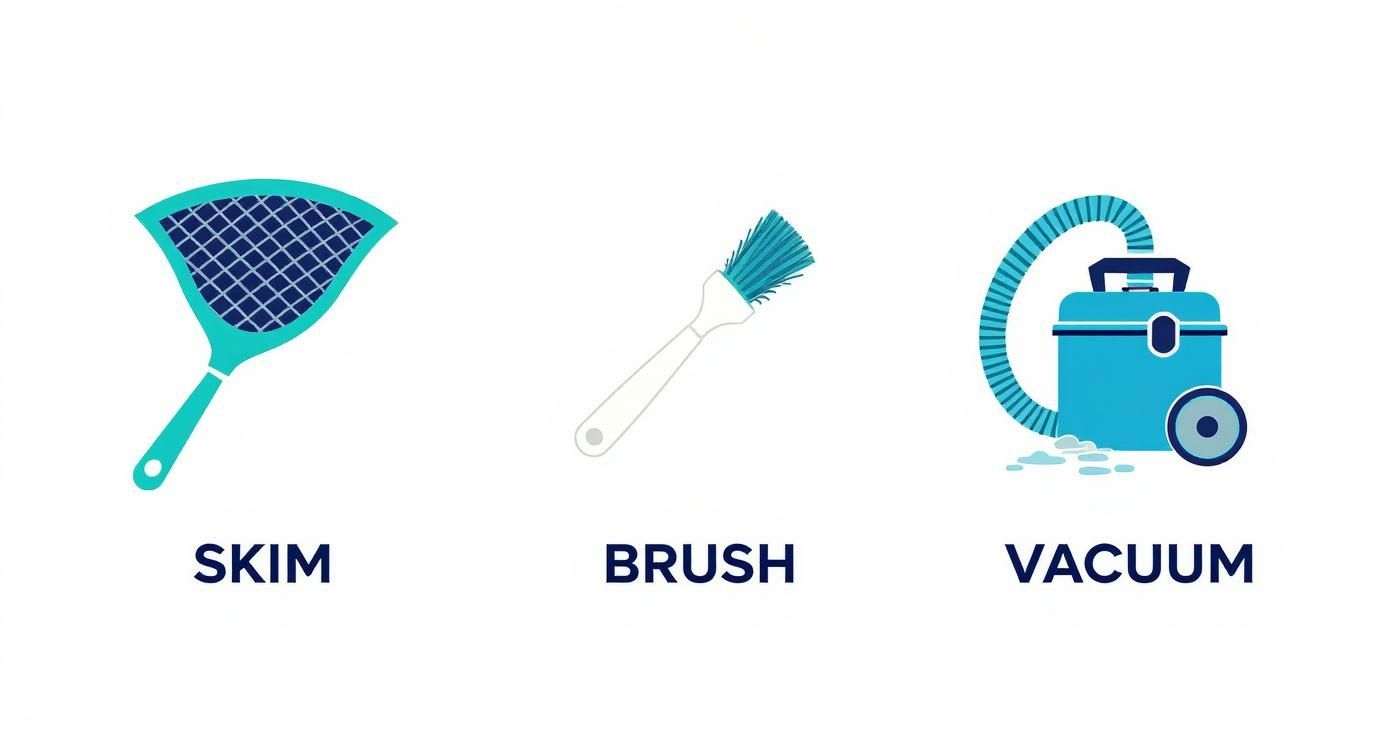
It really comes back to the basics. Consistent skimming, brushing, and vacuuming are your first and best line of defense against more complex problems.
Florida-Specific Challenges and When to Call for Help
Our environment here is no joke. Heavy leaf drop from oaks and palms can dump huge amounts of phosphates—algae's favorite superfood—into your pool. A single tropical storm can drop so much rain and debris that it throws your chemistry completely out of whack in just a few hours.
With 10.4 million residential pools in the U.S., it's clear that keeping them clean is a widespread challenge. In fact, about 85% of pools in major markets like ours are professionally maintained. There's a good reason for this reliance on experts; proper maintenance can cut down on water and energy use, which can otherwise spike household consumption by up to 10%. You can dig into more swimming pool maintenance statistics to see how pros optimize resource use.
When you're battling stubborn black algae, water that just won’t clear up, or the overwhelming mess after a storm, the DIY approach can quickly become a frustrating and expensive cycle of trial and error. That's when calling in a professional is the smartest move.
The team at Water Medic has seen it all and has the right tools to diagnose the root cause quickly. If you're tired of guessing, let our experts handle your Pool Troubleshooting and Repair and get your pool back to perfect condition, fast.
Common Pool Maintenance Questions Answered
We get a lot of questions from Florida pool owners trying to get a handle on keeping their swimming pool clean. After years in the field, believe me, we've heard it all. I’ve put together some of the most common questions we get, with straight-up answers to help you feel more confident about your pool care.
How Long Should I Run My Pool Pump in Florida?
Down here in Southwest Florida, you really need to run your pump for a solid 8 to 12 hours every single day. When the summer heat is blazing, I always tell people to lean towards the higher end of that—think 10 to 12 hours. This is non-negotiable if you want to keep algae from taking over, as it ensures every drop of water gets filtered and the chemicals are properly mixed.
Once things cool down in the "winter," you can usually dial it back to about 6 to 8 hours. The core principle is simple: you have to turn over the entire volume of your pool water at least once a day.
A quick pro tip: A professionally calibrated variable-speed pump is a game-changer. It can hit that turnover target way more efficiently and save you a surprising amount of money on your FPL bill. Our technicians at Water Medic can figure out the sweet spot for your specific pool to maximize efficiency and savings.
Is Hiring a Professional Pool Service More Expensive than DIY?
It's easy to think doing it yourself is cheaper, but you have to look at the whole picture. It's not just about the retail cost of chemicals and test kits. You also have to factor in your own time—which is valuable—and the very real risk of making a mistake that costs you big time.
One wrong move with a chemical can etch your pool's surface or fry your equipment. Suddenly, you're facing a repair bill that makes a monthly service plan look like a bargain.
Here’s the breakdown:
- Bulk Chemical Costs: A professional company like Water Medic of Cape Coral buys supplies in huge quantities, and we pass those savings directly to you.
- Expert Diagnosis: Our techs have seen it all. They can spot a failing pump seal or a subtle filter issue long before it becomes a catastrophic (and expensive) failure. Our Pool Equipment Repair Services can prevent small problems from becoming huge expenses.
- Guaranteed Results: Honestly, for most pool owners, the peace of mind that comes from knowing the job is done right is worth every penny. In the long run, it's often the smarter financial choice.
How Do I Get Rid of Stubborn Black Algae Spots?
Ah, black algae. It’s the worst. This stuff is so tough because it grows a protective outer shell that regular chlorine just can't penetrate. Your first move has to be brute force: scrub the spots hard with a stiff wire brush. (Warning: only do this on plaster or gunite pools, not vinyl or fiberglass!)
Once you've broken up that protective layer, you can go on the attack. Apply a granular chlorine or a dedicated black algaecide right on top of the spots you just scrubbed. Immediately after, shock the entire pool, and shock it hard. This isn't a one-and-done fix, either. You'll need to keep brushing those spots every day for the next several days while running your filter 24/7.
Because this type of algae is so notoriously difficult to kill off completely, this is one of those times I strongly recommend calling in a pro. We have the tools and treatments to make sure it's gone for good and doesn't come creeping back.
For more in-depth answers to common headaches, take a look through our comprehensive pool maintenance FAQs and see what other pool owners are asking.
When you're tired of the guesswork and just want a sparkling, swim-ready pool, Water Medic of Cape Coral is here to help. Our expert technicians take all the hassle out of pool maintenance, giving you back your weekends and your peace of mind. https://watermedic.com