
How Do I Fix A Green Swimming Pool
You step outside in Southwest Florida, coffee in hand, and your pool looks like a pond. Yesterday it was usable. Today it's green, cloudy, and somewhere between embarrassing and expensive.
That scene is common from Cape Coral to Fort Myers. Heat, heavy rain, long pump runs, topped-off water, and missed equipment problems can push a pool over the edge fast. Most homeowners respond the same way at first. They buy shock, pour it in, and hope the water clears by tomorrow.
Sometimes that works on a mild bloom. Often it doesn't.
A green pool is usually not just a chlorine problem. It's usually a circulation-and-chlorine failure, which is why the cleanup process matters more than just adding “more shock.” The practical fix starts with brushing, vacuuming, cleaning baskets and filters, correcting pH, and then shocking correctly, not the other way around. If you need help with the pool side of that process, Water Medic's swimming pool services cover the kind of cleanup and maintenance issues that usually sit behind recurring green water.
The bigger frustration is recurrence. A lot of pool owners clear the water once, only to watch the same problem come back after a storm, a vacation, or a few days of weak circulation. In Southwest Florida, that repeat cycle often points past the pool itself and back to the water entering the property. If the source water is carrying minerals and contaminants that make balance harder to hold, every top-off can make the next algae event easier to trigger.
That Green Monster in Your Backyard
You walk out after a summer storm and the pool has gone from blue to swampy green overnight. In Southwest Florida, that happens fast. Heat, rain, organic debris, heavy use, and top-off water can push a pool past the point where normal chlorination keeps up.
Green water means the pool lost control. Sanitizer demand rose, circulation fell off, debris stayed in the system, or balance drifted far enough that chlorine stopped doing its job well. The color gets the attention. The failure behind it is what has to be fixed.
Pool owners often treat this like a chemical shopping problem. It rarely is. Algae sticks to walls, settles into low-flow areas, and keeps recycling through dirty filter media. If the pool turned green, the problem usually started before the water changed color.
I tell customers to read a green pool as a warning sign, not a one-time mess. Something in the routine broke down. Sometimes it is a clogged basket or a tired filter. Sometimes it is weak sanitizer after a stretch of rain. In SW Florida, I also look at the water going back into the pool every time the owner tops off. Poor source water can make balance harder to hold and algae easier to trigger.
That is the part many guides skip. You can clear a pool and still keep feeding it water that works against you. If the house is taking in mineral-heavy or contaminant-loaded water, the pool inherits that burden a little at a time. That is one reason some homeowners keep fighting the same green-water battle every few months.
The immediate job is still the pool itself. Brush it. Clean it. Test it correctly. Restore circulation and sanitizer in the right order. If the cleanup is beyond a basic DIY recovery, professional swimming pool service from Water Medic can address the maintenance and equipment issues that usually sit behind repeat blooms.
The bigger question is why the pool keeps slipping back to green. In this part of Florida, the long-term answer often starts at the tap, not just at the pool edge. A whole house reverse osmosis system will not replace pool maintenance, but it can remove one of the hidden causes that keeps water balance harder than it should be.
Your First 24 Hours Diagnosing the Problem
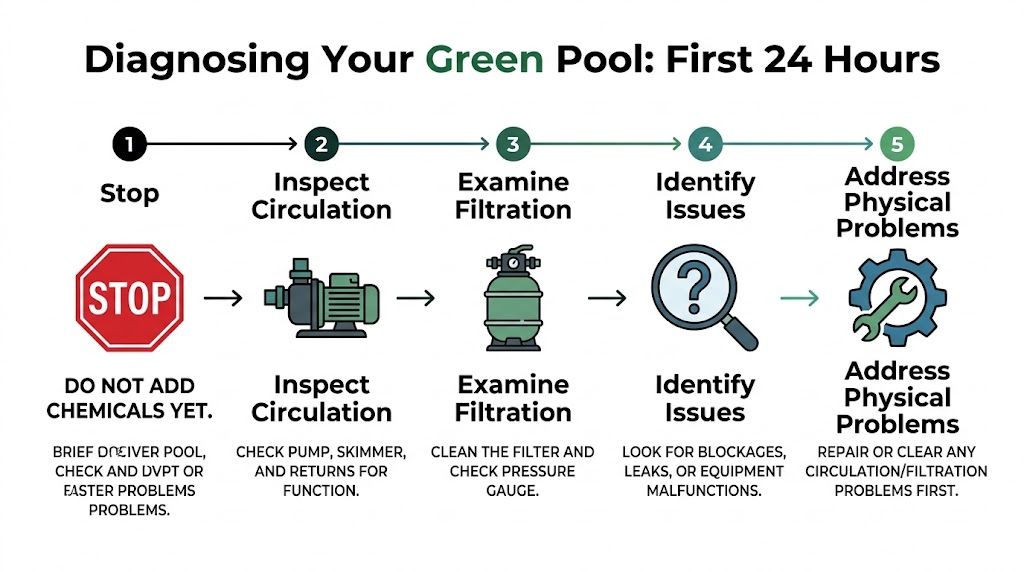
Stop before you add anything.
If you shock a pool with weak circulation, a clogged filter, blocked returns, or baskets packed with debris, you're trying to solve a mechanical problem with chemistry. That's why some pools stay green even after a heavy shock dose. The chlorine can't reach, suspend, kill, and clear contamination efficiently if the water isn't moving.
Start with the equipment path
Use the first day to check the full circulation chain:
Pump operation
Make sure the pump is primed, running, and moving water with visible return flow.Skimmer and pump baskets
Empty both. Packed baskets choke flow faster than people think.Return jets
Look for weak output or blocked returns. If one side of the pool is dead, algae gets a place to hold on.Filter condition
Clean it before treatment. A dirty filter can't catch what you're about to kill.
Pool guidance aimed at green water consistently points to circulation as a root cause. One trade guide specifically notes that poor pump runtime, clogged skimmer baskets, blocked return jets, or filter issues can keep water stagnant even after shock is added, and recommends making sure the pump runs 8 to 12 hours daily and that circulation is restored before and after shocking (green pool circulation guidance).
If you find a motor issue, a failing pump, or a filter system that isn't doing its job, pool equipment repair is often the true next step, not another bucket of chemicals.
Brush first, then remove what you loosen
Algae sticks to walls, steps, corners, ledges, and behind fittings. Brush all of it aggressively. You're not polishing the pool. You're breaking algae loose so sanitizer can reach it.
After brushing, vacuum what you can. If you're dealing with settled dead algae later in the cleanup, vacuuming to waste is often smarter than sending that debris back through the filter. It reduces filter loading, but it does mean you'll lose water and need to top the pool off.
Dead algae in the filter and algae on the walls are two different problems. You have to handle both.
What this first day tells you
This diagnostic phase shows whether you have a chemistry problem, a circulation problem, or a repair problem. That distinction matters. If the equipment side is weak, every chemical step that follows gets less effective.
The Chemical Counter-Attack Shocking Your Pool
Shock works only after the pool is physically ready for it. Once debris is out, surfaces are brushed, and circulation is restored, chlorine can finally reach the algae instead of getting burned up fighting bad conditions.
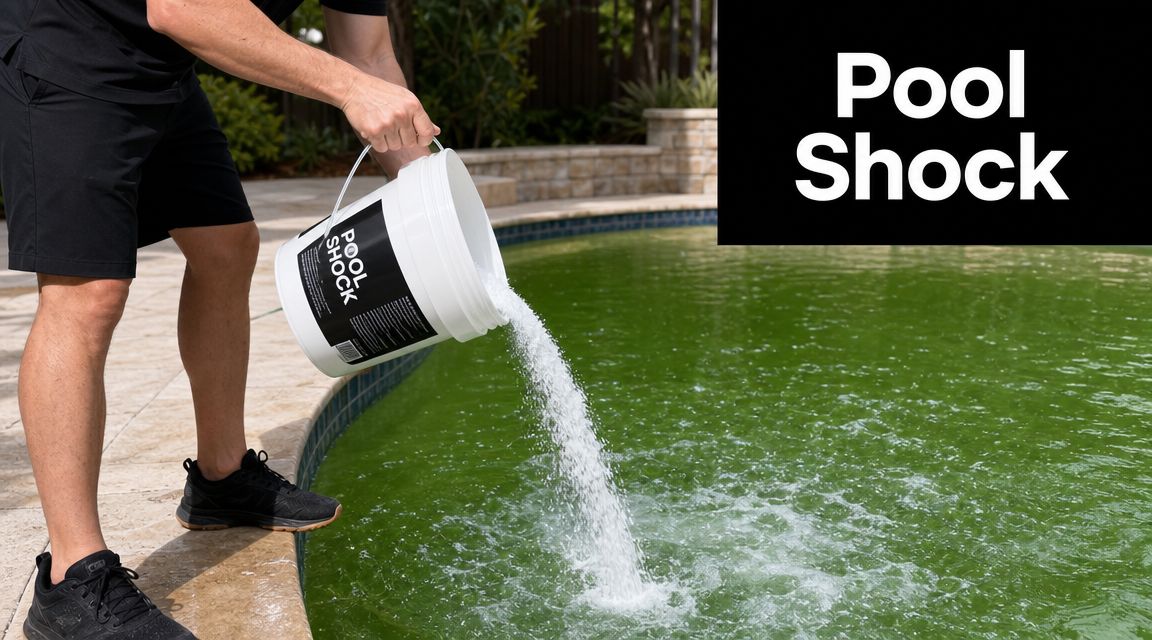
Get pH in line before you shock
High pH is one of the biggest reasons a shock treatment disappoints. Chlorine is still in the water, but it is less effective, so the pool stays green and the homeowner assumes the product failed.
Good pool care guidance puts testing and correcting pH before shocking near the top of the process for that reason. In the field, I see this all the time in Southwest Florida. Fill water tends to fight you. If you keep topping off with mineral-heavy, high-TDS source water, chemistry drifts faster and chlorine has a harder job.
Dose for the color you actually have
A light green pool and a dark, swampy pool do not need the same treatment. If you underdose, you often get a partial kill, cloudy water, and algae that comes right back.
One practical benchmark from BioGuard is to keep the system running during treatment and use one bag of shock for light green or teal water and two bags for green or dark green water per 50,000 L (shock dosing video guidance).
That gives homeowners a usable starting point. The true trade-off is cost versus speed. A lighter dose may look cheaper at the store, but repeated weak treatments usually cost more than hitting the problem correctly the first time.
What to do after the shock goes in
Shock is the kill step. Cleanup still has to happen.
- Keep the water circulating: Continuous circulation during the immediate treatment window gives chlorine contact time across the whole pool.
- Stay on top of the filter: Dead algae loads up sand, cartridges, and DE grids fast, which slows down the clearing phase.
- Watch for the color shift: Green water often turns cloudy blue, gray, or milky after a successful kill because the algae is dead but still suspended.
Later in the cleanup, this walkthrough can help you visualize the process:
When shock still doesn't work
If the pool stays green after a properly staged shock, the problem may not be chlorine alone. High CYA can weaken chlorine's practical effect. Metals can tint water green even when algae is not the main issue. In Southwest Florida, refill water quality is often the hidden problem behind both of those patterns.
Sometimes the right fix is partial drain and refill. That can lower stabilizer and dilute contaminants. But if the replacement water is already bringing in minerals and dissolved solids, you can clear the pool and still keep feeding the same cycle that caused the trouble.
That is why recurring green pool problems are often bigger than pool chemistry. They start at the house water supply. If the source water is poor, every top-off adds to the load, and the pool gets harder to balance month after month. A whole house reverse osmosis system addresses that upstream problem before it reaches the pool.
Finishing the Fight with Algaecides and Clarifiers
Shock kills the bloom. It doesn't automatically make the water pretty.
A lot of pools look worse before they look better. That's normal. Once algae dies, the water often turns cloudy because microscopic debris is still suspended. At that point, homeowners think the treatment failed when the opposite is usually true. The algae is dead. The cleanup just isn't finished.
What algaecide actually does here
An algaecide can help as a follow-up and as a preventive tool. It isn't the first move on a green pool with obvious circulation and chemistry problems, but it can support cleanup once the core steps are done.
Use it as part of a complete process, not as a shortcut. If algae is still attached to surfaces or the filter is overloaded, an algaecide won't overcome those physical issues by itself.
Cloudy water after treatment often means progress, not failure.
Why clarifiers help
Clarifiers work by binding tiny suspended particles into larger clumps that the filter can capture more easily. That's useful after shock because dead algae is often too fine to clear quickly on its own.
A practical sequence looks like this:
- After shock has had time to work: Let the sanitizer do the killing first.
- Once the pool shifts from green to cloudy: Consider a clarifier to speed filtration.
- During the clearing phase: Stay on top of filter cleaning, because captured debris still has to be removed from the system.
Anderson Pool and Spa's green-pool guidance emphasizes that operators often need to run the pump 24/7 until the water clears, clean the filter daily, and understand that the full cleaning cycle can still take 2 to 7 days depending on bloom severity (green pool cleanup process).
That's the trade-off. Clarifiers can shorten the path to clear water, but they don't replace patient filtration and filter maintenance.
The Real Reason Your Pool Keeps Turning Green
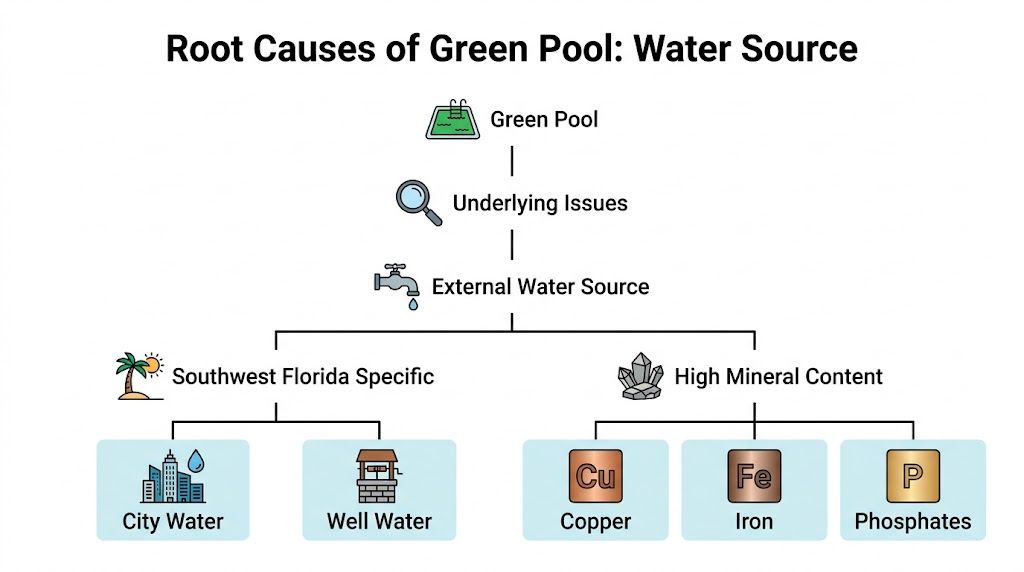
A pool that goes green once after a storm is one problem. A pool that keeps going green after you clean it up is a system problem, and in Southwest Florida, that often starts with the water coming onto the property.
Many homeowners stay focused on chlorine, pH, and filter cleaning while ignoring source water. That source water feeds every top-off, every autofill cycle, and every partial refill. If it carries metals, hardness, organics, or other contaminants, the pool never gets a clean reset. It keeps getting fed the same trouble.
The pool may only be showing the symptom
Recurring green water is often a property water issue wearing a pool-water disguise.
I see this in SW Florida all the time. A homeowner shocks the pool, brushes it, gets it blue again, then adds makeup water for a few weeks and starts fighting drift all over. The sanitizer demand climbs, staining starts to show, or balance gets harder to hold. The pool looks like the problem because that is where the failure becomes visible first.
Earlier sections covered common pool-side causes like poor circulation, chemistry imbalance, and overloaded filtration. Those still matter. But if every refill keeps introducing the same contaminants, the cleanup never sticks for long.
Why source water matters so much in Southwest Florida
This region is hard on pools. Evaporation is constant, rain can force water adjustments, and seasonal residents often leave systems running on auto for long stretches. That means top-offs happen often.
On well water, the usual headache is minerals and metals. On municipal water, the issue is often inconsistency. Either way, incoming water can push the pool toward staining, scale, cloudy water, and sanitizer inefficiency. Then the owner blames the last chemical added, when the bigger problem has been entering through the fill line the whole time.
That is the trade-off a lot of green-pool articles miss. They explain how to kill algae. They do not spend enough time on why the same pool keeps getting easier to destabilize after each refill.
Why whole house reverse osmosis changes the maintenance picture
A whole house reverse osmosis system treats water before it reaches the house plumbing and the pool makeup supply. That changes the baseline.
Cleaner incoming water means fewer unwanted minerals and contaminants entering the pool every time the water level drops and gets replaced. In practice, that usually means chemistry is easier to hold steady, surfaces are less prone to staining and scale, and equipment sees less mineral stress over time. It does not eliminate pool maintenance. It cuts down on how often the same water quality problems keep driving you back into recovery mode.
For homeowners who want a permanent solution, this is the structural fix that sits underneath better testing, better circulation, and better sanitation.
What solves the cycle instead of repeating it
Treat recurring green water in two layers.
| Problem layer | Short-term response | Long-term fix |
|---|---|---|
| Visible algae and green water | Brush, vacuum, clean the filter, rebalance, shock | Improve maintenance habits and correct equipment issues |
| Repeat green water after normal top-offs and seasonal use | Re-test, inspect the system, stop guessing with chemicals | Improve incoming water quality with whole house RO |
That second layer is where many pool owners get stuck. They keep paying for cleanup chemistry when the property keeps reintroducing the same water quality burden.
Water Medic of Cape Coral offers water treatment services for Southwest Florida homes and whole house reverse osmosis systems for properties dealing with source-water issues. In many recurring green-pool cases, that is the more useful conversation than another round of shock.
Getting Clear Water When to Call Water Medic
A typical Southwest Florida call goes like this. The pool turned green, the owner shocked it, brushed it, cleaned the basket, and waited. Two days later the water still looks wrong, or it clears for a week and slips right back.
That pattern usually means the problem is bigger than a missed chlorine dose.
When DIY is still reasonable
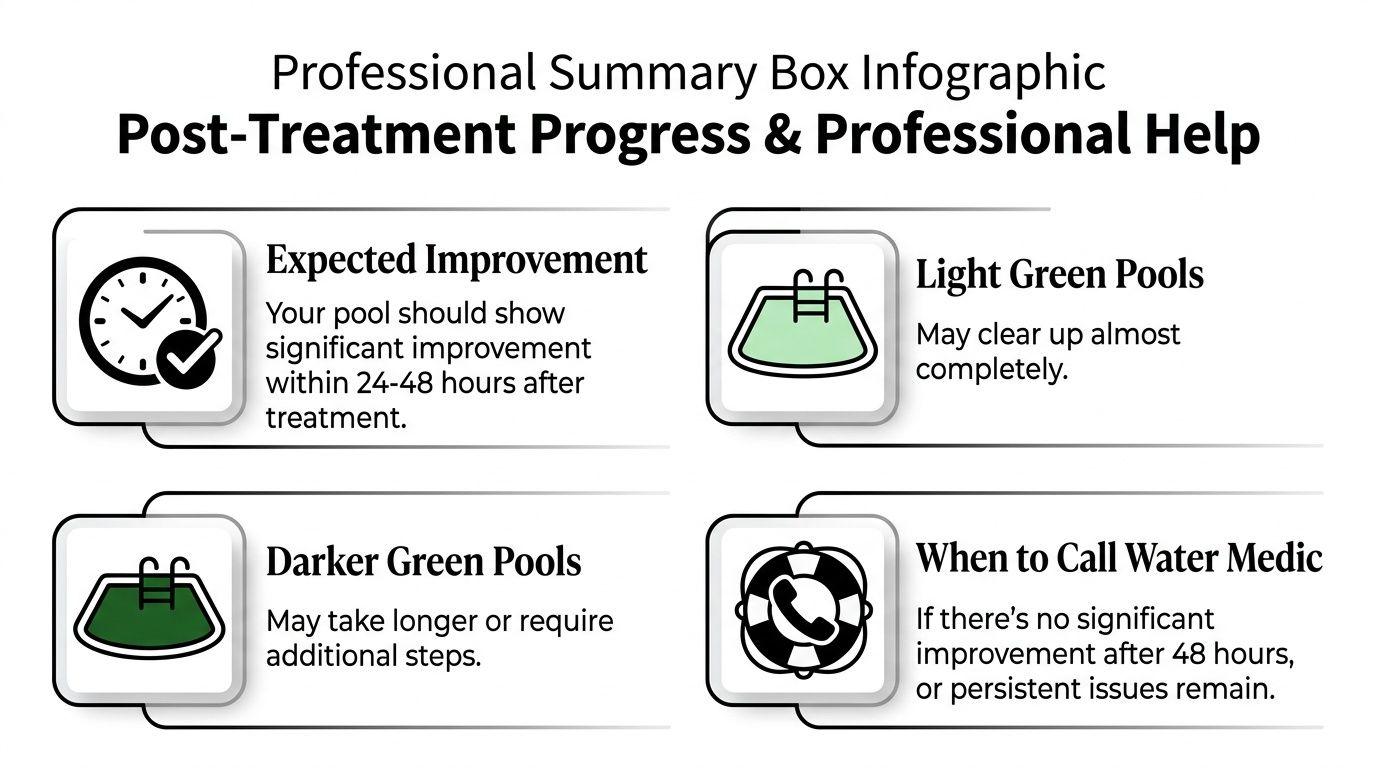
Keep working your own recovery if the color is improving, the pump is moving water well, and the filter is catching debris instead of clogging immediately. Green to dull blue or gray is progress. Cloudy water is frustrating, but it often means the algae is dead and the filter still has work to do.
Patience matters here. Homeowners often stop brushing, stop cleaning the filter, or start pouring in extra products too early. That slows the cleanup and can make the water harder to balance.
When it's time to stop guessing
Call for help if the pool stays green with little visible change, if circulation is weak, or if the water improves and then turns again after the next top-off or rain cycle. In the field, those repeat cases usually trace back to one of three things:
- Equipment problems: low flow, a dirty or failing filter, clogged lines, or return issues
- Chemistry interference: pH out of range, stabilizer levels that make chlorine less effective, or metals in the water
- Source-water pressure on the pool: refill water that keeps adding minerals and contaminants the pool has to fight every time the level drops
That third issue gets missed all the time in SW Florida. Pool owners focus on the water they see in the basin, but the refill water feeding the property can keep pushing the pool back toward staining, scaling, algae pressure, and unstable chemistry. At that point, another cleanup is only a short-term repair.
If you need a broader assessment, Water Medic water treatment and service options cover both pool-side troubleshooting and the underlying water-quality problems that keep showing up at the tap.
Repeated green-pool cleanup often means the pool is reacting to a property-wide water problem, not just a one-time algae bloom.
If your pool is green today, fix the immediate mess with disciplined cleanup. If it keeps happening, inspect the water feeding the house. In many Southwest Florida homes, whole house reverse osmosis is what finally breaks the cycle because it improves the source water that keeps reloading the pool.