Well Water Problems and Solutions Guide
When it comes to your well water, your senses are often the first alarm system. A weird taste, a funky smell, or cloudy water are all clear signals that something’s off. But here's the catch: the most dangerous problems, like bacterial contamination, are often completely invisible.
That’s why a professional water test isn't just a good idea—it's the only way to know for sure what's in your water and how to treat it. At Water Medic, we specialize in providing homeowners with clear answers and effective solutions to ensure their water is safe and clean.
Decoding Your Well Water: What The Signs Mean
Having your own well is a fantastic perk, giving you control over your water supply. The flip side is that you're now the one in charge of quality control. It can seem like a lot, but simply learning to spot the early signs of trouble is a huge first step toward keeping your water safe.
Think of it this way: your senses are on the front line. An unusual smell, a different taste, or a change in color are all clues that something has shifted in your well or the groundwater feeding it. These signs are your starting point for figuring out what's going on, and our team is here to help you solve the puzzle.
Quick Guide to Common Well Water Symptoms
To help you get started, we've put together this quick reference table. Use it to match what you're noticing with potential causes, which will point you to the right section in this guide.
| Symptom You Notice | What It Could Mean | Common Cause |
|---|---|---|
| Rotten egg smell | Presence of gas | Hydrogen Sulfide |
| Reddish-brown stains on fixtures | High mineral content | Iron |
| Metallic taste | Dissolved minerals | Iron, Manganese, or low pH |
| Soapy or slick feeling | High mineral content | Hard Water (Calcium/Magnesium) |
| Blue-green stains | Corrosive water | Low pH or Copper |
| Cloudy or hazy water | Suspended particles | Sediment, Silt, or Clay |
| Salty taste | High dissolved solids | Chlorides |
| Earthy or musty smell | Organic matter | Algae or Bacteria |
Remember, this table is a starting point. While these sensory clues are incredibly helpful, they don't tell the whole story.
The biggest mistake a well owner can make is assuming that if the water looks, smells, and tastes fine, it must be safe.
The most serious threats to your health—contaminants like E. coli, nitrates, and arsenic—are almost always odorless, tasteless, and invisible. This is why professional testing is non-negotiable for true peace of mind.
This visual guide breaks down some of the most common issues we find in private wells.
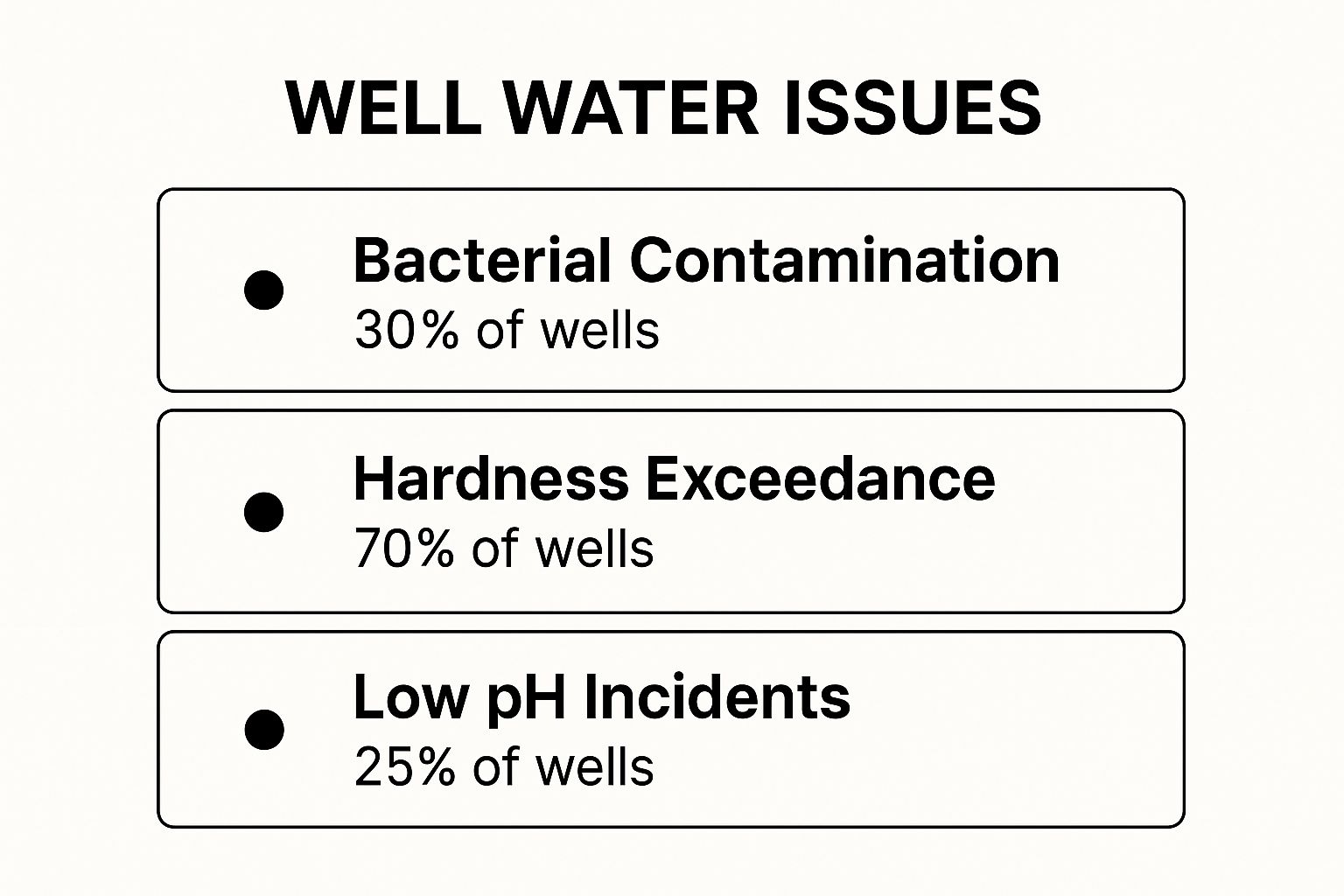
As you can see, while bacteria are a major concern, mineral issues like water hardness are something the vast majority of well owners have to deal with.
A Global Perspective on Water Safety
The challenge of keeping well water safe isn't just a local issue; it's a global one. Around the world, about 2 billion people don't have access to safely managed drinking water. A huge chunk of that number, nearly 300 million people, depend on unprotected wells and springs that are easily contaminated. If you're interested, you can find more on this global water challenge at Our World in Data.
This wider context really drives home how important it is to be proactive about managing your own water source.
Ultimately, testing is the only way to know exactly what’s in your water. Think of this guide as your first step in understanding the possibilities. When you're ready for a precise, professional analysis, explore our Water Testing Services and take the guesswork out of your water quality.
Solving Hard Water and Scale Buildup
If you're constantly scrubbing soap scum off your shower doors, pulling stiff, scratchy towels from the dryer, and wondering why your glassware never looks truly clean, you’re almost certainly dealing with hard water. It's one of the most common issues for well owners, but thankfully, the fix is straightforward. Hard water is simply water that’s loaded with dissolved minerals, primarily calcium and magnesium.
Think of it as “liquid rock.” As this mineral-heavy water travels through your home, it leaves these deposits behind. This chalky buildup, known as limescale, slowly narrows your pipes, much like cholesterol clogs arteries. Over time, this chokes off water flow and puts a serious strain on your entire plumbing system.
But the damage doesn't stop there. Limescale is the arch-nemesis of any appliance that uses water. It forms a rock-hard coating on your water heater’s heating elements, forcing it to work overtime—and use more energy—just to heat your water. This same scale buildup drastically shortens the lifespan of dishwashers, washing machines, and coffee makers, leading to frustrating and expensive replacements.
Understanding The Impact of Hard Water
While hard water isn’t a direct health risk, its effects are visible all over your home, creating a mountain of daily frustrations and hidden costs. The minerals react with soap to form a sticky, insoluble curd. That’s the soap scum you see in your tub and the film it leaves on your skin.
You've probably noticed some of these tell-tale signs:
- Spotty Dishes: Glasses and silverware emerge from the dishwasher with a stubborn cloudy film.
- Dull, Stiff Laundry: Clothes feel rough and colors fade prematurely because mineral deposits get trapped right in the fabric.
- Dry Skin and Hair: That same residue that coats your dishes also coats your skin and hair, leaving them feeling dry, itchy, and lifeless.
- Reduced Appliance Efficiency: Your water-using appliances have to fight against scale, which means higher utility bills and a shorter service life.
The real problem with hard water isn't just the day-to-day nuisance; it's the slow, silent damage it inflicts on your home's most expensive systems. A professionally installed water softener isn't a luxury—it's an investment in protecting your plumbing and appliances from premature failure.
The Permanent Solution: Ion Exchange
So, how do you solve this problem for good? The most effective and permanent solution is a whole-house water softener that relies on a process called ion exchange. This isn't just a filter that traps sediment; it actually changes the chemical makeup of your water before it ever enters your home.
Here’s a simple look at how it works:
- Hard Water Enters: Water from your well flows into the softener’s mineral tank, which is filled with thousands of tiny resin beads.
- The Exchange Happens: These resin beads hold a negative charge and are coated with positive sodium (or potassium) ions. As water flows past, the calcium and magnesium ions—the "hardness minerals"—are more strongly attracted to the resin, kicking the sodium ions off in a swap.
- Soft Water Exits: The resin grabs and holds onto the hardness minerals. In exchange, it releases the sodium ions into the water. The water that leaves the tank is now "soft" and ready to flow to every tap and appliance in your house.
This process effectively removes the minerals that cause all that limescale and soap scum. A professionally installed system from our team doesn't just treat the symptoms; it provides a lasting solution that protects your entire home. By exploring our professional Water Softener Systems, you can finally put an end to the frustrations of hard water and save significant money on repairs and energy costs down the road.
Getting Rid of Stains From Iron and Manganese
Have you ever noticed those ugly reddish-brown or black streaks ruining your sinks, toilets, and even your freshly washed laundry? It’s a frustratingly common sight for well owners. Those stains are the classic calling card of two mineral culprits: iron and manganese.
These naturally occurring minerals are notorious for turning your fixtures into a Jackson Pollock painting of rust and grime, even when the water coming from your tap looks perfectly clear.

This "clear water, ugly stain" phenomenon baffles a lot of homeowners, but it all comes down to simple chemistry. When iron and manganese are dissolved in your groundwater, they're invisible. The moment that water hits the air—splashing into your sink or mixing in your washing machine—it oxidizes. This process turns the dissolved minerals into solid particles, and those are what leave the stubborn stains behind.
The Two Faces of Iron
To actually solve an iron problem, you first have to know which type you're dealing with. A generic, off-the-shelf filter often fails because it’s not built for the specific chemistry of your well. This is exactly why getting a professional assessment is the only way to find a permanent solution.
Iron shows up in well water in two main forms:
- Soluble Iron: This is the sneaky one, often called 'clear-water iron.' The water runs crystal clear from the tap because the iron is completely dissolved. The staining only shows up later, after it has been exposed to the air.
- Insoluble Iron: This type is known as 'red-water iron.' In this case, the iron has already oxidized underground. The water comes out of the faucet looking rusty or discolored right from the start.
Manganese acts in a similar way, but it typically leaves brownish-black stains instead of red ones. Both minerals can also give your water an unpleasant metallic taste and, over time, clog your pipes and fixtures, leading to much bigger plumbing headaches.
The heart of the problem is that these minerals are dissolved, almost like sugar in water. A simple sediment filter won't touch clear-water iron. You need a system specifically designed to target and remove these dissolved metals before they can wreak havoc on your home.
The Professional Fix: Oxidation and Filtration
Effectively removing iron and manganese is a two-step dance. First, you have to force the dissolved, invisible minerals to become solid particles. Second, you have to physically filter those particles out of the water. This is where specialized filtration systems earn their keep by providing a robust and reliable fix.
Modern systems have gotten pretty clever about this. For example, our air injection oxidation systems are engineered to tackle even the most stubborn iron and manganese issues without relying on harsh chemicals.
They work by injecting a bubble of air into the filter tank, which naturally triggers the oxidation process for the iron and manganese. The newly formed solid particles are then trapped in a special media bed, allowing nothing but clean, clear water to flow into your home. It’s an approach that is not only highly effective but also very low-maintenance.
While we focus on individual homes, ensuring access to clean water is a fundamental need that presents huge global challenges. Providing safe well water is an achievable goal, but it comes with substantial costs. It's estimated that at least US$1 trillion annually is needed until 2030 to meet global water and sanitation goals. These investments are critical for drilling new wells, protecting water supplies from contamination, and preventing disease. You can learn more about these global efforts to provide safe water at World Vision.
Don't let iron and manganese stains diminish the value and enjoyment of your home. A professional diagnosis is the first step toward a permanent solution that’s custom-fit to your specific water chemistry. Our expert team can analyze your water and recommend the right iron and manganese filtration system to restore your water's clarity and protect your property.
Getting Rid of Bad Tastes and Smells in Your Water
When you turn on your tap, you're expecting fresh, clean water. So when you get hit with a funky smell or a weird taste instead, it’s a sure sign something’s off with your well. Think of these as red flags from your water supply, letting you know it needs a little help. The good news? Most of these issues are surprisingly straightforward to fix once you know what you're dealing with.
The first step is figuring out what's causing the problem. That classic "rotten egg" smell? That's almost always hydrogen sulfide gas, a byproduct of certain bacteria that can set up camp in your well. If your water smells more earthy or musty, you're likely dealing with decaying organic matter or a different type of harmless bacteria. Each unique scent is a clue.
Similarly, a metallic tang often points to an excess of minerals like iron, manganese, or copper—the same culprits behind those stubborn stains. A salty taste can signal high chloride levels, which might be from road salt seeping into the groundwater or even issues with a nearby septic system. You can see why a generic, one-size-fits-all filter usually leads to frustration; it just isn't designed to handle these specific problems.
Pinpointing Where the Smell is Coming From
Before you can pick the right fix, you have to do a little detective work. Finding the source of the odor tells you a lot about how big the problem is. A quick at-home test can help you narrow it down.
First, pour a glass of cold water from the tap. Take it to another room, wait a minute, and then give it a sniff. Now, do the exact same thing with a glass of hot water.
- Smell in Hot Water Only: If only the hot water smells bad, the problem is almost certainly your water heater. The heater has a part called a magnesium anode rod, which can react with sulfates in the water and create that stinky hydrogen sulfide gas.
- Smell in Both Hot and Cold Water: If both glasses have an odor, the issue starts back at the source—your well or the plumbing system itself. This means you'll need a broader solution.
It's worth remembering that a bad taste or smell is just a symptom, not the actual problem. The only way to know for sure what's in your water is with a professional analysis. It will tell you exactly which contaminants are present and at what levels, so you can create a treatment plan that actually works.
The Right Solutions for Fresh, Clean Water
Once you’ve nailed down the cause, you can find a solution that targets it directly. Guessing which filter to buy is a gamble. The key is to match the right technology to your specific issue to get the clean, great-tasting water you want from every tap.
For that rotten egg smell from hydrogen sulfide, an aeration system is usually the best bet. These systems work by injecting oxygen into the water, which forces the hydrogen sulfide gas to dissipate before the water even gets to your house. For musty or earthy tastes caused by organic stuff, an activated carbon filter is the industry standard. These filters act like a high-tech sponge, using porous carbon to trap the molecules causing the bad taste and smell.
At Water Medic, we don't do guesswork. We always start with a complete water diagnosis to find the exact source of any taste or odor issues. With that information, we can recommend and install the perfect Water Filtration System for your home. Don't just put a bandage on the problem—let our experts fix it at the source. We'll help you get back the fresh, clean water you deserve.
Protecting Your Family From Invisible Contaminants
It’s one thing to deal with stained sinks or water that smells a bit off. Those are annoyances. But the most serious problems with well water are the ones you can't see, taste, or smell. These are the invisible contaminants that can pose real health risks, quietly making their way into the water your family uses every single day.
Unlike hard water or iron, which practically announce their arrival, things like bacteria, nitrates, and arsenic can go completely unnoticed without a proper water test. This is where well ownership shifts from simple home maintenance to a critical part of keeping your family healthy and safe.
The Unseen Dangers in Your Well
A number of harmful substances can seep into the groundwater that feeds your well. Knowing what they are and where they come from is the first step in setting up a solid defense for your home.
You’d be surprised how close to home the sources can be:
- Failing Septic Systems: An old or poorly maintained septic system is a common culprit, potentially leaching dangerous bacteria like coliform and E. coli into the groundwater.
- Agricultural Runoff: Fertilizers and pesticides, whether from a large farm or just your neighbor's lawn, are loaded with nitrates. Rain and irrigation can wash these chemicals deep into the soil and, eventually, your water supply.
- Natural Geology: Sometimes, the problem is right under your feet. Contaminants like arsenic exist naturally in certain rock and soil layers, dissolving into the groundwater as it flows through.
Since you can't see or smell these threats, the only way to know for sure if they're in your water is through certified lab testing. When your family’s well-being is on the line, you simply can't rely on your senses.
Understanding the Health Risks
The health effects of these contaminants are serious and shouldn't be taken lightly. Coliform bacteria, for example, are an indicator that other disease-causing organisms could be in your water. E. coli itself can cause severe gastrointestinal illness.
Nitrates are especially dangerous for infants and can lead to a condition called "blue baby syndrome," a life-threatening illness that robs the blood of its ability to carry oxygen. Long-term exposure to arsenic, a known carcinogen, is linked to an increased risk of several types of cancer and other chronic health problems.
These dangers highlight a global reality: safe drinking water is the bedrock of public health. The lack of it contributes to roughly 1,000 child deaths every day from preventable water-borne diseases. This sobering statistic from the World Health Organization drives home just how vital it is to ensure the water from your own tap is safe.
The Definitive Solutions for Peace of Mind
Fortunately, we have proven technologies designed specifically to eliminate these invisible threats. These systems act as a final, powerful barrier between contaminants and your family. Unlike simple filters for taste or sediment, these are advanced solutions engineered to remove or neutralize the most dangerous substances.
Think of us as a partner in your home's health, ready to install certified systems that deliver true security.
Ultraviolet (UV) Purification for Biological Threats
When you’re fighting bacteria, viruses, and other microorganisms like E. coli, an ultraviolet (UV) purification system is the gold standard. It’s a brilliant, chemical-free process that essentially flips a light switch on pathogens.
Water flows through a chamber where it’s zapped with a powerful UV lamp. This light instantly scrambles the DNA of any microorganisms, making it impossible for them to reproduce and cause sickness. It's an incredibly effective, low-maintenance way to disinfect your water without adding a single chemical.
Reverse Osmosis for Nitrates and Arsenic
For dissolved contaminants like nitrates, arsenic, and other heavy metals, reverse osmosis (RO) is the most powerful solution out there. This technology uses a special membrane with pores so small they're almost unimaginable.
Picture it as an ultra-fine molecular sieve. High pressure forces water molecules through the membrane, but the larger contaminant molecules—like nitrates and arsenic—are left behind and flushed down the drain. What you're left with is exceptionally pure drinking water, free from a whole host of invisible threats.
Don't leave your family's health to chance. A professional water test is the essential first step to find out exactly what’s in your water. From there, our expert team can design and install the right Advanced Water Purification system to give you complete confidence in every single drop.
A Proactive Well Maintenance Checklist
https://www.youtube.com/embed/aUE7PcGRKxc
The best way to deal with well water problems is to prevent them from happening in the first place. Think about it like your car—it needs regular oil changes to keep running smoothly. Your well system is no different. It requires consistent care to keep delivering clean, safe water day after day.
A proactive approach doesn't just protect your water quality; it saves you from the stress and high costs of an emergency repair call. By building a few simple habits and scheduling professional check-ups for the bigger jobs, you can keep your well water flowing clean for years to come. This checklist will show you how.
Your Annual Well Wellness Plan
Consistency is everything when it comes to well maintenance. The single most important thing you can do is schedule an annual inspection with a qualified professional. During this visit, a technician can spot and fix minor issues before they spiral into costly failures.
This yearly check-up is a top-to-bottom review of your entire system, not just the water. A pro will:
- Inspect the Well Cap and Casing: They’ll check to make sure the wellhead has a tight seal, which is critical for keeping surface water, insects, and small animals out.
- Test the Pump and Pressure Tank: This involves checking the electrical parts, listening for any strange noises, and making sure the pressure tank is working correctly to give you steady water flow.
- Conduct a Flow Test: By measuring the water output, a technician can catch early signs that your pump is weakening or the well isn't producing as much water as it used to.
A well is more than just a hole in the ground; it’s a complex mechanical system. Scheduling an annual professional inspection is your best defense against unexpected breakdowns and ensures every part is working as it should.
DIY Checks and Best Practices
Between professional visits, there’s plenty you can do to keep your system in top shape. These simple tasks are your first line of defense.
First, keep the area around your wellhead clear. Make sure there’s at least a three-foot radius around it that's free of overgrown plants, debris, or any stored chemicals like pesticides or fertilizers. This helps prevent roots from damaging the casing and stops potential contaminants from seeping into the ground right next to your water source.
Second, get your water tested regularly. Even if your water looks, smells, and tastes fine, you should test it annually for bacteria and nitrates. It's the only way to know for sure that it's safe from the invisible threats we talked about earlier.
For homeowners who want complete peace of mind without the hassle, we offer service plans that handle everything. You can learn more about how our monthly maintenance programs make proactive care effortless, keeping your system in expert hands year-round.
Have Questions About Your Well Water? We've Got Answers.
When you rely on a private well, questions are bound to pop up. We get it. Below, we've tackled some of the most common ones we hear from homeowners just like you, offering clear, straightforward answers to help you feel confident about your water.
How Often Should I Get My Well Water Tested?
Think of it like an annual physical for your water supply. We highly recommend testing your well water at least once a year for the usual suspects: bacteria, nitrates, and pH levels. This gives you a consistent baseline for your water's health.
Of course, there are other times you'll want to schedule a test. If you suddenly notice a weird taste, a funky smell, or a change in color, that’s your cue. It's also smart to test after a major flood or any significant repairs to your well system. For a deep dive into what's really in your water, our professional water testing services can give you the detailed analysis needed for total peace of mind.
What Are The Warning Signs of a Failing Well Pump?
Your well pump is the workhorse of your entire system, and thankfully, it usually sends out a few distress signals before it gives up completely. Be on the lookout for these classic signs:
- Water pressure that sputters or goes up and down.
- Odd noises from the pump, like grinding, clanking, or constant clicking.
- Murky, cloudy, or sandy water coming out of the tap.
- A surprise spike in your electric bill with no other explanation.
Spotting any of these? It’s time to call in a pro, and quickly. Getting ahead of the problem can often save you from a no-water emergency and a much bigger repair bill down the road.
What's The Difference Between a Water Softener and a Water Filter?
This is a fantastic question because people often use these terms interchangeably, but they do very different jobs.
A water softener is a specialist. Its one and only mission is to tackle "hard" water by removing minerals like calcium and magnesium through a process called ion exchange. If you're fighting crusty scale buildup on fixtures and soap that won't lather, a softener is your solution.
On the other hand, a water filter is a more general term for any system that removes other contaminants. This could mean an iron filter to stop rusty stains, a carbon filter to get rid of bad tastes and smells, or a sediment filter to clear up cloudiness. The right system for you depends entirely on what's in your water—which brings us right back to why a good water test is always step one.
Don't leave the quality of your family's water to guesswork. With over 25 years of hands-on experience, the expert team at Water Medic of Cape Coral has seen and solved just about every well water problem for homeowners across Southwest Florida. From pinpoint testing to installing the perfect purification system, we're all about providing real, lasting solutions for clean, safe, and fantastic-tasting water.
Ready to get started? Visit us online at https://watermedic.com or give us a call today to schedule your consultation.