sulfur filter for well water: Effective Solutions That Work
That rotten egg smell… if you have a well, you probably know exactly what we're talking about. It's not just a nuisance; it's a clear signal that your water needs professional attention. The culprit is hydrogen sulfide (H2S) gas, a very common—and thankfully, solvable—problem for well owners, especially here in Southwest Florida. The best way to tackle it head-on is with a whole-house sulfur filter for well water, a system our experts design to knock out that H2S gas before it ever reaches your tap.
Solving the Rotten Egg Smell in Your Well Water
You turn on the shower, and there it is. That foul, sulfurous odor fills the bathroom. It’s one of the most common complaints we hear from homeowners with private wells. It means hydrogen sulfide gas is dissolved in your water.
While the low levels found in residential wells are usually not a health hazard, the smell is just plain awful. It can make everything from showering to doing laundry a miserable experience. This gas is produced by naturally occurring bacteria that thrive in low-oxygen environments, just like the conditions inside a deep well.
This isn't just an inconvenience, though. It's a symptom of a water quality issue that can cause real problems for your home. Ignoring it means putting up with a constant annoyance that can make you cringe when you have guests over and just lowers your family's quality of life.
Beyond the Bad Smell
The fallout from hydrogen sulfide goes way beyond that nasty odor. H2S is a corrosive gas, and over time, it can cause significant—and expensive—damage to your plumbing and appliances.
- Tarnishes Fixtures: You'll start to notice your copper, brass, and even silver fixtures turning dark or black. This includes silverware and jewelry.
- Stains Surfaces: It can leave ugly yellow or black stains on your clothes, sinks, toilets, and bathtubs.
- Corrodes Plumbing: This is the big one. H2S can slowly eat away at metal pipes and plumbing components, setting you up for leaks and major repair bills down the road.
The good news is that there are proven filtration methods to get your water back to being clean and fresh-smelling. There are several different technologies out there, from aeration to oxidizing filters, but the secret is matching the right solution to your well's specific water chemistry. Here at Water Medic of Cape Coral, we specialize in diagnosing these exact problems and installing the perfect sulfur filter for well water to protect your home. Exploring options like our advanced aeration systems is a great way to see how effective chemical-free solutions can be.
The goal isn't just to mask the odor but to eliminate the hydrogen sulfide gas at its source. A properly installed whole-house system treats every drop of water entering your home, ensuring every tap delivers clean, odor-free water.
This guide will walk you through everything you need to know about figuring out what's causing your sulfur water and how our team can get rid of it for good.
What's That Smell? Unmasking the Rotten Egg Odor in Your Well Water
If you've turned on your tap and been hit with the unmistakable smell of rotten eggs, you're not alone. It's a surprisingly common issue for homeowners with private wells, and the culprit is a gas called hydrogen sulfide (H2S). This gas is produced by tiny, naturally occurring bacteria that flourish in oxygen-poor environments—exactly like the conditions found deep inside a well.
Think of it like the smell you'd get from a marsh or a swamp. It's a natural process, but it's not something you want happening in your pipes. That odor is the most obvious sign, but the problems it causes run much deeper than just a bad smell. This isn't just about making your water pleasant; it's about protecting your home's entire plumbing system from gradual, costly damage.
The Silent Damage Hiding Behind the Smell
The rotten egg odor is what grabs your attention, but it's the invisible damage that's far more worrying. Hydrogen sulfide is corrosive, which means it slowly eats away at metals and other materials it touches. Over time, this sets off a chain reaction of problems all over your house.
Here’s a look at what untreated sulfur water can do:
- Tarnishes and Blackens Fixtures: The gas has a chemical reaction with metals like copper, brass, and silver. This is why you start seeing ugly black or tarnished spots on your faucets, showerheads, and even silverware.
- Stains Laundry, Sinks, and Tubs: The presence of H2S often leaves behind stubborn yellow or black stains on clothes, toilets, sinks, and bathtubs, making them look permanently dirty.
- Corrodes Pipes and Appliances: This is the most serious threat. The gas can corrode your metal plumbing from the inside out, leading to pinhole leaks and eventual pipe failure. It also wreaks havoc on the internal components of your water heater, dishwasher, and washing machine, drastically shortening their lifespan and leading to expensive repair bills.
Dealing with hydrogen sulfide has become a major focus in groundwater treatment. A proper sulfur filter for well water is designed to specifically target and remove this gas, which we typically see in concentrations from 0.05 mg/L to over 5 mg/L in well water, depending on the local geology. Left untreated, these sulfur compounds don't just smell awful; they actively degrade your plumbing and appliances. For anyone interested in the broader industry, you can discover more insights about the industrial filter market on coherentmarketinsights.com.
Is the Problem in Your Well or Just the Water Heater?
Before you can tackle the problem, you have to figure out where it's coming from. Sometimes, the bacteria creating the gas are only living inside your hot water heater. It's a warm, dark, and often stagnant environment—a perfect breeding ground.
A simple "sniff test" is the best first step. Run both the hot and cold water in your home. Does the rotten egg smell come from both taps, or is it only noticeable from the hot side? If it's just the hot water, the problem is likely isolated to your water heater. If you smell it from both, the source is your well itself.
Knowing where the odor originates is crucial because the fix is completely different. Treating a water heater is one thing, but if the issue starts at the well, you'll need a whole-house system to treat all the water entering your home.
The only way to be certain is with a professional water test. Here at Water Medic of Cape Coral, we can analyze your water to measure the exact concentration of hydrogen sulfide and check for any other hidden issues. This allows us to recommend the right solution that will actually work for your specific water chemistry.
Let's Find the Right Way to Get Rid of That Sulfur Smell
Choosing the right sulfur filter for your well isn't a one-size-fits-all deal. The best solution really depends on a few key things: how strong that rotten egg smell is, whether you're also dealing with iron, and frankly, how much maintenance you're willing to do. Think of it like picking a tool from a toolbox—you wouldn't grab a sledgehammer for a finishing nail. Our job at Water Medic of Cape Coral is to find you the perfect tool to bring fresh, clean water back to your home.
We're going to walk through the most common and effective technologies out there. We'll give you the straight scoop—the pros, the cons, and what it really takes to keep each system running smoothly. This way, you can feel confident you're making a smart choice that fits your water, your home, and your life.
Before you can fix the problem, you have to know where it's coming from. This little "sniff test" is the first step any pro would take.
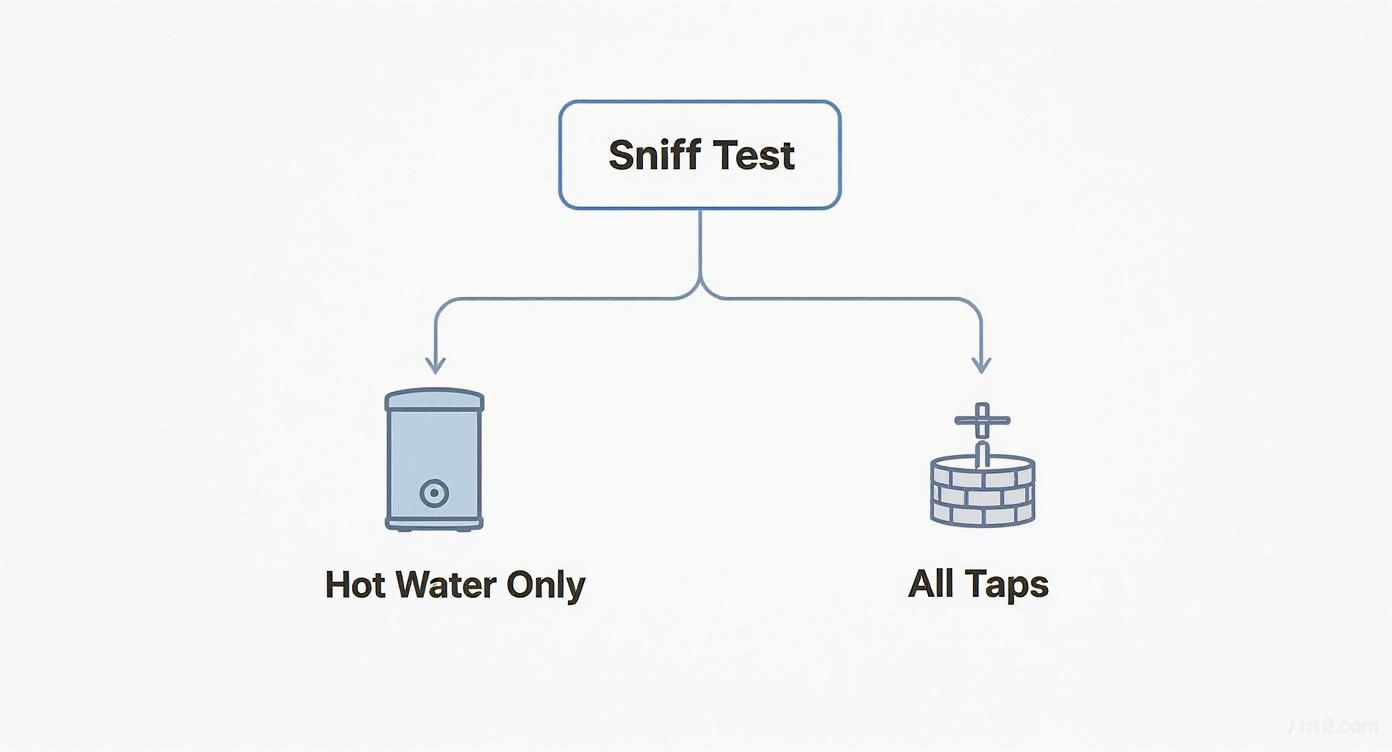
As you can see, if it's only the hot water that stinks, your water heater is the likely culprit. But if you smell it at both the hot and cold taps, the issue is coming directly from your well, and you'll need a whole-house treatment system to fix it.
Air Injection Oxidizing (AIO) Filters
These days, Air Injection Oxidizing (AIO) systems are the go-to for most sulfur problems. They're a modern, "set-it-and-forget-it" solution that uses a simple, natural process—oxidation—to get the job done without any chemicals.
Here’s the simple version of how it works: Water enters a single tank where a pocket of air is automatically trapped at the top. This blast of oxygen instantly converts the stinky hydrogen sulfide gas into tiny, solid particles. These particles get caught in a special filter media inside the tank. Every few days, the system automatically backwashes itself, flushing the trapped particles down the drain and refreshing the air pocket.
Why AIO Filters Are So Popular:
- Completely Chemical-Free: You don't have to add chlorine, peroxide, or anything else. That means no chemical aftertaste or smell.
- Super Low Maintenance: The system handles everything on its own. No chemicals to buy or handle, ever.
- Affordable to Run: With no ongoing chemical costs, your only expense is the tiny bit of electricity it uses.
AIO filters are a fantastic choice for the moderate levels of sulfur and iron we see all over Southwest Florida. You can learn more about our advanced air injection systems to see why they're our top recommendation for a hands-off approach to clean water.
Catalytic Carbon Filters
Catalytic carbon filters might look like a standard carbon filter, but the magic is in the media inside. It contains a specialized form of carbon that acts as a catalyst, speeding up the reaction that neutralizes hydrogen sulfide. Think of it as activated carbon on steroids.
This supercharged media encourages the H2S gas to convert into harmless sulfur compounds, which then get trapped on the carbon's surface. They work well for lower levels of sulfur, but the media does have a limited capacity. Once it's "full," the entire tank of carbon has to be replaced, usually every 1 to 3 years, depending on your water chemistry and how much water you use.
Chemical Injection Systems
When you're dealing with a really severe sulfur problem, you sometimes have to bring out the big guns. Chemical injection systems use a powerful oxidizer to completely wipe out the H2S gas and any sulfur-producing bacteria along with it. This is the heavy-duty workhorse of water treatment.
For homes with high concentrations of hydrogen sulfide or stubborn sulfur bacteria, chemical oxidation is often the only way to guarantee complete and consistent removal of that rotten egg smell.
These systems use a small pump to inject a very precise amount of an oxidizing chemical into your water line. The water then flows into a holding tank to give the chemical time to work its magic before moving through a final filter that polishes the water.
The Two Main Options for Chemical Injection:
- Chlorination: This is the old-school, tried-and-true method. Chlorine is a powerful disinfectant that kills sulfur bacteria and oxidizes H2S gas. We always install a carbon filter after it to remove any leftover chlorine taste and smell, so your water is just clean and fresh.
- Hydrogen Peroxide: This is a fantastic, modern alternative to chlorine. Peroxide is a strong oxidizer, but it breaks down into just oxygen and water, leaving absolutely no taste or chemical residue behind. It also works faster than chlorine, making it a "deluxe" option for complete odor removal.
While these systems are incredibly effective, they do require more hands-on attention. You'll need to refill the chemical solution tank from time to time. Of course, our professional maintenance plans can handle all of that for you, ensuring your system runs perfectly without you lifting a finger.
How to Choose the Right Size Sulfur Filter
Choosing the right sulfur filter for well water isn’t like picking an appliance off a shelf. It's about matching the system's power to your home's unique needs, and getting this wrong can be a costly, frustrating headache.
An undersized system will always be playing catch-up. You'll notice it when the water pressure drops or that rotten egg smell creeps back in during peak use—like when the shower, dishwasher, and washing machine are all running at once.
On the flip side, an oversized system is just overkill. You're paying a premium for capacity you’ll never actually use, which can even make the system operate less efficiently. The secret to hitting that sweet spot comes down to two key factors: your home's peak water flow rate and the specific chemistry of your well water.
It's no surprise that the demand for reliable filtration is on the rise. The global water filter market was valued at around USD 14.16 billion in 2023 and is expected to climb. A huge driver of this is well owners just like you looking for real solutions to hydrogen sulfide—that pesky gas causing bad odors and corroding pipes. Discover more insights about the water filters market on straitsresearch.com.
Determining Your Home's Water Flow Rate
Your flow rate is simply how much water is moving through your pipes at a given moment, measured in gallons per minute (GPM). Any filter you install has to be able to treat water at or above your home's peak GPM. If it can’t keep up, untreated water will slip right past the system, and that smell will be back before you know it.
Want a rough idea of your flow rate? You can do a quick check yourself.
The Bucket Test: A Simple GPM Estimate
- Grab a bucket: Find one with a known volume, like a standard 5-gallon bucket.
- Find an outdoor spigot: Make sure it's one that comes off the main line before any existing water treatment gear.
- Time the fill: Turn the water on full blast and use a stopwatch to see how long it takes to fill the bucket.
- Do the math: Divide the bucket size (in gallons) by the time it took to fill (in minutes). So, if it took 30 seconds (0.5 minutes) to fill a 5-gallon bucket, your calculation is 5 gallons / 0.5 minutes = 10 GPM.
This test gives you a decent baseline, but for a system that’s going to work reliably for years, it’s just a starting point.
While the bucket test is a great quick check, it doesn't account for the pressure changes and flow dynamics that a new filtration system will introduce. A professional flow rate test gives us the precise data needed for perfect sizing.
Why Professional Water Testing is Non-Negotiable
Beyond just the flow rate, the concentration of hydrogen sulfide, iron, and manganese in your water is what really dictates the type and size of filter you need. Higher contaminant levels demand a bigger system with more filter media to ensure the water has enough contact time to be treated properly.
Guessing here is a recipe for failure. A professional water analysis from Water Medic of Cape Coral takes all the guesswork out of the equation. We test your well water to measure the exact levels of these contaminants, giving us the hard data needed to select the perfect sulfur filter for well water.
For some issues, certain media like catalytic carbon is the best tool for the job, but you'd only know that with a proper test. You can learn more about our carbon filters and see how they fit into the picture.
By combining an accurate flow rate measurement with a detailed water chemistry report, we make sure the system we recommend is engineered for your home—not too small to do the job and not too big for your budget. It’s the only way to guarantee a permanent fix for your sulfur problem.
Understanding Your System's Maintenance and Costs
Putting a sulfur filter on your well is a fantastic move for better water quality. But just like your car or air conditioner, it’s a system that needs a little care to keep working its best. We believe in being upfront about what that looks like, so you can plan for the long haul without any nasty surprises.

The upkeep really depends on the type of filter you choose. Some are pretty much "set it and forget it," while others need a bit more hands-on attention to stay in top shape. Knowing the difference ahead of time is the key to picking a system that fits your life, not the other way around.
Typical Upkeep for Different Filter Types
Modern Air Injection Oxidizing (AIO) filters are about as low-maintenance as they come. These systems are smart—they clean themselves automatically every few days. The special media inside can last for years before it ever needs to be swapped out. Best of all, there are no chemicals to buy, so your ongoing cost is practically nothing.
Catalytic carbon filters, on the other hand, require a bit more involvement. The magic is in the specialized carbon that grabs the sulfur odor, but it can only hold so much. You'll likely need to replace the carbon media every 1 to 3 years. How often depends on your water's specific chemistry and your family's daily water usage.
Chemical injection systems are the workhorses, but they also require the most routine attention.
- Chlorine or Peroxide Refills: You'll need to keep the chemical solution tank topped off. The frequency depends on how much water you use and how strong that rotten-egg smell is.
- Pump Maintenance: The small injection pump is a mechanical part that might need a tune-up from time to time to make sure it’s adding the right amount of solution.
- Filter Changes: These setups usually have a carbon filter at the end of the line to give the water a final polish, and that filter will need to be replaced periodically.
If you’re ever unsure about filter changes, especially if you notice a funky smell returning, this guide to water filter replacement is a great resource to have bookmarked.
The Value of Professional Maintenance Plans
This is exactly where our professional maintenance plans make life so much easier. Instead of adding another item to your weekend to-do list, you can hand the responsibility over to us. We’ll keep your system on a precise service schedule so every part is working exactly as it should.
A well-maintained filtration system doesn't just provide clean water; it protects your initial investment. Regular service prevents unexpected breakdowns, maximizes efficiency, and extends the lifespan of your equipment significantly.
With a Water Medic maintenance plan, we take full ownership of your water quality. We handle the media replacements, refill the tanks, and run system check-ups so you don't have to give it a second thought. We're not just installers—we’re your long-term partners in clean water, committed to making sure you get fresh, odor-free water for years.
Why Southwest Florida Well Water Is Different
If you’ve ever filled a glass of water from a well in Cape Coral, Fort Myers, or Lehigh Acres, you already know our water is… special. The issues we deal with here aren’t what you’d find in most other parts of the country, which is why a generic water filter from a big-box store often just doesn't cut it. To solve a local problem, you need local expertise.
The root of our water challenges lies deep beneath our feet in the Floridan aquifer. This massive underground water source is made of porous limestone, which is fantastic for holding water but also creates the perfect environment for naturally occurring bacteria that produce sulfur. That's the source of the high hydrogen sulfide levels—and the unmistakable rotten egg smell—so common in our wells.
The Problem with Generic Solutions
A standard sulfur filter for well water that works like a charm for a homeowner up north might be completely overwhelmed by the mineral and gas concentrations we have in Southwest Florida. Those systems are typically designed for much lower levels of hydrogen sulfide or a different mix of dissolved minerals.
This is a really important point for anyone on well water here. You can easily spend good money on a system that isn't built for our local water chemistry, only to end up with the same smelly water and a lot of frustration. You need something designed to tackle the specific issues coming out of your well.
Southwest Florida's unique geology means our groundwater is often rich in sulfur compounds and dissolved minerals. A successful water treatment strategy must be designed specifically to handle this regional chemistry, not a generic national standard.
Local Knowledge for a Lasting Fix
This is exactly where having a local expert makes all the difference. At Water Medic of Cape Coral, we don't just work here—we live here. We test and treat this water every single day, which has given us a deep understanding of what works and what doesn't.
Our entire approach is built around our community’s needs.
- We know what to test for. Our water analysis looks for the specific concentrations of hydrogen sulfide, iron, and other minerals we know are common in local wells.
- We choose the right tools for the job. Based on your water test, we’ll recommend a system—like advanced air injection or catalytic carbon—that we know performs well under Southwest Florida's demanding conditions.
- We dial it in for you. We professionally size and calibrate every system we install to make sure it’s running at peak performance, giving you clean, great-smelling water you can count on.
More and more homeowners are looking for reliable solutions to well water problems, and it’s no surprise. The market for these treatment systems was valued at around USD 10.75 billion in 2024 and is expected to keep growing as people seek out real fixes for contaminants like hydrogen sulfide. Read the full research about water treatment market growth. We provide that reliable solution right here, backed by local experience, ensuring you get a system that works today and for years to come.
Putting It All Together: Your Local Solution for Sulfur-Free Water
You don't have to live with that rotten egg smell. It's a common problem for well owners in Southwest Florida, but it's one with a clear solution. As we've covered, picking the right sulfur filter for your well water isn't a one-size-fits-all deal. It takes a bit of know-how to get it sized and installed correctly for long-term success.
The good news? You don’t have to figure it all out on your own.
At Water Medic of Cape Coral, we take the guesswork out of the equation. We’re not just a company that sells filters; we’re local water quality experts who understand the unique chemistry of our groundwater here in the Cape Coral area. Our goal is to match your home and family with the perfect system from the get-go.
Our Proven Process for Pure Water
We’ve developed a straightforward process built on solid data and years of experience. It’s how we solve even the most stubborn sulfur problems, ensuring your investment pays off with fresh, clean water from every tap.
-
Step 1: In-Depth Water Analysis. Everything begins with a professional water test, right at your home. We need to know exactly what we're dealing with—the precise concentration of hydrogen sulfide, iron levels, and anything else that might be causing trouble.
-
Step 2: A Clear, Custom Recommendation. Armed with that data and an understanding of your home’s water usage, we'll walk you through the best options for your situation and budget. We’ll explain the pros and cons of each type of system so you can feel confident in your decision.
-
Step 3: Professional Installation and Ongoing Support. Our skilled technicians will install your new system with precision and care. But our job doesn't end there. We're here for the long haul with support and maintenance plans to keep your system running like new for years to come.
When you choose Water Medic, you're not just buying a piece of equipment. You're getting a permanent solution backed by a local team that’s genuinely committed to your family's water quality.
It's time to take back your water. Stop tolerating the rotten egg smell and the silent damage it's doing to your pipes and appliances. A real, lasting fix is just a phone call away.
Ready to finally get rid of that sulfur smell for good? Contact Water Medic of Cape Coral today. We’ll schedule a free, no-pressure water consultation and show you the path to clean, fresh, odor-free water.