
Pool Evaporation Rate: What Every Owner Should Know
A typical Cape Coral pool can lose roughly 1,000 to 2,000 gallons of water per month through evaporation alone, depending on its size and exposure. That loss isn't automatically a sign of a leak. Wind, warm water, low humidity, pool use, and an uncovered surface can all pull water into the air faster than many homeowners expect.
This guide gives you a practical way to understand your pool evaporation rate. You'll learn what the rate means, how five local conditions change it, how to work through an ASHRAE-style calculation, how to translate water loss into gallons and utility costs, which reduction methods deserve attention first, and how to use a bucket test when normal evaporation no longer explains the drop. Cape Coral's screened enclosures, salt air, heat-pump heaters, summer humidity swings, and open exposure near the Caloosahatchee or Gulf make generic national rules less useful than a property-specific check.
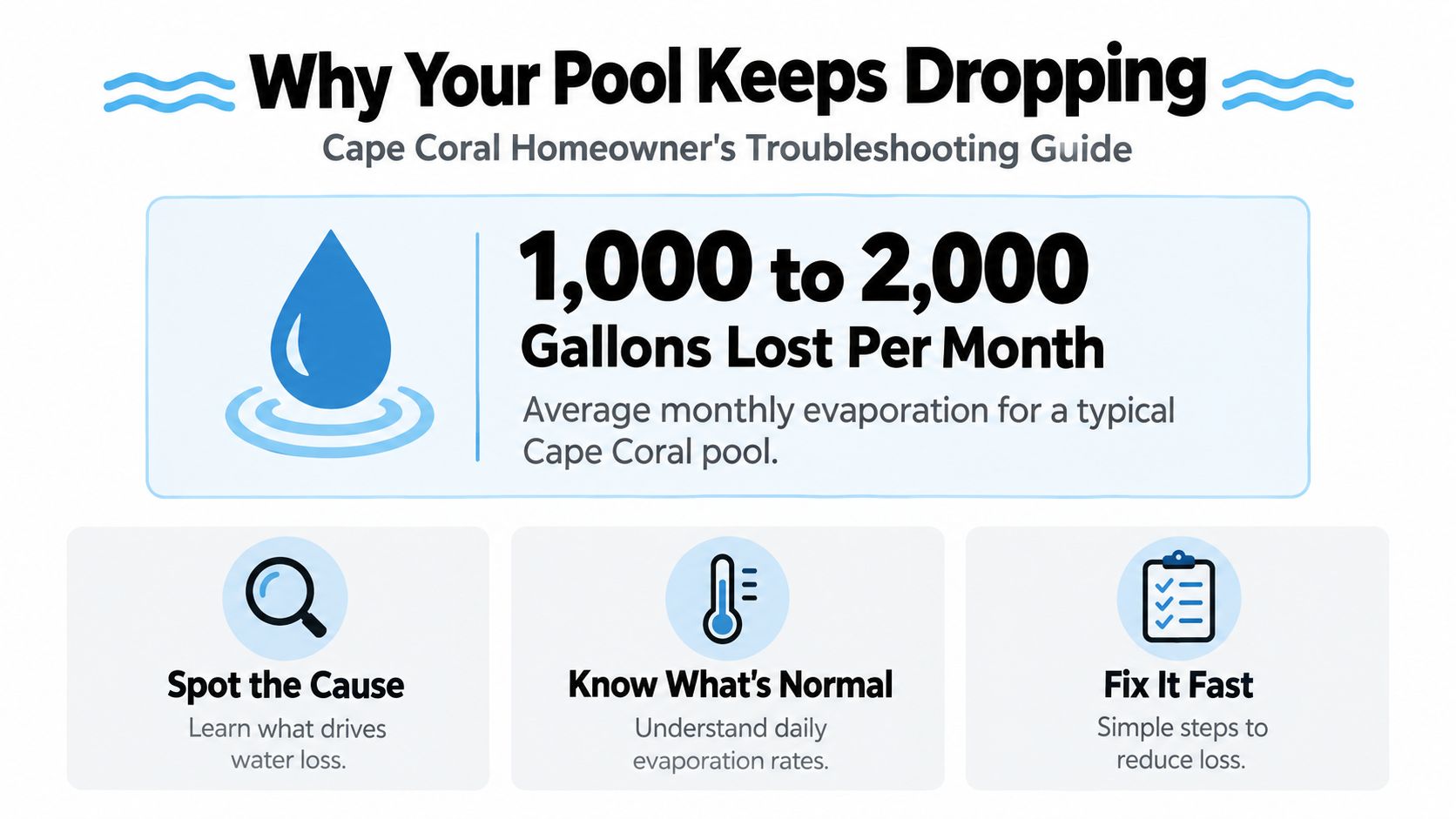
Why Your Pool Keeps Dropping
A quiet outdoor pool can lose about 0.5 kilograms of water per hour for every square meter of surface area under typical conditions. That small hourly loss adds up because the entire water surface is exposed. A wet towel on a Cape Coral lanai dries for the same basic reason: heat supplies energy, while moving air carries moisture away.
An outdoor-pool study recorded evaporation at 72% of the ASHRAE-predicted value in near-zero wind and 82% at a wind speed of 2.2 meters per second. During two overnight tests, evaporation accounted for 56% of total energy loss, compared with 26% from radiation and 18% from convection. The engineering study is available through this evaporation benchmark.
Cape Coral properties can fall above or below that baseline. A screened enclosure may block some direct wind, while an open lot can channel air across the pool. Heated water also evaporates readily when it remains warmer than the surrounding air, including during a humid evening. Salt air does not create evaporation by itself, although coastal exposure often brings the wind and outdoor airflow that increase surface exchange.
Start with a record, not a guess. Mark the water level and note the conditions before adding water.
Use these observations to separate normal evaporation from other losses:
- Measure the surface: A larger pool exposes more water to the air, so it can lose more water under the same conditions.
- Record the conditions: Write down water temperature, air temperature, humidity, wind, pool use, and whether a cover was in place.
- Separate sources of loss: Splash-out, filter cleaning, and automatic refill activity can resemble evaporation.
- Test unusual drops: If the level falls faster than expected during calm weather, compare the pool with a bucket.
The practical goal is to identify your property's normal pattern. A monthly change can reflect ordinary weather, heating, and use, while a faster unexplained drop deserves closer attention. If the comparison indicates a genuine water-loss problem, arrange professional pool leak detection.
What Pool Evaporation Rate Actually Means
A pool can lose about 1/4 inch of water per day in a typical Southwest Florida summer, yet that visible drop does not automatically indicate a leak. Evaporation is the exchange between the water surface and the air above it. A wet towel dries faster on a warm, breezy afternoon than in cool, still, humid air. Your pool responds to the same conditions.
Engineers describe this process with an ASHRAE-based equation:
V = 95.6 + 0.425Vw × (Pw − Pa) × Y^0.5
The symbols identify the main inputs:
- V represents the evaporation rate.
- Vw represents air movement across the surface.
- Pw represents vapor pressure at the water temperature.
- Pa represents vapor pressure in the surrounding air.
- Y represents the pool's water-surface area.
The key term is the difference between Pw and Pa, called the vapor-pressure deficit. Warm water places more moisture at the surface. Cooler, drier, or moving air can accept more of that moisture, so the gap grows and evaporation speeds up. Quiet water generally evaporates less than the equation predicts, while swimming and other activity can raise losses well above calm-water conditions. Review the ASHRAE-based pool evaporation research.
For homeowners, three units make the result useful:
- Inches per day, the easiest measure at the waterline.
- Gallons per day, which shows refill demand.
- Percent of pool volume per week, which puts the loss in context for a small pool, large pool, or attached spa.
Evaporation is only one possible source of a falling waterline. Swimming can cause splash-out, and filter cleaning can discharge water. A plumbing or equipment loss may continue during calm weather or change when the circulation system runs.
| Unit | Plain-English Meaning | Typical SW Florida Range |
|---|---|---|
| Inches per day | The vertical waterline drop | About 1/8 to 1/2 inch per day under common conditions, with more possible in extreme heat and wind, according to this pool evaporation reference |
| Gallons per day | The volume leaving the pool | Depends on surface area, weather, and water temperature |
| Percent per week | The share of total pool volume lost | Depends on pool depth and volume, not surface area alone |
Use about 1/4 inch per day as a starting baseline for a Southwest Florida summer, not as a pass-or-fail limit. Wind exposure or water heated above the surrounding air can push evaporation higher. A covered or sheltered pool may lose less. For additional guidance, compare your notes with these pool maintenance FAQs and track the waterline before assuming a leak.
The Five Factors That Drive Water Loss
Your pool's evaporation rate reflects five conditions working together: water temperature, air temperature, humidity, wind, surface area, and equipment that increases air-water contact. A single factor may have a small effect, while several aligned conditions can make the waterline fall much faster.
Water and air temperature
The water-to-air temperature gap controls how readily water becomes vapor. An 85°F pool in 90°F July air can still lose more water than the same pool in 70°F January air, because the summer water stays warm longer and usually faces more air movement. A heater that keeps water 5 to 20°F above ambient widens that gap and can increase evaporation, particularly after sunset, when the air cools while the pool remains warm.
Relative humidity
Humidity describes how much moisture the air already holds. Cape Coral summer conditions may be around 75%, while the dry winter comparison uses about 55%. Drier air can accept more water vapor, so evaporation generally rises. Humid air slows the process. Hot, dry conditions can reach 1/2 inch or more per day, while cooler or more humid conditions often stay below 1/4 inch per day, as explained in this humidity guidance for normal pool evaporation.
Wind exposure
A thin layer of humid air forms directly above the pool. Wind removes that layer and replaces it with drier air, much like repeatedly clearing steam from a mirror. An open pool near the Caloosahatchee, or one on an exposed Gulf-facing property, may therefore lose water faster than a pool protected by a tight screen enclosure. Breezes can roughly double or triple evaporation compared with still air, depending on the other conditions. This pool evaporation calculator shows how wind enters the estimate.
Surface area
A 15-by-30-foot pool exposes about 450 square feet of water. That exposed area, rather than depth alone, determines how much water contacts the air. A broad, shallow pool can therefore lose more water each day than a deeper pool with a smaller surface, even when the deeper pool contains more total gallons.
Heaters and water features
Heaters raise the water temperature and increase the vapor-pressure difference. Fountains, spillovers, and aeration features spread water into moving air, adding more opportunities for evaporation. Running them during the hottest, windiest part of the day can increase the loss. The effect is also noticeable when a heat pump keeps the pool warm overnight or an attached spa runs hotter than the main pool.
| Factor | SW Florida Effect | Approximate Impact on Daily Loss |
|---|---|---|
| Water and air temperature | Warm water and a wider temperature gap increase vapor pressure | Can move the rate above the 1/4-inch baseline |
| Relative humidity | Drier air increases the moisture deficit | Hot, dry conditions can reach 1/2 inch or more per day |
| Wind | Open exposure removes saturated air from the surface | Breezes can roughly double or triple loss compared with still air |
| Surface area | More exposed water creates more evaporation capacity | A 450-square-foot surface has greater exposure than a smaller pool |
| Heating and aeration | Warm water and active features increase air-water exchange | A heated pool can exceed an unheated pool under the same air conditions |
These factors explain why a monthly waterline change does not automatically indicate a leak. Compare sheltered and windy days, note whether the heater or water features ran, and record the drop under similar conditions. A steady loss that continues despite calm weather and inactive equipment deserves a leak check.
Working Through a Real Cape Coral Example
A precise ASHRAE calculation needs vapor-pressure values derived from temperature and humidity. The simplified formula also depends on engineering coefficients and unit conventions, so a homeowner should use the result as a worked estimate, then compare it with a measured waterline change.
Use a rectangular Cape Coral pool measuring 15 by 30 feet, with 450 square feet of exposed surface. The February example has 75°F air, 60% relative humidity, and 3 mph wind. The August example has 92°F air, 55% relative humidity, and 8 mph wind.
| Variable | February Day | August Day |
|---|---|---|
| Pool surface | 450 sq. ft. | 450 sq. ft. |
| Air temperature | 75°F | 92°F |
| Relative humidity | 60% | 55% |
| Wind speed | 3 mph | 8 mph |
| Water condition | Mild, near ambient | Warm summer water |
| Vapor-pressure deficit | Smaller | Much larger |
| Estimated daily loss | Lower | Higher |
Start by measuring or estimating the water temperature. Use a vapor-pressure table or calculator to find the saturation vapor pressure at that temperature. Estimate the air vapor pressure from the air temperature and relative humidity, then subtract Pa from Pw to find the vapor-pressure deficit.
Put that deficit, wind speed, and surface area into the ASHRAE-style expression. Convert the resulting water mass or volume into inches across the pool, then convert those inches into gallons using the measured surface area. Finally, compare the estimate with the observed waterline after allowing for rain, swimming, splash-out, and refilling.
The February day produces a lower estimate because the air is cooler, humidity is higher, and wind is lighter. The August case combines hotter air, drier conditions, and stronger wind, producing roughly three times more water loss in this example. That comparison reflects the same physical pattern found in outdoor-pool engineering work, where wind and active conditions can substantially raise evaporation above a quiet-water estimate. The outdoor-pool benchmark and ASHRAE comparison are documented here.
For a field check, record the pool level at the same time each day for several days. The formula gives you a starting point, while your own pool also responds to screen geometry, shade, water temperature, and equipment use. A loss that stays high during calm weather, with inactive features and no unusual use, merits a leak check rather than another evaporation estimate.
Translating Evaporation Into Gallons and Dollars
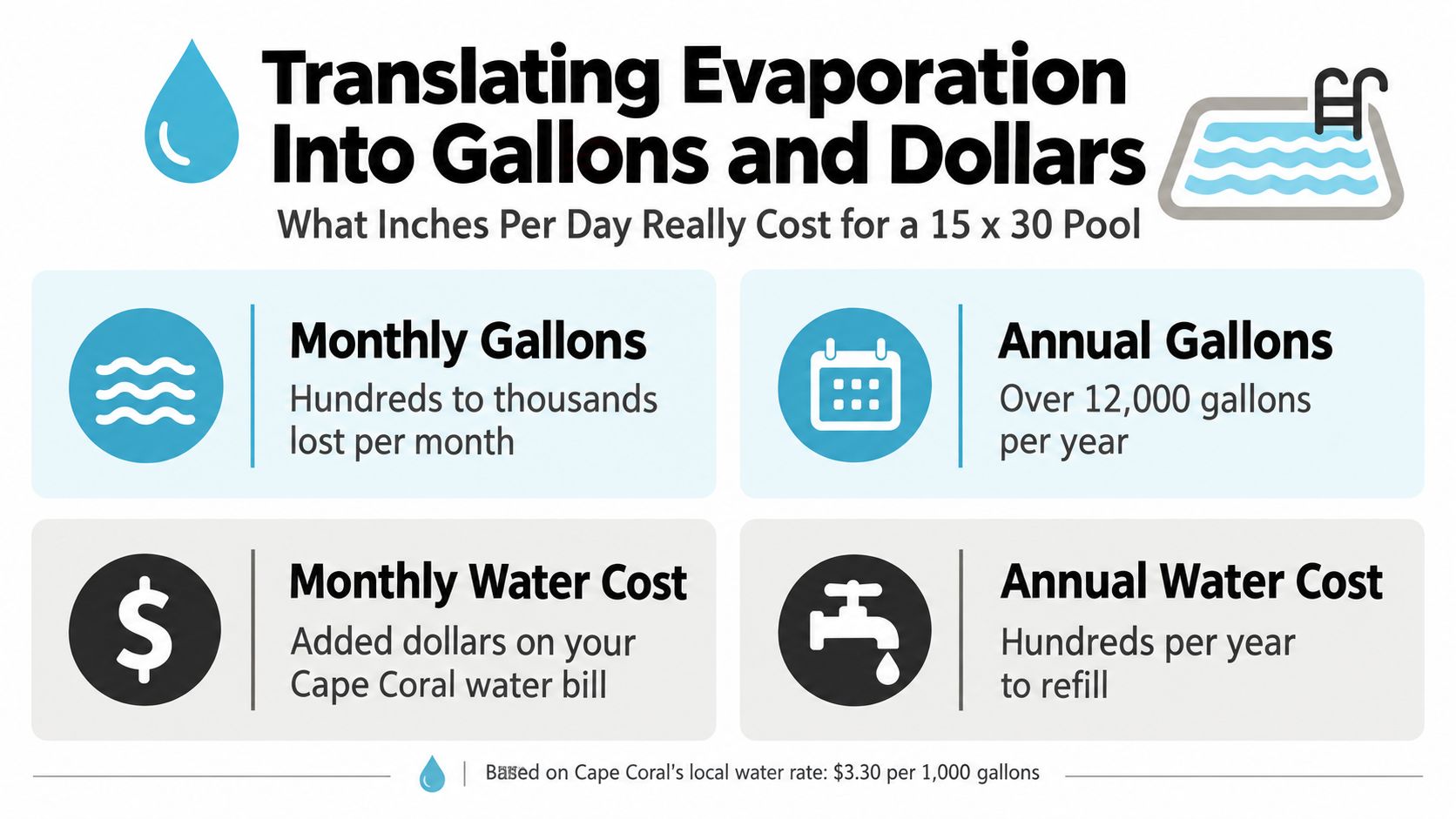
The 15-by-30-foot example has 450 square feet of exposed water. A vertical loss measured in inches becomes a volume loss when it is multiplied across that surface, which is why a seemingly small waterline change can create a substantial refill requirement.
Research on swimming-pool water use reported an average evaporation rate of 4.4 liters per square meter per day and estimated that some areas could lose nearly 4 million liters per square kilometer annually when covers aren't used. A separate Spanish swimming-pool engineering estimate reported 3.63 liters per square meter per day as an average daily rate. Read the engineering research on measured pool water use.
For a Cape Coral homeowner, a practical seasonal planning range is 1,500 to 2,000 gallons in a typical summer month, or about $11 to $15 at the local planning rate of roughly $7 per 1,000 gallons. Winter demand may be about half that, depending on the pool cover, water temperature, wind, and weather. Those figures are planning estimates rather than a guaranteed bill amount, since Cape Coral billing can include separate water and wastewater components and household use varies.
The direct refill cost is only part of the impact. Every refill can also introduce minerals and dissolved solids, while the remaining pool water becomes more concentrated as pure water evaporates. That concentration can contribute to harder water balancing, scale formation, and additional sanitizer or acid demand, as described in this background explanation of evaporation and pool chemistry.
Heated pools add another layer. When warm water leaves, the heater must replace the energy associated with the replacement water. A pool owner may also notice more frequent chemical adjustment and greater autofill activity. The annual total therefore depends on the months of exposure, the amount of heating, whether the pool is covered, and the actual utility rate.
Track three items for a useful one-year summary:
- Water volume: Record gallons added each month.
- Utility cost: Separate pool-related refill use from normal household demand where possible.
- Operating burden: Note heater runtime, chemical additions, and water-balance corrections.
Proven Ways to Slow the Loss
The most effective reduction method is the one that blocks air movement and separates the water from the atmosphere. A solid pool cover usually has the clearest physical advantage because it limits the exposed surface when the pool isn't being used. A liquid evaporation suppressant may suit homeowners who can't store or handle a physical cover, but product performance depends on application and weather.
| Strategy | Approx. Cost | Effectiveness | Payback |
|---|---|---|---|
| Physical pool cover | Varies by pool and cover type | High when installed correctly | Based on avoided refill, heating, and chemical demand |
| Liquid evaporation blanket | Ongoing product expense | Moderate and weather-dependent | Potentially faster for pools without cover storage |
| Landscaping or windbreak | Varies by planting and installation | Moderate when it blocks direct airflow | Gradual, with added shade and privacy benefits |
| Lower heater setpoint | Little or no installation cost | Moderate for heated pools | Immediate operating savings, balanced against comfort |
| Schedule aeration at night | Little or no installation cost | Helpful when features run during windy heat | Immediate if daytime feature use is substantial |
| Reduce water temperature slightly | Little or no installation cost | Helpful for heated pools | Immediate, provided the lower temperature suits users |
| Screen enclosure | Significant property-specific investment | High for wind and debris control | Longer-term, based on several operating benefits |
A cover deserves first consideration when the pool sits unused for long periods. Keep safety, drainage, storage, and HOA requirements in mind. For an uncovered pool, perimeter planting can reduce direct wind exposure, but don't place roots or irrigation where they can damage the deck or contaminate the water.
Heating strategy matters too. Lowering the setpoint slightly, reducing unnecessary nighttime heating, and limiting spillovers or fountains during peak wind can reduce the vapor-pressure gap. Running aeration features at night doesn't eliminate evaporation, but it can avoid the strongest daytime heat and wind.
The right choice depends on the property. A screened Cape Coral enclosure may already provide meaningful shelter, while an open pool near the water may need a cover to control exposure. A documented monthly pool maintenance program can also help you track water level, chemical concentration, equipment operation, and refill patterns before a small change becomes expensive.
When Evaporation Is Really a Leak
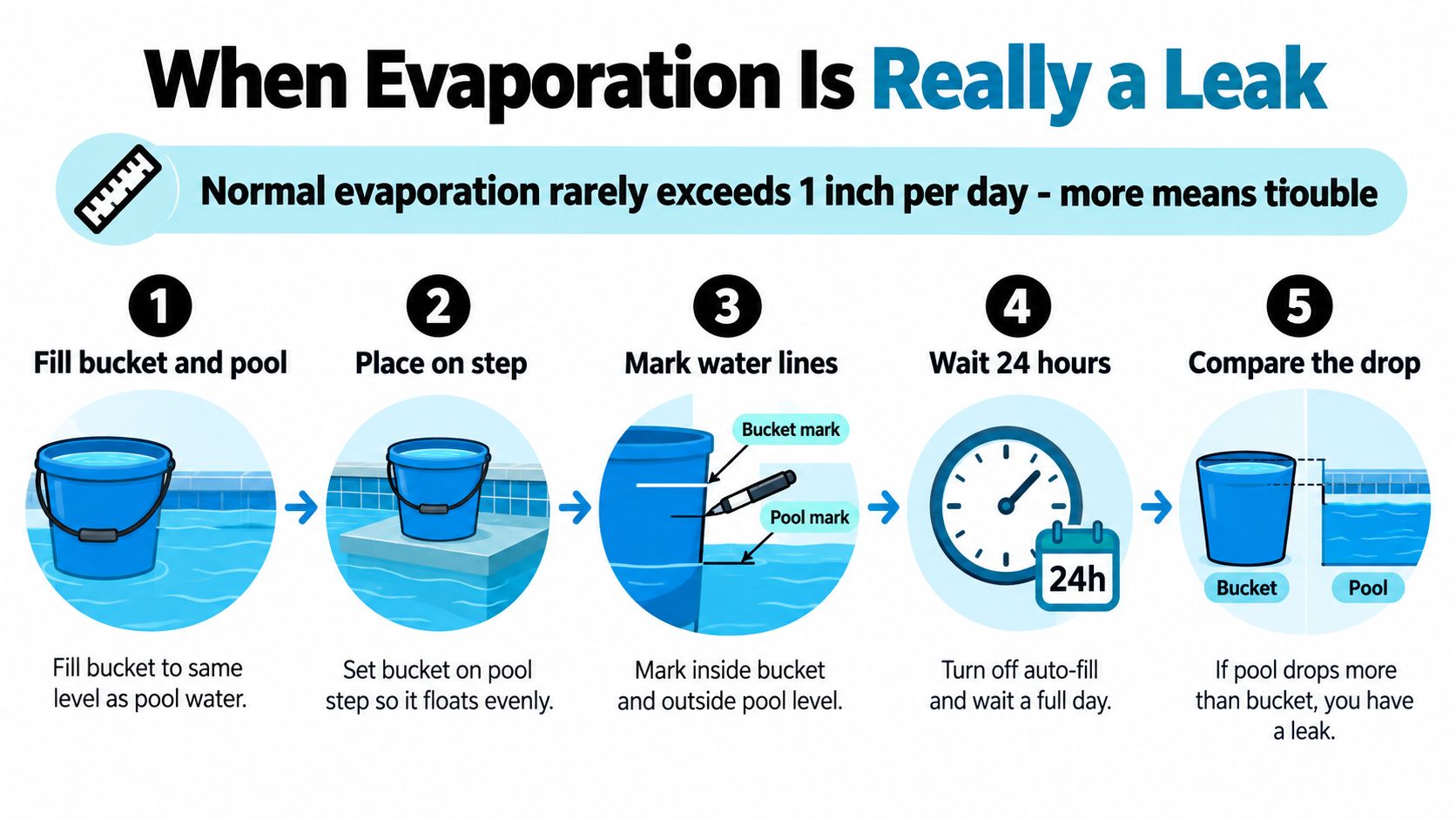
Normal evaporation in Cape Coral rarely exceeds 1 inch per day. A larger drop, especially under calm conditions or when the pool isn't heated, deserves investigation rather than repeated topping off. The simplest first screen is the classic bucket test.
- Fill a plastic bucket with pool water.
- Mark the waterline inside the bucket and the pool waterline outside it.
- Weigh the bucket down on the top step, keeping the bucket water exposed to the same air as the pool.
- Run the pump normally for 24 hours, but turn off automatic refill and don't add water.
- Compare the two marks.
If the bucket and pool fall by about the same amount, evaporation is the likely explanation. If the pool drops noticeably more than the bucket, the difference points to a leak-like loss rather than surface evaporation. Repeat the test if wind changes sharply during the test period.
An autofill can hide the evidence. If it runs repeatedly or for long periods each day, it may be replacing water before you see the pool level fall. Check the refill setting and observe whether the system continues adding water after the level is restored.
Look for these warning signs:
- Wet ground: A persistent wet spot near the pool can indicate abnormal water movement.
- Air at the returns: Bubbles appearing without a clear operational reason deserve attention.
- Tile-line damage: Cracks or separation around the waterline can provide a path for loss.
- Chemical changes: Unexplained dilution or repeated chemistry correction can accompany excessive water replacement.
When the bucket test shows a clear difference, a specialist can isolate the source with appropriate testing and recommend the safest repair path. Water Medic of Cape Coral offers pool service and water-treatment support for Southwest Florida homeowners, including help assessing unusual refill patterns and ongoing pool care. Visit Water Medic of Cape Coral to request an evaluation and discuss a practical plan for controlling evaporation-related water use.