
Your Guide to Pool Care How to Keep Florida Pools Clear
Keeping a pool pristine isn't rocket science, but it does require a consistent routine. Think of it as preventative care. A little bit of proactive maintenance, like skimming every day and testing the water weekly, is what stops 90% of common headaches like algae and cloudy water from ever getting started. When you're ready to hand off the chores, our team at Water Medic is here to help.
Your Essential Southwest Florida Pool Care Checklist
Having a pool in Southwest Florida is pure bliss, but our climate is no joke. The combination of relentless sun, sudden downpours, and year-round heat means you need a specific game plan for maintenance. This isn't just about ticking boxes on a chore list; it's about actively fighting back against algae, equipment wear, and wild swings in your water chemistry.
If you stick to a schedule, you’re protecting your investment and making sure the pool is always ready for you to jump in.
Let things slide, even for a weekend, and problems can snowball. A couple of days' worth of leaves can stain the plaster and clog up the skimmer, putting a real strain on your pump. This guide is your road map to making pool care manageable, but for a truly hands-off experience, nothing beats our comprehensive weekly pool service.
The Daily Pool Care Ritual
Your daily pool check-in should be a quick affair, maybe 10 to 15 minutes tops. The main goal here is simple: get the organic stuff out before it sinks and starts messing with your water chemistry.
- Skim the Surface: Grab your net and clear off any leaves, bugs, or other debris floating on top. This is especially crucial after one of our classic afternoon storms, which can dump a ton of junk into your pool in minutes.
- Visual Inspection: Just give the water a quick glance. Is it sparkling clear? Can you easily see the drain at the bottom? Spotting a little bit of cloudiness early is the key to preventing a major problem.
That fast daily skim is your best first line of defense. It stops debris from decaying and turning into algae food, and it keeps your skimmer basket clear so your pump can circulate water efficiently.
The Weekly Maintenance Foundation
This is where the real work of maintaining a healthy pool gets done. Your weekly routine is all about sanitation, cleanliness, and keeping the water perfectly balanced. Carve out about an hour each week to really dig in and do these things right.
Being consistent here is what prevents most of the issues that send people running to the pool store for expensive "shock" treatments or calling for a service visit. A properly maintained pool rarely turns green or cloudy.
This chart really lays out the workflow for a solid pool care routine.
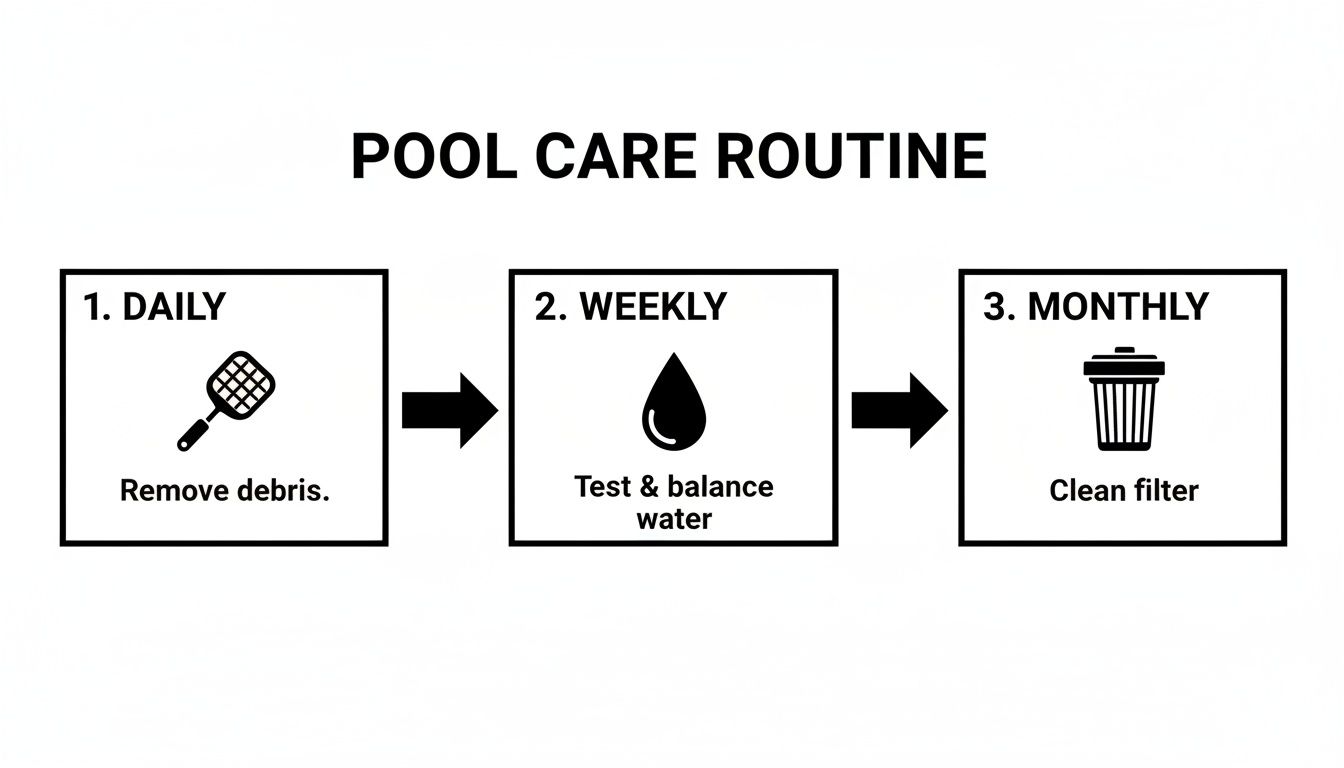
As you can see, the tasks build on each other, creating layers of protection that keep your pool in top shape.
Your Monthly Health Checkup
About once a month, it's time to pop the hood and check on your pool’s internal systems. These tasks are all about the equipment that’s humming away behind the scenes, keeping everything clean and moving.
A clean filter is the heart of a clear pool. Industry experts note that a dirty or clogged filter can reduce water circulation by up to 50%, drastically reducing the effectiveness of your chemicals and increasing energy costs.
Cleaning your filter—whether you have a cartridge, sand, or D.E. system—is probably the most critical thing you'll do all month. You should also take a look at the o-ring on your pump lid for any cracks and listen for any weird noises coming from your equipment.
Think of it as a wellness check for your pool's hardware. While you can definitely handle these steps yourself, if you'd rather have a completely hands-off experience, you can always explore the benefits of our professional monthly maintenance services. Our techs perform these deep checks to make sure every component is running perfectly, giving you total peace of mind and letting you get back to actually enjoying your pool.
Mastering Pool Chemistry for Crystal-Clear Water
Let's be honest, diving into pool chemistry can feel like you're back in high school science class. But getting a handle on it is the absolute key to keeping your pool looking its best. Think of your pool water as a living thing—when one part is out of whack, the whole system suffers. This can mean cloudy water, stubborn algae, or even skin irritation for your family and guests.
The good news? You only need to master a few core concepts to keep that water safe, balanced, and inviting.
Here in Southwest Florida, we're in a constant battle with the elements. The relentless sun burns through chlorine faster than you can add it, and our daily summer downpours wash away chemicals and throw your water's balance into total chaos. This is precisely why just tossing in a tablet and hoping for the best is a recipe for a green, frustrating mess.
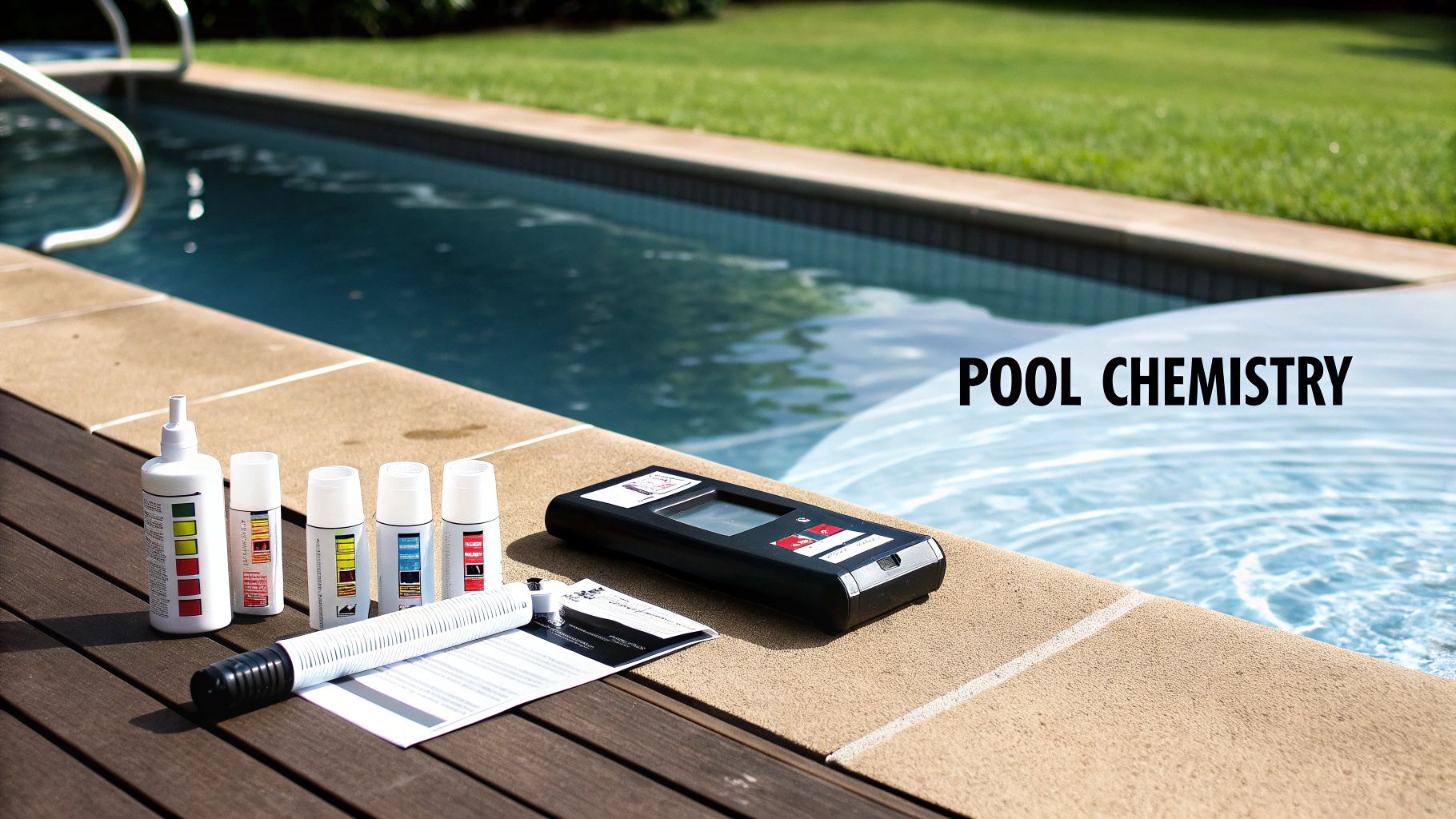
The “Big Five” of Pool Chemistry
To keep things from getting overwhelming, let’s focus on the "Big Five." These are the chemical readings that truly matter. They all work together, and getting them right is the foundation of a healthy pool.
- Free Chlorine: This is your sanitizer, the workhorse that kills all the nasty stuff like bacteria and algae. You want to keep this between 1-3 ppm (parts per million).
- pH: This simply measures how acidic or basic your water is. A high pH makes your chlorine lazy and ineffective. Aim for a tight range of 7.4 to 7.6.
- Total Alkalinity: Think of this as the buffer for your pH. Good alkalinity levels prevent wild pH swings. The sweet spot is 80-120 ppm.
- Calcium Hardness: This measures dissolved calcium. Keeping it between 200-400 ppm protects your plaster, tile, and equipment from getting etched or caked with scale.
- Cyanuric Acid (CYA): Also called "stabilizer," CYA is like sunscreen for your chlorine, protecting it from getting zapped by UV rays. The ideal range is 30-50 ppm.
These chemicals are a team. For instance, if your pH creeps too high, your chlorine basically stops working, even if the test strip says you have plenty in the water. That's how a pool can turn green overnight.
Why Perfect Balance Is Non-Negotiable
Keeping these levels dialed in isn't just about having clear water; it's a critical safety issue. In fact, consistent chemical balancing prevents an estimated 90% of waterborne illnesses in pools. That's a huge number, especially here in our warm climate where bacteria love to grow.
Here's a classic Florida scenario: A huge afternoon thunderstorm rolls through. The next morning, your pool is hazy. The rain has diluted your chemicals, dropping your pH and Total Alkalinity. Your first move should always be to test the water. Adjust the alkalinity first, then the pH, and finally your chlorine. Following that order is crucial.
At Water Medic, our pros use precise digital testing to keep every level perfect. This prevents problems like calcium scaling, which can cut a pool heater's lifespan in half—a costly and avoidable repair. You can explore more swimming pool chemicals market insights to understand the broader impact.
Here's a quick cheat sheet for the ideal ranges we target in local pools.
Ideal Pool Chemical Ranges for Southwest Florida
Keeping these numbers in check is your best defense against common pool problems in our unique climate.
| Chemical Parameter | Ideal Range | Importance in SWFL Pools |
|---|---|---|
| Free Chlorine | 1-3 ppm | Your primary defense against bacteria and algae, which thrive in our heat. |
| pH | 7.4-7.6 | Ensures chlorine is effective and prevents skin/eye irritation and equipment damage. |
| Total Alkalinity | 80-120 ppm | Acts as a buffer to stop heavy rains from causing drastic pH swings. |
| Calcium Hardness | 200-400 ppm | Protects plaster and tile from etching (too low) or scaling (too high). |
| Cyanuric Acid (CYA) | 30-50 ppm | Essential "sunscreen" that prevents the intense Florida sun from destroying your chlorine. |
Getting these readings right ensures your pool is not only sparkling but also safe for everyone to enjoy.
The Right Way to Add Chemicals
Handling pool chemicals requires care. Always, always read the manufacturer's label first. A cardinal rule is to never mix different chemicals together before putting them in the pool—you could create a dangerous reaction. And when you need to add acid, pour the acid into a bucket of water, never the other way around.
Add chemicals in small increments and let the pump run for a few hours before retesting. This gives the water time to circulate and gives you an accurate picture of the change. For granular products, it’s a great idea to pre-dissolve them in a bucket of pool water first to help them spread out evenly and avoid staining your pool surface.
This constant cycle of testing and adjusting can feel like a part-time job. It’s why so many homeowners around Cape Coral trust us with their weekly maintenance. We take the guesswork out of it with advanced digital photometers for pinpoint accuracy. This is especially true for trickier systems like saltwater pools, which have their own unique needs. You can learn more about how we manage them in our guide to professional saltwater pool service.
Ultimately, professional oversight ensures swimmer comfort and protects your pool investment from expensive damage, letting you simply enjoy the water.
Essential Pool Equipment Maintenance and Troubleshooting
Your pool's pump, filter, and heater are the unsung heroes of your backyard oasis. They’re the hardworking heart of the entire system, constantly circulating and cleaning the water day in and day out. If you want to avoid frustrating downtime and surprise repair bills, keeping this equipment in top shape is the secret. A little bit of preventative maintenance goes a surprisingly long way.
Think of your equipment pad as your pool’s command center. You'll save yourself a lot of headaches by learning to spot the subtle signs of trouble. Is there a new high-pitched whine coming from the pump motor? Is the water flow from the return jets weaker than usual? Catching these things early can turn a potential disaster into a minor fix.
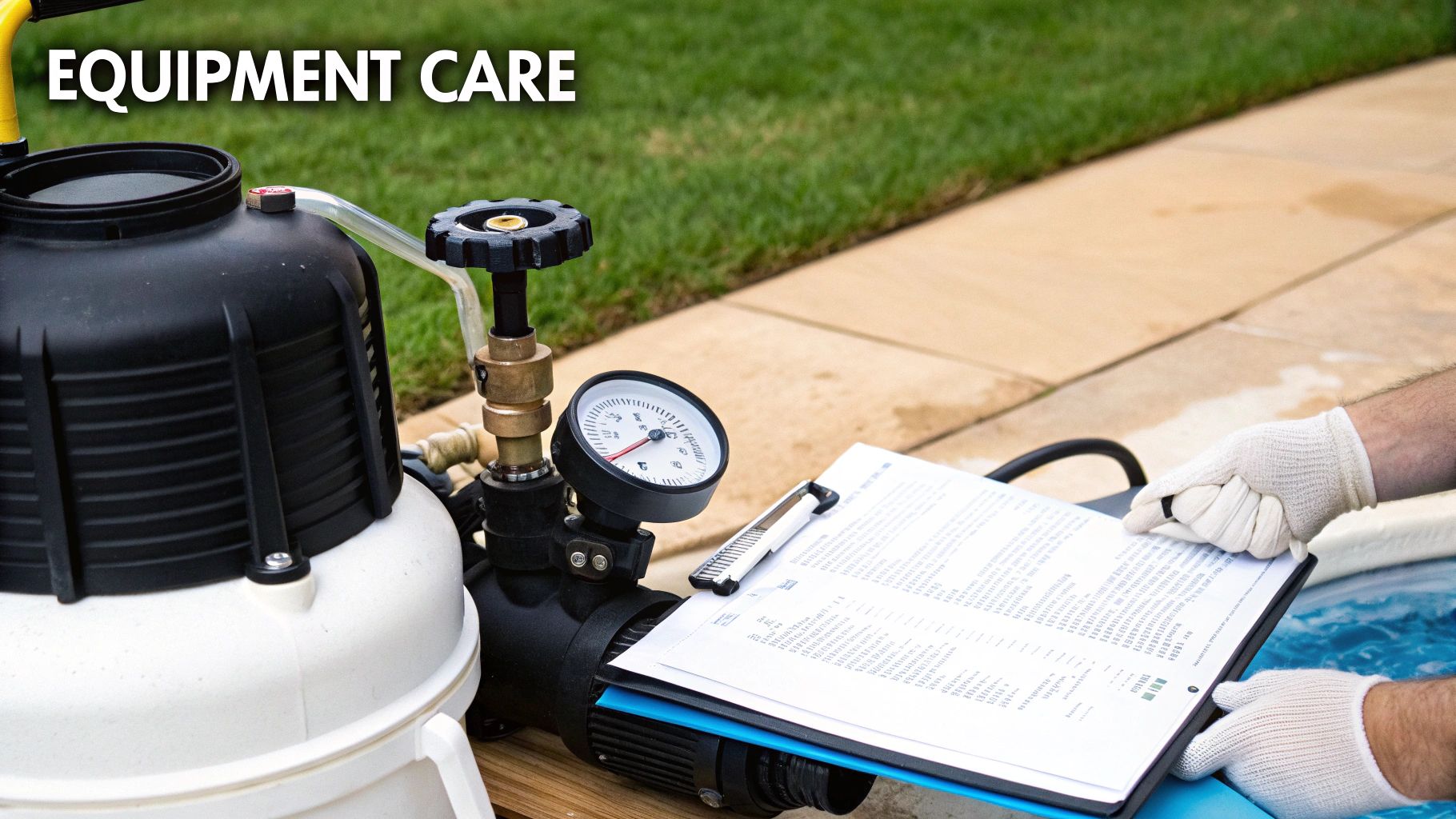
Your Pump and Filter Inspection Routine
The pump is the muscle, pulling water from the pool, while the filter acts as the kidneys, trapping all the gunk. They’re a team, so they need to be maintained as one.
Start with the simple stuff. Every week, make a habit of cleaning out your skimmer baskets and the pump basket. When these get clogged with leaves and debris, it forces the pump to work way too hard, straining the motor and shortening its life. Seriously, this five-minute task is probably the single best thing you can do to protect your most expensive piece of equipment.
Next up: get to know your filter’s pressure gauge. Right after you clean or backwash your filter, take a look at the pressure reading—this is your "clean" baseline, usually somewhere between 10-25 PSI. When you see the gauge climb 8-10 PSI above that number, it’s screaming at you to be cleaned again. Don't ignore it. High pressure puts a ton of stress on the filter tank, the plumbing, and all the seals.
Common Problems and Quick Fixes
Even a well-cared-for pool can throw you a curveball. Knowing a few basic troubleshooting steps can often save you a service call, but it's just as important to know when to throw in the towel and call a pro.
- Pump won’t turn on: Before you panic, check the easy stuff. Is the circuit breaker tripped? Is the timer set correctly? You'd be surprised how often it's something that simple.
- Pump is making a loud noise: A high-pitched screaming or a low grinding noise is usually a sign of bad motor bearings. That’s not a DIY job. It’s a clear signal to call for help.
- Pool isn't staying clean: If your water chemistry is spot on but the water is still hazy or dirty, the problem is almost certainly filtration. Check that filter pressure and make sure your pump is running long enough each day to turn over all the water.
Pro Tip: Efficient equipment isn't just about a sparkling pool—it’s about your wallet. We've seen proper pool care save homeowners up to 30% on energy bills. Modern, efficient pumps and clean filters drastically reduce energy use, which makes a huge difference here in Southwest Florida.
When to Bring In the Experts
While cleaning baskets is easy, some jobs are absolutely best left to the professionals. Things like replacing a pump motor, changing the sand in a sand filter, or figuring out a tricky electrical issue demand specialized tools and know-how. Trying to tackle these yourself can quickly lead to more expensive damage or, worse, a serious safety hazard.
This is where a good pool technician earns their keep. A struggling pump or an inefficient filter doesn’t just leave your pool dirty; it sends your FPL bill through the roof. If you’re dealing with persistent issues or your equipment is getting up there in age, let us come take a look. Our techs are trained to pinpoint the real problem and can provide expert equipment upgrade options to get your system back to peak performance.
And don't forget, total pool care extends beyond the water. Maintaining your enclosure and deck is part of protecting your investment. For some great advice on that, check out these Pool Cage Maintenance tips. At Water Medic, our goal is to make sure every part of your system operates efficiently, saving you money and giving you that perfect pool without the headache.
Seasonal Pool Care Strategies for the Florida Climate
Florida’s version of seasons might not involve snow, but your pool care routine absolutely needs to adapt to our unique, year-round climate. The easy-going maintenance that works in the pleasant spring just won't cut it during the sweltering, stormy summer. The real key to a healthy pool is adjusting your strategy to stay ahead of whatever the weather throws at you.
This goes way beyond just tweaking your chlorine levels. It's about shifting your entire approach to combat the specific challenges each part of the year presents. From the brutal UV rays of August to the torrential downpours of a September afternoon, each "season" requires a different battle plan.
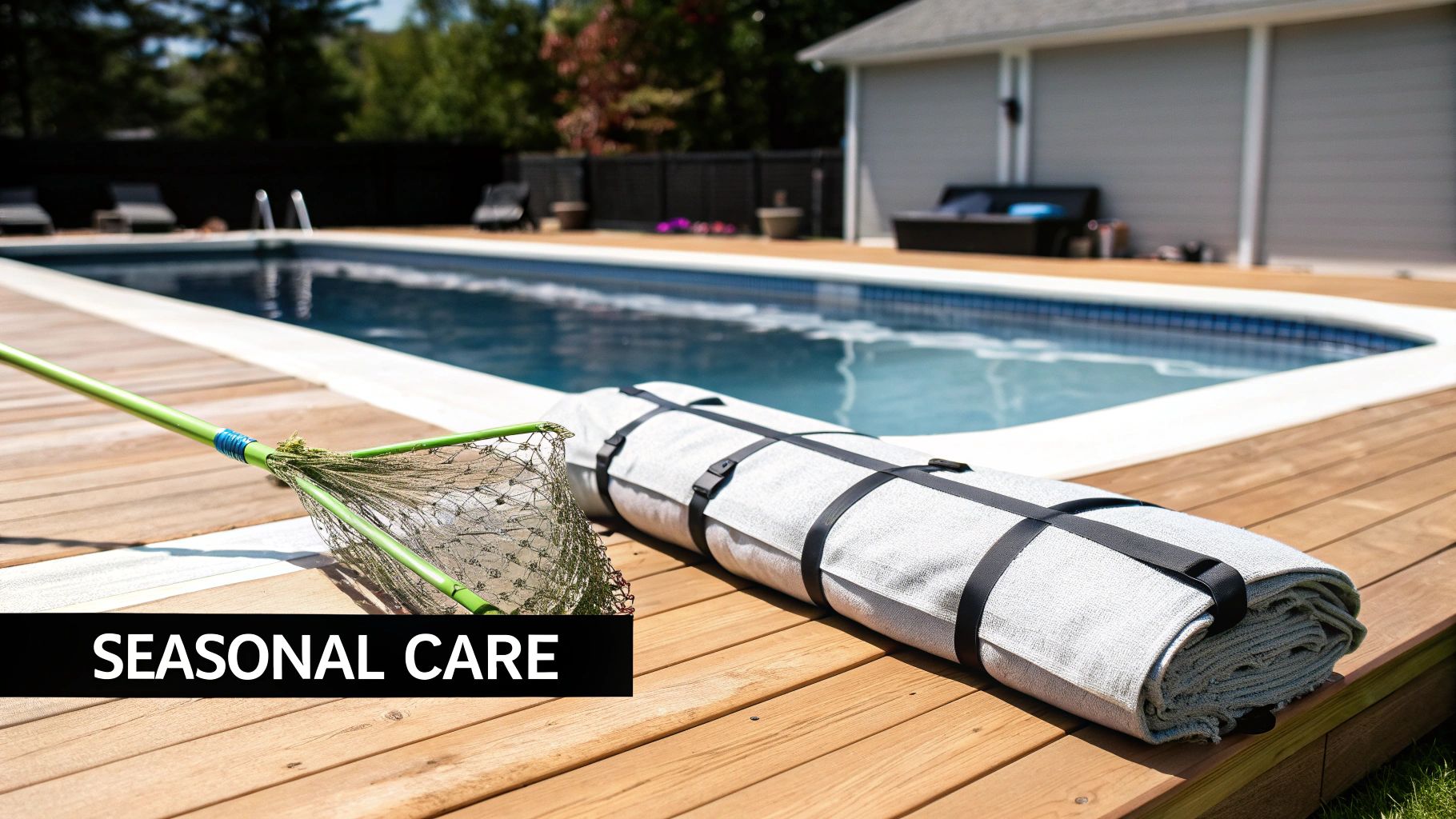
Surviving the Summer Heat and Rainy Season
Summer in Southwest Florida is a double whammy for pool owners. The intense heat and relentless sun create the perfect breeding ground for algae, while our daily downpours work overtime to dilute your carefully balanced chemicals. Your maintenance has to get more aggressive to keep up.
During these hot months, the sun's UV rays will obliterate your free chlorine in just a few hours. This means you have to test and add chlorine far more often. I also tell my clients to extend their pump's runtime to 10-12 hours a day. You need that extra circulation to keep the water properly filtered and sanitized.
Then there's the rain. A heavy downpour is essentially like dumping gallons of acidic, mineral-free water into your pool, which can crash your pH and alkalinity levels in a hurry.
- Test After Every Storm: Don't wait. Grab your test kit as soon as the rain stops.
- Rebalance Quickly: Focus on getting your alkalinity back in range first, as it stabilizes the pH. Then, adjust the pH to make your sanitizer effective again.
- Clear the Debris: Storms wash leaves, dirt, and phosphates (algae's favorite food) right into your pool. A thorough skim and vacuum afterward is non-negotiable.
Managing a pool through a Florida summer is a constant fight. The combination of more swimmers, intense sun, and diluting rains can overwhelm even the most diligent homeowner. This often leads to stubborn algae blooms that are a real headache—and expense—to get rid of.
Preparing for Hurricane Season
When a hurricane is on the way, your pool prep is all about damage control and safety. The goal is simple: minimize what can become a projectile in high winds. The one thing you do not do is drain your pool. That water provides critical weight that holds the pool shell in the ground, preventing it from popping out of the earth when the ground becomes saturated.
Before a storm arrives, get everything loose off the pool deck. I'm talking patio furniture, umbrellas, pool toys, and even your skimmer pole and vacuum. Anything not tied down is a potential missile. It's also a very good idea to shut off the power to your pool equipment at the circuit breaker to prevent damage from power surges. Once the storm passes, you can begin the cleanup, but be careful. Check for damage and clear all baskets before turning the power back on.
Adjusting for the Cooler “Winter” Months
Our "winter" is famously mild, but the cooler temperatures and shorter days give you a chance to ease up on maintenance and save a little money. With less sun and heat, chlorine lasts much longer in the water, and algae growth slows to a crawl.
You can usually cut your pump runtime back to 6-8 hours a day, which makes a noticeable dent in your electric bill. You’ll use fewer chemicals, too. Don't get lazy, though. You still need to skim, brush, and test the water weekly to keep it clean and balanced. You never know when that surprise 80-degree day will pop up in January, and you want to be ready for it.
Navigating these seasonal shifts is what separates a frustrating, cloudy pool from a pristine, inviting one. This is exactly what we handle at Water Medic of Cape Coral. Our weekly service is designed to adapt to these changes for you. Our technicians adjust chemical doses, pump schedules, and cleaning tasks based on the season and current weather, ensuring your pool is perfectly managed all year long without you having to lift a finger.
When to Call the Pros at Water Medic of Cape Coral
Doing your own pool care can be a satisfying part of homeownership, but it's crucial to know when a problem is bigger than a simple DIY fix. Knowing when to hand the job over to a professional is the smartest thing you can do to protect your pool investment and avoid turning a small issue into a costly nightmare.
Some problems are more than just a nuisance; they're symptoms of a deeper issue. If you’re stuck in a loop of fighting cloudy water that never seems to clear or battling the same patch of algae every other week, it’s a sign to call for backup. These persistent headaches often point to something more complex than a simple chemical imbalance, like an inefficient filter or a circulation problem.
Complex Repairs and Hidden Dangers
Let’s be honest: some jobs just aren't meant for the weekend warrior. Pool equipment is a tricky mix of high-pressure water and high-voltage electricity. That’s a dangerous combination if you don’t have the right training and tools. Things like swapping out a screaming pump motor, performing a full sand change in a filter, or figuring out an electrical glitch in your heater are best left to a pro.
A perfect example is a suspected leak. If you're constantly adding water and the level keeps dropping, you're not just wasting water; you're risking damage to your pool's foundation and the surrounding deck. Our technicians use specialized, non-invasive leak detection equipment to find the exact source of the leak without having to tear anything apart. It’s the difference between a precise repair and a messy, expensive guessing game.
Your time is your most valuable asset. While you might save a few dollars upfront on a DIY repair, a single mistake can lead to a much larger, more expensive problem. A professional service guarantees the job is done right the first time, protecting your investment.
The Value of Professional Weekly Service
Beyond just fixing things when they break, the best reason to call us is for consistent, worry-free maintenance. Your pool is a major feature of your home, and its condition has a real impact on your property's value. Especially here in Southwest Florida, a sparkling, perfectly maintained pool isn't just a nice-to-have—it's a major selling point.
Did you know that regular professional maintenance can boost property values by 7-10%? On the flip side, a neglected pool can scare off potential buyers in a heartbeat. Homes with professionally serviced pools don't just sell up to 30% faster; their owners also report 40% lower repair bills on average. Water Medic’s commitment to quality turns routine maintenance into a smart investment that pays you back. If you're curious about the industry, you can discover more insights on swimming pool services.
Ultimately, our weekly pool service is about more than just scooping leaves and adding chlorine. It's about giving you your weekend back and providing peace of mind, knowing your pool is always safe, healthy, and ready for you to enjoy. Let us do the work, so all you have to do is make memories.
Answering Your Top SWFL Pool Care Questions
Owning a pool in Southwest Florida is incredible, but it definitely comes with its own unique quirks. The non-stop sun, the torrential downpours—it all plays a part. After years in the business, we've heard just about every question you can imagine. Here are the ones that pop up most often.
How Many Hours a Day Should My Pool Pump Run in Florida?
This is a big one. During our long, hot summers, you absolutely need to run that pump for 8 to 10 hours every single day. Anything less, and you're not filtering the entire volume of your pool, which is just asking for trouble.
Once things cool down in the winter, you can usually dial it back to 6 to 8 hours and save a little on your electric bill.
The main goal is to get at least one full "turnover" of your pool's water each day. Skimping on pump time is probably the most common mistake we see homeowners make, and it's a fast track to cloudy water. If you really want to get efficient, a variable-speed pump is the way to go. They can run longer at a much lower speed, giving you superior filtration without the high energy cost. We can talk you through the best equipment upgrade options for your setup.
Why Does My Pool Always Get Cloudy After It Rains?
You're not imagining it. That milky, cloudy water after a downpour is a direct result of everything the rain carries with it. Our rain here is naturally a bit acidic, and it’s full of dust, pollen, and phosphates—which are basically super-food for algae.
When a storm dumps all that into your pool, it throws your water chemistry completely out of whack. Your pH and alkalinity levels plummet, which basically handcuffs your chlorine and makes it useless. This creates the perfect storm for cloudy water. After any heavy rain, testing and rebalancing your water right away is crucial. Our weekly service pros are constantly making small adjustments to stay ahead of the rainy season, keeping the water crystal clear no matter what the forecast says.
What Is This Black Stuff in My Pool and How Do I Kill It?
If you're seeing small black spots stubbornly clinging to your pool walls or floor, you've got a black algae problem. This isn't your average green algae; it's the toughest kind to get rid of because it grows a tough, protective shell that normal chlorine levels can't penetrate.
Getting rid of it is a fight. It takes a serious, multi-step attack. First, you have to physically break that protective layer by scrubbing it hard with a steel brush. Then, you hit it with a powerful, targeted algaecide and "shock" the pool with a massive dose of chlorine.
Because it digs its roots deep into the pores of your plaster, black algae has a nasty habit of coming back if you don't kill every last bit of it. This is one of those times when calling in a professional is your best bet to make sure it's gone for good.
The crew at Water Medic of Cape Coral has the pro-grade chemicals and proven techniques to knock out black algae and keep it from returning. Trust us, it’ll save you a ton of headaches.
Is a Salt Water Pool Really Easier to Take Care Of?
There's a common myth that saltwater pools are "maintenance-free," and it's just not true. Yes, the salt cell generates its own chlorine, which is convenient, but it's not a hands-off system by any means.
You still have to test and balance all the other key water chemistry levels—pH, alkalinity, calcium hardness, and stabilizer (cyanuric acid). The salt cell itself needs to be cleaned regularly to get rid of mineral buildup, and eventually, it will fail and need to be replaced, which is a pretty big expense. On top of that, the salty water can be more corrosive over time to things like ladders, handrails, and certain types of stone decking.
We provide expert weekly pool service for both saltwater and traditional chlorine pools, and we're always happy to give you the real-world pros and cons of each system.
Your pool is a huge investment in your home and your family's happiness. Don't let the stress of keeping it clean and balanced get in the way of enjoying it. The expert technicians at Water Medic of Cape Coral are here to take care of everything, from the weekly chemical checks to complex equipment repairs. We'll make sure your pool is always sparkling, safe, and ready for you to jump in.