Is Reverse Osmosis Water Distilled? An Expert Comparison
Let's clear this up right away: reverse osmosis (RO) water is not the same as distilled water. People often lump them together because both are known for producing incredibly pure water, but how they get there is completely different.
Think of it this way: RO uses force, while distillation uses heat. They are two distinct paths to a similar goal, but only one is designed for the modern home.
RO Water and Distilled Water Are Fundamentally Different
It's a common question we hear from homeowners: "Is my RO system just making distilled water?" It's a great question, because it shows they're thinking about water purity. But the answer is a firm no. Understanding the how behind each method is key to choosing the right water purification solution for your family.
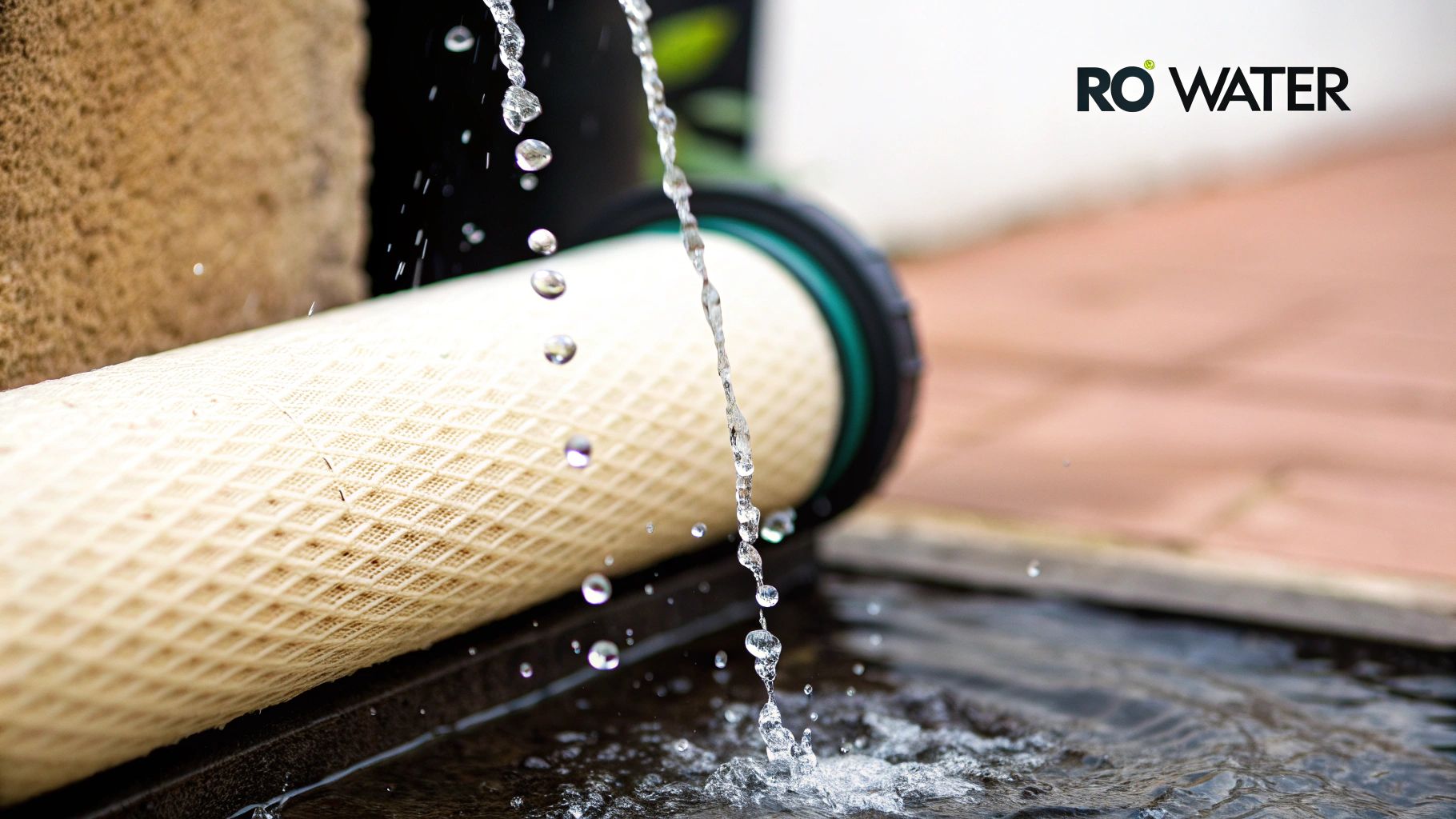
Reverse osmosis works by using your home’s water pressure to push water through an incredibly fine, semipermeable membrane. This membrane acts like a high-tech gatekeeper, letting clean water molecules pass through while blocking almost everything else—from lead and arsenic to fluoride and nitrates.
Distillation, on the other hand, mimics nature's own water cycle. It involves boiling water until it turns into steam, leaving all the heavy contaminants—like minerals, bacteria, and chemicals—behind. That pure steam is then captured and cooled, condensing back into liquid water.
The result? While our advanced RO systems filter out 90–99% of contaminants, distillation is even more thorough, removing virtually every single impurity. For a deeper dive into these methods, you can discover more insights about water purification at Freshwatersystems.com.
At a Glance: RO vs Distilled Water
To quickly see how these two stack up, here’s a simple comparison of their core differences.
| Characteristic | Reverse Osmosis (RO) Water | Distilled Water |
|---|---|---|
| Purification Method | Membrane Filtration (Pressure-based) | Boiling & Condensation (Thermal) |
| Mineral Content | Very low, often with beneficial minerals added back | Virtually zero minerals |
| Common Home Use | Drinking, cooking, ice makers | CPAP machines, irons, humidifiers |
| Production Speed | On-demand from a faucet | Slow, batch process |
This table makes it clear that while both produce high-purity water, their properties and best uses are quite distinct. Your choice really depends on what you need that pure water for, and for daily home use, RO is the superior choice.
How Reverse Osmosis Technology Purifies Your Water
When you hear about reverse osmosis (RO), you might picture something complex, but the idea is actually quite straightforward. It’s a filtration method that uses your home's own water pressure to push tap water through a series of specialized filters, giving you exceptionally pure drinking water right from your faucet. Unlike distillation, there's no boiling involved—just smart, multi-stage filtration.
The process starts with pre-filters. Think of these as the gatekeepers, responsible for catching the bigger stuff first. They trap particles like sediment, silt, and rust that can make water cloudy. This stage usually includes a carbon filter as well, which is great for removing chlorine—not only does this improve the taste right away, but it also protects the more sensitive parts of the system down the line.
The Heart of the System: The RO Membrane
After the pre-filters, the water moves on to the main event: the semipermeable RO membrane. This is where the real magic happens. The membrane is covered in microscopic pores, measuring a staggering 0.0001 microns wide. These pores are so tiny that only water molecules can squeeze through.
Everything else gets left behind.
- Rejected Contaminants: Dissolved solids like lead, arsenic, fluoride, nitrates, and sulfates are too large to pass and are simply washed away down the drain.
- Pure Water Passes: The water that makes it through is stripped of these impurities, leaving you with incredibly clean water.
This diagram gives a great visual of how the system works. Feed water comes in, pressure is applied, and the membrane separates the pure water from the waste stream.
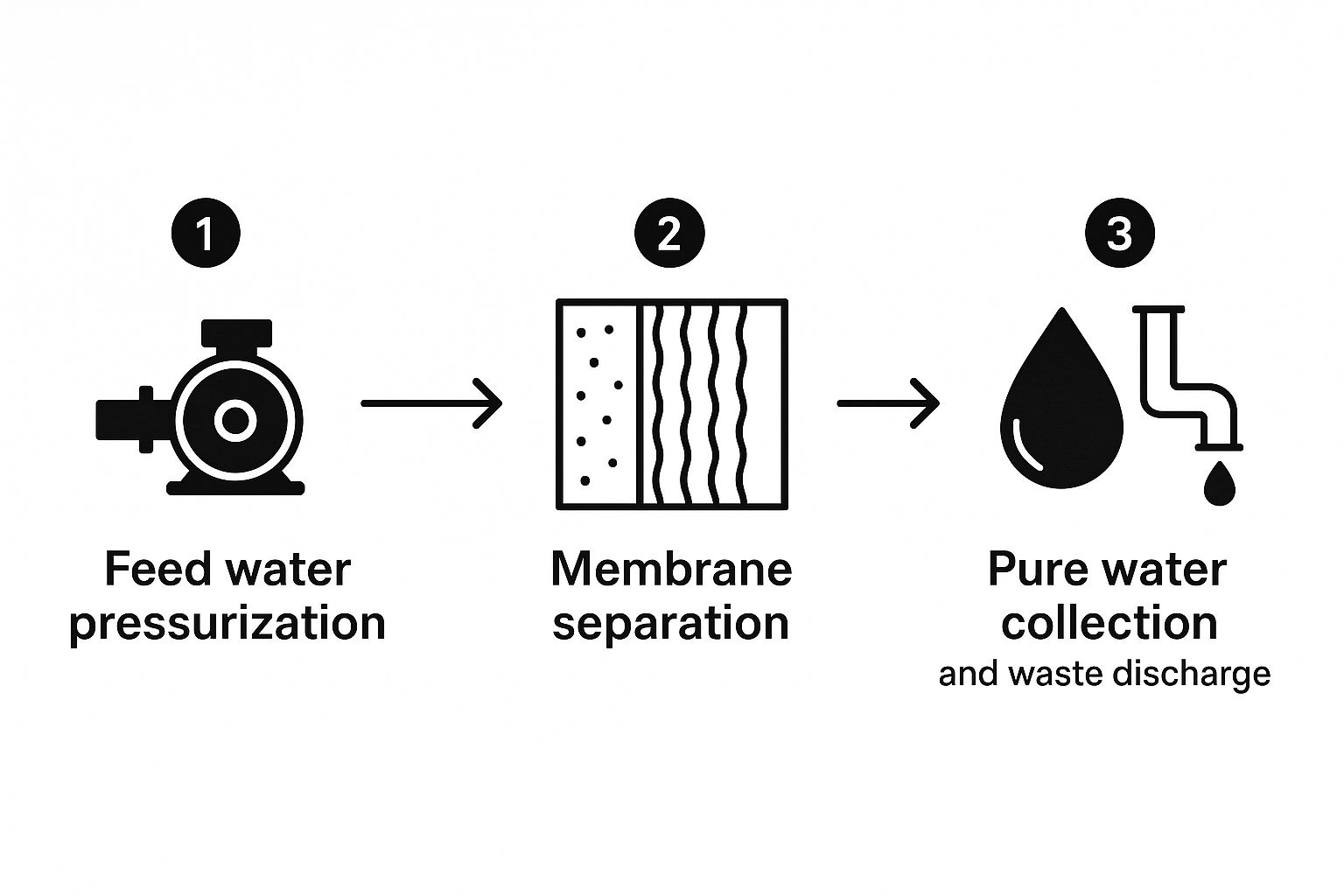
As you can see, RO is a physical separation process, which is fundamentally different from the thermal process of distillation. But the purification doesn't stop there. One final pass through a post-filter (usually another carbon filter) "polishes" the water, removing any lingering tastes or odors. The result is water that's not just pure, but crisp and refreshing to drink.
For homeowners who want this level of quality on demand, exploring different under-sink reverse osmosis systems is a great next step. A professionally installed system ensures your family has consistently great-tasting, high-quality water right at the kitchen sink.
Understanding The Science Behind Distillation
Where reverse osmosis uses high-pressure membranes, distillation takes a much more old-school approach. In fact, it's a process that mimics the earth's own hydrologic cycle. At its core, distillation is a simple thermal process: you boil water, capture the steam, and cool it back down.
The magic happens when the water hits its boiling point at 212°F (100°C). As it turns to steam, it leaves almost everything else behind. Heavy metals, salts, minerals, bacteria, and most other contaminants simply can't make the journey into a gaseous state. This physical separation is what makes distillation so effective.
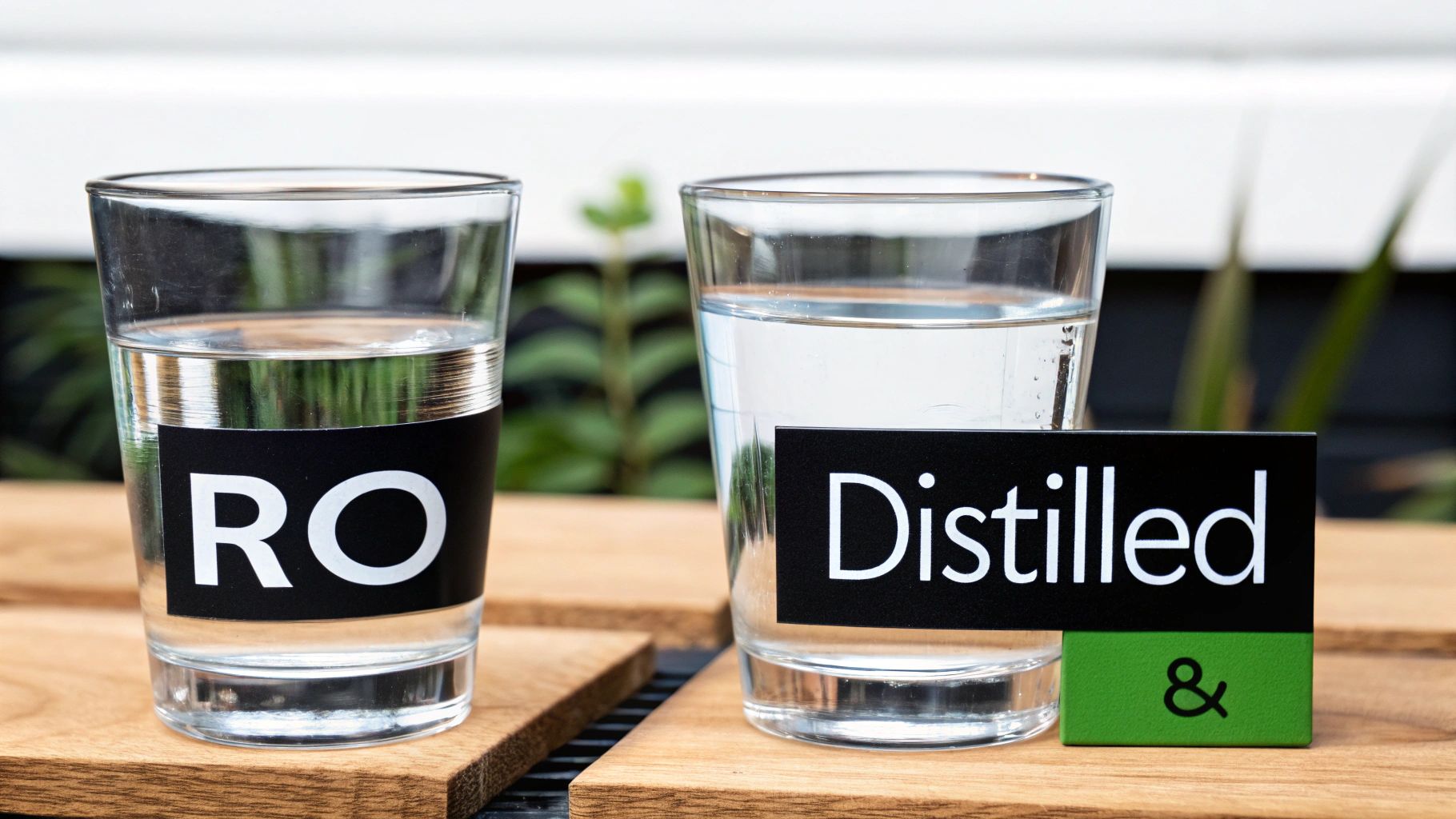
Once the pure water vapor is isolated, it's channeled into a cooling coil. Here, it condenses back into liquid, resulting in water that is exceptionally pure and almost completely devoid of dissolved solids.
Ideal Uses and Practical Drawbacks
This extreme level of purity is precisely why distilled water is critical in certain settings. It's the go-to choice for medical and laboratory applications, car batteries, and even household appliances like steam irons or CPAP machines where mineral scale would cause serious damage.
But for your kitchen sink? Distillation has some major downsides. The process is notoriously slow and demands a significant amount of electricity to keep that water boiling. It can easily take several hours just to produce a single gallon of water.
The slow-as-molasses production rate and high energy bill make a home distiller a tough sell for a family's daily drinking and cooking needs. It's just not practical.
This is exactly why on-demand systems like reverse osmosis have become the standard for most homes. While people asking "is reverse osmosis water distilled" are clearly looking for high purity, the methods and day-to-day realities are worlds apart. For homeowners who need that balance of purity, efficiency, and convenience, looking into other water filtration options is a smart move.
When you're weighing your options for pure water, it really boils down to three key things: purity, taste, and health impact. Both reverse osmosis and distillation are fantastic at cleaning up water, but the tiny differences in what they leave behind—or take out—make all the difference.
Purity, Taste, and Health: How Do They Stack Up?
Distillation is often seen as the gold standard for sheer purity. The process is simple and effective: boil water, collect the steam, and you're left with water that's nearly 100% free of contaminants. Everything from heavy metals and bacteria to beneficial minerals gets left behind.
But that total wipeout is exactly why distilled water has a reputation for tasting flat or even a bit "off." Without any minerals, water loses the subtle, crisp flavor we've come to expect.
The RO Edge: Better Taste and Smart Remineralization
This is where a modern reverse osmosis (RO) system really comes into its own. RO is just as effective at removing the nasty stuff—lead, arsenic, nitrates, you name it—but the filtration process isn't quite so aggressive. The result is water that tastes cleaner and more refreshing straight from the tap. It skillfully avoids that "dead" taste because it doesn't strip out absolutely everything.
We take things one step further by including a game-changing remineralization stage in our advanced RO systems. This moves beyond simple purification and into water enhancement. After the water passes through all the filters, we reintroduce a healthy, balanced mix of essential minerals like calcium and magnesium.
By reintroducing key minerals, the remineralization stage transforms purified water, elevating both its taste and its health benefits. It gives you the best of both worlds.
This thoughtful design means your family gets water that’s free from dangerous contaminants but is still packed with refreshing flavor and healthful minerals. That's why RO water with added minerals is widely considered the smarter choice for daily drinking and cooking.
While distilled water is perfect for specific tasks, RO water is built for everyday well-being. An RO system, particularly one with a remineralization filter, holds onto trace amounts of beneficial minerals. In stark contrast, distilled water's near-total lack of dissolved solids is what makes it ideal for medical settings or inside appliances like CPAP machines. You can learn more about the applications of purified water from Calsoftwater.com.
The True Cost and Convenience for Home Use
Purity and taste are huge factors, but let's be honest—for most of us, the decision really comes down to cost and convenience. When you’re thinking about your home, you have to weigh the initial price tag against what it's going to cost you day-to-day. This is where reverse osmosis really pulls ahead for the average household.
An RO system might have an initial setup cost anywhere from $200 to over $1,000, but the long-term running costs are surprisingly low. On the other hand, a home distiller might seem simple, but its energy consumption is massive. You're essentially boiling water for hours on end, and that shows up on your electricity bill. You can see a detailed financial breakdown of these systems at Waterdropfilter.com.
Efficiency and Daily Output
This is where the two methods are worlds apart. Convenience is all about having pure water when you need it, and a distiller just can't keep up with the demands of a modern home.
- Distillation: It's a batch process, meaning you have to wait. It can take a slow 4–6 hours just to produce a single gallon of water.
- Reverse Osmosis: This is on-demand. A typical system can deliver over 50 gallons per day, ready instantly at the turn of a tap.
Think about a typical day: filling water bottles for school, making coffee, cooking pasta, and getting a glass of water for yourself. Waiting hours for a gallon of water simply doesn’t work for a busy family. The on-demand nature of RO makes it the only practical choice.
For a household that values both its time and its money, the on-demand nature and lower operating costs of a reverse osmosis system make it the superior long-term solution.
The initial investment in a quality RO system pays for itself over time through lower running costs and unparalleled convenience. To help make this upgrade even easier, we offer flexible water system financing options. See for yourself how simple it can be to get pure, great-tasting water flowing in your home.
Choosing the Right Water System for Your Needs
Deciding between reverse osmosis and distilled water really boils down to how you live your life and what you need the water for. Both deliver exceptionally pure water, but they excel in completely different arenas. Matching the system to your goals is the key to getting the right performance and value.
For everyday life in a busy home—drinking, cooking, making that perfect cup of coffee, or even just filling the dog’s bowl—a reverse osmosis (RO) system is the clear winner. It provides a constant stream of pure, great-tasting water right from the tap. A distiller, which works in slow, small batches, just can't keep up with that kind of demand.
The Clear Choice for Daily Health
Our advanced RO systems also include a crucial remineralization stage. After stripping out all the bad stuff, we re-infuse the water with healthy minerals like calcium and magnesium. This does two things: it gets rid of that flat, sterile taste you often find with overly purified water and it actually improves the water’s health benefits, making it far better for daily hydration.
Distilled water is a tool for specific tasks where mineral content must be zero. Reverse osmosis water is the solution for a healthy, hydrated life.
We only recommend using distilled water for very specific applications where mineral-free water is an absolute must. Think of things like:
- Medical Devices: Crucial for CPAP machines and humidifiers, where minerals can cause damaging buildup.
- Household Appliances: Perfect for steam irons and car batteries to prevent corrosion.
- Scientific Settings: Used in labs where any mineral interference could ruin an experiment.
For everything else, the on-demand convenience, superior taste, and health advantages of a professionally installed RO system are simply in a different league. Understanding the nuts and bolts of different filtration methods, like those covered in our guide to carbon filters, helps put this choice into perspective.
Ready to upgrade your home’s water with a system built for real life? Contact our experts for a personalized consultation, and we'll help you find the perfect RO system for your family.
Your Questions, Answered
When you're trying to decide between reverse osmosis and distilled water, a few common questions always seem to pop up. Let's tackle them head-on so you can make a confident choice.
Can I Use Reverse Osmosis Water in a CPAP Machine?
It’s best not to. CPAP manufacturers are pretty clear on this one: use distilled water only.
Even though reverse osmosis water is incredibly pure, it can still leave behind trace minerals. Over time, those minerals build up inside the machine, potentially causing damage and affecting how well it works.
Does Reverse Osmosis Really Waste a Lot of Water?
That’s a fair question, and it used to be a major drawback. Older RO systems were notorious for their inefficiency, sending a lot of water down the drain just to produce a single gallon of pure water.
Thankfully, technology has come a long way. Modern systems are designed to be much more efficient, significantly reducing the amount of wastewater produced. While some water is still used to flush contaminants away, it's a far cry from the wasteful systems of the past.
Is Drinking Distilled Water Dangerous?
"Dangerous" is a strong word, but it's certainly not ideal for everyday drinking. The biggest issue is that distillation removes everything—including the beneficial minerals like calcium and magnesium that our bodies actually need.
While drinking it won't harm you in the short term, you're missing out on essential nutrients. This is why RO water with remineralization is a much better option for daily hydration. It gives you pure water plus the healthy minerals you want.
Ready to get pure, great-tasting water flowing right from your tap? The team at Water Medic of Cape Coral can help you find and install the perfect system for your home. Get your free quote today!