How to Test Water Quality at Home
You have a couple of solid options for testing your water at home. DIY test kits are great for getting a quick read on common culprits like chlorine, lead, and bacteria. But if you're dealing with well water or a persistent problem you just can't pinpoint, a professional lab test is the way to go for a truly comprehensive analysis.
Why Bother Testing Your Water?

It's tempting to assume the water coming out of your tap is perfectly safe. After all, municipal water is treated to meet federal standards. The problem is, that doesn't guarantee its purity by the time it actually reaches your faucet. A lot can happen on the journey from the treatment plant to your kitchen sink.
For any homeowner, knowing what's in your water is the first step to protecting your family's health and even your home's plumbing. A little proactive testing can give you incredible peace of mind and the power to fix potential issues before they spiral into bigger problems.
The Hidden Risks in City Water
Even if you're hooked up to a city water supply, you're not completely in the clear. The very infrastructure that brings water to your home—that complex, hidden network of pipes—can sometimes be the source of contamination itself.
- Aging Pipes: Many older municipal systems, and even the pipes in older homes, still contain lead. As these pipes corrode, lead can leach into your drinking water, posing a serious health risk, particularly for children.
- Treatment Byproducts: The chlorine used to disinfect city water is essential, but it can react with naturally occurring organic matter to form what are known as disinfection byproducts (DBPs), which have been linked to long-term health concerns.
- Breaks and Leaks: A simple water main break or runoff from a nearby industrial site can introduce bacteria, pesticides, and other unwanted chemicals directly into the supply line.
This is exactly why just reading the city's annual water report isn't enough. Testing the water that comes directly out of your tap is the only way to be certain about what your family is drinking every day.
Peace of mind isn't just about feeling safe; it's about having the data to prove it. Knowing exactly what’s in your water transforms uncertainty into actionable knowledge, allowing you to make informed decisions for your family's well-being.
The Unique Challenges of Well Water
If your home runs on a private well, the buck stops with you. The responsibility for ensuring your water is safe rests entirely on your shoulders. Unlike city water, well water isn't regulated or treated by any government agency, making regular testing an absolute must-do for well owners.
Well water is vulnerable to a whole different set of contaminants that can fluctuate with the seasons or changes in the surrounding environment. Problems can range from bacterial contamination from a failing septic system nearby to high nitrate levels from agricultural fertilizer runoff. You can find more details in our answers to frequently asked questions about well water systems. If you ever notice a sudden change in its taste, smell, or color, that's an immediate red flag telling you it's time for a test.
It's a stark reminder that while many of us have access to clean water, contamination is still a massive global issue. A 2017 study found that while 5.3 billion people had safely managed drinking water, another 1.4 billion only had access to "basic" services that weren't necessarily free from contaminants. This global picture really highlights why we should never take our water quality for granted, no matter the source.
In the end, whether you're on a city line or a private well, testing isn't a luxury—it's a critical part of responsible homeownership. An at-home test is a fantastic first screening tool, but for definitive answers and a complete breakdown, a professional water analysis will always give you the most reliable and thorough results.
Choosing the Right Home Water Test Kit
So, you’ve decided to test your water. That’s a fantastic first step toward ensuring your family’s health and safety. But a quick search for DIY kits can leave your head spinning—there are hundreds out there. How do you find the right one?
The key is to match the test to your specific situation. Are you just trying to figure out why you have hard water spots on your dishes? Or are you worried about something more serious, like lead from old plumbing or potential bacteria in your well water? Your reason for testing will point you to the right tool for the job.
Matching the Test to Your Concerns
Think of it like this: you wouldn't use a thermometer to check your blood pressure. The same principle applies here. Let's break down the most common options you'll find.
-
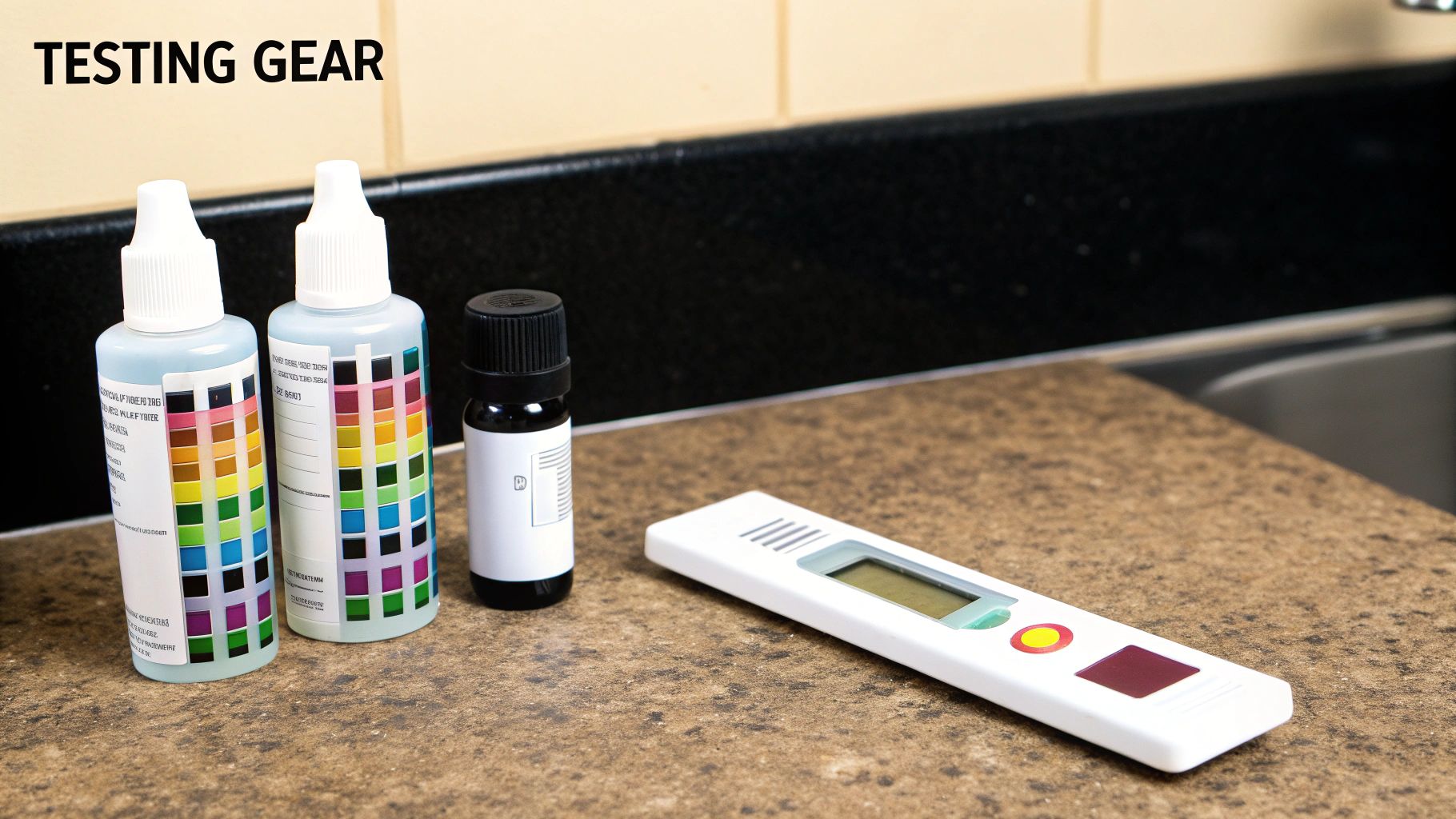
Test Strips: These are your go-to for a quick, affordable snapshot. You just dip a strip in a water sample, and the color changes tell you what's going on. They're perfect for getting a ballpark idea of general parameters like pH, chlorine, and water hardness. Fast and easy.
-
Color Disk Kits: If you need a bit more accuracy than a simple strip, these kits are a great middle-ground. You'll add a few drops of a reagent to your water, which changes its color. Then, you use a special viewer to match that color to a calibrated disk. They give you a much better read on specific things like iron or nitrates.
-
Digital Meters: For those of us who prefer a hard number over interpreting shades of blue, digital meters are the way to go. These handheld devices give you an instant, precise digital reading for things like Total Dissolved Solids (TDS) and pH. No guesswork involved.
Just remember, these kits are best thought of as screeners. A DIY test might flag the presence of lead, but it’s not going to tell you the exact concentration. That's a crucial piece of information for understanding your actual risk.
This infographic gives you an idea of just how common some of these water quality issues are for homeowners.
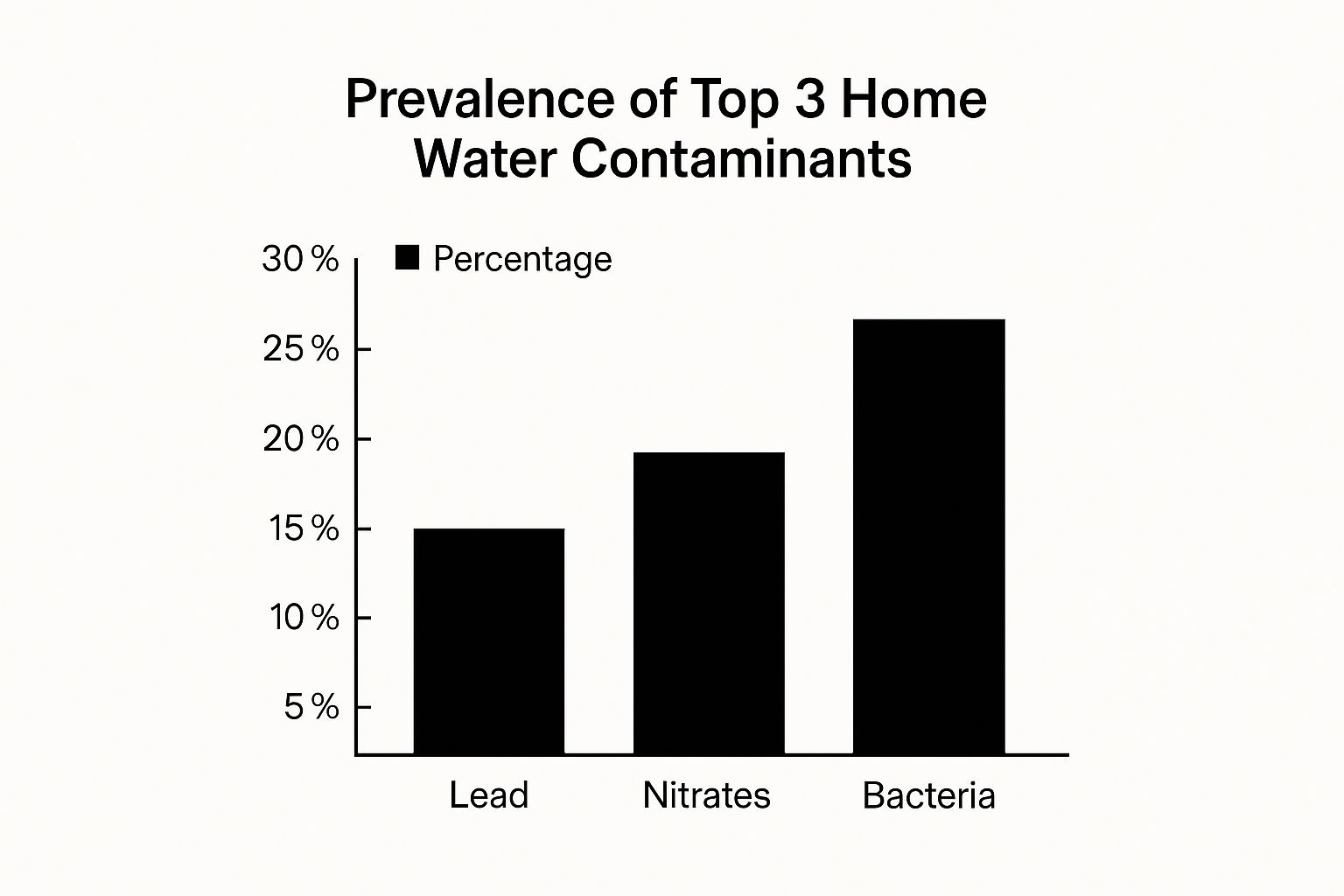
As you can see, invisible contaminants like bacteria are a real concern for many, which is why picking a reliable testing method is so important.
Comparison of Home Water Testing Methods
To make things even clearer, I've put together a simple table comparing the most common DIY water testing methods. This should help you quickly see the trade-offs between cost, accuracy, and what each test can actually tell you.
| Testing Method | Best For | Contaminants Detected | Accuracy | Cost |
|---|---|---|---|---|
| Test Strips | Quick, general screening and basic parameters | Chlorine, pH, hardness, nitrates, nitrites | Low to Moderate | $ |
| Color Disk Kits | More precise readings for specific contaminants | Iron, copper, ammonia, specific chemicals | Moderate | $$ |
| Digital Meters | Getting exact numerical data for certain metrics | Total Dissolved Solids (TDS), pH, temperature | High | $$$ |
| Professional Lab Test | Comprehensive, legally defensible, and precise analysis | Full spectrum including lead, arsenic, VOCs, bacteria, pesticides | Certified & Highest | $$$$ |
Ultimately, there's a balance to be struck between convenience, cost, and the level of detail you need. For a deeper dive into specific products and recommendations, you can explore our professional water testing services.
A home test kit is like taking your temperature when you feel sick—it tells you there might be a problem. A professional lab analysis is like getting a full diagnostic from a doctor—it tells you exactly what the problem is, how severe it is, and how to fix it.
When DIY Isn't Enough
Let's be clear: home test kits are incredibly useful for spotting red flags. If a test strip lights up for high nitrates or your TDS meter gives you a reading that’s off the charts, you've successfully uncovered a potential problem. That's a huge win.
But that's usually where their job ends.
These kits simply can't detect some of the most dangerous, complex contaminants out there—things like volatile organic compounds (VOCs), arsenic, or specific, harmful strains of bacteria. On top of that, their results are not certified. That becomes a major issue if you're buying a house or need to officially document a contamination problem.
This is the exact moment when you need to call in the pros. When you need definitive, accurate, and comprehensive results, our advanced laboratory testing services are the only way to get true peace of mind. We follow certified lab protocols to test for an extensive list of contaminants, giving you a detailed report and expert advice on what to do next to make your water safe.
How to Use Your Home Water Test Kit Correctly
Getting a reliable result from a DIY water test kit isn’t just about following the directions on the box. The whole effort hinges on how you collect the sample and run the test. Even a tiny mistake can throw off the results, giving you a false sense of security or causing unnecessary alarm.
To get this right, you have to think like a mini-scientist in your own kitchen. It's all about being meticulous to ensure the data you're getting is as accurate as your kit can possibly provide.
Preparing for an Accurate Sample Collection
The water you test needs to be a true snapshot of what you drink every day. That means collecting the sample without accidentally contaminating it with germs from your hands, gunk from the sink, or buildup from the pipes themselves.
First things first: wash your hands thoroughly with soap and water. Skip the hand sanitizer, though, as the alcohol can mess with some tests. If your kit provides a sterile container, be extra careful not to touch the inside of the bottle or the cap. That simple mistake can introduce bacteria and completely skew your results.
Next, you’ll want to prep the tap. Don’t just turn it on and fill the vial. The water that’s been sitting in your pipes overnight isn't what you typically drink, and it can contain higher levels of metals leached from the plumbing.
- Run the Cold Water: Let the cold tap run for a solid 3-5 minutes. This flushes out the stagnant water and pulls a fresh supply from your main line, which gives you a much better picture of your actual water source.
- Avoid Hot Water: Never, ever use the hot water tap for a test sample. Hot water heaters can be full of mineral deposits and sediment that have nothing to do with your cold water supply.
- Remove the Aerator: If you can, take a moment to unscrew the little screen (the aerator) from the tip of your faucet. These things can trap bacteria and debris that you definitely don't want in your sample.
The whole point of careful sample collection is to capture your water in its purest state, straight from the source line. Every step you take to prevent outside interference—from running the tap to handling the vial—directly boosts the reliability of your results.
Executing the Test with Precision
With your water sample in hand, the real work begins. Different kits, like test strips and reagent drop kits, have their own quirks. Precision is your best friend here, because small errors in this stage can lead to big misinterpretations down the line.
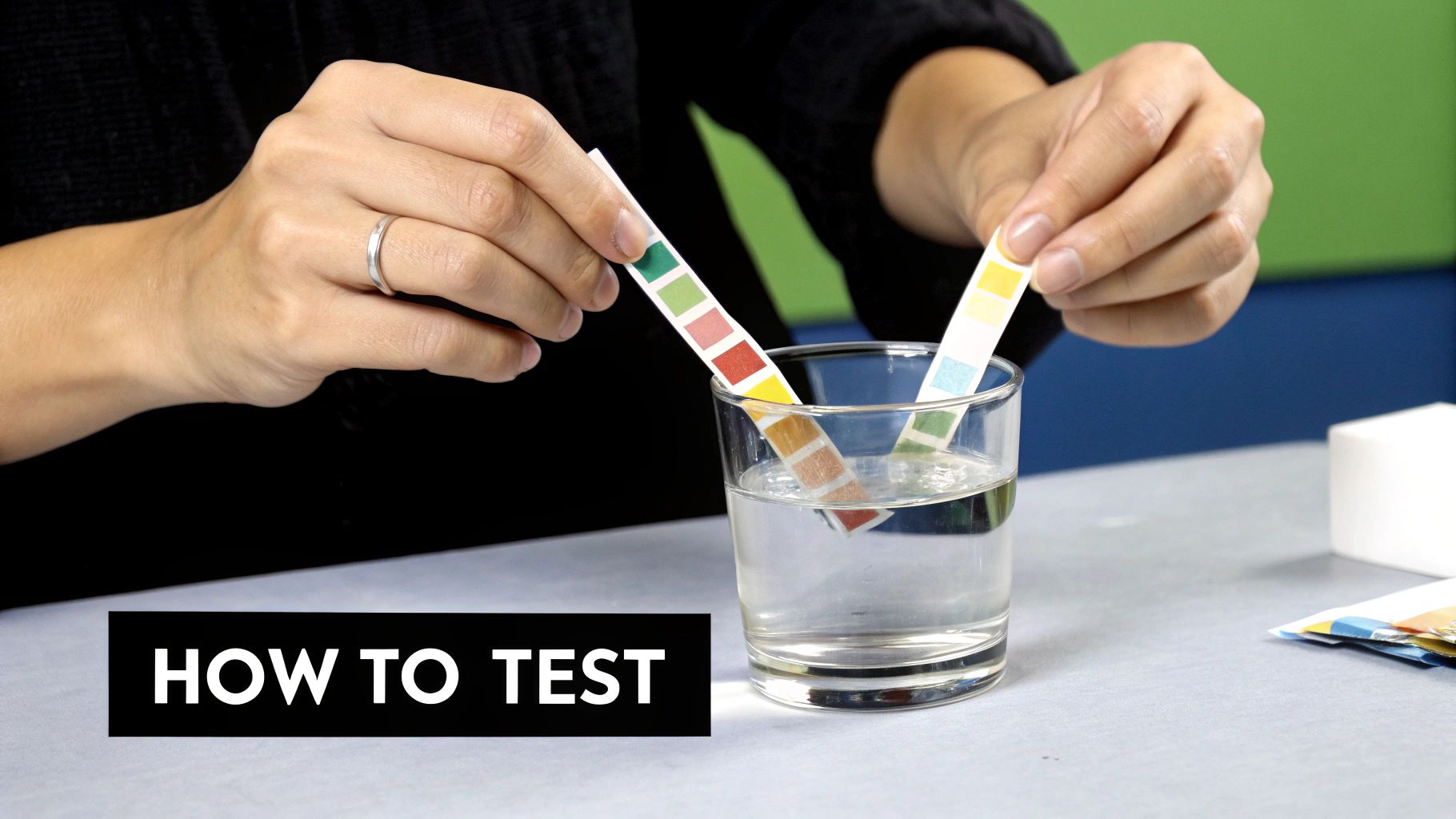
Take test strips, for example. Timing and lighting are everything. You need to dip the strip for the exact amount of time specified in the instructions—no more, no less. As soon as you pull it out, compare the color change to the chart. If you wait too long, the colors can keep developing and give you a false reading.
Here's a pro tip: always try to compare the colors in good, natural daylight. The yellowish glow of most indoor lights can make it surprisingly hard to tell the difference between subtle shades of green or blue on the chart. That could easily cause you to misread a critical result for something like pH or nitrates.
Common Mistakes with Reagent Drops
If you've opted for a kit with reagent drops—where you add a chemical to your water sample—the process demands even more attention to detail. These tests can be more precise than strips, but they're also way less forgiving of user error.
One of the most common mistakes I see is holding the dropper bottle at an angle. To get a consistent drop size every single time, you have to hold the bottle perfectly vertical over the vial. An angled drop is usually smaller, which means you're adding less reagent than required. The result? A weaker chemical reaction and a falsely low reading.
Another frequent slip-up is cross-contamination. If your kit tests for multiple things using different reagents, never let the tip of one dropper bottle touch the water sample. If it does, you could transfer chemicals back into the bottle and ruin it for any future tests. It's a tiny detail that makes a huge difference.
While these tips will help you get the most accurate reading possible from your kit, they also highlight the built-in limits of at-home testing. The strict protocols followed in a professional lab eliminate these kinds of variables. That’s why, for definitive answers—especially for serious concerns like bacteria or heavy metals—a professional water analysis is always the gold standard for your peace of mind and your family’s safety.
Making Sense of Your Water Test Results
You’ve carefully followed the instructions, collected your sample, and now you’re staring at a colored strip or a vial of tinted water. The chart is giving you a number, but what does it really mean? This is where a simple at-home test becomes a powerful tool, but only if you can connect the dots.
A number on a chart is just data until you link it to your family’s health and home. Interpreting these findings is the most crucial part of the process—it’s the moment you turn a chemical reading into a clear, actionable insight about the water you use every single day.
What Common Results Actually Mean
Your test kit likely screens for a handful of key indicators. Think of these results less as a final diagnosis and more as signposts pointing toward potential issues. Let’s break down what you might be seeing.
-
High Chlorine: If you get your water from a municipal supply, seeing some chlorine is perfectly normal—it’s the disinfectant used to kill germs. A high reading, however, is what causes that strong chemical taste and smell. It can also irritate sensitive skin and often indicates a recent "shock" treatment in the city’s system.
-
Hardness: This is a measure of dissolved calcium and magnesium. High hardness isn't a health concern, but it’s the reason you have soap scum in the shower, spotty dishes, and mineral buildup that can slowly destroy your appliances.
-
High Nitrates: This is a serious red flag, especially for homes with private wells. A high nitrate level often means agricultural runoff from fertilizers or contamination from a nearby septic system is getting into your water. This poses a significant health risk, particularly for infants.
-
Bacteria Presence: Any indication of bacteria, especially coliforms, demands immediate attention. It means your water source has been compromised somewhere along the line, which can lead to serious gastrointestinal illnesses.
It’s important to remember that even perfectly treated water can pick up contaminants during storage or handling right inside your home. Global studies show this is a widespread problem. For example, surveys in Bangladesh found that while 40.3% of water sources were contaminated at the collection point, that number skyrocketed to 81.9% by the time it was used in the home.
Your test kit result isn't a final grade; it's a conversation starter. It tells you what to ask next and, more importantly, when it's time to call in an expert for a much closer look.
The Limits of DIY Testing Become Clear
This is precisely where you’ll find the limitations of a home test kit. It might tell you that lead is present, but it won’t distinguish between a level of 5 parts per billion (ppb) and the EPA's action level of 15 ppb. That's a critical distinction when you’re making decisions about your family's safety.
Similarly, a positive result for "bacteria" doesn't tell you if it's a harmless strain or something more dangerous like E. coli. Without that specificity, you're left with more questions and a lot more anxiety.
When to Schedule a Professional Water Test
If any of your at-home test results come back showing levels outside the normal range, it’s time to stop guessing. A color-changing strip is a great first step, but it’s not what you should base critical health decisions on. The only way to be absolutely certain about your water’s composition is with a professional, lab-certified analysis.
A professional test gives you:
- Precise, quantitative results for a huge spectrum of contaminants.
- Detection of dangerous substances that DIY kits can't find, like arsenic, pesticides, and VOCs.
- Expert guidance to help you understand the report and choose the right filtration solution.
These detailed results empower you to take targeted, effective action. For example, if lead is confirmed, an under-sink reverse osmosis system can be a fantastic solution for targeted purification right at your kitchen tap.
Don’t let an ambiguous result leave your family’s health to chance. If your test raised any red flags, the next step is clear: Schedule your professional water analysis today. with our certified experts for a full-spectrum report and the definitive answers you deserve.
When It's Time to Call a Professional
Home test kits are fantastic for a quick, initial check-up. Think of them as a great first-line-of-defense, perfect for spotting obvious red flags right away. But there are absolutely times when a simple screening isn't enough. Certain situations call for the kind of precision and certainty that only a certified laboratory can deliver.
Knowing when to escalate from a home kit to a professional analysis is one of the most important parts of managing your home's water quality. The home kit might tell you that a door is unlocked, but a professional lab test can tell you who has the key, what kind of lock is on the door, and whether the frame is secure. When your family's health is involved, you want that complete picture.
Red Flags That Mean You Need an Expert
Some signs are too serious to ignore or leave up to the interpretation of a color-changing strip. If you encounter any of the following, it's time to bring in the experts.
- Your Home Test Results Are Vague or Worrisome: Did the strip show even a faint trace of lead? Or did the nitrate level look a little too high? Don't second-guess it. A professional test will give you a precise measurement, not a ballpark estimate.
- Something Is "Off" with the Water: If you suddenly notice a metallic taste, a rotten-egg smell, or a cloudy, murky appearance, that's your water telling you something is wrong. An expert can pinpoint the exact cause.
- Unexplained or Recurring Health Problems: Are people in your household dealing with ongoing stomach issues or skin irritation? Your water could be the hidden culprit. A professional lab can screen for a wide range of bacteria and contaminants that home kits miss.
- You Have a Private Well: This is a big one. Unlike city water, well water isn't treated by a municipality, which means you are 100% responsible for its safety. Annual professional testing isn't just a good idea—it's essential.
- You're Buying or Selling a Home: Certified water quality reports are often a standard part of real estate transactions, especially for properties with wells. This provides documented proof of water safety, offering peace of mind to everyone involved.
A professional water analysis isn't just another service—it's a critical investment in your family's health. It replaces guesswork with certified data so you can take the right action with confidence.
Why Professional Lab Analysis Is in a League of Its Own
The gap between a DIY kit and a professional lab test is huge. A home test might screen for a half-dozen of the most common suspects, but a certified lab can accurately identify hundreds of potential contaminants, often down to parts per billion.
The real value is in what the lab can find that a home kit can't even look for. We're talking about serious contaminants like:
- Volatile Organic Compounds (VOCs): These are nasty chemicals from things like industrial solvents, pesticides, or even fuel that can seep into groundwater.
- Arsenic and Other Heavy Metals: These can occur naturally in the ground, but they're toxic. You need sophisticated equipment for an accurate reading.
- Specific Strains of Bacteria: A lab can tell you not just if bacteria is present, but exactly what kind—like E. coli—which is critical for assessing the health risk.
- Pesticides and Herbicides: Agricultural and residential runoff can carry these chemicals into both well and city water supplies.
This kind of detail gives you legally recognized documentation you can rely on. Global data on water quality underscores just how complex the issue is. Between 2014 and 2020, studies across 27 countries revealed that many households struggled with reliable clean water, citing unreliability (75%) and inaccessibility (10%) as primary concerns. This really drives home the need to verify the safety of the water you control in your own home. Discover more insights about these global water quality findings.
When you need definitive answers, our professional water testing services deliver the comprehensive analysis required to truly protect your home. We rely on certified lab protocols to give you a full-spectrum report and expert guidance, ensuring your family’s water is clean, safe, and healthy.
Your Top Water Testing Questions Answered
We get a lot of questions about testing water at home. It can seem complicated, but it doesn't have to be. Here are some straight answers to the most common queries we hear, designed to give you the clarity you need.
How Often Should I Be Testing My Water?
This really depends on where your water comes from.
If you're on a municipal supply (city water), testing once a year is a smart move. It’s the best way to keep tabs on what's coming out of your tap and catch any new issues, like problems developing in your home's own plumbing.
For private well owners, the responsibility is all on you. You'll want to test annually for things like bacteria and nitrates. It's also a good idea to do a more comprehensive check every three years for other common contaminants. Of course, if you ever notice a sudden change in your water's taste, smell, or color, test it immediately.
Can I Really Trust an At-Home Test Kit?
Home kits are fantastic for a quick, initial check-up. Think of them as a screening tool. They're affordable and can give you a ballpark idea of what's going on, flagging obvious issues like high chlorine levels or very hard water.
But it's crucial to understand their limits. They simply can't match the precision of a certified lab. An at-home kit won't tell you the exact level of a contaminant, and it can't detect more dangerous things like pesticides or arsenic. When you need results you can stake your family's health on, a professional lab analysis is the only way to go.
My Test Showed High Chlorine Levels. What's Next?
Finding high chlorine is pretty common, since it’s the main disinfectant used in public water systems. While the levels are regulated for safety, a spike can create an unpleasant taste and odor or even irritate sensitive skin. A high reading might just mean the city recently "shocked" the system, but it could also point to a treatment imbalance.
Your best next step is to get a professional test to confirm the exact concentration. From there, one of our experts can walk you through the most effective filtration solutions to get your water back to tasting fresh and clean.
An at-home test kit is an excellent starting point, but a professional analysis is the definitive final chapter. It transforms a simple question mark into a clear, actionable plan for your family’s water safety.
Is Testing Well Water Different from City Water?
Completely different. Testing tap water is mostly about checking the quality after it's been treated by the city. You're looking for contaminants that might have been picked up on its journey to you, like lead leaching from old pipes.
Well water is a whole other story. It’s raw, untreated groundwater, and you are its sole guardian. A proper well test needs to be much more comprehensive, looking for:
- Bacteria like E. coli
- Nitrates from agricultural runoff
- Naturally occurring contaminants like arsenic or radon
Given the higher stakes and the total lack of municipal oversight, we always recommend professional lab testing for anyone with a private well. It's not worth the risk to guess.
When you need definitive answers about your water quality, Water Medic of Cape Coral provides the certified testing and expert solutions Southwest Florida has trusted for over 25 years. Don’t leave your family’s health to chance. Schedule your professional water analysis today.