
How to Fix Low Water Pressure in Your Home
That sad little trickle from your shower or kitchen faucet is more than just a morning annoyance. It's your plumbing system sending up a flare, signaling that something's not right. So many homeowners in Cape Coral just learn to live with weak water flow, not realizing it could be the first sign of a much bigger issue hiding in their pipes.
Let's put a number on it. Ideal water pressure for most homes is between 40 and 60 PSI (pounds per square inch). If you're consistently dipping below that, you're not just getting a disappointing shower—your dishwasher and washing machine are probably struggling to do their jobs properly, too.
Why You Can't Afford to Ignore Low Pressure
Tackling this problem now isn't just about getting a better shower tomorrow. It's smart, proactive home maintenance. The culprit could be as simple as a clogged faucet screen or as serious as a failing pressure regulator or a hidden leak. Catching it early can be the difference between a quick fix and a full-blown plumbing emergency requiring a professional plumber in Cape Coral.
Over the years here at Water Medic of Cape Coral, we've seen it all. But most of the time, the problem boils down to one of a few usual suspects:
- Clogged Aerators: The tiny screens on your faucets and showerheads are magnets for mineral buildup, which can easily choke off water flow.
- A Valve That's Not Fully Open: It sounds simple, but you'd be surprised how often we find that the main water shut-off valve or the meter valve has been partially closed.
- A Failing Pressure Regulator: This crucial device can wear out, leading to unpredictable pressure drops all over the house.
- A Hidden Water Leak: Even a pinhole leak somewhere in your system can cause a noticeable drop in pressure. Our team specializes in finding these hard-to-spot issues, and you can see how we do it with our professional leak detection services.
Before you start tearing things apart, it helps to have a quick reference for what might be going on. This table covers the most common issues we see and gives you a starting point for your investigation.
Quick Diagnosis: Common Causes and First Steps
| Potential Cause | Symptoms to Look For | Your First Action | Professional Help Needed? |
|---|---|---|---|
| Clogged Aerator | Low pressure at a single faucet or showerhead. | Unscrew the aerator, clean it with vinegar, and reinstall. | Usually not. |
| Partially Closed Valve | Sudden drop in pressure throughout the entire house. | Check your main shut-off and water meter valves; ensure they are fully open. | No, this is a simple DIY check. |
| Faulty Pressure Regulator | Pressure is too high or too low everywhere; sudden spikes or drops. | Check the gauge on the regulator (if present). Don't attempt to adjust it yourself. | Yes, regulator replacement requires a licensed plumber. |
| Hidden Pipe Leak | A gradual drop in pressure, an unexplained increase in your water bill, or damp spots. | Check your water meter for signs of continuous running when all fixtures are off. | Absolutely. Call a professional immediately. |
This table should give you a good idea of where to start. Sometimes the fix is straightforward, but other times, it's best to bring in an expert to avoid turning a small problem into a big, expensive one.
Trying to guess your way through a plumbing problem can be a costly gamble. A professional diagnosis from an experienced plumber is the quickest way to find the real source of the issue and get your water flowing properly again.
Think of this guide as your roadmap. We'll walk you through the simple checks you can do on your own and help you understand exactly when it’s time to pick up the phone and call for professional help. Our goal is to give you the confidence to figure out what's wrong and get that strong, steady water pressure back in your home.
Your First Line of Defense: Simple DIY Checks
Before you pick up the phone and assume you have a major plumbing disaster on your hands, let's walk through a few simple checks. We always tell homeowners to start here. More often than you'd think, the fix for low water pressure is something you can handle in a few minutes with zero cost.
A weak, sputtering stream from a single faucet? The first thing we’d bet on is a clogged aerator. It’s that little mesh screen at the very tip of your faucet. It’s designed to mix air into the water, but it’s also fantastic at catching all the tiny bits of sediment and mineral scale that flow through your pipes.
Cleaning Clogged Aerators and Showerheads
Getting that flow back is usually a breeze. Just unscrew the aerator from the faucet. If it's on tight, wrap a cloth around it and use a pair of pliers to protect the finish. Once it's off, take it apart and let the pieces soak in a small bowl of white vinegar for a couple of hours—this does a great job of dissolving all that crusty buildup.
After the vinegar soak, grab an old toothbrush and give the parts a good scrub to knock off any stubborn gunk. Rinse everything well, put it back together, and you should see a world of difference. For a more detailed guide, check out our post on how to clean and maintain your faucet aerators. A five-minute fix like this can save you a service call.
Check Your Shut-Off Valves
Now, if the weak pressure is happening all over the house, we need to think bigger. Our next stop would be the main water shut-off valves. You'll have one inside your home and another at the water meter near the street. It’s surprisingly common for these valves to get partially closed, maybe after some other work was done, choking off the water supply to the entire house.
Find your main shut-off valve—it’s usually in the garage, a utility closet, or the basement. Make sure it's turned all the way open. For a traditional wheel-style handle, that means turning it fully counter-clockwise. If you have a lever handle, it should be parallel with the pipe.
This is what a typical shut-off valve looks like. It needs to be completely open for your home to get full pressure.
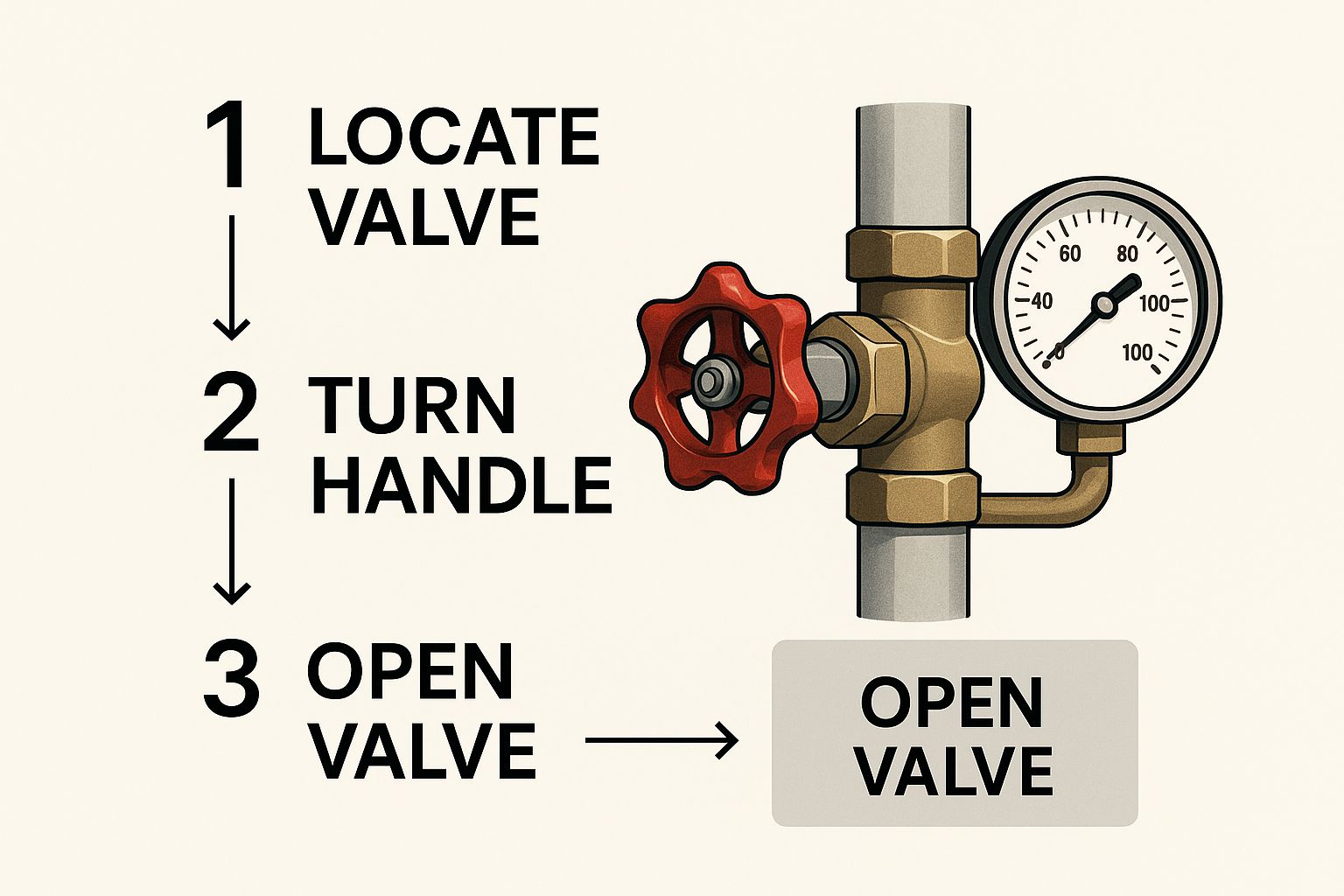
It seems obvious, but you’d be surprised how often our plumbers find a valve that’s only halfway open. Taking a moment to confirm this can save a lot of head-scratching.
A partially closed valve is just like a kink in a garden hose. The water source is perfectly fine, but the flow is getting pinched off right at the start. It's a simple fix that gets overlooked all the time.
By going through these simple steps, you'll either fix the issue yourself or arm yourself with crucial information. Knowing whether the problem is at one faucet or affects the whole house helps a pro from Water Medic pinpoint the real cause much faster if you do end up needing our help.
Digging a Little Deeper into Your Plumbing
If you've cleaned your aerators and checked the main shut-off valve with no luck, it's time to roll up your sleeves and investigate the core of your plumbing system. We're moving past the quick fixes now and into the components that really control your home's water pressure. While a handy homeowner can tackle some of these diagnostics, this is also where you start to see the line between a DIY project and a job for a professional.
When you're dealing with weak pressure in every single faucet, a faulty Pressure Reducing Valve (PRV) is one of the most common suspects. This bell-shaped valve is usually found right where the main water line enters your house, typically just after the main shut-off. Its entire job is to tame the high-pressure municipal water, stepping it down to a safe level for your home's pipes and appliances—usually somewhere between 40-60 PSI.
Finding and Checking Your Pressure Reducing Valve
Think of the PRV as a quiet workhorse. It does its job for years without complaint, but it doesn't last forever. Most have a lifespan of about 10-15 years. Over time, their internal parts can get gummed up with sediment or simply wear out, causing a slow decline or even a sudden drop in your water pressure.
Here are a few tell-tale signs that your PRV might be on its last legs:
- Consistently low water pressure everywhere in the house.
- Water pressure that seems to bounce up and down.
- A strange humming or vibrating sound coming from your pipes.
Adjusting a PRV can be tricky. If you crank it too tight, you risk creating dangerously high pressure that could damage your pipes, water heater, and washing machine. If your gut tells you the PRV is the problem, the best move is to have a professional from Water Medic of Cape Coral take a look. We can test it properly and replace it if needed as part of our comprehensive plumbing repair services.
The Sneaky Problem of Hidden Leaks
Another notorious pressure thief is a leak you can't even see. A tiny pinhole leak hidden behind a wall or under your concrete slab can siphon off just enough water to create a noticeable pressure drop. It's more than just an annoyance—it's a constant source of water waste that can lead to serious mold growth and structural damage.
You can run a quick, simple check for leaks using your water meter.
First, make sure absolutely everything that uses water is turned off. Double-check all faucets, toilets, the washing machine, dishwasher, and even the ice maker.
Next, head outside and find your water meter, which is usually in a covered box in your yard near the street.
Now, look closely at the meter's face. Most have a small triangle, dial, or wheel that acts as a leak indicator. If that little indicator is spinning, even just a tiny bit, it's a dead giveaway that you have a leak somewhere.
If you've noticed your water bill creeping up for no apparent reason, that's a huge red flag. When you pair an unexpectedly high bill with a gradual loss of water pressure, it’s a strong sign you need to act fast.
Pinpointing the exact location of a hidden leak requires specialized acoustic and thermal equipment—this is not a guessing game. This is where professional help is essential. Our team at Water Medic provides expert leak detection services to find the source of the problem accurately and without tearing up your home. Trying to find these leaks yourself often leads to a lot of frustration and unnecessary holes in your walls or floors. If your meter test points to a leak, give us a call. It's the smartest next step you can take.
When It's Time to Call in a Professional
Look, handling a clogged faucet aerator or making sure a shut-off valve is fully open can be a satisfying DIY win. But let's be realistic—some plumbing issues are just beyond a weekend warrior's toolkit. Knowing when to put down the wrench and pick up the phone is a critical part of being a smart homeowner. It’s not about giving up; it’s about protecting your home from potentially costly damage.
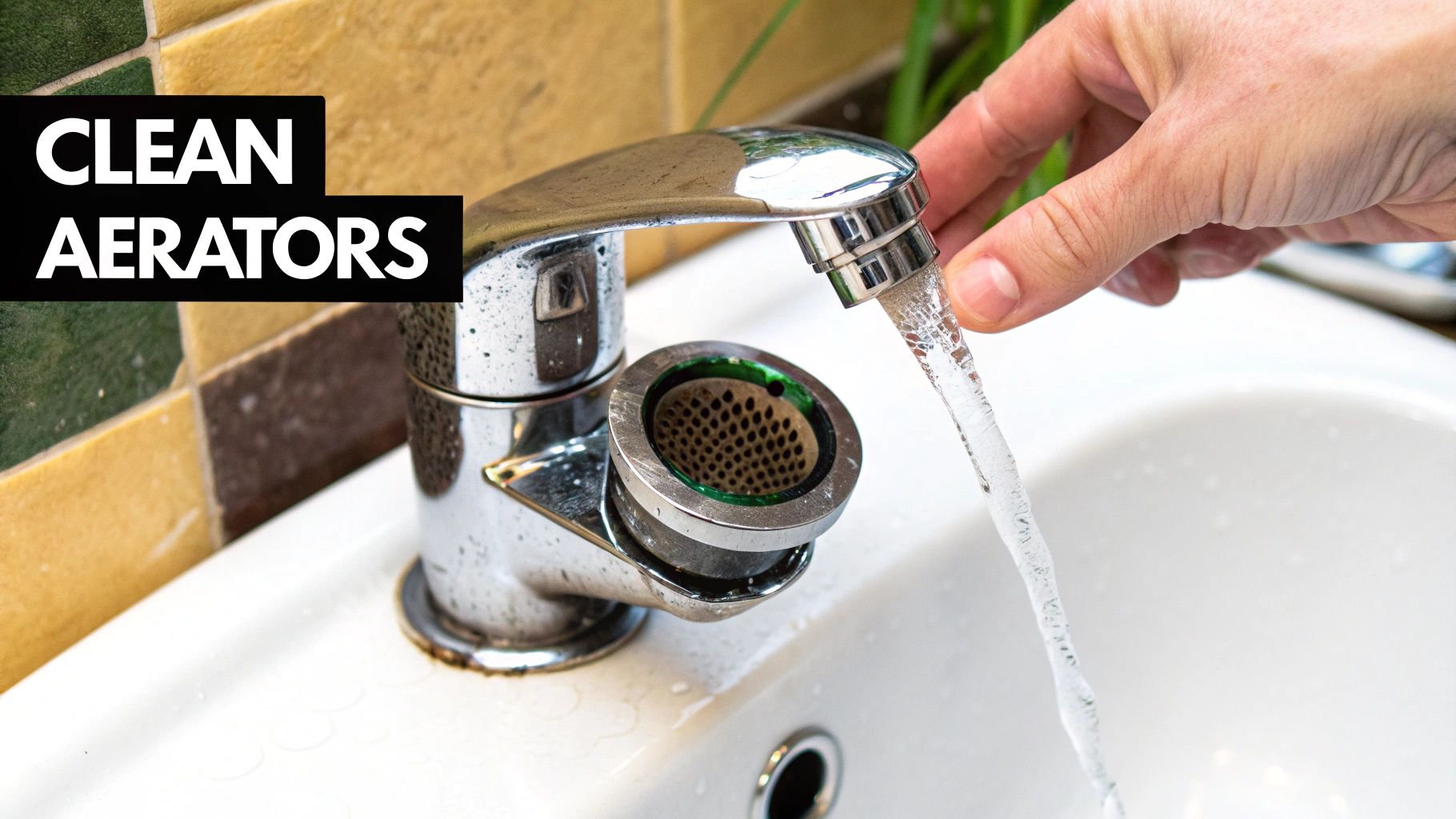
If you've run through all the simple fixes and your water pressure is still stubbornly low across the entire house, you’re likely dealing with a problem that requires specialized tools and a trained eye. This is where guessing games can get very expensive, very fast.
Telltale Signs of Deeper Pipe Problems
One of the biggest culprits we see, particularly in older Cape Coral homes, is good old-fashioned pipe corrosion. If your home dates back before the 1980s, there's a good chance you have galvanized steel pipes. Over the decades, these pipes rust and build up mineral scale from the inside out, slowly choking off the water flow. It’s like a clogged artery for your home.
You might be dealing with corroded pipes if you notice:
- Water that looks rusty or tastes metallic, especially for the first few seconds after you turn on a tap.
- Visible rust spots or flaking on any exposed pipe sections.
- A history of low pressure that has slowly but surely gotten worse over the years.
Tempted to pour harsh chemicals down the drain or blast it with pressure? Don't. You could easily break a weak, corroded spot and turn a pressure problem into a full-blown flood.
Expert Tip: Don't gamble with aging pipes. If you even suspect corrosion is the issue, a professional inspection is the only surefire way to know what you're dealing with and how to fix it safely.
When That Hidden Leak Is More Than Just a Drip
As we covered earlier, hidden leaks are notorious for tanking your water pressure. If you did the water meter test and it confirmed a leak, but there are no damp spots, puddles, or drips in sight, the problem is almost certainly inside a wall or under your foundation.
This is a clear sign to stop the search and call for backup. At Water Medic of Cape Coral, our plumbers use sophisticated diagnostic gear like acoustic listening devices and thermal imaging to find the exact source of the leak without tearing your home apart. This technology lets us target the problem with surgical precision, minimizing disruption and mess.
The Professional-Grade Solutions We Bring to the Table
When you call our team, you’re getting more than just a plumber with a wrench. You're getting an expert who can accurately diagnose whether the issue is a faulty pressure regulator, a deep-seated clog, or even a problem with the main supply line coming into your home.
Based on what we find, our recommendations might include:
- Pipe Descaling: A professional service that scours years of mineral buildup from the inside of your pipes, restoring their original flow capacity.
- A Full Home Repipe: For systems with severe corrosion or frequent failures, replacing old galvanized pipes with modern PEX or copper is often the best long-term solution. Our repiping services ensure your home has a durable, reliable plumbing system for decades to come.
- Advanced Diagnostics: We use the latest tools, which are part of a larger trend in smart water management. In fact, new advancements include automated sensors that can help stabilize pressure, which leads to major water savings and fewer complaints. You can read more about these smart systems to see how technology is changing water management globally.
At the end of the day, knowing how to fix low water pressure also means knowing when to call for a safe, correct, and lasting solution.
Considering a Water Pressure Booster System
Sometimes, the culprit behind your low water pressure isn't a hidden leak or a stubborn clog. It's just… your location. If your home is at the end of the municipal line, situated on a hill, or in a neighborhood with a consistently weak city supply, you’re fighting a battle you can't win with simple fixes.
When chronic low pressure is just a fact of life, a water pressure booster system can feel like a miracle. Think about it: a powerful, drenching shower to start your day, and a garden hose that actually reaches the back of the yard. That's what a booster system delivers.
At its core, the system is a pump and a pressure tank working in tandem. It takes the low-pressure water coming into your house, gives it a serious boost, and then sends it flowing to every faucet, showerhead, and appliance.
How a Booster System Restores Your Flow
While the technology has been around for decades, today’s systems are incredibly efficient. Back in the 1970s, these pumps were already capable of increasing water pressure by up to 50%. Fast forward to today, and plumbing industry reports show that over 80% of homes with a professionally installed system see a dramatic and lasting improvement.
But choosing the right one isn't as simple as grabbing a box off the shelf. The perfect booster pump for your home hinges on a few key things:
- The Size of Your Home: A sprawling house with three bathrooms needs a much more robust pump than a two-bedroom cottage to keep the pressure strong everywhere.
- Your Family's Water Habits: Do you have teenagers who take long showers while the dishwasher is running? Your peak water demand is a critical factor.
- The Existing Flow Rate: Before we do anything, we need to measure your current GPM (gallons per minute). This baseline tells us how much of a boost you actually need.
A water pressure booster is not a one-size-fits-all solution. A pump that's too strong can put a dangerous amount of stress on your pipes and joints, while one that's too weak is just a waste of money. Getting it right requires a professional assessment.
This is exactly why getting a professional installation is non-negotiable. A DIY or handyman job can easily lead to constant noise, frustrating leaks, or even severe damage to your entire plumbing system.
At Water Medic of Cape Coral, our technicians start with a thorough evaluation of your home's plumbing and your family's needs. We'll size the system perfectly and ensure a flawless installation for quiet, reliable, and blissfully high water pressure. You can explore our guide on the different types of well and booster pumps to see the kinds of solutions we can provide.
Common Questions We Hear About Low Water Pressure
At Water Medic of Cape Coral, we’ve heard just about every question you can imagine when it comes to low water pressure. It’s one of the most common and frustrating problems homeowners face. To help you get a better handle on what might be going on, here are some straightforward answers to the questions we get asked the most.
Why Is the Water Pressure Suddenly Low in Just One Faucet?
If you're dealing with a weak stream from just a single faucet—say, your kitchen sink—the good news is the problem is almost certainly right there at that fixture. It's not a whole-house issue.
The first and most common culprit is a clogged aerator. That’s the little screen right on the tip of the faucet where the water comes out. Over time, it gets gunked up with mineral deposits and tiny bits of sediment, creating a bottleneck. The fix is usually simple: just unscrew the aerator, give it a good soak in some vinegar, and scrub it clean.
If that doesn't do the trick, the issue might be the faucet's internal cartridge. When that gets clogged or goes bad, it can also choke off the flow. Replacing a cartridge is a bit more involved, so if you're not comfortable taking the faucet apart, that's a perfect time to give us a call for our expert faucet repair and installation services.
Can My Water Softener Be Causing Low Water Pressure?
Yes, absolutely. We see this one all the time. A water softener, especially if it's an older model or wasn't sized correctly for your home, can definitely restrict water flow.
The resin bed inside the unit is designed to filter minerals, but it can also trap sediment. When that bed gets clogged, it essentially acts like a dam in your plumbing system, reducing pressure for every fixture in your house. If you've noticed pressure slowly dropping over the years, or right after the softener was installed, the unit itself is a prime suspect. A Water Medic of Cape Coral technician can tell you for sure if it's clogged, malfunctioning, or just not the right system for your home.
What's the Average Cost to Fix Low Water Pressure?
This is the classic "it depends" question, because the cost can swing from a few cents to several thousand dollars. It all comes down to the source of the problem.
- Free Fixes: Cleaning out a clogged aerator? That just costs you a bit of time and a splash of vinegar.
- Minor Repairs: If your Pressure Reducing Valve (PRV) has failed, replacing it will typically run you a few hundred dollars.
- Major Work: The most serious cause is old, corroded pipes. In that case, a full home repipe is the only real, long-term solution, and that's a significant project.
The smartest money you can spend is on a professional diagnosis first. Throwing money at guesses—like replacing a faucet when the real issue is a bad PRV—is a waste. Getting an accurate assessment gives you a clear roadmap and an exact quote.
Should I Call the City About My Low Water Pressure?
Before you pick up the phone to call the city, do a quick check with your neighbors. Are they having the same issue? If everyone on the block suddenly has a weak trickle, then the problem is likely with the municipal water main. In that case, yes, calling your local water utility is the right move. It's their responsibility.
But if the problem is confined to your house, the responsibility is yours from the water meter inward. That's when you know the issue is somewhere in your own plumbing system, and it's time to bring in a professional to hunt it down.
Don't put up with the daily frustration of weak showers and trickling faucets. The expert team at Water Medic of Cape Coral has the experience and the right tools to find the real cause of your low water pressure and fix it for good.
Ready to get your flow back? Schedule your professional plumbing assessment today by visiting https://watermedic.com.