Your Guide to Home Water Quality Testing
Ever take a drink from your tap and wonder what you're really swallowing? Your water might look crystal clear and taste perfectly fine, but that doesn't tell the whole story. Hidden contaminants could be lurking, affecting everything from your family's health to the lifespan of your plumbing.
Testing your home's water quality isn't about being paranoid; it's about being informed. It moves you from uncertainty to empowerment, giving you a clear picture of what comes out of your faucet. A professional test is the first step toward getting the clean, safe water your family deserves.
Why You Should Test Your Home Water Quality
Think of your city's water report as a starting point, not the final word. It tells you the quality of the water as it leaves the treatment plant, but it can't account for the miles of pipes it travels through to get to your home—including the ones inside your own walls.
The only way to know what’s actually in your glass is to test it right at the source: your tap.
Uncovering Invisible Risks in Your Pipes
A lot can happen to water on its way to you. The journey from the municipal plant is long, and older infrastructure—both city-wide and in your house—can introduce problems that weren't there to begin with.
Here’s what might be happening after the water leaves the treatment facility:
- Lead Leaching: If your home was built before 1986, there's a good chance your plumbing contains lead. Over time, that lead can flake or dissolve into your drinking water.
- Localized Contamination: A sudden water main break down the street or nearby construction can introduce bacteria, sediment, and other unwanted materials directly into your supply line.
- Plumbing Corrosion: Water with an imbalanced pH can be corrosive, slowly eating away at your pipes and releasing metals like copper into your water.
Peace of mind comes from knowing exactly what’s in the water your family uses every day. A professional test provides a precise snapshot of your water's health at the most important point—your tap.
Beyond Health Concerns
Poor water quality isn't just a health issue; it can hit you in the wallet, too. Take hard water, for instance. It’s loaded with minerals like calcium and magnesium that, while not harmful to drink, can wreak havoc on your home.
This mineral buildup is the culprit behind stubborn soap scum, spotty dishes, and the chalky scale that clogs your appliances. That scale forces your water heater, dishwasher, and coffee maker to work harder, shortening their lifespan and driving up your utility bills.
More and more homeowners are catching on to these issues, which is why the demand for reliable testing is growing. People want to understand what's in their water and take control. You can discover more about this trend in water quality testing and see why it's becoming a priority. Our expert team at Water Medic is here to help you navigate it all and find the right solution for your home.
Choosing the Right Water Testing Method
When you're ready to find out what’s really in your water, you essentially have two paths for home water quality testing: you can grab a DIY kit from the store or call in the pros for a full lab analysis. Each has its pros and cons, and the best choice for you really hinges on what you’re worried about and how precise you need the results to be.
At-home kits are great for getting quick, ballpark readings. You'll usually find them as simple test strips that change color or sometimes as basic digital meters. They can give you a fast check on things like chlorine, pH levels, and water hardness.
But it's crucial to understand their limits. These kits are not designed to find the serious stuff—think lead, pesticides, or specific bacteria—with any real accuracy. They give you a hint, not a definitive answer.
The Limits of DIY Testing
A DIY test might tell you your chlorine is high, but it’s going to completely miss things like volatile organic compounds (VOCs) or heavy metals. The accuracy can be a bit shaky, and let's be honest, trying to match a tiny colored square to a chart can be subjective.
If you have a specific health concern or you're on a private well, a DIY kit should only be a starting point. Homes with well water, in particular, have a unique set of potential issues that a simple strip test just can't screen for. You can see what I mean by checking out some common well water questions.
The convenience of these kits is undeniable, though. With more people paying attention to water safety, the market for them is booming—it's expected to hit around $4.5 billion by 2033. This shows just how many homeowners are taking the first step to check for things like pH, hardness, nitrates, and nitrites on their own.
Deciding between a quick home test and a detailed lab analysis can be tricky. Here’s a straightforward comparison to help you figure out which method fits your situation.
DIY Test Kits vs Professional Lab Testing
| Feature | DIY Test Kits | Professional Lab Services |
|---|---|---|
| Accuracy | Provides a general estimate; can be prone to user error. | Highly accurate and precise, with results certified by technicians. |
| Scope | Limited to a few common parameters (e.g., pH, chlorine, hardness). | Comprehensive; detects a wide range of contaminants, including heavy metals, bacteria, and chemicals. |
| Speed | Instant or near-instant results. | Takes several days to a couple of weeks to get a full report. |
| Cost | Low initial cost, typically under $50. | Higher upfront investment, from $100 to several hundred dollars. |
| Best For | Quick spot-checks, general curiosity, monitoring basic softener performance. | Serious health concerns, homes with wells, real estate transactions, or getting a definitive baseline. |
Ultimately, while DIY kits have their place for quick checks, they can't replace the certainty that comes from a professional analysis.
Why Professional Lab Analysis is the Gold Standard
For a truly accurate and complete picture of your water, nothing beats sending a sample to a professional lab. When you work with a service like ours, you're not just getting numbers; you're getting a precise, scientific breakdown performed in a controlled environment. It completely removes the guesswork.
A professional test can detect an incredibly wide spectrum of contaminants, even in tiny amounts. We're talking about:
- Heavy metals like lead, arsenic, and copper
- Bacteria such as Coliform and E. coli
- Nitrates and nitrites, especially common in farming areas
- Industrial chemicals and pesticides
This infographic gives you a better idea of the kinds of things a comprehensive lab test can uncover in typical tap water.
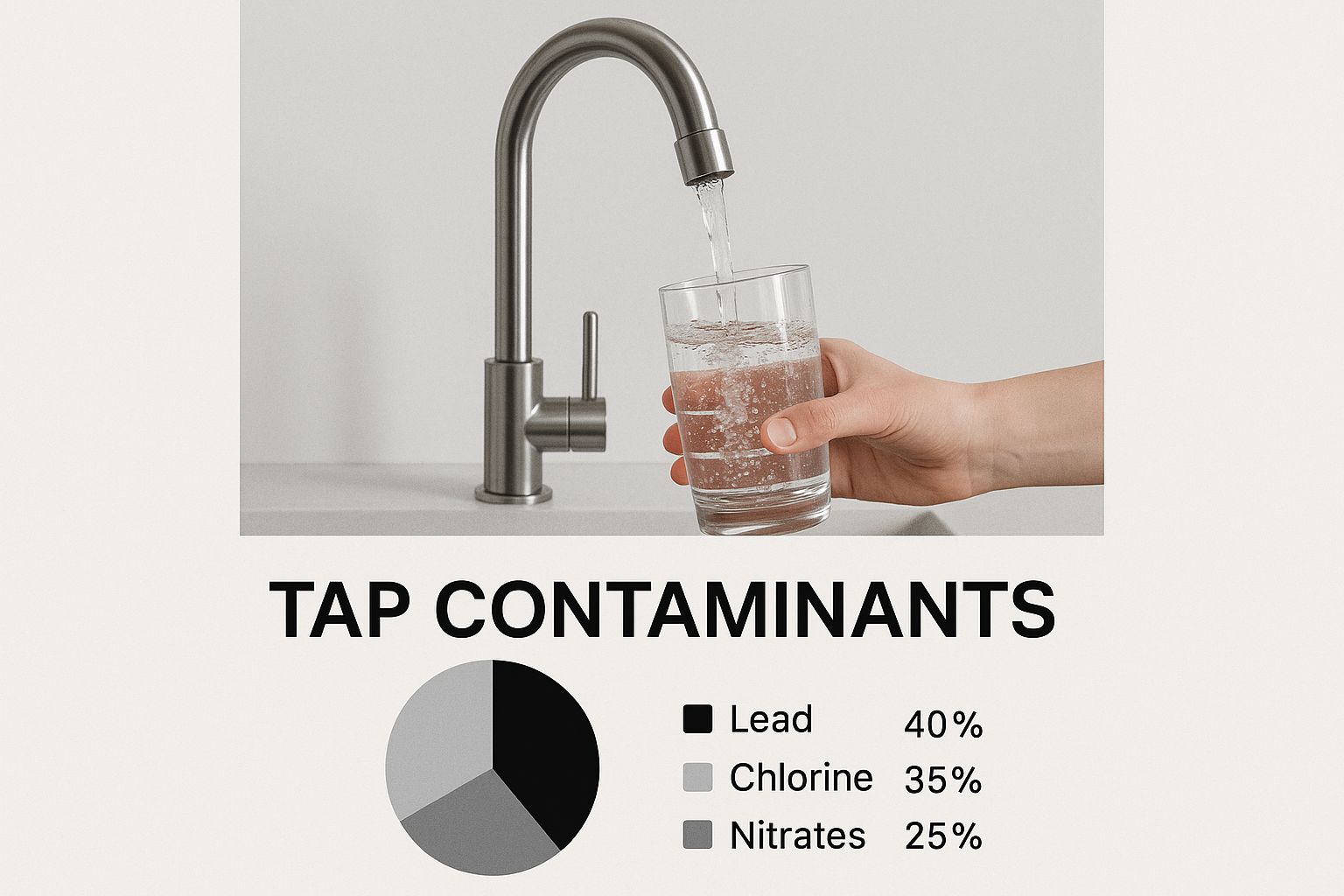
It’s a perfect illustration of how the most concerning contaminants are often the ones you can't see, taste, or smell. A lab report gives you the hard data needed to tackle these invisible threats head-on. By knowing exactly what’s in your water, we can recommend a solution that’s perfectly matched to your home’s specific needs, giving you total peace of mind.
How to Collect an Accurate Water Sample
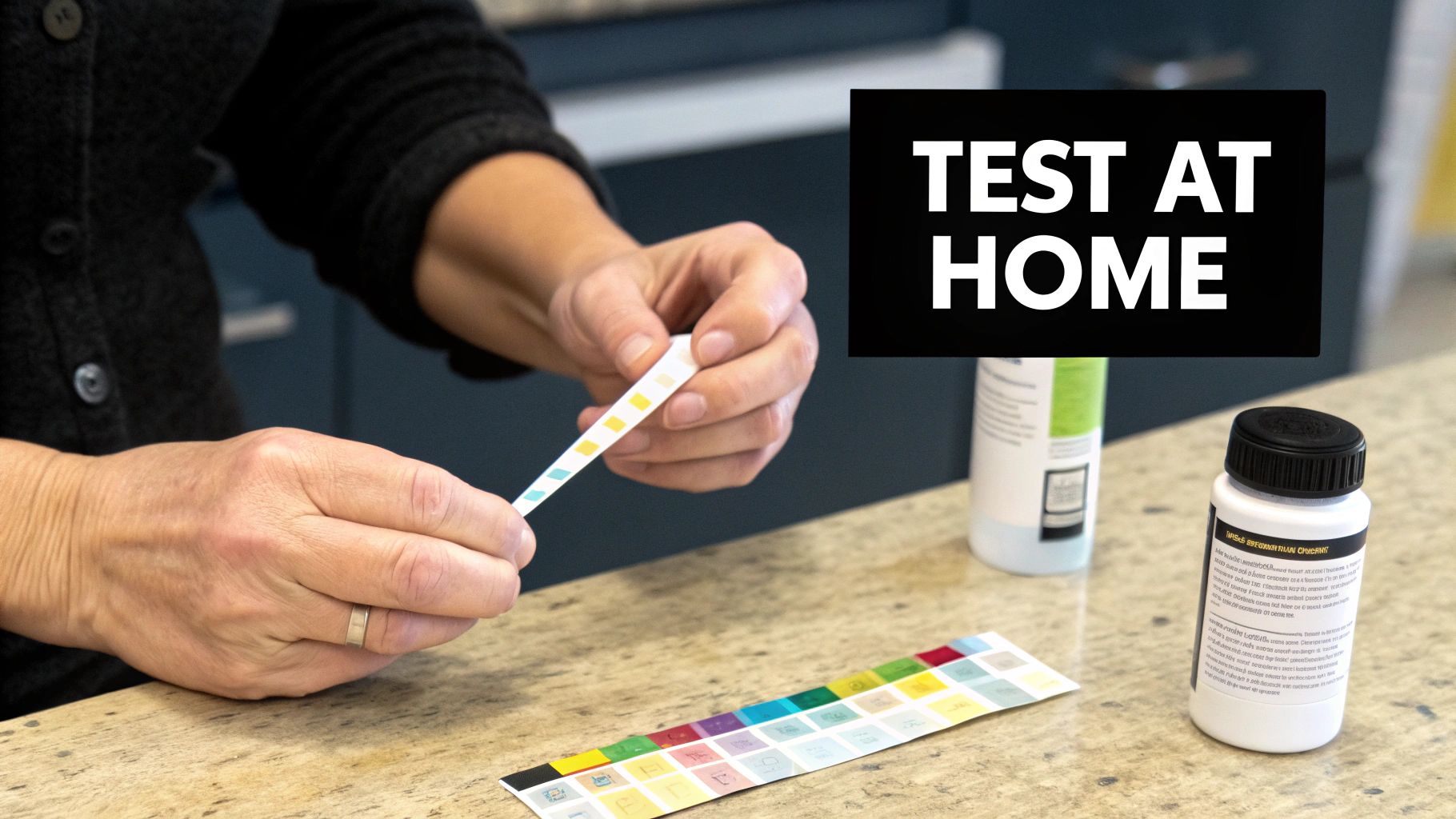
Here’s the thing about home water quality testing: your results are only as good as the sample you take. A poorly collected sample can give you completely misleading information, which is the last thing you want when you're trying to figure out the right treatment solution.
Think of yourself as a detective at a crime scene. Your job is to collect a pristine piece of evidence—a perfect snapshot of the water flowing through your pipes, untouched by outside contaminants. Whether you’re using a basic DIY kit or sending a sample to our lab, getting this first step right is everything.
Preparing Your Tap for Collection
Before you even think about filling that little bottle, you have to prep your faucet. Contaminants love to hang out on faucet aerators and in the stagnant water that sits in your pipes overnight. We need to get rid of them first.
Start by unscrewing any aerators, filters, or hose attachments from the faucet you’re testing. These can trap particles or even change the water's chemistry. Once the faucet is bare, turn on the cold water—and only the cold water—and let it run for a solid three to five minutes. This flushes out the old water and pulls in a fresh supply directly from your main line.
A classic mistake is grabbing a sample first thing in the morning. That water has been sitting in your pipes for hours, potentially leaching metals from the plumbing. It’s not an accurate picture of the water you use all day.
Best Practices for Contamination-Free Sampling
Now that the tap is ready, it’s time to collect. How you handle the sample container is just as important as flushing the pipes. The oils and microbes on your hands can easily contaminate a sample and throw off the results, especially for sensitive bacteria tests.
I’ve seen a lot of tests go wrong at this stage, so here are a few tips I always give people:
- Handle with care. Grab the collection bottle or vial from the outside. Never, ever touch the inside of the container or the cap.
- Don't rinse it out. Our professional kits, and many high-quality DIY ones, come with pre-treated containers. Rinsing them washes away preservatives that are essential for an accurate analysis back at the lab.
- Get the fill right. Hold the bottle under the stream without letting it touch the faucet. Fill it to the designated line, screw the cap on tight, and you're good to go.
Following these simple but critical rules is the key to getting reliable results you can actually trust.
Why You Might Test Multiple Faucets
Sometimes, a water issue isn't house-wide. If you notice a funny taste only coming from the kitchen sink, or discoloration in one specific bathroom, it’s a good idea to test more than one tap.
Comparing a sample from the "problem" faucet against one from a faucet that seems fine can help you diagnose the source. It tells you whether the issue lies with your home's main water supply or if it's isolated to a single fixture or pipe.
When you order our professional water testing services, the certified collection kit we send you has clear, foolproof instructions. We’ve taken all the guesswork out of it, ensuring the sample you mail back to us is perfect for a precise analysis. That way, the report you get is a true reflection of your water quality, allowing us to pinpoint the exact right solution for your home.
What Do These Water Test Results Actually Mean?
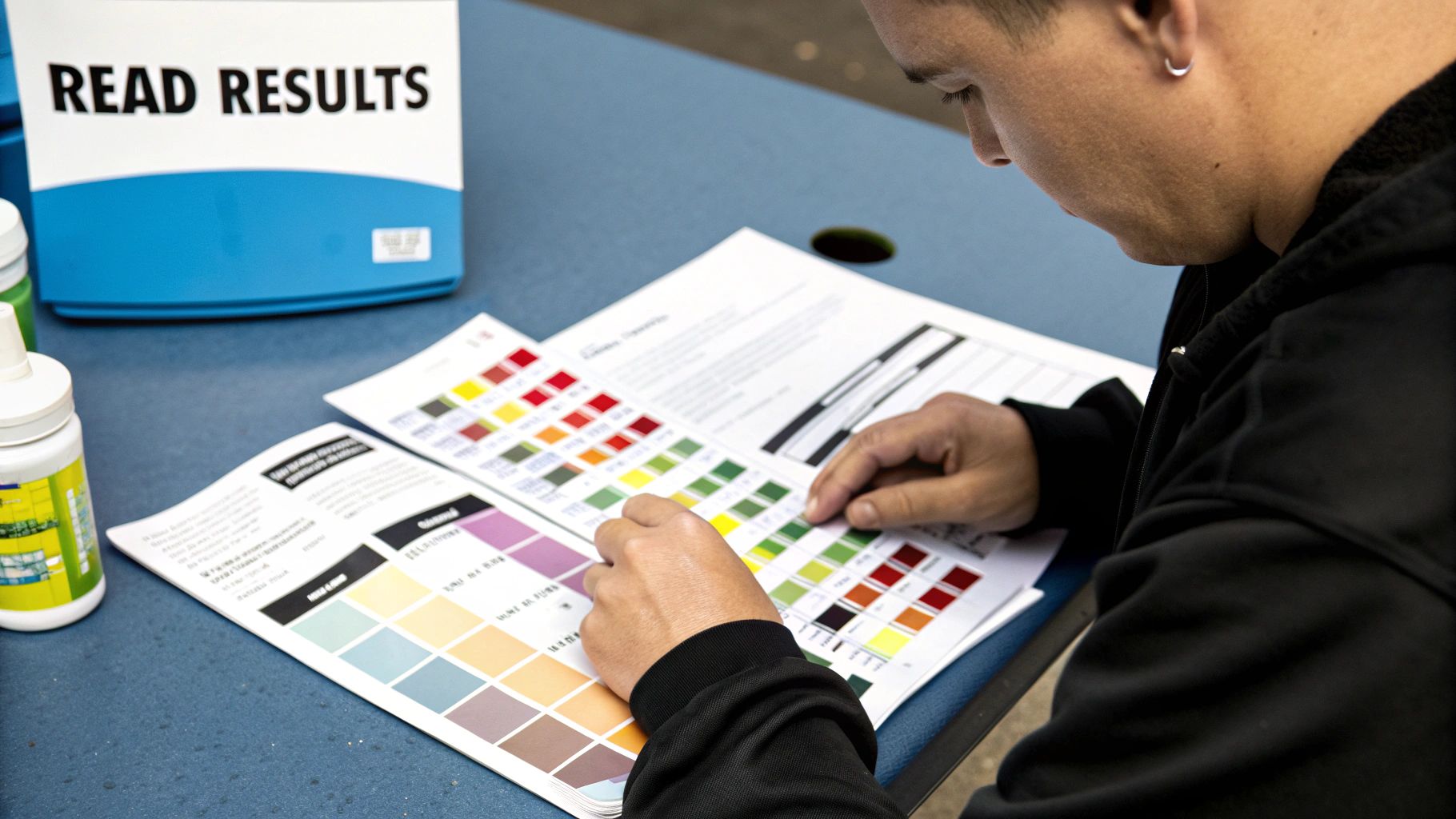
Getting your home water quality testing report back can feel like trying to read a foreign language. Suddenly you're faced with terms like "pH," "TDS," and "ppm," and it’s easy to feel a bit lost. But this is where the real work begins—translating those numbers into a clear picture of what’s in your water.
Think of each parameter on that report as telling a specific story about your water's journey from its source to your tap. Understanding that story is the key to choosing the right solution and making sure your water is not only safe but also pleasant to use day-to-day.
Making Sense of the Key Water Quality Numbers
Let's break down some of the most common measurements you’ll see on a water test. Knowing what these mean is the first step toward taking back control of your water quality.
You’ll find that some of these affect your family’s health, while others are all about protecting your home's plumbing and appliances from damage.
- pH Level: This is a simple measure of how acidic or alkaline your water is, on a scale of 0 to 14. Ideally, you want to be in the EPA-recommended range of 6.5 to 8.5. Water that’s too acidic (low pH) can be corrosive, which is a big problem if you have older plumbing, as it can leach lead and copper from pipes.
- Total Hardness: This number tells you how much dissolved calcium and magnesium is in your water. While it’s not a health risk, hard water is a major nuisance. It’s the culprit behind soap scum, scale buildup in pipes, and the reason your water heater and dishwasher might not last as long as they should.
- Chlorine: Your city adds chlorine to disinfect the water supply, which is a good thing. The downside? Too much of it can leave your water with that distinct "swimming pool" taste and smell, not to mention dry out your skin and hair.
- Nitrates: This is a big one for anyone on well water. Nitrates often seep into groundwater from agricultural runoff (like fertilizers) and can pose a serious health risk, especially for infants.
While a simple DIY test strip can give you a rough idea of some of these, only a professional lab analysis provides the precise numbers you need to make a truly informed decision.
Red Flags: Contaminants That Pose a Health Risk
Beyond general quality, a lab test is crucial for spotting the more serious threats—the ones you can't see, taste, or smell. If any of these show up on your report, it’s time to pay close attention.
High levels of certain contaminants aren't something you can just ignore. They often point to significant problems with your water source or even the plumbing inside your walls that need to be fixed right away.
The most frightening discoveries are often the ones that come with no warning signs. Lead is completely tasteless and odorless, and harmful bacteria can thrive in water that looks crystal clear. This is exactly why we advocate for professional lab analysis—it uncovers the hidden dangers.
Here are a couple of the most critical contaminants to look for:
- Lead: The science is clear: there is no safe level of lead in drinking water. Any detectable amount is a major cause for concern and usually signals corrosion in older pipes or fixtures.
- Coliform Bacteria: Finding these microorganisms in your water is a strong indicator that the supply could be contaminated with more dangerous pathogens, like E. coli.
If your results show your water is hard, the solution might be straightforward—you could start looking into the benefits of installing a quality water softener. But for more complex problems, the path forward isn't always so clear.
This is where our expert consultation really makes a difference. We don't just email you a confusing report and wish you luck. We take the time to walk you through it, line by line, explaining what each number means for your home and your family. We connect the dots between the lab data and a practical, real-world solution, taking all the guesswork out of the process and giving you a clear, personalized action plan.
Finding the Right Solution for Your Water
https://www.youtube.com/embed/b2uprymCOt4
Getting a home water quality testing report back is a huge first step. But the real work begins now: turning that information into a real solution. Think of your lab results as a precise roadmap, pointing you directly to the water treatment technology that will actually fix your specific problems.
This is where data becomes action. For instance, if your results confirm high levels of chlorine—the source of that "pool smell" in your tap water—the fix is often straightforward. A simple activated carbon filter is fantastic at absorbing chlorine and other chemicals that mess with taste and odor.
But what if you're dealing with hard water? If you see those stubborn white spots on your dishes or scale buildup in your coffee maker, you're fighting excess calcium and magnesium. In that case, you need a dedicated water softener. It’s built specifically to remove those minerals, which will protect your plumbing and make your water feel silky smooth.
Targeting Serious Contaminants
Now, if your test results bring back more serious news—like the presence of lead, arsenic, or bacteria—it’s time to look at more advanced filtration. These aren't just minor annoyances; they are direct risks to your family's health and demand a powerful, targeted response.
These more robust systems give you a higher level of purification for total peace of mind.
- Reverse Osmosis (RO) Systems: We consider these the gold standard for getting rid of a huge range of dissolved solids, including nasty stuff like lead, nitrates, and arsenic. RO technology works by forcing water through a special membrane that blocks even the tiniest contaminant particles.
- UV Purifiers: If your water test came back positive for bacteria, viruses, or other microorganisms, a UV purification system is your best line of defense. It uses powerful ultraviolet light to zap these pathogens without adding a single chemical to your water.
The best water treatment plan isn't a one-size-fits-all box you grab off a shelf. It’s a system designed and fine-tuned based on the unique chemistry of your water, as spelled out in your professional lab report.
From Testing to a Tailored Solution
Here at Water Medic, we believe testing and treatment are two halves of the same circle. Our team takes your specific lab report and uses it as a blueprint to engineer a custom water treatment system that directly neutralizes the contaminants found in your home. We don’t guess; we use hard data to build the right solution.
This data-driven approach is becoming more common. The global market for water testing and analysis is projected to be worth a massive $51.0 billion by 2035, and that growth is fueled by technology that connects testing data directly to home solutions. You can discover more insights about the water testing market's growth and see how the industry is shifting.
For homeowners who are facing a whole laundry list of issues, a comprehensive system is usually the smartest investment. You might be interested in learning how a whole-house reverse osmosis system works to deliver purified water to every single tap. By connecting the dots from testing to treatment, we make sure your family gets the clean, safe water they deserve.
Still Have Questions About Testing Your Water?
It's a lot to take in, and it's perfectly normal to still have a few questions floating around. Let's walk through some of the most common ones we hear from homeowners, so you can feel confident about what to do next.
How Often Should I Be Testing My Water?
This really comes down to where your water comes from.
If you have a private well, you're the one in charge of its safety—no city or county is checking it for you. That's why we strongly recommend getting a comprehensive lab test done at least once a year. It’s the only way to stay ahead of potential issues like bacteria or nitrate contamination that can change from season to season.
For those on a public water supply, your water is treated and regulated, so you can relax a bit. A good rule of thumb is to test every three to five years. That said, you should definitely test sooner if you notice anything off, like a new smell, a weird taste, or a change in color. It's also a smart move if you live in an older home with aging pipes or in an area near farms or industrial sites.
Is It Safer to Just Drink Bottled Water?
It’s a common belief, but bottled water isn't always the perfect solution people think it is. The quality can be all over the map depending on the brand, and the regulations can sometimes be looser than what your local tap water has to meet. And let's not forget the environmental toll of all that plastic and the never-ending cost.
Frankly, investing in a good water treatment system for your home is almost always a better long-term strategy. You get a reliable, permanent solution right at your tap, and it's often far more cost-effective than buying cases of bottled water year after year.
But What If My Water Looks and Tastes Totally Fine?
I get this question all the time, and it's probably the most critical one to address. Many of the most hazardous contaminants—things like lead, arsenic, certain pesticides, and bacteria like E. coli—are completely invisible. They don't have a taste or a smell.
Your senses are great, but they can't detect these hidden dangers. The only way to be absolutely certain your water is safe is to have it properly tested. Relying on how it looks or tastes can give a false sense of security, potentially exposing your family to health risks you're not even aware of.
Don't leave something as important as your family's health up to guesswork. At Water Medic, we provide certified, professional water testing that gives you a crystal-clear picture of what's coming out of your tap. Our experts will walk you through the results and help you find the right treatment solution for your home.