
Block Wall Cost: A Complete Guide for 2026
A typical block wall in Southwest Florida costs $15 to $30 per square foot installed, or about $60 to $240 per linear foot. Once you get into engineered retaining walls over 6 feet, drainage, reinforcement, and permitting can push that to $300 to $600+ per linear foot.
That wide spread is exactly why a Cape Coral homeowner can get one quote that looks manageable and another that feels absurd for the same property line. The wall isn't just concrete block. It's excavation, footing design, reinforcement, drainage, finish work, and the kind of code compliance that can't be skipped in Southwest Florida without paying for it later.
Why Block Wall Quotes Vary So Wildly in Southwest Florida
A homeowner in Cape Coral might call three contractors for what sounds like the same job, then get three very different numbers. One quote is for a simple decorative wall near grade. Another is for a retaining wall that has to hold back soil, handle drainage, and satisfy local requirements. Those are not the same project, even if they look similar from the street.
The wall type changes everything
A basic free-standing wall sits in the lower end of the market, while a retaining wall carries real structural responsibility. National pricing guides show typical installed costs around $15 to $30 per square foot or $60 to $240 per linear foot, but engineered walls over 6 feet can climb to $300 to $600+ per linear foot when drainage, reinforcement, and permitting are included. That gap exists because the contractor isn't just stacking block, they're building a structure that has to resist pressure and local site conditions.
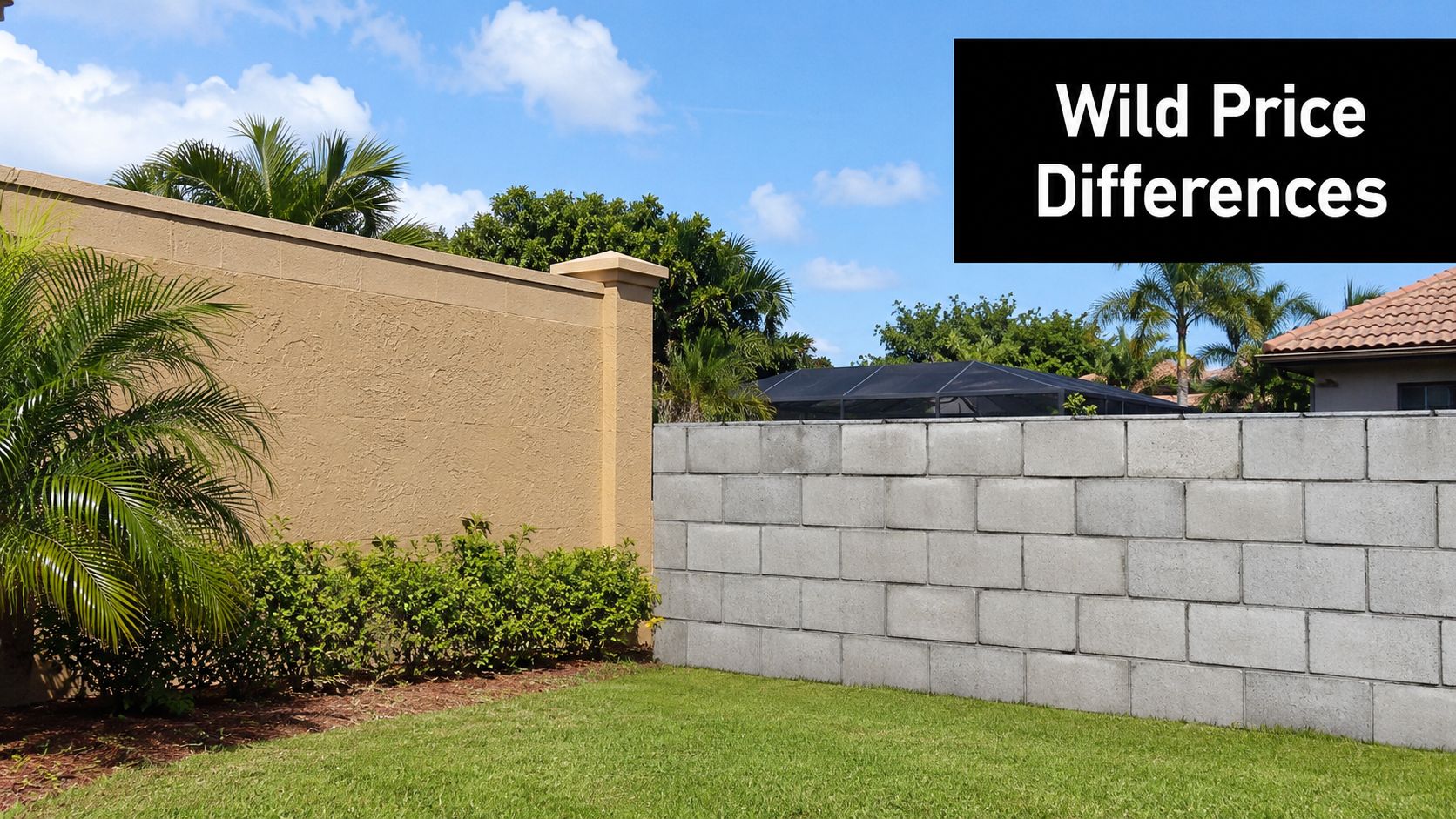
A lot of homeowners focus on the visible wall face and miss the part below grade. Footings, steel, grout, and drainage often make the difference between a quote that looks cheap and a wall that holds up. That's especially true in Southwest Florida, where high water and storm exposure make underbuilt walls a bad bet.
Practical rule: If one quote doesn't mention drainage, reinforcement, and permitting, it's not a real quote. It's a teaser.
Ask every bidder the same questions. Is it a garden wall, privacy wall, or retaining wall? Is engineering included? Are drainage details included? If the answers aren't specific, the number on the page doesn't mean much.
Current Block Wall Cost Ranges by Wall Type and Height
A homeowner in Southwest Florida can get a low-looking block wall quote that turns into a much bigger bill once the contractor adds drainage, reinforcement, and permit work. The wall type and the height drive that difference. A decorative garden wall and a structural retaining wall are not priced the same because they do not carry the same load, and taller walls need deeper footings, more steel, and more labor.
Real pricing bands homeowners should use
Current installed estimates put concrete block wall work around $15.11 to $19.61 per square foot in one national benchmark, while consumer-facing ranges commonly land around $15 to $30 per square foot and $60 to $240 per linear foot (HomeWyse). A 2025 pricing guide placed a typical backyard block wall at $4,000 to $18,000, with a midrange average of $9,500 for a wall about 6 to 8 feet tall and 30 to 50 feet long (LatestCost). Another market guide puts a common concrete or cinder block wall at about $80 to $150 installed per linear foot (The Site Math).
For planning, a 6-foot-tall, 50-foot-long basic hollow-core CMU wall is often estimated at $2,400 to $9,000, while larger projects often land in the $8,000 to $25,000 total range depending on finish and site conditions (Design Transition Studio). That spread is normal. It also shows why a quote with no dimensions is hard to trust.
| Block Wall Cost Ranges by Type and Height | Wall Type | Height Range | Cost Per Linear Foot | Cost Per Square Foot |
|---|---|---|---|---|
| Garden or privacy wall | Basic free-standing CMU | Lower to mid height | $60 to $150 | $15 to $30 |
| Standard residential wall | 4 to 6 feet | Common privacy height | $80 to $150 | $15 to $30 |
| Decorative split-face wall | 4 to 8 feet | Finish-driven projects | $70 to $280 | varies with design |
| Engineered retaining wall | Over 6 feet | Structural wall | $300 to $600+ | higher than basic wall bands |
A split-face block wall can run $70 to $280 per linear foot depending on whether it is a garden wall or a taller 4-to-8-foot wall. That is a finish premium, not a mystery. The wall still needs the same structural basics, but the face material and labor push the total up.
Height drives the jump
A 4-foot wall and an 8-foot wall do not scale evenly. Once the wall gets taller, footing size, reinforcement, and engineering matter more than block count, and that is where budgets start to move fast.
A quote should start with the wall's purpose. Decorative wall, privacy wall, or retaining wall. Then look at height. In Southwest Florida, that order matters more than the color of the block.
Material and Labor Breakdown for Block Wall Projects
A block wall quote that only lists one lump sum is obscuring the true cost. In Southwest Florida, the bill is split between materials, labor, and the extra work that comes with wet ground, drainage, and code-driven reinforcement. If a contractor does not spell those pieces out, you do not have enough information to compare bids.
What the material line actually includes
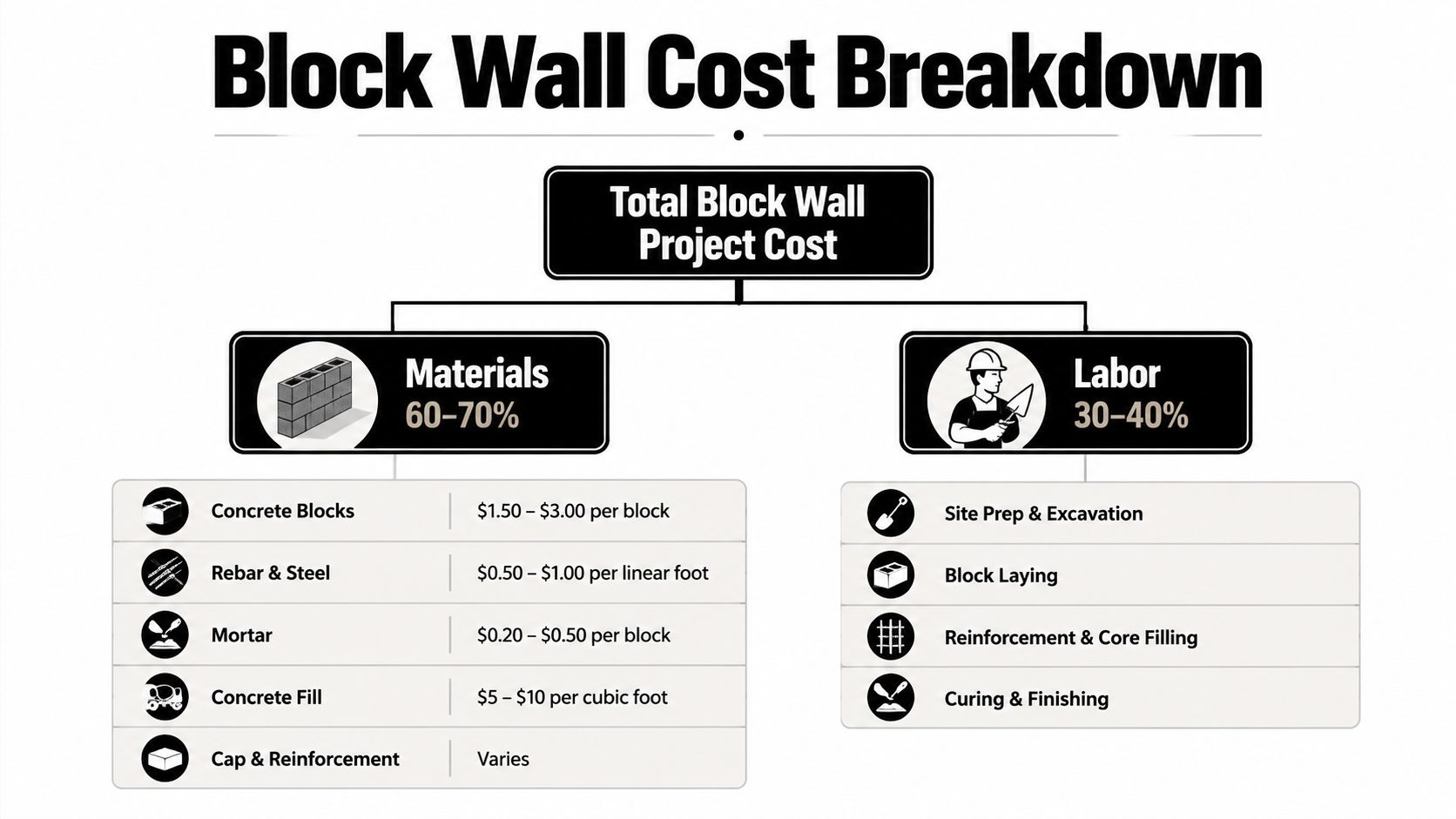
The material number starts with the block itself, but it does not stop there. Standard 8x8x16 CMU blocks are typically priced at $1.85 to $2.50 each. Type S mortar usually runs $10 to $15 per 80 lb bag, and grout fill lands around $6 to $9 per 80 lb bag. A standard 8x8x16 block covers about 0.89 square feet, so planners should budget roughly 1.13 blocks per square foot of wall area before waste, then add about 5% for breakage and cutting losses (HardhatCalc).
That count still leaves out the parts that drive a real job. Mortar yield, rebar spacing, grout fill, cap blocks, and footing concrete all move the total. Standard residential structural practice uses #4 vertical rebar at 48 inches on center and horizontal reinforcement in bond beam blocks every fourth course. That reinforcement is why a structural wall costs more than a simple stacked wall.
Labor is the big number
Labor usually takes the bigger share of the budget. Cost guides place materials at $5 to $13 per square foot and labor at $10 to $17 per square foot, which shows where the money goes (LatestCost). On a 350-foot, 6-foot-tall wall, one model projected 285 labor hours plus 18 footing hours and a total cost of $20,061. That kind of labor load explains why a quote that looks cheap often leaves out excavation, site prep, or finish work.
The labor side usually includes:
- Site prep and excavation, especially where access is tight.
- Block laying, which rises with wall height and turns.
- Reinforcement and core filling, which are required on structural work.
- Curing and finishing, which still takes time even when the wall is up.
A wall that looks simple on paper can turn labor-heavy fast if the site is tight, wet, or uneven.
That is the part homeowners miss. Raw block is not what blows up the budget. Site conditions and labor hours are.
Is Block Actually Cheaper Than Poured Concrete Over Time
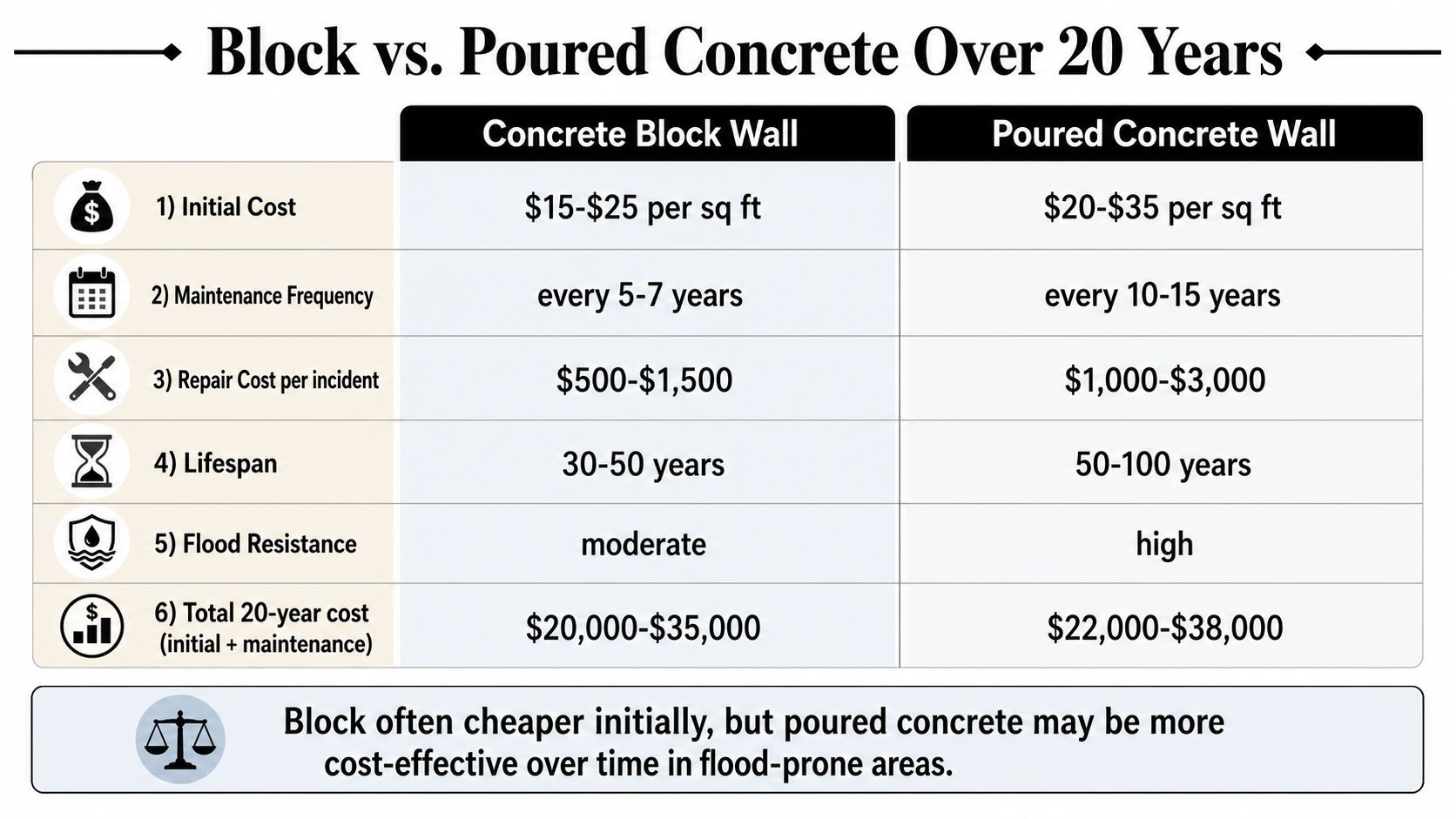
Block often wins on upfront price, but that's not the same thing as being the cheapest wall over the long haul. In Southwest Florida, a wall has to live in moisture, heat, and storm exposure. A material that looks cheaper on day one can become the more expensive choice if it needs more routine attention and repair.
Upfront cost is only part of the story
Comparative cost guides note that block walls may have lower initial material cost, while poured walls can be more durable and may reduce long-run repair costs because they have fewer joints and less routine maintenance (Seufert Construction). That matters because block walls rely on mortar joints, and mortar is where movement shows up first. Poured concrete removes a lot of those joints from the equation.
The decision gets sharper in moisture-heavy settings. In Florida, homeowners are not just buying a wall. They're buying resistance to weather, groundwater, and maintenance cycles. If the wall is serving as a retaining wall or a pool enclosure, durability should outweigh a small day-one savings.
Buy for the climate, not the brochure
A lot of consumer content treats block as the default. That's lazy advice. The right answer depends on how the wall will perform in your actual yard, on your actual soil, with your actual drainage constraints.
For buyers comparing options, I'd use this rule:
- Choose block when you need a strong, traditional masonry look and the wall is properly engineered.
- Choose poured concrete when long-term durability and fewer joints matter more than the lowest starting bid.
- Avoid price-only decisions on any wall that has to retain soil or stand up to persistent moisture.
That's the part most homeowners should care about. Not which wall is fashionable. Which wall stays serviceable with the least trouble over time.
Southwest Florida Factors That Drive Block Wall Costs Higher
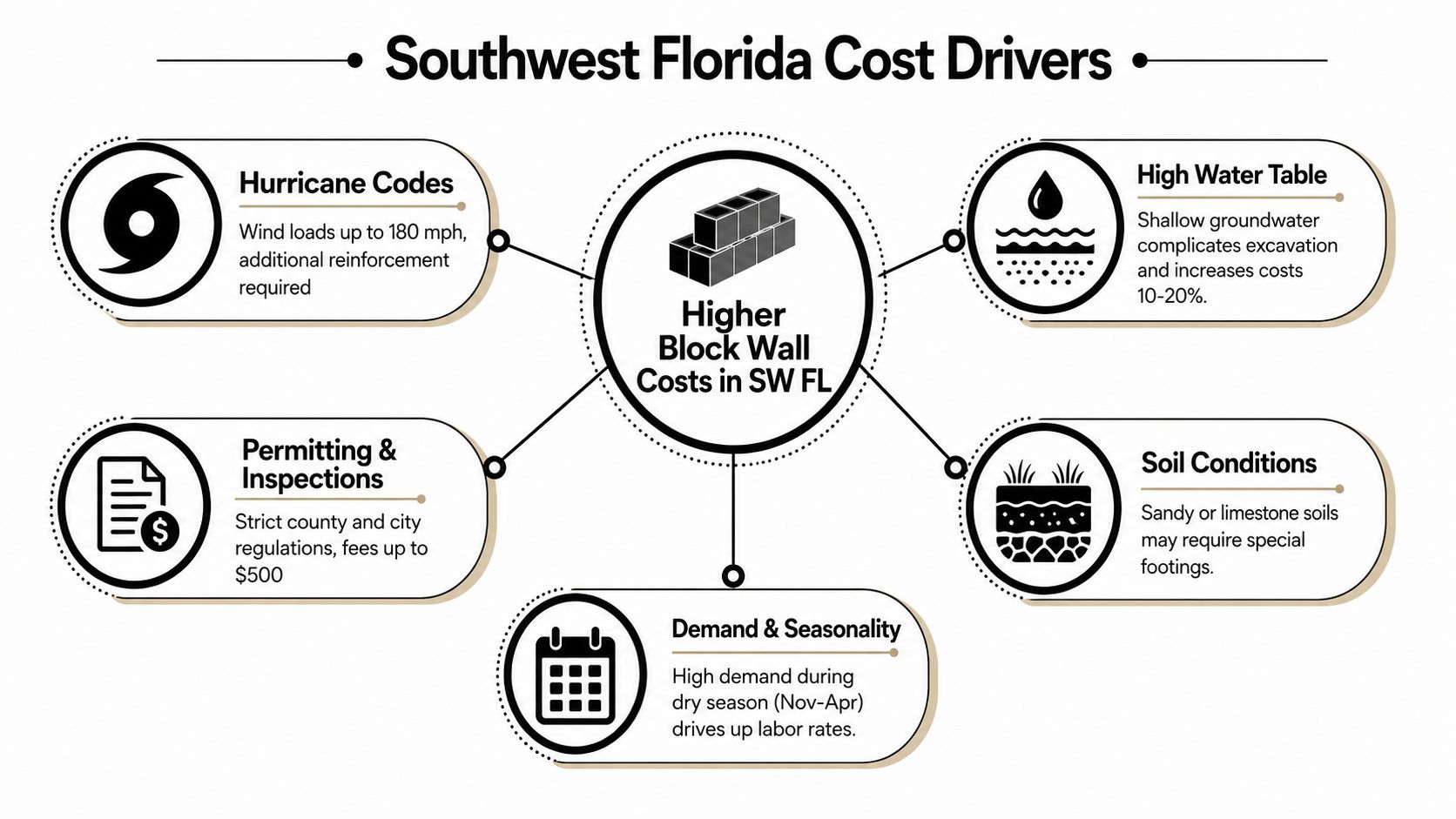
Southwest Florida doesn't price like a flat inland market. Cape Coral, Fort Myers, and Lee County have conditions that push block wall cost higher than generic national numbers suggest. The biggest drivers are simple, high water, sandy ground, hurricane requirements, and permit work that can't be skipped.
High water and soil conditions are budget items
National guides often ignore what happens when a site has a high water table or loose, sandy soil. In Southwest Florida, that means deeper footings, drainage planning, and more attention to reinforcement. Those are not premium upgrades. They're the cost of building a wall that belongs in this region.
The site work is where quotes separate fast. A cheap number might assume easy excavation and dry conditions. A real number assumes the wall may need more prep, more structure, and more time before the first block is set.
Code and permitting are not optional
Wall height changes the legal and engineering burden. Once a wall gets taller or serves a retaining function, the design must handle loads, drainage, and inspection requirements. That's why the local quote can jump from “pretty reasonable” to “why is this so high” in one line item.
The safest way to think about this is simple. If the contractor is building in Southwest Florida and doesn't talk about drainage, reinforcement, and permits, the quote is incomplete. A low number that ignores those items is the most expensive quote in the pile because it sets you up for change orders or a wall that doesn't belong on the site.
If your wall ties into a pool area or redesign project, coordinate the layout with your overall project plan. For homeowners thinking about backyard upgrades, this pool-focused resource is a useful starting point for keeping the whole property working together.
Local rule: In Southwest Florida, the best bid is the one that already assumes the hard parts.
That's the mindset that saves money here. Not chasing the lowest number, but making sure the contractor priced the wall you need.
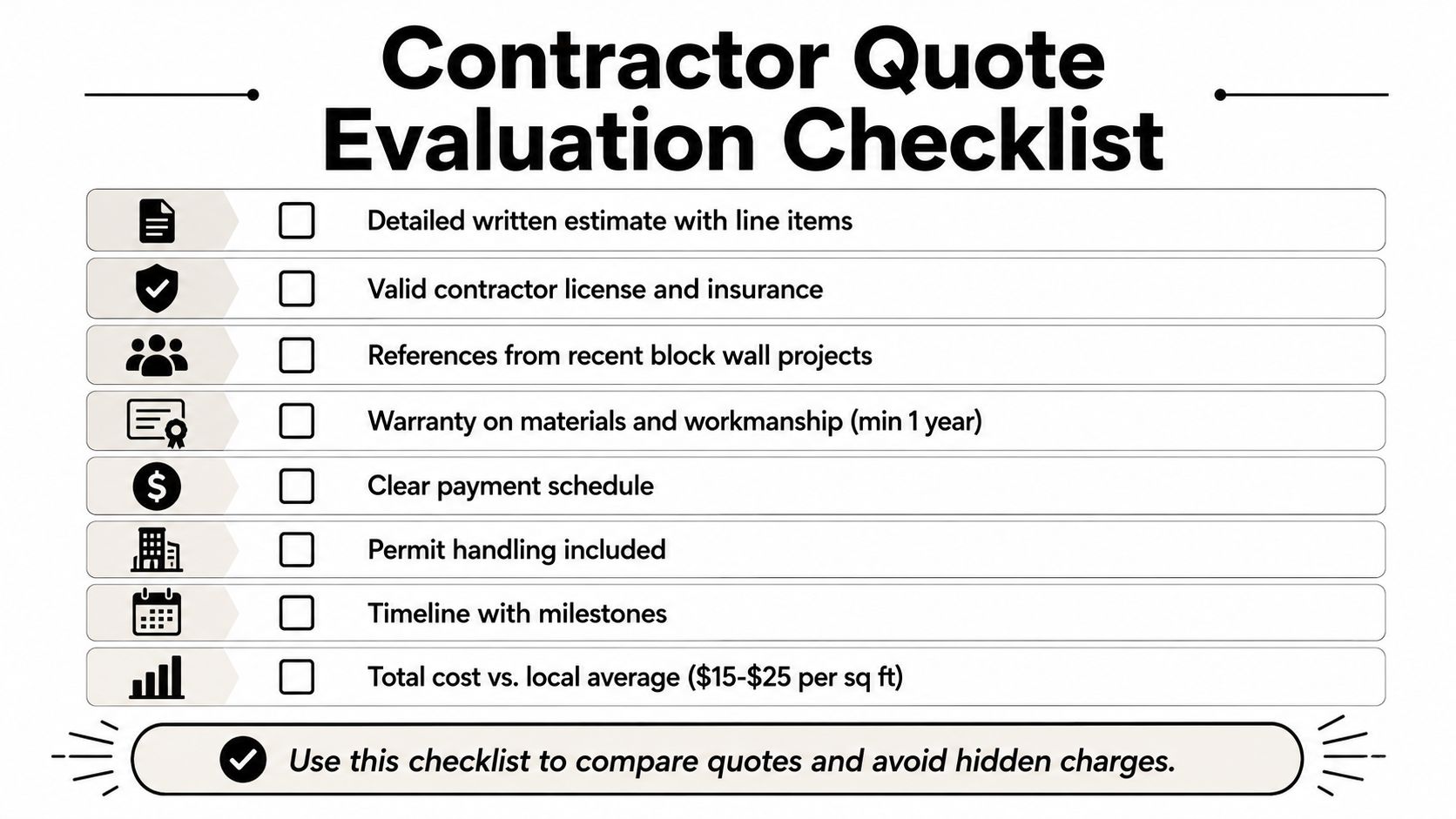
Your Contractor Quote Evaluation Checklist
A proper quote should read like a scope of work, not a guess. If you're comparing bids, the contractor needs to show exactly what's included so you can compare apples to apples. Otherwise, the cheapest estimate usually turns into the most expensive job after the first change order.
What every estimate should spell out
Start with the basics. The quote should identify the wall type, height, length, footing details, block type, reinforcement, drainage, and finish. If it's a structural wall, it should also say whether engineering and permits are included.
Use this checklist:
- Detailed written estimate with line items, so you can see material, labor, and extras separately.
- Valid contractor license and insurance, because masonry work is too expensive to trust to guesswork.
- References from recent block wall projects, especially in similar soil and drainage conditions.
- Warranty on materials and workmanship, with at least a basic written term.
- Clear payment schedule, so you're not front-loading risk.
- Permit handling included, if the project requires it.
- Timeline with milestones, so you know when excavation, build, and finish work should happen.
- Total cost versus local average, since a quote that's far below typical installed pricing needs a serious explanation.
Red flags that mean the bid is weak
A quote that skips drainage on a retaining wall is incomplete. A quote that says “block wall” but doesn't list height or reinforcement is incomplete. A quote that leaves permitting out of the total is incomplete.
If you want a financing option to help manage a larger project, this financing resource is worth reviewing before you sign anything. It's a smarter move than stretching a project with a thin scope just to hit a low monthly payment.
The best contractors don't hide the hard parts. They itemize them.
Investing in Proper Engineering and Drainage Up Front
Paying for proper engineering and drainage is cheaper than repairing a failed wall later. In a region with wet soil, storm pressure, and code scrutiny, skipping those details is a false economy. You're not buying paperwork, you're buying a wall that stays where it belongs.
Why the first build should be the final build
A wall built without enough drainage or reinforcement can create expensive problems that spread beyond the wall itself. Once a structure moves, cracks, or leans, repair work gets ugly fast. At that point, the owner is paying for demolition, rebuild, and cleanup instead of just paying once for a proper install.
The right approach is straightforward. Spend more on the front end for engineering, drainage, and correct reinforcement, and you reduce the chance of major corrective work later. That's the better investment in a market like Southwest Florida, where weather and water are part of the design, not afterthoughts.
If you're planning a wall as part of a larger property upgrade, use the wall design to support the whole site, not fight it. For service options that fit bigger residential and light commercial projects, see Water Medic of Cape Coral's services.
If you want a straight answer on your project, talk with Water Medic of Cape Coral and ask for help planning the right system around your home's real conditions. Visit Water Medic of Cape Coral to take the next step and get a solution built for Southwest Florida living.