
What Is a Submersible Well Pump: A Cape Coral Guide
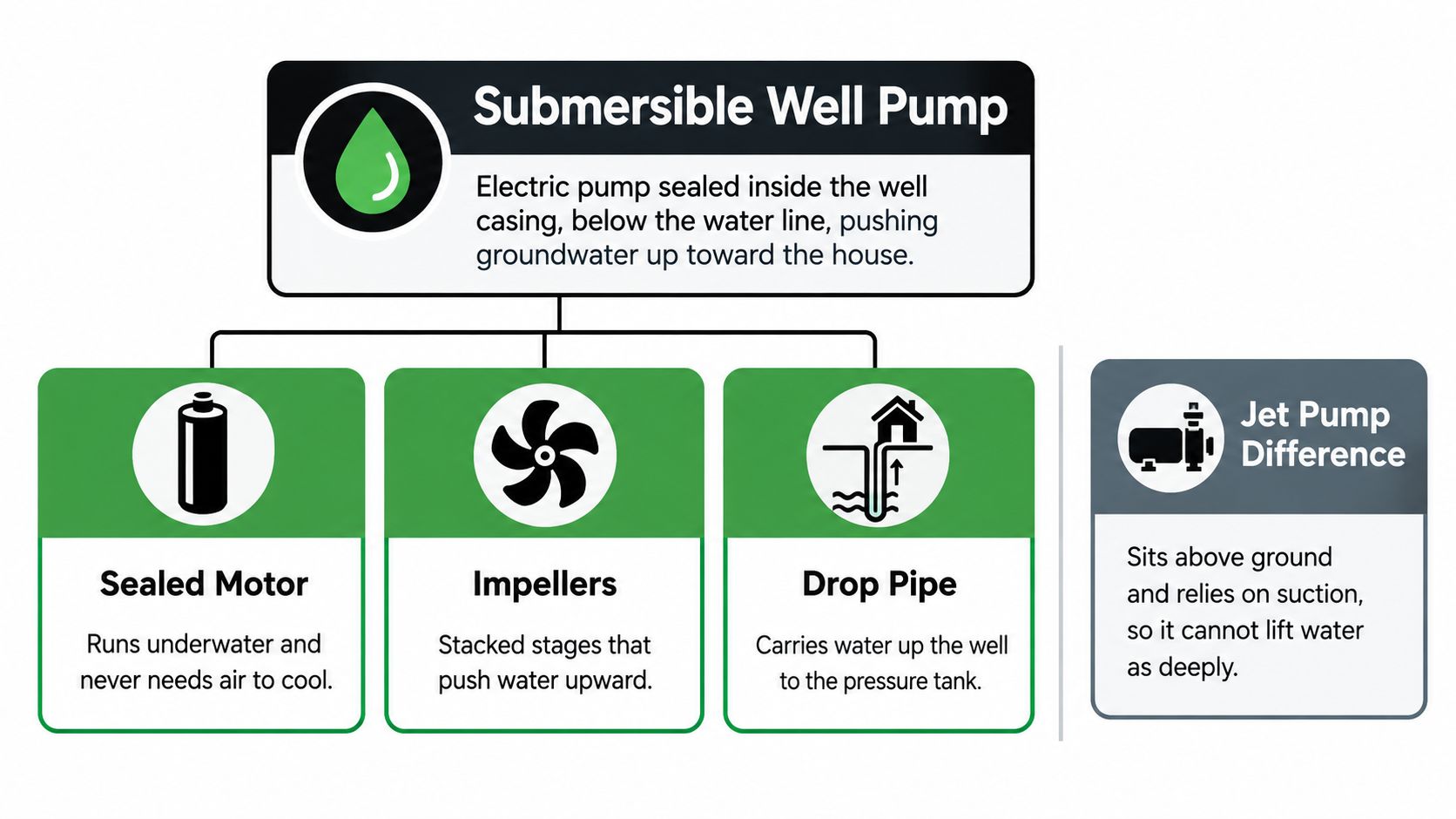
A submersible well pump is an electric pump sealed inside the well casing, below the water line, that pushes groundwater up toward the house, typically from depths of about 40 to 500 feet.
You turn on the kitchen faucet and the pressure seems fine, but the water tastes salty or leaves mineral residue on a glass. A working pump doesn't tell you whether that water is suitable for drinking or what treatment it needs. For a Cape Coral homeowner considering whole-house reverse osmosis, the right starting point is the water analysis and the equipment supplying it, not a bigger pump or a larger treatment package.
What a Submersible Well Pump Is and Where It Sits
The pump sits underwater inside the casing, with electrical power supplied from the surface. Unlike a surface pump, it pushes from below rather than relying on suction from above. Think of a straw that works from the bottom, with the pump acting like a hand squeezing water up the column.
The U.S. Environmental Protection Agency's private-well guidance identifies submersibles as the most commonly used pump type for deep private wells, describes a typical household unit as approximately 4 inches in diameter, and gives a usual pumping-depth range of about 40 to 500 feet. The EPA also explains that federal Safe Drinking Water Act requirements for public systems don't cover individual private wells, leaving owners responsible for testing and maintenance.
What the location means for you
The equipment stays out of the weather and occupies little yard space. The trade-off is access: replacing the submerged assembly generally means pulling the pump and drop pipe out of the well.
- Look at the surface equipment: A capped casing, electrical supply and nearby pressure tank can help identify the system without opening the well.
- Keep the records: The well log and pump installation paperwork tell a technician more than the appearance of the casing.
- Separate delivery from treatment: The pump supplies water; it doesn't establish water quality.
The point where that output meets whole-house water treatment deserves its own evaluation. Recognizing the equipment tells you where your water chain starts, not whether the water is ready to use untreated.
How the Pump Lifts Water Up and Into the House
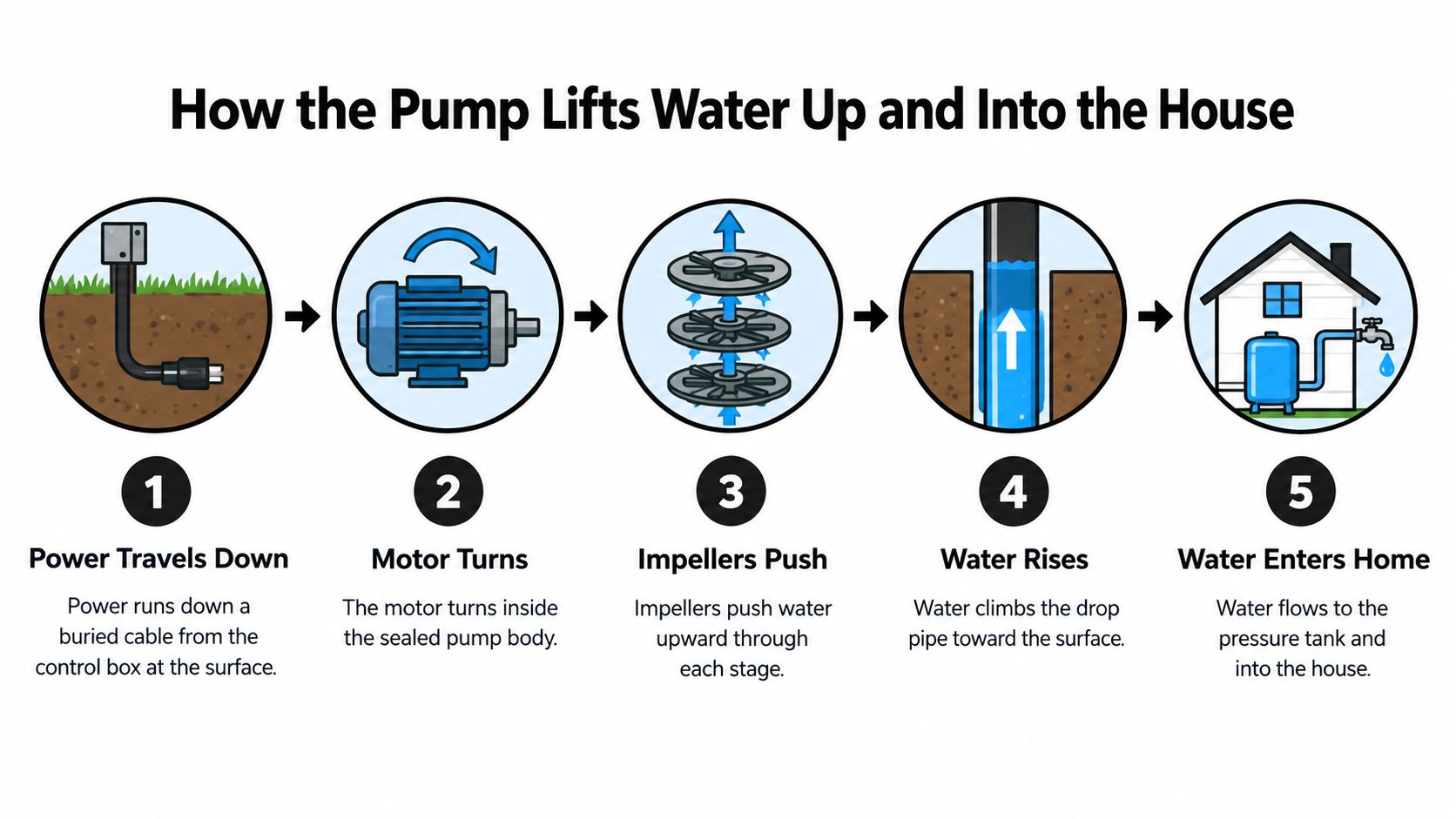
A submersible pump pushes water from below instead of lifting it by suction, so depth, lift and pipe friction matter as much as motor horsepower. The electrical and water paths work together:
- Power travels through the buried supply and down the drop cable, from the surface controls or control box where fitted.
- The motor turns inside its sealed housing. Water moving across the housing removes heat.
- Groundwater enters through the screened intake near the pump's lower assembly.
- Stacked impellers spin, adding pressure as water passes through successive stages.
- Water climbs the drop pipe toward the surface.
- A check valve holds the water column between operating cycles.
- The pressure switch starts and stops the motor at preset cut-in and cut-out limits; a technician confirms those limits from the switch and tank settings rather than assuming a standard range.
- The pressure tank provides an air cushion and stored pressurized water, so every small draw doesn't require a motor start.
Components worth identifying
- Underwater equipment: Motor, impellers, intake screen, drop pipe, check valve and drop cable.
- Surface controls: Pressure switch, pressure gauge and pressure tank.
Sizing requires more than reading the motor's horsepower. The U.S. Geological Survey's groundwater-well guidance describes the importance of flow, static and pumping water levels, well yield, lift, friction and required pressure; selection should be checked against the manufacturer's performance curve. A pump can look fine at the gauge while still sagging when several fixtures run at once, which is why delivered flow under load matters more than a reassuring reading with no water moving.
For the RO stage following the pressure tank, that distinction decides whether the rest of the water chain gets fed steadily or starves at peak demand. Surface equipment is accessible; submerged equipment isn't. If pressure, voltage, amperage and flow readings point below the casing, pulling the pump becomes a service decision, not a guess.
Submersible Pumps Compared With Other Well Pumps
Well pump types compared by location, depth and trade-off
| Pump type | Where it sits | Typical well depth | Main strength | Main trade-off |
|---|---|---|---|---|
| Residential submersible (4-inch) | Inside the well, below the water line | About 40 to 500 feet | Lifts from depth and stays out of weather | Service means pulling the pump and drop pipe |
| Multi-stage submersible (6-inch) | Inside a larger well casing, below water | Deep, high-yield wells | Higher flow from appropriate sizing and higher pressure from additional stages | Heavier assembly and higher installation cost |
| Shallow well jet pump | Above ground, in a sheltered equipment area or pit | Water level within the pump's rated suction lift | Easy service access | Cannot serve deep pumping levels; efficiency falls as lift increases |
| Deep-well jet pump | Ejector down the well, pump above ground | Within the manufacturer's ejector depth rating | Accessible motor and pump | Ejector arrangement reduces output as depth grows |
| Vertical turbine pump | Motor above ground, multi-stage bowls in the well | Deep wells and high-yield applications | Accessible motor | Long shaft and more components to maintain |
Read the table by pumping water level, not just drilled depth. A deep casing doesn't necessarily mean water must be lifted from its bottom.
Single-stage pumps suit lower-head duties; multi-stage assemblies use additional impellers to develop greater head. Fixed-speed equipment is simpler to control. A variable-frequency drive can hold pressure steadier, but slowing the motor also changes cooling conditions and adds electronic controls to maintain.
Selection rule: Match the pump to the well first, then match its delivered pressure and flow to the RO feed requirements.
The practical sequence is to confirm depth and yield, establish the treatment system's feed demand, then choose the pump arrangement. A submersible is the usual starting choice unless a shallow water level makes an accessible jet pump appropriate.
When buying a property, check for a shallow jet pump serving a pumping level beyond its rating. That mismatch can leave an otherwise suitable RO system without dependable feed pressure.
Why Pumped Well Water Needs Whole-House Reverse Osmosis
A pump can perform perfectly while delivering water containing dissolved salts, minerals and sediment. Whole-house reverse osmosis addresses water quality before treated water is distributed throughout the home. Whether it's necessary depends on the laboratory report and the homeowner's treatment goals, not merely the presence of a private well.
RO uses pressure to move water through a semipermeable membrane. Think of a strainer built for molecules, although actual membrane separation is more complex than particles passing through visible holes. The system produces treated water and a separate concentrate stream carrying rejected substances.
What membranes can and can't establish
The ANSI explanation of reverse-osmosis treatment describes RO as demineralization or deionization and discusses reductions involving salts, particles, chlorine, dirt and certain microorganisms. It also states that the standard applies to water already known to be microbiologically safe and of known quality. That limitation matters: membranes don't replace testing or a properly designed disinfection plan.
In a practical installation, separate pretreatment stages handle substances that could foul or damage the membrane. Sediment filtration, iron treatment, softening or carbon treatment may be appropriate, but each stage needs a reason. Adding equipment without matching it to the incoming water increases maintenance without necessarily improving results.
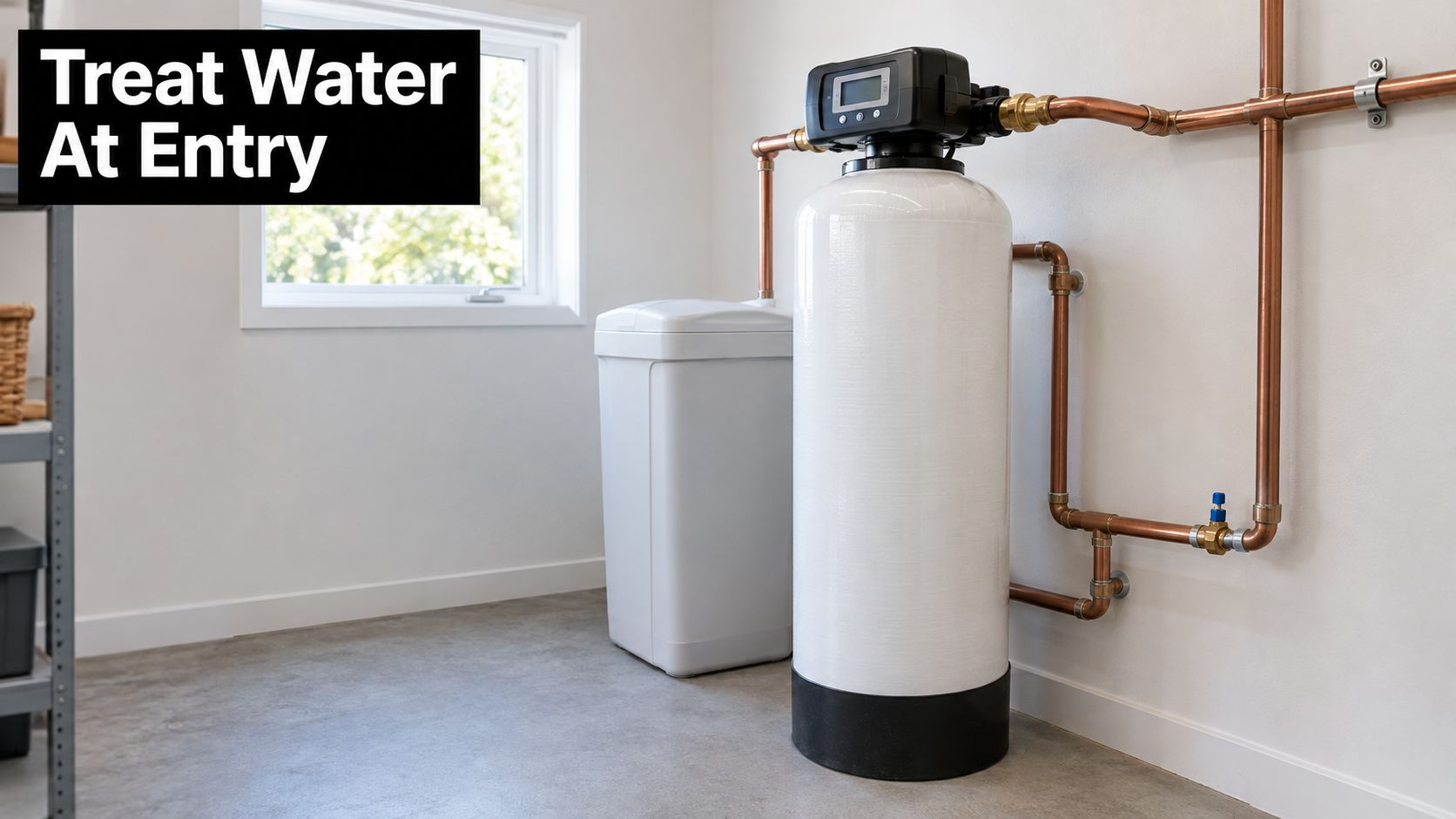
The softener pictured is a possible pretreatment component, not an RO membrane system. Softening addresses hardness; it doesn't provide the same dissolved-solids reduction as reverse osmosis.
Ask for performance tied to the equipment
NSF's explanation of NSF/ANSI 58 covers material safety, structural integrity, efficiency, recovery and required TDS reduction, while claims for contaminants such as arsenic, nitrate, lead and fluoride require applicable testing. The standard addresses point-of-use systems, so its name alone doesn't establish performance for a whole-house configuration.
Ask for documentation covering the exact equipment proposed. A certification mark isn't proof that every contaminant on your report will be reduced.
Clear water and steady pressure aren't proof of safe water. Match the treatment claim to the substance the laboratory actually found.
The pump and pressure tank must supply dependable feed conditions, while the treatment designer determines whether membrane boosting, treated-water storage and repressurization are needed. The well pump doesn't necessarily provide the membrane's full operating pressure.
RO sends part of its feed to a concentrate discharge, so recovery rate affects how much water the well must supply and how much discharge the property must accommodate.
Use this quote checklist:
- Ask for documented TDS reduction for the exact model.
- Request the recovery rate and calculated daily concentrate volume.
- Confirm which water-report findings justify each pretreatment stage.
- Require confirmation that the pump and pressure tank support the proposed feed demand.
Water Medic of Cape Coral offers whole-house RO services backed by more than 25 years of water-treatment experience. Its whole-house reverse-osmosis service is an option for homeowners who want the pump supply, treatment stages and ongoing service considered together rather than purchased separately.
Warning Signs Your Submersible Pump Needs Service
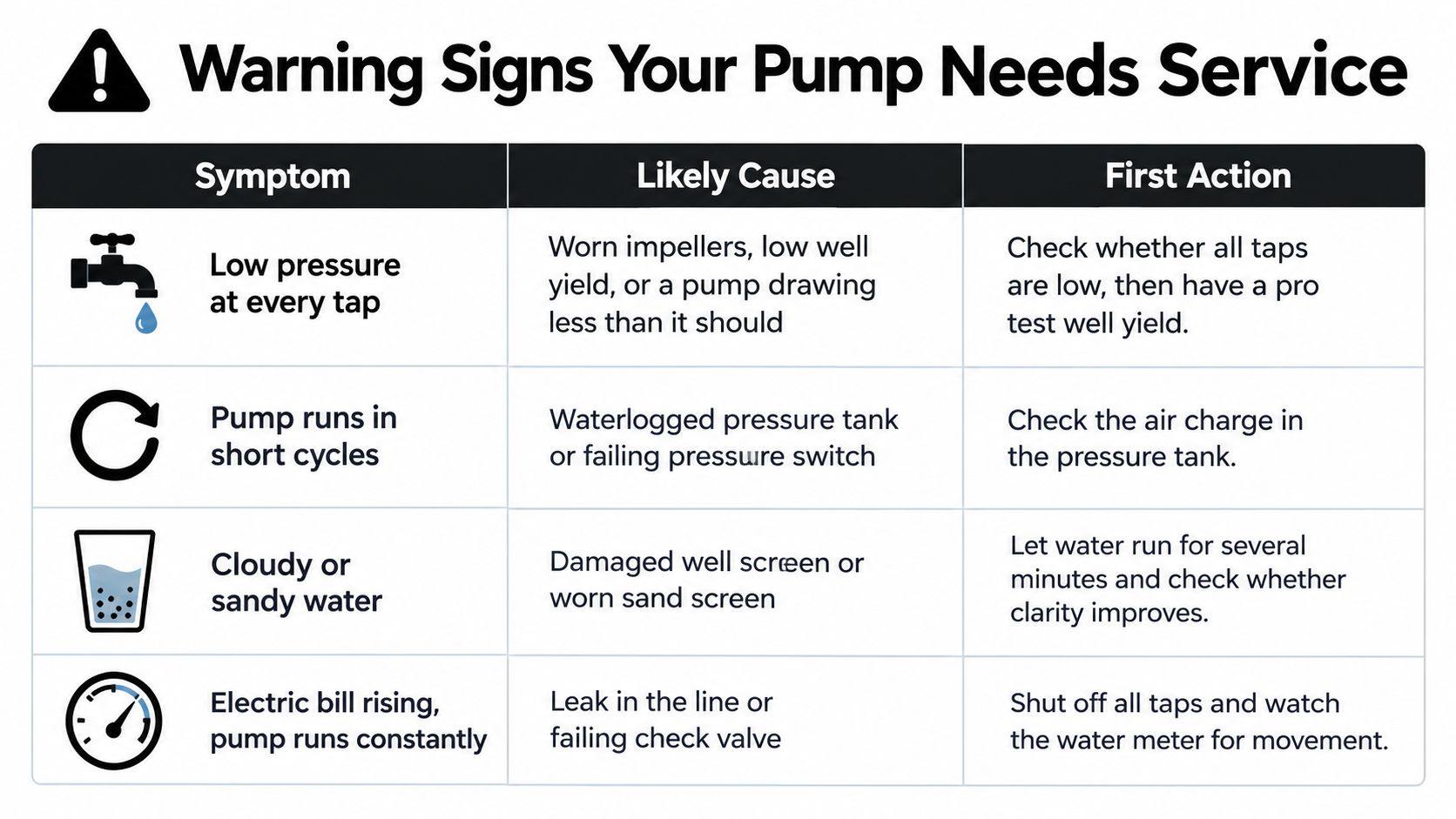
Low pressure throughout the house is a common reason to request service, but it doesn't automatically mean the submerged pump needs replacement. Restricted treatment filters or a pressure-tank problem can produce similar symptoms.
Submersible pump symptoms, likely causes and first actions
| Symptom | Likely cause | First action |
|---|---|---|
| Low pressure at every tap | Worn impellers, low well yield or reduced pump output | Read the tank gauge; have a technician check amp draw and output |
| Short cycling, frequent on and off | Waterlogged tank, faulty pressure switch or check valve not holding | Request tank air-charge and switch-setting checks |
| Sand or grit in the water | Oversized pump, deep drawdown or worn intake | Reduce heavy use and arrange inspection |
| Breaker trips or fuse blows | Motor overload, electrical fault or failing drop cable | Shut off power and call a professional |
| Pump hums but won't start | Failed control-box start components or low voltage | Shut off power and request diagnosis |
| Motor overheating | Low cooling flow, oversized casing, low yield or excessive throttling | Reduce demand and schedule prompt service; stop operation if overheating is suspected |
Wilo's motor-cooling guidance specifies a minimum motor-side water velocity of 0.1 m/s for the cited application, with a cooling shroud where excessive clearance prevents adequate flow. A larger casing doesn't automatically improve reliability; the motor still needs water moving across it.
Keep a useful service record
- Log operation: Arrange pressure and amperage checks several times a year.
- Label the breaker: Make safe shutdown straightforward.
- Maintain testing: Keep yearly water-test appointments.
- Prevent dry running: Don't repeatedly restart a pump that has lost its water supply.
- Save installation details: Record the installation date, depth and subsequent service.
Never pull the pump alone or open energized controls. Arrange professional well-water repair through the service team for testing, pulling and reinstallation when necessary.
What Cape Coral Private Wells Need Before Installation
Say you're planning a larger pump and a larger RO unit because the existing water supply disappoints you. That combination can make things worse if the well can't sustain the new demand.
Alberta Agriculture's water-system guidance.pdf) warns against installing a 10-gallon-per-minute pump on a well sustainably producing only 5 gallons per minute and describes submersibles as generally economical for wells about 80 feet or deeper, with liquid-level protection needed where dry running is possible. Over-pumping can lower the water level, draw sand and interrupt the feed supply.
For whole-house RO, concentrate demand must be included in the well-water budget. A unit's treated-water rating alone doesn't tell you how much groundwater it needs.
Start with a local water analysis
Cape Coral and Lee County homeowners should test for relevant dissolved solids, minerals, iron, hardness, hydrogen sulfide and microbial contamination rather than assuming neighboring properties have identical water. Odor and appearance can help identify what to investigate, but they can't establish the treatment specification.
The Florida Department of Health's private-well guidance recommends bacteria and nitrate testing at least annually; CDC guidance also includes annual total-coliform, TDS and pH testing. Private-well owners can't assume a public utility is monitoring their tap water.
Before replacing equipment, gather:
- Well performance: Yield, recovery rate, and static and pumping water levels.
- Equipment details: Pump capacity, voltage, pipe size and pressure-switch settings.
- Operating symptoms: Sand, cycling, reduced output and any changes during heavy demand.
Translate results into treatment choices
Water test results and what they change in the RO design
| Water test result | What it changes in the design | What to request from the provider |
|---|---|---|
| High total dissolved solids | Membrane selection, capacity and staging | Documented TDS reduction for the exact model |
| Bacteria detected | Validated disinfection before membrane treatment, with any necessary downstream protection | Disinfection plan and retest date |
| Nitrate above a safe level | Selection of equipment with verified nitrate reduction | Model-specific nitrate reduction claim |
| Iron, hardness or hydrogen sulfide | Filtration, softening or other appropriate pretreatment | Pretreatment specifications and maintenance schedule |
| Sediment or sand | Sediment prefilter sized for feed flow | Micron rating and change interval |
| Low well yield | Production rate and storage matched to sustainable supply | Feed demand, treated gallons per day and storage size |
High TDS doesn't automatically mean adding membrane stages. The designer must consider membrane limits, scaling potential and recovery together. Likewise, a sediment cartridge isn't a cure for a well producing sand; the source needs investigation.
Before signing: Require the provider to explain what each stage treats, how its performance is documented and what maintenance keeps it working.
Use the well-water FAQs to prepare questions, then request a site-specific treatment evaluation. The table should lead to a configured whole-house RO design, not a generic package with undocumented promises.
Confirm Your Pump and Water Before Choosing a System
Before buying treatment, confirm the water and the pump. A suitable RO design must account for what enters the system, what the well can sustain and how the household uses treated water.
- Obtain a current laboratory report covering bacteria, nitrate, TDS and pH, plus additional parameters the laboratory recommends.
- Gather the well depth, water levels, yield, voltage, pressure-switch settings and operating symptoms.
- Book an on-site water-system evaluation before ordering equipment.
Ask for a written proposal stating the treatment-stage order, documented reduction claims, feed requirements, recovery rate and concentrate-disposal plan. It should also explain storage, treated-water delivery, commissioning tests and maintenance responsibilities. If the pump shows failure signs, request a separate diagnosis rather than assuming treatment equipment will correct them.
The company focuses on water treatment, well-water repair and pool service; general home repairs belong with the appropriate trades. Call sooner if a breaker trips, sand appears or pressure drops suddenly, and don't repeatedly reset a tripping breaker.
Schedule the evaluation before purchasing. The equipment should fit your well and water report, not just a brochure's production rating.
Water Medic of Cape Coral offers whole-house reverse-osmosis systems and well-water diagnosis, repair and replacement services. Visit Water Medic of Cape Coral to arrange an evaluation that connects your water-test results with pump capacity, treatment requirements and a practical service plan.