Calculating Total Dissolved Solids
You turn on the kitchen faucet in Cape Coral and the water looks perfectly clear. Then the coffee tastes slightly salty, the shower leaves your skin tight, or the pool test shows a number that doesn't fit the rest of your readings. On a private well, appearances don't tell you enough. Calculating total dissolved solids, or TDS, gives you the first practical measurement for deciding whether your water needs more than basic filtration.
A TDS reading won't identify every contaminant, and it isn't a complete drinking-water safety test. It does show the combined concentration of dissolved material, which helps you decide whether to order laboratory testing, adjust pool treatment, or investigate a whole house reverse osmosis system for your Southwest Florida home.
Why Measuring Your Home Water Quality Matters
Cape Coral and Lee County homeowners deal with water sources that can behave very differently from one property to the next. A private well may draw water with a different mineral profile than a nearby home, and seasonal changes can alter what reaches the well. Coastal conditions also make salt-related concerns worth taking seriously, particularly when a homeowner notices a salty taste or a changing test result.
Clear water can still contain substantial dissolved minerals and salts. You won't see calcium, magnesium, sodium, or chloride by filling a glass. TDS turns that invisible load into a measurable concentration, usually reported in milligrams per liter, or mg/L, and parts per million, or ppm. The Water Medic well-water FAQ identifies TDS as a general water-quality test that provides an overall reading of dissolved minerals in well water.
Start with a baseline
Take a sample from the cold-water tap you use for drinking. Let the water run briefly, use a clean container, and record the date, location, and reading. If your home has multiple water sources, test each source separately rather than combining samples.
That first number is useful because it stops guesswork. A taste complaint, a pool balance problem, and a concern about a private well may all involve dissolved material, but they don't require the same response. TDS helps you identify which question to ask next.
Practical rule: Use TDS as a screening number, not as proof that water is safe or unsafe. A high or changing reading deserves follow-up testing that identifies the individual substances present.
The U.S. Environmental Protection Agency treats TDS as a secondary water contaminant, with a public-water secondary maximum contaminant level of 500 mg/L. Secondary standards address qualities such as taste, appearance, and technical effects rather than functioning as a direct health limit. The EPA-related private-well guidance lists reverse osmosis, ion exchange, and distillation among common methods for reducing TDS.
For a homeowner, the decision is straightforward. Test first, interpret the result in context, and choose treatment based on the chemistry behind the number. If the reading is high and the water is used throughout the home, point-of-use treatment may leave too much untreated water in daily use. That's where a properly designed whole-house approach deserves serious consideration.
Understanding What Total Dissolved Solids Really Are
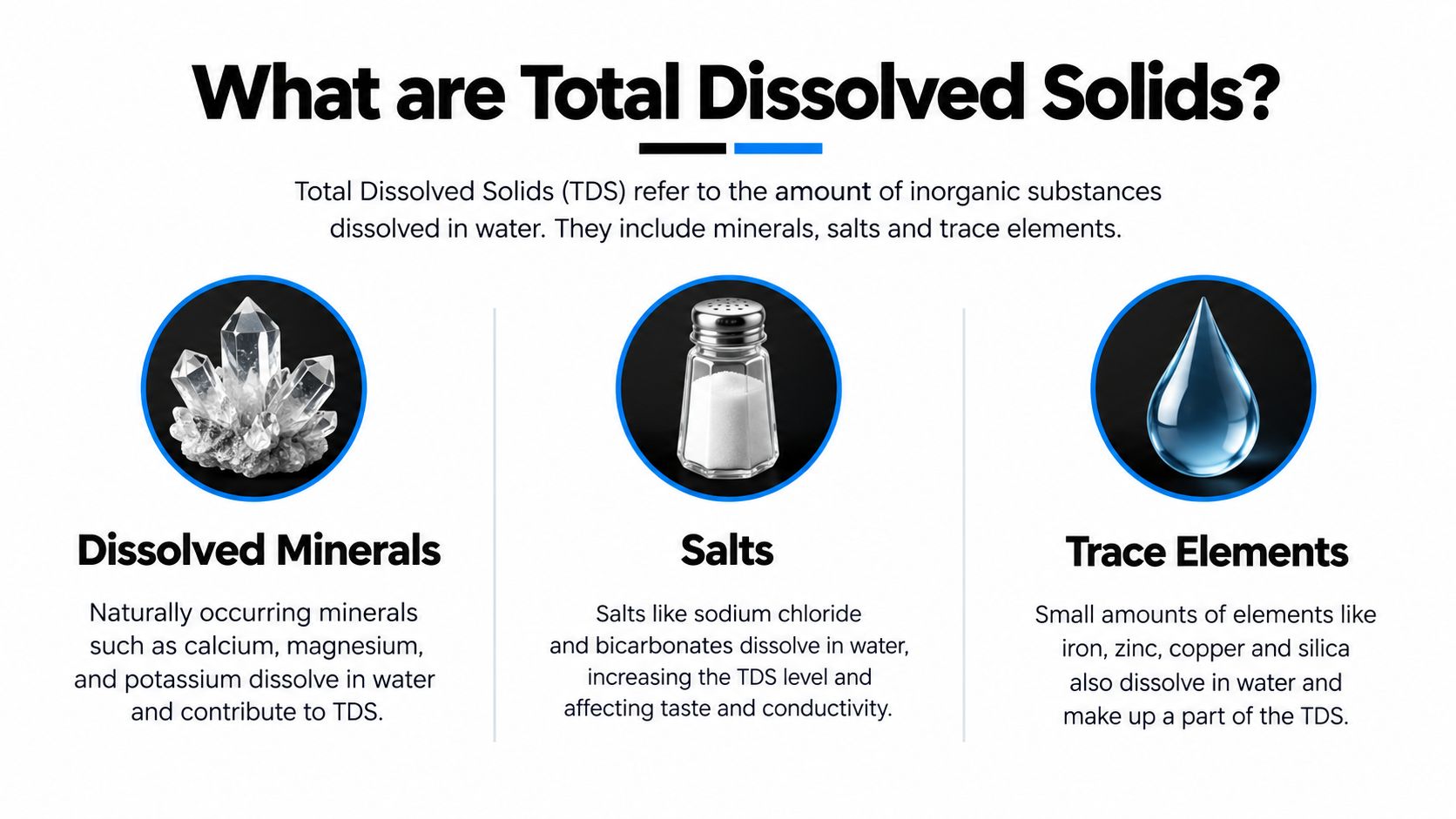
Total dissolved solids are the combined dissolved substances in water. The measurement can include naturally occurring minerals such as calcium and magnesium, salts such as sodium compounds, and trace metals. It may also include dissolved organic material. A TDS meter measures the total estimated concentration, not the identity or toxicity of each substance.
That distinction matters. A TDS number can't tell you whether the dissolved material is mostly desirable mineral content, sodium and chloride, or a contaminant that requires immediate attention. The World Health Organization background document on TDS explains that conductivity readings are converted to TDS using a factor that varies with the type of water.
Read the number as a palatability guide
The Australian Drinking Water Guidelines provide a useful way to understand how TDS may affect taste:
| TDS concentration | Palatability rating |
|---|---|
| 0–600 mg/L | Good |
| 600–900 mg/L | Fair |
| 900–1200 mg/L | Poor |
| Above 1200 mg/L | Unacceptable |
These ranges describe palatability, not a complete health assessment. The same guidelines state that no specific health guideline value exists for TDS, because no health effects are directly attributable to TDS alone. That should reduce panic, not eliminate action. Water can be unpleasant to drink, difficult to use, or unsuitable for a particular application even when TDS itself isn't a direct health limit.
Know what a TDS test cannot answer
A TDS meter won't identify bacteria, specific metals, nitrate, or other individual contaminants. If you're relying on a private well, pair the screening reading with a laboratory analysis suited to local conditions and your household's concerns. TDS tells you how much dissolved material is present. Laboratory testing tells you what that material is.
For treatment decisions, this difference prevents two common mistakes. Don't assume a low reading guarantees safe water, and don't assume every dissolved mineral is dangerous. Use the number to decide how urgently you need a broader test and whether reducing dissolved solids would improve taste and household water quality.
How to Measure and Calculate TDS Accurately
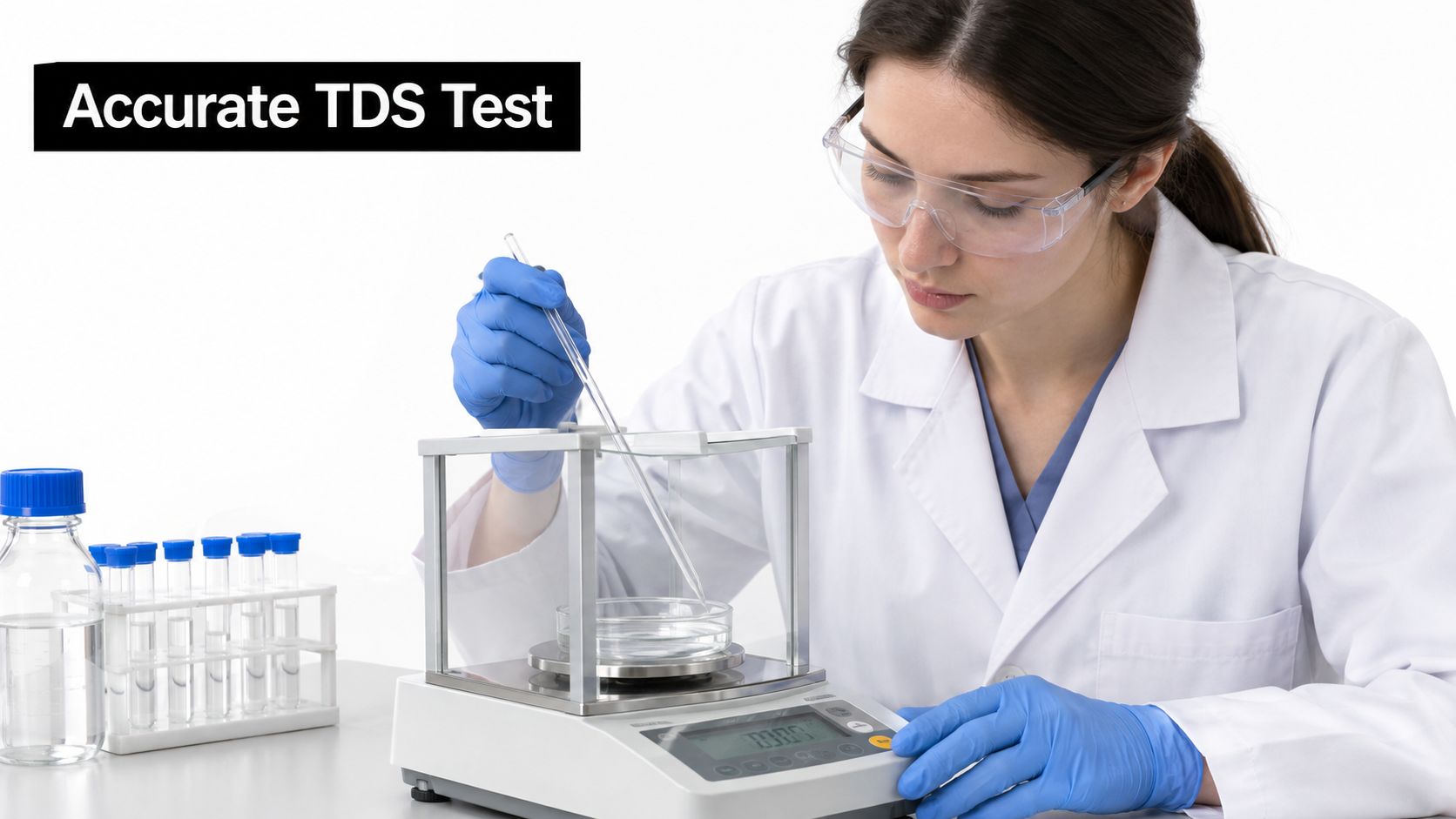
The most direct laboratory method is gravimetric testing. A laboratory filters a measured water sample, evaporates the filtrate, dries the remaining residue to a constant weight, and divides the dried residue mass by the sample volume. The result is reported in mg/L. EPA guidance describes constant weight as two consecutive measurements within 0.5 mg or 4%, whichever is smaller, with reporting rules that use 2 significant figures below 100 mg/L and 3 significant figures at 100 mg/L and above. See the EPA gravimetric TDS method for the laboratory workflow and reporting requirements.
That process is accurate, but it isn't convenient at a kitchen sink. For field screening, use a calibrated electronic conductivity meter that displays either conductivity or an estimated TDS value.
Follow a clean testing routine
Collect the sample correctly. Use a clean glass or plastic container. Avoid a container that has soap residue, salt, or cleaning chemicals.
Rinse the meter probe. Use clean water, then shake off excess water. Don't wipe the electrodes with a rough cloth.
Test at a consistent temperature. Conductivity changes with temperature, so use a meter with temperature compensation or test samples under comparable conditions.
Stabilize the reading. Place the probe in the sample without touching the container. Wait until the display settles, then record the number and units.
Repeat the measurement. Test a second sample from the same source. A result that changes sharply between carefully collected samples deserves a laboratory check or professional review.
If the meter displays conductivity, the conversion requires a factor. A rough field table can show 1,000 µS/cm corresponding to about 650 ppm TDS, while 2,000 µS/cm can correspond to about 1,450 ppm, and 5,000 µS/cm can correspond to about 3,950 ppm. Those are examples of estimation, not a universal formula. The WHO explains that the factor depends on the water's dissolved mineral mix.
Meter advice: Buy a conductivity or TDS meter that supports calibration, and record the conversion setting with every result. Two meters can produce different estimated TDS values from the same conductivity when they use different factors.
For a definitive result, use gravimetry. ALS explains why gravimetry is the accurate and definitive method for an unknown TDS sample, while conductivity-based estimates remain useful for operational monitoring. Don't compare results from different laboratories without checking filtration cutoffs and drying conditions. Method differences can make otherwise valid results difficult to compare.
Interpreting Results for Wells and Pools
A raw TDS number means different things in a drinking-water system and a swimming pool. Treating both applications with one rule is a reliable way to make the wrong decision.
For private well water, a high reading can point toward a heavier dissolved mineral and salt load. In coastal Southwest Florida, homeowners often pay particular attention to sodium and chloride because those substances can affect taste and the overall feel of the water. A TDS result doesn't prove saltwater intrusion or identify chloride, so use it as a reason to order targeted laboratory testing rather than as a diagnosis.
The practical interpretation is simple. If the water tastes salty, the reading is high, or the number has changed from your baseline, don't rely on a small countertop device to answer a large water-quality question. Use the result to discuss whole-house treatment and confirm the chemistry before selecting equipment.
Pools require a different frame of reference
Pool professionals use TDS as part of broader water-balance work, including the Langelier Saturation Index, or LSI. Historically, older industry formulas treated TDS as a fixed factor, using 12.1 for water from 0 to 1,000 ppm, 12.2 for 1,000 to 2,000 ppm, and 12.3 for 2,000 to 3,000 ppm. The International Code Council explanation of TDS history describes how the Association of Pool and Spa Professionals updated the factors by 2009 to cover water from 0 to 5,000 ppm.
Saltwater chlorine generators changed the operating context. Added sodium chloride pushed many saltwater pools beyond the old 3,000 ppm ceiling, so a reading that looks high beside a freshwater pool may be expected in a salt pool. The correct question is not “Is this number high?” It is “Is this number appropriate for this pool type, its salt system, and its complete chemistry?”
| Water setting | Sensible response |
|---|---|
| Private well used for drinking | Pair TDS with laboratory testing and evaluate treatment |
| Freshwater pool | Investigate an unexpected rise alongside water-balance results |
| Saltwater pool | Interpret TDS alongside the generator's operating requirements |
| Any source with a sudden change | Retest, document the result, and seek professional guidance |
A pool reading can't decide whether your household water needs RO, and a well-water reading can't determine pool balance by itself. Keep the applications separate, then use the right treatment plan for each.
Why Reverse Osmosis Is the Gold Standard for Treatment
If your goal is to reduce dissolved solids across the home, reverse osmosis is the strongest practical treatment choice. Carbon filtration improves taste and targets certain compounds, but it doesn't provide the same broad reduction of dissolved minerals and salts. Ion exchange can address selected ions, while distillation is rarely the most convenient whole-home strategy.
NSF/ANSI 58 and EPA WaterSense require reverse osmosis systems to reduce influent TDS by at least 75%, as documented in the EPA WaterSense reverse osmosis performance summary. That gives homeowners a firm performance baseline when comparing equipment instead of relying on vague claims about “purification.”
Consider an incoming reading of 800 ppm. A system meeting that minimum reduction could bring the calculated result to 200 ppm, and stronger real-world performance could reduce it further. The Australian palatability guidance places 0–600 mg/L in the good category, so that example illustrates why RO can change the drinking experience as well as reduce the dissolved load.
Choose whole-house treatment when the problem is whole-house
A point-of-use RO unit treats water at one faucet. That can work when the concern is limited to drinking and cooking, but it leaves untreated water at showers, laundry fixtures, ice makers, and other household points. If your testing shows that the source water has a broad dissolved-solids problem, a whole-home reverse osmosis system is the more coherent solution.
Proper design still matters. A professional must match membrane capacity, storage, pretreatment, pressure requirements, and maintenance intervals to the property's source water and demand. RO also shouldn't replace testing for specific contaminants. It is a treatment system, not a substitute for knowing what your water contains.
My recommendation is direct. If a private well produces persistently high TDS, unpleasant taste, or a confirmed salt burden, stop buying isolated filters and get a whole-house RO assessment. Reducing the dissolved load at the source gives your home's water treatment plan a clear purpose.
Partnering with Local Water Professionals
A TDS meter can tell you where to start, but it can't size a treatment system or interpret every result from a well and pool. A homeowner may bring in one reading from the kitchen tap, another from an outdoor source, and a separate pool result. Those numbers need to be connected to the water source, the intended use, and the treatment equipment already operating on the property.
Water Medic of Cape Coral has over 25 years of experience in water treatment and pool services. The company can use a TDS reading as the starting point for a broader conversation about laboratory testing, whole-house RO selection, installation, and ongoing pool maintenance. Its water treatment and pool services are relevant for homeowners, property managers, HOAs, and light commercial facilities that need consistent water management.
Don't make an expensive treatment decision from a single unexplained meter result. Bring your reading, note where and when you collected it, and ask a specialist to evaluate the full situation.
Water Medic of Cape Coral offers TDS testing guidance, whole-house reverse osmosis solutions, professional installation, and pool service for Southwest Florida properties. Use your reading as the starting point, then visit Water Medic of Cape Coral to schedule a conversation about cleaner household water and balanced pool care.