
Backflow Preventer Installation Cost in SW Florida
A typical backflow preventer installation cost for a home usually falls between $200 and $1,100. In Southwest Florida, that number is only the starting point, because a complete compliant install often also includes permit fees and ongoing annual testing.
A lot of homeowners first run into this cost when they're already spending money on something else. Maybe you're adding irrigation, updating a pool setup, or finally moving forward with a whole house water treatment upgrade because you're tired of staining, odor, scale, or questionable taste. Then the quote shows a separate line for a backflow device, and it feels like one more plumbing charge that appeared out of nowhere.
It isn't random. A backflow preventer protects the drinking water entering your home and helps prevent contaminated water from reversing into the supply. In Southwest Florida, where irrigation systems, pools, and advanced treatment equipment are common, it also plays a bigger role than most homeowners realize. If you're considering a whole house reverse osmosis system, this device becomes part of protecting the water quality you're paying to improve.
Understanding Your Backflow Preventer Quote
You get a plumbing quote for irrigation, a pool line, or a whole house RO install, and one extra line shows up: backflow preventer. The number may look small compared with the rest of the project, but in Southwest Florida that line item often decides whether the job passes inspection, can be tested properly, and protects the water quality you are paying to improve.
A quote also gets confusing fast because "backflow preventer" is a broad label. One contractor may be pricing a simple residential device for a low-risk connection. Another may be pricing a testable assembly, permit handling, and the piping changes needed to meet local requirements. Those are very different jobs, and they should not carry the same price.
That is why two quotes can look inconsistent even when both contractors are being honest.
On a basic residential job, installation costs can fall anywhere from the low hundreds up to around $1,100, with many homeowners landing in the $200 to $1,000 range depending on the device and installation conditions. The bigger issue for homeowners is that the install price is only part of the first-year cost. In this area, permit fees and required testing can turn a "reasonable" quote into a much larger total if they were left out at the start.
I see this most often on homes with more than a simple lawn connection. Add a pool autofill, multi-zone irrigation, chemical injection, or a whole house RO system, and the installer may need a higher-grade assembly, more clearance, and a location that allows future testing and service. Labor goes up. Materials go up. Permit coordination may follow.
A useful quote should tell you exactly what you are buying, not just give you one total.
Why the quote can vary so much
Two homes on the same block can have different pricing for good reasons. One may have exposed piping and plenty of room to install the device at the correct height with easy access. The other may need a retrofit, shutoff changes, pipe rerouting, or a new location to satisfy local code and testing access.
That matters because this is not a part you hide and forget. If the assembly cannot be reached, isolated, or tested correctly, the cheaper install can become the more expensive fix later.
What a solid quote should include
Before you approve the work, the quote should answer these questions:
- What device is being installed. A simple vacuum breaker, double check, and RPZ assembly are priced differently because they serve different risk levels.
- What labor is included. Cutting in a device on open pipe is one job. Reworking piping to create proper access and test clearance is another.
- Whether permit costs are included. In Southwest Florida, that is often part of the actual first-year number.
- Whether initial or annual testing is required. Some assemblies must be tested to stay compliant.
- Who is handling compliance. Homeowners should know whether the contractor is just installing hardware or delivering a code-ready job.
If the quote skips those details, you are not really comparing prices. You are comparing assumptions.
The right number considers the device, the install conditions at your home, and the local compliance steps that keep your water system protected from day one.
What a Backflow Preventer Does for Your Home
Water is supposed to move one way. From the utility side into your house. A backflow preventer is the device that helps keep it that way.
The easiest way to think about it is as a one-way security door for your plumbing. Normal flow comes in. Contaminated water should never be allowed to reverse and travel back toward clean water lines.
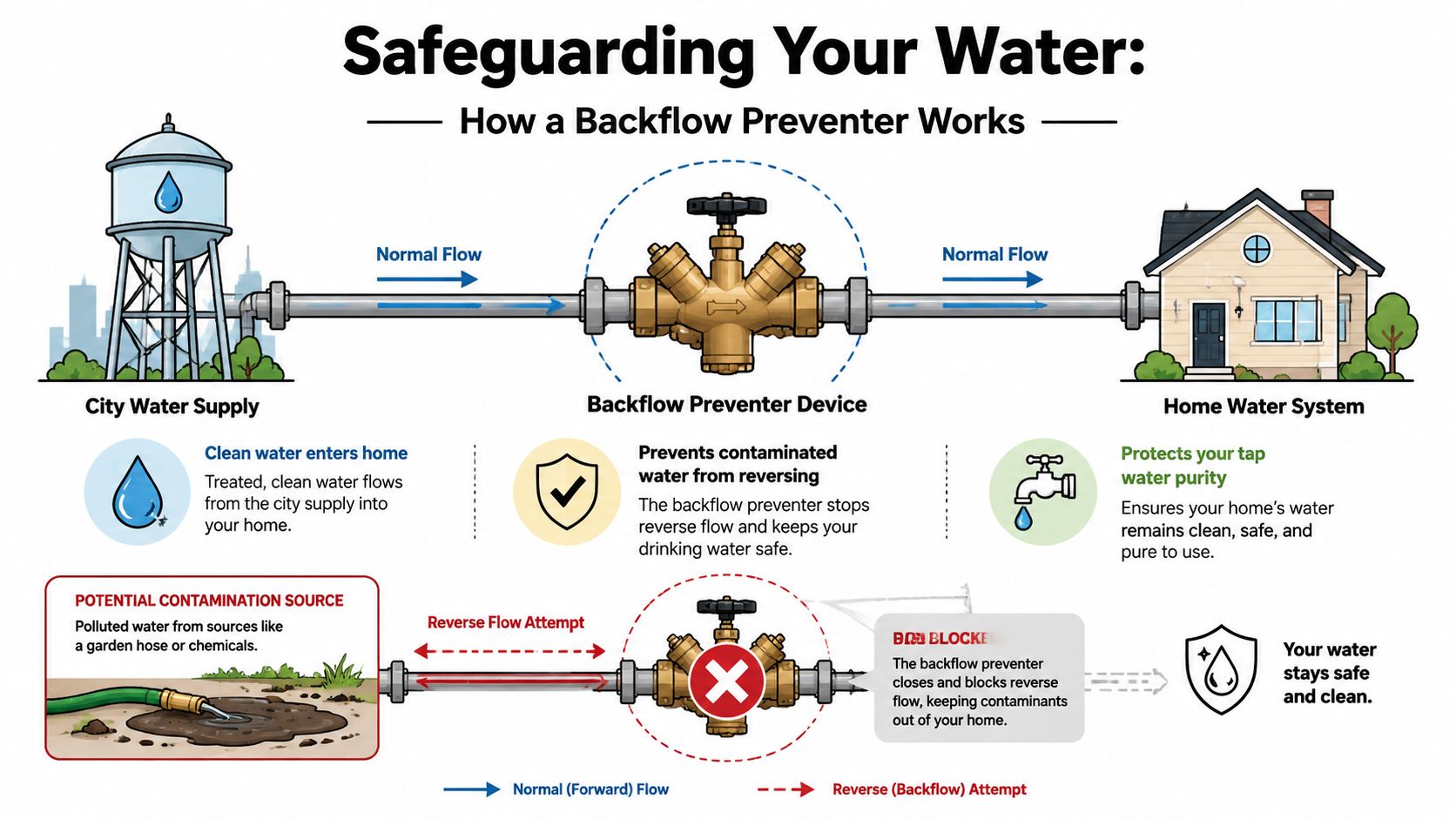
How backflow happens
Backflow usually shows up in two real-world ways.
- Back-siphonage happens when pressure drops on the supply side. A main break, nearby hydrant use, or other sudden demand can create suction.
- Back-pressure happens when pressure on the property side becomes greater than the incoming supply pressure and pushes water the wrong way.
For homeowners, the technical wording matters less than the risk. If your property has irrigation, pool equipment, chemical treatment, or water treatment discharge, there are points where non-potable water can be present. Without the right protection, that water can move where it shouldn't.
Why municipalities care
Florida municipalities don't require backflow devices to make plumbing projects harder. They require them because one unprotected connection can affect more than one house.
An irrigation line can expose the system to fertilizers, soil contact, and standing water. Pool equipment introduces chemically treated water. Advanced treatment systems can create drain and discharge conditions that need proper separation and protection. Once you understand that, the code requirement makes sense. It's about protecting both your family and the public water system.
A backflow preventer is part of keeping your tap water pure, not just passing inspection.
Why this matters more with advanced water treatment
Homeowners often think of water treatment as a filter problem. It's not only that. Good water treatment also depends on safe plumbing design.
If you're putting serious money into cleaner water, especially at the whole-house level, you don't want any weak point that can compromise the system. The backflow device is one of those critical pieces. It helps protect the quality of the water coming in before you ever get to membranes, tanks, filters, or polishing stages.
That is why this topic naturally connects to whole house RO. If your goal is safer, purer water throughout the house, the backflow assembly isn't separate from that goal. It's one of the supports underneath it.
A Detailed Breakdown of Installation Costs
A backflow quote in Southwest Florida can look modest at first, then grow once the full requirements show up. The installed device is only part of the first-year cost. Permit handling, certified testing, plumbing changes, and the type of assembly required often decide where the final number lands.
For a typical home, the practical question is not the national average. It is whether the property needs a basic vacuum breaker for a lower-risk application or a more protective assembly for irrigation, pool fill, or a higher-end treatment setup tied to a whole house reverse osmosis system for the entire home. That choice changes the quote fast.
Device type changes the quote fast
The least expensive options are small, application-specific devices. The more a system can expose the potable line to contamination or pressure changes, the more protective and expensive the assembly becomes.
This cost guide covering device pricing, labor, and testing places atmospheric vacuum breakers at about $100 to $300 for the part, notes some garden-hose models can start around $5 to $40, puts pressure vacuum breakers around $300 to $800 installed, and shows reduced pressure zone assemblies often at $1,000 to $3,500 installed, with some commercial cases running higher. The same guide notes labor rates commonly clustering around $75 to $150 per hour, $180 to $500 per hour, or more depending on region and job complexity.
That is why two homeowners can both ask for a "backflow preventer" and get very different prices. One may need a straightforward irrigation install. The other may need an RPZ, reworked piping, test cocks in an accessible location, and clearance that satisfies the inspector.
Estimated residential cost breakdown
| Cost Component | Typical Price Range | Notes |
|---|---|---|
| Basic atmospheric vacuum breaker part | $100 to $300 | Lower-cost category for simpler applications |
| Garden-hose model | $5 to $40 | Limited use case, not a substitute for higher-risk systems |
| Pressure vacuum breaker installed | $300 to $800 | Common for residential irrigation applications |
| RPZ assembly installed | $1,000 to $3,500 | Used for higher-hazard situations and more complex systems |
| Skilled labor | $75 to $150 per hour, or $180 to $500 per hour | Varies by region, access, and complexity |
| Annual testing | $30 to $300, or $50 to $300 | Recurring compliance cost, not part of hardware |
What pushes labor up
Labor goes up for visible reasons.
- Tight access. If the main line, equipment pad, or irrigation connection is buried behind landscaping, walls, or finished surfaces, the job takes longer.
- Placement rules. The assembly has to be installed where it can be tested, serviced, and approved. Good placement now prevents expensive correction work later.
- Piping changes. Older homes in Southwest Florida often need valves, unions, shutoffs, or sections of pipe rebuilt to fit the device correctly.
- Higher-hazard applications. More protective assemblies require more careful installation and often more inspection attention.
- Permit coordination. In some municipalities, part of the contractor's time goes into paperwork, scheduling, and documenting the test.
Cheap placement can become expensive maintenance. I have seen installs where the device itself was fine, but the location made testing awkward and future repairs harder than they needed to be.
The first-year total matters more than the install line
Homeowners should price the whole first year, not just the day of installation. That total usually includes the device, labor, permit cost, and required testing.
A HomeGuide summary of backflow costs notes broad installed totals like $200 to $1,000 or $300 to $2,500 depending on device type, while also noting that testing costs can run $30 to $300 per year, permits can add $50+, and labor is often $75 to $150 per hour.
That first-year view matters more in this part of Florida because many homes are not dealing with one simple plumbing line. They may have irrigation, pool equipment, outdoor kitchens, treatment equipment, or plans for whole-house purification. Once those systems enter the picture, backflow protection stops being a minor line item and becomes part of the home's safe-water design.
Ask for three numbers before you approve the work: installation, permit and testing, and expected annual service after that. That is the clearest way to compare bids.
The Critical Link to Your Whole House RO System
If you're installing a whole house reverse osmosis system, the backflow preventer stops being a side issue. It becomes part of the system design.
Whole house RO is the premium move for homeowners who want better water throughout the property, not just at the kitchen sink. It addresses water quality at the point where the house receives water, then treats it for broad household use. In Southwest Florida, where homeowners often want cleaner water for bathing, cooking, glassware, fixtures, appliances, and overall peace of mind, that matters.
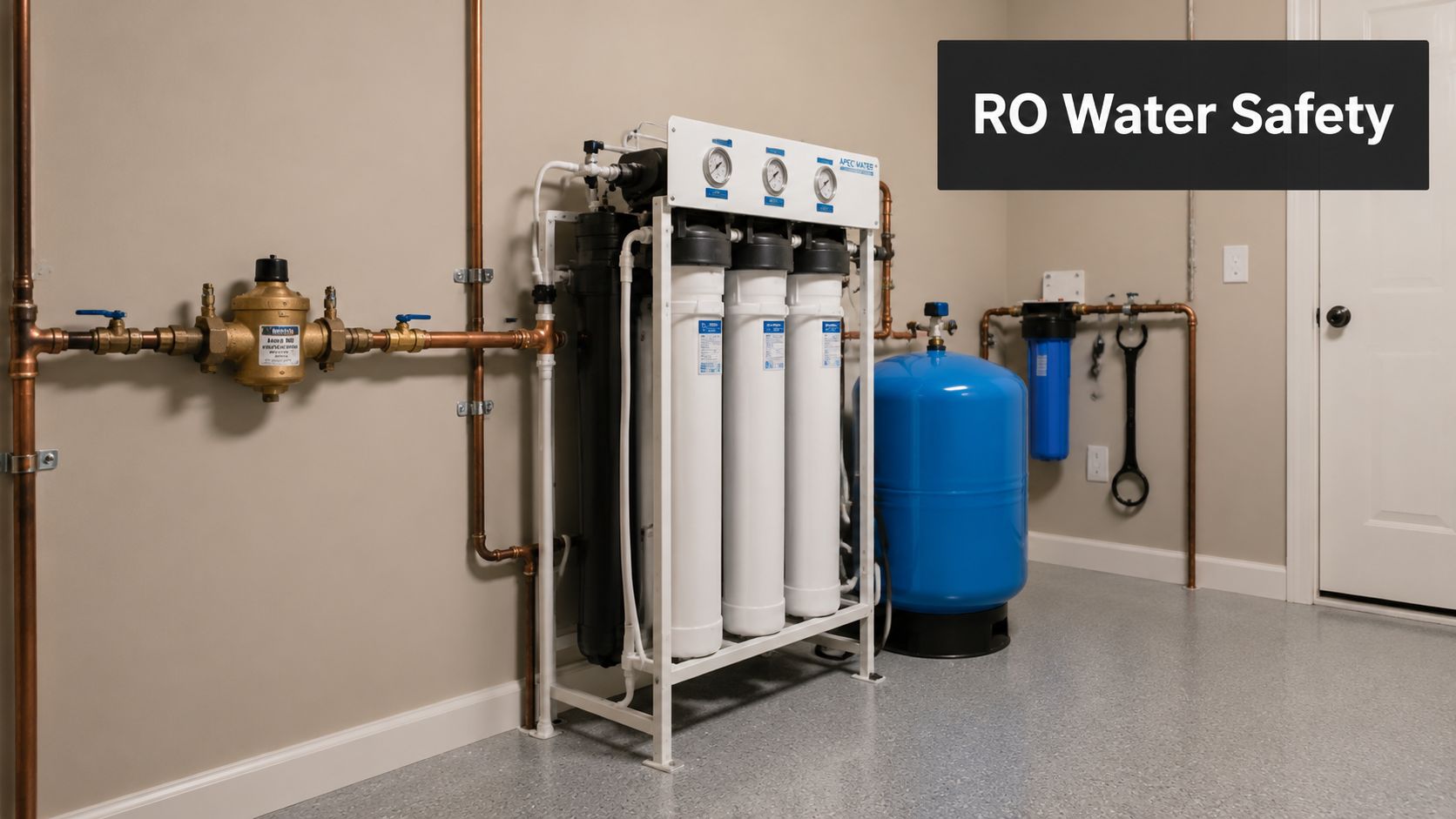
Why RO creates a backflow conversation
A reverse osmosis system doesn't just filter water. It separates purified water from concentrated reject water, often called brine. That discharge has to go somewhere. Once you create that kind of plumbing relationship inside a home, cross-connection protection matters.
That is why the backflow conversation belongs in the same room as the RO conversation. If the plumbing isn't protected properly, you're undercutting the entire goal of installing whole house purification in the first place.
For homeowners comparing options, a properly designed whole house reverse osmosis system should be approached as a complete water solution, not as a membrane package bolted onto existing plumbing without regard for backflow protection.
What works and what doesn't
What works is designing the water treatment system and the backflow protection together. The installer looks at the incoming line, available space, discharge path, service access, and the required protection level before the equipment is finalized.
What doesn't work is treating the backflow assembly as an afterthought. That's how homeowners end up with one contractor selling equipment, another correcting plumbing, and a third coming back later because the device can't be tested easily or wasn't the right type for the installation.
A strong whole house RO installation usually reflects a few decisions made correctly up front:
- The assembly matches the hazard level. Not every system needs the same device.
- The device is serviceable. Test cocks, shutoffs, and access matter later.
- The layout respects maintenance. Filters, membranes, tanks, and backflow protection shouldn't fight each other for space.
- The permit path is considered before installation. This prevents expensive rework.
Why homeowners in Southwest Florida connect this to purity
In this region, whole house RO isn't a luxury add-on in the abstract. It is often the answer homeowners pursue when they want cleaner, more stable water quality across the entire home. If that is the investment, then the supporting plumbing has to protect that investment.
That is where the backflow device earns its place. It helps keep contaminated or non-potable water from compromising the incoming side of the home's water supply. That supports the same outcome the homeowner is after with RO: safe, pure water at every tap.
One practical note from the field: when homeowners complain that a quote for a high-end water system feels inflated, the issue is often that they're looking at the filtration equipment and ignoring the code-compliant plumbing around it. In reality, that surrounding work is what turns a water treatment setup into a reliable whole-house system instead of a risky collection of parts.
Water Medic of Cape Coral handles both water treatment equipment and the plumbing side that supports it, which is useful when a project includes whole house RO and backflow requirements in the same scope.
Local Factors in Florida That Affect Your Price
A backflow preventer installation cost in Southwest Florida is shaped by local conditions. The same device can cost noticeably different amounts depending on where it goes, how easy it is to access, and what kind of system it's protecting.
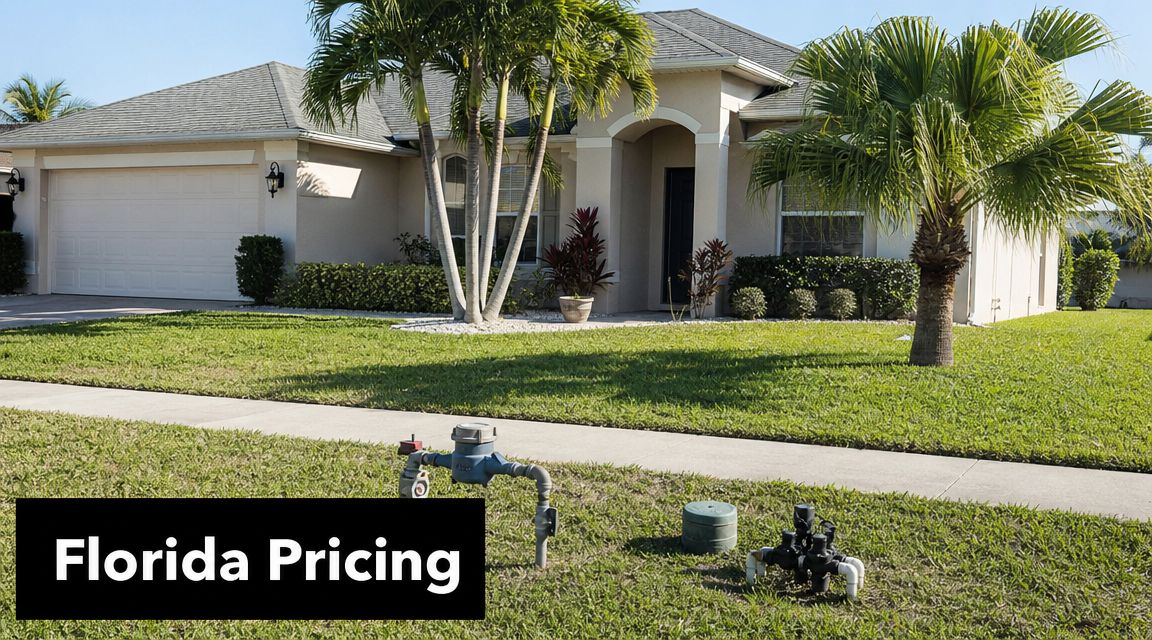
Why Southwest Florida jobs often need more thought
This region has a lot of properties with irrigation, pools, outdoor plumbing, and water treatment equipment. That alone raises the number of homes that need proper cross-connection protection.
Then there is the site itself. Some homes have a clean, open install area near the main supply. Others require more effort because the line is boxed in, crowded by landscaping, close to concrete, or awkward to service once the device is in place. In coastal areas, material choice also matters more because humid, salty air is hard on exposed components over time.
A homeowner usually sees this as "why is my quote higher than my neighbor's?" The answer is usually in the access, the code requirement, or the long-term serviceability.
The long-term price is shaped on installation day
This Florida-focused install cost guide notes typical skilled labor around $70 to $150 per hour, permit fees from $50 to $300, and annual testing averaging $100 to $200. The same guide makes an important practical point: the true lifecycle cost depends on whether the assembly is installed so it can be tested and serviced easily.
That matters in Florida because nobody wants a yearly service visit turned into a longer, messier call because the device was jammed into a bad location.
Good placement lowers friction for every future test, repair, or replacement.
A quick overview of the kind of equipment homeowners often pair with backflow protection can help frame the bigger water-system decision:
What to ask before you approve the job
Before you sign off, get clear answers on these points:
- Where the device will be installed. It should be accessible for testing and future service.
- Whether the quote includes permits. Don't assume.
- How the assembly fits your larger water setup. This matters if you also have irrigation, a pool, or treatment equipment.
- Whether the installer is planning for maintenance access. This saves money later.
In Southwest Florida, the cheapest visible install often isn't the cheapest ownership experience. A clean, code-compliant, maintainable install usually ages better.
Planning for Long-Term Costs and Maintenance
The installation invoice is only the beginning. Backflow devices live in a regulated part of your plumbing system, so they bring recurring obligations with them.
The biggest one is annual testing. Homeowners often focus on purchase price, but the device has to remain compliant and functional year after year. That is why long-term ownership matters more than shaving a little off the original quote.
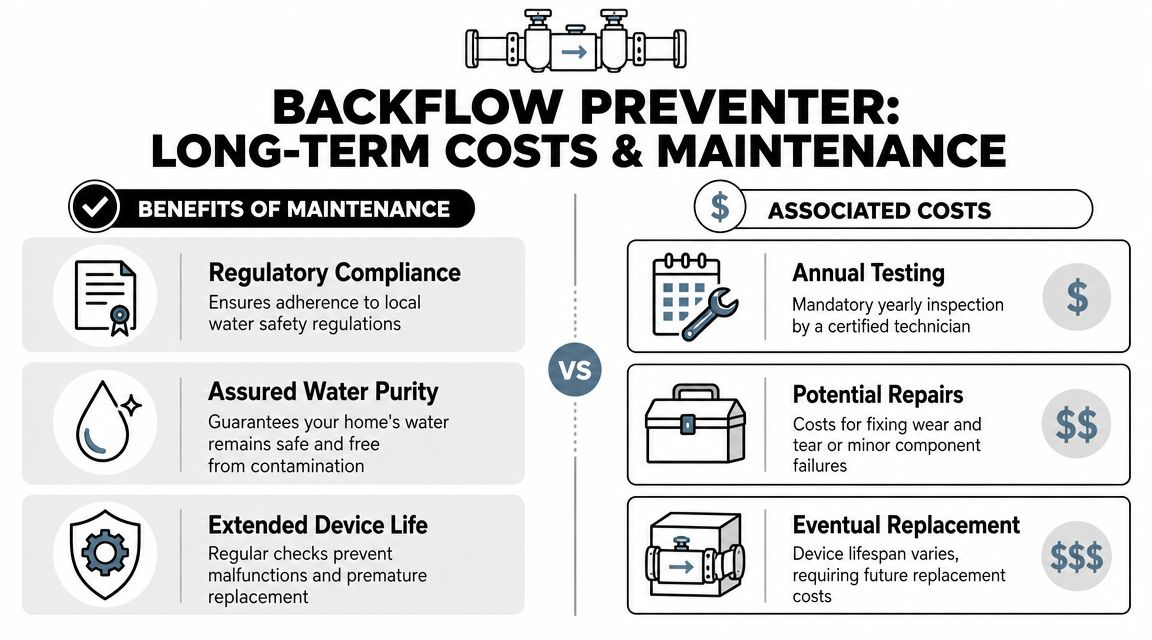
The recurring cost homeowners should expect
Published guidance shows annual testing is commonly reported in a range from $100 to $200 in one source, with broader industry ranges also appearing elsewhere. The same Florida-focused guidance cited earlier ties those recurring costs to compliance and maintainability, which is why placement matters on day one.
If your home also uses treatment equipment, it helps to think about maintenance as a system. Water softening, RO, and backflow protection all perform better when service access is planned instead of improvised. For homeowners comparing treatment strategies, water softener options may also come into the discussion depending on the water profile and the role of RO in the house.
Repair or replace
Often, a lot of homeowners spend money twice.
According to this repair versus replacement cost reference, minor repairs can cost about $35 to $200, more serious failures can go $500+, and full replacement can run $300 to $1,500+ depending on access and device type. The same source notes that the decision usually comes down to the age of the unit, accessibility, and whether upgrading to a higher-protection model makes more sense than putting money into an older assembly.
A practical way to consider this:
- Repair makes sense when the body is sound, the failure is limited, and the device is still appropriate for the application.
- Replacement makes sense when the unit is aging, access is poor, repeated service is adding up, or the property now needs a more protective assembly.
- Upgrade makes sense when you've changed the home's plumbing setup, especially with irrigation expansion, pool changes, or whole house purification work.
If a device is difficult to test, awkward to reach, and already costing you service money, replacement often solves more than one problem at once.
Your Next Steps for Safe and Pure Water
A backflow preventer isn't glamorous, but it protects one of the most important things in your home: the quality of the water supply entering it. In Southwest Florida, that matters even more because so many homes combine municipal water with irrigation, pools, and advanced treatment equipment.
If you're pricing a project now, don't ask only for the install number. Ask for the first-year number. You want the device type, labor scope, permit handling, testing expectations, and how the assembly fits with any water treatment equipment you're adding. That is especially important if you're considering whole house RO, where the plumbing protection is part of the water-quality outcome.
If budgeting is part of your decision, it's also worth reviewing available financing options before you delay a system that protects your water and supports a cleaner whole-home setup.
A clear quote and a code-compliant design will save you more frustration than a low number that leaves out the hard parts.
If you're planning a backflow install, replacing an older assembly, or pairing one with a whole house RO system, Water Medic of Cape Coral can help you review the full scope so you understand the first-year cost, the compliance requirements, and the best path to safer, purer water at home.