
Green Algae in Pool Treatment: Your Definitive How-To Guide
That green haze creeping into your beautiful Southwest Florida pool didn't just show up overnight. It's a sign that something is off-balance in your pool's little ecosystem, and those tiny green organisms are taking full advantage of it. Getting to the root of the problem is the only way to not just clear up the water, but to keep it from coming back.
First, Understand Why Your Pool Turned Green
Think of algae spores like tiny, invisible seeds that are always finding their way into your pool—through rain, wind, even on swimsuits. Normally, your chlorine is like a bouncer at the door, stopping them before they can get in and cause trouble. But when that bouncer gets overwhelmed or isn't on duty, the party starts, and an algae bloom is the result.
So, what weakens your pool's defenses? Here in the Cape Coral area, we see the same few culprits time and time again.
The Most Common Triggers for an Algae Invasion
-
Not Enough Chlorine: This is, without a doubt, the number one reason algae gets a foothold. The intense Florida sun, a heavy downpour, or a big pool party can burn through your chlorine reserves much faster than you think, leaving the water unprotected.
-
Out-of-Whack Water Chemistry: If your pool's pH creeps too high (anything over 7.6), it essentially handcuffs your chlorine. You can have plenty of chlorine in the water, but it won't be effective at killing anything. It's a classic case of working hard, not smart.
-
Poor Circulation: Algae loves still, stagnant water. If your pump isn't running long enough each day or if you have "dead spots" where water barely moves, you're practically rolling out the welcome mat for algae to settle in and multiply.
These issues are incredibly common, which is why so many pool owners find themselves battling green water. It's a huge issue globally, too. The market for algae-treatment chemicals shot past $3.1 billion in 2023, and the segment for green algae alone was responsible for about $1.3 billion of that. It's clear this is a widespread headache.
Tackling a full-blown algae bloom can feel like a part-time job, and it gets expensive fast with all the chemicals you have to buy. The absolute best defense is a consistent maintenance routine that prevents the problem in the first place.
While you can certainly handle it yourself, this is where professional routine swimming pool maintenance from Water Medic really pays off. We keep those crucial chemical levels dialed in, stopping algae before it ever has a chance to start. If you do have an outbreak, our technicians can pinpoint the exact cause and get your pool back to crystal clear much faster.
Kicking Algae to the Curb: Your Action Plan
Alright, now that you know what's feeding that green monster in your pool, it's time to roll up your sleeves. Getting rid of algae isn't about just tossing in some chemicals and crossing your fingers. It's a systematic attack, a step-by-step process to take back your water for good.
Before you do anything else, you have to get your water chemistry in line. Think of it as prepping the battlefield. If your pH and Total Alkalinity are out of whack, your main weapon—chlorine—is practically useless. Algae absolutely loves high-pH water, so your first move is to bring that pH down into the 7.0–7.4 range. This makes the water hostile to algae and supercharges your chlorine's effectiveness.
This flowchart really breaks down how things go wrong. It’s a vicious cycle.
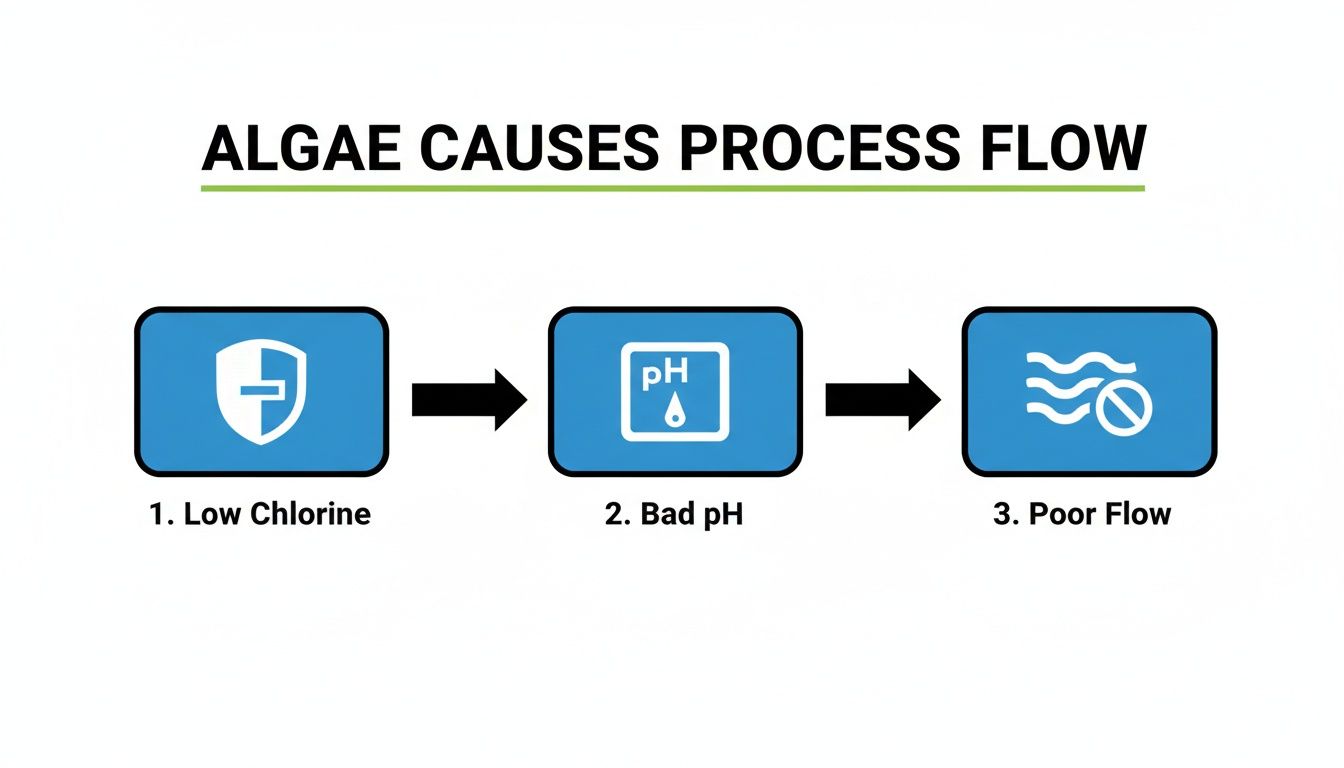
As you can see, low chlorine, bad pH, and poor circulation all feed into each other, creating the perfect storm for an algae takeover.
Time for the Knockout Punch: Shocking the Pool
With your water balanced, it’s time for the main event. We’re going to shock the pool, and we’re going to hit it hard. This means jacking up the free chlorine level so high that the algae simply can't survive. For a light-green pool, a "double shock" (twice the normal dose) is usually enough. But if your pool looks more like a swamp and you can't see the bottom, you'll need a triple or even a quadruple dose to get the job done.
A pro tip: always shock your pool at dusk or after the sun has gone down. That intense Florida sun is a chlorine killer and will burn off your unstabilized shock before it has a chance to work its magic.
Don't panic if your water turns a cloudy, milky-blue or even grayish color after shocking. That's actually a great sign! It means the chlorine is winning the war and oxidizing millions of dead algae cells. It looks worse before it gets better.
This is one of those areas where calling a pro really pays off. The shock you buy at a big-box store is fine, but the commercial-grade, high-strength stuff we use at Water Medic can cut the treatment time dramatically. We have the experience to nail the exact dosage—enough to wipe out the algae without turning your pool into a chemical bath.
Get Physical: Brushing and Algaecide
Chemicals can't do it all. That green stuff loves to cling to your pool's walls and floor, creating a slimy, protective shield. You have to break that shield by giving your pool a thorough, aggressive brushing.
Get in there and scrub everything:
- The walls, especially in the corners and on the steps.
- The entire floor, focusing on spots with poor circulation.
- Around ladders, lights, and return jets—these are algae's favorite hiding spots.
All that brushing kicks the algae up into the water, where the shock and algaecide can get to work. Once you're done scrubbing, it's time to add a quality algaecide. Think of shock as the heavy artillery and algaecide as the ground troops that hunt down the survivors. This one-two punch is incredibly effective. For really bad cases, industry guides recommend doses as high as 600 mL per 10,000 liters. This guide on restoring clear and clean water has some great technical details on this.
The Final Cleanup: Vacuuming and Filtering
After the battle is won, you're left with the aftermath: a cloudy pool full of dead algae. Now it’s all about cleanup. You have to get that dead organic junk out of your water.
If you have a thick layer of dead algae settled on the floor, the best way to deal with it is to vacuum it to "waste." If your filter system has that setting, it will bypass the filter entirely and send all that gunk straight out of the pool, which is exactly what you want. This keeps it from instantly clogging your filter.
Let's be honest, this whole process is a ton of work. It can take several days of testing, dosing, and hard labor. If you'd rather not play chemist and spend your weekend scrubbing, our professional pool cleaning services are the fast track back to a crystal-clear pool. We have the right equipment and a proven process to get it done quickly so you can get back to enjoying your Southwest Florida oasis. After vacuuming, the final step is letting your filtration system run to polish off that lingering cloudiness.
Put Your Pool's Filtration System to Work
Killing the algae with chemicals is a great start, but it's really only half the battle. Now, you’ve got a pool full of dead algae, which is why your water looks like a cloudy, murky swamp. This is where your filtration system takes center stage. Its job is to physically pull all that dead debris out of the water.
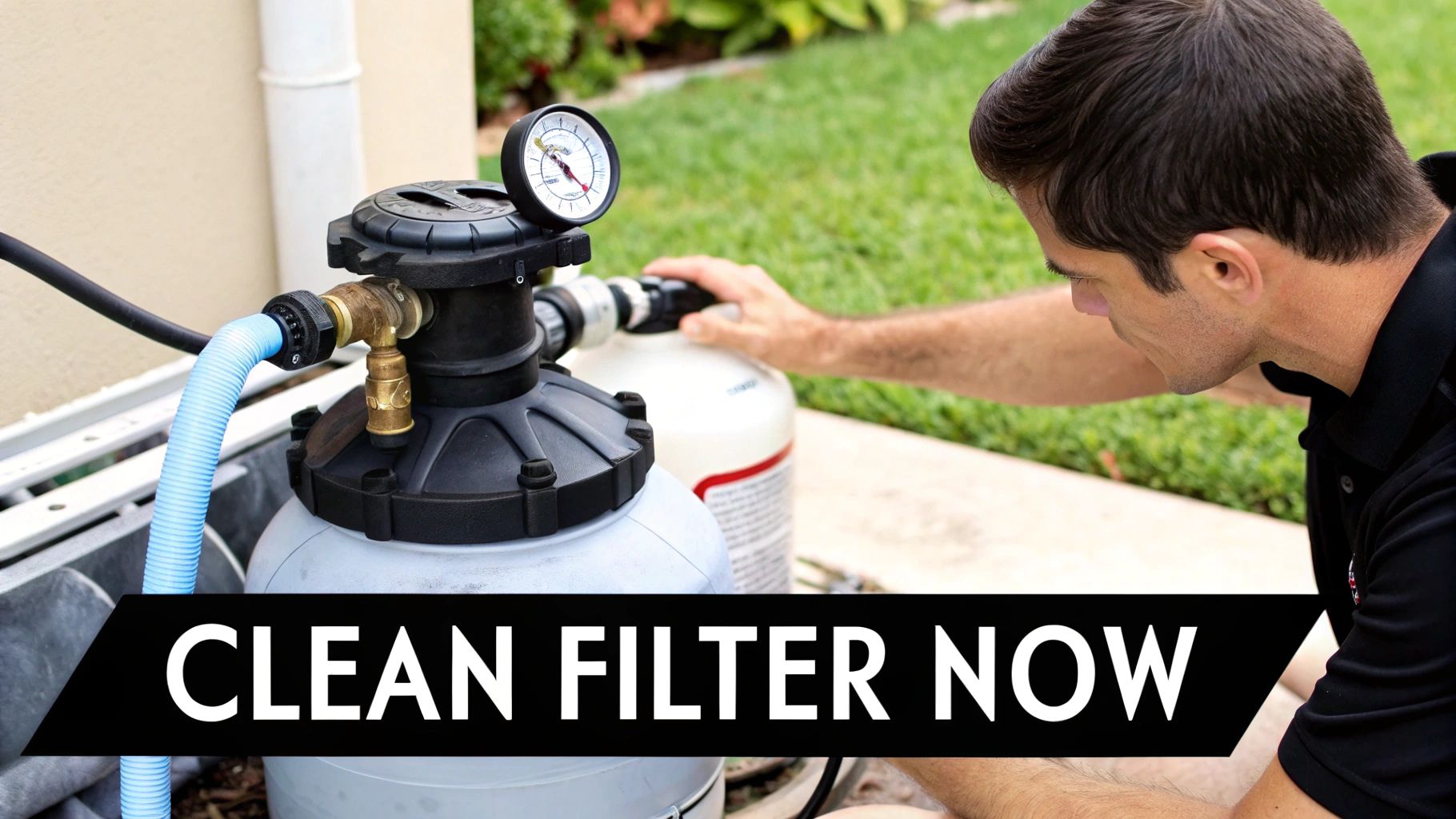
Think of your filter as the cleanup crew in your green algae in pool treatment plan. If it's already dirty or clogged when you begin, it simply won't be able to keep up. You absolutely must start with a clean filter to have any hope of clearing up a green pool efficiently.
Your Non-Negotiable Filtration Strategy
Here’s the single most important rule when you’re fighting an algae bloom: run your pump 24 hours a day, 7 days a week until that water is crystal clear again. Don't even think about turning it off. This constant circulation is the only thing that forces all that cloudy water through the filter so the dead algae can be trapped.
If you shut the pump off, even for a few hours overnight, everything just settles back to the bottom. You'll lose all your momentum. Continuous filtration is the secret to polishing your water back to that sparkling clean state.
How to Handle Your Specific Filter Type
Your filter is going to be working overtime, which means you need to give it some TLC. If you ignore it, the filter will clog, the pressure will skyrocket, and you could even end up sending all that gunk right back into the pool.
-
Sand Filters: Get ready to backwash. A lot. As the filter traps all that dead algae, you'll see the pressure gauge climb. Once it reads 8-10 PSI higher than its normal "clean" pressure, it’s time to backwash. When you're in the middle of a heavy-duty cleanup, this might even be a daily chore.
-
Cartridge Filters: These guys need to be cleaned by hand. You’ll have to pull the cartridges out and give them a really thorough hosing down. I strongly recommend using a dedicated filter cleaning solution to break down the oils and gunk that a simple water rinse just can't touch.
-
D.E. (Diatomaceous Earth) Filters: These work a lot like sand filters—you’ll backwash when the pressure gets too high. The crucial difference is that after you backwash, you must add a new "charge" of D.E. powder through the skimmer to recoat the filter grids.
One of the biggest mistakes I see homeowners make is what I call "shock and walk." They dump in the chemicals and assume the job is done. You have to stay on top of your filter. A clogged filter is useless, and all that money you just spent on shock and algaecide will go to waste. The follow-through is just as critical as the initial chemical assault.
This whole process puts a serious strain on your pump and filter. An older pump that isn't moving enough water or a filter with worn-out internals can make clearing a pool next to impossible. In fact, it's often the hidden reason algae keeps coming back.
If you’ve cleaned your filter repeatedly and the water just isn't getting any clearer after a couple of days, your equipment is probably the real culprit. Our technicians can diagnose the entire system to make sure every component is pulling its weight. If you suspect a problem, looking into professional pool equipment repair services can save you a ton of time, money, and frustration.
So, you’ve conquered the green monster and your pool is finally sparkling again. Fantastic. Now for the most important part: keeping it that way. Winning the war against algae isn't about one big, heroic battle; it's about setting up a simple, consistent routine that makes your pool an unfriendly place for algae to even think about growing.
This is the shift from reactive to proactive care. It’s what separates pool owners who are always fighting problems from those who just get to enjoy their backyard oasis. Think of it as building a defensive shield that algae spores just can’t get through.
Building Your Proactive Defense Strategy
Your pool maintenance should be like a weekly health check-up. A few small, consistent actions are infinitely more powerful than waiting for a disaster and then trying to fix it. The whole idea is to catch tiny imbalances before they have a chance to turn into a full-blown, green-tinted nightmare.
Here’s what that regular rhythm looks like:
- Test and Tweak Weekly: At the very least, you need to be testing your free chlorine and pH twice a week. Keeping your chlorine in that sweet spot of 1-3 ppm and your pH between 7.2-7.6 is your absolute first line of defense.
- Brush It Down: Even if the water looks perfect, give the walls, steps, and corners a quick brush once a week. This is crucial for knocking off any invisible little algae colonies before they get a foothold.
- Keep the Water Moving: Don't get lazy with your pump. You need to run it for at least 8-12 hours every single day. Good circulation is what ensures your chemicals are spread evenly and all the water gets filtered properly.
For those of us here in Southwest Florida, this routine isn't just a good idea—it's essential. The intense sun here burns through chlorine like crazy, and our legendary summer downpours can dilute your chemicals and wreck your pH in a matter of hours.
The Smart Way to Use Preventative Algaecides
While your sanitizer (chlorine) is the star of the show, a good preventative algaecide is its best supporting actor. Adding a small maintenance dose every week or two creates an extra layer of security, especially during our hot, rainy summer season. It’s cheap insurance that helps stop algae spores from ever germinating in the first place.
Interestingly, the market is shifting. The swimming pool treatment chemical industry, worth about USD 8.2 billion in 2023, is seeing a huge spike in demand for natural and biodegradable algaecides. As you can see in this market research report, people want effective solutions that are also gentler on the environment.
"An ounce of prevention is worth a pound of cure." Honestly, that old saying is the golden rule of pool care. A few minutes of simple maintenance each week will save you days of hard labor and hundreds of dollars in shock and other chemicals later on.
The Ultimate Hassle-Free Solution
Let's be real—life gets busy. It’s all too easy for pool maintenance to slide down the to-do list, and in our climate, one missed week is often all it takes for that green haze to start creeping back in. This is exactly why so many Cape Coral homeowners rely on our monthly pool maintenance plans. We take all the guesswork, labor, and stress right off your plate.
Thinking about DIY versus professional help? It’s a common question we get. Here’s a straightforward breakdown to help you decide what’s best for your lifestyle.
DIY Algae Prevention vs Professional Maintenance
| Aspect | DIY Approach | Water Medic Professional Service |
|---|---|---|
| Time Commitment | You'll spend 1-2 hours every week testing, brushing, and adding chemicals. | Zero hours for you. Your time is yours again; we handle everything. |
| Consistency | Depends entirely on your schedule. Easy to miss during vacations or busy weeks. | Guaranteed weekly service. Your pool is protected like clockwork, no matter what. |
| Chemical Costs | You buy and store all the chemicals yourself, usually paying retail prices. | It's all-inclusive. We use premium, commercial-grade chemicals for better results. |
| Problem Diagnosis | It's on you to figure out what's causing cloudy water or stubborn algae spots. | Expert oversight. Our trained technicians spot and fix potential issues before you even know they exist. |
Ultimately, choosing a professional service means your pool goes from being a recurring chore to a pure source of fun. With Water Medic, you can just trust that your pool will always be balanced, clean, and ready for you to jump in.
When To Call In a Pool Treatment Professional
Tackling a green pool on your own can be a satisfying weekend project, but let's be honest—sometimes you're just throwing good money after bad. It's not about giving up; it's about knowing when to tag in an expert to save your sanity, your time, and your wallet from endless trips to the pool store.
If you’ve done everything by the book—you've balanced the water, shocked it until you can't shock it anymore, and brushed until your arms are sore—but that green haze still lingers, it's a huge red flag. Stubborn algae that just won't die or keeps creeping back is almost always a symptom of a deeper problem.
Signs You're Fighting a Losing Battle
When you run into these classic roadblocks, calling a pro is often the smartest and cheapest move in the long run. Don’t waste another beautiful Southwest Florida weekend battling a swamp.
-
You Can't See the Bottom: This is the big one. If your pool is so murky you can't even make out the main drain in the deep end, you've got what we call a "black pool." This isn't just a simple algae bloom; it's a serious situation that needs a heavy-duty, systematic approach with commercial-grade products to fix it right.
-
The Algae Keeps Coming Back: There’s nothing more frustrating than clearing up your pool only to see that familiar green tinge return a week later. This vicious cycle usually points to a hidden culprit—maybe poor circulation from an old pump, a sand filter that needs a deep clean, or high phosphate levels that standard test kits just can't detect.
-
You Suspect an Equipment Problem: Is your filter pressure gauge acting weird? Does the pump sound like it's groaning? Pouring expensive chemicals into a pool with a failing circulation system is like trying to bail out a boat with a hole in it. You're just not going to win. Our pool equipment repair services can diagnose and fix the root cause.
Your time is valuable. A severe algae bloom can demand days, sometimes even weeks, of consistent, hands-on work. A professional can typically diagnose and clear it up in a fraction of that time, getting you back to enjoying your pool instead of just working on it.
Don't let a stubborn algae problem turn your backyard oasis into a source of stress. If any of this sounds like your situation, it’s time to call for backup. Contact Water Medic of Cape Coral today, and let our experienced technicians get your pool back to crystal clear.
Questions We Hear All The Time About Green Algae
Even when you have a plan, a green pool can throw a few curveballs. Here are the answers to some of the most common questions we get from pool owners here in Southwest Florida.
How Long Does This Actually Take?
Honestly, it really depends on how bad things have gotten. If you've just got a light green haze starting to cloud the water, you could be looking at a 2-3 day turnaround with consistent effort. You'll likely see a huge difference in the first 24 hours.
But if your pool looks more like a dark green swamp, you need to be more patient. That kind of cleanup is a marathon, not a sprint. Plan for it to take at least 3-5 days, and sometimes even a full week, depending on your filter system and the severity of the bloom.
Is a Little Bit of Algae Okay to Swim In?
I'm going to give you a hard "no" on this one. It’s not the algae itself that’s the main problem, but what it represents: a total lack of sanitizer.
If algae can thrive, it means there isn't nearly enough chlorine in the water to kill off the nasty stuff you can't see. We're talking about bacteria and other pathogens that can lead to everything from skin rashes and ear infections to some pretty serious stomach illnesses.
A pool with any visible algae is a compromised pool. The real danger isn't the green stuff, but the unsanitized water that's a breeding ground for bacteria. Keep everyone out until it's crystal clear again.
Can I Skip the Shock and Just Use Algaecide?
This is a shortcut that almost always backfires, costing you more time and money in the long run. Think of it this way: chlorine shock is the brute force that kills the massive algae bloom. Algaecide is more of a preventative measure or a finisher—it stops new spores from taking hold after the main battle is won.
Pouring algaecide into a full-blown green pool is like trying to put out a forest fire with a garden hose. It just gets overwhelmed. While some homeowners look into natural methods for treating biological growth for things like their lawns, a swimming pool requires a powerful initial shock to effectively wipe out an existing algae problem.
Wrestling with a green pool can eat up your whole weekend. If you’d rather just have it fixed fast without the guesswork, the team at Water Medic of Cape Coral is here to help. We have the pro-grade chemicals and equipment to get your pool from green to pristine in no time. Give us a call or visit us at https://watermedic.com to get your service scheduled.