Your Complete Guide to a Reverse Osmosis Drinking Water System
Picture a filter so fine it can catch contaminants on a molecular level. That's the essence of a reverse osmosis drinking water system. It’s like having an incredibly picky bouncer for your home's water supply, letting pure H₂O molecules through while turning away almost everything else—from dissolved minerals to nasty chemicals.
What Is a Reverse Osmosis System and Why Do You Need One
A reverse osmosis (RO) system is a powerful water purification process that uses a special semipermeable membrane to get rid of impurities. For homeowners, it's really the top-tier solution for water treatment, especially here in Southwest Florida where water quality can be a constant headache. The system works by forcing water through this microscopic filter, which effectively strips out a huge range of unwanted stuff.
This is a whole different ballgame compared to your basic faucet or pitcher filter. While those might make your water taste a little better by removing chlorine, an RO system goes much, much deeper. It targets the long list of contaminants that are completely invisible but can have a real impact on your home and your health.
The Unseen Gunk in Your Tap Water
For most of us, the water that comes out of the tap looks clear and seems fine. But looks can be deceiving. It's often loaded with dissolved solids and chemicals that simple filters just can't handle. An RO system is specifically designed to zero in on these problems, giving you a reliable source of pure, safe drinking water.
Here’s a look at some of the key things an RO system will pull out of your water:
- Total Dissolved Solids (TDS): This is the catch-all term for the minerals, salts, and organic matter that cause "hard water" and can give your water an off-taste.
- Heavy Metals: Nasty stuff like lead, arsenic, and copper can sometimes find their way into water supplies and are serious health concerns.
- Chemicals: Things like chlorine, fluoride, and nitrates are commonly found in both city and well water.
- PFAS: These are the infamous "forever chemicals" that are becoming a major public health issue.
A good reverse osmosis system can remove up to 99% of total dissolved solids. That level of filtration offers incredible peace of mind, knowing that the water your family drinks is as clean and safe as it gets.
The power of RO filtration lies in its comprehensive approach. It doesn't just improve taste; it fundamentally purifies the water.
This table gives a clearer picture of just how effective these systems are against a wide range of common water contaminants.
Common Contaminants Removed by Reverse Osmosis
| Contaminant Type | Examples | Typical Removal Rate |
|---|---|---|
| Heavy Metals | Lead, Arsenic, Mercury, Copper | 95% – 99% |
| Dissolved Solids (TDS) | Salts, Calcium, Magnesium, Nitrates | 90% – 99% |
| Chemicals | Chlorine, Fluoride, Pesticides | 90% – 98% |
| Emerging Contaminants | PFAS ("Forever Chemicals"), Pharmaceuticals | Up to 99% |
As you can see, from heavy metals to the salts that make water hard, RO provides a robust defense against nearly everything you don't want in your glass.
Why Modern Homeowners Are Making the Switch
It’s no surprise that people are getting more serious about water purification. In fact, reverse osmosis systems are on track to make up a 35% market share of the global water treatment market by 2025. This isn't just a fleeting trend; it’s a clear sign that homeowners are done guessing about what's in their water. You can learn more about the future of water treatment systems and see why this technology is leading the way.
Getting a professional-grade reverse osmosis drinking water system installed is more than just a home improvement project—it's a crucial step for your family's health and well-being. Here at Water Medic, we specialize in creating whole house reverse osmosis solutions that are built to handle the unique water challenges we face in Southwest Florida, turning your questionable tap water into pure, delicious refreshment.
How Multi-Stage Filtration Delivers Unmatched Purity
A modern reverse osmosis drinking water system isn’t just a single filter—it’s more like a highly specialized purification team. Each component has a specific job, working together in a sequence to strip away different types of impurities. Let's trace a drop of water as it makes its way from your tap to your glass.
This journey transforms cloudy, ordinary tap water into something exceptionally pure and clean.
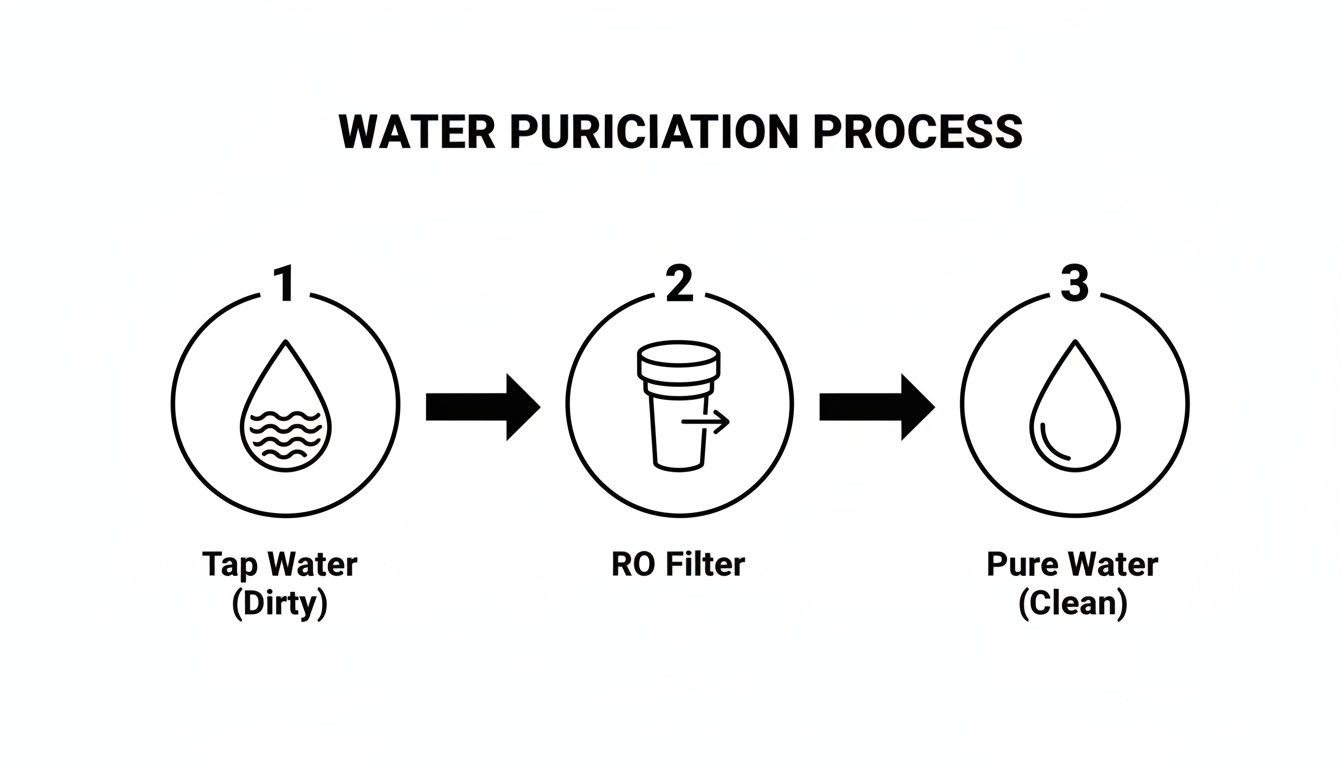
This carefully engineered process is what guarantees every drop is crystal-clear.
Stage 1: The Sediment Pre-Filter
First up, your water hits the sediment pre-filter. You can think of this as the system's bouncer, tasked with catching all the larger, visible gunk. Its main purpose is to protect the more sensitive, high-tech filters downstream.
This initial step is absolutely crucial. Without it, the finer filters would get clogged up and wear out in no time, so this stage handles the heavy lifting first.
Here’s what the sediment filter is designed to remove:
- Rust flakes from old pipes
- Sand and silt
- Dirt, clay, and other visible particles
By tackling the big stuff upfront, this filter clears the way for the next stages to focus on the microscopic contaminants they're built for.
Stage 2: The Carbon Pre-Filter
Once the water is visibly clear, it flows into the carbon pre-filter. This stage is all about chemistry. It uses activated carbon, which acts like a powerful sponge, grabbing onto chemical compounds that mess with your water's taste and smell.
Chlorine is the primary target here. Municipalities add it to disinfect the water supply, but it leaves that distinct chemical taste and odor. This filter is fantastic at neutralizing it. If you're curious, you can learn more about how different carbon filters work their magic on a wide range of impurities.
This filter also snags other unwelcome chemicals like volatile organic compounds (VOCs), making the water smell and taste clean and fresh.
Stage 3: The Reverse Osmosis Membrane
Now for the main event. The water reaches the heart of the system: the reverse osmosis membrane. This is where the real magic happens. The membrane is a sheet of material with pores so tiny—around 0.0001 microns—that they are far too small for the human eye to see.
High pressure forces water molecules through this microscopic maze, but almost everything else gets left behind. It’s an incredibly effective separation process that removes contaminants on a molecular level.
This single stage is powerful enough to remove up to 99% of all total dissolved solids (TDS). It blocks heavy metals like lead and arsenic, salts, and even tough-to-filter "forever chemicals" like PFAS.
This is what truly separates a reverse osmosis drinking water system from a simple countertop pitcher. It doesn't just strain the water; it fundamentally purifies it, isolating pure H₂O from an enormous list of dissolved contaminants.
Stage 4: The Final Polish
After its journey through the RO membrane, the purified water sits in a small storage tank, ready for when you need it. When you turn on your RO faucet, the water takes one last trip through a post-filter, which is usually another carbon filter.
Think of this as the final quality check. It "polishes" the water, removing any slight tastes or odors it might have picked up from the tank. The result is water that’s not just incredibly clean but has a crisp, refreshing taste that is truly second to none.
Choosing the Right RO System for Your Home
Picking the perfect reverse osmosis drinking water system isn’t a one-size-fits-all deal. It really comes down to matching the right technology to your home and your family's needs. With so many types and features out there, getting a handle on the key differences will help you make a smart investment in your water quality.
The first big choice you'll make is between a Point-of-Use (POU) system and a Point-of-Entry (POE) system. They each serve a very different purpose, so let's break down what that means for you.
Under-Sink vs Whole-House RO Systems
The most common system you'll find in homes is a Point-of-Use (POU) unit, better known as an under-sink system. It’s a compact setup that fits right in the cabinet under your kitchen sink, feeding pristine water to its own dedicated faucet. If your main goal is to get top-tier purified water for drinking and cooking, this is usually the perfect fit.
Of course, installing one of these means giving up some precious cabinet real estate. Thinking about smart storage solutions for maximizing cabinet space beforehand can make a big difference, especially in a busy kitchen.
Then there's the Point-of-Entry (POE) option, or a whole-house reverse osmosis system. This is the ultimate water treatment solution. We install it where the main water line enters your home, so it purifies every single drop of water you use—from the kitchen sink and dishwasher to your showers and laundry. It’s a game-changer for homeowners who want to eliminate hard water scale, protect their pipes and appliances, and enjoy pure water from every tap.
So, how do you choose? It all depends on what you're trying to achieve. Are you laser-focused on improving your drinking water, or do you want the full-package benefits of purified water everywhere in the house? To get a better sense of what a whole-house system involves, check out our deep-dive guide on whole house reverse osmosis.
To help you compare, here's a quick look at how the two types stack up.
Under-Sink vs Whole-House RO Systems
Use this comparison to decide which type of RO system best fits your home's needs, budget, and purification goals.
| Feature | Under-Sink RO System | Whole-House RO System |
|---|---|---|
| Purification Scope | Treats water at a single faucet | Treats all water entering the home |
| Primary Use | Drinking and cooking | All household uses (drinking, bathing, laundry) |
| Installation | Fits in a kitchen cabinet | Requires professional installation at the main water line |
| Cost | Lower upfront investment | Higher upfront investment |
| Space Required | Minimal, under a sink | Significant, often in a garage or utility area |
| Key Benefit | Targeted, high-purity drinking water | Total home protection and purified water everywhere |
Deciding between these two really sets the stage for the kind of water quality you'll enjoy day in and day out.
Decoding System Specifications
Once you know the type of system you need, it's time to look at performance specs. The most important one is the Gallons Per Day (GPD) rating. This tells you exactly how much purified water the system can produce in 24 hours. A family of four might only need a 50 GPD system for their kitchen sink, but a whole-house setup demands a much higher capacity to keep up with showers, laundry, and more.
A professional consultation is the best way to determine the right GPD for your household. An expert from Water Medic can assess your family's water usage patterns and recommend a system that meets your peak demand without wasting energy or water.
Water efficiency is another big one. Older RO systems were notorious for producing a lot of wastewater (often called brine) to flush away the filtered contaminants. Thankfully, modern high-efficiency systems have come a long way. They’re designed to minimize waste, which is great for the environment and your water bill.
Enhancing Your Water with Remineralization
A common question we get is whether reverse osmosis removes "good" minerals. The answer is yes—the membrane is so incredibly fine that it strips out almost everything, including beneficial minerals like calcium and magnesium. This gives you exceptionally pure water, but some people find the taste a little… well, flat.
That's an easy fix. We can add a remineralization filter as the final stage of the system. It puts a healthy blend of minerals back into the water after it’s been purified. The result is crisp, refreshing alkaline water that tastes fantastic. Here at Water Medic, we almost always recommend this simple upgrade so our clients get the best of both worlds: purity and great taste.
The technology behind these systems is advancing fast. The market for core RO components—like high-efficiency membranes and pumps—is expected to skyrocket from $16.9 billion in 2023 to $32.0 billion by 2029. This growth is driven by people just like you who are demanding better, purer water. You can read the full research about the growing RO market to see where the industry is headed. We make it our business to stay on top of these trends, ensuring we only install the most effective and efficient systems available today.
The Incredible Benefits of RO Drinking Water
Deciding to install a reverse osmosis drinking water system isn't just about filtering your water—it's a genuine investment in your family's health and your everyday quality of life. The perks extend far beyond just having "cleaner" water, creating a noticeable upgrade in everything from your morning coffee to your household budget.
Once you taste water that’s been stripped of all the extra stuff like chlorine, hard minerals, and other dissolved solids, you'll immediately get it. It’s a kind of purity that makes everything it touches just a little bit better.

Experience a World of Better Flavor
Ever notice a slight funk in your coffee or tea? The impurities in standard tap water are often the culprit. When you boil pasta, brew your morning cup, or mix a drink, those unwanted contaminants get absorbed, masking the natural flavors you’re supposed to be enjoying.
Water purified by RO is a clean slate. Without all those distractions, the true taste of your ingredients finally gets to shine through. You’ll notice your coffee is richer and smoother, your soups and sauces taste cleaner, and even your ice cubes will be crystal clear and completely flavorless—just as they should be.
Financial and Environmental Savings
If your family is in the habit of buying bottled water, you know how that expense creeps up. It’s surprisingly easy to spend hundreds, if not thousands, of dollars every single year on single-use plastic bottles.
A reverse osmosis drinking water system puts an end to that. It transforms your kitchen tap into an endless source of bottled-water-quality hydration for just pennies per gallon. The system quickly pays for itself, leading to significant savings down the road. Plus, you’ll be doing our environment a huge favor by dramatically cutting down on plastic waste, keeping countless bottles out of landfills and our beautiful Florida waterways.
By switching from bottled water to an in-home RO system, the average family can prevent thousands of plastic bottles from entering the waste stream each year. It’s a powerful step towards a more sustainable lifestyle.
Uncompromising Health Protection for Your Family
Maybe the most important benefit of all is the simple peace of mind you get from knowing your water is truly safe. RO systems are incredibly good at removing a whole host of harmful contaminants that other types of filters just can't catch. This includes some serious health threats that can lurk in both city water and private wells.
Think of an RO system as your family's final line of defense against:
- Heavy Metals: It effectively removes dangerous elements like lead, arsenic, and mercury.
- Chemicals: It filters out things you don't want to drink, like chlorine, fluoride, pesticides, and nitrates.
- PFAS: It targets those persistent "forever chemicals" that are a growing concern across the country.
- Dissolved Solids: It gets rid of the salts and minerals that cause hard water and off-tastes.
There’s a reason this technology is setting the new standard for home water purification. Reverse osmosis drinking water systems are a major player in the global market, which is expected to skyrocket from USD 21.1 billion in 2025 to USD 56.6 billion by 2034. With RO technology claiming a massive 66.3% share of the water filtration market in 2024, its effectiveness is undeniable. Discover more insights about the booming RO market and see why so many homeowners are choosing this superior solution. At Water Medic, bringing these advanced systems into your home to protect your family is what we do best.
Professional Installation and Simple Maintenance
A high-performance reverse osmosis drinking water system is a precision machine. To get the most out of your investment, it all starts with a flawless installation. You'll see DIY kits out there, but trust me, dealing with connecting water lines, drilling through countertops, and ensuring a perfect, leak-proof seal is a job best left to the pros. It's the difference between a system that just works and one that works perfectly for years.
Our certified technicians at Water Medic have done this hundreds of times. We handle the entire process with an expert touch, making sure every connection is secure and your system is calibrated for peak performance right from the start. This professional approach sidesteps all the common DIY headaches—leaks, low water pressure, or improper drainage—that can undermine the system's effectiveness and even lead to water damage.
The Value of Expert Installation
A professional installation isn't just about hooking up a few tubes; it's a complete service that guarantees your system will run efficiently for a long, long time. We've got a process that ensures everything is done right.
Here’s what our expert installation covers:
- Site Assessment: We'll find the best spot for the unit, tank, and dedicated faucet, taking your kitchen layout and existing plumbing into account.
- Secure Connections: We use professional-grade fittings and proven techniques to tie the system into your cold water line for a durable, leak-free setup.
- System Sanitization and Flushing: Before you pour your first glass, we completely sanitize and flush the entire system. This gets rid of any residues from manufacturing and ensures the water is pure from day one.
- Performance Testing: We don't leave until we've tested the water pressure, flow rate, and TDS levels to confirm your new system is working exactly as it should.
Entrusting your installation to a professional not only protects your warranty but also provides the critical peace of mind that your home and new system are in safe hands. It’s the best way to safeguard your investment.
A Simple Maintenance Schedule for Pure Water
Once your reverse osmosis drinking water system is up and running, a little routine maintenance is all it takes to keep it that way. Following a basic schedule is the key to ensuring your water stays pure and the system operates efficiently for its entire lifespan. The most important part? Changing the filters and the RO membrane on time.
For homeowners who'd rather not deal with it themselves, Water Medic offers comprehensive monthly maintenance services. We can manage all the filter changes and system checks for you, so you can just enjoy perfect water without lifting a finger.
Here is a typical replacement timeline to follow:
Your RO Maintenance Checklist
- Pre-Filters (Sediment and Carbon): Replace these every 6-12 months. They do the initial heavy lifting, and changing them on schedule protects the more delicate RO membrane from getting clogged with chlorine and sediment.
- Post-Filter (Polishing Carbon Filter): This one should be replaced every 12 months. It’s what gives your water that final, crisp, and clean taste.
- RO Membrane: The heart of the system, this should be replaced every 2-4 years. The exact timing depends on your local water quality and how much water you use, but that's a solid guideline.
Sticking to this schedule is the single most important thing you can do to ensure a consistent supply of delicious, purified water for your family.
Solving Southwest Florida's Unique Water Challenges with RO
Living in Southwest Florida is a dream, but our water can be a real headache. The water flowing from taps in Cape Coral, Fort Myers, and our surrounding communities often has a distinct local character—and not the good kind. Those generic, big-box-store filters just don't stand a chance against the specific issues we face here.
This is where a reverse osmosis drinking water system becomes less of a luxury and more of a necessity. Unlike a simple pitcher filter, an RO system is a powerhouse engineered to tackle the exact cocktail of contaminants found in our local water, giving you a targeted and highly effective solution.
Conquering Hard Water and High TDS
One of the most common complaints we hear from homeowners is about hard water. This is caused by high levels of Total Dissolved Solids (TDS), mostly calcium and magnesium. It's the culprit behind that chalky white residue on your dishes and faucets, and it’s what gives your water that heavy, mineral-like taste.
A reverse osmosis drinking water system is the ultimate weapon against high TDS. Its ultra-fine membrane works on a molecular level, stripping out these dissolved minerals before they ever reach your glass. This process effectively softens your drinking water, gets rid of the chalky taste, and leaves you with pure, crisp water that tastes the way nature intended.
Eliminating That "Rotten Egg" Smell
If you've ever noticed a "roten egg" smell from your tap, you're not alone. That unmistakable odor is caused by hydrogen sulfide gas, a common issue in our area, especially for homes with well water. While basic carbon filters might mask the smell temporarily, they rarely eliminate it completely.
RO systems, on the other hand, are built for this. The multi-stage filtration process—which includes powerful carbon filters and the RO membrane—works together to strip out the sulfur compounds that cause the foul odor. The result is completely odorless, refreshing water you’ll actually want to drink.
We understand the complexities of our local water because we live here, too. At Water Medic, we don't offer generic fixes; we provide specialized solutions designed to solve the exact water problems Southwest Florida homeowners face every day.
Your Best Defense Against Saltwater Intrusion
Being so close to the coast means saltwater intrusion into our groundwater and private wells is a real and growing concern. When this happens, it can raise the salinity of your tap water, giving it a salty taste and making it more corrosive to your home's plumbing and appliances.
This is a problem that only a high-performance reverse osmosis drinking water system can truly fix. It's the same core technology used in massive desalination plants to convert seawater into pure drinking water. An RO system for your home expertly removes sodium chloride and other salts, protecting your pipes and ensuring your water is perfectly pure.
You can learn more by exploring our detailed guide to SWFL Water Quality for a full breakdown of our regional water issues. Our team at Water Medic specializes in diagnosing these local problems and installing the right RO system to solve them for good, giving your family the safe, great-tasting water you deserve.
Your Reverse Osmosis Questions Answered
It's smart to have questions before making a big improvement to your home's water. We get it. Let's walk through some of the most common things people ask us about reverse osmosis drinking water systems so you can feel completely confident.
Doesn't RO Remove the Good Minerals, Too?
This is probably the number one question we hear, and it’s a great one. The short answer is yes. The reverse osmosis membrane is so effective at its job that it filters out almost everything—unwanted contaminants and beneficial minerals like calcium and magnesium alike.
For some people, this super-purified water can taste a little "flat." But there's a simple fix. We almost always install a remineralization filter as the final step. This special filter adds a healthy, balanced mix of minerals back into the water right before it hits your glass. You end up with the best of both worlds: ultra-pure water that also has that crisp, refreshing taste you want.
How Much Water Does an RO System Waste?
Early RO systems definitely had a reputation for being water hogs, sending a lot of "brine" (wastewater) down the drain to flush away the filtered-out gunk. Thankfully, things have changed a lot since then.
Modern, high-efficiency systems are designed to conserve as much water as possible. While older models might have wasted 3 or 4 gallons for every gallon of pure water they made, today's top systems are far better. The exact ratio depends on your home's water pressure, but we specifically choose systems for our clients that are built for performance and minimal waste.
What's the Average Cost of a System?
The investment in a reverse osmosis drinking water system really depends on what you need. A point-of-use system that just serves your kitchen sink will, of course, cost less than a whole-house system that treats every faucet in your home.
A few other things affect the final price:
- System Capacity: A system rated for more Gallons Per Day (GPD) is more powerful and will have a higher price tag.
- Extra Features: Things like the remineralization filter we talked about or a UV sterilizer (a must for many well water homes) will add to the cost.
- Professional Installation: While it's an added cost, professional installation is crucial. It ensures there are no leaks and that the system runs at peak performance from day one, saving you headaches and money down the road.
Think of a professionally installed RO system not just as an appliance, but as a long-term investment in your family’s health and your home's value. We always provide clear, detailed quotes so you know exactly what you're getting.
If you're digging into home improvement topics, you might also find these general homeownership FAQs helpful for other projects.
Ready to get the best-tasting, purest water you've ever had, right from your own kitchen tap? The team at Water Medic of Cape Coral is here to put together the perfect reverse osmosis solution for your home. Contact us today for a free consultation and let's get you better water. https://watermedic.com