
Your Pool Pump Making Loud Noise? A Practical Guide
That sudden grinding, rumbling, or high-pitched squeal coming from your pool equipment isn't just background noise. It's a cry for help. Think of it as your pump's specific language for telling you something is wrong, and different sounds point to very different problems—from a simple clog to a motor on its last legs.
Ignoring these audible warnings is a classic mistake that can quickly snowball a small, cheap fix into a full-blown motor replacement. Our team at Water Medic sees this all the time, and we're here to help you understand what's happening and what to do about it.
What That Loud Pool Pump Noise Is Telling You
Your pool pump is the heart of your entire circulation system. Day in and day out, it just works. A healthy, happy pump should produce nothing more than a steady, quiet hum. When that sound changes to a pool pump making loud noise, it’s time to play detective. Every new sound is a clue pointing you toward the root of the problem.
Learning to interpret these sounds is the key to catching issues early. A sudden shift from a gentle hum to a harsh new noise is the most obvious red flag you'll get. By understanding what you're hearing, you can act fast, potentially saving yourself hundreds of dollars and keeping your pool from turning green.
Decoding Common Pool Pump Noises
Different noises are symptoms of specific mechanical or plumbing problems. Let's break down what those sounds are trying to tell you.
This quick reference table can help you match the noise you're hearing to its most likely cause. It’s a great first step in figuring out how serious the problem is and what you should do next.
| Type of Noise | Potential Cause | What to Do Next |
|---|---|---|
| Loud Rumbling or Gurgling | Cavitation (Starved for Water): The pump is pulling in air instead of just water. | Check the pool's water level, empty the skimmer and pump baskets, and look for air leaks on the suction side pipes. |
| High-Pitched Screeching | Worn Motor Bearings: The internal bearings that let the motor shaft spin freely are failing. | Shut the pump off immediately. This requires professional repair to replace the bearings before the motor seizes. |
| Grinding or Rattling | Debris in the Impeller: Something hard, like a small rock or acorn, has made it past the basket. | Turn off the power at the breaker, open the pump, and inspect the impeller for a jam. |
Once you have a general idea, you can start to investigate further. Don't let a strange noise go unchecked for long.
-
Loud Rumbling or Gurgling: This sound is a clear sign your pump is struggling to get enough water, a condition we call cavitation. It’s literally “starving” for water, causing air pockets to form and collapse inside the pump housing. The most common culprits are a low pool water level or a clog in the skimmer or pump basket.
-
High-Pitched Screeching or Whining: That ear-splitting, metallic screech is the classic calling card of failing motor bearings. The bearings are what allow the motor shaft to spin at thousands of RPMs without friction. When they go bad, you get metal grinding on metal. This is a critical issue that needs to be addressed immediately.
-
Grinding or Rattling: If it sounds like there's a rock tumbler inside your pump, you're probably not far off. This noise almost always means debris has slipped past the pump basket and is now trapped in the impeller. Small stones, mulch, or even kids' toys can get stuck in there, damaging the delicate fins.
Key Takeaway: A noisy pump is never a good sign. The specific sound it's making is your best clue to diagnosing the problem, whether it's an issue with water flow, a foreign object, or worn-out internal parts.
Why Ignoring the Noise Is a Costly Mistake
It can be tempting to just hope the noise goes away on its own, but that’s a gamble that almost never pays off.
A screeching bearing, for instance, won't heal itself. It will eventually seize up completely, causing the motor to burn out. That turns a manageable bearing replacement into a much more expensive full motor replacement. Likewise, letting a pump run while it's starved for water can destroy the pump seal and warp the impeller, leading to leaks and permanent damage.
If you're hearing something unusual and aren't sure where to start, the experts at Water Medic of Cape Coral can pinpoint the source of the noise and get it fixed right. You can always contact Water Medic of Cape Coral for an expert assessment and bring the peace and quiet back to your pool area.
Finding the Real Source of That Racket
Alright, you've listened closely and have a good idea of what kind of noise your pump is making. Now it's time to play detective and figure out why. When your pool pump is making a loud noise, a little methodical investigation goes a long way. This means safely checking the most common trouble spots, from simple air leaks that are starving the pump for water to worn-out parts deep inside.
This diagram is a great starting point. It helps you connect the sound you're hearing—whether it's a rumble, a screech, or a grinding noise—to the most likely culprit.
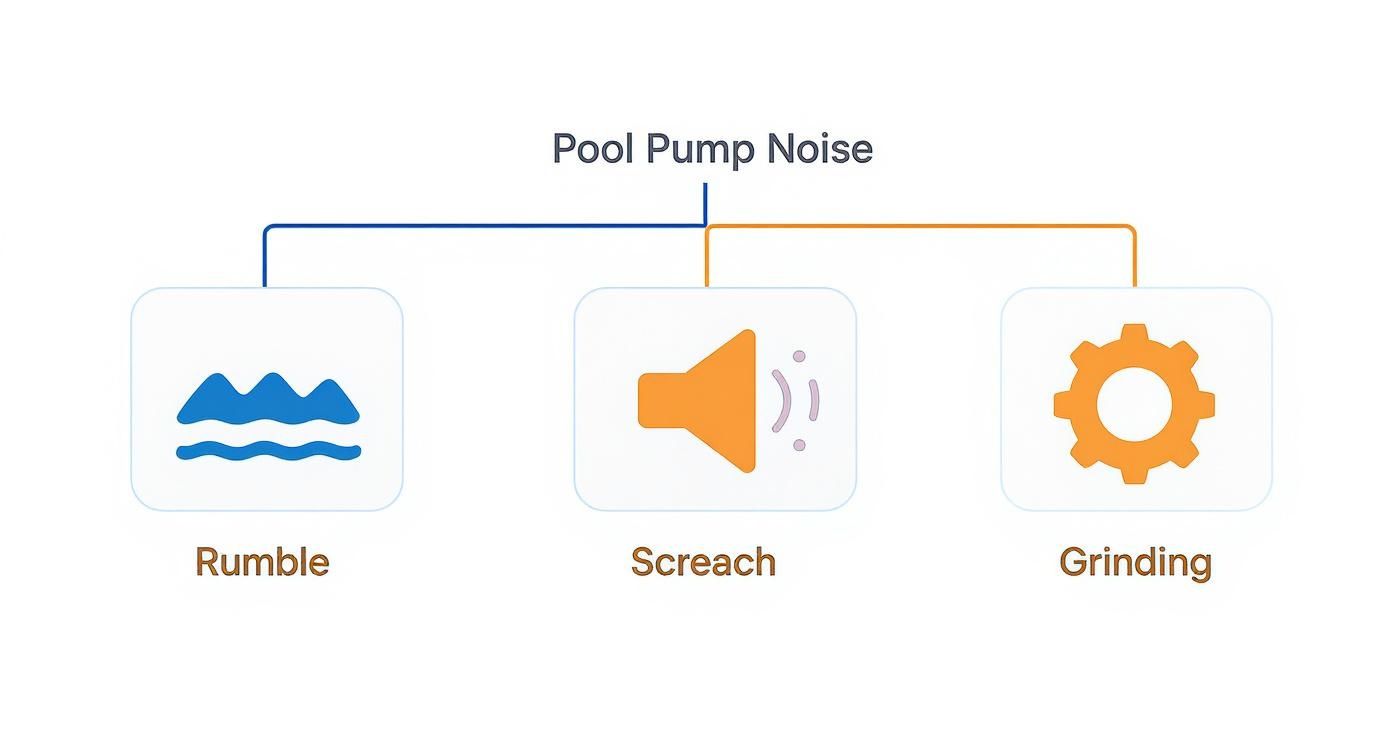
As you can see, different sounds point to very different problems. A rumbling noise usually sends you looking for water flow issues, while a screech or grind points to a mechanical failure inside the motor.
The Hunt for Air Leaks (Cavitation)
If your pump is rumbling, gurgling, or sounds like it's full of gravel, that’s almost always cavitation. It's a fancy word for a simple problem: the pump is sucking in air instead of just water. This is not only inefficient, but it can cause serious damage over time, so let's track down that leak.
Start with the easiest things first. Go look at your pool's water level. Is it at least halfway up the skimmer opening? If it's too low, the skimmer will suck in big gulps of air every time it runs. This is the #1 cause we see.
Next, check your skimmer and pump baskets for leaves, twigs, or other debris. A clog in either spot can restrict water flow, creating a vacuum that pulls air in through weak seals.
If those are clear, the pump lid's O-ring is your next likely suspect. Turn off the pump, open the lid, and carefully inspect that big rubber ring. If it looks cracked, stretched out, or flattened, it's not creating a proper seal.
Checking for a Clogged Impeller
Is the sound more of a rattling or grinding, as if a handful of rocks got inside? That's a classic sign that debris has snuck past the pump basket and is now jamming up the impeller. The impeller is a small, fan-like part that spins rapidly to push water, but its fins are delicate and can't handle debris.
To check this, you have to be safe. Go to your circuit breaker and shut off all power to the pool pump. Never, ever work on a pump without being 100% certain the power is off.
With the power off, open the pump and clean out the basket. Now, you’ll need to reach into the volute (the opening behind the basket) and feel around the impeller for anything stuck in there. We often find small pebbles, acorns, and even little plastic toys that have been sucked in.
Pro Tip: If you can't quite see or feel a clog but are pretty sure something's in there, you can sometimes use a bent piece of a wire coat hanger to gently feel around the impeller vanes. Just be very careful not to scratch or bend the plastic.
Diagnosing Worn-Out Motor Bearings
The most unnerving noise of all is often a piercing, high-pitched screech or a deep, metallic grinding that gets worse over time. This is the tell-tale sound of failing motor bearings. The motor shaft spins on tiny, sealed ball bearings, and after years of use, they simply wear out.
Here’s an old pro's trick for confirming bad bearings. While the motor is running, take a long screwdriver and carefully touch the metal tip to the back end of the motor case. Then, press your ear firmly against the plastic handle. The screwdriver acts like a stethoscope.
If you hear a loud, rough, grinding sound amplified through the handle, you’ve found your problem. The bearings are shot. This is a more involved repair that requires taking the motor apart.
Getting the diagnosis right is everything. If you’ve run through these checks and you're still not sure what's going on—or if the evidence points to a complex job like replacing motor bearings—it’s probably time to call for backup. Our team at Water Medic has the right tools and years of experience to pinpoint the problem and get it fixed correctly. You can check out our professional pool pump repair and replacement options to see how we can get your pool system back to running peacefully and efficiently.
When That Loud Noise Means Big Trouble
Let's be clear: not all pool pump noises are a five-alarm fire. A gentle hum is normal, and a bit of gurgling might just be some air in the system that needs to be bled out. But when that sound turns into a sharp, metallic, or grinding racket, your pump is screaming for help.
Ignoring a loud, mechanical noise is like putting tape over your car's check engine light. You're not fixing the problem; you're just waiting for it to get a whole lot worse—and a whole lot more expensive. Certain sounds are dead giveaways for serious internal problems that can completely fry your pump's motor if you let them go.
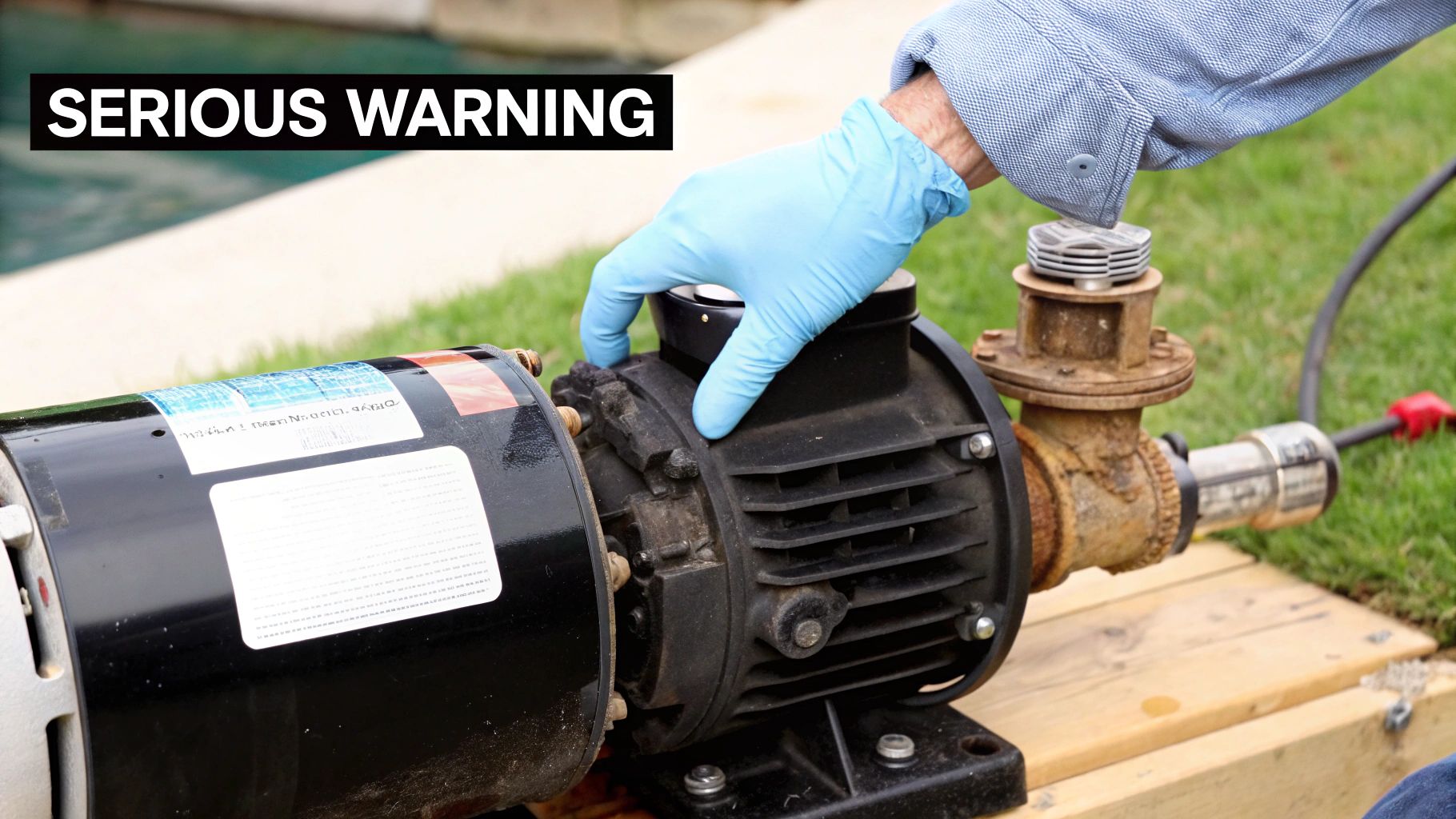
Sounds That Mean "Shut It Down, Now!"
Some noises are so bad that your first and only move should be to kill the power at the breaker. Continuing to run the pump when you hear these sounds can cause catastrophic damage in minutes, not hours.
- A Piercing Squeal or High-Pitched Whine: This is the classic, unmistakable sound of dying motor bearings. Bearings are what allow the motor shaft to spin thousands of times per minute without friction. Once they fail, you've got metal grinding on metal, creating intense heat that will absolutely cook the motor.
- Loud, Metallic Grinding: This often goes hand-in-hand with the squeal of bad bearings. It could also mean the impeller is so damaged that it's physically hitting the inside of the pump housing. This can happen if a piece breaks off or if the bearings are so shot that the whole motor shaft is wobbling around.
- A Sudden, Loud Bang, Then… Silence: If you hear a pop followed by either silence or just a low hum, you might have just blown a capacitor or, worse, the motor has completely seized. A seized motor is usually the end of the line, often caused by running it with bad bearings for too long.
Crucial Takeaway: If you hear that high-pitched, metal-on-metal screech or a violent grinding sound, don't wait. Don't think about it. Shut the pump off immediately. You might just save yourself from having to buy a whole new motor.
The Ripple Effect of a Rattling Impeller
A rattling noise might not sound as terrifying as a screech, but it’s a problem that can quickly snowball. More often than not, that sound means debris—a small rock, a twig, or even a piece of a broken skimmer basket—is caught in the impeller.
When the impeller is clogged or damaged, it can’t push water properly. This poor circulation is the first step toward a cloudy, green pool. Beyond that, a damaged impeller gets thrown off-balance, creating vibrations that put immense stress on the motor shaft and bearings, causing them to wear out much faster.
Keeping the Peace in Cape Coral
Aside from the health of your pump, a screamingly loud unit can become a real headache for your neighbors. Here in residential areas like Cape Coral, a pump that drones or whines nonstop is a major source of frustration, especially if it kicks on early in the morning or runs late at night.
Believe it or not, pool pumps are one of the top sources of noise complaints to local councils. Some older pumps can hit 70 decibels—that's as loud as a vacuum cleaner or busy street traffic. If a neighbor complains, ignoring it can lead to official notices or even fines. You can learn more about how pump noise can affect your community and what the local regulations are.
Knowing what these different noises mean helps you make the right call. Clearing a clogged impeller might be a simple DIY job, but anything involving the motor’s internal parts is best left to a pro. Don't risk turning a simple repair into a complete pump replacement. If you're hearing something that sounds serious, our team at Water Medic of Cape Coral provides expert pool equipment repair to safely diagnose the issue and stop the damage in its tracks.
Keeping Your Pool Pump Quiet with Proactive Maintenance
When it comes to a pool pump making a loud noise, the best defense is a good offense. Instead of waiting for a high-pitched squeal or a gravelly rumble to ruin your afternoon, you can get ahead of it with a simple maintenance routine. Honestly, preventing a problem is always easier and a whole lot cheaper than fixing one.
Think of it like the routine maintenance you do on your car. You don't wait for the engine to blow up to change the oil. A few minutes of your time each week can make a massive difference, extending the life of your pump and keeping your backyard the peaceful oasis it's meant to be.
Your Weekly Quiet-Pump Checklist
Consistency is everything. By folding a few quick checks into your weekly pool care, you can head off the most common culprits behind a noisy pump before they even start. This isn't about becoming a master mechanic; it's about making sure your pump isn't struggling to do its job.
- Keep the Water Level Right: This is the big one. Make sure your pool water stays at least halfway up the skimmer opening. If it drops too low, the pump starts sucking in air, leading to that loud, churning sound of cavitation.
- Empty Those Baskets: A clogged skimmer or pump basket essentially starves your pump of water, forcing it to work harder. Check them at least once or twice a week and clear out any leaves, palm fronds, or other debris to keep the water flowing freely.
- Lube the Lid O-Ring: About once a month, pop the lid off your pump and check the O-ring. If it looks dry, cracked, or flattened, it's a prime suspect for an air leak. A quick application of a silicone-based lubricant will keep it supple and maintain a perfect, airtight seal.
Expert Takeaway: Catastrophic pump failures rarely happen out of the blue. They're almost always the end result of small, overlooked issues—like a basket full of leaves or a dried-out O-ring—that slowly force the motor to overwork itself to death.
Long-Term Strategies for a Silent System
Looking beyond the weekly routine, a few smart moves can keep your pump running whisper-quiet for years. For instance, ensuring your pump is wired correctly with proper motor protection strategies is crucial for guarding against electrical issues that can cause damage and noise.
Another fantastic long-term investment is simply upgrading your equipment. Modern variable speed pumps are a game-changer. They can operate at noise levels as low as 33 dB(A)—that's quieter than a library—compared to older single-speed models that can roar at 70 dB. Not only are they quieter, but they are also up to 15 times more energy-efficient, saving you a bundle on your utility bills.
The Smartest Move: A Hands-Off Maintenance Plan
Let's be real—life gets busy. If you're a homeowner in Cape Coral who would rather enjoy the pool than work on it, a professional maintenance plan is the perfect solution.
Our team at Water Medic can handle all the routine checks for you, from cleaning baskets and lubricating seals to spotting the early warning signs of wear and tear. This hands-off approach guarantees your pump stays in peak condition, preventing noise issues and maximizing its lifespan. If you’re ready to learn how we can keep your system running silently year-round, check out our popular monthly pool maintenance packages. It’s the easiest way to protect your investment and keep your pool relaxing and quiet.
When to Call a Professional for Pump Repair
While I’m a big believer in homeowners tackling basic maintenance, like cleaning a pump basket or topping off the water, you need to know where to draw the line. When your pool pump is making a loud noise, that line can get real clear, real fast. Knowing when to put down the tools and call in a pro is the single most important decision you can make for your safety and your wallet.
Honestly, some jobs just demand a level of skill and specific tools that most folks don't have lying around in their garage. Trying to muscle through a complex repair without the right training can take a small, fixable issue and turn it into a complete system failure. This is especially true when you're dealing with the pump's motor or anything electrical.
Drawing the Line: DIY vs. a Service Call
It's tempting to try and fix it yourself—I get it. But certain sounds are your pump's way of screaming for a professional. If you've gone through the easy checks and the noise is still there, or if you can tell the sound is mechanical and coming from deep inside the motor, it's time to call for backup.
Here are the situations where calling a professional is a no-brainer:
- Replacing Motor Bearings: That piercing, high-pitched screech is the classic sign of shot bearings inside the motor. Swapping them out means tearing the motor down completely, using a specialized tool called a bearing puller, and pressing the new ones on perfectly. One wrong move and you’ve wrecked the whole motor.
- Swapping a Bad Capacitor: Does your pump just hum without starting? Or maybe it made a loud pop and then died? That points to a bad capacitor. It looks like a simple part, but capacitors hold a serious electrical charge, even with the power off. Messing one up can give you a nasty shock.
- Anything Involving Electrical Wiring: If you even suspect an issue with the wiring, the timer, or the breaker connection, just stop. Don't touch it. Water and electricity are a deadly mix, and our technicians are trained to handle these high-voltage systems safely.
Safety First: The risk of electric shock or fire is no joke when you're working on pool pump motors. A professional not only fixes the problem but makes sure your equipment is 100% safe to operate. You really can't put a price on that peace of mind.
The Value of Experience (And the Right Tools)
When you call a technician from Water Medic of Cape Coral, you're not just paying for a repair; you're investing in years of hands-on experience. We show up with everything needed to do the job right the first time—from bearing pullers and multimeters to a truck stocked with the most common replacement parts. We've seen it all and can pinpoint the true source of a noise quickly, saving you the headache and expense of trial-and-error repairs.
Beyond that, you need to trust who's working on your property. It's crucial to feel confident you're hiring a licensed and insured plumber or a certified technician who guarantees their work. That level of professionalism is something we stake our reputation on.
Keeping the Peace with Your Neighbors
A noisy pool pump isn't just an annoyance for you; it can quickly become a neighborhood issue. Some communities have even started to enforce noise restrictions on pool equipment, and homeowners can get hit with fines or be forced to install expensive soundproofing. Some of the newer solutions, like acoustic pump enclosures, can cut pump noise by up to 80%, but getting the pump fixed is always the best first step.
A professionally repaired pump is a quiet pump. At Water Medic of Cape Coral, our expertise in pool equipment repair means your system will run smoothly and silently. If your pump is causing a racket, don't gamble on a DIY fix that might not hold up. Give us a call at (239) 574-4125 to schedule your service and let our experts bring some quiet back to your backyard.
Answering Your Top Questions About Noisy Pool Pumps
Even after you've done some digging, it's normal to still have questions when your pool pump is making a racket. You're not alone; we hear the same concerns from homeowners all the time about costs, quick fixes, and how long their equipment should last. Let's get you some straight answers so you can figure out what to do next.
Dealing with a noisy pump is a headache, but knowing what you're up against makes a huge difference. Understanding the potential costs and realistic fixes helps you make a smart call for your home and your wallet.
How Much Will It Cost to Shut That Thing Up?
This is always the first question, and the honest-to-goodness answer is: it really depends on what's causing the noise. Sometimes, you get lucky. A simple fix, like replacing a worn-out pump lid O-ring to stop it from sucking in air, might only cost you $20 for the part. If you just need to clear some gunk out of the impeller, your only cost is a little bit of your time.
But when you're dealing with the internal mechanics, things get a bit more involved.
- Motor Bearings: That high-pitched screeching or grinding? That's almost always the motor bearings. Having a pro replace those will typically run you somewhere between $250 and $450, depending on your pump's make and model.
- Full Motor Swap: If the bearings were ignored for too long, they can seize up and completely fry the motor. In that case, you're looking at a full motor replacement, which can range from $500 to $900, sometimes more for high-performance models.
- Brand New Pump: If your pump has seen better days and is getting close to a decade old, putting hundreds of dollars into a repair might not be the best investment. Often, the smarter move is to replace the whole unit with a modern, energy-efficient model.
Here at Water Medic of Cape Coral, we don't believe in surprises. We'll find the exact source of the noise and give you a clear, upfront quote before we touch a thing. You'll know exactly what you're paying for. You can request a professional diagnosis and estimate here to get started.
Can I Just Put a Box Over It to Make It Quieter?
Yes, a cover can muffle the sound, but you have to be careful. You can't just throw a tarp over it or build a tight wooden box. That pump motor gets hot—really hot—and it needs constant airflow to keep from overheating. Boxing it in without proper ventilation is a serious fire hazard and a surefire way to kill the motor.
The right way to do this is with an acoustic pump enclosure. These are specially designed to deaden the noise while still allowing the motor to breathe. But even with the right cover, you need to remember the most important part:
A pump cover is a band-aid, not a cure. It hides the noise, but it doesn't fix the mechanical problem making the noise in the first place. Ignoring a screaming bearing is just asking for a much bigger, more expensive failure down the line.
How Long Is a Pool Pump Supposed to Last, Anyway?
With good care, a quality pool pump should give you 8 to 12 years of service. The single biggest factor in getting it to last that long is regular, basic maintenance. Keeping it shielded from the brutal Florida sun and rain, emptying the baskets regularly, and keeping your water chemistry balanced will make all the difference.
Usually, the motor bearings are the first major part to go, but that's after years of hard work. If your pump is creeping up on that 10-year mark and you're staring at a hefty repair bill, it's often more practical to replace the entire unit. Today's pumps are worlds apart in efficiency and are incredibly quiet. If it's time for an upgrade, we can help you explore modern, quiet, and energy-efficient pump options that will save you a bundle on your electric bill.
If you're tired of the racket and just want your peaceful backyard back, let us take it from here. The team at Water Medic of Cape Coral has the know-how to find the real problem and fix it right, for good. For expert service you can count on, give us a call today at (239) 574-4125 or find us online at https://watermedic.com.