How to Maintain Pool Chemistry: Balanced, Crystal-Clear Water
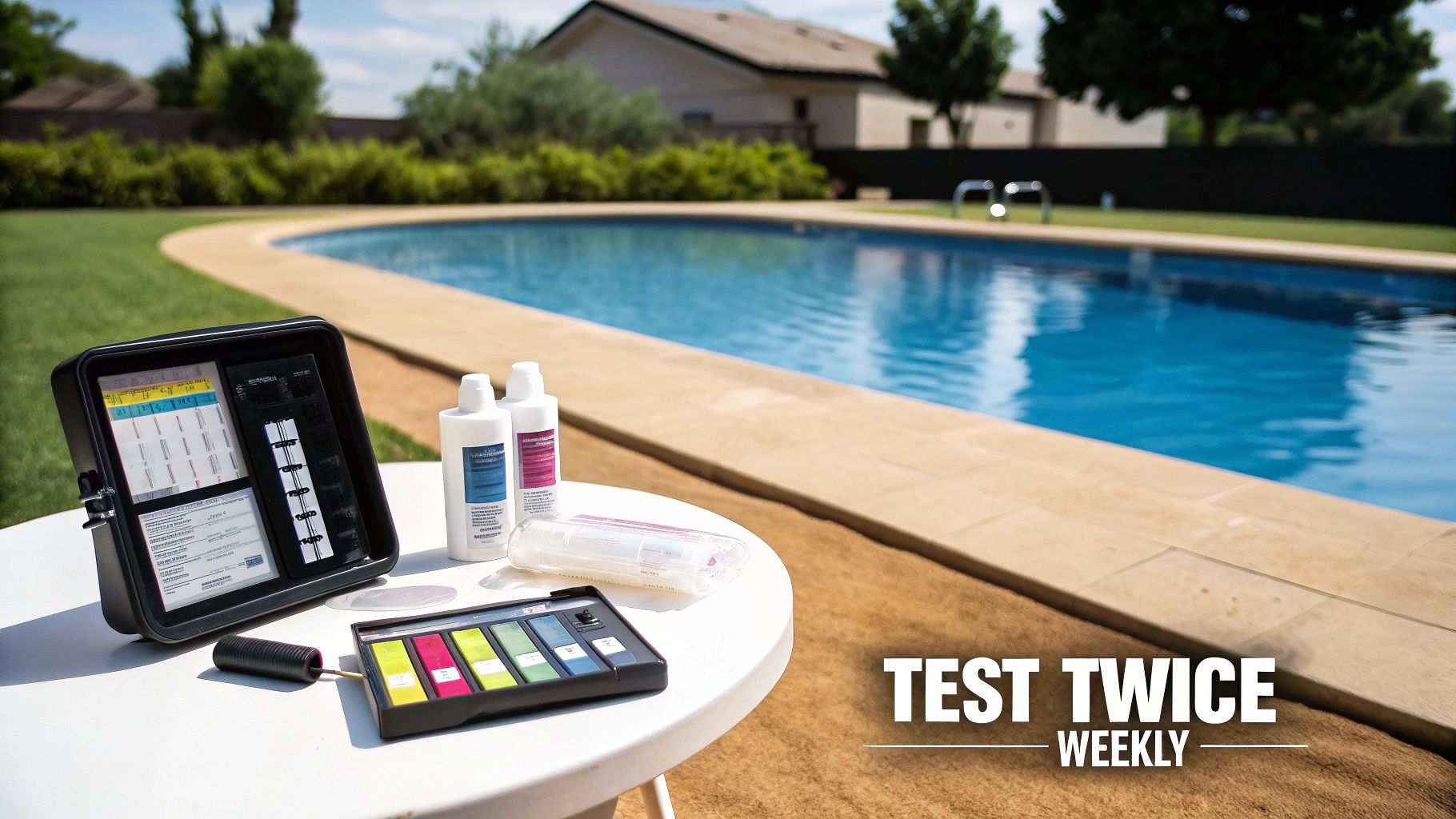
Keeping your pool chemistry in check really just comes down to a consistent routine. The golden rule? Test your chlorine and pH levels twice a week, and then add the right chemicals to get everything back in line. Staying on top of this simple habit is the secret to keeping your water safe and clear. This proactive approach heads off bigger problems like algae blooms or cloudy water before they ever get started, saving you time and money.
Your Guide to Crystal Clear Pool Water
When you first start out, learning how to maintain your pool's chemistry can feel like a high school science experiment. But it’s far more about consistency than it is about complexity. The whole point is to keep the water stable so your sanitizer can do its job and the water feels good on your skin and eyes without damaging your pool’s surfaces. Letting it slide is just asking for headaches and extra expense down the road.
It's a big part of pool ownership. In the United States alone, there are around 10.7 million swimming pools, and over 97% of them are at someone's home. The average yearly cost to keep them running can be anywhere from $3,000 to $6,000, with a huge chunk of that budget going straight to chemicals.
The Essentials for Perfect Pool Water
Before you can get that perfect water, you need the right tools for the job. It’s not just about knowing what to toss in the water, but understanding why each chemical is so important.
Here’s what every new pool owner should keep on hand:
- A Reliable Test Kit: It doesn't matter if you like simple test strips, a liquid reagent kit, or a fancy digital reader. What matters is that it's accurate. This is your foundation.
- Core Chemicals: At a minimum, you'll need a sanitizer like chlorine, a pH increaser and decreaser, and an alkalinity increaser.
- Shock Treatment: This is a heavy-duty dose of oxidizer you'll use regularly to zap any lingering contaminants and keep the water fresh.
This is your basic toolkit for maintaining clear, safe water. The same principles of clean, balanced water apply to other backyard features, too. In fact, it’s similar to what you should know before installing a hot tub in your backyard.
Juggling chemicals and test kits isn't for everyone. If you’d rather spend your time swimming than measuring, professional pool services can handle the science for you, ensuring perfect water all season long.
Our comprehensive swimming pool services are designed to take the guesswork out of maintenance. We provide expert care so you can simply enjoy your crystal-clear pool.
Mastering Pool Water Testing
If there’s one non-negotiable step in keeping a healthy pool, it’s testing the water. Without accurate testing, you're essentially flying blind, just guessing what chemicals to toss in. Think of it as your pool’s regular check-up—it’s the only way to truly understand what your water needs to be clear, safe, and comfortable.
This goes way beyond just aesthetics. It’s a genuine safety issue. The World Health Organization has linked thousands of water-related illnesses each year directly to pools that aren't disinfected properly. It's the same reason public pools are held to such strict testing standards, and it's a practice every single backyard pool owner should take to heart.
Choosing Your Testing Method
You’ve got a few solid options when it comes to testing your water. The right one for you really just boils down to your budget, how much time you want to spend, and how precise you need to be.
- Test Strips: These are the go-to for a quick, daily check-in. They’re cheap, fast, and dead simple to use. Just dip the strip, wait a few seconds, and match the colors on the strip to the chart on the bottle. Perfect for keeping an eye on chlorine and pH.
- Liquid Reagent Kits: For anyone wanting a bit more accuracy, a liquid kit is the classic choice. You add a few drops of a reagent to a small water sample and watch the color change. These kits give you a more detailed picture and let you test for a wider range of chemical levels.
- Digital Readers: If you want to eliminate all the color-matching guesswork, a digital reader is the ultimate tool. These handheld devices provide an exact numerical reading, giving you the highest level of precision.
No matter which method you land on, always check the expiration date on your kit. Old test strips or reagents will give you skewed results, which is a surefire way to start a frustrating cycle of adding the wrong chemicals.
Pro Tip: When you take a water sample, don't just scoop from the surface. Plunge your arm elbow-deep into the pool, away from the return jets or skimmer. This pulls water from the main body of the pool and gives you a far more accurate snapshot of what's really going on.
Creating a Consistent Testing Schedule
When it comes to pool care, consistency is everything. Sticking to a regular testing schedule is the best way to catch small imbalances before they spiral into big problems like a full-blown algae bloom or stubbornly cloudy water.
During the height of swim season, when your pool is getting the most use, you should be testing your free chlorine and pH at least twice a week. Other levels, like total alkalinity and calcium hardness, can usually be checked on a weekly basis.
While testing at home is crucial, we know it can sometimes feel like a science experiment gone wrong. If you want total peace of mind, our professional water analysis delivers lab-grade results. We can use that data to build a flawless maintenance plan for you. For a truly hands-off experience, you can learn about our monthly maintenance programs where our experts take care of all the testing and balancing for you.
Balancing pH and Total Alkalinity
Think of pH and Total Alkalinity (TA) as the dynamic duo of your pool's water chemistry. Get them working together, and your chlorine will be more effective, the water will feel better on your skin, and you’ll protect your expensive equipment from damage like corrosion and scaling. Nailing this balance is one of the first things you learn when you're figuring out how to maintain pool chemistry.
While they're a team, they don't have equal roles. Total Alkalinity is essentially the anchor for your pH. It acts as a buffer, stopping your pH from bouncing all over the place every time it rains or you have a big pool party. This is exactly why you should almost always adjust your alkalinity first.
The Alkalinity-First Rule
Let's walk through a common scenario. You test your water after a big storm and find that both your pH and alkalinity are low. It's a classic problem caused by rainwater dilution. Your first thought might be to dump in chemicals for both, but that's a rookie mistake that'll have you chasing your tail for days.
The right move is to tackle the Total Alkalinity first. By adding an alkalinity increaser (which is just a fancy name for sodium bicarbonate), you build a stable chemical foundation. As you raise the alkalinity, it will naturally nudge the pH level up a bit, too. Sometimes, this is all you need to get the pH back in line.
This is why getting a good, clean water sample and an accurate test reading is so critical. You can't fix what you can't measure.

As you can see, the process always starts with a reliable test. From there, you can make smart decisions about what your water really needs.
How to Adjust Your Levels Safely
Once your alkalinity is locked in, it's time to zero in on the pH. You're shooting for a sweet spot between 7.4 and 7.6.
- If your pH is low: You'll need a pH increaser, usually soda ash (sodium carbonate).
- If your pH is high: Grab a pH decreaser, like muriatic acid or sodium bisulfate.
A word of advice: don't get impatient. Read the dosage instructions on the label for your pool's size. Add the chemical slowly around the edges of the deep end while the pump is running to get it circulating. Then, walk away. Give it at least six hours to do its job before you even think about re-testing. This simple step prevents you from overshooting your target, which just creates a whole new problem.
Juggling pH and alkalinity can feel like a never-ending battle. If you're constantly fighting pH swings or can't seem to clear up cloudy water, the root cause might be deeper than just needing another scoop of chemicals.
If you find yourself stuck in a frustrating loop of testing and adding chemicals without seeing real results, it's probably time to bring in an expert. Our pool technicians can spot the underlying issue quickly, saving you a ton of money on wasted chemicals and, more importantly, a lot of headaches.
Effective Chlorine and Sanitizer Management
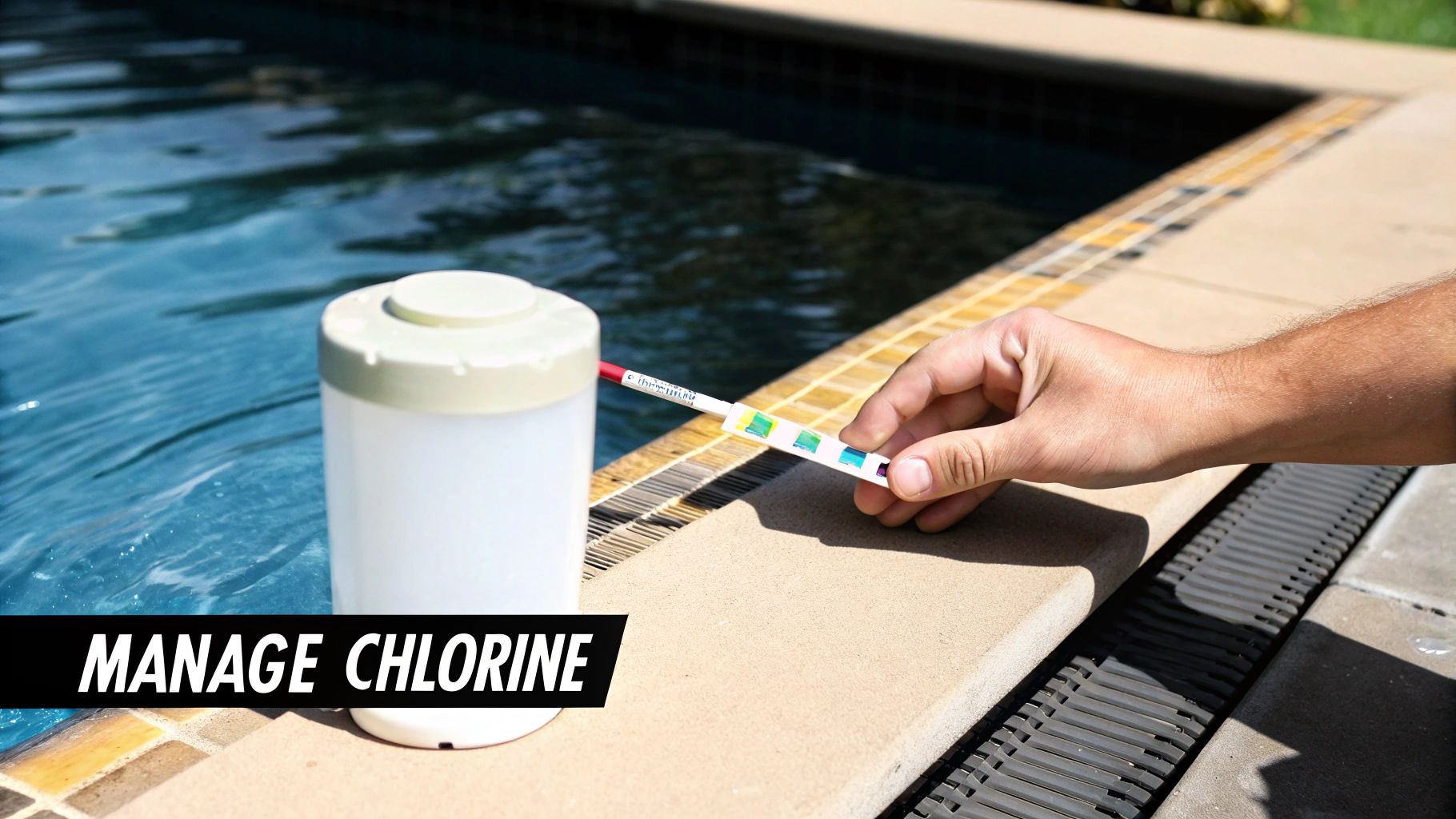
Think of chlorine as the tireless bodyguard for your swimming pool. It’s on constant duty, neutralizing germs, bacteria, and algae before they can turn your oasis into a swamp. But getting sanitizer management right is more art than science, and it goes way beyond just tossing a chlorine tablet in the skimmer and calling it a day.
Proper sanitization is a big deal. The global pool chemical market was valued at $1.13 billion in 2023 and is expected to hit $1.72 billion by 2032. With nearly 80% of U.S. residential pools relying on chlorine, homeowners are clearly invested in getting it right. Good chemical management is what prevents not just algae blooms, but also the stinging eyes and skin irritation that can ruin a perfect pool day.
Getting a Handle on Your Chlorine Levels
To really understand what's happening in your water, you need to know that not all chlorine is created equal. When you test your water, you're actually looking at three different measurements, and each one tells a crucial part of the story.
- Free Chlorine (FC): This is your front-line defender. It’s the active, available sanitizer that’s ready to kill contaminants. Your target here is a consistent 1-3 parts per million (ppm).
- Combined Chlorine (CC): This is the "spent" chlorine. It has already done its job by combining with contaminants like sweat, oils, and ammonia. It’s a weak sanitizer and the real source of that classic, harsh "pool smell."
- Total Chlorine (TC): Just what it sounds like—the sum of your Free and Combined Chlorine.
The magic is in the relationship between these numbers. If your combined chlorine level starts to climb above 0.5 ppm, it’s a red flag. It means your free chlorine is being used up faster than it can be replenished, and it's time to intervene.
When swimmers complain about a strong "chlorine" smell and irritated eyes, the culprit is almost never too much chlorine—it's too little effective chlorine and too much combined chlorine (chloramines). Shocking the pool is the solution.
The Supporting Cast: Stabilizer and Saltwater Systems
Chlorine has a natural enemy: the sun. The sun's UV rays can burn off your free chlorine in just a few hours, leaving your pool unprotected. That's where Cyanuric Acid (CYA), or stabilizer, comes in. It acts like sunscreen for your chlorine, dramatically extending its life. But it's a delicate balance—too much CYA can actually render your chlorine less effective.
If you’re looking for a more hands-off approach to sanitization, a saltwater pool is a fantastic alternative. These systems use a generator to convert a low level of salt in the water into a steady, consistent supply of fresh chlorine. This often results in silkier-feeling water and eliminates the sharp chemical highs and lows. If that sounds appealing, learning the specifics of saltwater pool service is a great place to start.
Trying to keep free chlorine, combined chlorine, and stabilizer levels in perfect harmony can feel overwhelming. Our tailored pool care packages are designed to take that stress off your shoulders, ensuring your sanitizer is always dialed in for clean, sparkling, and safe water.
When and How to Shock Your Pool
https://www.youtube.com/embed/20igUA6YOn0
Sometimes, your pool needs more than its daily dose of chlorine. It needs a hard reset. We call this shocking the pool, or superchlorination, and it's your most powerful tool for blasting contaminants, getting rid of that nasty "chlorine" smell, and bringing back that crystal-clear sparkle. Think of it as a deep clean for your water, especially when your regular sanitizer just can't keep up.
Knowing when to shock is just as important as knowing how to do it. While shocking your pool weekly or every other week during swim season is a great baseline, certain situations call for an immediate treatment to stop problems before they start. It's the best way to get ahead of issues before they become visible headaches.
Key Triggers for Shocking Your Pool
Your pool is pretty good at telling you when it needs a shock. If you ignore the signs, you're setting yourself up for cloudy water, algae blooms, and that all-too-familiar chemical odor that signals a problem, not a clean pool.
You’ll want to grab a bag of shock after:
- A Heavy Rainstorm: Rain doesn't just dilute your chemicals; it washes in all sorts of contaminants and phosphates—basically, a buffet for algae.
- A Big Pool Party: Every person who jumps in brings sweat, oils, and other organic gunk that can quickly overwhelm your normal chlorine levels.
- You See Cloudiness or Algae: The moment your water looks hazy or you spot a hint of green, it's time to act. Don't wait.
- There’s a Strong "Chlorine" Smell: That sharp, irritating smell isn't from too much chlorine. It's from chloramines (or combined chlorine), which means your free, effective chlorine is used up and needs a serious boost.
The type of shock you use matters, too. For most situations, a classic calcium hypochlorite (cal-hypo) shock is your workhorse. It's a powerful oxidizer that’s perfect for both routine maintenance and clearing up bigger issues. On the other hand, if you just want a quick refresh without the downtime, a non-chlorine shock is a great option. It uses potassium monopersulfate and lets you get back in the water in as little as 15 minutes.
I always tell pool owners to shock their pool in the evening. The sun is chlorine's worst enemy and its UV rays can burn off up to 90% of unstabilized chlorine in just a couple of hours. Shocking at dusk gives the chemicals all night to work their magic without interference.
The Correct Way to Shock
Don't just rip open a bag and dump it in. There’s a right way to do this to protect both your swimmers and your pool's surface.
First, always read the instructions on the bag to figure out the right amount for your pool's size. Next—and this is a step people often skip—pre-dissolve the shock granules in a bucket of pool water. This prevents the concentrated chemicals from sinking to the bottom and bleaching or even damaging your liner. Once it's dissolved, walk around the edge of the pool and slowly pour the mixture into the water.
After adding the shock, you need to let your pump and filter run for at least eight hours straight to make sure it circulates everywhere. And nobody—I mean nobody—gets back in the water until your test kit shows the free chlorine level has dropped back down to a safe range of 1-3 ppm.
I get it, this can feel like another chore at the end of a long week. If you'd rather have a truly hands-off experience, our weekly maintenance service handles all of this for you. We shock the pool whenever it's needed, ensuring your water stays perfect without you ever having to lift a finger.
Answering Your Top Pool Chemistry Questions
Even when you have a good system down, pool chemistry can throw you a curveball now and then. It’s just part of the learning process. Here are a few of the most common questions and head-scratching issues we run into with pool owners across Southwest Florida. Think of this as your go-to cheat sheet for troubleshooting like a seasoned pro.
Getting a handle on these common quirks is what really builds confidence. It's the difference between pool care feeling like a chore and it being just another simple part of owning your personal oasis.
Why Is My Pool Cloudy if the Chlorine Is High?
This is easily one of the most frustrating things to see as a pool owner. You run your tests, the chlorine reading is high, but the water still looks like a hazy, milky mess. What gives?
When you have high chlorine but cloudy water, it's a huge red flag that something else is off. The problem isn't a lack of sanitizer; it's that the sanitizer is being rendered useless.
Here are the usual suspects:
- pH is Out of Whack: If your pH drifts too high, it handcuffs your chlorine, slashing its effectiveness. The chlorine is in the water, but it simply can’t do its job of attacking contaminants.
- Your Filter is Clogged: The filter is your pool's workhorse. If it’s gunked up with oils, minerals, and other debris, it can’t grab the microscopic particles that are making your water look cloudy.
- Total Dissolved Solids (TDS) are Through the Roof: Think about it—every single chemical you add leaves a little something behind. Over time, these solids build up, and once the TDS level gets too high, the water itself can become hazy and tough to clear up.
First things first, test and balance your pH and alkalinity. After that, give your filter a really good, deep cleaning or a proper backwash. If the cloudiness hangs around, a dose of water clarifier can act as a magnet, clumping those tiny particles together so your filter can finally trap them. If you feel like you're in a never-ending fight with cloudy water, our pool troubleshooting service can come out and diagnose the root cause once and for all.
How Often Should I Be Testing My Pool Water?
When it comes to pool chemistry, consistency is everything. You can't just test when you feel like it.
During the height of swim season here in Florida, you need to be testing your free chlorine and pH levels at least twice a week. These two are the most volatile and have the most direct impact on how the water feels and how safe it is for swimmers.
Your other key levels—total alkalinity, calcium hardness, and cyanuric acid (your stabilizer)—can be checked weekly. It's also a great habit to test the water after any major event that could throw your balance off. This includes things like a big summer rainstorm, a weekend pool party with lots of guests, or even just topping off the pool with a significant amount of fresh water from the hose.
Catching a small imbalance early is infinitely easier and cheaper than fixing a big, nasty problem later. A quick five-minute test today can absolutely save you from a week-long battle with a green pool.
What's the Difference Between Free and Total Chlorine?
Getting this concept down is a real game-changer. It’s one of those things that, once you understand it, makes managing your pool so much more intuitive.
Here’s the simplest way to think about it:
-
Free Chlorine (FC): This is the good stuff. It’s the active, available sanitizer that’s floating around ready to seek and destroy bacteria, algae, and other germs. This is the number you're really focused on, and you want to keep it in that ideal 1-3 ppm range.
-
Total Chlorine (TC): This is just what it sounds like—the total amount of chlorine in the water. It’s the sum of your Free Chlorine and your Combined Chlorine.
-
Combined Chlorine (CC): This is the "used-up" chlorine, also known as chloramines. It’s chlorine that has already done its job by combining with contaminants like sweat, sunscreen, and oils. It’s a terrible sanitizer and, ironically, it's what causes that classic "pool smell" and stings your eyes.
Your goal is always to keep your Combined Chlorine level as close to zero as you can, ideally under 0.5 ppm. When you see that CC number start to creep up, it’s a clear sign that it’s time to shock the pool. Shocking breaks apart those chloramine bonds, which frees up your chlorine to get back to work keeping the water sanitized.
Stop guessing and start enjoying your pool. The expert technicians at Water Medic of Cape Coral have over 25 years of experience keeping pools in Southwest Florida sparkling clean and perfectly balanced. Let us handle the science so you can focus on swimming. Schedule your service today at https://watermedic.com.