
Your Essential Water Softener Maintenance Schedule
A solid, consistent maintenance schedule is what separates a water softener that lasts a decade or more from one that gives you grief and fails early. Think of it less as a chore and more as the best way to protect your investment. A few minutes spent checking salt levels, cleaning the tank, and just keeping an eye on things prevents costly breakdowns and keeps the system running smoothly. Following a clear schedule is the key to longevity, and when you need a hand, our preventative maintenance services ensure it's done right.
Why a Maintenance Schedule Is Your Best Defense
Letting your water softener run on its own without any attention is just asking for trouble. Over time, the very minerals it’s designed to trap—mostly calcium and magnesium—can start to build up inside the system itself. This scaling is like plaque in an artery; it slowly suffocates the unit, reducing its performance until it eventually fails.
Regular maintenance is all about stopping that buildup before it gets out of control. Simple, routine checks can dramatically extend the life of your softener, ensuring you always have the soft water you paid for.
The Cost of Neglect vs Proactive Care
Being proactive with your water softener really pays off. The little bit of effort it takes to do regular inspections is nothing compared to the hefty bill for an emergency plumbing repair or, even worse, a full system replacement.
When a softener gives out unexpectedly, it’s not just about the water getting hard again. It can cause leaks, water pressure problems, and a return of that chalky scale on all your faucets and appliances.
A good maintenance plan is your best line of defense. If you want to get serious about it, borrowing from the principles of creating effective Standard Operating Procedures (SOPs) can help you build a foolproof routine. For any homeowner who wants to protect their investment, this kind of structured approach is a must.
By creating and sticking to a simple schedule, you stop being reactive—fixing problems as they pop up—and become proactive, preventing them from ever happening. It saves you money and, just as importantly, a lot of headaches.
Here's a quick look at what a typical schedule involves.
At-a-Glance Water Softener Maintenance Timetable
Use this quick timetable to stay on top of the key maintenance tasks that keep your system in optimal condition.
| Maintenance Task | Recommended Frequency | DIY or Professional? |
|---|---|---|
| Check Salt Levels | Every 2-4 weeks | DIY |
| Break Up Salt Bridges | As needed (check monthly) | DIY |
| Clean the Brine Tank | Every 6-12 months | DIY |
| Clean the Resin Tank | Annually | DIY (using a cleaner) |
| Check for Leaks/Damage | Every 3-6 months | DIY |
| Full System Inspection & Tune-up | Every 1-2 years | Professional |
While many of these tasks are straightforward, a professional tune-up can catch subtle issues you might miss. An efficient system is a well-maintained one, and we're always here to help.
Your Hands-On Maintenance Checklist
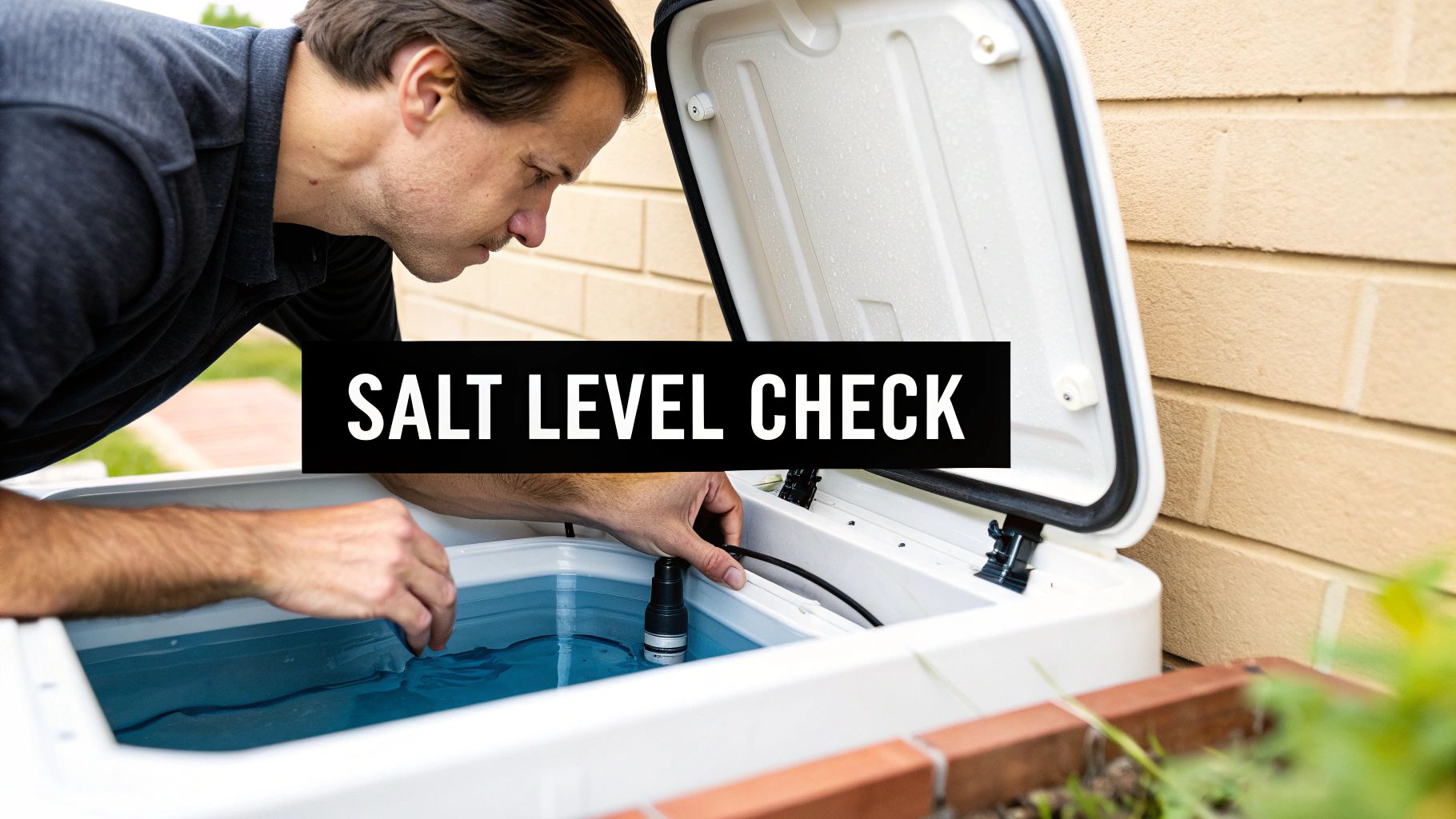
Keeping up with a water softener maintenance schedule doesn't need to be a huge chore. Honestly, with just a few hands-on checks, you can take care of the most common upkeep yourself. This is your first line of defense to keep your system running smoothly and catch little problems before they turn into big, expensive ones.
The most common job, of course, is keeping an eye on the salt. I tell all my clients to just glance at the brine tank every couple of weeks. As a rule of thumb, make sure the tank is always at least one-third full. More importantly, the salt level should always be a few inches above the water level inside.
That Pesky Salt Bridge: What It Is and How to Fix It
One of the most frequent reasons a softener stops working is something we call a salt bridge. This is just a hard crust of salt that forms in the tank, usually because of high humidity or even just from overfilling it. It creates an empty space underneath the crust, preventing the water from dissolving the salt to make brine. No brine, no soft water.
It's easy enough to check for. Just give the side of the tank a gentle tap. If it sounds hollow, you've likely got a bridge. To fix it, grab a broom handle and carefully poke at the top layer of salt to break up that crust.
Expert Tip: If you find yourself constantly breaking up salt bridges, it could be a sign of poor-quality salt or just too much humidity where the softener is located. If it keeps happening, it might be worth having a pro take a look to see if there's an underlying issue.
For landlords or anyone managing a property, it's helpful to view the water softener as just one piece of the puzzle. An ultimate rental property maintenance checklist can give you a bigger picture of how all your home's systems work together.
A Deeper Clean for Key Parts
Besides managing the salt, a few other parts need your attention to keep the mechanical side of things humming along.
- Clean the Brine Tank: Set a reminder to do this about once a year. You'll want to completely empty the tank and give it a good cleaning. Salt impurities can build up into a sludge at the bottom over time, and that gunk can eventually clog the whole system.
- Check the Venturi Valve: This little valve is what creates the suction to pull the brine into the resin tank. It can get clogged with sediment. Your owner's manual should have simple instructions for cleaning it out, which often gets things working perfectly again.
These DIY tasks will handle most of the routine care. But what happens if you've checked for bridges and cleaned the tank, but your water is still hard? That's usually the signal that it's time to call in an expert. Our team can run a deeper diagnostic on the control valve and the resin bed.
To get a better idea of what a professional service call involves, check out our guide on monthly maintenance. It breaks down what our technicians look for to make sure your system has a long, efficient life.
Getting to Know Your System’s Regeneration Cycle
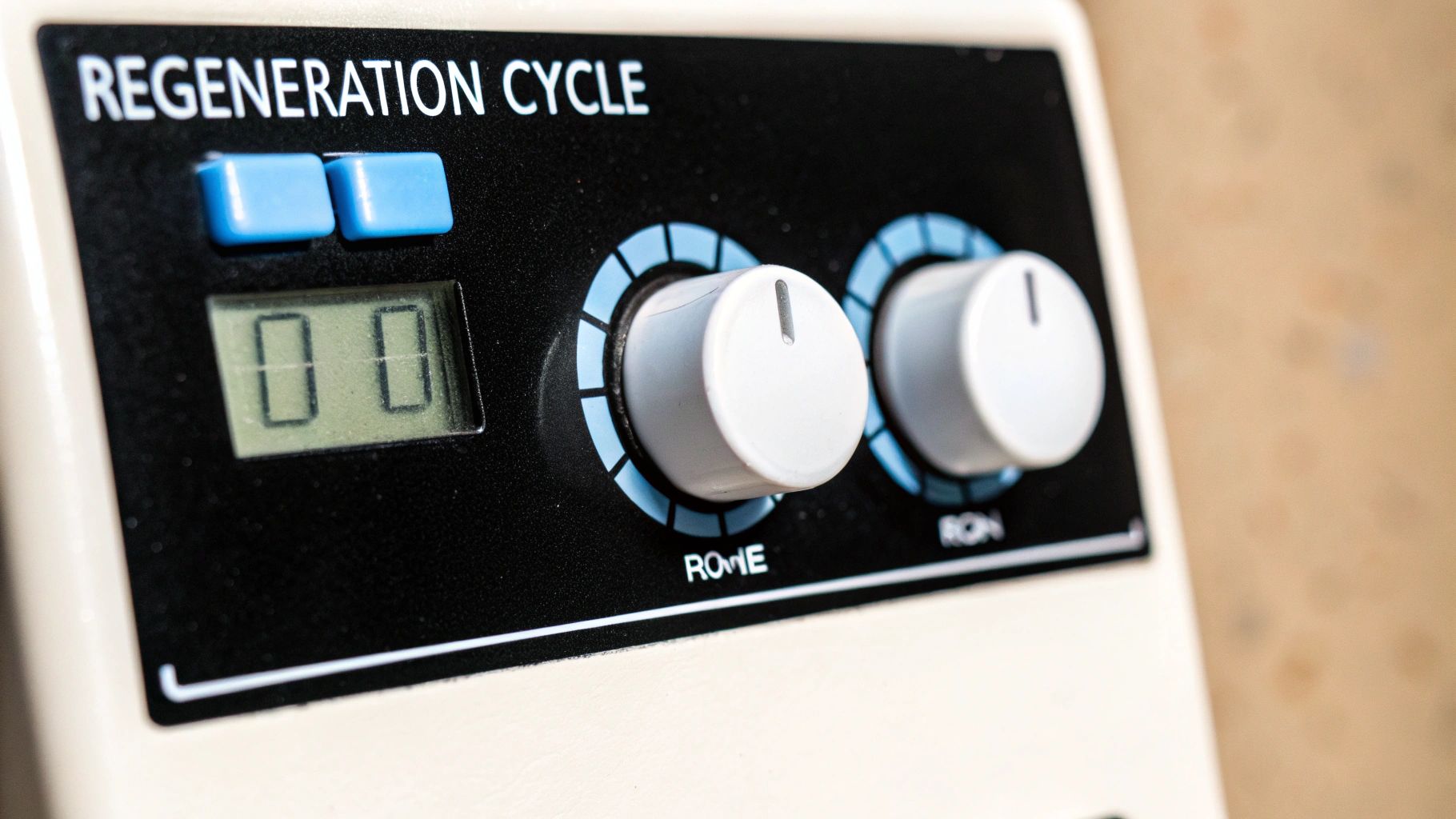
Think of the regeneration cycle as your softener’s built-in "reset" button. It’s the process where the system flushes out all the hard minerals it has collected and recharges its resin beads with salt. This is the single most important job your softener does, and it’s a cornerstone of any effective water softener maintenance schedule.
The trick is finding that sweet spot. If the cycle runs too often, you’re just throwing salt and water down the drain. But if it doesn’t run enough, you’ll start seeing the tell-tale signs of hard water again—spots on your glasses and that scaly buildup around your faucets.
What Determines the Right Regeneration Frequency?
There’s no magic number for how often your system should regenerate. It’s a custom calculation based on your specific situation, which is why a professional calibration can make such a difference.
Here’s what we look at:
- Your Household Size: It’s simple math—a family of five will go through more water than a household of two, meaning the softener needs to recharge more often.
- Water Usage Habits: Are there long showers, daily loads of laundry, and a constantly running dishwasher in your home? The more water you use, the harder your system works.
- Your Local Water Hardness: Here in Southwest Florida, our water is notoriously hard. That puts a much heavier demand on your softener compared to regions with only moderately hard water.
Let’s put that into perspective. A family of four living in an area with very hard water might need their system to regenerate every other day. On the flip side, a couple with moderately hard water might only need a cycle every four or five days. Nailing these settings is crucial for both performance and your wallet. Getting a pro to set up one of our high-quality water softeners ensures it's perfectly tuned for your home from day one.
A correctly calibrated regeneration cycle not only guarantees consistently soft water but also optimizes salt consumption, saving you money over the long term. If your settings haven’t been checked in a while, it’s a smart move to have a technician verify them.
The whole process usually takes about 60 to 90 minutes to run. If you’re curious about the math behind how these schedules are set, you can find great insights on water softener regeneration online. And if you think your system’s cycle is off, don’t guess—give our team a call for an expert adjustment.
Knowing When to Call for Professional Service
While following a regular water softener maintenance schedule is fantastic for handling the basics, there are times when you absolutely need to call in a pro. Keeping the salt topped up and doing a quick clean is one thing, but some problems are clear signs of a deeper issue that your toolbox and user manual just can't solve.
Don't ignore the warning signs. Pushing your system when it’s struggling can turn a simple fix into a full-blown replacement. For example, if you're seeing persistent error codes on the display that just won't clear with a reset, that usually points to an issue with the control valve's electronics or a motor. The same goes for any strange grinding or loud clunking sounds during the regeneration cycle—that’s not normal. It’s often the sound of gears stripping or a motor on its last legs.
Signs That Demand an Expert Eye
Sometimes, the clues are a bit more subtle but just as serious. Have you noticed a sudden drop in water pressure all over the house? That could be a sign that your resin bed is clogged or has "channeled," a messy problem that's tough to fix without the right equipment.
Maybe the most infuriating sign is when you start seeing those hard water spots creep back onto your glassware and faucets, even though you know the salt tank is full. When that happens, it’s a dead giveaway that the system isn't regenerating properly. This is usually caused by one of a few culprits:
- A faulty control valve that isn't cycling correctly
- A clogged injector or venturi that can’t create the suction needed for the brine
- A resin bed that's completely exhausted or coated in iron and sediment
These aren't simple DIY tasks. Trying to take apart the control head or flush the resin tank on your own can quickly lead to irreversible damage, a voided warranty, and even a major water leak.
Think of it this way: a professional service call isn't just another bill. It's an investment in protecting your appliance and your home. Our team has the specialized diagnostic tools and years of hands-on experience to get to the root of the problem and fix it right the first time. You can check out our full range of expert plumbing and water system services to see how we help keep systems like yours running perfectly.
How Smart Technology Is Changing Water Softener Maintenance
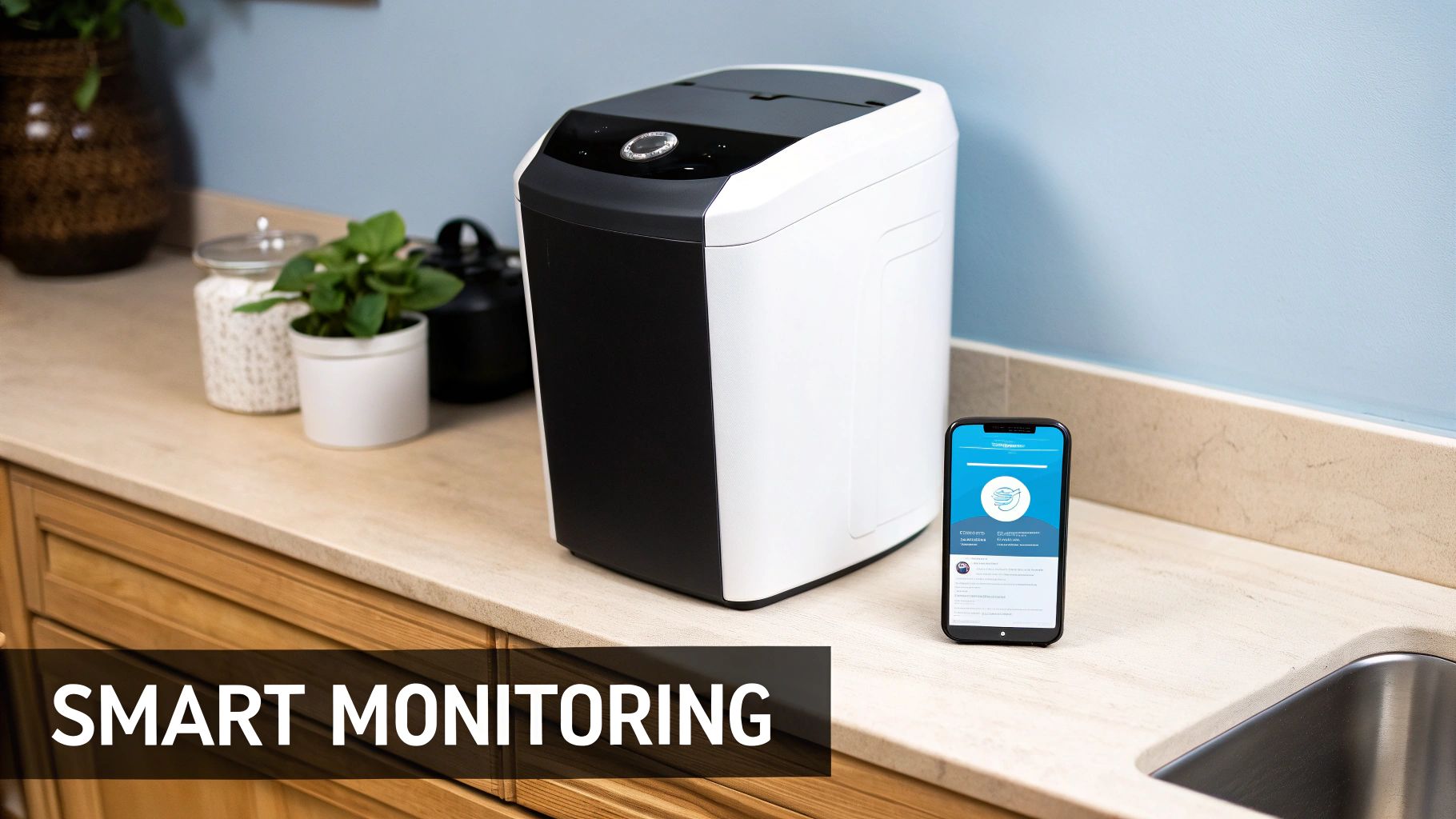
The old-school water softener maintenance schedule is getting a serious tech-fueled makeover. Modern systems, especially smart, Wi-Fi-connected softeners, are built to take much of the guesswork and manual labor off your plate.
It’s a huge shift in how we manage water quality at home. Many new units can now:
- Monitor salt levels and ping your phone when you're running low.
- Detect unusual water flow that might signal a leak.
- Optimize regeneration cycles based on your family's actual water usage, cutting down on salt and water waste.
This push for smarter home integration is a big reason the water softener industry is booming. In fact, you can see just how much by checking out the projected growth of the water softener market, which is on track to hit USD 8.7 billion by 2035.
Where Convenience and Necessary Care Meet
While these smart features are incredibly convenient, they don't make your softener invincible. Automation is fantastic for the day-to-day stuff, but it can't replace a trained eye looking over the whole system.
Smart tech is great for alerting you to immediate needs like low salt or a possible leak. But it can't physically inspect the core mechanical parts for signs of wear and tear. That’s why an annual professional check-up is still your best bet for long-term reliability.
At the end of the day, the mechanical components—the valves, the motor, the resin bed—are what do the heavy lifting. They still require a hands-on inspection to make sure everything is working as it should. Here at Water Medic, our team is trained to service everything from the most basic traditional models to the latest smart systems, ensuring your investment is protected, no matter what tech you have.
Answering Your Top Water Softener Questions
Even with a perfect maintenance routine, you’re bound to have questions. It's totally normal. After years in the field, we’ve heard just about everything, so let's tackle some of the most common ones that pop up for homeowners.
How Much Salt Should Be in the Tank?
This is probably the number one question we get. A good rule of thumb is to keep the salt level at least one-third full at all times.
You also want to make sure the salt stays a few inches above the water level inside the tank. But be careful not to overdo it! Piling salt all the way to the top can lead to something called a "salt bridge." This is a hard crust that forms over the water, and it stops your softener from making the brine it needs to actually soften your water.
What’s the Best Kind of Salt to Use?
Walking down the aisle at the hardware store, you'll see a few different options. Here’s the breakdown:
- Evaporated Salt: This is the good stuff. At about 99.9% pure sodium chloride, it’s the cleanest option and leaves almost no gunk behind in your tank.
- Solar Salt: A great middle-of-the-road choice. It's much cleaner and dissolves better than rock salt.
- Rock Salt: It's the cheapest, but you get what you pay for. It contains a lot of extra minerals that don't dissolve, eventually turning into a thick sludge at the bottom of your tank.
For almost every modern water softener out there, we tell our customers to stick with evaporated or solar salt pellets. You'll get better performance and won't have to clean out that sludge nearly as often.
What about when I go on vacation?
Yep, you can leave it running. Newer, demand-initiated models are smart enough to know you aren't using water, so they'll just hold off on regenerating. If you have an older system that runs on a timer, you could unplug it to save a little salt and water. For any trip longer than a week, putting the system into bypass mode is always the safest move.
If you're ever scratching your head about your particular system, just ask one of our techs during a service call. We're happy to walk you through it.
At Water Medic of Cape Coral, our goal is to give you the confidence to manage your home's water system. With 25 years of experience, we've seen it all. When you need a hand, whether it's for a quick tune-up or a brand-new installation, we're here to help. Schedule your service with us today and see the difference expertise makes.