Choosing a Water Filtration System for Sulfur Smell
The right water filtration system for sulfur smell has to go after the root of the problem: hydrogen sulfide gas. To really knock out that "rotten egg" smell for good, you’ll likely need something more robust than a standard carbon filter, like an aeration system or an oxidizing filter, especially if your sulfur levels are moderate to high. At Water Medic, we specialize in diagnosing and solving this common Southwest Florida issue, ensuring your home's water is clean and odor-free.
Finding The Source Of The Rotten Egg Smell In Your Water
That nasty rotten egg odor is more than just an annoyance—it's a dead giveaway that hydrogen sulfide (H2S) gas has infiltrated your water supply. Before you can even think about a fix, you have to play detective. Pinpointing where the smell is coming from is the absolute first step to getting fresh, clean water back into your home.
The smell could be from naturally occurring sulfur bacteria down in your well, or it could be a specific issue brewing inside your hot water heater. The good news is that our expert technicians can diagnose this quickly, saving you time and money by ensuring we treat the right problem from the start.
Hot Water vs. Cold Water: Your First Big Clue
Here's the most important question to answer: does the smell come from all your faucets, or only when you turn on the hot water? This one simple test will immediately narrow down the list of suspects.
First, run a cold water tap for a couple of minutes. Fill up a glass and take it into another room, away from the sink, before you smell it—this helps avoid confusing a smelly drain with smelly water. Now, do the exact same thing with just the hot water.
- Smell in Hot Water Only? This almost always points to your water heater. Bacteria can have a reaction with the anode rod inside the tank, creating hydrogen sulfide gas that only shows up when you call for hot water. Our team can quickly service or replace the rod to solve this.
- Smell in Both Hot and Cold Water? If every tap stinks, the source is your main water supply. For most of us in Southwest Florida, that means it’s coming directly from the well. This is a whole-house problem that needs a point-of-entry filtration system.
This flowchart gives you a simple visual path to follow for your initial diagnosis.
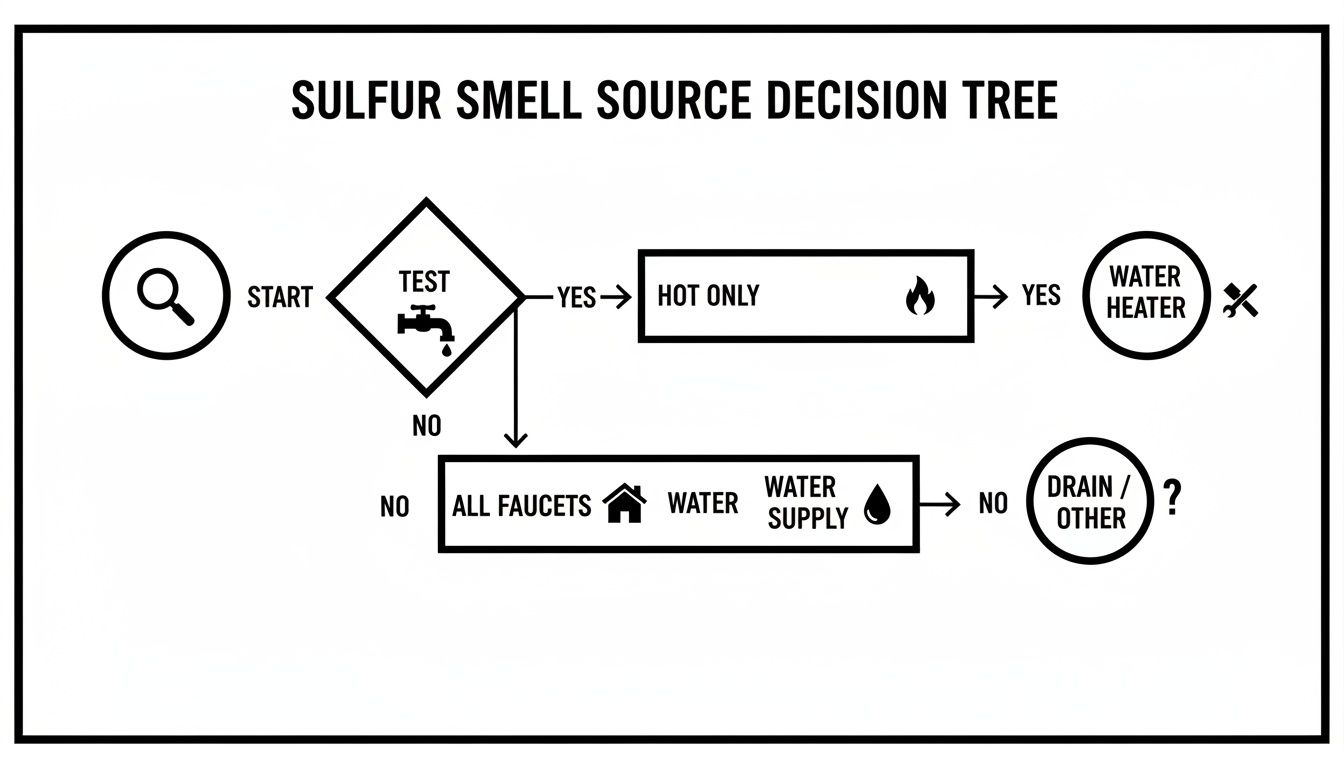
Following this decision tree helps you figure out whether you should be inspecting your water heater or looking into a whole-house water treatment solution.
To help you get started, here's a quick checklist to walk through the symptoms.
Quick Sulfur Smell Diagnostic Checklist
Use this table to quickly identify the likely source of the sulfur smell in your home's water.
| Symptom | Likely Cause | Next Step |
|---|---|---|
| Smell is only present when using hot water. | Bacteria reacting with the anode rod inside the hot water heater. | Call Water Medic to disinfect the tank and consider replacing the magnesium anode rod with an aluminum or zinc-aluminum one. |
| Smell is present in both hot and cold water. | Hydrogen sulfide gas or sulfur bacteria in the well or main water supply. | Schedule a professional water test with us to confirm H2S levels and identify the perfect filtration solution. |
| Smell is faint and only at one specific faucet. | Bacteria buildup in the aerator or drain P-trap of that specific sink. | Clean the sink drain and faucet aerator thoroughly before re-testing. |
| Smell is present at all faucets but fades after the water runs for a few minutes. | Hydrogen sulfide gas that has built up in the well or pressure tank. | This indicates a whole-house issue. A free professional water test from Water Medic is the best next step. |
By checking these symptoms, you can get a much clearer idea of what's going on before you spend any money.
Understanding Hydrogen Sulfide Levels
The strength of that rotten egg smell usually tells you how much H2S you're dealing with. Our noses are surprisingly sensitive to it—we can detect hydrogen sulfide at concentrations as low as 0.5 parts per million (ppm).
Once you get into the 1-2 ppm range, the smell is unmistakable. Go above 2 ppm, and you're not just dealing with an odor; the gas can actually become corrosive to your pipes and appliances.
Sometimes, the problem really is just your hot water heater. Knowing how long hot water systems last and their common failure points can help you rule this out before investing in a whole-house system.
Expert Takeaway: Fixing a hot water heater issue is a world away from solving a whole-house sulfur problem. A correct diagnosis from the get-go ensures you put your money into the right solution, saving you the headache of buying a fix that doesn't actually address the root cause.
For those of us in Cape Coral and Southwest Florida, especially on well water, this is a familiar battle. Our local geology often contributes to higher levels of sulfur-producing bacteria. If you’ve confirmed the smell is coming from your entire water supply, the next definitive step is a professional water test. It gives us a complete breakdown of your water's chemistry, making sure the water filtration system for sulfur smell we recommend is a perfect match for your home's needs. If you have questions about your well, our Well FAQs page is a great resource for local homeowners.
Whole House Systems vs. Point of Use Filters
Alright, so you’ve figured out the rotten egg smell is everywhere in your house. Now comes the big decision: do you tackle the problem for your entire home, or just try to fix it at a single faucet? This is a critical fork in the road, and the choice you make impacts everything from your morning shower to the lifespan of your pipes and appliances.
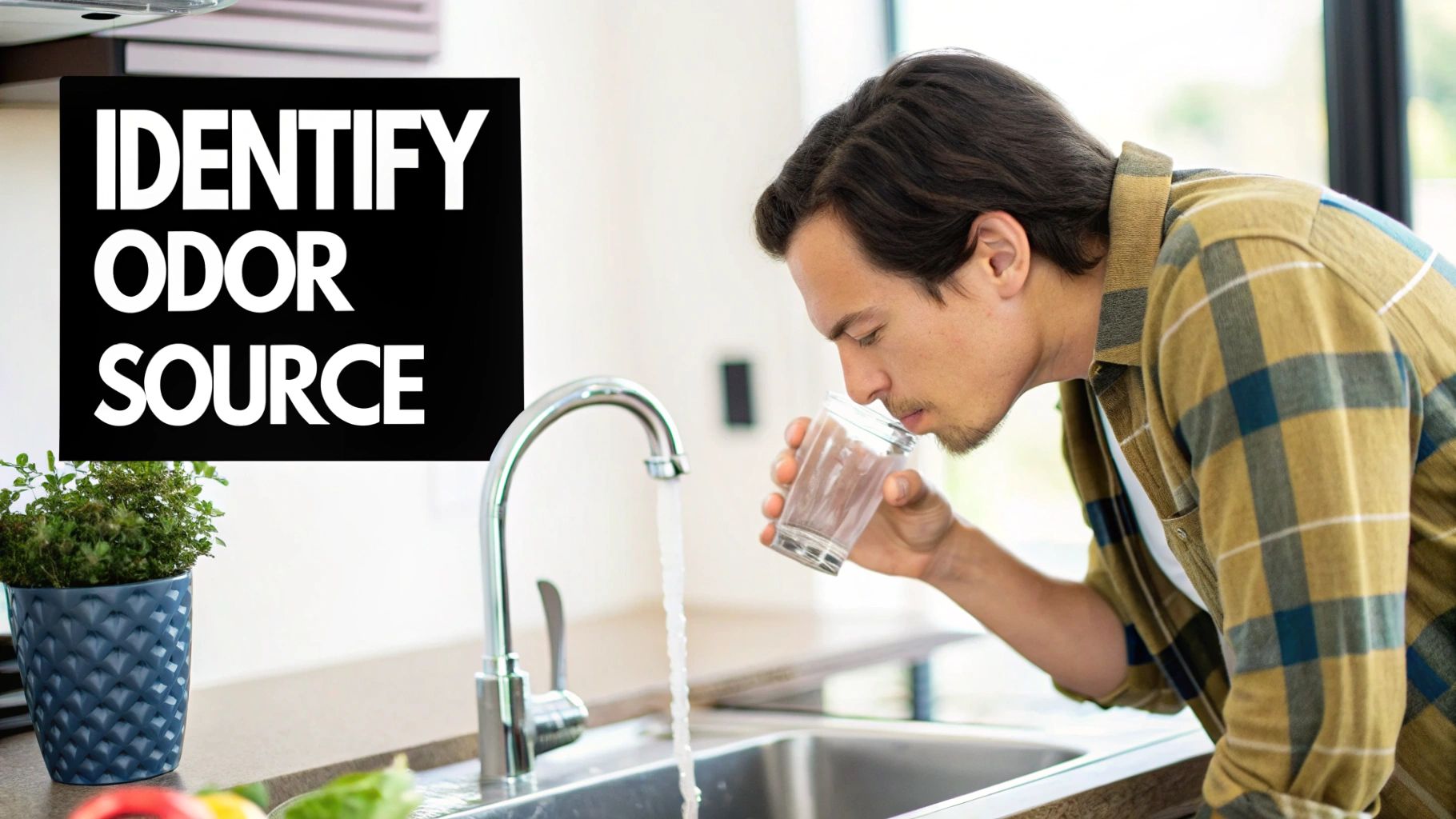
When that sulfur odor is hitting you from the kitchen sink, the bathroom, and even the laundry room, it's a dead giveaway that the issue is systemic. In these cases, a whole-house system—what we in the industry call a Point-of-Entry (POE) system—is really the only way to go. It gets installed right where the main water line comes into your home, treating every single drop of water before it ever has a chance to travel through your plumbing.
The Case for Treating Your Entire Home
A whole-house water filtration system for sulfur smell is about so much more than just making your drinking water taste better. It's about protecting your entire property. Hydrogen sulfide isn't just stinky; it's corrosive. Left untreated, it will eat away at copper pipes, brass fittings, and the delicate internal parts of your dishwasher, washing machine, and water heater.
Let’s talk real-world benefits. A POE system from Water Medic:
- Prevents Corrosion: You're actively protecting your plumbing from premature leaks and failure.
- Extends Appliance Life: Your expensive, water-using appliances will run more efficiently and last years longer without corrosive water wearing them down.
- Improves Your Daily Life: Imagine taking a shower without that awful smell, or having your laundry come out smelling genuinely fresh.
Putting in a POE system is a true investment in your home. It stops the problem at the source, guaranteeing that every faucet delivers clean, odor-free water.
The Limitations of Single-Tap Filters
Now, what about those smaller filters that fit under the kitchen sink or clip onto a faucet? These are known as Point-of-Use (POU) filters, and they’re designed for one thing: treating small amounts of water for drinking or cooking. They might look like a cheap and easy fix, but for a widespread sulfur problem, they're completely out of their league.
A POU filter is like putting a band-aid on a broken arm. It might cover the immediate symptom—the taste of your drinking water—but it does absolutely nothing to stop the corrosive damage happening inside your walls or the foul smell in your shower.
These little filters just aren't built to handle the water volume or the level of contamination needed to protect a whole house. They'll get clogged with sulfur compounds in no time, forcing you into a frustrating cycle of frequent and costly filter replacements without ever solving the root cause.
For a pervasive issue like a sulfur smell, treating the entire home isn’t just the best option—it's the only one that truly makes sense. It protects your property value, makes your daily life more pleasant, and gives you the peace of mind that comes from having clean water everywhere. If you want the absolute purest water at the tap on top of whole-house odor removal, looking into options like our whole-house reverse osmosis systems can deliver the ultimate solution.
Comparing The Best Filtration Methods For Sulfur Removal
So, you’ve confirmed the rotten-egg smell is coming from every tap in your house. The next move is picking the right filtration technology to get rid of it for good. This isn't a one-size-fits-all situation; the system that works for your neighbor might not be the best fit for you.
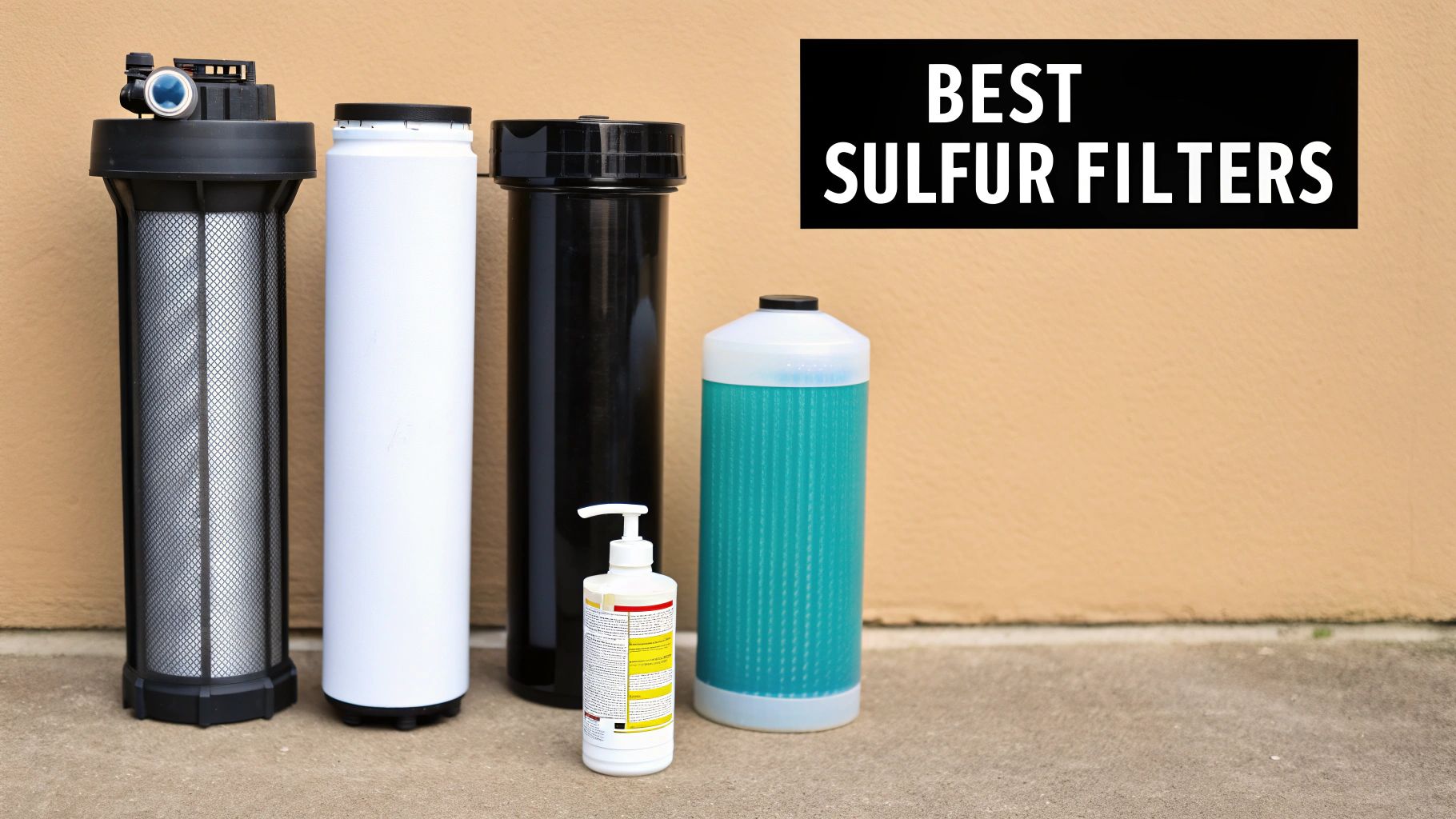
Choosing the right water filtration system for sulfur smell comes down to understanding the science behind each method and, most importantly, matching it to the amount of hydrogen sulfide (H2S) in your water. Let's walk through the professional-grade solutions we rely on every day to help homeowners in Southwest Florida get their clean water back.
The Most Common Ways to Tackle Sulfur Smell
When you're dealing with H2S, you can't just filter it out like a piece of sand. You have to change its chemical state first. Most effective systems work by oxidizing the hydrogen sulfide gas, turning it into solid sulfur particles that can then be easily filtered from the water.
Here’s a quick look at the most common technologies and how they stack up against each other.
| Filtration Method | Best For (H2S Level) | Pros | Cons & Maintenance |
|---|---|---|---|
| Aeration System | Moderate to High | Completely chemical-free. Low operating costs (just electricity for the pump). | Requires space for a large tank. The follow-up filter needs regular backwashing. |
| Oxidizing Filter | Moderate to High | Highly effective and self-contained. Low maintenance; automatically cleans itself. | Higher upfront cost than simple carbon. Media may need eventual replacement (many years). |
| Catalytic Carbon | Low to Moderate | Good for milder odors. Can also improve taste and remove other contaminants. | Limited capacity; not for heavy H2S. Carbon needs to be replaced periodically. |
| Chemical Oxidation | Very High / Severe | The most powerful method available. Also kills iron bacteria. | Requires handling chemicals (chlorine). More complex multi-tank setup. |
As you can see, the right choice really depends on the severity of your specific water problem. Let's dive a little deeper into how each of these works in the real world.
Aeration Systems: The Natural Approach
Aeration is a refreshingly simple, chemical-free process. Think of it as "airing out" your water on a massive scale. An aeration system works by injecting a stream of air (oxygen) directly into your water supply.
This blast of oxygen triggers a natural reaction with the dissolved hydrogen sulfide gas, converting it from a smelly gas into harmless, microscopic particles of elemental sulfur. Once it's in a solid form, a sediment filter downstream can easily trap and remove it.
- Best For: Homes with moderate to high levels of H2S.
- Pros: It’s a huge plus for homeowners who want to avoid chemicals. The day-to-day operating costs are also very low—just a bit of electricity for the air pump.
- Cons & Maintenance: These systems aren't tiny. You need dedicated space for both the aeration tank and the follow-up filter. That filter will also need periodic backwashing to flush out all the sulfur it has collected.
Oxidizing Filters: The Workhorse Solution
For most of the homes we see, an oxidizing filter is the perfect balance of power and convenience. These systems look a lot like a typical water softener tank but are filled with a special media, like manganese greensand or catalytic carbon. This media is a catalyst that dramatically speeds up the oxidation of H2S.
As water flows through the tank, the media instantly converts the hydrogen sulfide into solid sulfur, trapping it within the filter bed. Then, on a pre-set schedule, the system automatically runs a backwash cycle to deep-clean itself, flushing all the trapped sulfur particles down the drain.
Our Expert Insight: For many homes here in Cape Coral, a properly sized oxidizing filter is the gold standard. It's an efficient, set-it-and-forget-it unit that consistently eliminates that rotten egg smell without asking the homeowner to lift a finger.
This reliability is why it’s our go-to recommendation for a wide range of well water problems.
Carbon Filters: Knowing When to Use Them
If you're dealing with just a faint, occasional sulfur smell, a carbon filter might be all you need. Standard activated carbon works through adsorption, where contaminants like H2S essentially stick to the carbon's massive internal surface area. The problem? Regular carbon gets "full" of sulfur very quickly and stops working.
A much better option for sulfur is catalytic carbon. This advanced media doesn't just trap H2S; it actively helps convert it into less smelly compounds, making it far more effective and longer-lasting. You can explore the different types of carbon filtration systems we offer to see if this simpler approach fits your mild odor issue.
Chemical Oxidation: The Heavy-Duty Method
What if your water smells overwhelmingly bad? For extremely high H2S levels or when you're also fighting slimy iron bacteria, you have to bring in the big guns: chemical oxidation.
This method uses an injector to add a small, precise amount of an oxidizer like chlorine into your water. The water then sits in a holding tank for a few minutes, giving the chlorine time to completely neutralize the H2S. Afterward, the water passes through a large carbon filter which removes the oxidized sulfur particles and any leftover chlorine, so your water is left smelling and tasting perfectly clean.
This is a powerful, multi-stage process for the toughest water problems. A professional water test is the only way to know for sure which system is the right one. That data tells us everything we need to recommend the most efficient and cost-effective solution for your home.
Why You Shouldn't DIY Your Sulfur Water Filter
It's tempting to watch a few online videos and think, "I can do that." Trying to install a whole-house water filtration system for sulfur smell yourself seems like a smart way to cut costs. But trust me, this isn't like installing a simple under-sink filter. These are complex systems tied directly into your home's main water supply, and a small mistake can create a massive, expensive headache.
Here in Southwest Florida, we get the calls all the time to fix DIY jobs gone wrong. We’ve seen everything from systems that are completely wrong for the home’s water usage to botched connections that lead to serious leaks. A professional installer isn't a luxury; they're your safeguard against these all-too-common disasters.
The Hidden Dangers of a DIY Install
Those "how-to" guides often gloss over the real-world risks. Without the right experience, specialized tools, and knowledge of local plumbing, you can easily find yourself in way over your head.
Here are the most common problems we encounter when fixing DIY attempts:
- Wrong System Size: If the system is too small for your home's flow rate, your water pressure will drop, and the filter won't keep up. Too big, and you've just wasted money on capacity you'll never use.
- Plumbing Leaks: This is the big one. Cutting into your main water line requires absolute precision. A slightly off connection can create a slow, hidden leak that fosters mold growth or a major burst that floods your garage or utility room.
- Incorrect Filter Media: Choosing the right media (like catalytic carbon or an oxidizing filter) is 100% dependent on your specific water chemistry. Guessing wrong means the system simply won't work, and you're back at square one with a lighter wallet.
- Improper Programming: Modern systems need to be calibrated for backwash cycles and regeneration. If these settings are off, you could be wasting thousands of gallons of water or, even worse, the filter media won't get cleaned properly and will quickly become useless.
A professional installation isn't just about connecting two pipes. It’s about ensuring the entire system is perfectly sized for your water, seamlessly integrated with your plumbing, and fine-tuned for peak performance and a long lifespan.
Also, keep in mind that many advanced systems with pumps or UV lights need dedicated electrical work. This is a job for a professional home improvement electrician to ensure everything is wired safely and up to code.
The Water Medic Advantage: Peace of Mind Included
When you work with a team like Water Medic, you’re not just buying equipment. You’re investing in a complete, guaranteed solution that takes all the guesswork and risk off your shoulders. We manage every single detail to make sure your system works perfectly from the moment it's turned on.
Our process is built on years of local experience:
- Real Water Analysis: It all starts with a free, comprehensive water test at your Cape Coral home. This isn't optional for us—it's essential. The data tells us exactly how much hydrogen sulfide, iron, and other contaminants we're dealing with so we can select the perfect system.
- Expert Plumbing Integration: Our certified technicians know the plumbing setups in Southwest Florida homes inside and out. We guarantee a clean, professional, and leak-free installation that meets all local codes.
- Precise System Calibration: We don’t use factory presets. We program your system based on your water test results and your family’s usage patterns, ensuring it runs efficiently and the filter media lasts as long as possible.
- Solid Warranty & Local Support: Every installation we do is backed by a strong warranty. More importantly, we’re right here in the community. If you ever have a question or need service, a local expert is just one call away.
Don't gamble with your home and your investment. Let the pros at Water Medic deliver a solution that gets rid of that rotten egg smell for good. Contact us today to schedule your free water test and consultation and get started on the path to clean, fresh water.
Thinking About Long-Term Costs and Maintenance
When you decide to install a water filtration system for sulfur smell, you're making a real investment in your home. It's about more than just getting rid of an annoying smell; it's about comfort and protecting your property. That's why it's so important to look past the initial price tag. The true cost of any system reveals itself over years of use, and picking the right one from the start is key to making a smart, sustainable choice.
Lots of folks get fixated on the upfront cost of the equipment and installation. We get it. But from our experience, cheaper, off-the-shelf systems can end up costing you a lot more down the road. They often need constant tinkering, expensive media changes, and just don't hold up. A high-quality, professionally installed system might cost more initially, but it almost always saves money and headaches over its lifespan.
Breaking Down the Total Cost of Ownership
To really understand the investment, you need to look at the whole picture—the day-one price plus what it takes to keep it running smoothly. Different types of sulfur removal systems come with very different maintenance needs, and that directly affects your budget and your time.
Here’s a realistic look at where the money goes:
- Initial Installation: This covers the system itself and the professional labor to get it plumbed into your home correctly. It’s the biggest single check you’ll write, but paying for a pro install prevents a world of expensive problems later.
- Media and Filter Replacements: If your system uses carbon or another type of filter media, it will need to be replaced eventually. How often depends entirely on how much sulfur is in your water and how much water your family uses.
- Chemical Refills: For systems that rely on chemical oxidation, you'll have a recurring cost for chlorine or other oxidizers.
- Electricity Usage: Modern systems are pretty energy-efficient, but things like aeration pumps and electronic control valves will add a little bit to your monthly power bill.
Knowing what's in your water is everything. Sulfur levels aren't the same everywhere. Far from it. Data from the Global Environment Monitoring System shows that while the average in freshwater is about 20 mg/L, groundwater can swing wildly from 0 to 230 mg/L. This is exactly why a one-size-fits-all filter from a big box store is often a bad bet. To learn more about this variance, you can discover more about sulfur's presence in water sources and see why a professional water test is non-negotiable.
How a Quality System Actually Saves You Money
It might sound strange, but spending more upfront on a robust, professional-grade filtration system is one of the best financial moves you can make for your home. That rotten egg smell is caused by hydrogen sulfide gas (H2S), and it's not just stinky—it's corrosive. It's quietly eating away at your pipes and appliances.
By tackling corrosive H2S right where it enters your home, a good system acts like a shield. It protects your dishwasher, your washing machine, and especially your water heater from getting destroyed from the inside out. We're talking about preventing premature failures that could easily cost you thousands in replacement bills.
At Water Medic, we also lean toward solutions that don't add another chore to your to-do list. Many of the oxidizing filter systems we install are essentially "set-it-and-forget-it" units. They're designed to clean themselves automatically with a backwashing cycle, so you aren't stuck with a bunch of hands-on maintenance. This convenience factor is a huge reason they’re so popular with our customers here in Cape Coral.
When you call us, you’re not just buying a filter. You're getting a long-term partner who's committed to the quality of your water. We don't just sell you a box and walk away—we provide the support and service to keep it running perfectly, protecting your home and your wallet for years to come.
Your Questions About Sulfur Water Filtration, Answered
When that rotten egg smell follows you from the shower to the kitchen sink, it's easy to feel overwhelmed. You know you need a fix, but what's the right one? Making a decision about a water filtration system for sulfur smell is a big step, and you deserve to feel confident about it. We've spent years in homes all over Southwest Florida tackling this exact issue, so we've heard just about every question there is.
Let's cut through the confusion and get you some straight answers. Our goal is to give you the clear, practical information you need to get back to enjoying fresh, clean water in your home.
Will a Water Softener Get Rid of the Sulfur Smell?
This is easily the most common question we hear, and the short answer is a definite no. A quality water softener is brilliant at its job, which is removing the minerals like calcium and magnesium that cause hard water buildup. It does this through a process called ion exchange.
But that process does absolutely nothing to address hydrogen sulfide (H₂S) gas, which is what's causing that awful smell. In fact, sending high levels of hydrogen sulfide through a softener can actually foul up the resin beads inside, shortening its lifespan and making it less effective at softening your water. Think of it this way: you wouldn't use a hammer to turn a screw. You need the right tool for the job, and for H₂S, that's a dedicated system like an aeration tank or an oxidizing filter.
How Long Does a Whole-House Filter Installation Take?
We know the last thing you want is a major disruption to your home. That's why we've got our installation process down to a science. For most homes here in the Cape Coral area, a full, professional installation of a whole-house sulfur filter will take somewhere between three to five hours.
What happens in that time? Our certified technicians will:
- Find the best, most practical spot for the new system.
- Expertly tie into your main water line, installing the proper bypass valves for future maintenance.
- Connect the new filter and set up its regeneration or backwash schedule based on your home's water quality and usage.
- Run a complete check for leaks and ensure everything is operating at peak performance before we leave.
We come prepared with everything needed to do the job right in one go. Our aim is to get you back to normal as quickly as possible, but with much, much better water.
Is Hydrogen Sulfide in My Water Dangerous?
The concentrations of hydrogen sulfide that create that rotten egg odor are generally not considered a direct threat to your health when you drink the water. The EPA even calls it a "secondary contaminant," which is a technical way of saying it’s more of a nuisance—affecting taste, odor, and appearance—than a primary health risk.
But don't let that fool you. The presence of H₂S is a huge red flag. It signals that the conditions in your well are ripe for other, more harmful bacteria to grow. Beyond that, hydrogen sulfide is incredibly corrosive. It will actively eat away at copper pipes, brass fittings, and the metal components inside your appliances and water heater. Ignoring the smell is like letting a slow, expensive disaster unfold inside your walls.
Why Does My Cape Coral Water Smell So Bad?
If you live in Cape Coral or anywhere in Southwest Florida and you're on well water, you're dealing with our unique local geology. The groundwater here works its way through layers of limestone and ancient, decaying organic material. This environment is the perfect breeding ground for a specific type of bacteria called sulfur-reducing bacteria.
These harmless, naturally occurring microbes use sulfate for energy instead of oxygen. As they "breathe," they release hydrogen sulfide gas as a waste product. That gas dissolves into your well water, and by the time it gets to your faucet, you've got that signature smell. It’s not your fault—it’s just a fact of life in our aquifer, and one that requires a targeted water treatment solution.
At Water Medic of Cape Coral, we're not just selling boxes of equipment. We deliver complete, lasting solutions designed specifically for the water challenges we face right here in our community. If you're finally ready to kick that rotten egg smell to the curb, let our local pros give you a free, no-pressure water analysis to pinpoint the perfect system for your home.