
Sulfur Filters for Well Water Solved
That foul "rotten egg" smell coming from your tap is more than just a nuisance; it's a clear signal from your well water that something's off. The culprit is hydrogen sulfide (H₂S), a dissolved gas that modern sulfur filters are specifically designed to tackle, leaving you with nothing but clean, fresh water.
What Causes the Rotten Egg Smell in Your Well Water

If you've turned on a faucet and recoiled from that all-too-familiar stench, you're in good company, especially here in Southwest Florida. That distinctive smell is the signature of hydrogen sulfide, a gas that forms deep underground.
So where does it come from? It's usually the work of sulfur-reducing bacteria. These tiny organisms thrive in oxygen-poor environments like deep wells and even parts of your plumbing system. They essentially "breathe" sulfate and feed on organic matter, releasing that stinky hydrogen sulfide gas as their waste product. It's a natural process, but one with a very unpleasant result for your home.
A Common Problem in Southwest Florida Aquifers
For those of us in Cape Coral, Fort Myers, and the surrounding areas, this isn't just a random occurrence. Our region's wells tap into the Floridan aquifer, a massive underground system rich in limestone. This limestone naturally contains sulfates, which is basically a feast for those odor-producing bacteria.
When your well pump kicks on, it pulls up water that's saturated with this dissolved gas. The H₂S stays trapped in the water until it hits the air at your faucet. The moment it's released from pressure, the gas escapes and that pungent smell fills your kitchen or bathroom. This is why it can seem like the smell comes out of nowhere.
More Than Just a Bad Smell
While the odor is impossible to ignore, hydrogen sulfide brings more than just a bad smell to the party. Letting it go unaddressed can cause a ripple effect of problems throughout your home.
The presence of hydrogen sulfide isn't just an inconvenience; it's an active agent of corrosion. Even at low concentrations, this gas can cause significant damage to your home's vital systems over time, turning a simple water quality issue into a costly plumbing problem.
The corrosive nature of H₂S is particularly aggressive toward metals, which means your plumbing and appliances are directly in the line of fire. Here’s what it can do:
- Tarnished Silverware: Your nice silverware can develop a black, tarnished film that's difficult to scrub off.
- Stained Laundry: Forget bright whites. Clothes can come out of the wash with dingy yellow or brown stains.
- Discolored Fixtures: Sinks, tubs, and toilets can develop ugly black stains that are a constant battle to clean.
- Plumbing Corrosion: This is the big one. Over time, H₂S can eat away at copper, brass, and iron pipes, leading to pinhole leaks and expensive plumbing emergencies.
The good news is you don't have to put up with it. High-quality sulfur filters for well water are the permanent fix for this problem. Here at Water Medic, we diagnose the specific cause of your water problems and install the right system to get rid of hydrogen sulfide for good. By treating the source, you can protect your home, your pipes, and your peace of mind while enjoying the clean, odor-free water your family deserves.
Pinpointing Your Exact Water Problem

Before you can fix that rotten-egg smell, you have to know exactly what you're dealing with. Just guessing at the cause is a recipe for frustration—it often leads to buying the wrong equipment and wasting a lot of time and money.
Think of it like a doctor running tests before writing a prescription. A professional water analysis gives us the hard data needed to design the right solution. It’s the only way to get a clear, accurate picture of your water's chemistry so we can select and size the correct sulfur filters for well water for a permanent fix.
Is It Your Well or Your Water Heater?
First things first, let's play detective. Where is the smell actually coming from? A simple test at your faucet can give you a major clue.
- Smell from all taps (hot and cold): If the odor shows up instantly no matter which faucet you turn on, the hydrogen sulfide is almost certainly coming from your well itself.
- Smell only from hot water taps: This can sometimes mean the problem is inside your hot water heater. A component called an anode rod can react with sulfates in the water, creating that distinct rotten-egg smell right inside the tank.
While this is a great starting point, it's not foolproof. Even if the smell is worse with hot water, the root cause often still lies in the well. To dive deeper into other common issues, check out our frequently asked well questions.
Why a Professional Water Test Is Not Negotiable
A comprehensive lab test does more than just confirm the presence of sulfur. It tells us how much is there, measuring the hydrogen sulfide level in parts per million (ppm). This number is the single most critical piece of information for choosing the right filtration system.
It doesn't take much to cause a problem. Water with as little as 1 ppm of hydrogen sulfide can be corrosive enough to tarnish your silverware and copper plumbing. The good news is that modern oxidizing filters can handle concentrations up to 6 ppm when set up correctly. This helpful fact sheet on sulfur in well water offers more detail on these concentrations.
A professional water analysis is your roadmap to clean water. It eliminates guesswork and ensures the system we recommend is perfectly matched to your home's specific water chemistry, solving the entire problem, not just one symptom.
A full analysis also screens for other troublemakers that often tag along with sulfur, especially here in Southwest Florida. We're talking about things like iron and manganese, which cause their own set of staining and taste problems. Finding these upfront means we can recommend a system that tackles everything at once, giving you a complete and lasting solution.
How Do You Even Filter a Smell Out of Water?
It sounds a bit like magic, doesn't it? Removing a smell from water. But it’s not magic—it's just good, solid science. The key is understanding that the "rotten egg" smell isn't just a smell; it's a gas called hydrogen sulfide (H₂S) that's dissolved in your well water. You can't filter a gas directly. So, the goal of any effective sulfur filter is to first change that gas into a solid particle, which can then be easily trapped and removed.
The process that makes this happen is called oxidation. If you've ever seen a sliced apple turn brown after being exposed to the air, you've seen oxidation in action. The oxygen in the air reacts with the apple's surface. Sulfur filters do something very similar. They introduce an oxidizer—usually oxygen from the air—to your water, which instantly reacts with the hydrogen sulfide gas. This reaction transforms the invisible, smelly gas into tiny, solid particles of elemental sulfur. Now that it’s a solid, we can grab it.
Air Injection Oxidation: The Modern Gold Standard
In our experience, the most effective and hassle-free technology for homeowners today is Air Injection Oxidation (AIO). We recommend these systems constantly because they are powerful, self-sufficient, and completely chemical-free. Think of an AIO system as a complete, miniature water treatment plant all contained within a single tank.
Here’s a quick rundown of how it works, step-by-step:
- Air is Introduced: As water from your well enters the filter tank, the system cleverly draws in a pocket of air, creating a bubble of pure oxygen at the top.
- Oxidation Happens Instantly: Your water then showers down through this oxygen-rich bubble. The moment it does, the hydrogen sulfide gas is oxidized into solid sulfur particles. Iron and manganese are oxidized this way, too.
- Filtration Catches the Solids: Next, the water flows down through a specialized bed of filter media. This media acts like a net, trapping all those newly formed sulfur particles (and any iron or manganese).
- Automatic Cleaning: The system is smart. Every few days, it automatically triggers a powerful backwash cycle that flushes all the trapped particles out of the media and down the drain. This resets the filter, leaving it clean and ready to go.
This all-in-one process is incredibly efficient and low-maintenance, which is why it’s a top choice for well owners here in Southwest Florida. Our specially designed air injection systems are built to handle the unique water chemistry we find in our local aquifers.
A Look at Other Sulfur Filtration Methods
While AIO systems are our go-to for most situations, they aren't the only tool in the toolbox. The best solution for your home always comes down to what we find in a professional water test. Other technologies have their place, too.
To make it easier to see how these options stack up, here’s a quick comparison.
Comparing Sulfur Filter Technologies
| Filtration Method | How It Works | Best For | Typical Maintenance |
|---|---|---|---|
| Air Injection (AIO) | Injects a bubble of air to oxidize H₂S into solid sulfur, then filters it. | High levels of sulfur, iron, and manganese. A great all-in-one solution. | Set-it-and-forget-it. Just needs occasional service checks. |
| Catalytic Carbon | Uses special carbon media to accelerate the oxidation of H₂S, trapping sulfur particles. | Low to moderate sulfur levels without significant iron. | The carbon media needs to be replaced every 1-3 years. |
| Manganese Greensand | A manganese-coated media oxidizes H₂S, iron, and manganese on contact. | Moderate to high levels of sulfur and iron, a classic method. | Requires a second tank with potassium permanganate that must be kept full. |
Let's dive a little deeper into those alternatives.
Catalytic Carbon Filters
These filters look just like a standard carbon water filter, but the magic is in the media inside. It uses a special type of "catalytic" activated carbon, which is designed to dramatically speed up the natural reaction between hydrogen sulfide and any oxygen already present in your water. The surface of the carbon acts as a catalyst, converting the H₂S gas into solid sulfur that gets stuck in the filter. You'll find this technology in systems using advanced GAC (Granular Activated Carbon) filter cartridges. This approach can work well for lower concentrations of sulfur, but the media gets used up and will need replacing more often than an AIO system.
Manganese Greensand Filters
This is one of the old-school, tried-and-true methods that’s been used for decades to remove sulfur and iron. The filter uses a natural mineral called glauconite that is coated with manganese dioxide, a powerful oxidizing agent. When your water flows through it, the H₂S is instantly oxidized and filtered out.
The key takeaway is this: Effective sulfur removal is always a two-step dance. First, you have to turn the gas into a solid (oxidation). Second, you have to physically screen that solid out of the water (filtration). The different technologies are just different ways of accomplishing that first step.
The catch with greensand is that the manganese coating gets "used up" over time. To keep it working, the system has to be "regenerated" with a chemical called potassium permanganate—a bright purple liquid you have to keep stocked in a separate tank. While effective, it adds an extra maintenance task and ongoing cost that modern AIO systems have eliminated.
Understanding how these systems turn a stinky gas into a harmless solid is the first step. It shows you that a proper filtration system isn't just covering up a symptom—it's solving the root cause of your water problem for good.
Choosing the Right Sulfur Filter for Your Home
Okay, you’ve got your water test results and you know a bit about how these filters work. Now comes the most important part: picking the right system for your home. This is where the science from the lab report meets the reality of your pipes, your family, and your daily life. It’s all about matching the right tool to the specific job at hand.
Think of it like being a tailor. You wouldn’t just guess at a suit size; you’d take precise measurements. We do the same thing with your water. The exact amount of hydrogen sulfide (H₂S) in your well points us directly to a specific type of filter, while a different reading might mean another approach is a much better fit.
Reading the Story Your Water Test Tells
That water test is more than just a page of numbers. It’s the blueprint for designing the perfect filtration system. The main character in this story is the concentration of hydrogen sulfide, which we measure in parts per million (ppm).
For example, if you have low to moderate H₂S levels, a catalytic carbon filter can often get the job done beautifully. They’re a great choice when that sulfur smell is the main problem and you don't have a lot of other contaminants mucking things up. But for the stubborn, high-concentration sulfur problems we see so often here in Southwest Florida, you need something with more muscle. That’s usually when an Air Injection Oxidation (AIO) system becomes the hero, since it's built to aggressively knock out high levels of H₂S, iron, and manganese all at once.
Choosing a filter isn't about buying the biggest or most expensive unit on the shelf. It’s about working together to find the most efficient and effective solution that perfectly matches your home's unique water chemistry and how you actually use water every day.
This diagram shows how different contaminant levels guide us toward the right technology. It’s a roadmap for treating well water.
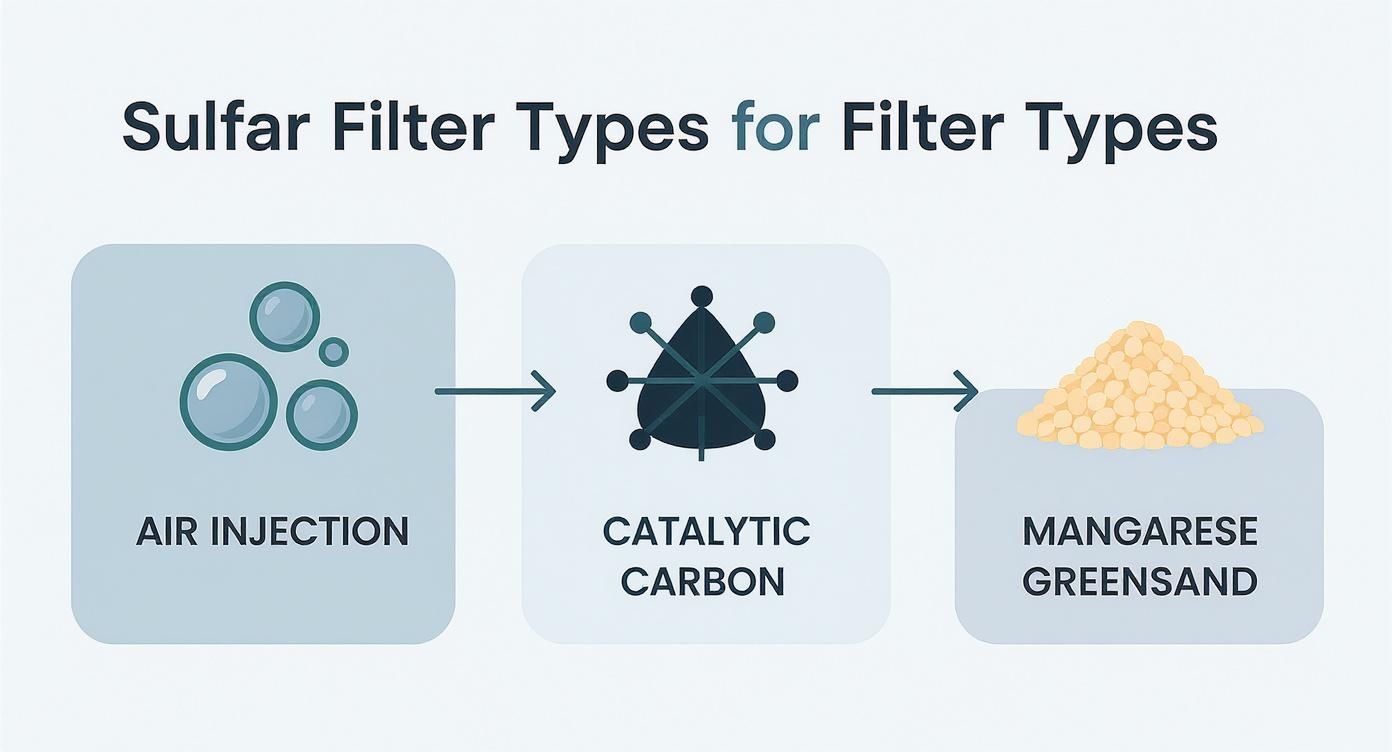
The big takeaway here is that every filter type shines under different conditions. That’s why getting a professional water analysis is the non-negotiable first step. It puts you on the right path from the start.
Factors Beyond Just the Sulfur Smell
While that rotten egg smell is what gets your attention, a successful system depends on looking at the whole picture. When choosing the right sulfur filters for well water, we have to consider several other critical factors that determine how well the system will actually perform. A Water Medic expert will always dig into these details.
1. Water Flow Rate (GPM)
How much water does your home use at its peak? We measure this in gallons per minute (GPM). If a filter is too small for your home, it simply can’t keep up when the dishwasher, washing machine, and a shower are all running. You’ll notice a drop in water pressure and, worse, the filter won’t be able to do its job. We make sure your system is sized to handle your household's busiest moments without breaking a sweat.
2. Family Size and Water Usage
It’s simple, really. A house with two people uses water very differently than a house with five. Your family’s size directly impacts your total daily water consumption, which tells us what capacity your filter needs and how often it should regenerate. We’ll match you with a system that can comfortably meet your needs without being constantly overworked.
3. The Presence of Other Contaminants
Sulfur rarely shows up to the party alone. Your water test might also show significant levels of iron, manganese, or sediment. If that’s the case, a simple catalytic carbon filter probably won’t be enough. Our job is to identify a system—often an AIO unit—that can tackle all these troublemakers at the same time. You can learn more in our guide about how specialized carbon filters for well water can target specific issues.
4. Available Space and Plumbing
Finally, we have to deal with the practical side of things. Where will the system physically go? We'll check out the space you have near your well equipment and pressure tank to ensure a clean, professional installation that fits neatly into your existing plumbing.
By carefully weighing each of these factors, we get far beyond a generic, one-size-fits-all solution. Working with a Water Medic expert means you get a system that’s truly custom-fit for your home. This prevents you from overspending on a unit that’s overkill or, even worse, wasting money on a system that just can't handle the job. This detailed, personalized process is the key to years and years of clean, great-tasting, odor-free water.
Professional Installation and Long-Term Care

You can have the most advanced sulfur filter on the market, but its real-world performance comes down to one thing: the quality of the installation. A flawless setup is non-negotiable. If a system isn’t sized, plumbed, and programmed perfectly from the get-go, it simply won't deliver the clean, odor-free water you’re paying for. This is where bringing in a seasoned professional makes all the difference.
When the Water Medic team shows up, our mission is to make the whole process seamless. We’re not just hooking up a tank; we’re carefully integrating the new sulfur filter into your home’s main water line, making sure every connection is solid and leak-proof. Our certified technicians dial in every last detail, from programming the control valve to setting the backwash frequency based on your actual water usage. We pride ourselves on working cleanly and efficiently, leaving your home better than we found it.
Getting the System Programming Just Right
One of the most crucial steps during installation is programming the system’s backwash or regeneration cycle. Think of this as the filter’s self-cleaning mode. It’s an automated process that flushes out all the trapped sulfur and iron, essentially hitting the reset button on the filter media.
Setting this cycle is a bit of an art. Program it to run too often, and you're just wasting water and salt (if applicable). Don't run it often enough, and the filter media gets saturated and clogged, which is when that nasty rotten-egg smell starts sneaking back in. Our experts fine-tune your system’s programming based on your specific water test results and your family’s size, ensuring it runs at peak efficiency from day one.
What to Expect for Long-Term Maintenance
You’re making a smart investment in your home’s water quality, and it’s one worth protecting. Just like your car or HVAC system, sulfur filters for well water need a little ongoing care to keep them running smoothly for years to come.
The maintenance chores depend on the type of system you have. An Air Injection Oxidation (AIO) system, for example, is wonderfully low-maintenance. Still, it needs a periodic check-up to make sure the air injector is clear and the media bed is in good shape. Other systems, like those with manganese greensand, will need you to keep a separate tank topped off with a regenerating solution.
"Think of professional installation as the foundation of your water treatment solution. Proper setup and a clear maintenance plan are what ensure your system delivers on its promise of clean water for years, not just months."
We make this easy by offering straightforward maintenance plans. They’re designed to keep your system in prime condition so you never even have to think about it. These plans are truly the best way to protect your equipment and guarantee your water quality never dips. You can learn more about our hands-on approach and what makes us different on our page about our air injection filter expertise.
Our routine maintenance service covers all the bases:
- System Inspection: We do a full top-to-bottom check of every component, from the control valve down to the plumbing connections.
- Media Health Check: We take a close look at the filtration media to confirm it’s still doing its job of pulling contaminants out of your water.
- Cycle Reprogramming: Life changes—kids move out, you have more guests. We can adjust the backwash cycles to match your current water usage for continued efficiency.
Choosing Water Medic means you’re getting more than just a piece of equipment; you're getting a long-term partner dedicated to keeping your water pure. From the initial expert installation to proactive maintenance down the road, we’re here to make sure you enjoy perfect water for years to come.
Why Southwest Florida Well Water is So… Unique
If you live anywhere from Cape Coral to Fort Myers and have a well, you’re probably all too familiar with that notorious “rotten egg” smell. It’s a common complaint, and I can tell you, it’s not just bad luck. That smell is a direct result of our unique local geology. This isn't a problem you can solve with a generic, off-the-shelf filter; it’s a regional challenge that needs a real, local solution.
Our homes are built right on top of the Floridan aquifer, a huge underground water source flowing through porous limestone. That limestone is loaded with sulfates and other organic goodies that create the perfect buffet for sulfur-reducing bacteria. These are the little guys responsible for producing the hydrogen sulfide gas that makes your water stink.
Why You Need a Local Pro
Here’s something most people don’t realize: in our aquifer, sulfur rarely shows up to the party alone. The same underground conditions that give us smelly water also bring along a few other unwelcome guests that can wreak havoc on your home.
- Stubborn Iron Stains: The low-oxygen environment deep in the aquifer lets iron dissolve right into the groundwater. The result? Those ugly orange and brown stains on your sinks, toilets, and laundry that are impossible to scrub away.
- Hard Water Headaches: Our limestone foundation is basically calcium carbonate. As water seeps through it, it picks up these minerals, making our water incredibly hard. This is why you see scale buildup on faucets, soap scum in the shower, and why your water-using appliances work so hard and die so young.
- Gritty Sediment: Because the limestone is so porous, fine bits of sand and sediment can easily get pulled into your well, clogging up pipes and even damaging the very filters meant to fix the problem.
This is why picking the right sulfur filters for well water here is so critical. You need a system that’s built to fight a multi-front battle against this specific cocktail of contaminants.
A System Designed for Our Water, Not Just Any Water
A filter you order online or grab from a big-box store just isn't engineered for the complex water chemistry we have in Southwest Florida. At Water Medic, we’re your neighbors. We’re out here every day, solving these exact problems in homes just like yours. We know what’s in the water because we test it and treat it constantly.
That deep, hands-on knowledge lets us build systems that tackle the trifecta of sulfur, iron, and hardness all at once.
This is a nationwide issue, of course—more than 13 million U.S. households get their water from private wells, and many of them deal with hydrogen sulfide. The market for filters is huge, which you can see if you discover more insights about the water filtration market. But a solution for well water in the mountains of North Carolina won’t cut it down here.
Choosing a local expert means you're not just buying a filter; you're investing in a solution engineered by a team that understands Southwest Florida’s unique water from the ground up.
When you call Water Medic, you’re getting a system that’s been precisely sized and configured for your home and your water. We’re not interested in quick fixes. We’re here to give you a permanent solution so you can finally stop worrying about your water.
Your Sulfur Water Filter Questions Answered
When you're ready to get rid of that rotten egg smell for good, a few final questions usually pop up. We get it. This is an important investment in your home, and you deserve clear, straightforward answers before moving forward.
Here’s a look at the most common questions we hear from homeowners right here in Southwest Florida. Our aim is to give you the confidence that you're not just buying a piece of equipment, but a permanent solution to your water problems.
How Much Does a Whole-House Sulfur Filter Cost?
The cost of a whole-house sulfur filter really depends on the type of system you need and how much sulfur is actually in your water. It's less of a one-size-fits-all product and more of a custom solution for your home.
That's why we start with a free, professional water test. Based on those results, we can give you a transparent, all-in quote with no hidden fees or surprises. We believe in finding the right long-term solution that fits your budget, not just selling you a box.
Will a Sulfur Filter Also Remove Iron from My Water?
Yes, and that's one of the biggest benefits. The best sulfur removal systems, particularly the air injection systems we often recommend, are masters at tackling multiple problems at once. They're designed to pull out sulfur, iron, and manganese simultaneously.
Here in Southwest Florida, it's rare to find well water with just one of these issues—they usually show up together. An integrated system solves everything with a single, efficient unit, which simplifies installation and makes future maintenance a breeze.
A professional installation from Water Medic protects your warranty and guarantees your system operates at peak efficiency from day one, saving you from costly leaks or ineffective filtration down the road.
Can I Just Install a Sulfur Filter Myself?
While the DIY spirit is admirable, installing a whole-house water filter is one of those jobs where experience really counts. It involves cutting into your home's main water line, properly sizing the unit for your water usage, and programming the backwash cycles.
A small mistake during setup can cause major headaches, from leaks that damage your property to a system that simply doesn't work right. Letting a certified professional handle the installation ensures it’s done correctly the first time, protecting your investment and giving you true peace of mind.
How Long Does a Sulfur Filtration System Last?
A quality, professionally installed sulfur filter is built to last. With the right care, you can expect it to serve your home for 10 to 15 years, sometimes even longer.
The key to that longevity is consistent, proactive maintenance. Just like changing the oil in your car, regular service keeps the system running at peak performance. That's why we offer hassle-free maintenance plans to make sure you get clean, odor-free water for years to come, maximizing the value of your investment.
Ready to finally get rid of that rotten egg smell for good? The team at Water Medic of Cape Coral has over 25 years of experience solving the unique water challenges of Southwest Florida. Contact us today for a free water analysis and a no-obligation quote.