Reverse Osmosis vs Carbon Water Filtration Guide
When you're weighing reverse osmosis against carbon water filtration, the right choice really boils down to what you want to achieve with your water. Reverse osmosis gives you the highest level of purification, stripping out an incredibly wide range of contaminants, right down to the molecular level. On the other hand, activated carbon is more of a targeted solution, fantastic for making your water taste and smell better by removing things like chlorine and certain organic chemicals.
Choosing Your Home Water Filtration System
For any of us living in Southwest Florida, picking the right water filtration system is a big deal for our family's health and peace of mind. Our local water can have its own set of unique issues, so it's smart to know exactly how different technologies tackle them. The two most popular options out there, reverse osmosis and carbon filtration, work in completely different ways to get you very different results.
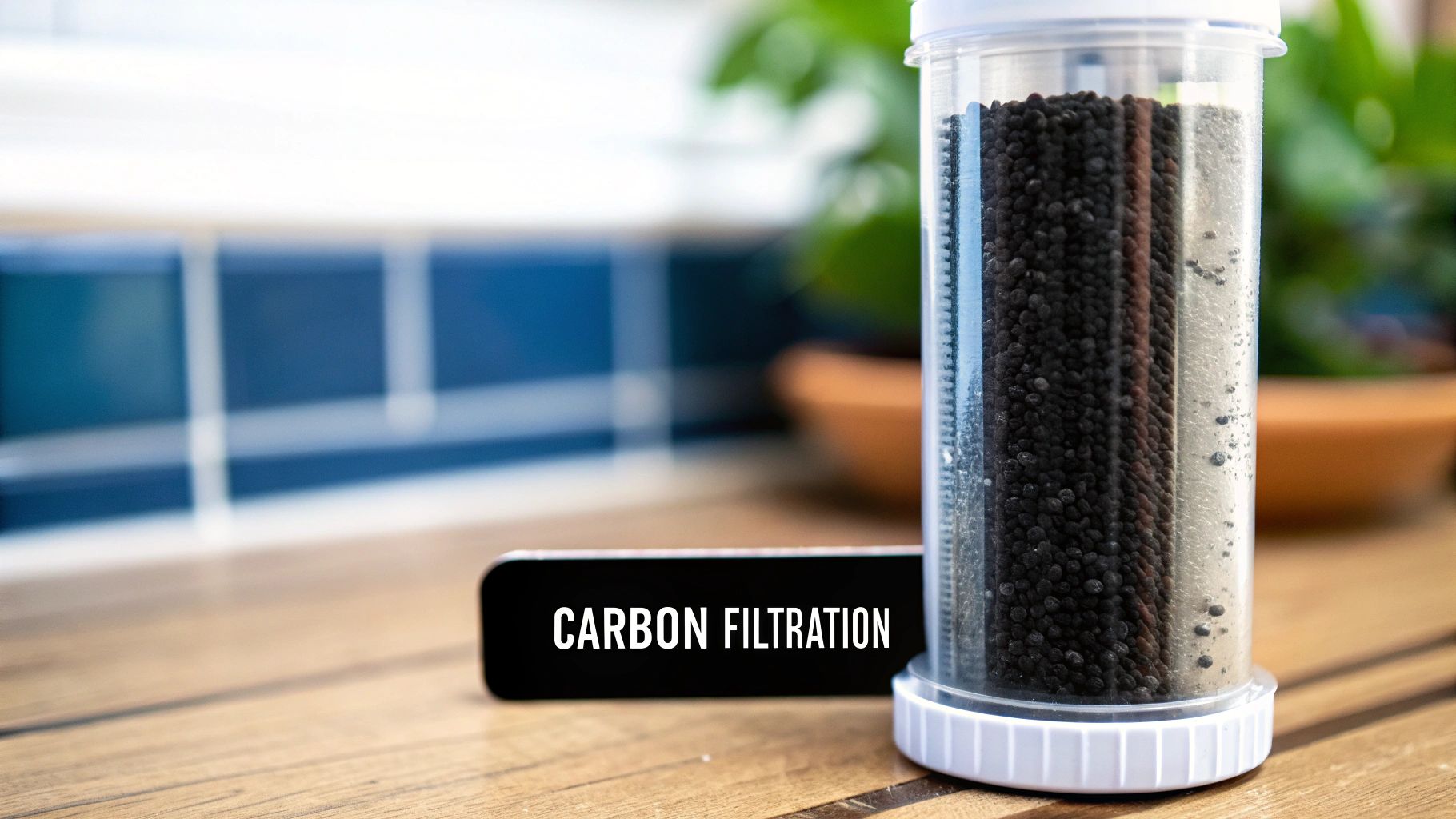
Think of an activated carbon filter as a sort of chemical magnet. It uses a process called adsorption, where contaminants—like the chlorine from city treatment, pesticides, and volatile organic compounds (VOCs)—physically stick to the carbon's surface. This makes it a go-to choice for dramatically improving the taste and smell of your tap water.
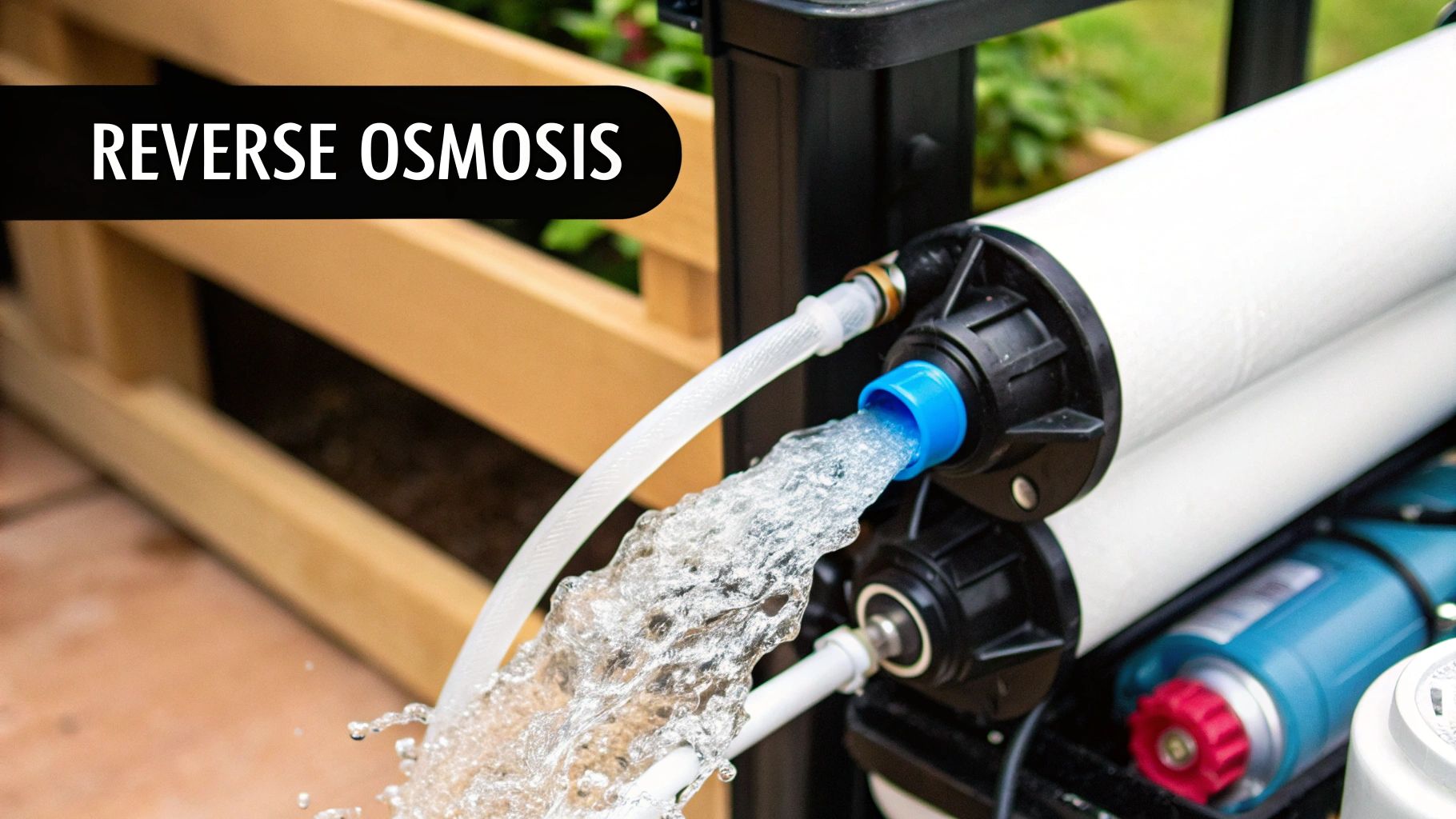
A reverse osmosis (RO) system, however, is more like a microscopic bouncer. It uses high pressure to force water through a special membrane filled with tiny pores, blocking almost everything that isn't a pure water molecule. We're talking dissolved salts, heavy metals like lead and arsenic, and even fluoride. If you're looking for the ultimate in-home purification, you can explore our under-sink reverse osmosis systems.
It all comes down to the scope of filtration. Carbon filters are specialists, targeting specific chemicals to improve aesthetics like taste and odor. RO systems are generalists, creating a broad barrier against a much wider spectrum of potential contaminants.
To help put these differences into perspective, here's a quick side-by-side look at the two technologies.
At a Glance: RO vs. Activated Carbon
This table breaks down the core distinctions between Reverse Osmosis and Activated Carbon systems, giving you a quick summary of what each one does best.
| Attribute | Reverse Osmosis (RO) | Activated Carbon |
|---|---|---|
| Primary Function | Water purification (removes up to 99% of contaminants) | Water improvement (removes taste/odor contaminants) |
| Key Contaminants Removed | Dissolved solids, heavy metals, fluoride, salts | Chlorine, VOCs, pesticides, herbicides |
| Effect on Minerals | Removes beneficial minerals | Leaves beneficial minerals intact |
| Typical Installation | Point-of-use (e.g., under a sink for drinking water) | Point-of-use or whole-home systems |
| Water Waste | Produces wastewater (brine) during filtration | No wastewater produced |
Ultimately, picking the best system for your home starts with knowing exactly what's in your water. This guide will walk you through a detailed comparison, giving you the confidence to make the right call for your family.
How Reverse Osmosis Technology Purifies Water
When you’re looking for the absolute gold standard in home water purification, reverse osmosis—usually just called RO—is the technology to beat. It's a surprisingly elegant process that uses your home's own water pressure to do something remarkable. It forces your tap water through a special semipermeable membrane, which is basically a filter with incredibly tiny pores.
Think of this membrane as a molecular bouncer. It’s extremely selective. The small, pure water molecules get a pass to go right through, but the bigger contaminant molecules are stopped dead in their tracks. Everything that gets blocked—dissolved salts, heavy metals, and other gunk—is then simply flushed away down the drain.
The list of what an RO system can remove is impressive and directly addresses the water quality issues we often see here in Southwest Florida. It’s highly effective at getting rid of dissolved salts, heavy metals like lead and arsenic, fluoride, nitrates, and a whole host of other impurities that you really don't want in your drinking water.
The Multi-Stage Filtration Process
One of the biggest misunderstandings about reverse osmosis is that it's just a single filter. Nothing could be further from the truth. A quality RO system is actually a multi-stage purification machine, with each stage playing a critical role.
Here's a breakdown of how a typical system works:
- Sediment Pre-Filter: This is the first line of defense. It catches the big stuff—dirt, sand, rust, and silt. Its main purpose is to protect the more sensitive, and more expensive, filters that follow, helping them last longer and work more effectively.
- Carbon Pre-Filter: Before your water ever hits the main event, it flows through an activated carbon filter. This is a vital step because it removes chlorine and other chemicals that could seriously damage the delicate RO membrane. This is why RO systems often incorporate carbon filtration right into their design.
- The RO Membrane: This is the heart and soul of the system. Here, intense pressure forces water molecules through the membrane, physically separating pure H₂O from the contaminants. The purified water moves on, while the concentrated waste stream of contaminants is sent to the drain.
- Carbon Post-Filter: As a final touch, after the clean water leaves its storage tank, it passes through one last carbon filter. This is often called a "polishing" filter because it removes any lingering tastes or odors, guaranteeing the water you get from the tap is exceptionally fresh and crisp.
By layering these different filtration methods, a reverse osmosis system provides a level of purity that a single, standalone filter just can't touch. It’s a comprehensive approach designed for maximum contaminant removal.
Unmatched Performance and Purity
There's a reason reverse osmosis is the leading technology in the global water filtration market. Its unparalleled ability to strip out dissolved salts, heavy metals, and other tricky contaminants has made it the go-to solution for millions. In fact, RO technology commands a massive 35% to 38.5% of the total revenue share in the water filtration industry, which speaks volumes about its reliability and effectiveness. People are more aware of water quality than ever, and RO systems are proven to remove up to 99% of dissolved impurities, meeting even the strictest health standards.
This level of purification makes a real, tangible difference in the water you use for drinking and cooking every single day. Getting it right, however, requires a proper, professional installation. Our team ensures your under-sink reverse osmosis system is set up perfectly to deliver peak performance from day one, giving your family the pure, safe water they deserve.
The Role of Activated Carbon Filtration
While reverse osmosis acts like a fine-toothed comb for water purity, activated carbon filtration is more like a specialized magnet. It’s a targeted, highly effective way to improve your water quality, and it’s been trusted for centuries. The basic idea—using charcoal to keep water fresh—has been around since ancient times. Of course, today’s technology is much more sophisticated, but the goal is the same: dramatically improving the taste, smell, and overall enjoyment of your tap water.
Activated carbon filters operate on a fascinating principle called adsorption. Think of the carbon inside the filter as a super-porous sponge with a mind-boggling amount of surface area. As water passes through, certain contaminants like chlorine, pesticides, and various chemicals are literally drawn to the carbon's surface and stick to it, getting trapped. This is precisely why carbon filtration is the go-to solution for getting rid of that distinct "swimming pool" taste and smell so common in city water.
How Carbon Adsorption Works for You
At its core, an activated carbon filter’s job is to remove the specific chemicals that make water unappealing. It’s about making your water more enjoyable to drink and cook with. For many homeowners in Southwest Florida who are on a municipal water supply, this is often all they need.
These filters are particularly good at removing:
- Chlorine: This is hands-down the number one reason tap water tastes and smells bad.
- Volatile Organic Compounds (VOCs): This is a broad category that can include industrial chemicals and solvents.
- Pesticides and Herbicides: Agricultural runoff can sometimes find its way into our water sources.
By zeroing in on these culprits, carbon filtration delivers an immediate, noticeable upgrade to your daily life. Your morning coffee will taste cleaner, and a simple glass of water becomes refreshing again. It’s a straightforward and efficient fix for the most common water complaints.
The Right Solution for Taste and Odor Concerns
There's a reason activated carbon has been a mainstay in water treatment for so long—it just works. It remains a cornerstone technology for chlorine removal and taste improvement, which is why it’s a favorite for homeowners everywhere. In fact, the market for home water filtration, where carbon filters are a key player, is expected to swell to over USD 21 billion by 2032. This isn't surprising, given how cost-effective these systems are and their ability to improve water quality without producing any wastewater. You can see more details on this trend in the home water filtration unit growth report from Verified Market Research.
If your main complaint is the chemical taste and smell of your city water, an activated carbon filter is almost always the most sensible and economical choice. It solves the most obvious sensory problems without the higher cost and complexity of a full-blown purification system.
This focused approach makes carbon filters incredibly versatile. At Water Medic, we install a range of systems designed to meet different needs. Whether you want a simple under-sink filter for your kitchen or a powerful whole-home system to treat every faucet, our team can guide you to the right choice. You can see what’s possible by exploring our high-quality carbon water filters. We’ll make sure you get a system that’s perfectly matched to tackle the unique water challenges we face here in Florida, delivering crisp, clean water to your entire home.
Comparing Contaminant Removal Capabilities
When you're trying to decide between reverse osmosis and carbon water filtration, this is where the rubber meets the road. The single most important question is: what, exactly, does each system take out of your water? For us here in Southwest Florida, that means looking at everything from the chlorine our cities use to treat water, all the way to potential agricultural runoff and the dissolved solids that make our water "hard."
The core difference is in how they work. Activated carbon filters act like a chemical magnet, using a process called adsorption to grab onto certain contaminants. Reverse osmosis, on the other hand, uses a super-fine membrane to physically block an incredibly wide range of impurities. This basic difference in technology is why you get such drastically different results in your glass.
How Activated Carbon Targets Specific Issues
Think of activated carbon filters as specialists. Their real talent lies in making your water taste and smell better by targeting the things that cause those aesthetic issues. It’s like a highly effective sponge, but for specific chemicals.
An activated carbon filter is best known for tackling:
- Chlorine: This is the big one. Carbon is fantastic at removing that classic "city water" taste and odor caused by chlorine.
- Volatile Organic Compounds (VOCs): This category includes a mix of industrial chemicals and solvents that can find their way into the water supply.
- Pesticides and Herbicides: Carbon does a good job of reducing many common chemicals used in agriculture.
While great for those specific jobs, a carbon filter has its limits. It won’t touch dissolved solids, heavy metals like lead or arsenic, nitrates, or fluoride. It's designed to improve your water, not truly purify it.
The Comprehensive Purification of Reverse Osmosis
A reverse osmosis (RO) system is a completely different beast. It offers a much more thorough, no-nonsense approach to water treatment. Instead of targeting specific chemicals, its semipermeable membrane acts as a gatekeeper, stopping nearly everything larger than a water molecule from passing through. This is why RO is considered a true water purification method.
The real power of a reverse osmosis system is its ability to remove the invisible threats that carbon filters miss. This includes heavy metals, dissolved salts, nitrates, and fluoride—impurities that often have no taste or smell but can carry significant health concerns.
Let's break down how each system performs against the common water contaminants we see in our area.
Contaminant Removal: RO vs Activated Carbon
The table below gives you a clear, side-by-side look at what you can expect from each technology when it comes to specific contaminants.
| Contaminant Type | Reverse Osmosis Effectiveness | Activated Carbon Effectiveness |
|---|---|---|
| Chlorine (Taste & Odor) | Excellent (uses a carbon pre-filter) | Excellent (its primary function) |
| Heavy Metals (Lead, Arsenic) | Excellent (removes up to 99%) | Poor to None |
| Total Dissolved Solids (TDS) | Excellent (removes salts, minerals) | None |
| Nitrates & Sulfates | Excellent | Poor to None |
| Fluoride | Excellent | None |
| Pesticides & VOCs | Good to Excellent (membrane + carbon filters) | Good |
| Bacteria & Viruses | Excellent | None (unless specifically certified) |
As you can see, it’s not really a close race in terms of overall performance. This is why RO technology has become the standard for homeowners and even municipalities seeking the highest level of purification. In fact, with municipal projects making up over 45% of revenue in the global filtration market, the trend toward superior purification is undeniable. You can get a deeper look at the market trends driving RO adoption in this detailed industry analysis from Grandview Research.
This visual comparison highlights some of the other key differences, including costs and maintenance.
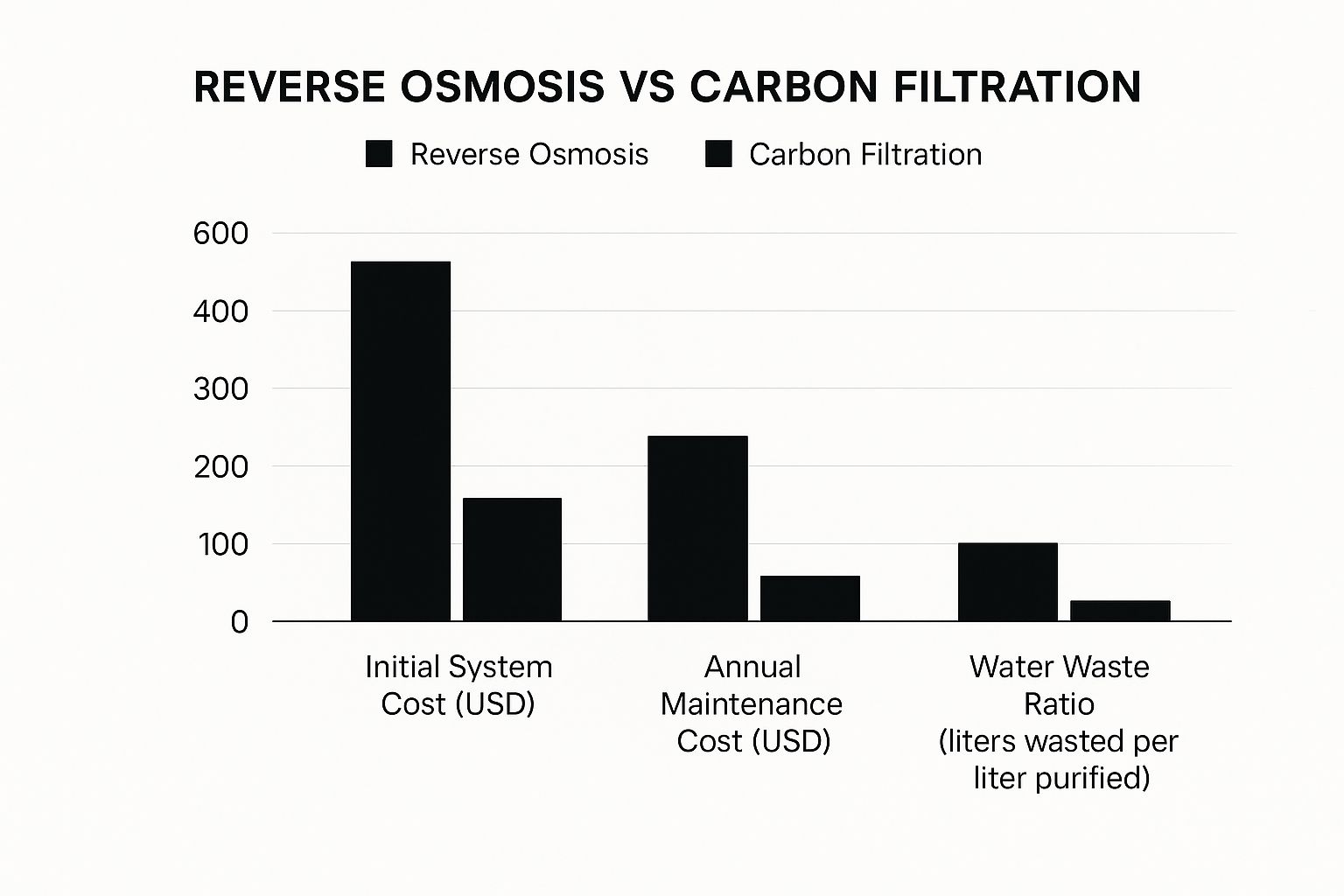
The infographic makes it clear: while reverse osmosis comes with a higher upfront investment and does produce some wastewater, it delivers a standard of purity that carbon filtration simply can't achieve on its own.
Making an Informed Decision
So, how do you choose? It all starts with knowing what’s actually in your water. You can’t fix a problem you haven’t identified, and this is why the first step should always be understanding the specific chemistry of your home's water.
Guessing is a recipe for disappointment. You could easily invest in a system that doesn't even address your primary concerns. For instance, if your water is high in dissolved solids or has nitrates, a carbon filter isn't going to do you much good. The only way to know for sure is with a proper analysis.
We always recommend starting with our professional water testing services. Our experts will give you a detailed breakdown of your water quality, giving you the hard data you need to choose a system that will truly protect your family's health and give you peace of mind.
Analyzing Long-Term Costs and Maintenance
When you're looking at water filtration, the price on the box is just the beginning of the story. To really understand what you're getting into, you have to look at the total cost of ownership. That means factoring in everything from filter replacements to operational costs over the entire life of the system. This is the only way to choose a solution that works for your water and your wallet.
On the surface, a reverse osmosis (RO) system has a higher upfront cost, and there's a good reason for that. It’s a more complex setup, with multiple stages: pre-filters, the RO membrane itself, a post-filter, a storage tank, and its own dedicated faucet. We always recommend professional installation to make sure it runs right, which is also part of that initial investment.
Activated carbon filters, on the other hand, are usually much more affordable to buy and install. These systems are simpler, whether it's a basic filter under the sink or a larger tank for the whole house. But don't let that lower entry price fool you; you'll need to stay on top of regular filter changes to keep it working effectively.
Breaking Down Ongoing Maintenance Needs
The real difference in long-term cost often boils down to maintenance. With a carbon filter, your main recurring expense is replacing the filter cartridges or the carbon media itself. How often you do this depends entirely on your water usage and how much gunk is in your water, but a typical under-sink carbon filter needs a new cartridge every 6 to 12 months.
RO systems have a more detailed maintenance schedule because there are more parts to manage.
- Pre-filters (Sediment and Carbon): You'll need to swap these out every 6-12 months. Their job is to protect the RO membrane, which is the most important (and expensive) part.
- RO Membrane: This is the heart of the system. It can last 2-3 years, but that lifespan really depends on your water quality and how diligent you are about changing those pre-filters.
- Post-filter (Polishing Carbon Filter): This final filter, which gives the water a clean, crisp taste, is usually replaced once a year.
Letting filter changes slide is a bad idea for either system. It’s not just about performance—you can actually damage the unit or, worse, let contaminants slip right through into your drinking water. Sticking to a schedule is non-negotiable for protecting your investment and your family.
Factoring in Operational Costs and Efficiency
Another key piece of the reverse osmosis vs carbon water filtration cost puzzle is efficiency—specifically, how much water each system uses. Activated carbon systems are incredibly efficient in this regard. They produce zero wastewater; every single gallon that goes in comes out filtered and ready to use.
RO systems work differently. The purification process creates a stream of wastewater, often called brine, that carries away all the rejected contaminants. I know what you’re thinking—wasteful. And older systems definitely were, sometimes wasting several gallons for every one gallon of clean water they produced. Thankfully, technology has come a long way. Modern, high-efficiency models have massively improved this ratio. Today’s best systems waste as little as 1-2 gallons for every gallon purified.
While this wastewater adds a little bit to your monthly water bill, most homeowners agree it’s a small price to pay for pristine drinking water. We make it a point to install only high-efficiency systems to minimize this impact, so you get the purest water without the guilt of excessive waste.
To keep your system in top shape without you having to think about it, we offer plans that cover all the necessary upkeep. You can learn more about how our expert monthly maintenance services can protect your system for the long haul. At the end of the day, thinking of a reverse osmosis system as a long-term investment in your health really puts the cost into perspective, and professional maintenance ensures you get every bit of value out of it for years to come.
Making the Right Choice for Your SWFL Home
So, how do you decide between a reverse osmosis system and a carbon filter? It really boils down to your specific situation here in Southwest Florida—what’s coming out of your tap, and what you want to fix about it. It’s less about which system is "better" overall and more about which one is the right tool for the job in your home.
Let's walk through a few common scenarios to help you figure out where you land.

Think of this as the final step: matching the technology to your real-world needs. Getting this right means you’ll be happy with your investment for years to come.
When to Choose a Reverse Osmosis System
If any of these situations sound familiar, a reverse osmosis (RO) system is almost certainly what you need. RO is the heavy-hitter, designed for comprehensive water purification when you can't afford to compromise.
- You Are on Well Water: Here in Florida, private wells are a different beast. They can be high in dissolved minerals, nitrates from nearby agriculture, and other things that municipal water treatment would normally handle. An RO system acts as a final, powerful barrier, giving you control over your water quality.
- You Have High TDS Levels: If your water tastes salty or just "off," you likely have a high concentration of Total Dissolved Solids (TDS). Carbon filters can't touch TDS. Only an RO system can significantly reduce these levels, which drastically improves the taste and even protects your appliances.
- You Want Maximum Purity: For some families, it's non-negotiable. If you have young children, someone with a compromised immune system, or you simply want the absolute cleanest drinking water you can get, RO is the only way to go. It tackles contaminants that carbon filters miss, like heavy metals and fluoride.
When an Activated Carbon Filter is the Smarter Pick
On the other hand, an activated carbon filter can be the perfect fit. It's a fantastic, affordable solution when you're looking to improve municipally-treated water that's already considered safe.
You should opt for an activated carbon system if:
- Your Main Goal is Better Taste and Smell: Is your biggest complaint that your tap water tastes and smells like a swimming pool? That’s the chlorine from the city treatment plant. An activated carbon filter is specifically designed to adsorb chlorine, solving that problem beautifully and efficiently.
- Your Water is Already Deemed Safe: If you trust your municipal water supply but just want to "polish" it for a better drinking experience, this is your answer. It's a simple, effective upgrade without the complexity or cost of an RO system.
The right filtration system is not just about technology; it's about peace of mind. Choosing the correct one ensures every glass of water from your tap is clean, safe, and enjoyable for your family.
Get Expert Guidance for Your Home
I know this can feel like a lot to sort through, but you don't have to figure it out alone. The only way to be certain is to know exactly what’s in your water. At Water Medic, we help Southwest Florida homeowners get clear, straightforward answers every day.
We can guide you through these final steps with a free, personalized water quality consultation. One of our experts will come out, test your water, and explain the results in plain English. From there, we can recommend a system that actually fits your home's needs and your budget—all backed by professional installation and service you can count on.
Frequently Asked Questions
When you're weighing the differences between reverse osmosis and carbon water filtration, a few common questions always seem to pop up. Here are the answers we most often give to Southwest Florida homeowners, helping you feel totally confident in your choice.
Does Reverse Osmosis Remove Beneficial Minerals?
Yes, it does, and this is one of its defining features. The RO membrane is so incredibly fine that it strips out almost everything—including healthy minerals like calcium and magnesium.
Most of our mineral intake comes from food, but some people really prefer the taste of water with minerals in it. That's why many homeowners opt for a remineralization filter. This adds a balanced blend of minerals back into the water after it's been purified, which often improves the taste and can give it a more alkaline quality. It's a simple and very popular upgrade.
How Often Do I Need to Change the Filters?
Staying on top of filter changes is key to keeping your water pure, and the schedule really depends on your local water quality and how much you use. As a general rule, activated carbon filters need a fresh cartridge every 6 to 12 months to keep working effectively.
Reverse osmosis systems have a few more moving parts, so the schedule is a bit more involved:
- Pre-filters (sediment and carbon): These usually need to be swapped out every 6-12 months.
- RO Membrane: This is the heart of the system and, with good maintenance, can last 2 to 3 years.
Following this schedule is non-negotiable for performance. To make it a non-issue for our customers, our professional monthly maintenance plans take care of all filter changes for you, ensuring your system is always running at its best.
Can I Install These Systems Myself?
While you can probably handle a simple under-sink carbon filter yourself if you're handy, a reverse osmosis system is a whole different ballgame. Installing an RO system means tapping into your home's plumbing, drilling a hole in your countertop for the dedicated faucet, and making sure the entire unit is properly pressurized.
We always recommend professional installation for RO systems. A small mistake during a DIY setup can lead to persistent leaks, poor water quality, and might even void the manufacturer's warranty. It's a small investment to guarantee your system works perfectly from the get-go.
Ready to get crystal-clear, great-tasting water flowing from your tap? The expert team at Water Medic of Cape Coral is here to help. We provide professional water testing and install the highest-quality filtration systems in Southwest Florida. Contact us today for a free consultation and discover the perfect solution for your family. Learn more at https://watermedic.com.